Life Guide

Friday of the Sixteenth Week in Ordinary Time
July 28, 2023

Today’s Readings:

https://bible.usccb.org/bible/readings/072823.cfm


Moses with the Ten Commandments – Rembrandt


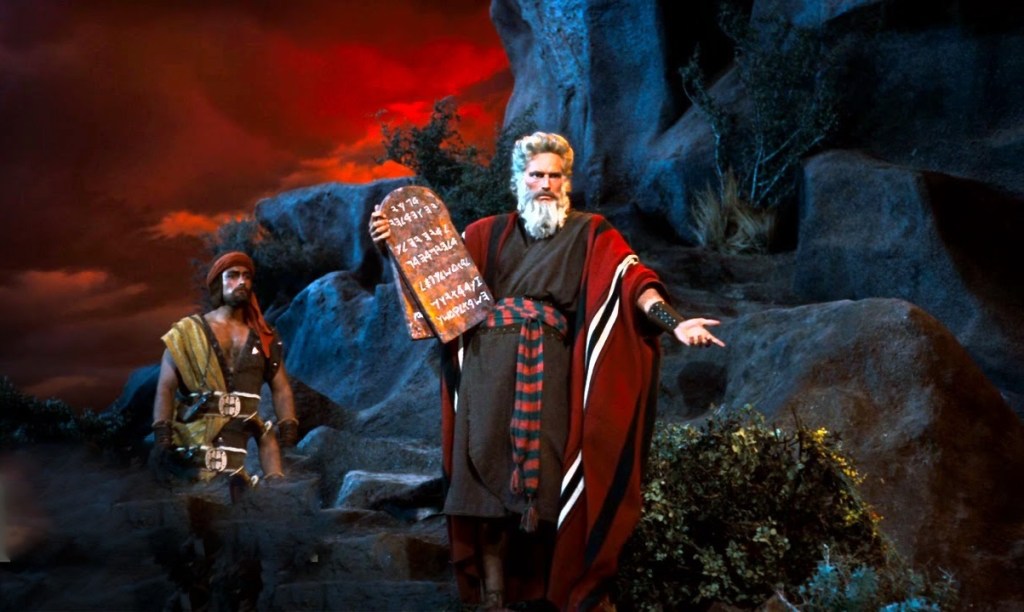
Today, in God’s Lavish Mercy, we are presented with a summary version the Ten Commandments.

But the daily readings have skipped over a dramatic passage. In between today’s reading and yesterday’s, Mount Sinai has exploded with the thunderous voice of God.

On the morning of the third day there were peals of thunder and lightning, and a heavy cloud over the mountain, and a very loud blast of the shofar,* so that all the people in the camp trembled.
But Moses led the people out of the camp to meet God, and they stationed themselves at the foot of the mountain.
Now Mount Sinai was completely enveloped in smoke, because the LORD had come down upon it in fire. The smoke rose from it as though from a kiln, and the whole mountain trembled violently.
The blast of the shofar grew louder and louder, while Moses was speaking and God was answering him with thunder.

Exodus 19:16-19

The writer of Exodus wants us to know that God was serious when delivering the Commandments:

With appropriate ritual preparation on the part of Israel (19:1–15), YHWH comes storming into the presence of Israel (19:16–25). This divine arrival, technically characterized as a theophany, a showing of God, is a disturbing upheaval of the mountain. This description of divine arrival is highly stylized and may reflect something of a repeatable liturgical performance. YHWH, shrouded in mystery, is accompanied by fire, smoke, the violent shaking of the mountain, a blast of trumpets, and thunder. The mountain, occupied by this assertive deity, is now saturated with dangerous holiness, so dangerous that YHWH might “break out against them” (19:22).

Walter Brueggemann – Delivered into Covenant (Pivotal Moments in the Old Testament)

These commandments, delivered clearly and deliberately in today’s passage, form the immutable groundwork for relationship with God. God makes it clear from the beginning that friends of God honor both God and neighbor, and in so doing honor themselves. While many of the Commandments are stated as prohibitions, they are really guides toward wholeness and balance in spiritual and communal life.


I remember, as a youngster, using the Commandments as a guide when preparing my list for weekly confession. It was hard to generate that list because, most of the time, I was a fairly good kid. I was pretty sure I hadn’t coveted my neighbor’s wife or anything like that.

I had not yet learned to capture the spirit of the Commandments which is just and humble relationship with God and God’s Creation. This relationship is rooted in awareness of and reverence for God’s Presence in all things.

In the Beatitudes, Jesus teaches us the perfection of the Ten Commandments. A magnificent book that helped me learn this is The Spirituality of the Beatitudes by Michael Crosby – another life-changing book.


But the seed sown on rich soil
is the one who hears the word and understands it,
who indeed bears fruit

and yields a hundred or sixty or thirtyfold.

Matthew 13:23

Like the seed variously scattered in today’s Gospel reading, our daily choices and actions may or may not fall short of the fertile ground. Of course, we have the spirit of the Commandments as a guide for that assessment. But the surer guide is the new Law of Love poured out for us on the still and silent Mount Calvary, and codified for us in the Gospel.


Poetry: The Garden of Love – William Blake, the famous mystical poet of late 18th and early 19th century England, was a deeply committed Christian. But he loathed organized religion because he felt that it destroyed the spirit of true faith. I chose this poem because it might reflect what happens when we see the Commandments only as spiritless rules.

I went to the Garden of Love,
And saw what I never had seen:
A Chapel was built in the midst,
Where I used to play on the green.
And the gates of this Chapel were shut,
And 'Thou shalt not' writ over the door;
So I turn'd to the Garden of Love,
That so many sweet flowers bore.
And I saw it was filled with graves,
And tomb-stones where flowers should be:
And Priests in black gowns, were walking their rounds,
And binding with briars, my joys & desires.

Music: The Ten Commandments – Johnny Cash – A delightful song that suggests we can find theologians anywhere if we just look for them! 😉
Clouds and Parables

Thursday of the Sixteenth Week in Ordinary Time
July 27, 2023

Today’s Readings:

https://bible.usccb.org/bible/readings/072723.cfm


Today, in God’s Lavish Mercy, our readings lead us to consider when, why, and how God speaks.

We all know that the big scene from Exodus is the delivery of the Ten Commandments. So as Sinai bubbles and churns in today’s reading, we may be waiting for that theophany.

But today’s passage from Exodus is not about the Commandments themselves. It is about getting oneself ready to hear what God is about to say.


God instructs Moses on how to prepare the people so that they have listening hearts able to respond with understanding and commitment.

While Israel was encamped here in front of the mountain,
the LORD told Moses,
“I am coming to you in a dense cloud,
so that when the people hear me speaking with you,
they may always have faith in you also.”
When Moses, then, had reported to the LORD the response of the people,
the LORD added, “Go to the people
and have them sanctify themselves today and tomorrow.
Make them wash their garments and be ready for the third day;
for on the third day the LORD will come down on Mount Sinai
before the eyes of all the people.”

Exodus 19:9-11

  • They are to expect a “cloud”
  • They are to see Moses as a conduit to God.
  • They are to prepare their hearts by symbolically preparing their garments.
  • They are to wait, in the mode of a vigil, for the Lord to speak.

In the late 1960s I, like the rest of the immediately post-Vatican II Church, was hungry to learn more enlightened theology. Around that time, I had the amazing opportunity of attending a lecture by the controversial priest and theologian Fr. Hans Küng. Some considered him a prophet, and some an iconoclast. But no one disagreed that he was a genius and an eminent voice for reform in the Catholic Church.

I was just beginning my theological education, and I knew — well actually — zip!

So I began to read everything I could find by or about Küng. I did serious prep work before the day came for the lecture. And it helped. I was ready to listen. My brain was spinning when I left the presentation (Küng is not easy!). Still, what little I understood inspired me to the next steps in my learning which has been life-long.


I think that’s what God is doing in today’s passage – readying hearts to listen to God’s life-long invitation to Covenant. That Covenant will be rooted in the community’s hearts by their faithfulness to the spirit of the Ten Commandments. And it will grow like any healthy relationship in love and mutual disclosure.


In our Gospel, Jesus talks about listening too. When asked why he spoke in parables to the crowd, Jesus replies:

Because knowledge of the mysteries of the Kingdom of heaven
has been granted to you, but to them it has not been granted.
To anyone who has, more will be given and he will grow rich;
from anyone who has not, even what he has will be taken away.
This is why I speak to them in parables, because
they look but do not see and hear but do not listen or understand.

Matthew 13:11-13

Parables can be a little bit like those Sinai clouds – their truth may not be immediately evident. But by faithfulness, the horizon clears and the light dawns. Although they might appear to be, parables are not descriptions of sowers and seed, and prodigal children or devoted fathers. Jesus’s parables are revelations about us and God, told in simple stories so that we won’t be quite as dazed by their powerful truth as I was by that long-ago lecture.


When I walked out of the Küng lecture, believe me, I was in a cloud. His presentation was so dense with meaning that I felt like I knew less coming out than going in! Sometimes when we hear the parables, we might have a similar feeling. But that’s why we pray, year after year, with the infinitely revealing scriptures. They meet us where we are in our particular circumstances, and will always take us deeper into God if we are prepared to let them.

And Jesus assures us that our efforts to follow him will be rewarded:

But blessed are your eyes, because they see,
and your ears, because they hear.
Amen, I say to you, many prophets and righteous people
longed to see what you see but did not see it,
and to hear what you hear but did not hear it.”

Matthew 13:16-17

Coming into deeper relationship with God takes time – dedicated time for silence, prayer, reflection, learning, and action born of contemplation. Let’s renew our deep desire for this kind of relationship.


Prose: excerpts from “The Cloud of Unknowing“, which is an anonymous work of Christian mysticism written in Middle English in the latter half of the 14th century. The text is a spiritual guide on contemplative prayer in the Late Middle Ages. The underlying message of this work suggests that the way to know God is to abandon consideration of God’s particular activities and attributes, and be courageous enough to surrender one’s mind and ego to the realm of “unknowing”, at which point one may begin to glimpse the nature of God. (Wikipedia)


  1. When you first begin, you find only darkness, and as it were a cloud of unknowing. You don’t know what this means except that in your will you feel a simple steadfast intention reaching out towards God. Do what you will, and this darkness and this cloud remain between you and God… Reconcile yourself to wait in this darkness as long as is necessary, but still go on longing after him whom you love.
  2. The nature of love is that it shares everything. Love Jesus, and everything he has is yours.…He may, perhaps, send out a shaft of spiritual light, which pierces this cloud of unknowing beteween you, and show you some of his secrets… then will you feel your affection flame with the fire of his love, far more than I can possibly say now…

Music: Transcending from “The Cloud of Unknowing” by Robert Kyr

Caritas patiens est benigna est
omnia suffert omnia credit
omnia sperat omnia sustinet
videmus enim nunc
per speculum in enigmate
tunc autem facie ad faciem
nunc cognosco ex parte
tunc autem cognoscam
sicut et cognitus sum
nunc autem manet
fides spes caritas
tria haec
maior autem his est caritas

Love is patient, Love is kind.
It bears all things, Believes all things,
Hopes all things, Endures all things.
For now we see
In a mirror, dimly,
But then we will see face to face.
Now I know only in part;
Then I will know fully,
Even as I have been fully known.
So now remain Faith, hope, love; These three,
But the greatest of these is love.

Sowers of Goodness

Memorial of Saints Joachim and Anne,
Parents of the Blessed Virgin Mary
Wednesday of the Sixteenth Week in Ordinary Time
July 26, 2023

Today’s Readings:

https://bible.usccb.org/bible/readings/072623.cfm


Mary with Joachim and Anne – Pietro Ayers


Today, in God’s Lavish Mercy, we pray with Anne and Joachim, parents of Mary, Mother of Jesus. Praying with them is challenging because we know little or nothing about this holy couple. Their names appear nowhere in the Bible. There are no canonical readings about them. So how can we imagine what they might have been like in order to imitate their spirituality?

What we have come to venerate as the miraculous story of Anne and Joachim comes to us primarily from the 2nd century apocryphal Gospel of St. James which is part of the New Testament Apocrypha.

The term “Apocrypha” refers to scores of manuscripts written about Christ and early Christianity which, for any number of reasons, have not been included in the scriptural canon – the Bible as we know it.


If you are interested in learning more about these books, their influence, and why they are not part of the cureent canon, this Wikipedia article is a great place to start. I found it fascinating:

https://en.wikipedia.org/wiki/New_Testament_apocrypha


For our prayer today, we might think of Anne and Joachim in the light of our passage from Matthew. We are quite familiar with the image of the “sower” as someone working in a field for the purpose of a successful crop.

But let’s expand that image to be one who “sows” good deeds – righteousness – within the fields of family, neighbohood and world. This was Anne and Joachim’s work which generated the wholesome being who was Mary. This then was the work of Mary who was the mothering cradle for the Incarnation. Their lives, fertile with goodness, were the life-giving fields for the first-fruits of Christ.


The kind of seed we sow, and how we sow it, matters, as our Gospel tells us:

A sower went out to sow.
And as he sowed, some seed fell on the path,
and birds came and ate it up.
Some fell on rocky ground, where it had little soil.
It sprang up at once because the soil was not deep,
and when the sun rose it was scorched,
and it withered for lack of roots.
Some seed fell among thorns, and the thorns grew up and choked it.
But some seed fell on rich soil, and produced fruit,
a hundred or sixty or thirtyfold.
Whoever has ears ought to hear.

Matthew 13:3-9

Most of us went out many years ago to “sow” in our life’s field. Certainly the seed, good or bad, has fallen on a number of both hospitable and inhopitable places. Reflecting today, and committing for the future, we might look to this first Holy Family. Their stories buried deeply in history, still by their fruits we know them. Such fruit yields from grace planted in faithful hearts. Let’s ask them to help us be their imitators.


Prose Prayer: My mother had great devotion to St. Anne and, when our family had a need, often made an offering through the Shrine of St. Anne de Beaupre in Canada. Mom and I would recite this prayer together, especially on Tuesday which an old tradition dedicates to St. Anne. When Mom passed away on a Tuesday, I felt it was a special gift and that surely St. Anne came to accompany her to heaven.


Music: Lamb of God from the Mass of St. Ann composed by Ed Bolduc who is Director of Music at St. Ann’s Parish in Marietta, Georgia. I was familiar with the Gloria but not other parts of the composition. I thought this Lamb of God was appropriate for today’s feast because it sounds like a lullaby good St. Anne might sing to her Grandchild.

Thunderous Son!

Feast of Saint James, Apostle
July 25, 2023

Today’s Readings:

https://bible.usccb.org/bible/readings/072523.cfm


Today, in God’s Lavish Mercy, we celebrate St. James the Greater. As you know, there were two Aposltes named James. It can get confusing. I know because about half the men in my family are named James. It’s hard to call out to one of them at a family reunion because four or five people will answer when you yell, “Hey, Jim!”

So tradition has solved the St. James name problem by designating one as “the Greater” and one as “the Less”, descriptors based on age not importance. Today we celebrate James the Greater.


Mary Salome and Zebedee with Sons James and John
according to Hans Seuss Kolmback – c.1511
(Love the hat, or what? And, baby John is already holding the “cup”!)


James and his brother John were sons of Zebedee. In Mark 17, Jesus nicknames the two of them “Sons of Thunder”, so he must have had some early insight into their fiery nature. That nature was clearly displayed after the Transfiguration when Jesus began his final journey to Jerusalem. He had sent the disciples ahead to prepare an overnight stay in a Samaritan village, but the villagers rejected Jesus. This made the Zebedee boys mad so they asked Jesus:

… the people there did not welcome him, because he was heading for Jerusalem. 
When the disciples James and John saw this, they asked,
“Lord, do you want us to call fire down from heaven to destroy them?” 
But Jesus turned and rebuked them.
Then he and his disciples went to another village.

Luke 9:53-56

You know what, I really like these guys! James and his brother John were all-in to Jesus and the Gospel. Their thundery enthusiasm got convoluted at times but, by word and example, Jesus continued to redirect their immense energy toward God’s Will.

I like their mother too. She had her own kind of fire and wanted the best for her boys as today’s Gospel indicates:

The mother of the sons of Zebedee approached Jesus with her sons
and did him homage, wishing to ask him for something.
He said to her,
“What do you wish?”
She answered him,
“Command that these two sons of mine sit,
one at your right and the other at your left, in your Kingdom.”

Matthew 20:20-21

With a surface reading of this passage, we might consider Mrs. Zebedee a little dense or arrogant. But Jesus simply responded by reminding her that her sons too, like him, would experience suffering before any heavenly reward.

The Gospel does not record Mrs. Zebedee’s response, whether she was miffed, chastened, frightened, or apologetic. What later chapters do record is that she got the message and embraced it. Of all the disciples she, with only a few other brave women and her boy John, showed up at the foot of the cross.

Where our man James the Greater was on that Good Friday we do not know. But he certainly stuck with Jesus in the long run.


The Zebedee Family, with its many Gospel appearances, can teach us so much about relationship with Jesus, about maturing slowly – sometimes haltingly – in Gospel faith, and about long-term fidelity to God’s Will. Let us pray with them today.


Poetry: from The Parables of Our Lord and Savior Jesus Christ, c.1763

PARABLE LXIII.

The two Sons of Zebedee.
The spouse of Zebedee, that bare
The sons of Thunder, made a pray'r,
As she to Christ adoring came;
And Jesus said, What would the dame?
‘Grant me, O Lord, that either son
‘Be with thee in thy kingdom; one
‘Upon thy right hand to appear,
‘The other on the left as near.’
But Jesus answer'd their desire,
‘Ye know not what ye would require.
‘Do ye yourselves of strength believe.
‘The cup I drink of to receive?
‘And in that baptism be baptiz'd,
‘Which is for Christ himself devis'd?’
O Lord, we do, they answer make.
‘Ye shall indeed my cup partake,
‘Be baptiz'd in my baptism too;
‘But 'tis not of my gifts to you,
‘On right or left to place, but theirs
‘For whom my heav'nly Sire prepares’
But when this thing was told the ten,
They were enrag'd at both the men:
But Jesus call'd them all, and said,
‘Ye know the Gentiles chuse a HEAD,
‘And that great prince that holds the reins,
‘Will plead a merit for his pains:
‘But with you it shall not be so;
‘Who would be great, he shall be low,
‘And he th'aspiring chief of all
‘A lord at ev'ry servant's call.
‘'Tis with the Son of Man the same,
‘To serve, and not be serv'd, he came;
‘A minister of no esteem,
‘Which dies the myriads to redeem.’
When Christ the multitudes had fed
With God's good fishes and his bread,
At once so great was his renown,
The people proffer'd him a crown,
From which in haste the Lord withdrew
To better points he had in view.
Christians must honour and obey
Such men as bear the sov'reign sway.
But, in respect of each to each,
The Lord and his apostles teach,
That we should neither load nor bind,
But be distributive and kind

Music: Congaudeant Catholici from the Codex Calixtinus – Music for the Feast of St. James the Apostle

The Codex Calixtinus (or Codex Compostellus) is a manuscript that is the main element of the 12th-century Liber Sancti Jacobi (‘Book of Saint James’), a pseudepigraph whose likely author is the French scholar Aymeric Picaud. The codex was intended as an anthology of background detail and advice for pilgrims following the Way of Saint James to the shrine of the apostle Saint James the Great, located in the cathedral of Santiago de Compostela, Galicia. The collection includes sermons, reports of miracles and liturgical texts associated with Saint James, and a set of polyphonic musical pieces. In it are also found descriptions of the route, works of art to be seen along the way, and the customs of the local people.

Three parts of the Codex Calixtinus include music: Book I, Appendix I, and Appendix II. These passages are of great interest to musicologists as they include early examples of polyphony. (Wikipedia)

Today’s selection is the Congaudeant Catholici. I could not find an English translation of the lyrics but, for the Latin scholars reading here, go to it with the text below! For the rest of us, it’s just a beautiful ancient melody to pray with.

Latin text

Congaudeant catholici,
letentur cives celici

Refrain: die ista

Clerus pulcris carminibus
studeat atque cantibus.

Hec est dies laudabilis,
divina luce nobilis.

Vincens herodis gladium,
accepit vite bravium.

Qua iacobus palatia,
ascendit ad celestia.

Ergo carenti termino
benedicamus domino.

Magno patri familias
solvamus laudis gratias.

No Sign Will Be Given Except…..

Monday of the Sixteenth Week in Ordinary Time
July 24, 2023

Today’s Reading:

https://bible.usccb.org/bible/readings/072423.cfm


Today, in God’s Lavish Mercy, Jesus is pestered by scribes and Pharisees who want him to prove himself by a sign.

Jesus answers their jibing in a kind of spiritual code.

Some of the scribes and Pharisees said to Jesus,
“Teacher, we wish to see a sign from you.”
He said to them in reply,
“An evil and unfaithful generation seeks a sign,
but no sign will be given it
except the sign of Jonah the prophet.
Just as Jonah was in the belly of the whale three days and three nights,
so will the Son of Man be in the heart of the earth
three days and three nights.

Matthew 12:38-40

So what exactly is “The Sign of Jonah”? Sounds like the title of a Dan Brown novel, doesn’t it?

Well, it is the title of a wonderful book, but not one by Dan Brown.


When I was in high school, I was obsessed with the writings of Thomas Merton. The fire was ignited by my freshman homeroom teacher who gave me a copy of his “Seeds of Contemplation” — another book that changed my life. Inspired by that first read, I slowly made my way through Seven Storey Mountain, No Man is an Island, Thoughts in Solitude … finally coming, in a veil of limited understanding, to “The Sign of Jonas”.

I didn’t understand the title. What I did begin to understand, as Merton journaled his daily life in the Abbey of Gethsemane, was that we discover God not by any external revelation or intellectual acquisition, but by our choices for love in the pattern of Jesus.

In today’s Gospel, the scribes and Pharisees seek an external demonstration that Jesus is all powerful. But their seeking is an insincere attempt at self-satisfaction, not a choice for Gospel love.


So what does Jonah have to do with the Pharisees’ insincerity? Jonah, given a mission by God, could not initially align himself with God’s call. At God’s irresistable invitation, Jonah spent three days of solitude in a whale’s belly contemplating his circumstances. By the graces gained in his solitude, Jonah emerged as a prophet for God.


As recounted in his book, the whale’s belly for Merton was his life in Gethsemane Abbey where he found the profound meaning and deep awareness of his vocation.

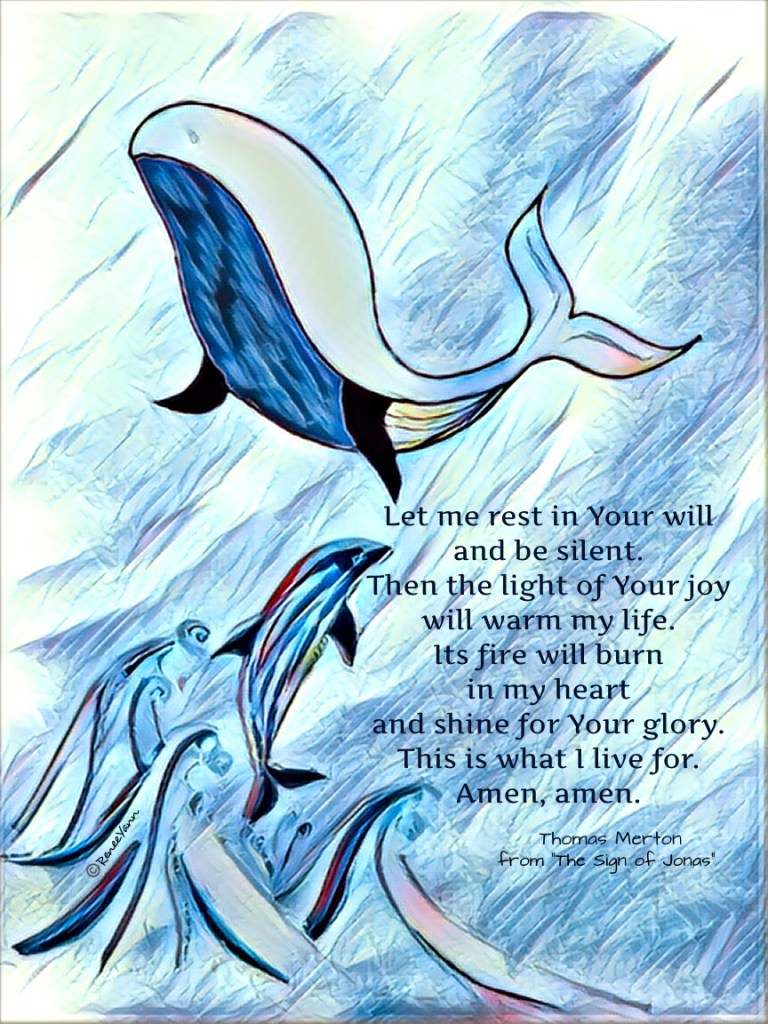
Let me rest in Your will and be silent.
Then the light of Your joy will warm my life.
Its fire will burn in my heart
and shine for Your glory.
This is what I live for. Amen, amen.


It may not sound all that inviting, but every one of us is called to the “whale’s belly”. Our transformation there is accomplished by our congruity with Christ’s sojourn in the tomb. Like Jesus, we must die to self for the sake of others. Like Jonah, we must abandon our fears and conveniences to become signs of God’s love in the world.


The Pharisees didn’t get it. And, God help them, I understand. It’s hard to get it! Life seems so much easier if we run away from this deep call like Jonah did at first. But the call remains: to be God’s Word in the world – to “shine for God’s glory“.


The editorial staff of the National Catholic Reporter wrote this about Merton’s Sign of Jonas:

Thomas Merton wrote in his early journals that the “sign of Jonas” — the mystery of Christ’s death and resurrection — is “burned into the roots of our being.” Sooner or later, everyone faces the universal truth that only through death to self do we find life. Merton embraced this sign and described himself as one like Jonah, because “I find myself traveling toward my destiny in the belly of a paradox.”


We may need to choose a little “whale-belly” time to get our hearts straight with this astounding yet universal call to be “for God” in our paradoxical world.


Poetry: two poems from “You! Jonah!” by Thomas John Carlisle

THE GREAT INTRUDER
It is exasperating
to be called
so persistently
when the last thing
we want to do
is get up and go
but God
elects
to keep on
haunting
like some
holy ghost.

———————–

COMING AROUND
And Jonah stalked
to his shaded seat
and waited for God
to come around
to his way of thinking.
And God is still waiting
for a host of Jonahs
in their comfortable houses
to come around
to His way of loving.

Music: Jonah and the Whale – Louis Armstrong – lyrics below

Jonah was a man who got a word from the Lord
Go and preach the Gospel to the sinful land‿
But he got on a ship and he tried to get away
And he ran into a storm in the middle of the sea

Now the Lord, He made the waves just roll so high
The ship begin to sink and they all begin to cry
So they pulled ole Jonah out of the hole
And they jumped him in the water just to lighten up the load

Now the Lord made a whale, long and wide Lord, Lord waddnat a fish
And he swallowed up Jonah, hair and hide Lord, Lord waddnat a fish,
Mmm, Lord, mmm, Lord

Now Jonah started to pray in the belly of the whale
Lord, Lord waddnat a fish
He repented of his sins like a man in jail
Lord, Lord waddnat a fish
Mmm, Lord, mmm, Lord

Now Jonah must o’ been a bad man, he must o’ been a sinner
Lord, Lord waddnat a fish
Cos when the whale got him down, he didn’t like his dinner
Lord, Lord waddnat a fish
Mmm, Lord, mmm, Lord

Well he swum around the ocean, sick as he could be
Lord, Lord waddnat a fish
And after three days, whoops! he had to set him free
Lord, Lord waddnat a fish, mmm

So the whale spit Jonah out onto dry land
Lord, Lord waddnat a fish
And went on to preaching like a righteous man
Lord, Lord waddnat a fish

Then the people quit their sins when they heard him the town
Lord, Lord waddnat a fish
So when you hear the call, don’t you turn the Gospel down
Lord, Lord waddnat a fish, mmm?

Good Ground for Hope

Sixteenth Sunday in Ordinary Time
July 23, 2023

Today’s Readings:

https://bible.usccb.org/bible/readings/072323.cfm


Today, in God’s Lavish Mercy, our readings revolve around the dynamic of hope – God’s hope planted in our spirits and our hope entrusted to God’s Mercy.

As we pray with these passages, it helps to remind ourselves of the true definition of “hope”. It is a word that many of us use carelessly to the point that we may have lost the power of its meaning – as in when we say things like, “I hope it doesn’t rain”. What we really mean is that we wish it wouldn’t rain.

Hope is not the same as wishing. Wishing is a mental activity that has no power to make its object come true. Hope, on the other hand, is a resident condition of our spirits that frees us to live with enthusiasm and gratitude despite whatever outcome may arise.

Wishing dissapates when conclusions pass. Hope is eternal because it draws its energy from faith in God’s Infinite Mercy and the promise of eternal life.


The Book of Wisdom’s author understood the Source from which hope springs:

Though you are master of might, you judge with clemency,
and with much lenience you govern us;
for power, whenever you will, attends you.
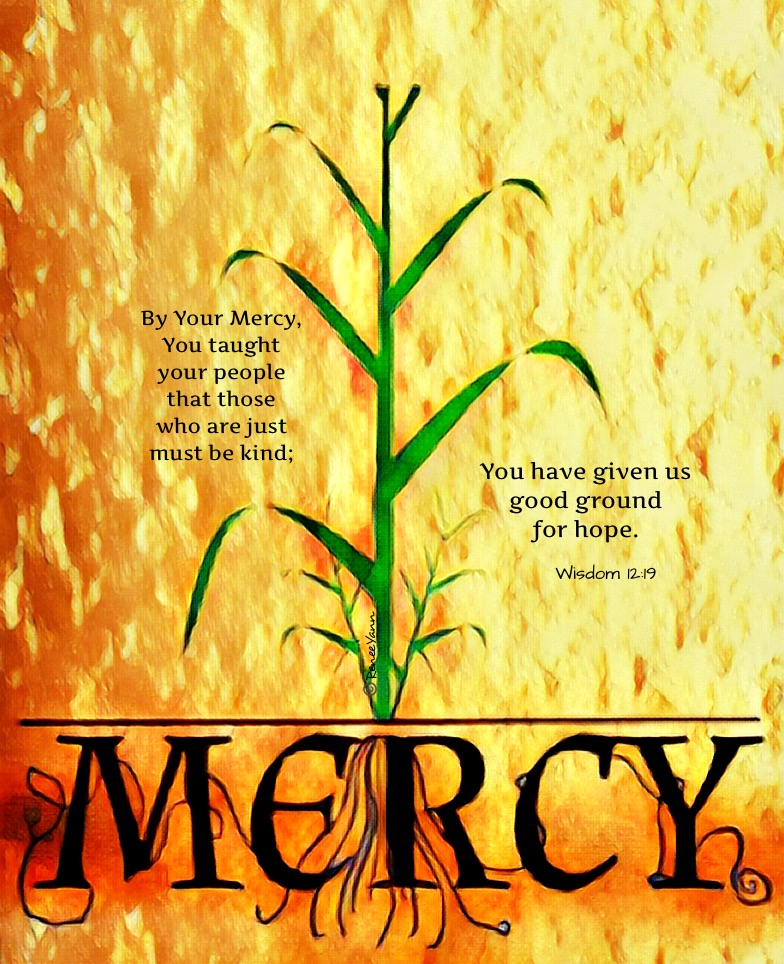
And you taught your people, by your deeds,
that those who are just must be kind;
and you gave your children good ground for hope
that you would permit repentance for their sins.

Wisdom 12:18-19

Paul, in another passage from magnificent Romans 8, acknowledges that we can sustain hopeful hearts only by the power of the Holy Spirit who lifts us up and prays within us when we are too overwhelmed to do so ourselves.

The Spirit comes to the aid of our weakness;
for we do not know how to pray as we ought,
but the Spirit intercedes with inexpressible groanings. 
And the one who searches hearts
knows what is the intention of the Spirit,
because Spirit intercedes for the holy ones
according to God’s will.

Romans 8:26-27

Jesus gives us a great parable for understanding hope. How discouraged might that farmer have been when the enemy tried to ruin his crop! But instead, the farmer realized that his field, like life, can sustain both the wheat and the weeds. If we live hopefully and faithfully, the wheat can be gathered from the harvest, and the weeds ultimately cast aside.


How many times in our own lives have we nearly been overwhelmed by the weeds! There is no life which passes without its hurts, disappointments, confusions, and dashed wishes! Some experience a sparse scattering of these weeds, and some lives are thick with difficulty. How surprising that it is often in the latter circumstance that hope rises up and sustains hearts.


As our Responsorial Psalm reminds us, those who live simply and sincerely are most able to tap deeply into the mysterious power of hope.

Blessed are you, Father, Lord of heaven and earth;
you have revealed to little ones the mysteries of the kingdom.


Poetry: From “Odes” – George Santayana was a Spanish-American philosopher known more for his aphorisms than his poetry. He came up with lines like, ‘Those who cannot remember the past are doomed to repeat it”, and “Fanaticism consists in redoubling your effort when you have forgotten your aim.”

IV

Slowly the black earth gains upon the yellow,
And the caked hill-side is ribbed soft with furrows.
Turn now again, with voice and staff, my ploughman,
Guiding thy oxen.
Lift the great ploughshare, clear the stones and brambles,
Plant it the deeper, with thy foot upon it,
Uprooting all the flowering weeds that bring not
Food to thy children.
Patience is good for man and beast, and labour
Hardens to sorrow and the frost of winter.
Turn then again, in the brave hope of harvest,
Singing to heaven.

Music: Weed and Wheat – Silayio Kirisua is a Maasi woman who represented Kenya in the Voice of Holland singing competition. After winning the competition, she has become an international sensation.

Magdalene, Disciple of Christ

Feast of Saint Mary Magdalene
July 22, 2023

Today’s Readings:

https://bible.usccb.org/bible/readings/072223.cfm


(This is a “repeat post”, but I think it’s worth the repeat. I hope you agree.)

Today, in God’s Lavish Mercy, we pray with St. Mary Magdalene, disciple of Christ.

Massimo_Stanzione,_Mary-Magdalene_in_meditation
Magdalen in Meditation by Massimo Stanzione

Modern scripture scholarship recognizes Mary Magdalene as a disciple and companion of Jesus.  She is present in stories throughout all four Gospels, and most notably, as one who remained with Jesus at the foot of the Cross. Mary is the first witness to the Resurrection who then announces the Good News to the other disciples.

Over the centuries, Mary Magdalene has been confused with the many other Marys in the Gospel, as well as with the unnamed repentant woman who washes Jesus’ feet with her tears. These confusions have inclined us to think of Mary Magdalene as a reformed prostitute. This erroneous concept has supported a diminished understanding of the role of women in the ministry of Jesus and done a huge disservice to Mary’s vital role as beloved disciple.

The Gospel passage for the feast captures the powerful moment when the Resurrected Jesus is first revealed to the world. The scene also portrays the deep love, trust and friendship between Jesus and Mary Magdalene – a relationship which serves as a model for all of us who want to be Christ’s disciples. I imagined the scene like this in an earlier Easter reflection:

 Rabbouni

 The Upper Room on Holy Saturday evening: a place filled with sadness, silence and seeking. Jesus was dead. Jerusalem, scattered to their various houses to keep Shabbat, murmur their shocked questions under their shaky prayers.

 We have all been in rooms like this. They enclose a special kind of agony – one teetering between hope and doubt, between loss and restoration. It may have been a surgical waiting room or the hallway outside the courtroom. Sometimes, such a space is not bricks and mortar.  It is the space between a sealed envelope and the news inside. It is the hesitant pause between a heartfelt request and the critical response. In each of these places, we exist as if in a held breath, hoping against hope for life, freedom, and wholeness.

 It was from such a room that Mary Magdalene stole away in the wee hours. A woman unafraid of loneliness, she walked in tearful prayer along the path to Jesus’ tomb. Scent of jasmine rose up on the early morning mist. Hope rose with it that his vow to return might be true. Then she saw the gaping tomb, the alarm that thieves had stolen him to sabotage his promise. She ran to the emptiness seeking him. She was met by angels clothed in light and glory, but they were not enough to soothe her.

 Turning from them, she bumped against a gardener whom she begged for word of Jesus, just so she might tend to him again. A single word revealed his glory, “Mary”. He spoke her name in love.

 As we seek the assurance of God’s presence in our lives, we too may be unaware that God is already with us. The deep listening of our spirit, dulled with daily burdens, may not hear our name lovingly spoken in the circumstances of our lives. God is standing behind every moment. All we need do is turn to recognize him.

 Turn anger into understanding. Turn vengeance into forgiveness. Turn entitlement into gratitude. Turn indifference into love. All we need do is turn to recognize him.


For a comprehensive and enlightening lecture on the current theological and scriptural thinking on Mary Magdalen, follow this link to an Elizabeth Johnson, CSJ lecture at Fordham.

Click here for lecture


Music: I Know That My Redeemer Liveth

The Passover of the Lord

Friday of the Fifteenth Week in Ordinary Time
July 21, 2023

Today’s Readings:

https://bible.usccb.org/bible/readings/072123.cfm


Today, in God’s Lavish Mercy, we hear the familiar tones of the central Exodus story.

Waiting for Easter Vigil

As we prayerfully read this passage, we may be carried back to the many Holy Saturday liturgies we have attended in our lives. In our memories, it is early spring, the evenings are still dark, and chapel is barely lit. We know the momentous story we are about to hear and re-enact. We believe it is brought to fruition in the sacramental liturgy we are about to offer. And, within all the memories, all the rituals, and all the words, one phrase stands out:

It is the Passover of the Lord.

“This is how you are to eat the lamb:
with your loins girt, sandals on your feet

and your staff in hand,
you shall eat like those who are in flight.
It is the Passover of the LORD.


Walter Brueggemann says that, in the act of “passover”, the community chooses to move on from its prohibitive existence to a new way of being. It chooses an alternative that requires “departure”:

That alternative is not easy or obvious or automatic. It requires a departure, an intentional departure from that system that the Bible terms “exodus.” In that ancient narrative the Israelites did not want to go, and once they had gone they wished to resubmit to Pharaoh. The departure is a piece of demanding, sustained work. The capacity to think and imagine and act and live beyond that system requires imagination that has dimensions of the psychological, the economic, and the liturgical. Indeed, the core liturgy of Israel (Passover) and the derivative liturgies of the church are practiced departures that now and then take on reality in the world.

Walter Brueggemann: Journey to the Common Good

In our reading from Matthew, and continually throughout the Gospel, Jesus invites his community to a profound “departure” – to a new understanding of the Law as love not requirement.

When the Pharisees criticize the hungry disciples for plucking and eating grain heads on the Sabbath, Jesus confronts them:

I say to you, something greater than the temple is here.
If you knew what this meant, I desire mercy, not sacrifice,
you would not have condemned these innocent men.
For the Son of Man is Lord of the sabbath.”

Matthew 12:7-8

Something greater than the Temple?????? The Pharisees stare at Jesus in stunned amazement! Could such a thing be possible?

Our Gospel tells us that not only is it possible, it is reality. The “Temple” and the old Law had lost their heart to the belief that personal power and affluence trumped human need. Their “systems” for becoming holy had become vacuous.

Jesus teaches that gaining sanctity requires that we live in mercy toward ourselves and others. Rituals, Temples, Churches and codes of conduct are meaningless unless they direct us always to act in mercy. When these same institutions and practices contradict God’s Mercy, we must have the courage for “departure” and “passover”.

“Departure” though does not mean abandonment. It means ceasing the merciless practices condoned by institutionalization, and having the courageous perseverance to build new paths to meaning.


It is clear in the Jewish practice of Passover that the exodus memory became a paradigmatic narrative through which all social reality is described and re-experienced. That is, the narrative pertains to a one-time remembered social upheaval caused by God’s holiness; but the narrative looks beyond that one-time memory to see that the same transactions of oppression and emancipation continue everywhere to evoke holy power.

Walter Brueggemann, Journey to the Common Good

Every day of our lives, we are called to “passover” into greater spiritual awareness, merciful practice, and just living. We may hear the call in small personal interactions, or in the larger context of our fragmented world.

We are faced constantly with alternatives between (just to name a few):

  • selfishness or generosity
  • forgiveness or vengefulness
  • honesty or pretense
  • peacemaking or rabble-rousing
  • addiction or freedom
  • informed decision-making or arrogant ignorance
  • gossip or respect
  • action for the poor or indifferent comfort
  • political and economic elitism or social justice
  • respect fro Creation or utilitarian ignorance

The sacred bridge in each of these passovers is the Gospel of Jesus Christ. Choosing it wholeheartedly, we will arrive on the right side of God.


Poetry: Journey – by Mary Oliver

One day you finally knew
what you had to do, and began,
though the voices around you
kept shouting
their bad advice--
though the whole house
began to tremble
and you felt the old tug
at your ankles.
"Mend my life!"
each voice cried.
But you didn't stop.
You knew what you had to do,
though the wind pried
with its stiff fingers
at the very foundations,
though their melancholy
was terrible.
It was already late
enough, and a wild night,
and the road full of fallen
branches and stones.
But little by little,
as you left their voices behind,
the stars began to burn
through the sheets of clouds,
and there was a new voice
which you slowly
recognized as your own,
that kept you company
as you strode deeper and deeper
into the world,
determined to do
the only thing you could do--
determined to save
the only life you could save.

Music: Took Me Out of Egypt – David Baroni (lyrics below)

Lord I’m feel so empty seems like we’re so far apart
Even tho’ some may applaud me
You alone can see my heart
You don’t look at my achievements or my ability
All You really wants is all of me
And though it frightens me to give my control
There is only room for one King
In the throne room of my soul

Lord You took me out of Egypt
Now take Egypt out of me
You delivered me from Pharaoh
now set me free from me
Let my heart become a promised land
Where the desert used to be
Lord You took me out of Egypt
Now take Egypt out of me

Blessed are the pure in heart
For they shall see the Lord
But eyes that only look to earth
Will lose the rich reward
Of the fellowship eternal the blissful unity
Of the ones who live in Jesus
And no longer serve King Me

Lord You took me out of Egypt…….

Lord I love the gifts You’ve given me
But I love the Giver more
And to worship You more perfectly
That’s what those gifts are for

Lord You took me out of Egypt…….

Yoked to God’s Name

Thursday of the Fifteenth Week in Ordinary Time
July 20, 2023

Today’s Readings:

https://bible.usccb.org/bible/readings/072023.cfm


Today, in God’s Lavish Mercy, God is actively at work in both our scripture passages.

In our reading from Exodus, God instructs Moses in the Divine plan for Israel’s deliverance. It’s as if they’re sitting together at a drawing table laying out the course of history! Moses has some trepidation about how the people will accept this audacious plan. He asks for more detail on the game plan and God gives him a powerful answer:

Moses, hearing the voice of the LORD from the burning bush, said to him,
“When I go to the children of Israel and say to them,
‘The God of your fathers has sent me to you,’
if they ask me, ‘What is his name?’ what am I to tell them?”
God replied, “I am who am.”
Then he added, “This is what you shall tell the children of Israel:
I AM sent me to you.”


Forever after God’s revelation to Moses, Moses is tied heart-to-heart with God in the unfolding plan of Creation. It is an image similar to the one Jesus uses in today’s Gospel.

Jesus asks us to be tied heart-to-heart with him, yoked to him as we seek our salvation. Jesus assures us that in that unity we will find rest and peace. The assumption might be that Jesus carries most of the weight and labor while we, conjoined with him in trust, benefit from his salvific action. The yoke is the sacred discipline of sincere openness to God’s Will wrought by prayer and Gospel living.

Jesus says all this within another “I am” statement – but this time God’s Name is given in descriptors rather than nomenclature: I am meek and humble of heart

Jesus said:
“Come to me, all you who labor and are burdened,
and I will give you rest.
Take my yoke upon you and learn from me,
for I am meek and humble of heart;
and you will find rest for yourselves.
For my yoke is easy, and my burden light.”

Matthew 11:28-30

Poem Prayer: from Prayer Seeds by Joyce Rupp

Unnameable God, I feel you
with me at every moment.
You are my food, my drink,
my sunlight, and the air I breath.
(Psalm 16; Stephen Mitchell)

with each refreshing rain
each slant of sunshine
each beam of moonlight
each whisper of wind

in every spiraling thought
every turning of the heart
every spoken and written word
every action large and small

you stead, you lead
you encourage, you guide
you embrace, you never let go

one with my soul, one with my life
one with me in the first breath
one with me in the last

you know me now
you will know me
always and forever

I remember
I rejoice


Music: Holy is God’s Name – John Michael Talbot

Angels Hidden in the Bushes

Wednesday of the Fifteenth Week in Ordinary Time
July 19, 2023

Today’s readings:

https://bible.usccb.org/bible/readings/071923.cfm


Today, in God’s Lavish Mercy, our readings lead us to consider how God is present in our lives, calling us to deeper spiritual awareness and vitality.


In Exodus 3, Moses has fled Egypt and taken up a new, uneventful life, working for his father-in-law, napping by the sheepfold in Midian.

Meanwhile, Moses was tending the flock
of his father-in-law Jethro, the priest of Midian.


The text makes no notation that Moses is contemplating the gravity of his past experiences, nor seeking spiritual meaning from them. As a matter of fact, the first three chapters of Exodus make little reference to God, except for God’s faithfulness to the resistant midwives who saved Moses’ life.

Left up to Moses, no great theophanic event would be recorded in Exodus. It would simply be a story about a Midian shepherd too scared to go back to his old hometown. It was God Who made the magic happen in Exodus, and oh, what magic it was!


We first have notice that God is about to act in the final verses of Exodus 2:

A long time passed (after Moses fled), during which the king of Egypt died. The Israelites groaned under their bondage and cried out, and from their bondage their cry for help went up to God.
God heard their moaning and God was mindful of the covenant with Abraham, Isaac and Jacob.
God saw the Israelites, and God knew….

Exodus 2: 23-25

Because God knew – and always knows – our sufferings and joys, God cares and is present to us in our lives. We are not always aware of that Divine Accompaniment, as perhaps Moses was unaware in his Midian field.

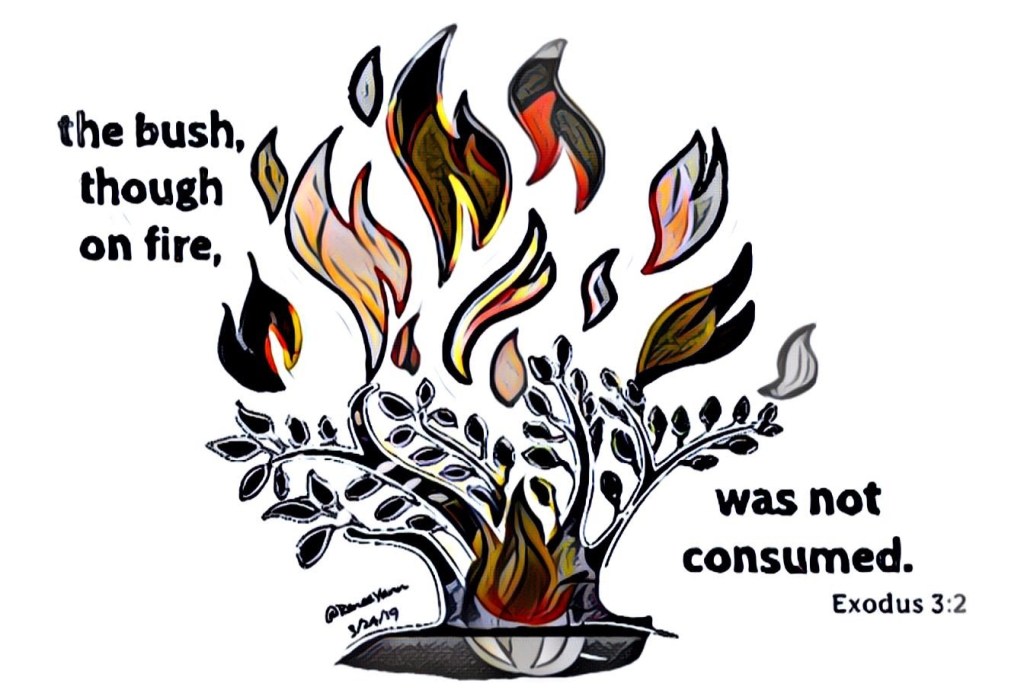
God woke Moses up with a burning bush. Then, by sharing his Name, God invited Moses to the deep spiritual intimacy which empowered him to act for God in the world.

God called out to him from the bush, “Moses! Moses!”
He answered, “Here I am.”
God said, “Come no nearer!
Remove the sandals from your feet,
for the place where you stand is holy ground.
I am the God of your father,” he continued,
“the God of Abraham, the God of Isaac, the God of Jacob.”


I think, for most of us, God is often hidden in our circumstances. I know I haven’t found too many buring bushes along life’s road. So what’s the secret to that deep spiritual awarnessthat allows us to live always in God’s Presence?

Jesus tells us in today’s Gospel that the secret is innocence.

At that time Jesus exclaimed:
“I give praise to you, Father, Lord of heaven and earth,
for although you have hidden these things
from the wise and the learned
you have revealed them to the childlike.


Spiritual innocence is not childish or uniformed. It is not faultless or naïve. The childlike quality Jesus describes is guileless, trusting, open, and wise. It waits in prayer and reflection for God’s time and movement. It believes despite doubt, and hopes despite setback.

Humble Moses – murderer, exile, and loafer on his in-law’s farm – had this kind of innocence. Like a wick awaiting kindling, Moses’s innocent heart caught fire with God. After that there was never an unnoticed “bush” in his life. After all, every one of them might contain angels!


Poetry: excerpt from Aurora Leigh by Elizabeth Barret Browning

But man, the two-fold creature, apprehends
The two-fold manner, in and outwardly,
And nothing in the world comes single to him.
A mere itself,–cup, column, or candlestick,
All patterns of what shall be in the Mount;
The whole temporal show related royally,
And build up to eterne significance
Through the open arms of God. 'There's nothing great
Nor small,' has said a poet of our day,
(Whose voice will ring beyond the curfew of eve
And not be thrown out by the matin's bell)
And truly, I reiterate, . . nothing's small!
No lily-muffled hum of a summer-bee,
But finds some coupling with the spinning stars;
No pebble at your foot, but proves a sphere;
No chaffinch, but implies the cherubim:
And,–glancing on my own thin, veined wrist,–
In such a little tremour of the blood
The whole strong clamour of a vehement soul
Doth utter itself distinct. Earth's crammed with heaven,
And every common bush afire with God:
But only he who sees, takes off his shoes,
The rest sit round it, and pluck blackberries,
And daub their natural faces unaware
More and more, from the first similitude.

Music: Burning Bush – Terrana and Manicardi

Burning bush You are, 
glowing and endless love. 
Living in Your midst, 
to live by You, 
to be alive in You. 

This Fire does not consume 
the essence of every person. 
You show Yourself in creation
in all of the beauty,  
that speaks and cries out Thee.

That You are Love 
in a flower, in the waves of the sea, 
in the dawn, in the song of a swan, 
in a kiss of a child to his mother 
in the farewell of a dying father. 

You are Love 
In a man who climbs the slope, 
In a woman who chooses life, 
In a star bursting with light, 
In the forgiveness that brings pain. 

You are earth, water, air and fire. 
Earth, water, air and fire. 

(Interlude)

Let’s take off our shoes 
in front of so much love. 
We need only to listen to 
the beautiful, the good, the true, 
That lies around us. 

For it’s Love
In a flower, in the waves of the sea,
in the dawn, in the song of a swan, 
in a kiss of a child to his mother
in the farewell of a dying father

It is Love
In a man who climbs the slope, 
In a woman who chooses life, 
In a star bursting with light,
In the forgiveness that costs pain

(Interlude)
repeat above
You are earth, water, air and fire
Earth, water, air and fire