Today, in God’s Lavish Mercy – and tomorrow – we will hear from Haggai, one of the twelve minor prophets of the Hebrew Scriptures. These dozen writers are referred to as “minor” because of the length of their writings, not their value.
So Haggai, even though many of us have never heard of him, has something important to say for Judeo-Christian tradition and for each of us who read him. Let’s see what that might be.
Haggai is prophesying during the Persian period of Jewish history, around the middle of the 6th century, BC. The Jewish people had been back home from the Babylonian captivity for almost 20 years. When they first returned they were passionate about rebuilding the Temple. But as the decades passed, and opposition from their non-Jewish neighbors increased, their commitment waned.
The building of worship places has always been an activity with fans on both sides of the aisle. Some argue that God needs a spot where the Divine Presence can be recognized and revered. Others believe that the effort and resources expended in such building could better be used in human services for God’s poor and needy people. Haggai’s community had people in both camps. (Sound familiar?)
Haggai offers a turning point for their arguments. He tells the people they are a mess. The absence of a central symbol for their faith has weakened and scattered them to their own selfish pursuits. He tells them to look at themselves:
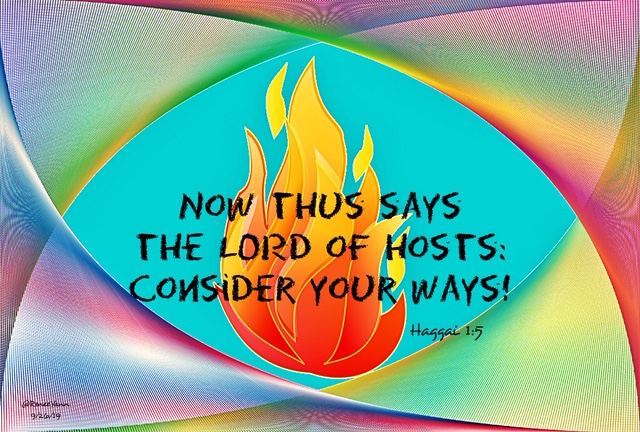
Consider your ways! You have sown much, but have brought in little; you have eaten, but have not been satisfied; You have drunk, but have not been exhilarated; have clothed yourselves, but not been warmed; And whoever earned wages earned them for a bag with holes in it.
The Temple, while it is important, isn’t the most important part of Haggai’s prophecy. He tells the people they have lost their souls. The lack of a central, shared faith has caused them to forget who they are. They will remember only when they remember God’s centrality in their lives.
Haggai appeals to the people to restore a public life which gives honor to God. For their time and circumstance, such a return is symbolized by the rebuilding of the Temple which had been destroyed at the time of their enslavement by Babylon.
We humans often forget what’s important. We chip away at, and ultimately destroy, what makes us who we are by little acts of faithlessness, deceit, covetousness, and envy. These small treacheries grow into big ones redeemable only by an impeachment of the soul and the renewal of a common moral purpose. Haggai offered that conversion to Israel. Pope Francis is offering it to us today.
Video: TED Talk by Pope Francis given at the Annual TED Conference in 2017 and pleading for a “Revolution of Tenderness”. (Yes, it’s long, but it is profound. When he delivered this talk, the Pope was given a standing ovation by some of the most prestigious business people of our time.)
Today, in God’s Loving Mercy, Ezra carries on his shoulders the whole repentant nation of Israel. He is bent in “shame and humiliation” for them as he begins his prayer for God’s mercy.
The Prophet Ezra Prays– Gustave Doré
At the time of the evening sacrifice, I, Ezra, rose in my wretchedness, and with cloak and mantle torn I fell on my knees, stretching out my hands to the LORD, my God.I said:
“My God, I am too ashamed and confounded to raise my face to you, O my God, for our wicked deeds are heaped up above our heads and our guilt reaches up to heaven.
Ezra 9: 6-7
It is a highly dramatic prayer, ripping out from Ezra’s soul. He not only wants to get God’s attention. Ezra wants to make an indelible impression on the community he prays for.
God doesn’t shout back an answer to Ezra’s expressive prayer. Instead, we get the sense of God’s still, eternal Presence waiting for Israel’s eyes to clear in recognition, like finally seeing the mountain peak through the mist:
And now, but a short time ago, mercy came to us from the LORD, our God, who left us a remnant and gave us a stake in his holy place; thus our God has brightened our eyes and given us relief in our servitude.
“ …God has given us a stake in his holy place”….
That place is ever-present, ever-available Lavish Mercy – always awaiting us if we can clear our hearts to see it.
Once we do see the faithfulness of God, we are ready to chance the journey Jesus invites us to in today’s Gospel:
Take nothing for the journey …. set out and go from village to village proclaiming the good news and restoring wholeness everywhere.
Luke 9:3-4
Poetry: Take Nothing for the Journey – Joyce Rupp, OSM
Take Nothing for the Journey
Heal and Proclaim …
Were the twelve afraid?
Did they wonder if they could do those things?
Compared to the quality of your ministry,
Did they feel inadequate and unworthy?
What persuaded them to go? Your words?
Your friendship? Their enthusiasm?
Your deep belief that they could do it?
And you said:
“Take nothing for the journey”.
What did you mean?
Trust or more than trust?
Did you perhaps imply that we can’t wait
Until we have all the possible things we need?
That we can’t postpone “doing”
Until we are positive of our talents?
That we can’t hold off our commitment
Until we are absolutely sure
We won’t make a mistake?
I think of all the excuses and reasons
We can give for not serving and giving:
No time, no talent, no knowledge,
No energy, no assured results.
You say, “Take nothing.
Don’t worry about your inadequacies.
I will provide for you.
Go! Just Go! Go with my power.
Risk the road, risk the work.
Go! I will be with you.
What else do you need?”
Music: Great Is Thy Faithfulness – written by Thomas O. Chisholm Sung here by Austin Stone Worship – Jaleesa McCreary (Note the sweet smile on her beautiful face just before she begins to sing. Grace!)
Today, in God’s Lavish Mercy, Luke gives us a jolt with this Gospel passage that has always disturbed me:
The mother of Jesus and his brothers came to him but were unable to join him because of the crowd. He was told, “Your mother and your brothers are standing outside and they wish to see you.” He said to them in reply, “My mother and my brothers are those who hear the word of God and act on it.”
Luke 8:19-21
Honestly, I don’t want Jesus to sound officious like that with his family! I want him to wiggle through the crushing crowd and run into Mary’s loving arms. I want him to hug his mom to bits and pummel his little brothers on the back with callow delight.
And you know what – I think that might be exactly what Jesus did, on the way uttering the seemingly callous phrase which Luke has isolated and immortalized.
Like all scripture passages, we can read this one in the slant of our own light. At the same time, it is important to access the wisdom of scripture scholars in order to understand depths we might not otherwise discern. There is a scholarly consensus that this Lucan passage is intended to show us how radically dedicated Jesus was to his mission. The passage affirms that the mission is more important even than family ties … in other words, more important than anything. For thirty years Jesus had lived a quiet life somewhere within his mother’s circle of care. In this Gospel, that quiet time is over and he is on the path to his Passion, Death, and Resurrection.
I understand that radicality and the courage it takes to live it. I failed at it once (at least) but learned immensely from the failure.
When I was a young religious, there was a call for US nuns to minister in Nicaragua. I wanted to answer that call. When I told my mother about my emerging decision, she froze in time. My father had died just about a year and a half before. The thought of also “losing” me to a socio-politically volatile Central America traumatized my mom.
But my mom was so brave. She didn’t say, “Don’t go.” She simply said, “Take me with you. I can cook for all of you.”
Mom and I at the 41st Eucharistic Congress Philadelphia (1976)
Needless to say, I wasn’t going to take my mom into a political boiler in order to satisfy my plans. But I also wasn’t going to leave her alone in the thinly-veiled desperation of her offer. I didn’t go to Nicaragua and, like Robert Frost’s split road, that has made a profound difference in my life.
That decision almost fifty years ago was a good one, and opened the way for me into other opportunities to serve God’s people. The Gospel did not suffer because of my hesitations or my mother’s. We both trusted our humanity that had, for all our lives, been directed toward God’s love.
But at this juncture in Jesus’s life, the Gospel demands that he open his heart beyond any familial or personal ties in order to embrace all people in the Gospel.
There are frequent times in each of our lives when we must choose for the largeness of the Gospel over limited self-interest. Enriching ourselves daily in scriptural wisdom will strengthen us to respond generously at those times.
Prose: Pope Francis on praying with the scriptures:
Through prayer a new incarnation of the Word takes place. And we are the “tabernacles” where the words of God want to be welcomed and preserved, so that they may visit the world. This is why we must approach the Bible without ulterior motives, without exploiting it. The believer does not turn to the Holy Scriptures to support his or her own philosophical and moral view, but because he or she hopes for an encounter; the believer knows that those words were written in the Holy Spirit, and that therefore in that same Spirit they must be welcomed and understood, so that the encounter can occur.
Music: O Word of God – Ricky Manolo – In this hymn, passages from the Psalms – snippets of God’s Word – are sung in a round within the plea for God’s Word to come into our hearts.
O Word of God, come into this space. O Word of God, come send us your grace. Open our minds; show us your truth. Transform our lives anew.
O Word of God, come into this space. O Word of God, come send us your grace. Open our minds; show us your truth. Transform our lives anew.
Here I am, O Lord my God I come to do your Will.
Blessed are the poor in spirit, the Kingdom of Heaven is theirs.
To the upright, I will show the saving power of God.
Let all the nations praise You, O God. Let all the nations praise You.
The Lord is my shepherd, there is nothing I shall want.
Today, in God’s Lavish Mercy, we begin three weeks of readings from some of the lesser known prophets and reformers in ancient Israel:
Ezra: instrumental in restoring the Jewish scriptures and religion to the people after the return from the Babylonian Captivity and is a highly respected figure in Judaism.
Nehemiah: his book describes his work in rebuilding Jerusalem during the Second Temple period.
Haggai: a Hebrew prophet during the building of the Second Temple in Jerusalem, and one of the twelve minor prophets in the Hebrew Bible. He is known for his prophecy in 520 BCE, commanding the Jews to rebuild the Temple
Zechariah: His greatest concern was with the building of the Second Temple
Baruch: the prophet Jeremiah’s scribe who is mentioned at Baruch 1:1. The book is a reflection of a late Jewish writer on the circumstances of Jewish exiles from Babylon
Malachi: Malachi describes a priesthood that is forgetful of its duties, a Temple that is underfunded because the people have lost interest in it, and a society in which Jewish men divorce their Jewish wives to marry out of the faith. (W. Gunther Plaut)
Joel: delivers a message of warning and repentance to the southern kingdom of Judah after the nation was divided.
Jonah: prophesied the destruction of Nineveh, but attempts to escape his divine mission.
Now some of my readers who are scripture geeks like me may have been interested in the above list. The rest of you skipped down to this paragraph to see if I had anything at all interesting to say about today’s readings. 😉
How about this? While Israel’s prophets and reformers speak to a certain time in history, their themes speak powerfully to our own times and culture as well:
Walter Brueggemann describes the prophets’ two primary themes:
First, they are very sure that political economic arrangements that contradict the purpose of God cannot be sustained.
Second, the prophets are voices of hope that affirm that God is a future-creating agent who keeps promises and who, against all odds, creates a new world reality that is distinct from present power arrangements.
Walter Brueggemann: From Judgment to Hope
The prophets remind us that, beyond any purely temporal interpretation of life, God is real and intimately involved in the unfolding of both our personal and global histories. When we pray with the prophets, we are strengthened in courage to engage our world, and to act in hope for the redemption of our culture.
In today’s reading, the reformer Ezra speaks a word of liberating alternative hope to a people who had been decimated by the Babylonian Captivity. Many of them thought they had lost their soul in Babylon. Ezra, by the power of God, breathes it back into them.
Therefore, whoever among you belongs to any part of his people, let him go up, and may his God be with them! Let everyone who has survived, in whatever place they may have dwelt, be assisted by the people of that place with silver, gold, goods, and cattle, together with free-will offerings for the house of God in Jerusalem
Ezra 1:3-4
As we consider our own times, our “breathers of hope” may come to mind: Pope Francis working to rebuild the Church, and Martin Luther King inspiring a vision of equity, respect and inclusion. We may think of voices like St. Oscar Romero, Venerable Catherine McAuley, Simone Weil, St. Edith Stein, Greta Thunberg, Servant of God Dorothy Day, or Pierre Teilhard de Chardin. Each one has spoken selflessly for peace, mercy, justice, and wholeness in a fragmented, sinfully distracted society.
In today’s Gospel, Jesus, Divine Daystar of every prophet’s hope, calls each one of us to the work of hope-filled prophecy, and faith-filled listening:
Jesus said to the crowd: “No one who lights a lamp conceals it with a vessel or sets it under a bed; rather, he places it on a lampstand so that those who enter may see the light. For there is nothing hidden that will not become visible, and nothing secret that will not be known and come to light. Take care, then, how you hear. To anyone who has, more will be given, and from the one who has not, even what he seems to have will be taken away.”
Matthew 5:1-6
Poetry: Advice to a Prophet – Richard Wilbur
When you come, as you soon must, to the streets of our city,
Mad-eyed from stating the obvious,
Not proclaiming our fall but begging us
In God’s name to have self-pity,
Spare us all word of the weapons, their force and range,
The long numbers that rocket the mind;
Our slow, unreckoning hearts will be left behind,
Unable to fear what is too strange.
Nor shall you scare us with talk of the death of the race.
How should we dream of this place without us?—
The sun mere fire, the leaves untroubled about us,
A stone look on the stone’s face?
Speak of the world’s own change. Though we cannot conceive
Of an undreamt thing, we know to our cost
How the dreamt cloud crumbles, the vines are blackened by frost,
How the view alters. We could believe,
If you told us so, that the white-tailed deer will slip
Into perfect shade, grown perfectly shy,
The lark avoid the reaches of our eye,
The jack-pine lose its knuckled grip
On the cold ledge, and every torrent burn
As Xanthus once, its gliding trout
Stunned in a twinkling. What should we be without
The dolphin’s arc, the dove’s return,
These things in which we have seen ourselves and spoken?
Ask us, prophet, how we shall call
Our natures forth when that live tongue is all
Dispelled, that glass obscured or broken
In which we have said the rose of our love and the clean
Horse of our courage, in which beheld
The singing locust of the soul unshelled,
And all we mean or wish to mean.
Ask us, ask us whether with the worldless rose
Our hearts shall fail us; come demanding
Whether there shall be lofty or long-standing
When the bronze annals of the oak tree close.
Lily of the Valley, let your sweet aroma fill my life
Rose of Sharon show me how to grow in beauty in God's sight
Fairest of ten thousand make me a reflection of your light
Daystar shine down on me let your love shine through me in the night

Lead me Lord, I'll follow. Anywhere you open up the door
Let your word speak to me, show me what I've never seen before
Lord I want to be your witness, you can take what's wrong and make it right
Daystar shine down on me, let your love shine through me in the night

Lord I've seen a world that's dying wounded by the master of deceit
Groping in the darkness, haunted by the years of past defeat
But when I see you standing near me shining with compassion in your eyes
I pray Jesus shine down on me let your love shine through me in the night

Lead me Lord, I'll follow anywhere you open up the door
Let your word speak to me, show me what I've never seen before
Lord I want to be your witness, you can take what's wrong and make it right
Daystar shine down on me, let your love shine through me in the night
Today, in God’s Lavish Mercy, we pray with Psalm 145 which, with our Sunday readings, ties together the themes of call and commitment.
In our first reading, Isaiah proclaims a repentant urgency to that call:
Seek the LORD while he may be found, call him while he is still near.
Isaiah 55:6
In our second reading, Paul confirms his own ultimate commitment to that call and urges his followers to imitate him:
Christ will be magnified in my body, whether by life or by death….
Only, conduct yourselves in a way worthy of the gospel of Christ, so that, whether I come and see you or am absent, I may hear news of you, that you are standing firm in one spirit, with one mind struggling together for the faith of the gospel.
Philippians 1:20;27
But our Gospel reveals that not everyone responds immediately to God’s voice in their lives. Some of us come late to the call of grace. Nevertheless, our generous God seeks us, time and again, and embraces us fully no matter how close to the evening.
The early hires chafe against this system, imagining themselves somehow deprived by the Master’s abundance. Perhaps we heard attitudes like theirs expressed in self-sufficient phrases like:
but I’ve worked hard for everything I have
you need to earn your way in life
it’s not a free ride
if you can’t stand the heat, get out of the kitchen
Walter Brueggemann writes that the Psalms refute such an attitude:
The counter-world of the Psalms contradicts our closely held world of self-sufficiency by mediating to us a world confident in God’s preferential option for those who call on him in their ultimate dependence.
Psalm 145 lifts us beyond our selfish imaginations. It expresses the grateful praise of one who, swaddled in God’s lavish blessing, recognizes that Divine Justice looks like Mercy not calculation.
The LORD is gracious and merciful, slow to anger and of great kindness. The LORD is good to all and compassionate toward all his works.
Psalm 145: 8-9
Poem: by Rumi
By the mercy of God,
Paradise has eight doors.
One of those is the door of repentance, child.
All the others are sometimes open,
sometimes shut,
but the door of repentance is never closed.
Come seize the opportunity:
the door is open;
carry your baggage there at once.
Mercy Day – Feast of Our Lady of Mercy September 24, 2023
As Mercy Day approaches, I begin my annual reflections on the indescribable gift of Mercy in my life. A bouquet of Catherine’s quotes, phrases that I treasure, suggests itself for my prayer:
My legacy to the Institute is charity…
Mercy, the principal path pointed out by Jesus Christ…
This is your life, joys and sorrows mingled …
It is better to relieve a hundred imposters than to suffer one really distressed person to be sent away empty.
But today I choose a phrase that, when I first read it many years ago, rang like a bell in my heart. It is a phrase Catherine used to describe the magical beginnings of the Sisters of Mercy:
“It began with two, Sister Doyle and I …”
It. That’s what Catherine called this indescribable reality we know as “Mercy”, this small beginning that has blossomed into a living, universal energy.
It. That embodiment of God’s Love in human caring and tenderness. That deep awareness of our “being in God” which frees us to be for another.
Though we can never fully describe it, every Sister of Mercy knows how she caught it. We saw someone living it, sharing it, rejoicing in it. And we were captured in its preternatural glow.
Srs. Peggy Musselman, Gail deMacedo, and Theresa Gormley walking down Aldine St. to St. Hubert’s High School (1963)
For me, it was the unalloyed joy and hospitality of the Sisters of Mercy at my high school. I wanted to be like them, to discover the secret of their generous warmth. I wanted to have enough of that energy in my own heart to dispense it so easily to anyone who needed it.
At my graduation with my beloved sponsor, Sr. Mary Giovanni
I didn’t have a clue when I asked to join them on my life’s journey. I was young, idealistic, and completely untested by the world. I simply trusted that, with them, I could open myself to the “It” that had inspired them. And that trust has yielded the central gift of my life, as Frances Warde describes it when talking about Catherine McAuley:
“You never knew her. I knew her better than I have known anybody in my life. She was a woman of God, and God made her a woman of vision. She showed me what it meant to be a Sister of Mercy, to see the world and its people in terms of God’s love; to love everyone who needed love; to care for everyone who needed care. Now her vision is driving me on. It is a glorious thing to be a Sister of Mercy!”
Happy Mercy Day to all our Sisters, Companions, Associates, and Co-ministers throughout the world, and to everyone in the Mercy Family who has been touched and changed by “It”. Indeed, what a glorious thing!
Today, in God’s Lavish Mercy, we have our final reading from 1 Timothy. In the closing words of this letter, Paul pleads with Timothy, and with the community Timothy shepherds, to stay faithful. Paul encourages them to do this even though the Power they believe in is invisible.
… keep the commandment without stain or reproach until the appearance of our Lord Jesus Christ that the blessed and only ruler will make manifest at the proper time, the King of kings and Lord of lords, who alone has immortality, who dwells in unapproachable light, and whom no human being has seen or can see. To him be honor and eternal power. Amen.
1 Timothy 6:14-16
In our Gospel today, Jesus describes the Word of God aa a seed that falls upon the human heart with varying results. It is a parable we are familiar with and we get it. If we don’t have a ready heart, plowed and furrowed with faith and charity, that lonely seed is going to die.
The problem is that even when that seed falls into our very faithful hearts, we don’t always SEE the results. The work of faith is a work with invisible powers. It is a work with hope, with trust, with perseverance, with courage – much like the work in any garden.
I hear really good people, whose lives are beautiful witnesses to faith, still question themselves and their goodness. Because their lives are threaded with challenges and disappointments, they think their lack of faith might be the cause. Because the world at large may appear to be a mess, they wonder if the God they believe in is really there!
Indeed, even though the seed of God’s Word is alive, still it is buried in the realities of our lives. And we wait in sometimes doubtful anticipation for its flowering.
Paul knew that Timothy would encounter these roadblocks just as we all do. That is why his letters to Timothy are a powerful source of encouragement to us all as we strive to live a holy life. As we close these letters today, don’t put them on a shelf forever. I go back to Timothy often just to grab a few verses for light in a shadowy time. I encourage you to do the same.
The final verses of 1 Timothy struck me with a smile as I read them today. They follow just after today’s reading:
O Timothy, guard what has been entrusted to you. Avoid profane babbling and the absurdities of so-called knowledge. By professing it, some people have deviated from the faith.
Poetic Prose: Rainer Maria Rilke
When I think of the Paul’s letters to young Timothy, I am reminded of Rilke’s Letters to a Young Poet. Here is a favorite passage:
You are so young; you stand before beginnings…
have patience with everything that
remains unsolved in your heart.
Try to love the questions themselves,
like locked rooms and like
books written in a foreign language.
Do not now look for the answers.
They cannot now be given to you
because you could not live them.
It is a question of experiencing everything.
At present you need to live the question.
Perhaps you will gradually,
without even noticing it,
find yourself experiencing the answer,
 some distant day.
On Saturday, September 23, 2023, at 2:50 AM Eastern Time, we in the Northern Hemisphere will cross the threshold of the Autumn Equinox. I wrote this reflection a few years ago and thought some of you might enjoy reading it to recognize and celebrate this passage. When my brother and I sold our parents’ house and closed the door behind us for the last time, it was like stepping into a deepening season of our lives.
Like Autumn Light
It was the house we had grown up in and its now empty corners echoed a thousand joys. My brother and I stood on its threshold, ready for the final time to close the door behind us. Mom had died eight months before, following Dad to a heaven we believed in. Now the house had been sold, emptied, cleaned and blessed. It was time to move on.
That moment on the threshold is a still-shot in the memory of those long-ago days. Such a moment is the tightwire between memory and promise; the border between regret and gratitude. It is the passageway between fear and trust. It is the line we draw between loneliness and independence.
Such a moment is like the soft, grey stillness just before dawn when everything is possible but nothing is yet real. It is an exquisite time when life invites us to become all and more than we had ever been.
The days of autumn are like that threshold. They invite us to a second version of ourselves. They allow us to pause on time’s lintel, to assess the strengths gathered through the years, and to enter the power of our harvest days.
Autumn skies, beautiful at dusk, encourage us to explore our shadows without fear or hurry. Glorious sunsets convince us that light, like life, never dies. It only changes.
This is a grace-filled liminal time where we might recall all the many doorways we have crossed on the journey to who we are.
It is a time we might reflect on the invitations offered at each crossing and who we have become because of our yeses and our nos.
It is a time to wait for new light, but still to bless the rich darkness that holds the deep roots of our life.
It is a time to realize that we lift our foot for the next step purely on the music of all that has been given to us.
In the autumn times of our lives, let us pause to allow the Light to pool in our souls. That deepening has so much to offer us as we pass through the doorways of time.
Today, in God’s Lavish Mercy, we pray with Psalm 49, the point of which according to Walter Brueggemann is this:
The point is that death is the great equalizer, and those who are genuinely wise should not be impressed by or committed to that which the world over-values.
Walter Brueggemann: From Whom No Secrets Are Hid
We may have heard the sentiment stated more succinctly by an anonymous scholar:
You can’t take it with you.
This is the core message Paul imparts to Timothy in our first reading:
For the love of money is the root of all evils, and some people in their desire for it have strayed from the faith and have pierced themselves with many pains.
1 Timothy 6:10
The advice is about more than money, or “dollar-bucks” as my 7-year-old grandnephew calls them.
The instruction is about our priorities – whom, why and what we love, value, and sacrifice for.
Walter Brueggemann
The opposite of this “love of money” is an unselfish, sacrificial love for others. This is the love Jesus hopes for in his disciples as he blesses them in today’s Gospel.
It takes courage to live such discipleship. As human beings, we tend to fear any kind of deprivation. We crave security, and sometimes we think money and possessions can give us that. Our readings today redirect that all too common misperception.
The world can be a very dark place, and of course, we will have fears and worries. Paul and our psalmist direct us to the right place to calm these concerns. Jesus calls us to believe in and live in the Light which is our true security.
Our psalm reminds us to keep our eyes on the eternal promise we have all been given.
But God will redeem my life, will take me from the hand of Darkness.
Psalm 49:16
Poetry: Accepting This – Mark Nepo
Yes, it is true. I confess,
I have thought great thoughts,
and sung great songs—all of it
rehearsal for the majesty
of being held.
The dream is awakened
when thinking I love you
and life begins
when saying I love you
and joy moves like blood
when embracing others with love.
My efforts now turn
from trying to outrun suffering
to accepting love wherever
I can find it.
Stripped of causes and plans
and things to strive for,
I have discovered everything
I could need or ask for
is right here—
in flawed abundance.
We cannot eliminate hunger,
but we can feed each other.
We cannot eliminate loneliness,
but we can hold each other.
We cannot eliminate pain,
but we can live a life
of compassion.
Ultimately,
we are small living things
awakened in the stream,
not gods who carve out rivers.
Like human fish,
we are asked to experience
meaning in the life that moves
through the gill of our heart.
There is nothing to do
and nowhere to go.
Accepting this,
we can do everything
and go anywhere.
Music: His Eye is on the Sparrow (You might recall this version from the movie “Sister Act II”)
Today, in God’s Lavish Mercy, we pray with Paul and Matthew that we may deepen our reverence for the call we have received.
I, a prisoner for the Lord, urge you to live in a manner worthy of the call you have received, with all humility and gentleness, with patience, bearing with one another through love, striving to preserve the unity of the Spirit through the bond of peace: one Body and one Spirit, as you were also called to the one hope of your call; one Lord, one faith, one baptism; one God and Father of all, who is over all and through all and in all.
But grace was given to each of us according to the measure of Christ’s gift.
Ephesians 4:1-7
Many of us think of a “call” as a one-time event, for example, the moment we say “yes” to a marriage proposal, or the profession of vows in religious commitment.
Our Gospel describes such a life call for Matthew:
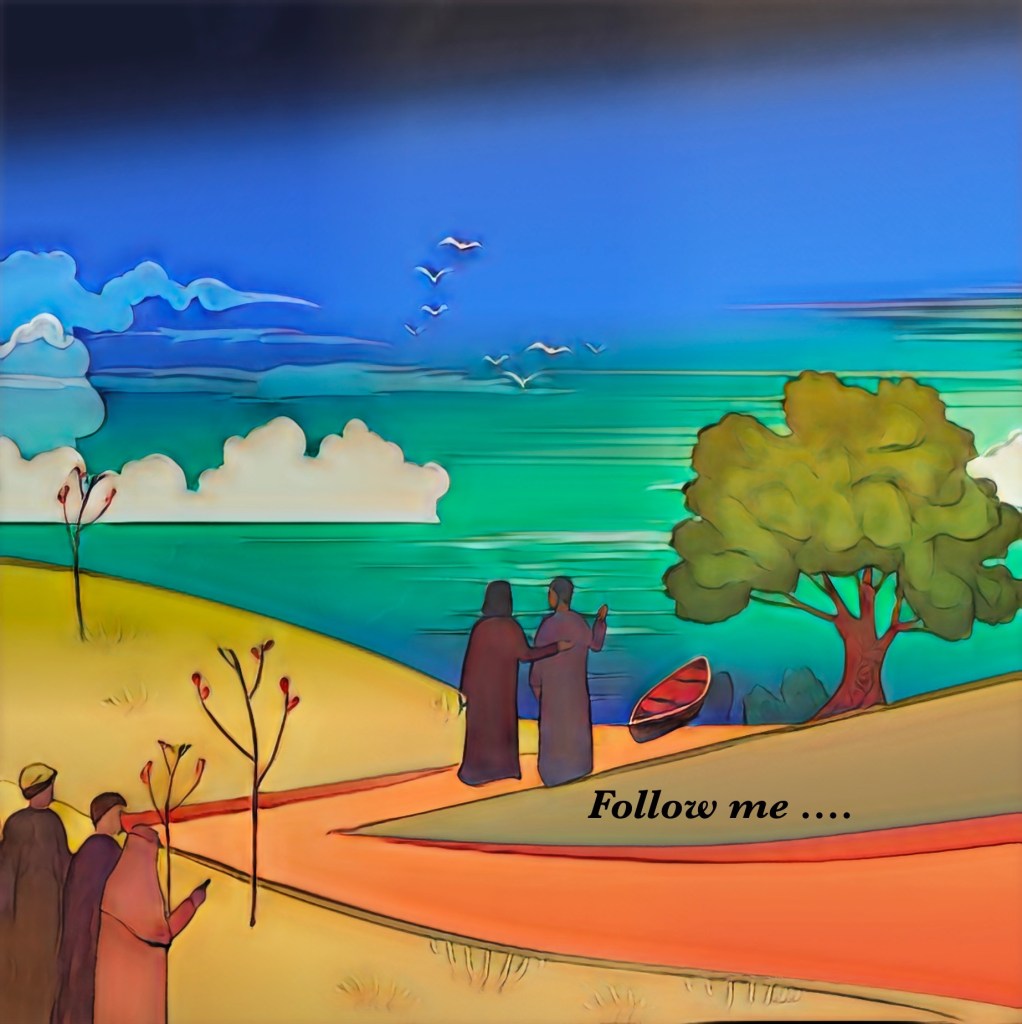
As Jesus passed by, he saw a man named Matthew sitting at the customs post. He said to him, “Follow me.” And he got up and followed him.
Matthew 9:9
But we can be certain that this was not Matthew’s only and final call. Jesus kept calling Matthew every day of his life to move deeper and deeper into the heart of God.
Like Matthew, we are all sitting at the table of life sometimes unaware of God’s power passing right in front of us. Matthew looked up from his tax sheets just in time to see Jesus’s all-knowing, all-loving glance. And that moment changed everything for Matthew. The call, crystalized in that sacred moment, had unfolded for years and would continue to unfold throughout Matthew’s life.
Maybe we spend a lot of our time fiddling with life’s calculations like Matthew did. We need to make our checkbooks balance, our calendars synchronize, our recipes succeed, our bills resolve. Sometimes we have so much ciphering going on that we don’t even glance up to see real Life passing by.
Jesus teaches that the underlying calculus of our lives must be mercy. He wants us to see where mercy is needed and to spend ourselves in its name. When Matthew’s buddies criticized him for following his call, Jesus confronted them with their own call, “Go and learn…”
The Pharisees saw this and said to his disciples, “Why does your teacher eat with tax collectors and sinners?” He heard this and said, “Those who are well do not need a physician, but the sick do. Go and learn the meaning of the words, I desire mercy, not sacrifice. I did not come to call the righteous but sinners.”
Matthew 9:11-13
I hope those pharisaical critics listened. I hope I do too.
Poetry: The Calling of St. Matthew – James Lasdun
This beautiful, thought-provoking poem by James Ladsun suggests that Matthew had prepared himself, over many years and through many choices, to hear the call when it finally came. The poet imagines that Matthew had completed a slow emptying of his life in charity and thus left the space for God’s voice.
Lasdun wrote the poem referencing a painting of the same name by Caravaggio. ‘The painting was completed in 1599–1600 for the Contarelli Chapel in the church of the French congregation, San Luigi dei Francesi in Rome, where it remains. This painting, by the way, is a favorite of Pope Francis. He has said he went often to contemplate it on his earlier visits to Rome.
Not the abrupt way, frozen
In the one glance of a painter’s frame
Christ in the doorway pointing. Matthew’s face
Bright with perplexity, the glaze
Of a lifetime at the countinghouse
Cracked in the split second’s bolt of being chosen.

But over the years, slowly,
Hinted at, an invisible curve;
Persistent bias always favoring
Backwardly the relinquished thing
Over the kept, the gold signet ring
Dropped in a beggar’s bowl, the eye not fully

Comprehending the hand, not yet;
Heirloom damask thrust in a passing
Stranger’s hand, the ceremonial saddle
(Looped coins, crushed clouds of inline pearl)
Given on an irresistible
impulse to a servant. Where it sat

A saddle-shaped emptiness
Briefly, obscurely brimming … Flagons
Cellars of wine, then as impulse steadied
into habit, habit to need,
Need to compulsion, the whole vineyard
The land itself, graves, herds, the ancestral house,

Given away, each object’s
Hollowed-out void successively
More vivid in him than the thing itself,
As if renouncing merely gave
Density to having; as if
He’s glimpsed in nothingness a derelict’s

Secret of unabated,
Inverse possession … And only then,
Almost superfluous, does the figure
Step softly to the shelter door;
Casual, foreknown, almost familiar,
Calmly received, like someone long awaited.
Music: The Call – Vaughan Williams
Come, my Way, my Truth, my Life: Such a Way, as gives us breath: Such a Truth, as ends all strife: Such a Life, as killeth death
Come, My Light, my Feast, my Strength: Such a Light, as shows a feast: Such a Feast, as mends in length: Such a Strength, as makes his guest
Come, my Joy, my Love, my Heart: Such a Joy, as none can move: Such a Love, as none can part: Such a Heart, as joys in love












 Lavish Mercy