Today, in God’s Lavish Mercy, we pray with Psalm 25, set perfectly in the midst of a few readings that speak to us about, among other things , “the Father’s Will”.
I think there is no greater spiritual mystery than the meaning of “God’s Will”, (and not wanting to show up Thomas Aquinas, I’ll resist explaining it here. 😂🧐)
But we’ve all heard attempts at explaining it, haven’t we, especially as it relates to suffering— as in:
everything that happens is God’s Will, so we must accept it
God wills our suffering to test us
if God wills that we suffer, He will give us the strength to endure it
I just don’t think so … not the God I love and Who loves me.
But these attempts to explain suffering are understandable because we want to rationalize the things we fear. Most of us, I think, struggle with the problem of evil and suffering in the world. We want to know what to do when, as Rabbi Kushner wrote, “… Bad Things Happen to Good People”.
Our first reading from Ezekiel shows us that even the ancient peoples met this struggle. The prophet seems to suggest that if you’re bad, you’ll suffer. If you repent, you won’t. Well, we all know that’s not quite the reality! But nice try, Ezekiel.
Our psalm gently leads to another way of facing suffering as the psalmist prays for wisdom, compassion and divine guidance. In the Garden of Gethsemane, Jesus himself prayed like this as he confronted his impending suffering.
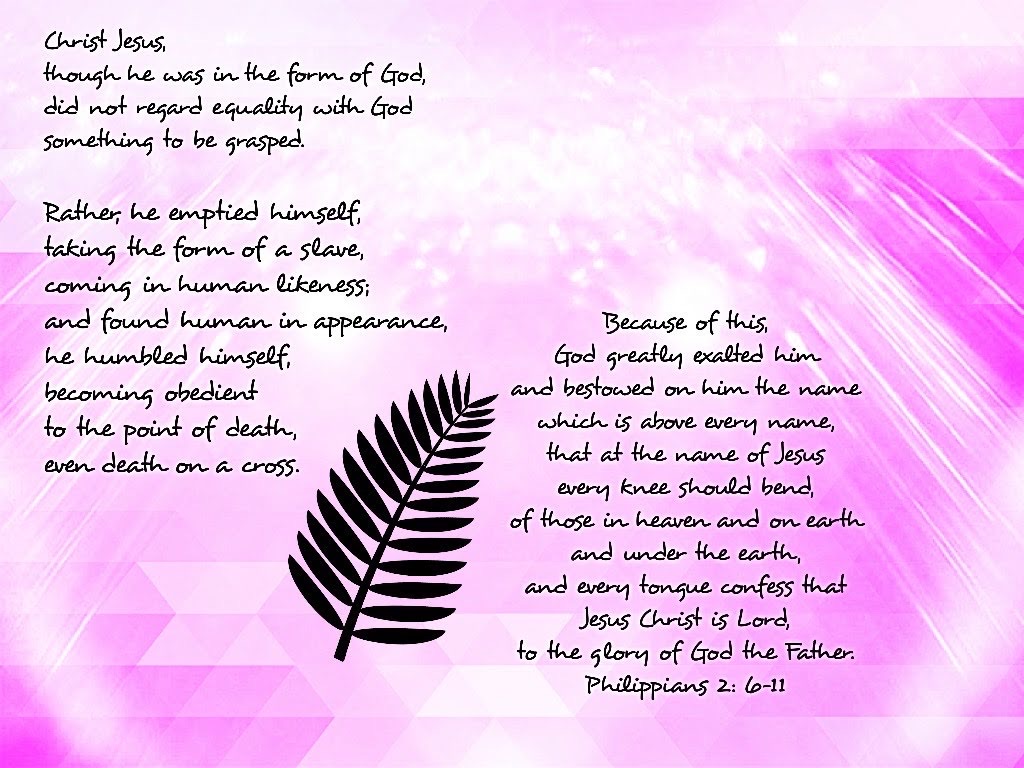
In our second reading, Paul places before us the example of Jesus who, in the face of suffering, was transformed by love:
Praying with these readings, each one of us must come to our own peace with the mystery of suffering. What we can be sure of is this: God’s Will is always for our wholeness and joy as so simply taught to us when we were little children:
God made me to know, love, and serve God, and to be happy with God in this world and forever.
Our Gospel tells us that such happiness comes through faith and loving service, through responding to “the Father’s Will”. May we have the insight, the love, and the courage!
Poetry: Of Being by Denise Levertov
I know this happiness is provisional: the looming presences — great suffering, great fear— withdraw only into peripheral vision: but ineluctable this shimmering of wind in the blue leaves: this flood of stillness widening the lake of sky: this need to dance, this need to kneel: this mystery:
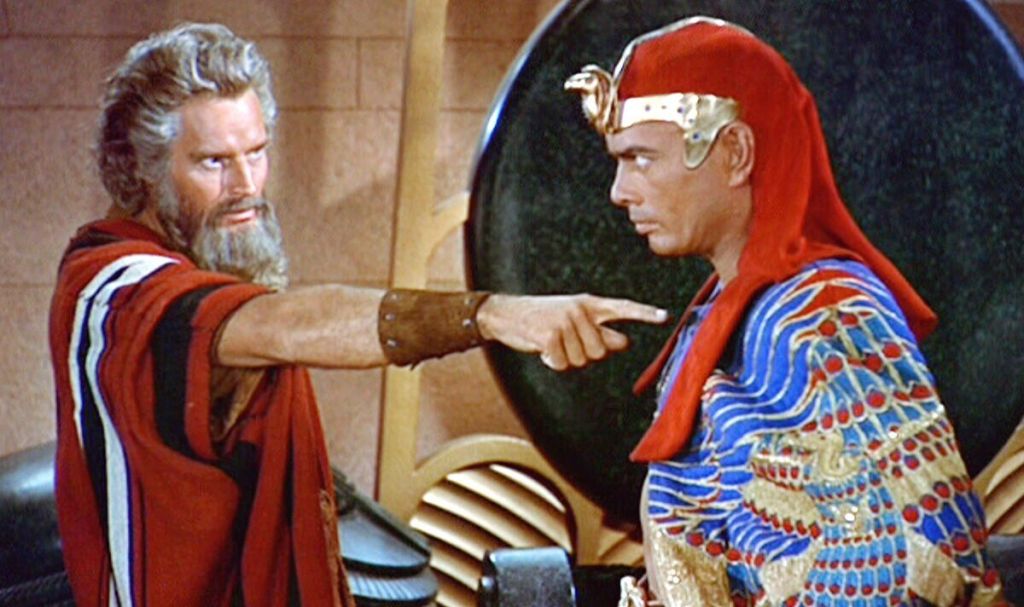
Today, in God’s Lavish Mercy, as we continue with Matthew, we begin a nearly three-week engagement with the Book of Exodus. Our companion along the way will be Moses (and, on occasion, Charlton Heston).
The Book of Exodus, a literary masterpiece, has profoundly influenced religion and culture for over 3000 years. Finally written down about 300 years before Christ, it is a gathering of the rich oral traditions and salvation history of the Judea-Christian faith. A total of forty chapters, the Book can be divided into two key parts: the liberation from Egyptian enslavement and the formation of a new, life-giving Covenant with God.
The Book’s enduring influence can be ascribed to these two themes. They reflect the universal life cycles in all of nature and in each one of our lives. The totality of human culture as well as our individual biographies are stories of breaking forth from whatever binds us into the call and promise of fuller life.
Today’s chapter is an introduction or bridge from the time of Joseph, (when Israel thrived in Egypt), to just before the emergence of Moses, (when Israel suffered in Egypt).
A new king, who knew nothing of Joseph, came to power in Egypt. He said to his subjects, “Look how numerous and powerful the people of the children of Israel are growing, more so than we ourselves! Come, let us deal shrewdly with them to stop their increase; otherwise, in time of war they too may join our enemies to fight against us, and so leave our country.”
Accordingly, taskmasters were set over the children of Israel to oppress them with forced labor.
Exodus 1:8-11
The theme of suffering also anchors our passage from Matthew:
Jesus said to his Apostles: “Do not think that I have come to bring peace upon the earth. I have come to bring not peace but the sword.
Matthew 10:34
The suffering imposed upon both “the children of Israel” and true disciples of Jesus generates from the same source – fear:
Pharaoh is afraid of what he will lose should the growing Israelite community turn on him.
The fear of losing one’s life in Christ inhibits the heart from true discipleship.
As we pray and study these next few weeks with the Book of Exodus, we may be moved to consider the fears both within and around us that prevent us from growing to fuller life.
Our world is full of the fears that induce violence and retribution. Our own spirits may be restrained with the fear of what we might lose by falling deeper into a Gospel life.
Our journey through Exodus offers us a time to consider and examine the fears we perceive. These fears may not necessarily be big spiritual impediments. They may be as simple as the fear of not being right, first, liked, included, or successful. But those very simple fears, left moldering in our hearts, are the seeds of the isolation, domination, and dissolution we see so rampant in our current culture.
Praying with Exodus, may we ask for courage to name and expose our personal and societal fears to God’s healing grace. We might begin with this thought from Paula D’Arcy:
Who would I be, and what power would be expressed in my life, if I were not dominated by fear?
Israel finally answered that question by coming into Covenant with God and Community with one another. The path is much the same for us in our lives.
Poetry: Immortality by Lisel Mueller
In Sleeping Beauty’s castle the clock strikes one hundred years and the girl in the tower returns to the world. So do the servants in the kitchen, who don’t even rub their eyes. The cook’s right hand, lifted an exact century ago, completes its downward arc to the kitchen boy’s left ear; the boy’s tensed vocal cords finally let go the trapped, enduring whimper, and the fly, arrested mid-plunge above the strawberry pie fulfills its abiding mission and dives into the sweet, red glaze. As a child I had a book with a picture of that scene. I was too young to notice how fear persists, and how the anger that causes fear persists, that its trajectory can’t be changed or broken, only interrupted. My attention was on the fly: that this slight body with its transparent wings and life-span of one human day still craved its particular share of sweetness, a century later.
Music: Fear is a Liar by Zach Williams – in this song, Williams images God as Fire, a Fire upon Whom we can cast our fears for a return of Love.
It feels appropriate that, before we resume gathering together in Lavish Mercy tomorrow, I comment a bit on my time away from the blog.
First, I sincerely thank you all for your prayers and encouragement. In a shadowy time, you gave me the generous lights of comfort and joy. I am deeply grateful.
Now, as I continue to heal from a time of unexpected vulnerability, I have the advantage of being able to reflect in peace on what has happened to me.
Part of that peace and healing has been a move to our Motherhouse, a loving community where I have the support and care I need right now. I am blessed beyond words by this gift.
This photo was taken in the early 1900s for the Merion Historical Society
My new room is on the very western end of the building (See blue arrow above.) However, I look out my ample windows not to a sunset horizon – but instead to the imposing wall of our magnificent chapel. Some were concerned that the “wall view” might not be optimal. They didn’t realize that the wall housed an unexpected gift – a bird’s eye view of the glorious rose window that, for over a century, has blessed our chapel with dawn Light.
And I am now on the other side of that Light as it flows over my beloved community – a place that feels ever closer to God with each sunrise.
Sometimes, especially in the evening, I will catch a lovely glow within chapel on one of the several stained glass windows. I consider these my own special sunsets given only to me for my unique reflection. These windows are icons for me as I pray and learn from my own little “passover experience” this winter.
Evening Window from the Outside!
During times of suffering, loss, or unchosen change in our lives, it is hard to turn to the Light. As we begin our Holy Week walk, consider that Jesus faced this struggle in the shadows of Gethsemane. There, he taught us what it takes not only to turn toward Light, but to become It.
Then going out he went, as was his custom, to the Mount of Olives, and the disciples followed him.
When he arrived at the place he said to them, “Pray that you may not undergo the test.”
After withdrawing about a stone’s throw from them and kneeling, he prayed, saying, “Father, if you are willing, take this cup away from me; still, not my will but yours be done.”
And to strengthen him an angel from heaven appeared to him.
Matthew 22: 40-43
As it was with Jesus, a “Gethsemane moment” in any of our lives is an invitation to abandon ourselves in trust to God’s inscrutable Love — a falling helplessly, but hopefully, into a Love that changes everything.
For Jesus, his embrace of God’s Will in that tenebrous garden opened his heart to the glory of the Resurrection and led him to the other side of Light. How might such self-giving open and lead us?
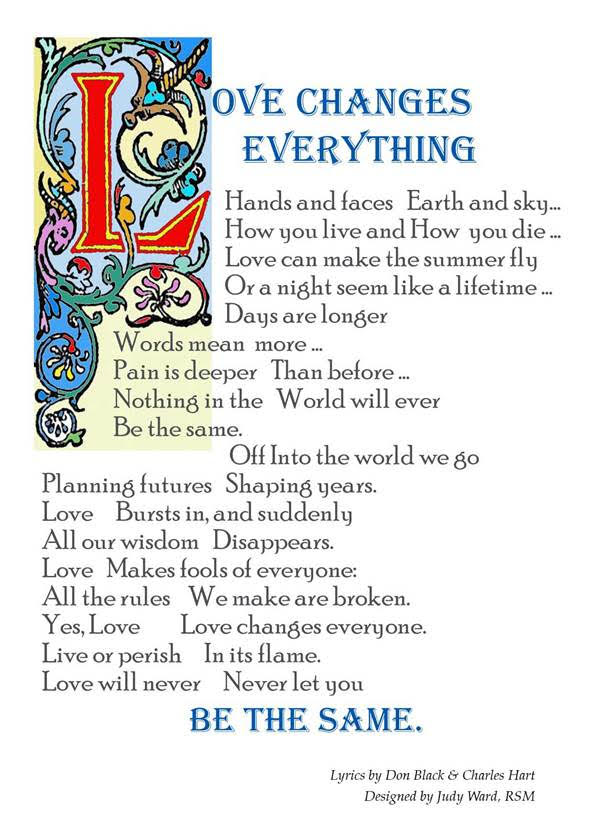
Love Changes Everything – Andrew Lloyd Webber, Don Black, and Charles Hart
Today, in God’s Lavish Mercy, Isaiah once again promises light despite the darkness, understanding despite the emptiness, life despite the devastating hold of poverty.
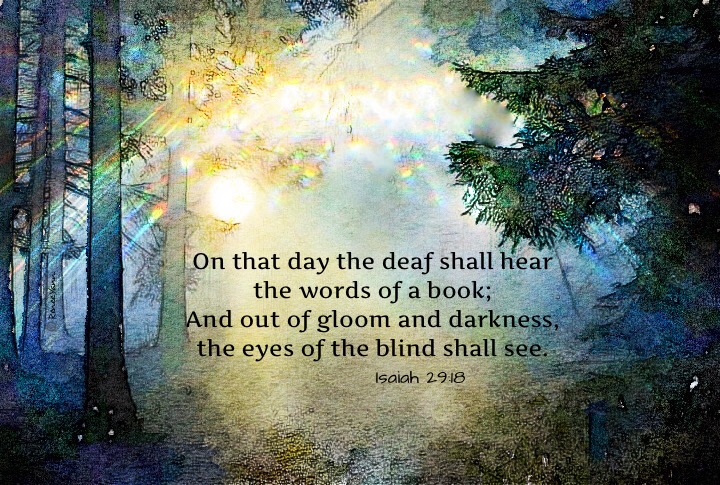
Thus says the Lord GOD: But a very little while, and Lebanon shall be changed into an orchard, and the orchard be regarded as a forest! On that day the deaf shall hear the words of a book; And out of gloom and darkness, the eyes of the blind shall see. The lowly will ever find joy in the LORD, and the poor rejoice in the Holy One of Israel.
Isaiah 29:18-19
Isaiah’s promises shone a beacon of hope to the oppressed people of his time. As I pray with his words today, I am deeply aware of the oppressions of our own time and the people who suffer under them.
Over the course of these days, I am praying with a delegation of people currently in Central America to remember, bless, learn from, and bear witness to the lives of four martyrs.
The Roses in December delegation marks the 42nd anniversary of the martyrdom of four U.S. women religious. On December 2, 1980, members of the U.S.-trained-Salvadoran National Guard raped and killed lay worker Jean Donovan, Maryknoll Sisters Ita Ford, MM, and Maura Clarke, MM, and Ursuline Sister Dorothy Kazel, OSU. The women had been accompanying the Salvadoran people displaced by war and poverty. Their witness cost them their lives. Their deaths shook the world and were emblematic of the violence suffered by the Salvadoran people and the power of accompaniment.
These women lived with the kind of hope and faith Isaiah describes. It is an active faith necessary in all times because, sadly, in all times there will be brutal and inhuman oppression of the vulnerable by the powerful. These woman chose to stand for the Gospel instead.
During an earlier anniversary of the Roses in December event, social justice activist Jean Stolkan asked the question, “What do these women call us to today?” Jean served in El Salvador herself and has continued to advocate for human rights and social justice. Jean is currently Social Justice Coordinator for the Sisters of Mercy of the Americas. She offered these insights in answer to her question:
The challenges we face today are different from the challenges we faced when the four church women died. They call for new perspectives and new structures, new vision and new social movements to adequately respond to the need for justice for present and future generations.
Today our hearts go out to the peoples of El Salvador and Honduras, Guatemala and Mexico, as they struggle with basic issues of survival and rebuilding of their lives after so many disasters: hurricanes and earthquakes, but also violence and poverty. We pray for an outpouring of compassion and solidarity, that we may continue to address in systemic ways the underlying human failings – structural poverty, racism, violation of human rights, destruction of the environment – that these and other natural and human disasters unmask with such brutal clarity.
Please join your own prayer today for a new flowering of social justice, respect for human rights, and a mutual reverence for our common home as we remember these valiant Gospel women.
Poetry: El Salvador – Javier Zamora
( Poet Javier Zamora was born in the small El Salvadoran coastal fishing town of La Herradura and immigrated to the United States at the age of nine, joining his parents in California. He earned a BA at the University of California-Berkeley and an MFA at New York University and was a 2016-2018 Wallace Stegner Fellow at Stanford University.)
Salvador, if I return on a summer day, so humid my thumb
will clean your beard of  salt, and if  I touch your volcanic face,

kiss your pumice breath, please don’t let cops say: he’s gangster.
Don’t let gangsters say: he’s wrong barrio. Your barrios

stain you with pollen, red liquid pollen. Every day cops
and gangsters pick at you with their metallic beaks,

and presidents, guilty. Dad swears he’ll never return,
Mom wants to see her mom, and in the news:

every day black bags, more and more of us leave. Parents say:
don’t go; you have tattoos. It’s the law; you don’t know

what law means there. ¿But what do they know? We don’t
have greencards. Grandparents say: nothing happens here.

Cousin says: here, it’s worse. Don’t come, you could be    ...
Stupid Salvador, you see our black bags,

our empty homes, our fear to say: the war has never stopped,
and still you lie and say: I’m fine, I’m fine,

but if  I don’t brush Abuelita’s hair, wash her pots and pans,
I cry. Like tonight, when I wish you made it

easier to love you, Salvador. Make it easier
to never have to risk our lives.
Music: El Salvador – Peter, Paul and Mary
“El Salvador” is a 1982 protest song about United States involvement in the Salvadoran Civil War, written by Noel Paul Stookey and performed by Peter, Paul and Mary. The song originally appeared on the 1986 album No Easy Walk To Freedom.
There’s a sunny little country south of Mexico Where the winds are gentle and the waters flow But breezes aren’t the only things that blow in El Salvador
If you took the little lady for a moonlight drive Odds are still good you’d come back alive But everyone is innocent until they arrive in El Salvador
If the rebels take a bus on the grand highway The government destroys a village miles away The man on the radio says: “now, we’ll play South of the Border”
And in the morning the natives say “We’re happy you have lived another day Last night a thousand more passed away in El Salvador” Ooh, ooh, ooh, ooh Ooh, ooh, ooh, ooh, ooh, ooh, ooh
There’s a television crew here from ABC Filming Rio Lempe and the refugees Calling murdered children: “The Tragedy of El Salvador”
Before the government camera twenty feet away Another man is asking for continued aid Food and medicine and hand grenades for El Salvador
There’s a thump, a rumble, and the buildings sway A soldier fires the acid spray The public address system starts to play: “South of the Border”
You run for cover and hide your eyes You hear the screams from paradise They’ve fallen further than you realize in El Salvador La la la, la la la la La la la, la la la la la Ooh, ooh ooh ooh ooh
Just like Poland is protected by her Russian friends The junta is assisted by Americans And if sixty million dollars seems too much to spend in El Salvador
They say for half a billion they could do it right Bomb all day and burn all night Until there’s not a living thing upright in El Salvador
And they’ll continue training troops in the USA And watch the nuns that got away And teach the military bands to play: “South of the Border”
Killed the people to set them free Who put this price on their liberty Don’t you think it’s time to leave El Salvador? Oh, oh oh oh oh Oh oh oh oh oh, oh oh, oh oh oh oh oh
Today, in God’s Lavish Mercy, Wow! Job is as distraught as anybody I’ve ever seen! He is sorry he was ever born, that’s how terrible his circumstances are.
Hopefully, none of us has ever been at such a “Job Point”. But we’ve had our own small brinks where we’ve stood and yelled into the silence, “Why?”
Why me?
Why my family?
Why someone so good?
Why now?
Why like this?
All these “whys” are fragments of the essential question of the Book of Job: How can a good God allow evil to exist? The question even has its own name: theodicy – defined as the vindication of divine goodness and providence in view of the existence of evil.
Philosophers and theologians have proposed an array of explanations. But these fall short of satisfying us when we are the ones at the brink.
When we try to balance the concepts of evil with God’s goodness, we are wrestling with a mystery, not a problem. Problems, like unsolved math equations, have answers – even though we may not have found them yet.
Mysteries do not have finite answers. Sacred mysteries engage our faith to grow deeper in relationship with God, Who shares our life and suffering beyond our human understanding.
As we pray with Job today, let us pray for the courage to trust and engage our incomprehensible God.
Poetry: Mystery – Rumi
God writes mysteries on our hearts
where they wait silently for discovery.
Alleluia, alleluia. My sheep hear my voice, says the Lord; I know them, and they follow me.
Today, in God’s Lavish Mercy, we jump into several weeks of readings from:
Paul’s letters – a little of Thessalonians and a lot of Corinthians
a little of Matthew’s Gospel and a lot of Luke’s
Still centering on our daily Alleluia Verse, as we have been since after Eastertide, we open our prayer to the experience of these early communities as they deepened in their Christian story.
Thessoloniki, Greece
Thessalonika was one of the first cities where Paul worked to form a Christian community. That church suffered persecution but showed “endurance and faith”. Paul obviously has great affection for these steadfast believers, an affection which reflects God’s own love for them.
We ought to thank God always for you, brothers and sisters, as is fitting, because your faith flourishes ever more, and the love of every one of you for one another grows ever greater.
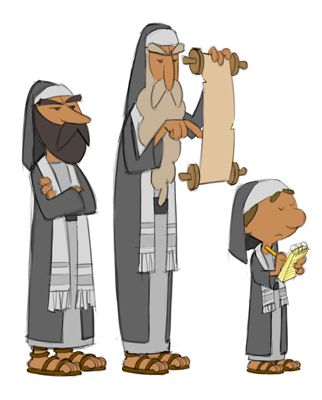
Matthew’s Gospel shows us Jesus in an opposite situation from Paul. Jesus is speaking out to a faithless group – Pharisees and scribes who pervert religion with meaningless superficialities which make it harder for people to reach God.
Animation character designs by Cedric Hohnstadt of the Pharisees for the video series “What’s In The Bible?”
Rather than gratitude and blessing, Jesus preaches woe to those who so subvert the faith journey of their community.
Woe to you, blind guides, who say, ‘If one swears by the temple, it means nothing, but if one swears by the gold of the temple, one is obligated.’ Blind fools, which is greater, the gold, or the temple that made the gold sacred?
“religious” distortions vs. sincere faith
One would think it should be easy to tell the difference between true faith and manipulative “religion“. But apparently, it’s not so easy. In every age, including our own, we see people caught up in the distortions of religion which disrespect human rights and freedom.
When we see religion used as a pretext for violence, exclusion, political advancement or economic domination, those “woes” should start ringing in our head.
One who swears by the altar swears by it and all that is upon it; one who swears by the temple swears by it and by the one who dwells in it; one who swears by heaven swears by the throne of God and by the one who is seated on it.
This advice from Jesus could be a little confusing, but in essence it calls us to be sincere and direct in our approach to God and to our sisters and brothers. It is a teaching offered more clearly in an earlier Matthean passage, the Sermon on the Mount:
But I tell you do not swear at all, either by heaven since that is God’s throne, or by earth, since that is His footstool, or by Jerusalem, since that is the city of the great King. Do not swear by your own head either, since you cannot turn a single hair white or black. All you need say is ‘Yes’ if you mean ‘yes’, ‘No’ if you mean ‘No’; anything more than this comes from the Evil One.
Matthew 5:34-37
Poetry: Poetics of Faith – Denise Levertov
‘Straight to the point’
           can ricochet,
                      unconvincing.
Circumlocution, analogy,
           parable’s ambiguities, provide
                      context, stepping-stones.

Most of the time. And then

the lightning power
           amidst these indirections,
                      of plain
unheralded miracle!
           For example,
                      as if forgetting
to prepare them, He simply
           walks on water
                      towards them, casually –
and impetuous Peter, empowered,
           jumps from the boat and rushes
                      On wave-tip to meet Him –
a few steps, anyway –
           (till it occurs to him,
                      ‘I can’t, this is preposterous’
and Jesus has to grab him,
           tumble his weight
                      back over the gunwale).
Sustaining those light and swift
           steps was more than Peter
                      could manage. Still,
years later,
           his toes and insteps, just before sleep,
                      would remember their passage.
Music: Roberto Cacciapaglia – Angel Falls
just some lovely instrumental music to accompany your thoughts as you pray.
Today, in God’s Lavish Mercy, as we inch closer to Holy Week, we meet both a very troubled Jeremiah and Jesus.
The Prophet Jeremiah Weeping Alone on a Hill (from the Wellcome Trust)
Jeremiah, the Old Testament mirror of Jesus’s sufferings, bewails the treachery even of his friends:
I hear the whisperings of many: “Terror on every side! Denounce! let us denounce him!” All those who were my friends are on the watch for any misstep of mine.
Jeremiah 20:10
That’s really raw, because you can get through almost anything in the company of true friends.
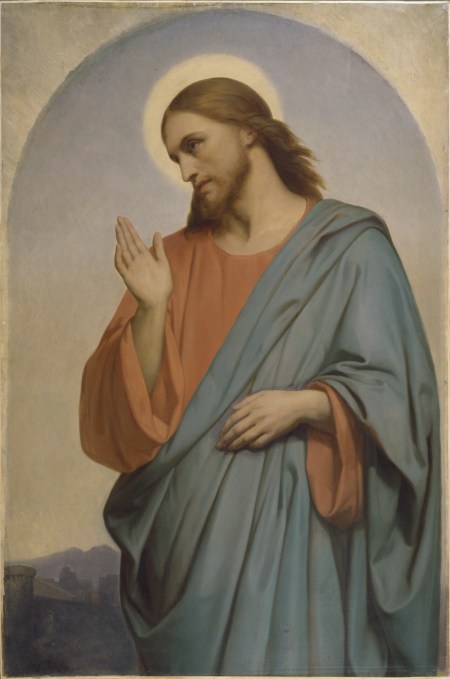
Jesus Weeping Over Jerusalem by Ary Scheffer (1795-1858)
Jesus came as a Friend and hoped to find Friends of God by his ministry. And he did find many. But not all.
It takes some work to be a true friend of Jesus. Some didn’t have the courage, or generosity, or passion, or hopeful imagination to reach past their self-protective boundaries – to step into eternal life even as they walked the time-bound earth.
In today’s Gospel this band of resisters project their fears and doubts to the crowds around them. The evil sparks inflame the ready tinder of human selfishness. The mob turns on Jesus, spiritual misers scoffing at the generous challenge to believe.
Jesus pleads with them to realize what they are doing:
If I do not perform my Father’s works, do not believe me; but if I perform them, even if you do not believe me, believe the works, so that you may realize and understand that the Father is in me and I am in the Father.
John 10:37-38
But Jesus and Jeremiah, though troubled, are grounded in God. Our Responsorial Psalm captures what might have been their silent prayer:
Poetry: The following transliteration of Psalm 18, composed by Christine Robinson, might help us to be with Jesus in his moment, and in our own moments of fear, anxiety, or doubt.
I open my heart to you, O God for you are my strength, my fortress, the rock on whom I build my life. I have been lost in my fears and my angers caught up in falseness, fearful, and furious I cried to you in my anguish. You have brought me to an open space. You saved me because you took delight in me. I try to be good, to be just, to be generous to walk in your ways. I fail, but you are my lamp. You make my darkness bright With your help, I continue to scale the walls and break down the barriers that fragment me. I would be whole, and happy, and wise and know your love Always.
February 1, 2022 Tuesday of the Fourth Week in Ordinary Time
You have followed the story in these daily passages. Absalom rebels, designing to usurp his father’s throne. A massive battle rises between them. David, as commander-in-chief, remains behind, but gives instructions to his generals to spare Absalom’s life. Joab ignores the command, killing Absalom in a moment of vulnerability.
David is devastated.
David and Absalom – Marc Chagall (Fair Use)
I think there is no more wrenching human emotion than regret. When I ministered for nearly a decade as hospice chaplain, and later in the emergency room, I saw so much regret.
People who had waited too long to say “I’m sorry”, “I forgive you”, “Let’s start over”, “Thank you for all you did for me”, “I love you”…..
Instead, these people stood at lifeless bedsides saying things like, “I should have”, “I wish…”, “If only…”
Life is complex and sometimes difficult. We get hurt, and we hurt others — sometimes so hurt that we walk away from relationship, or stay but wall ourselves off.
We might think that what is missing in such times is love. But I think it is more likely truth. In times of painful conflict, if we can hear and speak our truth to ourselves and one another, we open the path to healing.
If you want the truth, I’ll tell you the truth. Listen to the secret sound, the real sound, which is inside you.
Kabir
That healing may demand adjustments, agreements, even a willingness to step apart in mutual respect. But if the changes emerge from shared truth, restoration and wholeness are possible.
David and Absalom never found that path because they were so absorbed in their own self-interests. Theirs was the perfect formula for regret – that fruitless stump that perpetually sticks in the heart.
Poetry: How Clear, How Lovely Bright – A.E. Houseman
How clear, how lovely bright,
How beautiful to sight
    Those beams of morning play;
How heaven laughs out with glee
Where, like a bird set free,
Up from the eastern sea
    Soars the delightful day.
To-day I shall be strong,
No more shall yield to wrong,
    Shall squander life no more;
Days lost, I know not how,
I shall retrieve them now;
Now I shall keep the vow
    I never kept before.
Ensanguining the skies
How heavily it dies
    Into the west away;
Past touch and sight and sound
Not further to be found,
How hopeless under ground
    Falls the remorseful day
I remember a trauma surgeon leaving the hospital late one night after an unsuccessful effort to save a young boy who had been shot.
The doctor carried the loss so heavily as he walked into the night barely whispering to me, “I’m just going to go home and hug my kids.”
As we pray over David and Absalom today, let us examine our lives for the fractures that are still healable and act on them. Let us “hug” the life we have within and all around us. Regret is a lethal substitute.
When David Heard – Eric Whitaker ( The piece builds. Be patient. Lyrics below)
When David heard that Absalom was slain, he went up into his chamber over the gate and wept, and thus he said;
My son, my son, O Absalom my son, would God I had died for thee!
When David heard that Absalom was slain, he went up into his chamber over the gate and wept, and thus he said;
Today, in God’s Lavish Mercy, we pray with Psalm 33 which
“proclaims the LORD as the one
in whom the righteous may place their trust and hope.”
James L. Mays: Psalms (Interpretation: A Bible Commentary for Teaching and Preaching)
Upright is the word of the LORD, and all his works are trustworthy. God loves justice and right; of the kindness of the LORD the earth is full.
See, the eyes of the LORD are upon those in awe, upon those who hope for God’s kindness, To deliver them from death and preserve them in spite of famine.
Psalm 33: 4-5; 18-19
This is a good psalm to be reminded of as we encounter readings from Isaiah and Mark which sound almost Lenten in tone. Our psalm reminds us that, despite adverse appearances, God abides with us and fosters our well-being.
Isaiah gives us the image of a broken Jesus, crushed by a “suffering that justifies many”.
Christ as the Man of Sorrows – Albert Durer
Mark recounts the story of the two rather oblivious disciples asking to sit in glory beside Jesus. They do not realize that the path to this glory is through Gethsemane and Calvary.
Jesus asks these disciples the same question he asks us throughout our lives:
“Can you drink the cup that I will drink?”
Each of our sufferings and sacrifices may be small or large in life. But when they are united with Christ in faith and hope, they all are redemptive.
We will be asked, as Jesus was, to lay down our life in love.
It may be in the unselfish raising of a family, or the humble pastoring of a church community.
It may be in the long-term care of an elderly parent or neighbor.
It may be in a ministry of healing, teaching, or encouragement where another requires our labor, patience and mercy.
It may be as a public servant who actually serves, or as a private nurse who tenderly nurses.
It may be as a community member who builds life by respect, responsibility, and mutuality.
We will come to realize, as did the ambitious sons of Zebedee, that true discipleship is not flash and glam. It is the daily choice to quietly lift the cup we have been given, and raise it to the honor of God – in openness, trust, joy and delight that we are called to share in the life of Christ.
Poetry: Can you Drink the Cup – Scott Surrency, OFM.Cap
Can you drink the cup? Drink, not survey or analyze, ponder or scrutinize – from a distance. But drink – imbibe, ingest, take into you so that it becomes a piece of your inmost self. And not with cautious sips that barely moisten your lips, but with audacious drafts that spill down your chin and onto your chest. (Forget decorum – reserve would give offense.)
Can you drink the cup? The cup of rejection and opposition, betrayal and regret. Like vinegar and gall, pungent and tart, making you wince and recoil. But not only that – for the cup is deceptively deep – there are hopes and joys in there, too, like thrilling champagne with bubbles that tickle your nose on New Year’s Eve, and fleeting moments of almost – almost – sheer ecstasy that last as long as an eye-blink, or a champagne bubble, but mysteriously satisfy and sustain.
Can you drink the cup? Yes, you — with your insecurities, visible and invisible. You with the doubts that nibble around the edges and the ones that devour in one great big gulp. You with your impetuous starts and youth-like bursts of love and devotion. You with your giving up too soon – or too late – and being tyrannically hard on yourself. You with your Yes, but’s and I’m sorry’s – again. Yes, you – but with my grace.
Can you drink the cup?
Can I drink the cup?
Yes.
Music: The Cup of Salvation ~Shane & Shane (Lyrics below.)
I love the Lord for He heard my voice And answered my cry for mercy Because He listened to me I will call upon Him as long as I live
CHORUS
What shall I render to the Giver of life and who all things are made What shall I render to the One who paints the oceans blue Jesus Christ
I will lift up a cup of salvation Call on the Name of the Lord How do I repay the life that You gave I’ll call on the Name of the Lord Lift up a cup, You have already poured
What kind of rendering is found in this taking Found in this drinking of love Love so abundant He meets me in depravity With one thing to give
CHORUS
You have delivered my soul from death My eyes from tears My feet from stumbling And I will walk before the Lord In the land of the living
Today, in God’s Lavish Mercy, we pray with Psalm 97 which is built on two themes:
God reigns over all the earth
those who acknowledge God’s power have abundant reason to rejoice
This is good news for the people to whom Joel is preaching! Joel’s community has been devastated by locusts and drought. They are surrounded by adversaries. Life is just not easy for them. They have felt abandoned by God.
But Joel tells them that indeed God is annoyed, but still is always on the side of the faithful.
The LORD roars from Zion, and from Jerusalem raises his voice; The heavens and the earth quake, but the LORD is a refuge to his people, a stronghold to the children of Israel. Then shall you know that I, the LORD, am your God, dwelling on Zion, my holy mountain; Jerusalem shall be holy, and strangers shall pass through her no more.
Psalm 97 reflects the same confident promise to all who suffer. Despite everything we are to rejoice!
The mountains melt like wax before the LORD, before the LORD of all the earth. The heavens proclaim God’s justice, and all peoples see God’s glory. R. Rejoice in the Lord, you just! Light dawns for the just; and gladness, for the upright of heart. Be glad in the LORD, you just, and give thanks to God’s holy name.
So we are encouraged to heed Joel’s advice – to stir up our hearts in faith, to look around at all the faith-filled promises of nature mentioned in our first reading. We can learn:
from the sun which both rises and sets
from the moon which turns its mood but never disappears
from snow and rain which cycle invisibly through the years
from the leaves which hold the secret of eternal life
God abides with us, even amidst the “droughts” and “locusts”. And if we are faithful, all will be well.
Poetry: There are many wonderful images in Joel 4. One is that of the “Valley of Decision”, an image that has lent itself to many applications in art and literature. Here is one such poem:
OK — two of my “favoritest” actors!!!!
The Valley of Decision by John Oxenham
The World is in the Valley of Decision; It is standing at the parting of the ways; Will it climb the steps of God to realm elysian — Or fall on horror of still darker days?
Will it free itself of every shameful shackle? Will it claim the glorious freedom of the brave? Will it lose the soul of Life in this debacle, And sink into a mean dishonored grave?
All the world is in the Valley of Decision, And out of it there is but one sure road; Eyes unsealed can still foresee the mighty vision Of a world in travail turning unto God.
All the world is in the Valley of Decision. Who shall dare its future destiny foretell? Will it yield its soul unto the Heavenly Vision, Or sink despairing into its own hell?
The World is in the Valley of Decision; — It is standing at the parting of the ways; Will it climb the steps of God to realm elysian — — Or fall on horror of still darker days?
Will it free itself of every shameful shackle? — Will it claim the glorious freedom of the brave? Will it lose the soul of Life in this debacle, — And sink into a mean dishonored grave?
All the world is in the Valley of Decision, — And out of it there is but one sure road; Eyes unsealed can still foresee the mighty vision — Of a world in travail turning unto God.
All the world is in the Valley of Decision. — Who shall dare its future destiny foretell? Will it yield its soul unto the Heavenly Vision, — Or sink despairing into its own hell?














 Lavish Mercy