Today, in Mercy, we begin with the powerful and moving story of Joseph – sweet, innocent son of of Jacob who was betrayed by his brothers. Jacob sends Joseph to work with his brothers, believing they love him. He was wrong.
Our Gospel then tells the story of the frustrated landowner who sent his son on mission to settle his accounts. though the landowner’s servants had been abused by the tenants, he believed his son would be respected. He was wrong.
Both these stories are prototypes of the Father sending Jesus to redeem us. The intention is the same. The hope is the same. Unfortunately, the result is the same.
In our Gospel, Jesus realizes that the Father’s hope for him will not be met with openness and acceptance. He sees the Pharisees milling around in hateful conversation.Referencing the parable, Jesus says:
“The Kingdom of God will be taken away from you
and given to a people that will produce its fruit.”
When the chief priests and the Pharisees heard his parables,
they knew that he was speaking about them.
And although they were attempting to arrest him,
they feared the crowds, for the crowds regarded him as a prophet.
This morning, let’s pray for all those who send their beloveds out in hope to do good in the world:
for police officers, firefighters, first responders whose families send them out each day always fearing for their safety
for medical personnel who risk sickness in their care for others
for missionaries and justice workers who encounter threat and danger in helping others
for peacekeepers and military who work to end war and tyranny
for all of us when we reach out in justice and courage, hoping to be received with respect and mutuality
May the example of Christ inspire and sustain us to do our part for God’s continuing redemption of the world.
Today, in Mercy, our Gospel gives us the disturbing parable of the rich man, sometimes called Dives, and Lazarus, a very poor man.
The story is disturbing because
Lazarus suffers so desperately
Dives is impervious to that suffering
God won’t give Dives a break after his death
We fear being in either of these guys’ situations
Probably, like most people, we’d rather be rich than poor. But would we rather be generous with that wealth or selfish? Do we ever find ourselves thinking thoughts like this, deciding we’re not responsible for the gap between rich and poor:
“I worked hard for what I have. Let everybody else do the same!”
That wealth gap cannot be mended simply by giving a dollar to a corner beggar nor by donating our wornout clothes to Goodwill. This kind of re-balancing requires a conversion of heart which touches our economic, political and moral understanding.
I was struck this morning by this headline from The Economist, a British weekly magazine.
How can today’s Gospel inspire and encourage us in a global culture that infcreasingly marginalizes persons who are poor, resourceless, and politically oppressed?
May the story of Lazarus and Dives influence us to use the powers we have to make just and generous decisions.
We can vote for just, generous and moral leaders.
We can advocate for universally just policies.
We can donate to compassionate causes.
We can confront hateful speech and stereotyping.
We can speak and act for justice, peace, inclusivity and mercy.
We just have to be courageous before, like Dives, it is too late for us.
I can’t imagine why, can you? McCarrick has lived a reprehensible life hidden in the cloak of ecclesiastical superiority. His sins are disgusting, wrought upon the innocence of children and vulnerable young men. His pretense enrages us, rendering us fools for the honor and respect paid him.
McCarrick has become a symbol for the ghastly swath of sexual scandal running through the institutional Church’s core. He represents a misplaced faith, the distortion of clericalism, the corruption of trust, and the poisonous fruit of chauvinistic sexism in our culture.
He is a pathetic man with a failed life. But does God love him?
The answer is so important:
because we hate in McCarrick what we hate in our Church – the institutionalized distortion of power in the name of faith.
because if God does not love him, we have no need to forgive him
because if God does love him, and forgive him, so must we
because if we forgive him, we must forgive our Church
because we must work to redeem and rebuild what we have forgiven
I don’t know Theodore McCarrick. I never met him or even thought of him. But when his crimes surfaced, I lost sleep over him. In this one man, all my mortal disappointment in our Church took flesh. All my heartbroken anger found a face to glare at, a life to scorn.
And then I looked at his picture. By some unexpected grace, I saw him for what he is – a broken, pitiable, failed old man whom God still loves. Seeing this, I saw our fractured, corrupted Church in a different light … the pale light of hope that it, too, might be redeemed.
If Theodore McCarrick’s life counts for anything positive among us, perhaps this is it.
Today, in Mercy, Genesis tells the story of the first murder. Driven by jealousy and resentment, Cain takes the life of his own brother, Abel. Cain then denies any responsibility for the crime with the now oft-repeated line:
Am I my brother’s keeper?
God’s outrage is the answer to Cain’s question. God bans Cain from the soil which had been his livelihood, because that same soil now cries out with Abel’s blood.
The account is appalling and traumatic. We have gotten so used to hearing it that we may be immune to the abomination. Brother turned against brother. God’s gift of life and hope taken irrevocably in a moment of selfish anger. All of First Creation must have fallen on its knees in sadness and shock at this primal crime.
Friends, as you pray today, pick up the newspaper. See Cain’s crime repeated over and over again as humanity becomes more and more desensitized to its horror. We have even devolved to the point that some murders are “legal” under the pseudonyms of war, abortion, genocide, and capital punishment. Our culture is rife with the abuse of life in so many forms that we have become hardened to its reality just to protect our souls.
When Jesus meets such hardness of heart in our Gospel, he refuses to give them a sign of his power. He just walks away.
Let us pray that God will not walk away from our desensitized generation – that he will give us a sign of grace to open our eyes.
Music: Kyrie Eleison Lord, have mercy) ~ Michael Hoppè
(Visuals appear to be filmed at Normandy, soil filled with the blood of those who died on D-Day)
P.S. I am sending a second reflection later today that has been heavily on my mind. I hope some of you find a spiritual benefit in it.
Today, in Mercy, I would like to share a homily about today’s Gospel that I prepared for the Catholic Health Association in 2015. Even though it is a little long, I hope you find it fruitful for your prayer.
It is a soft, summer morning in Capernaum and Jesus is in the height of his ministry. Large crowds follow him wherever he goes, crowds hungry with hope; crowds fired by his counter-cultural words and miraculous deeds. This morning, Jesus prepares to speak to them, to translate into language they can comprehend the Eternal Life that lives in his heart. His back is to the gentle, sunlit sea. The hubbub softens to a murmur, finally stilled by the lapping waves.
But before Jesus can begin, a distressed man bursts through the gathered crowd. His robes fly about him as he runs to Jesus and falls at his feet. This man is important, so important that we all have known his name for two thousand years. This is Jairus who lives nearby and organizes the worship in the synagogue. Now breathless and swallowing sobs, Jairus pleads with Jesus: Please! My daughter! You can give her life!
Every loving father has been Jairus at least once in his life. We know these fathers. We are these fathers. They are the ones who burst into emergency rooms with a seizing infant in their arms. They are the ones who stare blankly at the pronouncement of a stillborn child. They are the old men in war-ravaged countries who kneel at the sides of their fallen sons and desecrated daughters. They are all the men throughout history rendered helpless by the forces of unbridled power, greed and death.
The merciful heart of Jesus understands this man and his desperate urgency. Without even a word, Jesus gets up and accompanies Jairus to the place of his pleading.
But there is another urgency pushing forward from the crowds: a woman, apparently of low importance for we have never known her name. She is a woman whom the ages have defined by her affliction. She is “The Woman with the Hemorrhage”. Without the status of Jairus, she approaches Jesus as such a woman must. She crawls behind him at his heels, reaching through the milling masses to even scrape the hem of his garment.
This is a troubled woman, a stigmatized woman. Her life has been spent, literally, in embarrassment, isolation, fatigue and, no doubt, abuse. For twelve years – coincidentally the life span of Jairus’ s daughter – her vitality has bled out of her. Her face is gaunt; her eyes sunken. Her soul’s light is all but extinguished. She is a woman who knows a particular kind of scorn.
We know these women. We are these women. They are the ones filled with remorse for an aborted baby. They are the ones who miscarry their longed-for child. They are the women whose beautiful young sons are profiled, stereotyped and hunted on the violent streets. They are the mothers of “The Disappeared”. They are the women who suffer disproportionately from war, poverty, hunger and violence. They are trafficked women, prostituted women, women victimized by the long saga of domination and dehumanization.
It is just such a broken woman who stretches her fingers through the Galilean dust in a last reckless reach for healing. She finds only the hem of his robe. Touching it, she is transformed, like a parched meadow in the spring rain. Her whole being reaches up to receive the holy restoration. She knows herself to be healed. And it is enough; it is everything. She retreats into the resignation of her otherwise lonely life.
But Jesus wants more for us than just the practical miracles we beg for. We ask for one healing; Jesus wants our eternal salvation. We ask for one blessing; Jesus wants our entire lives to be filled with grace. We ask for one prayer to be answered; Jesus wants our life to become a prayer.
Jesus feels the electrical touch of her hope. He feels the secret healing she has extracted from him. He turns to seek her. Can you see their eyes meet? Yes, the bleeding has been stemmed, but he sees the deeper wounds that scar her soul. His look of immense mercy invites her to tell him “the whole truth”. By her touch, she has commandeered a physical healing. But by his gracious turning toward her, her entire being is renewed. In this sacred glance, her history has been healed. Her future has been pulled from darkness into light. Her capacity to love has been rekindled. She now and forever will remember herself as a child of God.
Jairus waits, no doubt impatiently, at the edge of this miracle, anxious for such power to touch his daughter’s life. He fears they have lingered too long with the woman. His servants arrive, confirming his fears. He receives the dreaded report, “Your daughter has died.”
Jesus now pushes Jairus to the gauntlet of pure faith. In the face of this devastating news, Jesus tells him, “Do not be afraid; just have faith.” Is this not an almost impossible command? Like Jairus, we all know what it is to worry for our children:
Fathers of color teach their sons behaviors to protect them from profiling.
Immigrant parents fear their children will be ripped from them in a pre-dawn raid.
Famine-ravaged mothers watch their children disappear into hunger.
In hospitals and doctor’s offices, devastated parents summon the courage to accompany their critically ill child.
And Jesus says, “ Don’t be afraid. Have faith.”! What can he possibly mean?
Perhaps it is this simple. In Jairus’s home, Jesus takes the dead girl’s hand. He says, “Talitha, koumi – Little girl, arise.” His call to her heart tells her there is no darkness, devastation or death from which God cannot draw us into life. This is the truth Jesus brings to the little girl and to us. But it is a truth that, in our fear and need, we cannot always see.
For the moment, this girl lives. But at some time in history she, like all of us, will die. So the miracle is not the restoration of her life. The miracle is that her eyes, and her parents’ eyes, are opened to the power of God over death. Despite all appearances, God’s life endures eternally.
This is the revelation of this Gospel passage. If we live by faith, we live beyond cure into healing. If we live by faith, even death can bring life. If we live by faith, we are free to release all worry into the abundant mercy of God who grants us healing even beyond our asking or desire.
Man or woman, old or young, at some time in our lives each one of us has been Jairus. Each one of us has been one or the other of these two women. Within their stories of woundedness and deep faith, our stories shelter. Jairus and the afflicted women – unnamed like so many women throughout time – believed there was a way to new life. They reached for it. They begged for it. What is it in us that cries out for such healing? What is it in us that, without the touch of Jesus, teeters on the verge of death?
Simply by believing, these three Gospel figures became new beings. Simply by believing, their orientation changed from darkness to light. By their example, let us lift up those wounded and deadened places in our hearts and world before the loving gaze of Jesus.
To what suffering in our souls is God whispering the encouragement, “Talitha, koum”? What is the “whole truth” Jesus is inviting us to confide? Let us arise and respond to him in the full energy of our faith. Let us gaze with boundless confidence into the eyes of God’s mercy.
Today, in Mercy, Paul reminds his listeners of all the sufferings they endured when they first embraced the Christian faith. He goes on to encourage them to persevere, even in the midst of ongoing challenges:
… do not throw away your confidence; it will have great recompense.
It’s a speech with all the overtones of a great pep talk. At first it reminded me of our old coach Miss Weed (seriously), back in the days when I played basketball. She never gave up; never gave in.
During one game, I called time out because I was pretty sure I had just broken my finger blocking a shot. Miss Weed unsympathetically told me, “No time outs! No broken bones! Get back in and finish the game!” Later, waiting to get my hand casted at the clinic, I reflected on what I had learned.
Maybe that’s the way Paul’s community felt as they read this passage. “Time out, Coach! This Christian stuff is tough!”
But Paul had an amazing caveat that Miss Weed didn’t have. Paul held up before his audience the promise of eternal life. Things comparable to broken fingers pale in that Light!
So today, let’s get back in the game with all our hearts – living our life in Christ with gusto and joy. Often it is not easy. But always look to the Light. And …
… do not throw away your confidence; it will have great recompense.
Music: We’ve Got This Hope – Ellie Holcomb (Lyrics below)
We’ve got this hope
We’ve got a future
We’ve got the power of the resurrection living within
We’ve got this hope
We got a promise
That we are held up and protected in the palm of His hand
And even when our hearts are breaking
Even when our souls are shaking
Oh, we’ve got this hope
Even when the tears are falling
Even when the night is calling
Oh, we’ve got this hope
And we’re not alone
Our God is with us
We can approach the throne with confidence
Cause He made a way
When troubles comes
He’ll be our fortress
We know that those who place their hope in Him will not be ashamed
And even when our hearts are breaking
Even when our souls are shaking
Oh, we’ve got this hope
Even when the tears are falling
Even when the night is calling
Oh, we’ve got this hope
Our hope is grounded in an empty grave
Our hope is founded on the promise that He made
Today, in Mercy, our Gospel describes a scene that has always nettled me a bit.
Jesus is teaching a group inside his small house in Capernaum. He has moved there as he begins his public ministry. Word of his preaching and miracles has created a hubbub all around him, to the point that he can’t get a chance to eat or to rest.
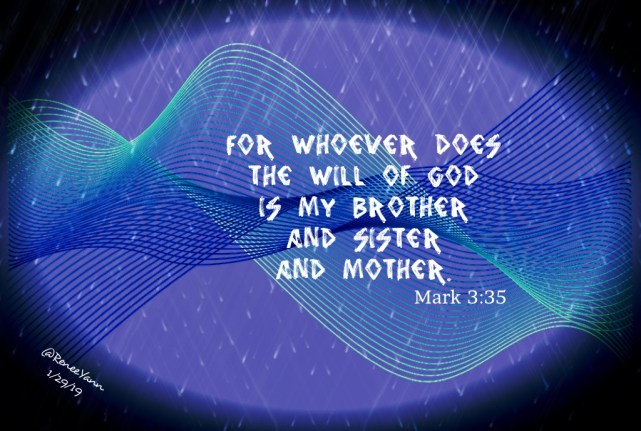
Just a few lines earlier in the Gospel, Mark describes how concerned Jesus’s relatives are about his well-being. Mark 3:21 goes so far as to say:
“When his relatives heard ( how besieged he was) they set out to seize him,
for they said, ‘He is out of his mind’.”
In today’s passage Jesus’s “mother, brothers and sisters” arrive at his home, prevented from entering by the large crowd. They stand outside asking for him. When Jesus hears this, he delivers the nettling remark:
“Who are my mother and my brothers?”
It seems so insensitive, doesn’t it? These people have loved Jesus, played with him, grown up with him! And his mother! My goodness, we all know to listen to, respect, and welcome our mothers!
Praying with this passage though may reveal another dimension in our understanding of Jesus. What Jesus may be saying is this:
All of you, my followers, are closer to me than even the most precious human ties. Myfamily is now the all-encompassing family of my Father. My path is now the Father’s will, not my human family’s hopes and expectations.
Jesus is, at once, acknowledging to his family, his followers and, no doubt, himself that the Father is about to use his life in ways that will transform, awe and shock the world.
He is telling his disciples to be prepared for the same thing if they truly follow him.
I have always imagined Jesus, in the unrecorded memory of this passage, taking Mary aside afterward, gently explaining his purpose. I see her hand on his maturing lightly-whiskered cheek, tears both of pride and fear in her eyes, and a perfect mutual understanding in their smiles.
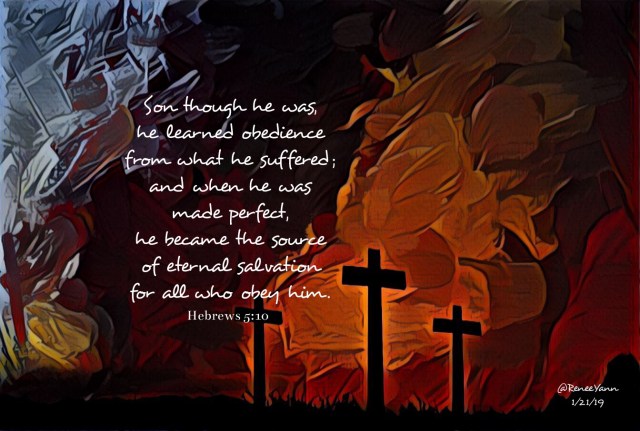
Today, in Mercy, our reading from Hebrews describes Jesus as the perfect high priest.Through the Father’s call, Jesus took on our imperfect nature and transformed it by his life, death and Resurrection. In the Eucharist, Jesus left us a living memorial of this transformation so that we might participate in its saving mystery.
Paul’s “perfected priest” is patient because his own weakness humbles him. He does not take honor upon himself, but receives it humbly from God.
Jesus, the model of this priesthood,
… in the days when he was in the Flesh, … offered prayers and supplications with loud cries and tears to the one who was able to save him from death, and he was heard because of his reverence.
The perfection of Christ’s priesthood was accomplished through suffering and obedience. This is how Jesus teaches us to live in reverence and humble service.
As I read and pray with this scriptural understanding of priesthood, I pray for our Church. The catastrophic scandals involving our priests and leaders have deeply shaken the faith of many Catholics, including my own.
Many of us are frustrated by the continued refusal of our Church to open itself to new models of priestly service which are grounded in mutuality, inclusivity and simplicity.
The accretions of institutionalization, hierarchical camouflage, and sexist rationale have mitigated the Church’s credibility to touch the lives of ordinary people, especially our emerging adults.
In our Gospel, Jesus talks about an old cloak that needs a patch to make it whole again. He talks about new wine that must be captured and preserved in new wine skins. For me, he is talking about our Church which must be continually renewed and transformed.
May our present suffering and confusion be transformed by our humble obedience to God’s call – just as the high priest of our first reading was perfected.
Let us pray today for our good Pope, bishops, theologians and spiritual leaders – and for the whole People of God – that we may hear and respond.
Today, in Mercy, we again read from the epistle to the Hebrews and the Gospel of Mark. We will be doing this for the next month or so.
Hebrews is unique in that it was written rather specifically for Jews who had become Christians. They were people who were steeped in the spirituality and expectations of the Old Testament. They had been waiting for a militant Messiah who would deliver them from earthly suffering by a display of power and might.
During the first century of Christianity, as the nascent Church experienced persecution, that hope for delivery re-emerged. Although they had accepted a Resurrected Christ, the community’s own present suffering fixated them on the Passion and death of Jesus. They questioned how that anguished man could really be the One foretold in their Hebrew Scriptures, and how he could transform their lives.
Can’t we empathize with those early Judea-Christians? The mystery of suffering and death still haunts us. Don’t we sometimes question why Jesus had to die like that – why we have to die, why the people we love have to die? Don’t we feel at least some resistance to this overwhelming mystery?
The author of Hebrews tries to address those doubts by showing that the majesty of Christ resides not just in his divine nature, but in his loving willingness to share our human nature. By doing so, Jesus demonstrated in his flesh the path we must take to holiness. He leads the way through our doubts if we put our faith in him.
This is the core mystery of our faith: that God brings us to eternal life not by a path outside our human experience. Rather, Jesus shows us how to pattern our lives on the profound sacrificial love which is the lavish Mercy of God. The path to eternal life is not around our human frailties but through them.
Mark gives us just one Gospel example of that love today in the healing of the man with the unclean spirit. That spirit was one of resistance to the Word of God, screaming out as Jesus began to preach a Gospel of love, faith, and forgiveness.
As we pray these scriptures today, let us put before God’s healing touch any resistance in our hearts to Jesus’s call to be merciful love in the world.
Music:Crown Him with Many Crowns, an 1851 hymn with lyrics written by Matthew Bridges and Godfrey Turing and sung to the tune ‘Diademata‘ by Sir George Job Elvey.
This majestic hymn reflects how mid-19th century theology attempted to embrace the Redemptive mystery. Still, many of its suggestions, though cast in an earlier idiom, are well worth reflection.
Today, in Mercy, we once again hear that powerful passage from Isaiah, “Comfort Ye, My People”.
Our Gospel gives us the gentle parable of the Good Shepherd who finds and comfortshis lost sheep.
As we listen to today’s tender music, let us slowly name in our prayer those who most need God’s comfort.
We may pray for ourselves, for someone we love, for those we know by name, or for those dear to God though nameless to us – all who suffer throughout the world.
Music: Comfort My People -Created by: Michelle Sherliza, OP; Music by: Monica Brown











 Lavish Mercy