Lent: Reaching for Peace

March 28, 2022
Monday of the Fourth week of Lent

Today, in God’s Lavish Mercy, we receive a perfect encouragement from Isaiah:
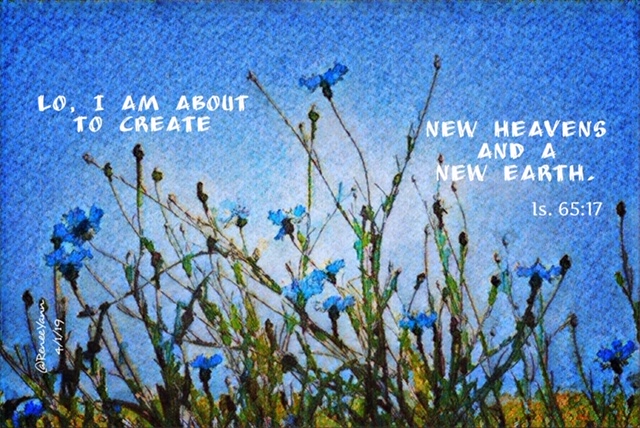
Is65_new heavens

Walter Brueggemann calls Isaiah 65 “a glorious artistic achievement”. Indeed, these images confirm his statement:

  • a new heavens and a new earth;
  • constant rejoicing and happiness
  • people will be a delight
  • no weeping or crying;
  • long life for all
  • everyone with a home
  • enough for all to eat

As we pray with this passage today, we may experience a longing for a return to our beautiful, safe world – a world before pandemic, a world before the specter of WW III. In today’s violent and besieged environment, we all pray from a place of anxiety, loss, constraint, or some degree of suffering. 

Isaiah’s community prayed from the same place. All the beautiful images were a promise not yet realized. The prophetic poetry of Isaiah is a call to courageous hope, not a description of current circumstances.

upside

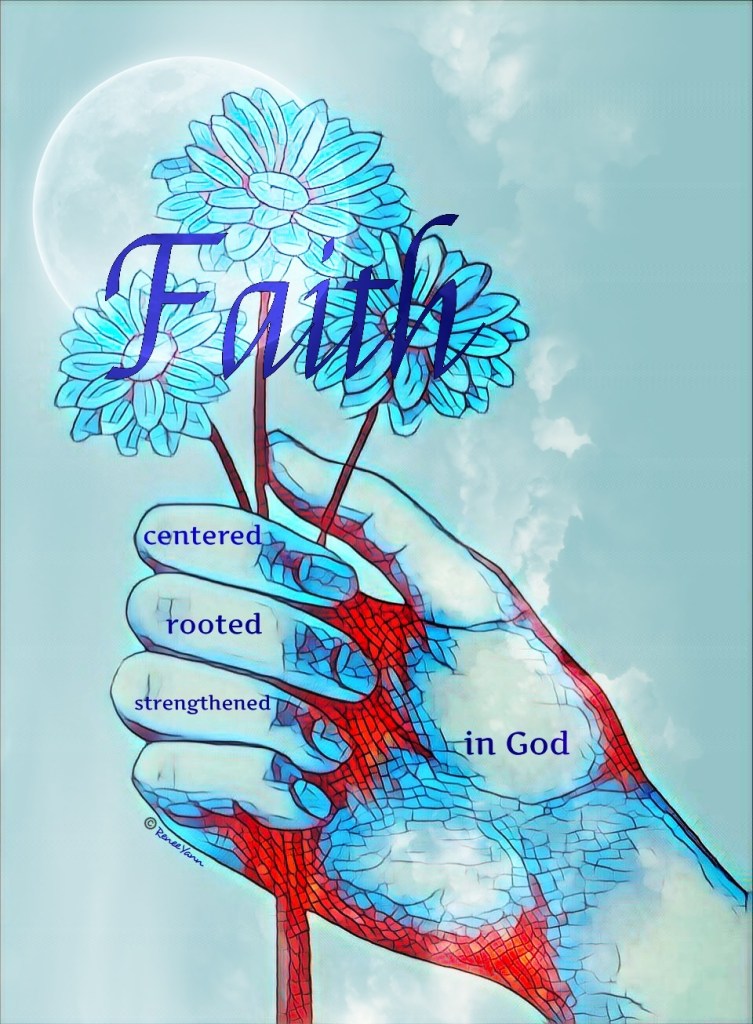
Faith invites us, even as we experience a bittersweet longing, to trust that God is with us, teaching us and leading us deeper into the Divine Understanding. Even as circumstances turn our world upside down, God will guide the falling pieces to a blessed place if we commit to find God in the tumbling.

I don’t think many of us would deny that the world has needed fixing for a long, long time. The systems we have built leave many in deficit throughout the world, and we have failed to address the wound.

War, pandemic, forced migration of the poor, climate catastrophe all have laid that failure bare.

As we pray for resolutions to these sufferings, may we be opened to an irrevocable awareness of our common humanity and responsibility for one another.

Only by such an outcome will we move closer to Isaiah’s peaceful Kingdom. Only by our courage to embrace it, can God fulfill the Promise in us.


Poetry: by Emily Dickinson

I many times thought Peace had come
When Peace was far away —
As Wrecked Men — deem they sight the Land —
At Centre of the Sea —

And struggle slacker — but to prove
As hopelessly as I —
How many the fictitious Shores —
Before the Harbor lie —


Music: O Day of Peace – Carl P. Daw
Lent: Look to a New Day

March 27, 2022
Fourth Sunday of Lent
Laetare Sunday

It’s optional, but I’ve always liked it — when the Church’s sacred ministers wear “pink” on Laetare Sunday — Roman Catholicism’s Fourth Sunday of Lent.

The day’s theme comes from the entrance antiphon reflecting on Isaiah 66:10-11: “Rejoice, Jerusalem, and all who love her. Be joyful, all who were in mourning; exalt and be satisfied at her consoling breast.”

Laetare is the first word — meaning “rejoice” — in the Latin text. On Laetare Sunday (as similarly with the Third Sunday of Advent’s Gaudete Sunday) the Church expresses hope and joy in the midst of our Lenten fasts and penances. Call it pink — or, more fittingly, rose — this change in color indicates a glimpse of the joy that awaits us at Easter, just before we enter into the somber days of Passiontide.

MICHAEL R. HEINLEIN -https://www.simplycatholic.com/laetare-sunday/

Today, in God’s Lavish Mercy, halfway through Lent, we see in our readings glimpses of new life.

The captivity in Egypt had been TOUGH on Israel. During those many decades, they had appeared to be abandoned and forgotten by God.  It was a harsh reckoning for them … hard to be forgotten. Even then, when they thought they had found freedom, they still wandered for forty years in the desert.

But now Israel stands at a new horizon.  Moses has died and Joshua has become Israel’s leader.  God tells him that it is a new day:

“Today I have removed the reproach of Egypt from you.”


In our second reading, Paul tells us:

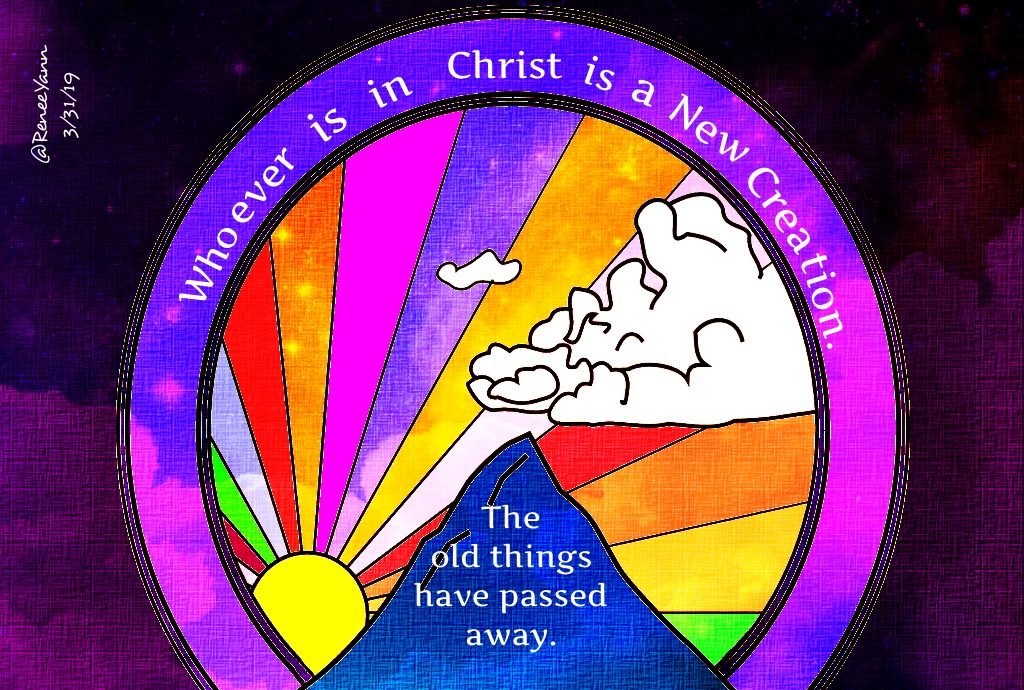
Whoever is in Christ is a new creation:
the old things have passed away;
behold, new things have come.


And in our revered Gospel story of the Prodigal Son, Jesus tells us:

This beloved child of mine was dead, and has come to life again;
was lost, and has been found.


All of these passages speak to us in our Lenten journey, and in our Life journey.  We have experienced our own “Egypts”, times when we felt disconnected, even abandoned, by God.  We have sometimes felt we were journeying aimlessly toward an unknown goal. We have at times wandered, like the prodigal son, from the path of God’s love. We have darknesses in our memories that still long for Light.

This poem from Mary Oliver might capture the feeling for us:

Someone I loved once gave me
a box full of darkness.
It took me years to understand
that this, too, was a gift.
~ Mary Oliver ~


In today’s readings, God is reminding us that the Light awaits us. Forgiveness, reconciliation, new energy and grace are the gifts of Easter – the gifts where we must keep our eyes focused as we journey.


So let us do as e.e.cummings encourages us in this poem:

Let It Go – e.e. cummings

let it go – the
smashed word broken
open vow or
the oath cracked length
wise – let it go it
was sworn to
go

let them go – the
truthful liars and
the false fair friends
and the boths and
neithers – you must let them go they
were born
to go

let all go – the
big small middling
tall bigger really
the biggest and all
things – let all go
dear

so comes love


Music: Remember Not the Things of the Past – Bob Hurd
(Lyrics below)

Remember not the things of the past;
now I do something new,
do you not see it?
Now I do something new, says the Lord.

In our distress God has grasped us by the hand,
opened a path in the sea, and we shall pass over,
we shall pass over, free at last.

In our parched land of hypocrisy and hate,
God makes a river spring forth,
a river of mercy, truth and compassion; come and drink.

And who among us is sinless in God’s sight?
Then who will cast the first stone, when he who was sinless
carried our failings to the cross?

Pressing ahead, letting go what lies behind,
may we be found in the Lord, and sharing his dying,
share in his rising from the dead.

Lent: Releasing Praise

March 26, 2022
Saturday of the Third Week of Lent

Today, in God’s Lavish Mercy, we are encouraged to pray. Hosea tells us:

Come, let us return to the LORD,
it is he who has rent, but he will heal us;
… the LORD will come to us like the rain,
like spring rain that waters the earth.


Let the image of that truth sink into your parched spirit.

rain

Our Gospel leads us to pray humbly:

But the tax collector stood off at a distance
and would not even raise his eyes to heaven
but beat his breast and prayed,
‘O God, be merciful to me a sinner.’

As we pray humbly today, let us ask for God’s refreshment for all our sisters and brothers across the earth. In good times and in trials, let us always praise God.


I would like to share one of my own poems with you today, as we kneel before God with all struggling Creation begging God for humanity to be washed in Mercy.

        All Creation    

 All Creation kneels,
a Single Being,
to praise God.

 From its immense heart,
it sings myriad songs at once,
Morning and Evensong,
Praise and Dirge,
Alas and Alleluia,
intermingled

 It sings even over its own scars,
where the chasms cry out for balm.
It sings both the remembrance
and the hope of blessing.
It sings the endurance of faith
and the confidence of love.

 In roar and silence,
darkness and light,
Creation kneels,
a Single Being,
to praise God.


Music: Total Praise sung by the Brooklyn Tabernacle Choir.  Just watching these faith-filled people lifts my heart and gives me hope.  I trust it will do the same for you, dear friends as we pray for one another.

Lent: Willing Love

March 25, 2022
Solemnity of the Annunciation of the Lord

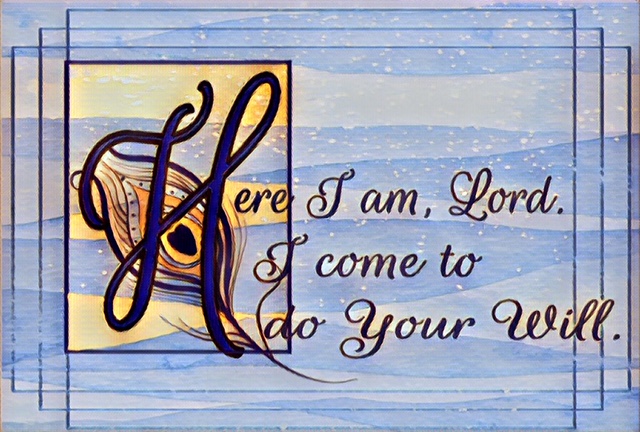
Today, in God’s Lavish Mercy, on this feast of the Annunciation, we can hear Mary proclaiming our psalm’s refrain which echoes down through the ages:

Psalm 40:8-9

We are all here to do God’s Will. That’s why God made us. But sometimes, we struggle so hard either to learn God’s Will or to avoid it.

Praying with Mary this morning, I thought this about “God’s Will” – It is not a plan we must discover, or that unfolds in surprises throughout our lives. It’s not a set of circumstances meant to test our faith. If we think of it this linearly, we cripple and diffuse its power.

Because God is Love, God’s Will is simply this: 

Love. 
Always love. 
Love always as God would love. 
Choose always what Love would choose.
Love.

That’s what Mary did.


Annunciation – Henry Ossawa Tanner

Poetry:  Aubade: The Annunciation – Thomas Merton
(An aubade is a poem or piece of music appropriate to the dawn or early morning.)


When the dim light, at Lauds, comes strike her window,
Bellsong falls out of Heaven with a sound of glass.
Prayers fly in the mind like larks,
Thoughts hide in the height like hawks:
And while the country churches tell their blessings to the
distance,
Her slow words move
(Like summer winds the wheat) her innocent love:
Desires glitter in her mind
Like morning stars:
Until her name is suddenly spoken
Like a meteor falling.
She can no longer hear shrill day
Sing in the east,
Nor see the lovely woods begin to toss their manes.
The rivers have begun to sing.
The little clouds shine in the sky like girls:
She has no eyes to see their faces.
Speech of an angel shines in the waters of her thought
like diamonds,
Rides like a sunburst on the hillsides of her heart.
And is brought home like harvests,
Hid in her house, and stored
Like the sweet summer's riches in our peaceful barns.
But in the world of March outside her dwelling,
The farmers and the planters
Fear to begin their sowing, and its lengthy labor,
Where, on the brown, bare furrows,
The winter wind still croons as dumb as pain.

Music: Ave Maria – performed by Daniela de Santos

Lent: Pray for the Enemy

March 24, 2022
Thursday of the Third Week of Lent

Today in God’s Lavish Mercy, Jeremiah begins our readings by describing the evil heart:

… they obeyed not, nor did they pay heed.
They walked in the hardness of their evil hearts
and turned their backs, not their faces, to Me.

Jeremiah :24

It is a terrible thing to encounter a truly evil-hearted person – someone who exudes a twisted energy which is the polar opposite of God’s Love.

I believe we are seeing such a individual now in the person of Vladimir Putin. His actions leave us astounded at their arrogance and cruelty. How can such a person face himself, and certainly, how can he face God?


But our Psalm and Gospel Verse, lead me to ask myself the question:

What if we prayed FOR Vladimir Putin?

Come, let us bow down in worship;
let us kneel before the LORD who made us.
For he is our God,
and we are the people he shepherds, the flock he guides.
R. If today you hear his voice, harden not your hearts.

What if we took pity on the wretched soul he has become and asked God to heal his mind and give him a new heart? He has become sick with evil, and that is a tragic thing to see in a leader responsible for millions of lives!


All of us feel tremendous sorrow and compassion toward the Ukrainian people. But in the end, no matter what, they will triumph through their sincerity, courage and faithfulness.

Putin, on the other hand, is otherwise lost for all eternity.


Will you consider praying today for Putin and those who share his evil culpabilities that they may yet hear the voice of goodness, justice, peace, and reverence for human life?

As we witness the power of God revealed in our Gospel story, let us ask that the evil of war be driven out of the hearts of all those responsible for the outrageous suffering and inhumanity being perpetrated again the people of Ukraine and in all war-infested parts of our world.


Music: Shchedryk by Mykola Leontovich

One of the world’s most famous Christmas songs – The Carol of the Bells – was based on the Ukrainian song Shchedryk, written in 1916 by composer Mykola Leontovich, which was in turn based on the melody and lyrics of a pre-Christian folk song.

This is Gimnazija Kranj Symphony Orchestra and Choir’s dedication to brave Ukrainian people who suffer under the brutal Russian invasion. Our musicians performed this beautiful love song a couple of years ago. Tine Bec did an amazing arrangement. It was composed by Mykola Leontovych: Shchedryk (Carol the Bells) with a splendid arrangement, made by composer Slovenian Tine Bec.

This arrangement is magical. It starts like deep sad mourning and continues to strengthen, unitarian voice, which is stronger than any steel, any armoury and any Russian bullet, rocket or trank grande. Music is a winner. It gives hope, unites us in a way, that no aggression will ever win.

Arrangement: Tine Bec
Piano: Monika Podlogar; Cello: Katarina Minatti

Lent: Faith’s Legacy

March 23, 2022
Wednesday of the Third Week of Lent

Today, in God’s Lavish Mercy, our readings lead us to thank God for our heritage of faith. They remind us how precious that heritage is.


Moses, after reiterating the history of God’s goodness to Israel, enjoins the People:

Take care and be earnestly on your guard
not to forget the things which your own eyes have seen,
nor let them slip from your memory as long as you live,
but teach them to your children and to your children’s children.

Deuteronomy 4:6

Jesus, too, acknowledges the importance of his religious heritage:

Do not think that I have come to abolish the law or the prophets.
I have come not to abolish but to fulfill.
Amen, I say to you, until heaven and earth pass away,
not the smallest letter or the smallest part of a letter
will pass from the law,
until all things have taken place.

Matthew 5:17

Readings such as these move us to remember, consider and appreciate our own faith story – that personal unfolding of grace-filled circumstances which have led us to our present relationship with God.

For many of us, faith planted itself in us through the seeds of our family. We simply “inherited” the faith from our parents, grandparents and extended family. That community of blessings was extended through our parish and through our Christian education.

Take time to remember:

  • Who taught you your childhood prayers?
  • Who told you Bible stores?
  • Who prepared you for the sacraments?
  • Who served as a example to you of what a good Christian is like?

The answers will not be some big religious events. They will be simple memories that, at the time, you might not have even recognized as important to your faith life. I remember, for example, that every day in Lent my father walked with me to 6:30 AM Mass. Because many of the laborers had to be in work by 7:00 AM, the priest distributed communion for them before the Mass began. Just after the Gospel, Dad and all the other workmen would quietly exit to get to work on time. No fanfare. No preachy words. Just deep faith and devotion.

I can’t exactly put that lesson into words. All I know is that it deeply affected my faith and my profound appreciation for the Eucharist — and for my Dad.


And as you grew up and grew older:

  • Who has sincerely engaged with you on your questions of faith and morality?
  • Who has encouraged you to live a life of Christian service and social justice?
  • Who has modeled everyday holiness for you?
  • Who challenges and invites you to deeper spirituality and Christian witness?

The names and faces who have come into your prayer as you considered these questions — these people are the “fathers” and “mothers’ of your faith.


And of course, these questions may lead us
to ask ourselves how we have done these things
for the generations now depending on us
for the transmission of faith?


Poetry: On Religion – Kahlil Gibran (1883-1931)

And an old priest said, Speak to us of Religion.
And he said:
Have I spoken this day of aught else?
Is not religion all deeds and all reflection,
And that which is neither deed nor reflection, but a wonder and a surprise ever springing in the soul, even while the hand hew the stone or tend the loom?
Who can separate his faith from his actions, or his belief from his occupations?
Who can spread his hours before him, saying, “This for God and this for myself’ This for my soul, and this other for my body?”
All your hours are wings that beat through space from self to self.
He who wears his morality but as his best garment were better naked.
The wind and the sun will tear no holes in his skin.
And he who defines his conduct by ethics imprisons his song-bird in a cage.
The freest song comes not through bars and wires.
And he to whom worshipping is a window, to open but also to shut, has not yet visited the house of his soul whose windows are from dawn to dawn.

Your daily life is your temple and your religion.
Whenever you enter into it take with you your all.
Take the plough and the forge and the mallet and the lute,
The things you have fashioned in necessity or for delight.
For in revery you cannot rise above your achievements nor fall lower than your failures.
And take with you all men:
For in adoration you cannot fly higher than their hopes nor humble yourself lower than their despair.

And if you would know God be not therefore a solver of riddles.
Rather look about you and you shall see Him playing with your children.
And look into space; you shall see Him walking in the cloud, outstretching His arms in the lightning and descending in rain.
You shall see Him smiling in flowers, then rising and waving His hands in trees.


Music: e Will Serve the Lord

Lent: Forgive As Forgiven

March 22, 2022
Tuesday of the Third Week of Lent

Today, in God’s Lavish Mercy, we meet Azariah of Fiery Furnace – a great champion of faith ready to bolster ours in our own uncertain times.

In our reading from the Book of Daniel, Azariah (later Abednego) prays a moving prayer of urgency, repentance, supplication, and trust:

And now we follow you with our whole heart,
we hold you in awe and we pray to you.
Do not let us be put to shame,
but deal with us in your kindness and great mercy.
Deliver us by your wonders,
and bring glory to your name, O Lord.

This prayer rang very true for me today, as I prayed for God’s mercy and miracles all over our suffering earth, especially in Ukraine.


And then we move to our Gospel, which brings before us the always thorny issue of forgiveness. Forgiveness is easy when it is something we seek for ourselves. Yes, we may have done something wrong. But we see the issue from inside our own heart. We know we didn’t mean it, made a mistake, or didn’t fully understand the harm we caused. We know we deserve forgiveness.

But what about the other guys — the ones who hurt us or someone we love? They meant it, didn’t they!!!! Their treachery was no mistake. They understood all along the harm they would cause! How could we ever forgive them?

Isn’t that the way the tapes sometimes run in our heads when we are hurt by another, or when we witness such hurt?

In our Gospel, Jesus offers us the character of the forgiving master who represents our Creator. The parable teaches that God accepts and heals our weakness – God forgives. But once forgiven, we are called to be like God – forgiving others and desiring their healing.

Does this mean we ignore or forget the pain forced on others or ourselves? I don’t think so. It means that we use it as a catalyst to remember how in need of grace we and all our sisters and brothers are as we learn to live in love.


Poetry: As we pray with such awareness, how appropriate today’s psalm-poem is:

Your ways, O LORD, make known to me;
            teach me your paths,
Guide me in your truth and teach me,
            for you are God my savior.
Remember that your compassion, O LORD,
            and your kindness are from of old.
In your kindness remember me,
            because of your goodness, O LORD.
Good and upright is the LORD;
            thus showing sinners the way.
God guides the humble to justice,
            and teaches the humble God’s way.

Psalm 25:4-9

Music: Forgiveness – Matthew West

Lent: The Miracle of Transformation

March 21, 2022
Monday of the Third Week of Lent

Today, in God’s Lavish Mercy, our readings are about prophets and miracles, brought to us by Elisha and Jesus.

The core of the readings is this: some of us want the prophets’ miracles, but we don’t want their challenge to live in God’s freedom. We want their cures, only to return to lifestyles that make us spiritually sick or imprisoned.

Wanting to write about these themes, I decided to check with my favorite Old Testament scholar, Walter Brueggemann to see if he had any wisdom on the story of Naaman.

Naaman
Naaman brings his retinue and gifts… from The Pictorial History of Palestine and the Holy Land (1844) by John Kitto

Well, Walter certainly did…. something so good and wise that I won’t water it down with my own words. The link is below. It’s a little long, but so worth your reading and meditation. I hope you’ll take the time.

Click here for Walter Brueggemann’s article


Music: some instrumental music to listen to while you’re reading

Lent: Finding the Firelight

March 20, 2022
Third Sunday of Lent

Today, in God’s Lavish Mercy, we have powerful readings – they get really serious about repentance!

Ex3_2 bush

In our first reading, Moses has been on a kind of decades-long sabbatical on his father-in-law’s homestead. After the young glory days of Egypt, and the ensuing drama that exiled him, Moses had settled into being a humble shepherd in Midian. He probably wasn’t expecting a fiery, direct telegram from God.

But God never gives up on the eternal plan for us. So God, divinely expert at getting our attention, conflagrates a bush right in front of Moses.  Supposedly, it was not that unusual for this type of bush to spontaneously combust in the desert heat. What was unusual was for it not to be consumed by the fire.

God then delivers a message of overwhelming fidelity to Moses:

Thus shall you say to the Israelites:
The LORD, the God of your fathers,
the God of Abraham, the God of Isaac, the God of Jacob,
has sent me to you.
This is my name forever;
thus am I to be remembered through all generations.

Because of God’s mercy and fidelity, the Israelites – and Moses – are getting another chance to live in covenant with God.


In our Gospel, Jesus tells his followers not to ignore such chances. He reminds his listeners that life is fragile and transitory. If we haven’t acted on God’s invitation to grace, we might lose the opportunity. Again, using the symbol of a tree…

Jesus told them this parable:
“There once was a person who had a fig tree planted in his orchard,
and when he came in search of fruit on it but found none,
he said to the gardener,
‘For three years now I have come in search of fruit on this fig tree
but have found none.
So cut it down.


If we look back over our lives, we might realize that there have been burning bushes all over the place – times and events where life offered us a choice between grace or sin, smallness of heart, and selfishness. When we chose grace, the bush kept burning and was not consumed. It lit our way to deeper covenant with God.

These final weeks of Lent offer us countless encouragements to look for God’s Fire in our hearts and to go deeper toward the Light. Let’s not ignore them.


Poetry: Burning Bush by Karle Wilson Baker, American poet, (1878 – 1960)

This poem refers to the plant “burning bush”, but carries sentiments touching on faith, hope and peace similar to our readings.

My heart, complaining like a bird,
Kept drooping on her weary nest:
” Oh, take me out under the sky,
Find me a little rest! “

I took her out under the sky,
I climbed a straggling, sandy street,
Where little weathered houses sag,
And town and country meet,

And in the corner of a yard
Unkempt, forlorn, and winter-browned,
A single sprig of Burning Bush
Thrust up from the bare ground.

It bore no leaf as yet — one flower,
Three pointed buds of pure rose-flame:
Up whirred my heart, circled in air,
Back to my bosom came.

And that was all I showed to her —
I could not find another thing —
But, ” Take me home again, ” she cried,
” And I will sing and sing! “


Music: Fire of God – Craig Musseau

Prayers with St. Joseph

Devotional prayer, I think, has become less popular today.  We lean toward Scripture, meditation, contemplation…

rosary

But I have always found devotional prayer helpful and calming in times of stress and crisis. 

You might want to return to a favorite prayer of your youth —

  • Look Down Upon Me, Good and Gentle Jesus
  • Angel of God, My Guardian Dear
  • The Rosary, said slowly, letting the beads teach your fingers patience and trust
  • And, of course on his feast, the comforting Litany of St. Joseph.

Don’t worry about saying the whole thing.  Pray slowly.  Let the depth of the phrase sink into your anxieties.  When you find a phrase that embraces you, rest in it. Talk to dear St. Jospeh about your “heart condition”.

Litany of St. Joseph

Lord, have mercy
Christ, have mercy
Lord, have mercy
God our Father in heaven, have mercy on us.
God the Son, Redeemer of the world, have mercy on us.
God the Holy Spirit, have mercy on us.
Holy Trinity, one God, have mercy on us.

Holy Mary, pray for us.
Saint Joseph, pray for us.
Noble son of the House of David
Light of patriarchs
Husband of the Mother of God
Guardian of the Virgin
Foster father of the Son of God
Faithful guardian of Christ
Head of the holy family
Joseph, chaste and just
Joseph, prudent and brave
Joseph, obedient and loyal
Pattern of patience
Lover of poverty
Model of workers
Example to parents
Guardian of virgins
Pillar of family life
Comfort of the troubled
Hope of the sick
Patron of the dying
Terror of evil spirits
Protector of the Church

Lamb of God, you take away the sins of the world,
have mercy on us.
Lamb of God, you take away the sins of the world,
have mercy on us.
Lamb of God, you take away the sins of the world,
have mercy on us.

Let us pray. God, in your infinite wisdom and love you chose Joseph to be the husband of Mary, the mother of your Son. May we have the help of his prayers in heaven and enjoy his protection on earth. We ask this through Christ our Lord. Amen

Music:  Seeking Serenity – Nicholas Gunn