
Psalm 17: Apple of God’s Eye
Friday of the Twenty-fourth Week in Ordinary Time
Friday, September 18, 2020

Today, in God’s Lavish Mercy, we pray with Psalm 17, a confident prayer calling on God’s intervention.
The psalmist tenders a plea:
Hear, O LORD, a just suit;
Psalm 17:1
attend to my outcry;
hearken to my prayer
from lips without deceit.
But before reiterating that plea, the pray-er convinces God that she is worthy of an answer:
You have tested my heart,
Psalm 17: 3-4
searched it in the night.
You have tried me by fire,
but find no malice in me.
My mouth has not transgressed
as others often do.
As your lips have instructed me,
I have kept from the way of the lawless.

It sounds a little boastful but it really isn’t. The one who prays this psalm is very familiar with God and God with her. There are no secrets between them. She knows that she is infinitely loved and protected, not despite her vulnerability but because of it.
The psalmist, from long experience, is confident asking for help, as we would be asking a friend to turn and listen to us:
I call upon you; answer me, O God.
Psalm 17: 7
Turn your ear to me; hear my speech.

Have you ever been asked for prayers because you are “a good prayer”?
It happens to nuns all the time.
But no prayer is more powerful than another. We say “Of course” to such requests because it is our intention to join our prayer with that of the requester.
Show your wonderful mercy,
Psalm 17: 8-9
you who deliver with your right arm
those who seek refuge from their foes.
Keep me as the apple of your eye;
hide me in the shadow of your wings
Each of us is God’s “eye-apple”. Each of us, when we give ourselves to a long familiarity with God, will be wrapped in the confidence of one who is always answered.
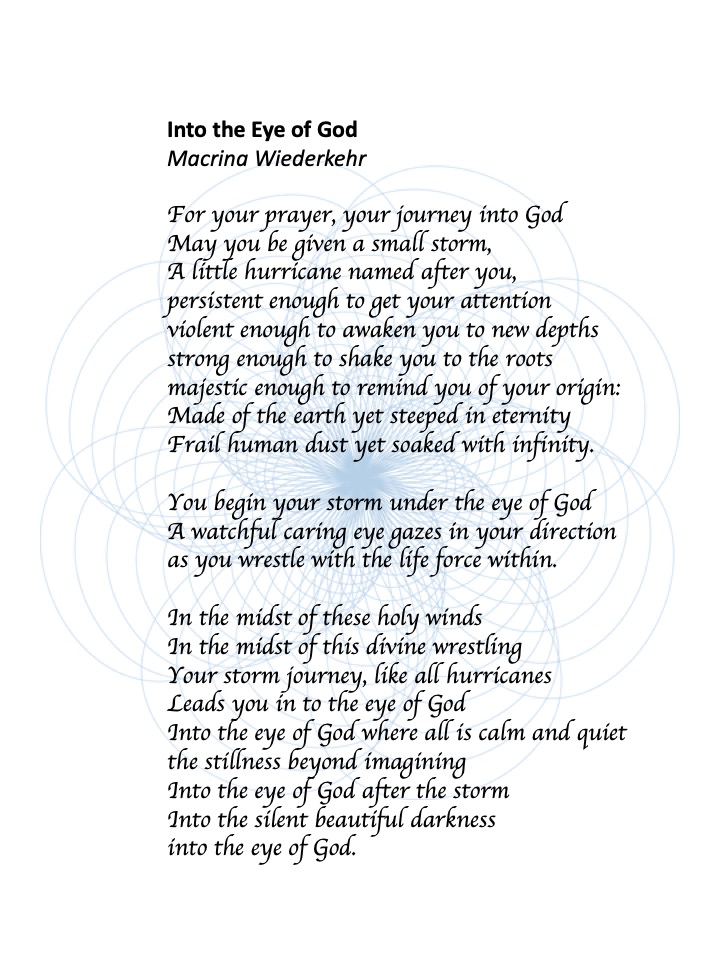
( In a second posting, I’ll be sending on an extra meditation on The Eye of God by Macrina Wiederkehr – beautifully profound.)
Poetry: As Kingfishers Catch Fire – Gerard Manley Hopkins

As kingfishers catch fire, dragonflies draw flame;
As tumbled over rim in roundy wells
Stones ring; like each tucked string tells, each hung bell’s
Bow swung finds tongue to fling out broad its name;
Each mortal thing does one thing and the same:
Deals out that being indoors each one dwells;
Selves — goes itself; myself it speaks and spells,
Crying Whát I dó is me: for that I came.
I say móre: the just man justices;
Keeps grace: thát keeps all his goings graces;
Acts in God’s eye what in God’s eye he is —
Chríst — for Christ plays in ten thousand places,
Lovely in limbs, and lovely in eyes not his
To the Father through the features of men’s faces.
Music: The Apple of My Eye by Umb-5 and Sam Carter
Sometimes a non-spiritual song captures a spiritual meaning in a beautiful way. Let God sing to you with this lovely song.
Psalm 118:
Thursday of the Twenty-fourth Week in Ordinary Time
Thursday, September 17, 2020

Today, in God’s Lavish Mercy, we pray with Psalm 118 (Confitemini Domino), part of the Hallel. Hallel consists of six Psalms (113–118), which are recited as a unit, on joyous occasions such as Passover.
This joy arises from the core belief
and experiential evidence that
“God’s Mercy endures forever”.
Give thanks to the LORD, Who is good,
Psalm 118: 1-2
Whose mercy endures forever.
Let the house of Israel say,
“God’s mercy endures forever.”
Looking at the entire psalm, we see the prayer of a person delivered from enemies, one who has taken refuge in the Lord. And the Lord has responded both in protection and abiding relationship.
Our Gospel story of the woman with the alabaster jar reiterates this theme. Surely this woman is beset by enemies, both within and without. Ultimately, grace moves her to take refuge at the feet of Jesus’s Mercy. She does this by breaking through any inhibiting tradition in order to offer Jesus her own intimate act of tenderness. Moved, Jesus reciprocates.

As we seek to be fully embraced in God’s Lavish Mercy, what “ointments”, held too long, must we pour out to God. What illusions do we cling to convincing us we have no need for repentance, forgiveness, transformation?
What little jars of selfishness, pride, or arrogance keep us from fully giving and receiving Mercy?
In my distress, I poured my heart out to the LORD;
Psalm 118: 13-14
the LORD answered me and set me free.
The LORD is with me now, I am not afraid;
darkness has no power against me.
Poem: Mended by Annie Villiers
Invisible mending
This is the place where souls come
To be mended where
Tatty ends of unfinished business
Or business unravelled
Are drawn together and tenderly
Made new.
Nimble stitches
Seen only by the weaver
Whose loving fingers
Repair the frangible fabric of lives.
Music: Confitemini Domino – Taize Community
Confitemini Domino, quoniam bonus,
quoniam in sæculum misericordia ejus.
O give thanks unto the Lord, for he is gracious,
because his mercy endureth for ever.
Psalm 33: Convinced!
Memorial of Saints Cornelius, Pope, and Cyprian, Bishop, Martyrs
Wednesday, September 16, 2020
Today, in God’s Lavish Mercy, we pray with verses from Psalm 33, the whole of which is the steadfast prayer of a person convinced of God!

As we read through Psalm 33, there is no hem and haw, no grey! It’s about God as the center of the psalmist’s, and the nation’s, life:
Know that the LORD is God;
Who made us, Whose we are;
God’s people, the flock God tends.
Our first reading grows from a similar conviction. Paul tells the Corinthians that our rootedness in God is not about spiritual eloquence, knowledge or holy detachment. He allows that it’s a little bit about faith and hope. But, over all things, it’s about love.
Lesson: We can’t be like the Gospel’s marketplace children. There should be but one song in our hearts – the same one Love sang as Love created each one of us in Her image.
For upright is the word of the LORD,
and all his works are trustworthy.
He loves justice and right;
of the kindness of the LORD the earth is full.
Poetry: Great Heart of God – (Nicholas) Vachel Lindsay (1879 – 1931), an American poet who is considered a founder of modern singing poetry, as he referred to it, in which verses are meant to be sung or chanted.
O great heart of God,
Once vague and lost to me,
Why do I throb with your throb to-night,
In this land, eternity?

O little heart of God,
Sweet intruding stranger,
You are laughing in my human breast,
A Christ-child in a manger.

Heart, dear heart of God,
Beside you now I kneel,
Strong heart of faith. O heart not mine,
Where God has set His seal.

Wild thundering heart of God
Out of my doubt I come,
And my foolish feet with prophets' feet,
March with the prophets' drum.
Music: Coulin – James Last – just a lovely instrumental to pray with today. ❤️
Psalm 100: Joy Hides in Sorrow
Memorial of Our Lady of Sorrows
Tuesday, September 15, 2020
Today, in God’s Lavish Mercy, we pray with Psalm 100, the “Jubilate Deo” – “Rejoice in the Lord”. These verses, on the feast of our Sorrowful Mother, might seem a bit contradictory:
Sing joyfully to the LORD, all you lands;
serve the LORD with gladness;
come before him with joyful song.
But I think the seeming contradiction reveals a deep truth.
For those who live in God,
no sorrow can eradicate their resolute joy.

Certainly, like Mary, the faithful heart feels sorrow for both personal pain and the pain of all Creation. But the pain and sorrow is not the end of their feeling. There is a joyful hope because God abides with us in any suffering, promising that no evil can defeat the one who believes.
Mary believed that with all her heart and lived it. She invites us to the same courageous faith. As Psalm 100 assures us:
Know that the LORD is God;
Who made us, whose we are;
God’s people, the flock God tends.
For the Lord is good,
whose kindness endures forever,
and whose faithfulness is to all generations.
Poem: Today’s poetic passage is from one of the great classics of Christian literature, A Woman Wrapped in Silence by Father John W. Lynch.
The book is a masterpiece best appreciated in reflective contemplation. I have chosen a sliver of its beauty today, one of many that captures Mary’s joy born of faith-filled suffering. This selection imagines what it was like when Mary remained in the Upper Room as the others, not knowing what to expect, went to the tomb early on Easter morning. The Resurrected Jesus comes to Mary first, before any other appearance.
Or is
it true or thought of her she found no need
To search? And better said that she had known
Within, they’d not discover him again
Among the dead? That he would not be there
Entombed, and she had known, and only watched
Them now as they were whispering of him,

And let them go, and listened afterward
To footsteps that were fading in the dark.

To wait him here. Alone. Alone. A woman
Lonely in the silence and the trust
Of silence in her heart that did not seek,
Or cry, or search, but only waited him.

We have no word of this sweet certainty
That hides in her. There is not granted line
Writ meager in the scripture that will tell
By even some poor, unavailing tag
Of language what she keeps within the silence.
This is hers. We are not told of this,
This quaking instant, this return, this Light
Beyond the tryst of dawn when she first lifted
Up her eyes, and quiet, unamazed,
Saw He was near.
Music: Jubilate Deo – Mozart
We Set our Psalm Aside
Today, in God’s Lavish Mercy, I must put our Psalm in the background and refer to an earlier post for this Feast.
On this Feast of the Exaltation of the Holy Cross, our readings include the sublime Philippians Canticle.
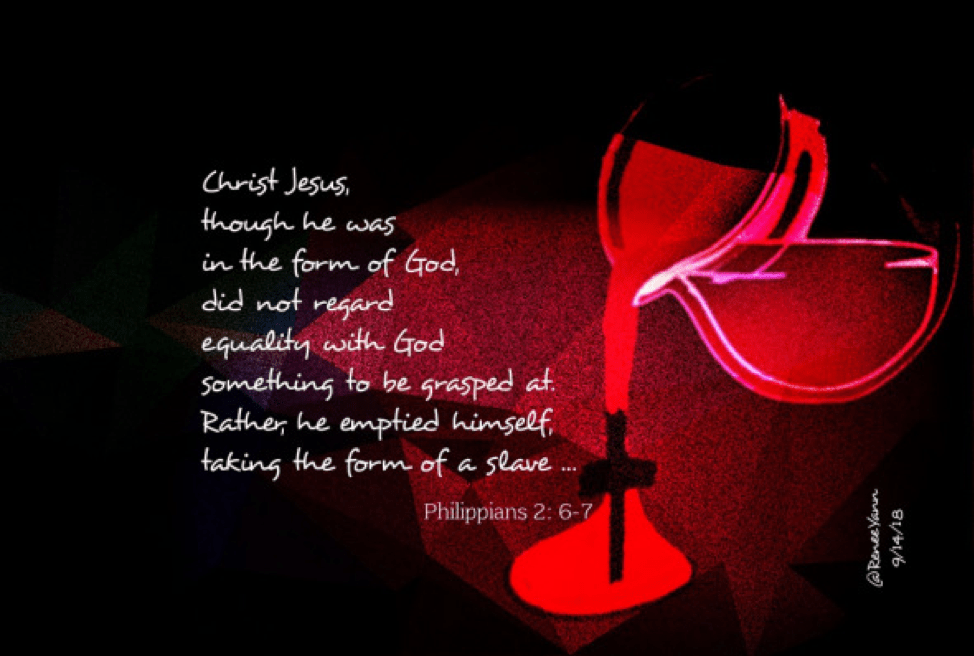
To me, this is the most beautiful passage in the Bible – so beautiful that nothing else needs to be said about it.
As we read it lovingly and prayerfully today, may we take all the suffering of the world to Christ’s outstretched arms – even our own small or large heartaches and longings.
Poetry: God’s Love for Us – Julian of Norwich (1342-1416)
The love of God most High for our soul
from Revelations of Divine Love
is so wonderful that it surpasses all
knowledge. No created being can fully know
the greatness, the sweetness, the
tenderness, of the love that our Maker has
for us. By his Grace and help therefore let
us in spirit stand in awe and gaze, eternally
marvelling at the supreme, surpassing,
single-minded, incalculable love that God,
Who is all goodness, has for us.
Music: Philippians Canticle ~ John Michael Talbot
And if there be therefore any consolation
And if there be therefore any comfort in his love
And if there be therefore any fellowship in spirit
If any tender mercies and compassion
We will fulfill His joy
And we will be like-minded
We will fulfill His joy
We can dwell in one accord
And nothing will be done
Through striving or vainglory
We will esteem all others better than ourselves
This is the mind of Jesus
This is the mind of Our Lord
And if we follow Him
Then we must be like-minded
In all humility
We will offer up our love
Though in the form of God
He required no reputation
Though in the form of God
He required nothing but to serve
And in the form of God
He required only to be human
And worthy to receive
Required only to give
Psalm 103: Be Like God
Twenty-fourth Sunday in Ordinary Time
Sunday, September 13, 2020
Today, in God’s Lavish Mercy, we pray with Psalm 103, and its gentle comforting refrain:
The Lord is kind and merciful,
slow to anger, and rich in compassion.
Our Sunday readings encourage to become like this merciful, forgiving, patient, compassionate Lord.
I’m not doing so well at that. Anybody else with me? Sometimes I feel like we’re living in a desert devoid of humanness and reverence.

Somehow, in our current political and cultural environment, too often I feel angry and even outraged. Those kinds of feelings don’t leave much room for compassion and its accompanying virtues!
Recently I witnessed two wonderful friends openly spat on social media because of their opposing political camps. I’ve seen family members shut each other out for the same reasons. We can’t turn on the TV without seeing a barrage of hateful words and actions unleashed against other human beings.
I feel poisoned and sick when I see the culture we have brewed for ourselves!
In our first reading, Sirach seems to have felt pretty sickened by his environment too. He counsels his listeners:
Forgive your neighbor’s injustice;
then when you pray, your own sins will be forgiven.
Could anyone nourish anger against another
and expect healing from the LORD?
Paul, in our second reading, tells us why we should change our hateful behavior:
None of us lives for oneself, and no one dies for oneself.
For if we live, we live for the Lord,
and if we die, we die for the Lord;
so then, whether we live or die, we are the Lord’s.
In our Gospel, Jesus uses a stunning parable to drive home the commandment for forgiveness. I don’t think any of us really wants to end up like the selfish, wicked servant – handed over to the torture of our own hatreds.
This Sunday’s readings are serious. They’re not kidding. We have to change any sinful incivility or hate that resides in our hearts. We may not be able to change our feelings. But we can stop feeding them with lies, propaganda, and conspiracy theories.
What we can change are our actions and words. And we must.
Poetry: Love my enemies, enemy my love by Rebecca Seiferle
Oh, we fear our enemy’s mind, the shape
in his thought that resembles the cripple
in our own, for it’s not just his fear
we fear, but his love and his paradise
.
We fear he will deprive us of our peace
of mind, and, fearing this, are thus deprived,
so we must go to war, to be free of this
terror, this unremitting fear, that he might

he might, he might. Oh it’s hard to say
what he might do or feel or think.
Except all that we cannot bear of
feeling or thinking—so his might

must be met with might of armor
and of intent—informed by all the hunker
down within the bunker of ourselves.
How does he love? and eat? and drink?

He must be all strategy or some sick lie.
How can reason unlock such a door,
for we bar it too with friends and lovers,
in waking hours, on ordinary days?

Finding the other so senseless and unknown,
we go to war to feel free of the fear
of our own minds, and so come
to ruin in our hearts of ordinary days.
Music: Kyrie Eleison – Lord, have Mercy
This is an extended, meditative singing of the prayer. I like to listen to it in the very early morning. Just doing that is a good prayer for me.
Psalm 116: The Return?
Saturday of the Twenty-Third Week in Ordinary Time
Saturday, September 12, 2020
Today, in God’s Lavish Mercy, we pray with the lilting Psalm 116, an intimate, tender, and powerful prayer.
The psalmist, overwhelmed by God’s goodness, asks a clear and urgent question:
How shall I make a return to the LORD
for all the good God has done for me?

The verse itself shows the spiritual awareness of the questioner. Some people don’t believe God has done anything for them. They think they’ve done everything for themselves! And it’s sad to see somebody lost in that illusion.
They never feel awe and gratitude that they have received, as pure gift from God:
- the breath of life
- the capacity to believe, hope and love
- the beauty of all Creation
- the heritage of faith, family and friendship
- the blessing of community in its many forms
- the particular gifts that make them unique in the world
- the capacity to care, act, and change things toward good
- the irrevocable invitation to befriend God
- the Lavish Mercy and steadfast accompaniment of that Divine Inviter
- the promise of eternity

As we grow in our capacity to recognize and live out of these gifts, we deepen in our “sacrifice of praise”.
Walter Brueggemann describes a sacrifice of praise like this:
It must be an intimate, yielding act of trustful submission of “spirit and heart,” not “sacrifice and burnt offerings”. The speaker (psalmist), now situated in glad praise, can imagine an intimacy and communion in which contact between God and self is available and in which the distinction between the two parties is clear and acknowledged—God in splendor, the self in “brokenness”.
That “brokenness” is fully given to God to heal and empower with grace so that one’s life becomes a witness to God’s love.
To you will I offer sacrifice of thanksgiving,
and I will call upon the name of the LORD.
My vows to the LORD I will pay
in the presence of all his people.
The “sacrifice of praise” is not accomplished in a single declaration or decision. It can begin like that. But to last, it must be “lived into”, moment by moment, through an intentional, prayerful life. That is the lesson of today’s Gospel – it is how we build our “house” on rock.
Poetry: God of Shelter, God of Shade – by Irene Zimmerman, OSF
God of shelter from the rain,
God of shade from the heat,
I run from You
through the muddy street
of my uncommitted heart
till wild winds beat
against my doors,
blasting sand
through all my walls,
and I stand
without retreat,
hear Your command
to be the wheat.
Sweet the giving!
Sweet this land!
God of shelter from the rain.
God of shade from the heat.
Music: Alvin Slaughter and Inside out - The Sacrifice of Praise
Psalm 84: The Presence
Friday, September 11, 2020

Today, in God’s Lavish Mercy, we pray with Psalm 84 in which the psalmist expresses great love and longing to dwell in God’s protection.
My soul yearns and pines
for the courts of the LORD.
My heart and my flesh
cry out for the living God.
The psalm, while it alludes to the Temple as God’s house, offers a broader and deeper understanding of that sacred dwelling place. Psalm 84 describes an abiding so universal that it welcomes even the sparrow into its embrace.

Even the sparrow finds a home,
and the swallow a nest
in which she puts her young—
Your sanctuaries, O LORD of hosts,
my king and my God!
Praying today with this lovely psalm, I focus on my desire to be completely embraced by God – to feel that unquestioning faith, trust, hope and love in all circumstances of my life . This kind of confidence doesn’t come from any temple, building, or church. It comes from the Presence we find WITHIN our “temples”. If that Presence is gone, the “temple”is simply a pile of bricks.

An image rose in my mind of my niece Katelyn when she was about 18 months old. My mother had just died. When my brother and family arrived at Mom’s house shortly after, little Katelyn scurried quickly to the kitchen, my mother’s usual habitat. She wanted that irreplaceable hug from Grandmom. But the kitchen chair was empty. Katelyn touched the chair and, still pre-verbal, looked up at me wondering and confused – much like I was. The kitchen had become a temple without a presence. Neither she nor I were sure where to touch the love that had once been there.
Katelyn’s glance is burned on my memory even now, over 30 years later. I have seen it in so many eyes since then, where lives have been struck with a sadness or tragedy that takes their heart away.
Psalm 84 reminds us that the healing of such bereavements happens in the Heart of God, the immutable Presence holding all our “temples” in its palm.
Blessed they who dwell in Your house!
continually they praise you.
Blessed they whose strength you are!
their hearts are set faithfully upon life’s journey.
We experience all kinds of death, loss, darkness and emptiness in our lives. In those times, how do we touch God’s abiding love? How do we find Light?
Psalm 84 encourages us to be honest with God, to express our longing, to believe God wants our good, and to be sincere in our desire for God’s Presence in our lives.
For a sun and a shield is the LORD God;
grace and glory bestowing;
The LORD withholds no good thing
from those who walk in sincerity.
Poetry: To Be Held – Linda Hogan
To be held
by the light
was what I wanted,
to be a tree drinking the rain,
no longer parched in this hot land.
To be roots in a tunnel growing
but also to be sheltering the inborn leaves
and the green slide of mineral
down the immense distances
into infinite comfort
and the land here, only clay,
still contains and consumes
the thirsty need
the way a tree always shelters the unborn life
waiting for the healing
after the storm
which has been our life.
Music: Heinrich Schütz set Psalm 84 in the German translation by Martin Luther as part of his Op.2, Psalmen Davids sampt etlichen Moteten und Concerten.
Psalm 139: Lord, You Know Me
Thursday of the Twenty-third Week in Ordinary Time
Thursday, September 10, 2020

Today, in God’s Lavish Mercy, we pray with Psalm 139, such a deeply personal and beautiful meditation. It is all we need for our prayer today.
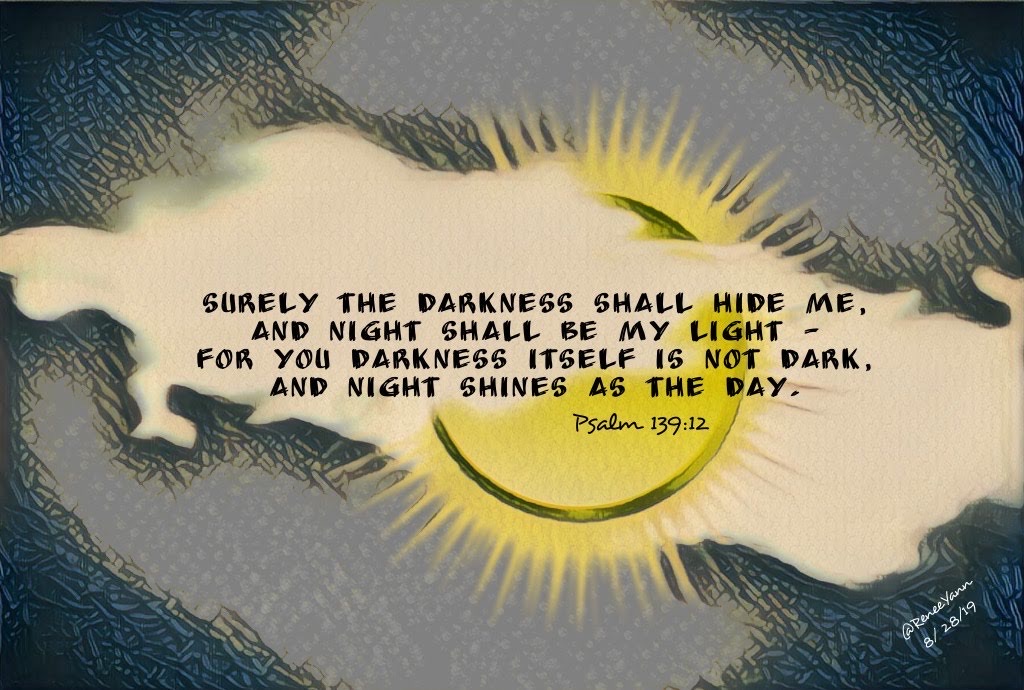

Psalm 139
For the director of music. Of David. A psalm.
1
You have searched me, Lord,
and you know me.
2
You know when I sit and when I rise;
you perceive my thoughts from afar.
3
You discern my going out and my lying down;
you are familiar with all my ways.
4
Before a word is on my tongue
you, Lord, know it completely.
5
You hem me in behind and before,
and you lay your hand upon me.
6
Such knowledge is too wonderful for me,
too lofty for me to attain.
7
Where can I go from your Spirit?
Where can I flee from your presence?
8
If I go up to the heavens, you are there;
if I make my bed in the depths, you are there.
9
If I rise on the wings of the dawn,
if I settle on the far side of the sea,
10
even there your hand will guide me,
your right hand will hold me fast.
11
If I say, “Surely the darkness will hide me
and the light become night around me,”
12
even the darkness will not be dark to you;
the night will shine like the day,
for darkness is as light to you.
13
For you created my inmost being;
you knit me together in my mother’s womb.
14
I praise you because I am fearfully and wonderfully made;
your works are wonderful,
I know that full well.
15
My frame was not hidden from you
when I was made in the secret place,
when I was woven together in the depths of the earth.
16
Your eyes saw my unformed body;
all the days ordained for me were written in your book
before one of them came to be.
17
How precious to me are your thoughts,[a] God!
How vast is the sum of them!
18
Were I to count them,
they would outnumber the grains of sand—
when I awake, I am still with you.
19
If only you, God, would slay the wicked!
Away from me, you who are bloodthirsty!
20
They speak of you with evil intent;
your adversaries misuse your name.
21
Do I not hate those who hate you, Lord,
and abhor those who are in rebellion against you?
22
I have nothing but hatred for them;
I count them my enemies.
23
Search me, God, and know my heart;
test me and know my anxious thoughts.
24
See if there is any offensive way in me,
and lead me in the way everlasting.
O God, You Search Me and You Know Me- Bernadette Farrell
 Lavish Mercy