Today, in Mercy, danger continues to escalate for Jesus.
Our first reading from Jeremiah foreshadows Jesus’s situation. Some powerful people didn’t want to hear what Jeremiah preached. And we can understand why: Jeremiah prophesied the destruction of Jerusalem because of Israel’s unfaithfulness. It’s a message that was hard to swallow.
The core of Jeremiah’s teaching was this: You people have to change. This is not the way God created the world to be.
But the people couldn’t listen. They had let the skewed reality of their lives become normal and needed. They couldn’t accept the world of mutual love and justice that God imagined for them.
Jesus meets the same kind of stonewalling.
In today’s passage, the hard-hearted rationalize their resistance:
“The Christ will not come from Galilee, will he? Does not Scripture say that the Christ will be of David’s family and come from Bethlehem, the village where David lived?”
But their antagonism isn’t really about geography and lineage. It’s about blind comfort in a world balanced toward their advantage. It’s about the fear of grace-inspired change.
Isn’t it the truth that we’ll use almost any argument to resist what demands our conversion? I understand why these guys “each went to his own house”, as the Gospel says in closing. They took refuge from grace in the little pretense of their own control.
They didn’t have the courage to open their hearts to Jesus. Do we?
Music:Spirit, Open My Heart –Alfred V. Fedak
(P.S. For those who grew up with classic rock and roll, check out the second song below.)
Second Song:
While I was drawing today’s picture, I was listening to my 50s playlist. Please don’t think me irreverent, but I was struck how this song (written by Hank Williams and sung by Jerry Lee Lewis) could really be God singing to cold-hearted humanity. I also thought some of you might need a little rock and roll as much as I do right now 🙂 Lyrics below.
Cold Cold Heart
I tried so hard my dear to show that you’re my every dream.
Yet you’re afraid each thing I do is just some evil scheme
A memory from your lonesome past keeps us so far apart
Why can’t I free your doubtful mind and melt your cold cold heart
Another love before my time made your heart sad and blue
And so my heart is paying now for things I didn’t do
In anger unkind words are said that make the teardrops start
Why can’t I free your doubtful mind, and melt your cold cold heart
You’ll never know how much it hurts to see you sit and cry
You know you need and want my love yet you’re afraid to try
Why do you run and hide from life, to try it just ain’t smart
Why can’t I free your doubtful mind and melt your cold cold heart
There was a time when I believed that you belonged to me
But now I know your heart is shackled to a memory
The more I learn to care for you, the more we drift apart
Why can’t I free your doubtful mind and melt your cold cold heart
Today, in Mercy, our reading from the Book of Wisdom clearly describes the machinations and motivations of an evil heart. We see fear, jealousy, control, and greed all strangling the described plotters.
Wisdom also shows us the characteristics of the good heart: justice, holy knowledge, purity, gentleness, patience, strength and perseverance.
The struggle between these two dimensions has defined human interactions ever since Eden.
Our Gospel tells us that these forces met their ultimate contest in the Passion and Death of Jesus Christ. And the Victor has been revealed in the triumph of the Resurrection.
These beliefs are the foundation of our faith, bedrocks we can live by when life’s circumstances test our resolve and courage.
We face such a test right now. Some people ask if God is punishing us, or has God abandoned us. Some people wonder if there is really a God at all who could let this happen to his people.
Today’s readings might help us rebalance our faith and dig deeper into its mysteries – because faith is a relationship, not a handbook. No matter how hard we search, pat answers don’t exist … just the daily learning to which the Gospel invites us.
In the life of Jesus, the Father neither caused evil nor removed it. The Father simply remained one with Jesus – living, loving, suffering with him. God does that with us too.
So when we pray, do we pray for miracles? Sure we do! Some miracles would be really great right now. Even Jesus prayed for that kind of intervention in Gethsemane:
Father, if you will, take this cup from me.
But when that didn’t happen, Jesus stayed the faithful course, trusting that he was already safe in his Father, no matter what swirled around him.
We may want to pray our poignant Responsorial Psalm today, asking God to help us faithfully abide in its promise. Here is a beautiful translation by Steven Mitchell from his book, A Book of Psalms:Reflections Adapted from the Hebrew (Available on Amazon – C)lick here for Amazon
I will bless the Lord at all times; my lips will sing out his praise. I will thank him for the love he has shown me and the clarity that gladdens my heart.
Sing out with me and thank him; be grateful for all his gifts. Turn to him; let your soul feel his presence; oh taste and see that the Lord is good; happy are those who trust him.
You who desire true life and wish to walk on God’s path: Depart from evil; do good; seek peace with all your soul.
The Lord cares for the righteous and watches over the merciful.
He is near when their hearts are broken; when their spirits are crushed, he is with them. And though they may undergo hardships, he fills them with blessings in the end.
Music:The Poor Man Cries – Marty Goetz (Lyrics below)
Lyrics
The Lord On High is very near
To all who call on Him
This poor man cries and He hears
And delivers him from all his fears
For the Lord is nigh to them that fear Him
The contrite will have light never dim
The righteous cry and He hears
And delivers them from all their fears
From all their fears
“Gad-lu l’Adonai ee’ti,
Oon’ ram’ma sh’mo yach-dau”
I will bless Him all my days
His praise shall continually be in my mouth
To the King I sing with pride
And the humble hear
And the sad, are glad in Him
His angels fly ’round those near
If you ever listen close you might hear
You just might hear
“Gad-lu l’Adonai ee’ti,
Oon’ ram’ma sh’mo yach-dau”
I will bless Him all my days
His praise shall continually be in my mouth
He brings good things so I know
He’s always here
Never denied I’m supplied by Him
For He has his eyes on those He holds dear
And He delivers them from all their fears
From all their fears
This Poor Man Cries, and He hears
And delivers him from all his fears, from all his fears
Today, in Mercy, God sends Moses down to straighten out his “depraved people” because, despite all God’sgoodness to them, they have preferred “the golden calf”.
In the deprivations of this pandemic time, when all of us are doing a lot of soul-searching, we are discovering quite a few golden calves still running around in our times.
One of them jumped out at me last night when I read this headline:
Texas’ lieutenant governor suggests grandparents
are willing to die for US economy
I woke up this morning still appalled by the statement.But upon reflection, I realized that Mr. Patrick may have unwittingly done us a great service if we ruthlessly unpack his cavalier remarks.
How have we gotten to a world where such a statement can be uttered and even approved by some? How can we so blatantly ignore basic moral principles such as the sanctity of every life, and that the ends never justify the means? Well, let’s take a look at Moses’ “depraved” community. They seem to have reached a similar moral deprivation.
I think the key lies with the golden calf.The idol is a symbol of the Israelite community’s economy, what they really deem most important, what they really worship when they think God isn’t looking. When they look upon its golden reflection, they see themselves mirrored back the way they want to be – rich, powerful, and dominant. Lt. Governor Patrick’s statement should make us consider how we have become hypnotized by the same idolatries.
Let’s face it.We live in a culture that has normalized war, capital punishment, abortion, illegal detention, corporate hijacking of natural resources, unchecked pollution, and commercialization of deadly substances like tobacco. Why are we surprised that we’re ready to sacrifice the elderly to preserve the sheen on our “golden calf”?
We have created a world where we welcome information sources that tell us lies just so we can be falsely convinced and dangerously indifferent. It’s really hard to discern a moral path amidst today’s political complexities. So let’s just build that golden calf whose mesmerizing patina permits us to remain morally comatose!
I hope we allow this man’s callous commentary to continue to stab our consciences:
Somebody’s beloved can die
not only so that my beloved can live,
but can also have an undamaged economy.
What “economy”, for God’s sake? Does he mean the one where over 40 million Americans and nearly 800 million worldwide face daily hunger? Or where 80 million Americans have inadequate or no health insurance? Or does he mean the extractive economy which causes two-thirds of the world population to live on less than $10 per day?
I’m pretty sure he means instead the economy of the “ golden calf” where
half of the world’s net wealth belongs to the top 1%
top 10% of adults hold 85%
while the bottom 90% eke out existence onthe remaining 15% of the world’s total wealth
I’m not willing to die to shore up that economy, are you? But I’m sure willing to fight to change it.
So, at least, thanks for inspiring me, Lt. Governor Patrick and God help you!
Music: If There’s a God in Heaven – Elton John – (a song that could reflect how the ancient Israelites struggled with their tortuous journey. (Lyrics below)
Torn from their families
Mothers go hungry
To feed their children
But children go hungry
There’s so many big men
They’re out making millions
When poverty’s profits
Just blame the children
If there’s a God in heaven
What’s he waiting for
If He can’t hear the children
Then he must see the war
But it seems to me
That he leads his lambs
To the slaughter house
And not the promised land
Dying for causes
They don’t understand
We’ve been taking their futures
Right out of their handsThey need the handouts
To hold back the tears
There’s so many crying
But so few that hear
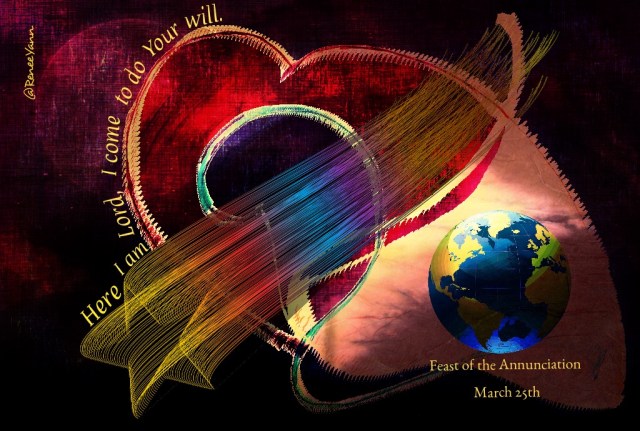
(I hope you will enjoy my reminiscence on this Feast of the Annunciation. I published it previously, but I loved praying with it again this morning. This strange Corona Virus time gives us all a chance to look back over the “salvation history” of our lives. Where were your “calls”, your turning points, your wake-up moments? What do you give thanks for in this moment, as we stand still and look our lives right in the eyes?)
March 25th, fifty-seven years ago, was a pleasantly warm day in Philly, with a strong hint of spring in the air. I remember the day as clearly as if it dawned just this morning.
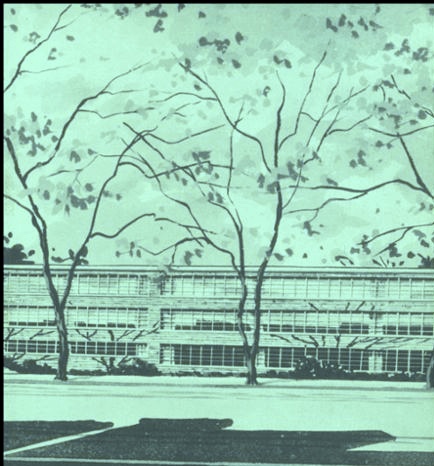
St. Hubert’s HS Windows
I sat in 2nd period senior year math class, glancing at the greening cherry tree at the window, and yearning for graduation. Sister Helen Mary, IHM ( I still remember her even though she thought I was pretty forgettable in math) decided to set the formulas aside and talk about Mary and the Feast of the Annunciation.
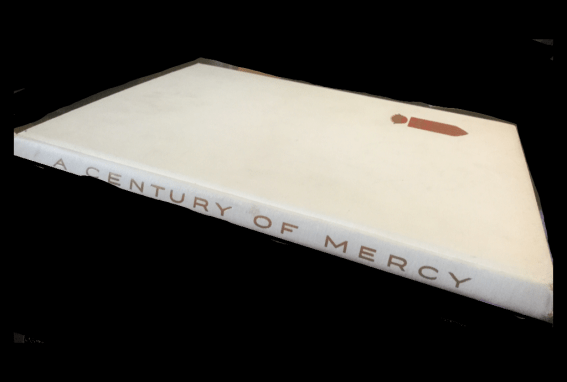
For several years, I had been toying with the thought of a religious vocation – but I hadn’t really given my heart to it. But, just three days before, while meeting up with one of my friends in her home room, I had noticed the Centenary Book of the Sisters of Mercy on Sister Mary Giovanni’s desk. I liked the pictures in it so I asked if I could borrow the book for a night or two.
It had never crossed my mind to consider becoming a Sister of Mercy. I hadn’t really known any until high school. But as soon as I met them I liked them. They were friendly, joyful people with a beautiful mix of humanity and spirituality.
Blissfully reading that book on the evening of March 24th, I opened to the magnificent center page. It is hard to decipher it in the picture, but the motto written above the painting of the Crucifixion deeply touched me, “Love One Another”.
Another page offered a phrase that grabbed my heart and, to this day, has never let it go:
The Sisters of Mercy take a fourth vow of service of the poor, sick and ignorant.
I suppose that, during trig class the next morning, I was already primed for Sister Helen Mary’s talk. She said that Mary responded fully and joyfully when God called her. In a flash as quick as an angel-wing, I decided to do the same.
I left class, found Sister Giovanni and, before 3rd period, I had committed to become a Sister of Mercy.
Now I look back over those fifty-seven glorious years, and my heart sings in thanksgiving for my vocation, my beloved Sisters and the precious people I have served. I turn the ring, given at my profession, and read the cherished motto, “Love One Another “. Our God is a faithful God. Just as He did for MAry, God took a young girl’s gossamer promise and wove it into a divine love story.
I love this powerful poem Annunciation by Denise Levertov. May it enrich us on this sacred feast. Great song after.
Annunciation
by Denise Levertov
‘Hail, space for the uncontained God’
From the Agathistos Hymn, Greece, Sixth Century
We know the scene: the room, variously furnished,
almost always a lectern, a book; always
the tall lily.
Arrived on solemn grandeur of great wings,
the angelic ambassador, standing or hovering,
whom she acknowledges, a guest.
But we are told of meek obedience. No one mentions
courage.
The engendering Spirit
did not enter her without consent.
God waited.
She was free
to accept or to refuse, choice
integral to humanness.
____________________________
Aren’t there annunciations
of one sort or another
in most lives?
Some unwillingly
undertake great destinies,
enact them in sullen pride,
uncomprehending.
More often
those moments
when roads of light and storm
open from darkness in a man or woman,
are turned away from
in dread, in a wave of weakness, in despair
and with relief.
Ordinary lives continue.
God does not smite them.
But the gates close, the pathway vanishes.
______________________________
She had been a child who played, ate, slept
like any other child – but unlike others,
wept only for pity, laughed
in joy not triumph.
Compassion and intelligence
fused in her, indivisible.
Called to a destiny more momentous
than any in all of Time,
she did not quail,
only asked
a simple, ‘How can this be?’
and gravely, courteously,
took to heart the angel’s reply,
perceiving instantly
the astounding ministry she was offered:
to bear in her womb
Infinite weight and lightness; to carry
in hidden, finite inwardness,
nine months of Eternity; to contain
in slender vase of being,
the sum of power –
in narrow flesh,
the sum of light.
Then bring to birth,
push out into air, a Man-child
needing, like any other,
milk and love –
but who was God. From: The Stream & the Sapphire: Selected Poems on Religious Theme
Music: To God Be the Glory – Sandi Patty (Lyrics below)
How can I say thanks
For the things You have done for me?
Things so undeserved,
Yet You gave to prove Your love for me;
The voices of a million angels
Could not express my gratitude.
All that I am and ever hope to be,
I owe it all to Thee.
To God be the glory,
To God be the glory,
To God be the glory
For the things He has done.
With His blood He has saved me,
With His power He has raised me;
To God be the glory
For the things He has done.
Just let me live my life,
Let it pleasing, Lord to Thee,
And if I gain any praise,
Let it go to Calvary.
Today, in Mercy, our readings describe a deep and hidden stream revealed by God –
first to Ezechiel …
The Vision of Ezechiel by Rafael
then to a long-paralyzed man …
The pool of Bethesda, by Schönherr.
So many stories in Scripture are laced with the same theme: there is a infinite mystery hidden under the surface of life:
Keep searching. Keep searching.
The precious pearl that awaits discovery.
The lost coin that must be found.
The mustard seed buried in circumstance.
The stream running deep under appearances.
We might be tempted to dismiss our first reading from Ezechiel as over-described allegory. But its rendition of the slow, steady deepening, through which God leads the prophet, offers us an apt image to reflect on our own graced journey.
Hasn’t God led us gently to the faith we have today? Like young children learning to ride the ocean breakers, we have been taught by a patient God. He returns in every tide to take us deeper into our next capacity for grace.
For thirty-eight years, the man in today’s Gospel has been paralyzed by the water’s edge. Maybe we know how he feels.
He believes that his life is beyond transformation. He cannot dive under the surface of his circumstances to find the quickening waters.
Jesus gives him the key to unlock his paralysis. In a short phrase, Jesus offers the man a multilayered question:
What do you really want in your deepest heart?
When you find the answer, break through all that has kept you from that deepest desire.
Step with Me through the next wave, and the next until, finally, we swim together in the great ocean of covenanted trust.
As our Responsorial Psalm promises:
God is our refuge and our strength, an ever-present help in distress. Therefore we fear not, though the earth be shaken and mountains plunge into the depths of the sea.
There is a stream whose runlets gladden the city of God, the holy dwelling of the Most High. God is in its midst; it shall not be disturbed; God will help it at the break of dawn.
Music: I Am – Marty Goetz (Lyrics below)
Come, behold the works of the Lord
How He has wrought the desolation
How He has brought His early help
The Lord of Hosts is with us
The God of Jacob is our refuge
When the nations rage and all the kingdoms fall
He says I Am, I Am, I Am all
And there’s a river whose streams make glad the city of God
They flow to His Holy habitation
They flow to the home of the Most High
The Lord of Hosts is with us
The God of Jacob is our refuge
He breaks the bow, he shatters the spear
And says I Am, I Am, I Am here!
So we will not fear Though the worlds should change
Though the waters roar
Though the mountains shake and tremble
For He’s a present help in trouble, in trouble
Be still and know that I am God
I Am exalted in the nations
I Am exalted in the earth
The Lord of Hosts is with us
The God of Jacob is our refuge
To the ends of the earth He causes wars to cease and says
I Am, I Am, I Am peace
He says I Am, I Am, I Am peace
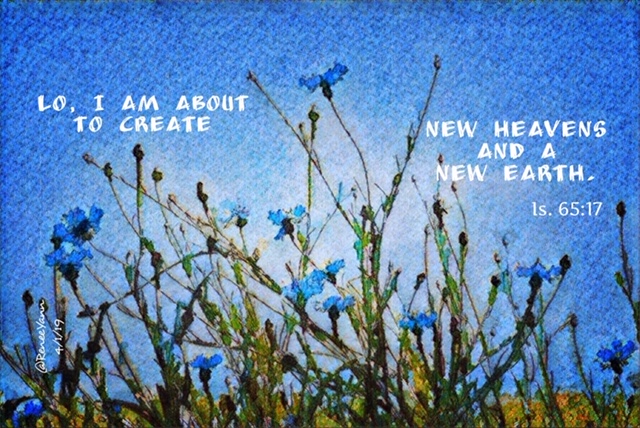
Today, in Mercy, all I can think is, “This passage from Isaiah could not have come at a more perfect time!”
Walter Brueggemann calls Isaiah 65 “a glorious artistic achievement”. Indeed, these images confirm his statement:
a new heavens and a new earth;
constant rejoicing and happiness
people will be a delight
no weeping or crying;
long life for all
everyone with a home
enough for all to eat
As we pray with this passage today, we may experience a longing for a return to our beautiful, safe world. During this pandemic, we all pray from a place of anxiety, loss, constrainment, or some degree of suffering.
Isaiah’s community prayed from the same place. All the beautiful images were a promise not yet realized. The prophetic poetry of Isaiah is a call to courageous hope, not a description of current circumstances.
Faith invites us, even as we experience a bittersweet longing, to trust that God is with us, teaching us and leading us deeper into the Divine Understanding. Even as circumstances turn our world upside down, God will guide the falling pieces to a blessed place if we commit to find God in the tumbling.
I don’t think many of us would deny that the world before Corona needed fixing. The systems we have built have left many in deficit long before 2020, and we have failed to address the wound.
Corona has laid that failure bare.
Now that some of that deficit is universally shared, may we be opened to an irrevocable awareness of our common humanity and responsibility for one another.
Only by such an outcome will we move closer to Isaiah’s peaceful Kingdom. Only by our courage to embrace it, can God fulfill the Promise in us.
March 22nd is the 39th anniversary of my Dad’s death.
I wanted to share this poem with you all because I believe even the darkest times come back to the Light. It’s a good time to remember that.
The Call
The deepest groan
sound ever tore from me
was on the day
my father died.
My brother’s voice
ran through the telephone
in liquid sorrow,
like a strong willow weeping,
holding roots down deep,
but spilling over tenderly
at fragile edges.
With his brave and wounded summons,
a primal broken cry
escaped from me
without my willing it.
It welled up, ebony and viscous,
from the center of my being,
molten, from a fissure
in the rock where I am rooted.
At that moment,
I am certain of it,
my father’s spirit separated
from the earth, or went
down invisible to join it.
When I finally came to him,
through a long journey,
a failing warmth from his blue skin
was all that met me,
and the blue memories waving
in a somnolent field
over his lifeless body,
that I picked, one by one,
like flowers in the silence.
That bouquet is preserved
in my soul as in a white
glass vase. I bring it out
for blessing rites upon
things my father would have blessed
had he not died.
The benediction of these flowers
has fallen now for years
on all the lovely, growing
things in family, in self,
and slowly, over years, they’ve
turned from blue to all the colors
they once were in his heart,
like rainbows
or glass the deeper stained
by setting sun.
Laetare! Rejoice! Lent has run half its distance to Easter.
I know it may be a bit difficult to rejoice in this Corona time, but think of this.
Spring has stepped over the horizon! The long winter watch is over. But before we shake off its black velvet wraps for good, it might be well to think about what winter has taught us. It may strengthen us for this unusually challenging spring!
The stretch of time between November and April is all about waiting. Bulbs wait under the frozen earth. Bears hibernate in the cold mountains. Birds migrate, their old nests empty until the spring. All creation seems to enter a time of patience and unrealized expectation. But it is not a time of desolation. It is a time of hope for things yet unseen. Perhaps we can make our Corona time that kind of hopeful time.
We human beings also experience “winter” – not simply the seasonal one – but “winters of the spirit”. We all go through times when our nests have been emptied; times when all the beautiful flowering aspects of our lives seem dormant; times when our vigor and strength seem to hide in the cave of depression or sadness. These “winters” take many forms. We may find ourselves sick of a job we had always loved. We may find a long, committed relationship wavering. We may find the burdens of age or economics overwhelming us. We may be the unwilling bearers of responsibilities we had not bargained for.
But if we listen, under the deep silence of waning winter, the wind rustles. It carries the hint of a new season. It carries the hope of the renewing cycle of our lives. In that silence, we may be able to hear our own heartbeat more clearly. We may come to a clearer understanding of what is most important in our lives. In the stillness, we may be forced to know and understand ourselves in a deeper way.
In this time of global angst and uncertainty, I think of a powerful image from the works of St. Teresa of Avila. St. Teresa imagines God as a warm healer leaning over our frozen world, setting free the beauty of our spirits. This is what she says:
And God is always there, if you feel wounded. He kneels over this earth like a divine medic, and His love thaws the holy in us.
When we are compassionate and offer one another hope and light, we free what is sacred in us and we do a holy work. Every time you touch another person’s life, — in these times, from at least six feet away — you have the chance to change winter into spring. You have a chance to be like God.
Call someone who may feel very alone. Be “Laetare” for them! Pray for someone suffering illness or loss. Send healing hopes to those you may not even know in distant places of our shared earth. Light, Easter rising and renewed life will come. Let us trust God and hold one another up as we wait.
Today, in Mercy, we are encouraged to pray. Hosea tells us:
“Come, let us return to the LORD, it is he who has rent, but he will heal us; … the LORD will come to us like the rain, like spring rain that waters the earth.”
Let the image of that truth sink into your parched spirit.
Our Gospel leads us to pray humbly:
But the tax collector stood off at a distance and would not even raise his eyes to heaven but beat his breast and prayed, ‘O God, be merciful to me a sinner.’
As we pray humbly today, let us ask for God’s refreshment for all our sisters and brothers across the earth. In good times and in trials, let us always praise God.
I would like to share one of my own poems with you today, as we kneel before God with all struggling Creation begging God for the rain of Mercy.
All Creation
All Creation kneels,
a Single Being,
to praise God.
From its immense heart,
it sings myriad songs at once,
Morning and Evensong,
Praise and Dirge,
Alas and Alleluia,
intermingled
It sings even over its own scars,
where the chasms cry out for balm.
It sings both the remembrance
and the hope of blessing.
It sings the endurance of faith
and the confidence of love.
In roar and silence,
darkness and light,
Creation kneels,
a Single Being,
to praise God.
Music: Total Praise sung by the Brooklyn Tabernacle Choir.Just watching these faith-filled people lifts my heart and gives me hope.I trust it will do the same for you, dear friends as we pray for one another. (Lyrics below)
Lord, I will lift mine eyes to the hills
Knowing my health is coming from You
Your peace You give me in times of the storm
You are the source of my strength,
You are the strength of my life,
I lift my hands in total praise to You
Lord, I will lift mine eyes to the hills
Knowing my health is coming from You
Your peace, You give me in times of the storm
You are the source of my strength
You are the strength of my life
I lift my hands in total praise to You
You are the source of my strength
You are the strength of my life
I lift my hands in total praise to
Amen, Amen, Amen, Amen
You are the source of my strength
You are the strength of my life
Today, in Mercy, I’m going to tell you a story. But first …
In our first reading, the passionate prophet Hosea offers us this quintessential Lenten advice:
Return, O Israel, to the LORD, your God; you have collapsed through your guilt. Take with you words, and return to the LORD
In our Gospel, Jesus is giving advice too. A sincere scribe seeks out Jesus’ wisdom:
One of the scribes came to Jesus and asked him, “Which is the greatest of all the commandments?”
Jesus instructs the scribe:
The Lord our God is Lord alone!
You shall love the Lord your God with all your heart,
with all your soul,
with all your mind,
and with all your strength.
Then Jesus goes on to tell him the second greatest commandment:
You shall love your neighbor as yourself.
Assessing the scribe’s sincerity, Jesus promises him:
“You are not far from the Kingdom of God.”
Praying with these passages on this particular date took me back to March 20, 1963, Wednesday of the 3rd week of Lent that year. I was almost 18 years old and, while not wise as a scribe, I too sought answers to guide my faith.
One place I found thatwisdom was at the desk of a wonderful Sister of Mercy, Sister Mary Giovanni. Like many high school girls back then, I hung around Sister’s homeroom after school. Her good humor, gentle interest, and kind encouragement nourished all of us still slightly silly but ever-so-earnest young women.
On that particular afternoon, an unusual white book sat on Sister’s desk. Its gold letters attracted me and I asked what it was. Sister said it was her community’s centenary book and that, if I wanted, I could borrow it to read.
That little book changed my life. Well, I guess what it actually did was to capture many loose threads running through my mind and heart, and to tie them into a conviction.
I had been toying with a religious vocation ever since third grade. I did love God with my whole heart, just like the young scribe in today’s Gospel. And I loved the nuns and I always wanted to be like them. But actually becoming like them was another story.
That little white book gave me the courage and will to make that commitment. Here’s what it said:
The Sisters of Mercy, in addition to the vows of poverty, chastity and obedience, take a fourth vow of service of the poor, sick, and ignorant.
That was it! That short sentence opened my understanding to see that loving God had to be demonstrated in love of neighbor. The two great commandments are always interdependent.
So I decided to “take my words”, as Hosea encourages, and to ask God if He would have me as a Sister of Mercy.
Less than a week after reading that book, I signed up to become a Sister of Mercy. And I have continued to become one every day for almost 60 years. Because just as Jesus said to the scribe, I believe I am “not far from the Kingdom of Heaven”. But I’m not there yet. Everyday is a chance to grow deeper into the glorious gift that was opened to me back in March 1963.
As you pray with these passages today, take a long view of God’s continuing call in your life. You may have been called to marriage and parenthood, priesthood, a generous single life, a profession which allowed you to serve others.
In each individual call, we are invited to love God with all our hearts and to love others as God loves them. Let’s pray for one another’s continuing deepening in our particular call.
Music: The Call – written by Vaughn Williams from the poetry of George Herbert
(Lyrics below)













 Lavish Mercy