Today, in Mercy, our readings are not reassuring. They basically tell us that it’s a tough world out there, and it might get us – body and/or soul. They tell us to straighten up and live right before it’s too late!
I don’t really like the “in your face” readings, but they certainly are clear and effective. Just picture that poor fig tree, trying like crazy – for three years – to bear fruit! I know that I’ve been trying my whole life to overcomes some of my fruitlessness. I certainly hope God continues to be patient with me!
Nevertheless, the message of today’s Gospel is clear. Don’t take that patience for granted.Repent of any small godlessness you’re clinging to.
Forgive the recent and long ago hurts you’ve locked up inside.
Make amends for any meannesses you can remember.
“Show and Tell” your love to the people who love you.
Show and Tell your blessing to the people who don’t.
Today, in Mercy, having blessed and reassured the Ephesian community of the power of their Baptism, Paul instructs them in how to live a Christian life. He says that their Baptism demands a life worthy of their call.
Do you feel called? In your daily life, do you recognize the demand to witness to a graced life in the face of a sometimes ungracious world?
Paul says that’s what it’s all about:
the humble, gentle, patient exercise of Christian love
the building of inclusive community through acts of peace
the embrace of one God Who claims all humanity as one people
Therefore, anything that suggests hate, aggression, pride or exclusion is not worthy of our Baptismal call.
I watched – or tried not to watch – a few political ads last night. I heard the vitriolic rhetoric before I could tap the mute button. I saw the news clip about the terrorizing of a particular party’s leaders. My heart keeps saying, “What has happened to us?”
And then I read Paul’s admonitions on Christian responsibility.
Even if our culture’s rampant hostility makes us sad and angry, we must respond to it with Christian courage and peace-building action. We must not become like those who stun us with their indifference to life, humanity, morality and truth. We must never make an appeal to religion as an excuse for loveless behavior.
In our Gospel, Jesus challenges his listeners in a similar way:
Why do you not know how to interpret the present time? Why do you not judge for yourselves what is right?
Our times will challenge our Christian character. Will we pass the test?
Today, in Mercy, we are gifted with another magnificently beautiful prayer from Ephesians. Friends, there are times when simply nothing more can be said.
Let your heart kneel in God’s Presence as you savor this powerful prayer:
I kneel before the Father, from whom every family in heaven and on earth takes its name, that he may grant you in accord with the riches of his glory to be strengthened with power through his Spirit in your inner self, and that Christ may dwell in your hearts through faith; that you, rooted and grounded in love, may have strength to comprehend with all the holy ones what is the breadth and length and height and depth, and to know the love of Christ that surpasses knowledge, so that you may be filled with all the fullness of God.
Now to him who is able to accomplish
far more than all we ask or imagine, by the power at work within us, to him be glory in the Church and in Christ Jesus to all generations, forever and ever. Amen.
Today, in Mercy,Paul proclaims his mission to the Gentiles, announcing that through the Gospel, salvation is offered to all people. He says that, by grace, he became a minister of this Gospel – called to preach “the inscrutable riches of Christ”.
And Paul certainly did an extraordinary job. He had been given much by God, and he gave it back wholeheartedly.
In the Gospel, Jesus talks about that same kind of investment. In answer to Peter’s confusion about the call to be ready for God, Jesus tells the story of wily steward.
This servant had been given much: trust, responsibility, power and probably higher pay. But when the master is away, the trusted servant fails him, acting cruelly and greedily in his own interest.
Jesus ends the story with a pronouncement that has always shaken me a little:
For unto whomever much is given, much will be required.
I know I’ve been given a stunning abundance by God: faith, family, friends and a thousand other graces. But my will and ability to give back sometimes feels as fragile as a decaying leaf. Ever feel like that?
It turns out that even Paul, great Apostle to the Gentiles, felt that way too. He says so in his letter to the Corinthians. Paul asks God to remove his fragility.
But He said to me, “My grace is sufficient for you, for my power is made perfect in weakness.”
Let’s pray today to be good stewards of the amazing riches God has given us – in Creation, Faith, Grace and Community. Let us invite God’s power to perfect our weakness, all for the sake of God’s glory.
Even a lacy leaf can be beautiful when it is filled with Light.
Music: My Grace is Sufficient for You – Keith and Amy Amano
Today, in Mercy,Luke’s Gospel describes the expectant fidelity God gives us and desires from us.
The master of the house was away on a long journey. Likely he would have tried to return home in daylight, because the ancient roads were dark and menacing at night. Perhaps the evening meal was already prepared in anticipation of his arrival. But he does not appear over the distant rise where all the household’s eyes are trained.
You know how they waited. You’ve waited for loved ones coming home in bad weather. You’ve waited for beloved holiday guests when flights are delayed or traffic is snarled.
You watch for headlights cresting down the far road. You listen for the sound of a car door closing. Minutes seem like hours. The perfectly prepared meal cools, and your energy slackens as you pick at the olives and breadsticks.
Sometimes our prayer life feels like that. We do all the things necessary to welcome God’s grace, but instead we feel distant from the Divine Presence. We long for God’s warm blessing over the feast of our life, but God tarries somewhere at the other edge of our hope.We feel like these Gospel servants who wait, exhausted, even into the early morning hours.
But we don’t give up. Our hope remains steadfast because God has promised. And it is in that fidelity that our eyes are opened to realize that God had been present all along — just not looking as we had expected.
It turns out that God is the One who had been waiting… waiting for us to see.
Music: A country tune today, maybe overly simple. But I find some country music has a profound nugget of truth buried in the twang. I hope you can enjoy it.
Today, in Mercy, our readings are all about riches. How appropriate that seems in a week where the whole country is absorbed in a $1.6 billion dollar lottery dream!
How many news bits this week showed interviews with John and Jane Q. Public, informing us of how they might use such winnings. Of course, all reports indicated an amazingly altruistic response to a winning ticket. It seems everyone will help his unfortunate brother-in-law, and buy his mail carrier new shoes. Hmm? I wonder?
Not so with Gospel Farmer today. He hits the jackpot in the fields and, as many of us might, decides to keep every last grain for himself. Oops! On the night of that decision, he dies, leaving the grain behind along with his selfish legacy.
Jesus tells us:
Take care to guard against all greed, for though one may be rich, one’s life does not consist of possessions.
Paul tells us what it does consist of:
God, who is rich in mercy, because of the great love he had for us, … brought us to life with Christ, raised us up with him …
We are to live among one another as mirrors of this Divine kindness and richness — not holding on to every last – very transitory- grain of our “possessions”.
Friends, every one of us, through our Baptism, already holds the winning ticket to the only treasure that lasts – eternal life. May our lives reflect that immense grace in deeds of love and mercy.
Today, in Mercy, our readings from Isaiah and Mark sound almost Lenten in tone. Isaiah gives us the image of a broken Jesus, crushed by a “suffering that justifies many”.
Mark recounts the story of the two rather oblivious disciples asking to sit in glory beside Jesus. They do not realize that the path to this glory is through Gethsemane and Calvary.
Jesus asks them the same question he asks us throughout our lives:
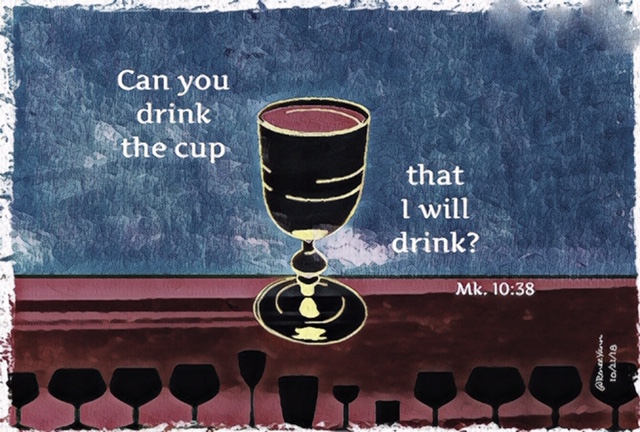
“Can you drink the cup that I will drink?”
We know that there are sacrificial cups of many sizes and shapes among us. Just this past week, with the canonization of St. Oscar Romero, we were reminded of the immense sacrifices of Romero and the Salvador people to practice their faith in dignity.
Each of our sufferings and sacrifices may seem so much smaller by comparison. But when they are united with Christ in faith and hope, they too are redemptive.
We will be asked, as Jesus was, to lay down our life.
It may be in the unselfish raising of a family, or the humble pastoring of a church community.
It may be in the long-term care of an elderly parent or neighbor.
It may be in a ministry of healing, teaching, or encouragement where another requires our labor, patience and mercy.
It may be as a public servant who actually serves, or as a private nurse who tenderly nurses.
It may be as a community member who builds life by respect, responsibility, and mutuality.
We will come to realize, as did the ambitious sons of Zebedee, that true discipleship is not flash and glam. It is the daily choice to quietly lift the cup we have been given, and raise it to the honor of God – in openness, trust, joy and delight that we are called to share in the life of Christ.
Music: The Cup of Salvation ~Shane & Shane (Lyrics below.)
I love the Lord for He heard my voice
And answered my cry for mercy
Because He listened to me
I will call upon Him as long as I live
CHORUS
What shall I render to the Giver of life and who all things are made What shall I render to the One who paints the oceans blue Jesus Christ
I will lift up a cup of salvation Call on the Name of the Lord How do I repay the life that You gave I’ll call on the Name of the Lord Lift up a cup, You have already poured
What kind of rendering is found in this taking
Found in this drinking of love
Love so abundant He meets me in depravity
With one thing to give
CHORUS
You have delivered my soul from death
My eyes from tears
My feet from stumbling
And I will walk before the Lord
In the land of the living
Today, in Mercy, we read the magnificent Ephesians prayer, spoken by Paul over his beloved community — and over us.The phrases are like sacred honey, each one to be individually savored and consumed.
I never cease giving thanks for you
May God give you a spirit of wisdom and revelation
May the eyes of your hearts be enlightened
May you know what is the hope that belongs to God’s call
… what are the riches of glory in his inheritance among the holy ones
… and what is the surpassing greatness of his power for us who believe
Wow! What if we prayed for one another like that? What if we prayed for ourselves like that?
Sometimes we, and our companions on life’s journey, do require prayers for a specific need: recovery from illness, strength in a time of trial, courage in darkness.
But we should pray for one another every day – a prayer that transcends specific needs – a prayer for wisdom, faith, understanding, and wild confidence in God’s lovingpower in our lives.
Such a prayer, like Paul’s, helps create a web of spiritual resilience for our beloveds, around them and within them. This is the power of the Communion of Saints.
Today, in Mercy, on this memorial of Saints John de Brébeuf, Isaac Jogues, and Companions, Paul tells us that we were created “for the praise of His glory”. Paul emphasizes the phrase by using it twice in the first reading.
Thinking about the prayer of praise may remind us of the four types of prayer we learned by nemonic as a child: ACTS.
Adoration
Contrition
Thanksgiving
Supplication
The last three types are prayers centered in the self. They express my regrets, my gratitude, and my needs.But the first type, Adoration, is centered on God – a prayer of awe and absorption into God’s Presence.
That kind of prayer is so important to deepening our relationship with God. We can understand why just by considering our human relationships.
In order to love someone deeply and intimately, we have to forget ourselves and allow ourselves to embrace their reality. It’s very hard to do this. We are naturally self-centered and self-concerned. But through generosity, intentionality and self-sacrifice, we can learn to love unselfishly.
We can learn to love God like this too. Our prayer of adoration may be a shared silence with God. It may be simple phrases we offer in the awareness of God’s Being, as we breathe the breath of God’s life:
You are Beauty….
You are Life….
You are Mercy….
You are Love…
You are…
We let go of time and purpose. We give ourselves to the One who sustains us.
We don’t ask for anything, say thanks or sorry for anything. We simply absorb God’s Presence and return it in praise.
If we feel the need for words to begin this prayer, we might use the first phrases of an old, beloved mantra – the Divine Praises:
Blessed be God. Blessed be God’s Holy Name. Blessed be Jesus Christ, truly God, truly human. Blessed be the Name of Jesus. Blessed be His Most Sacred Heart. Blessed be His Most Precious Blood.
Today, in Mercy, we celebrate the Feast of St. Luke, evangelist, writer of the Gospel and the Acts of the Apostles, and devoted missionary companion of Paul.
Luke’s Gospel is unique in several ways.
Six miracles appear only in Luke:
the miraculous catch of fish
the raising of the widow’s only son
healing a possessed, crippled woman
healing a man with dropsy
cleansing of ten lepers
healing the man’s ear in Gethsemane
Eighteen parables are unique to Luke, including the beloved stories of the Good Samaritan and the Prodigal Son.
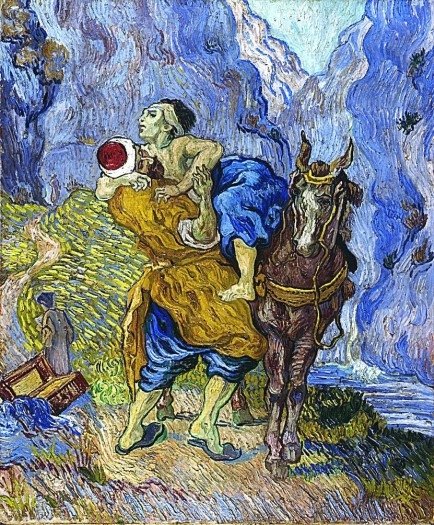
Van Gogh’s Good Samaritan
While both Matthew and Luke contain the story of Christ’s birth, only Luke includes those beautiful passages which now comprise the joyful mysteries of the rosary: Annunciation, Visitation, Nativity, Presentation, and Finding in the Temple.
Only Luke gives us the Magnificat and the cherished words of the Hail Mary.
Think of all that we would not be able to visualize without Luke’s blessed writings. No Gabriel. No Elizabeth, Zachary, Anna or Simeon. No tender Samaritan or merciful loving Prodigal Father to show us God’s face.
Rembrandt’s Prodigal Son
Maybe some of your favorite passages are among these Lucan treasures. You might want to choose one to accompany you throughout your day.
The music today is a country song, not really about St. Luke’s Gospel, but certainly reflecting its love and respect for those who are poor.









 Lavish Mercy