Bearing Fruit

Memorial of Saint Irenaeus, Bishop and Martyr
Wednesday of the Twelfth Week in Ordinary Time
June 28, 2023

Today, in God’s Lavish Mercy, both our readings speak to the call to bear holy fruit for God.

In the passage from Genesis, we are witnesses to a delightful conversation between Abraham and the Lord. The homey tone and mutuality of their exchange reveals Abraham’s great comfort in God’s Presence – to the point of his feeling free to give God some advice:

The Lord said, “Fear not, Abram!
I am your shield;
I will make your reward very great.”

But Abram said,
“O Lord GOD, what good will your gifts be,
if I keep on being childless
and have as my heir the steward of my house, Eliezer?”
Abram continued,
“See, you have given me no offspring,
and so one of my servants will be my heir.”

Genesis 15:1-3

Like many of us, what Abraham doesn’t realize is that God already has him covered. God has a desire and plan for Abraham’s fruitfulness – a dream far beyond any that Abraham can himself conceive.

God took him outside and said:
“Look up at the sky and count the stars, if you can.
Just so,” he added, “shall your descendants be.”
Abram put his faith in the LORD,
who credited it to him as an act of righteousness.

Genesis 15:5-6

The “act of righteousness” described here in Genesis is an offering God asks of each of us in our lives: confident faith expressed in loving action.

Think about it. Abraham and Sarah have waited and waited (for five chapters now) for God’s promise of fruitfulness to transform their barren lives. It hasn’t happened yet! Abraham asks God, “What’s going on????”


Brueggemann says:

The large question (posed in this chapter) is that the promise does delay, even to the point of doubt. It is part of the destiny of our common faith that those who believe the promise and hope against barrenness nevertheless must live with the barrenness.


… the promise does delay,
even to the point of doubt

Oh, my dears, have we not all been there? Have we not all, at some time or another, anguished over the questions of our own fruitfulness, destiny, meaning, survival, relevance in this life? Have we not sometimes wondered if God is even there?


But God is, and will arise out of any barreness or darkness if we can be faithful. God says to us, as to Abraham, “Take it easy, Abe. I gotcha’. Trust me and believe. The “fire pot” and the “flaming torch” are coming. Keep your heart ready!”

When the sun had set and it was dark,
there appeared a smoking fire pot and a flaming torch,
which passed between those pieces.
It was on that occasion that the LORD made a covenant with Abram,
saying: “To your descendants I give this land,
from the Wadi of Egypt to the Great River the Euphrates.”

Genesis 15:17-18

Poetry: The Night Abraham Called to the Stars – Robert Bly

Do you remember the night Abraham first saw
The stars? He cried to Saturn: "You are my Lord!" 
How happy he was! When he saw the Dawn Star,

He cried, "You are my Lord!' 
How destroyed he was 
When he watched them set. 

Friends, he is like us:
We take as our Lord the stars that go down.
We are faithful companions to the unfaithful stars.

We are diggers, like badgers; we love to feel 
The dirt flying out from behind our back claws.
And no one can convince us that mud is not 

Beautiful. It is our badger soul that thinks so.
We are ready to spend the rest of our life
Walking with muddy shoes in the wet fields.

We resemble exiles in the kingdom of the serpent.
We stand in the onion fields looking up at the night.
My heart is a calm potato by day, and a weeping

Abandoned woman by night. 
Friend, tell me what to do,
Since I am a man in love with the setting stars.

Music: Promise Keeper – David Joost
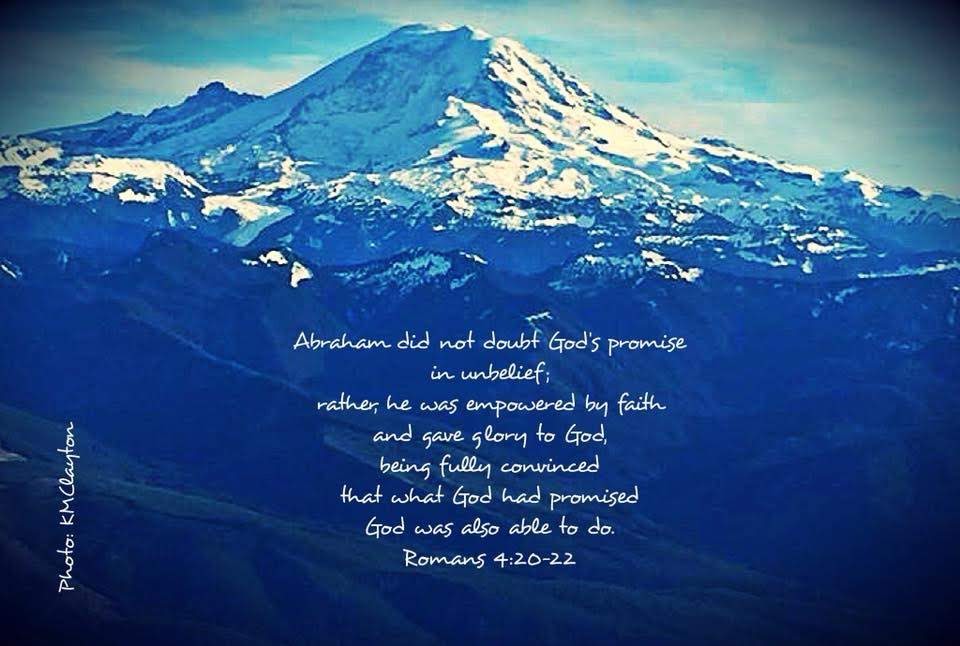
God’s Promises

Monday of the Twelfth Week in Ordinary Time
June 26, 2023

Today’s Readings:

https://bible.usccb.org/bible/readings/062623.cfm


Today, in God’s Lavish Mercy, we begin a pilgrimage with the ancient believers who first received God’s call into a community of faith.

Today’s liturgy initiates a seven-week reading of the Pentateuch (the first five books of the Bible), starting with three weeks of Genesis.


Walter Brueggemann, renowned Hebrew Scriptures scholar, writes that Genesis tells the story of two Divine calls:

  • the call of Creation as God’s handiwork (Genesis 1-11)
  • the call of the faith community as God’s witness (Genesis 12-50)

Gen. 1—11 concerns the affirmation that God calls the world into being to be God’s faithful world.
Gen. 12—50 concerns the affirmation that God calls a special people to be faithfully God’s people.
Genesis is a reflection upon and witness to these two calls. It is concerned with the gifts given in these calls, the demands announced in them, and the various responses evoked by them.

Walter Brueggemann – Genesis: Interpretation: A Bible Commentary for Teaching and Preaching

Our three weeks of readings, from Genesis 12 to 50, focus on that second call of the faith community and can offer us graced insights into our life in the Church and in the world.


As Genesis 11 closes, the condition of the world is rather dire. The descendants of Adam and Noah had been wandering around the Middle East, finally trying to settle down in ancient Babylonia. There they decide to build a city and a tower which they think will make them self-sufficient enough to avoid a second flood. God isn’t pleased. God wants them to be faithful and depend on God not themselves.

So the LORD scattered them from there over all the earth,
and they stopped building the city.
That is why it was called Babel,
because there the LORD confused the speech of all the world.

Genesis 11:8-9

Then, in Genesis 12 (our reading today), God reaches into the scattered chaos with an astounding promise for two elderly, barren, and probably hopeless people. It is a call to renewed and deeper relationship, a call that God has been offering again and again since the beginning of time:

The LORD said to Abram:
“Go forth from the land of your kinsfolk
and from your father’s house to a land that I will show you.

“I will make of you a great nation,
and I will bless you;
I will make your name great,
so that you will be a blessing.
I will bless those who bless you
and curse those who curse you.
All the communities of the earth
shall find blessing in you.”

Genesis 12:1-3

In prayer, we can take any scripture passage and separate its wordy threads to find ourselves. Each one of us, at least at some time in our lives, has been Abraham or Sarah – maybe a little bit alone, confused, feeling disconnected from God and neighbor. Or maybe feeling the weight of aging, tangled in familial labyrinths, or wounded from accumulated miscalculations in our life’s wanderings.

In whatever scattered chaos we may find ourselves, today’s first reading tells us to listen. God’s irrevocable promises are encircling and guiding us to renewed stability. Hearing God’s voice, “Abram went as the LORD directed him”. As we begin these weeks with Genesis, we are invited to do the same.


Poetry: from Selected Poetry of Jessica Powers

    I love Abraham, that old weather-beaten
unwavering nomad; when God called to him,
no tender hand wedged time into his stay.
His faith erupted him into a way
far-off and strange.  How many miles are there
from Ur to Haran?  Where does Canaan lie,
or slow mysterious Egypt sit and wait?
How could he think his ancient thigh would bear
nations, or how consent that Isaac die,
with never an outcry or an anguished prayer?
I think, alas, how I manipulate
dates and decisions, pull apart the dark,
dally with doubts here and with counsels there,
take out old maps and stare.
Was there a call at all, my fears remark.
I cry out: Abraham, old nomad you,
are you my father?  Come to me in pity.
Mine is a far and lonely journey too.

Music: The Yearning – Nicholas Gunn

Will We Live Our Faith Out Loud?

Tuesday of the Twelfth Week in Ordinary Time

June 25, 2019

Click here for readings

Today, in Mercy, we begin several weeks of readings from the Book of Genesis. 

Some people think of Genesis as a literal history. Others think of it more as a myth. Was there a real Adam and Eve? A real apple? A real snake?

When we get caught up in these ambivalences about Genesis, we are likely to miss the whole point. And the whole point, according to Hebrew Scripture scholar Walter Brueggemann is this:

… these texts should be taken neither as history nor as myth.
Rather, we insist that the text is a proclamation
of God’s decisive dealings with his creation. 


“God’s decisive dealings with God’s Creation…”

What a powerful phrase! So over the next few weeks, here is our opportunity:

How does God want to be with us,
to love us,
and to share the ongoing Creation with us?


Today’s reading, according to Brueggemann, is the second part of a four-part drama:

Genesis 11: 30—25: 18 “The Embraced Call of God”
Will Abraham live by faith? 

This second segment poses a profound question to us, and to our Church:
Have we embraced God’s call in our lives and will we live our faith OUT LOUD!

Jesus asks us the same question in today’s Gospel: Will we live our faith OUT LOUD?


Will we:
“Do to others whatever you would have them do to you.”

cage

How to help children at the border and in inhuman detention centers:

Click here.


Music: By Faith -Keith and Kristyn Getty

Genesis – Get Out of My Garden!

Saturday, February 16, 2019

Click here for readings

in every age

Today, in Mercy, Adam and Eve get to “pay the piper”. Now, they have to answer to God for the delicious, forbidden bite!

And God is tough on them! No hint of that “lavish mercy”! Of course, the writer(s) of Genesis had to fold a lot of explanations into this story such as:

  • why we feel body shame
  • why we are estranged from nature
  • why women suffer labor
  • why men work hard to no avail
  • why we die

We know that these explanations were written originally to meet the questions of an ancient culture. They were told and retold in the form of a story with all that structure’s inherent possibilities and handicaps.

Some of us are inclined to accept “story” only as history, demanding that the events recount specific concrete people and interactions. In other words, we demand that Adam and Eve were real people with a historical identity.

Some of us accept the “story” only as myth, not necessarily integral to the foundation of our modern faith.

The great biblical scholar Walter Bruggemann says neither stance is accurate. He says that these sacred stories are “mystery” which continue to unfold through the ages in the faith-life and sharing of the living community.

As we pray with these passages, we may deepen our faith by looking for the revelations within them:

  • God created us in God’s own image
  • God formed a covenant of love with us
  • We are called to be responsive to that loving covenant 
  • We sometimes fail and reap the fruits of that failure
  • But God did not dissolve Creation nor the Covenant
  • And so, in every age, we place our hope in Jesus Christ, the New Creation and New Covenant

Music: In Every Age ~ Janet Sullivan Whitaker

Original Innocence

Wednesday, February 13, 2019

Click here for Readings

Today, in Mercy, Genesis gives us a picture of our “Original Innocence“. It is a beautiful story, the earth freshly sprung from nothingness, our Ancient Ancestor cradled to life in the palm of God’s hand.

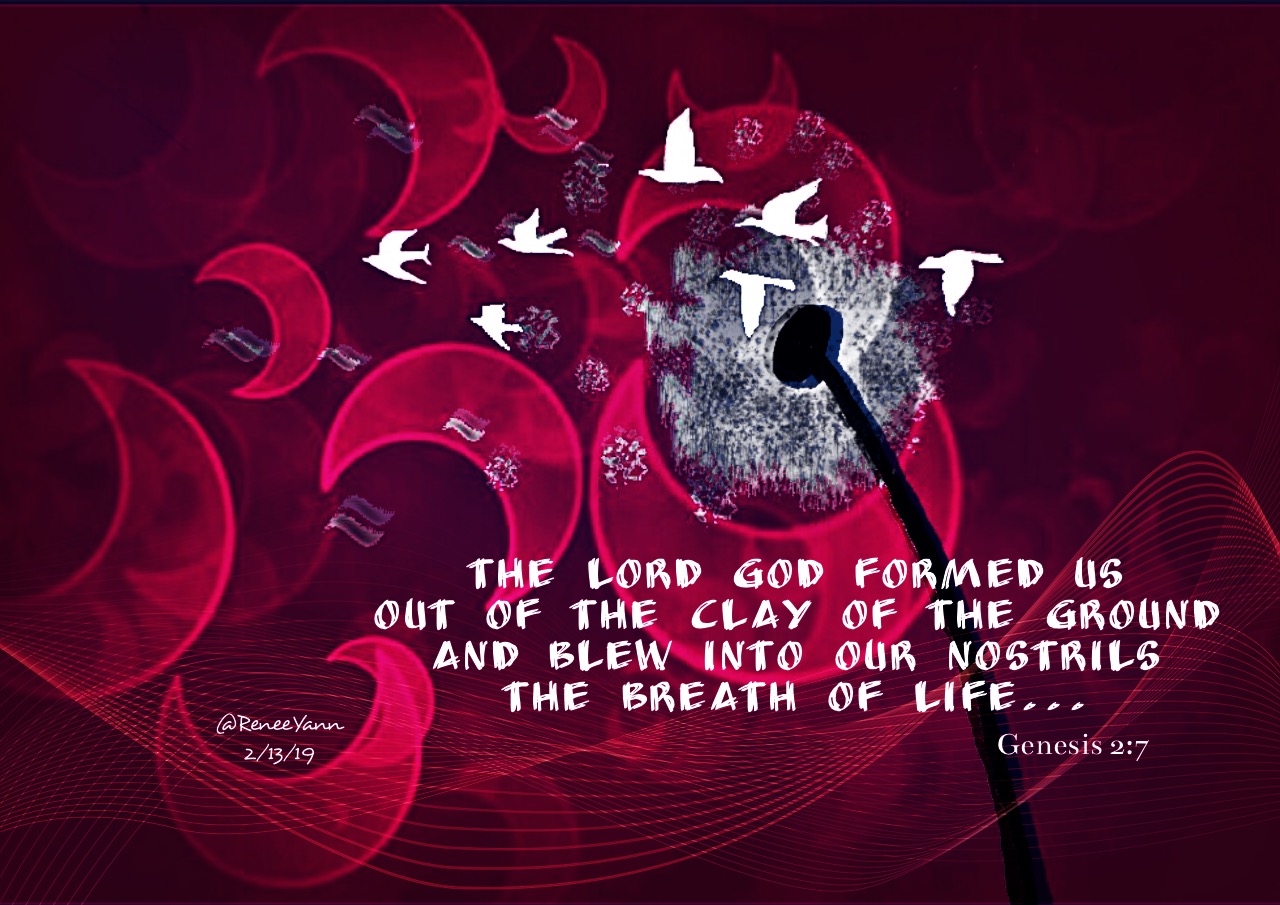
Gen2_7 breath

See God gazing at this work of his fingers, bending over it in love. See God draw up his own eternal breath and gently whisper it into this yet lifeless image of God’s own Divinity.

Adam bursts forth, the dazzling image of God Who, liking what He has made, draws a second, even more lovely creature from its side.

All was given to these two glorious creatures – all but the right to consume the knowledge of good and evil. It almost seems that God feared their innocence could not sustain such knowledge. And it ensues that God is right (of course!)

The elegantly profound poet Ranier Maria Rilke captures the drama with this poem:

I read it here in your very Word

I read it here in your very Word,
From the story of the gestures
With which your hands cupped themselves
Around our becoming, warm and wise.

 You said, live loudly and die softly,
And over and over again you said: be.

But before the first death came Murder.

At this, a rift tore
through your ripened spheres,
And a crying-out,
And tore away the voices
That had just begun to gather
To speak you
To carry you,
Over the chasm of everything–

 And what they’ve since then stammered
Are fragments
Of your ancient name.

I’ll leave you with this poem, and with your own prayerful thoughts on the divine image of your soul, its original innocence, and the reclamation of that innocence in the gift of Jesus Christ.

Music: For the Music of Creation ~ Shirley Elena Murray & Daniel Nelson
(Lyrics below)

For the music of creation,
for the song your Spirit sings,
for your sound’s divine expression,
burst of joy in living things:

       God, our God, the world’s composer,
hear us, echoes of your voice —
music is your art, your glory,
let the human heart rejoice!

Psalms and symphonies exalt you,
drum and trumpet, string and reed,
simple melodies acclaim you,
tunes that rise from deepest need,

       hymns of longing and belonging,
carols from a cheerful throat,
lilt of lullaby and lovesong
catching heaven in a note.

All the voices of the ages
in transcendent chorus meet,
worship lifting up the senses,
hands that praise, and dancing feet;

       over discord and division
music speaks your joy and peace,
harmony of earth and heaven,
song of God that cannot cease.

Incline My Heart

Tuesday, February 12, 2019

Click here for Readings

Today, in Mercy, we launch into about two weeks of readings from Genesis and from Mark.

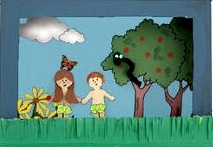
Adam and Eve


The story of Genesis is one of the first Bible stories we learn as children. Because of this, some of us, myself included, tend to read Genesis on a simplistic level, picturing the now unattainable Garden, the first animals, and the humans ultimately dressed in their grassy outfits. 


These two weeks offer us a great opportunity to take our understanding of this beautiful book up a notch.

Imagine what the Genesis story meant to the first community to hear it! Their faith had been invested in an array of gods, both friendly and inimical, who seemed to control their daily experiences. Many times, these gods were in competition among themselves with disastrous results for humans!

By contrast, the God of Genesis is One God, All-Powerful and All-Knowing – the Author of all Creation. Human beings are created in the image of this One God with Whom they are in unique and special covenant. 

Roger Nam, Associate Professor of Biblical Studies at George Fox Evangelical Seminary in Portland, Oregon, summarizes this special character of Genesis. I found his description helpful to my prayer:

As you consider the wondrous nature of creation, it is important to recognize the radical, remarkable, and revolutionary nature of the Genesis creation in its original context. This presentation of God comes as a wonderful relief and assurance to the family of ancient Israel.

The God of Genesis 1-2:4a provides assurance to those who work to raise crops against their numerous natural challenges. The God of Genesis 1-2:4 brings peace to the nation struggling for survival against the numerous encroaching enemies from all sides. God is one. God is powerful. And God created us in his image. This opening passage of our Bible constitutes the essence of good news.

As we pray today, we might ask God to conform our hearts to the perfect order of Creation, the Law and Covenant of Mutual Love. We pray with today’s responsorial psalm:

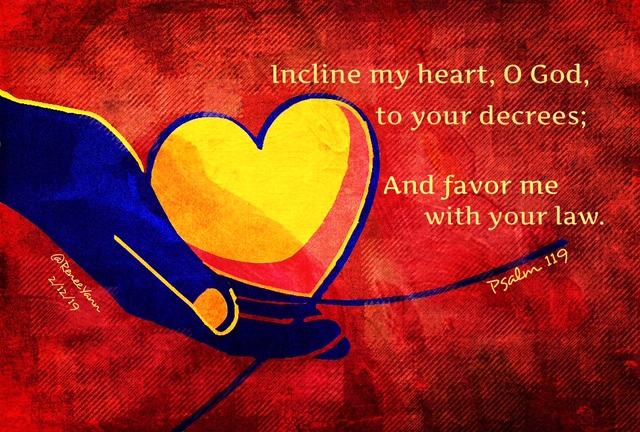
Ps119 incline my heart

Instead of music today, a reflective reading from Genesis: