The Lord GOD is my help, therefore I am not disgraced; I have set my face like flint, knowing that I shall not be put to shame. He is near who upholds my right; if anyone wishes to oppose me, let us appear together. Who disputes my right? Let him confront me. See, the Lord GOD is my help; who will prove me wrong?
Isaiah 50: 7-8
Have you had moments in your life when you’ve said to yourself, “This is it. Like it or not, face the music.”?
Some of these times are unhappy, even scary. Some of them are just overwhelming. But they are times when we realize we have no choice but to go forward – that the time has come for whatever the life-changing reality is before us.
Jesus is at such a moment. All the energies of his life have now converged to this confrontational moment where he fully discovers his Oneness with the Father and Holy Spirit.
Today, in God’s Lavish Mercy:
We examine our own lives, and the shared life we live in the global community. How might the pattern of Jesus’s life, particularly in these critical moments, teach us the way to holiness and wholeness?
Poetry: from Philippians 2
I have always found this passage from Philippians to speak so much more than the printed words which carry it.
Let each of you look not only to your own interests,
but also to the interests of others.
Have this mind among yourselves,
which was in Christ Jesus, who,
though he was in the form of God,
did not consider equality with God
something thing to be grasped at,
but emptied himself,
taking the form of a servant,
being born in human likeness.
And being found in human form,
he humbled himself and became obedient unto death,
even death on a cross.
Therefore God has highly exalted him
and bestowed on him the name
which is above every other name,
so that at Jesus' Name, every knee should bend,
in heaven and on earth and under the earth,
and every tongue proclaim
to the glory of God the Father,
that Jesus Christ is Lord.
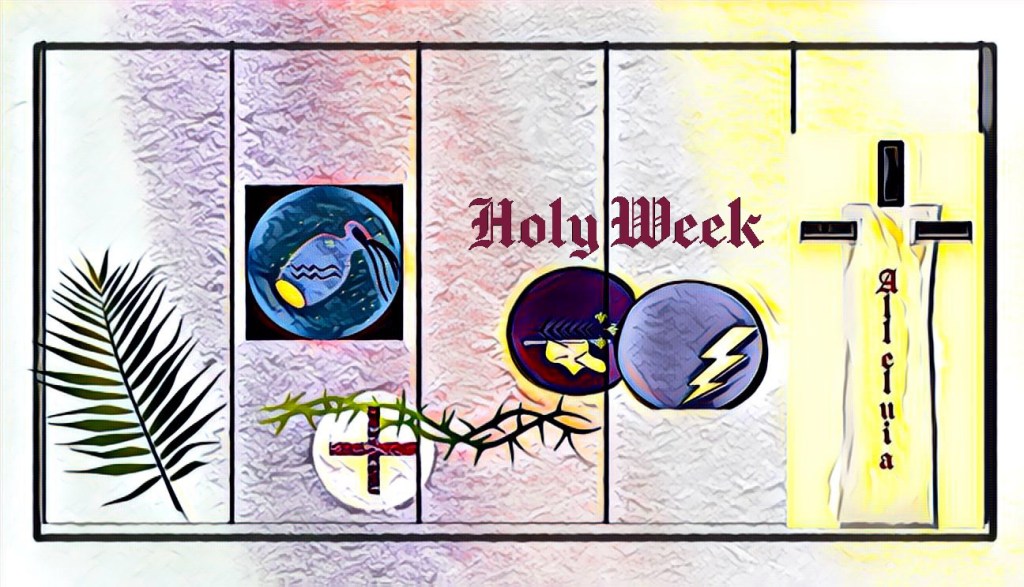
Holy Week and Eastertide are times of sacred journey for Christians. We walk with Christ into the true and deepest dimensions of our lives.
All life is about journey and passage. At some time in each of our lives, we are passing:
from emptiness to abundance
from loneliness to love
from exhaustion to renewal
from anxiety to peace
from burden to freedom
from confusion to understanding
from bitterness to forgiveness
from pain to healing
from mourning to remembrance
The great Feasts of Holy Week and Easter, and the reflective weeks that follow, assure us that God accompanies us in all our journeys from darkness to light. The sacredness of these days invites us to quietly name whatever darkness surrounds us and our global family, and to reach through it to the hand of God. Like a parent leading a child in from the storm, the God of Easter longs to bring our hearts home to fullness and joy.
During these coming weeks, I will continue offering reflections centered on a single word, since many of you have expressed to me an appreciation for this approach. In the archives listed on the right of the blog, you can access more extensive reflections for each day of the liturgical cycle, accumulated over the past six years.
As we begin these sacred days, let’s pray for one another. And let us pray particularly for those whose current lives are closely patterned on the sufferings of Christ that, with Him, they may be strengthened with Easter hope and courage.
Today, in God’s Lavish Mercy, the clouds thicken around Jesus.
Reclining at table with his disciples, Jesus was deeply troubled and testified, “Amen, amen, I say to you, one of you will betray me.” The disciples looked at one another, at a loss as to whom he meant.
John 13:21
How painful for Jesus, and for these who have shared the glorious years of his ministry, to now sit with suspicion among yesterday’s friends. How lonely for each one as the dark force of doubt pushes them away from one another!
Only love can break through this kind of doubt, courageously exposing the truth in order that it might be reconciled and offered forgiveness:
One of his disciples, the one whom Jesus loved, was reclining at Jesus’ side. So Simon Peter nodded to him to find out whom he meant. He leaned back against Jesus’ chest and said to him, “Master, who is it?”
Jesus answered, “It is the one to whom I hand the morsel after I have dipped it.” So he dipped the morsel and took it and handed it to Judas, son of Simon the Iscariot.
John 13: 21-26
As the rest of the Passion story unfolds, both Judas and Peter will need the kind of forgiveness these readings describe. Both prove false to Jesus’s trust. But one has the humble contrition to seek forgiveness. The other cannot forget himself enough to do so.
This “doubtful Tuesday” can teach us much about expectations, courage, truth, love, trust, humility, and forgiveness. Let us sit beside Jesus at the Gospel table and ask him, like the Disciples, how we measure up to his hope for us.
Poetry: Christ Washed the Feet of Judas – George Marion McClellan
Christ washed the feet of Judas! The dark and evil passions of his soul, His secret plot, and sordidness complete, His hate, his purposing, Christ knew the whole. And still in love he stooped and washed his feet.
Christ washed the feet of Judas! Yet all his lurking sin was bare to him, His bargain with the priest, and more than this, In Olivet, beneath the moonlight dim, Aforehand knew and felt his treacherous kiss.
Christ washed the feet of Judas! And so ineffable his love ’twas meet, That pity fill his great forgiving heart, And tenderly to wash the traitor’s feet, Who in his Lord had basely sold his part.
Christ washed the feet of Judas! And thus a girded servant, self-abased, Taught that no wrong this side the gate of heaven Was ever too great to wholly be effaced, And though unasked, in spirit be forgiven.
And so if we have ever felt the wrong Of Trampled rights, of caste, it matters not, What e’er the soul has felt or suffered long, Oh, heart! this one thing should not be forgot: Christ washed the feet of Judas
Music: The Kiss – Joe Niemand
Meet me in the garden My love Meet me there at midnight
At the place only we know My love A kiss awaits tonight
In the darkness between the flowers My love In the shadows of the moon
Your lips will tear the pretense like the curtain tomorrow afternoon
And so the glow of approaching torches Makes the darkness dance like black flames Ever faster to the music of every heart that refuses to be saved
I prayed this could be different That my death could save you too But your choices are your own Now my friend, do what you came to do
Today, in God’s Lavish Mercy we find Jesus standing at the edge of Light and Darkness.
Isaiah, speaking in the Father’s voice, summons and commissions Jesus to the act of Redemption:
Thus says God, the LORD, who created the heavens and stretched them out, who spreads out the earth with its crops, Who gives breath to its people and spirit to those who walk on it:
I, the LORD, have called you for the victory of justice, I have grasped you by the hand; I formed you, and set you as a covenant of the people, a light for the nations,
To open the eyes of the blind, to bring out prisoners from confinement, and from the dungeon, those who live in darkness.
Isaiah 42: 1-8
The divine mandate is triumphant in tone and looks to the other side of Good Friday for its power and hope. But Jesus is no fool. He realizes that Sunday’s paper-thin adulation will shrivel in the coming week’s turmoil. He knows that before the Alleluias sound there will be a sorrowful adagio.
So as enemies seethe in Jerusalem’s shadows, Jesus seeks the light and warmth of his beloved friends. Among them, Mary in particular reaches into his silence, touching threads of hope tangled with disappointment, of courage knotted with fear.
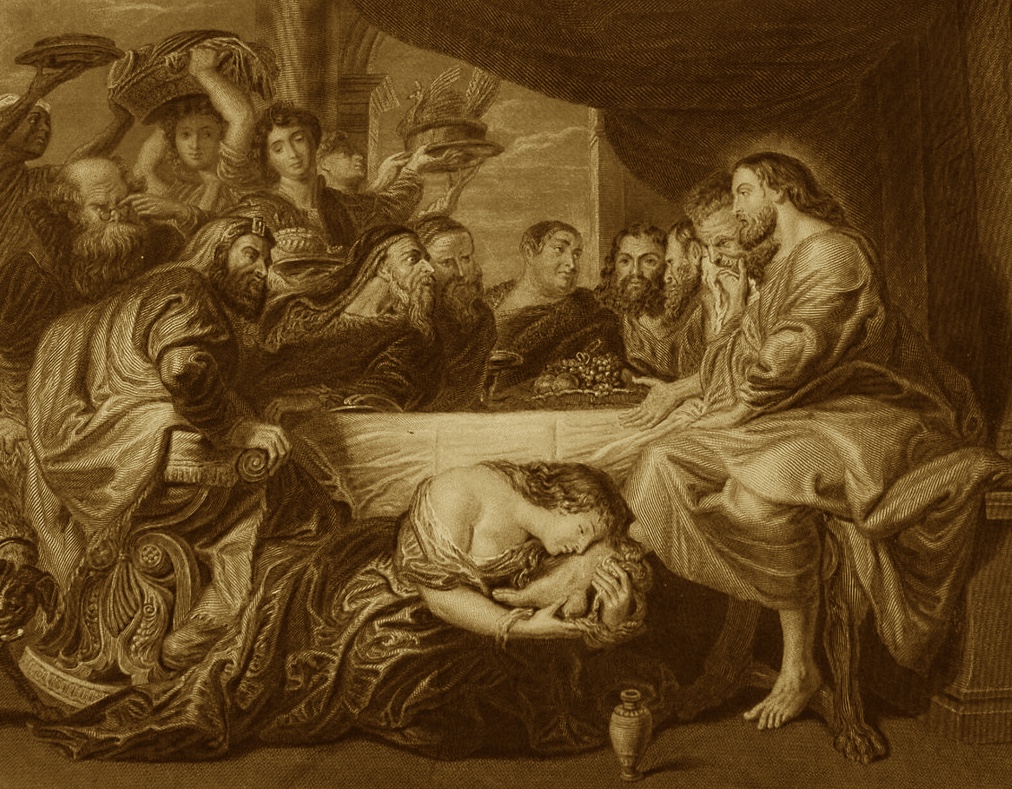
In Bethany, they gave a dinner for him, and Martha served, while Lazarus was one of those reclining at table with him. Mary took a liter of costly perfumed oil made from genuine aromatic nard and anointed the feet of Jesus and dried them with her hair; the house was filled with the fragrance of the oil.
John 12: 1-3
Into this warm comfort, Judas injects his icy venom. This is no surprise to John who clearly describes Judas not as a spontaneous betrayer, but as a long-smoldering “thief” who had never fully embraced his discipleship:
Then Judas the Iscariot, one of his disciples, and the one who would betray him, said, “Why was this oil not sold for three hundred days’ wages and given to the poor?” He said this not because he cared about the poor but because he was a thief and held the money bag and used to steal the contributions.
John 12: 4-6
Today’s readings are filled with the emotions and personalities that Jesus experienced. We will find ourselves somewhere among these as we walk by his side toward Calvary.
Poetry: I Should Not Dare to Leave My Friend – Emily Dickinson
I should not dare to leave my friend,
Because—because if he should die
While I was gone—and I—too late—
Should reach the Heart that wanted me—
If I should disappoint the eyes
That hunted—hunted so—to see—
And could not bear to shut until
They ‘noticed’ me—they noticed me—
If I should stab the patient faith
So sure I’d come—so sure I’d come—
It listening—listening—went to sleep—
Telling my tardy name—
My Heart would wish it broke before—
Since breaking then—since breaking then—
Were useless as next morning’s sun—
Where midnight frosts—had lain!
Music: Gautier Capuçon & friends play Adagio in G minor (Albinoni, arr. Werner Thomas-Mifune)
Today, in God’s Lavish Mercy, the betrayal of Jesus continues, as does his mounting courage to endure its consequences.
In our first reading, the experience of the prophet Isaiah foreshadows that of Jesus. We can hear Jesus praying in Isaiah’s words:
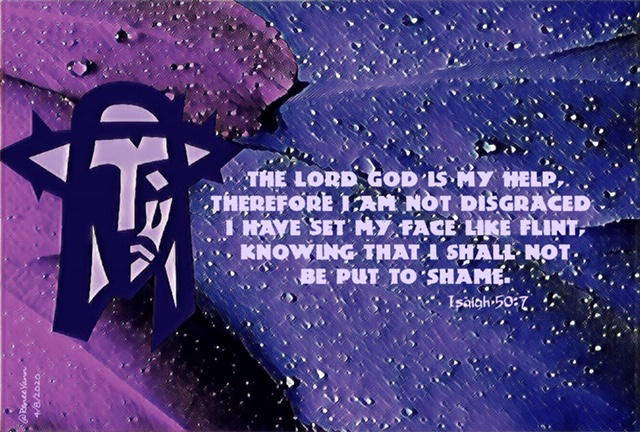
The Lord GOD is my help, therefore I am not disgraced; I have set my face like flint, knowing that I shall not be put to shame. He is near who upholds my right; if anyone wishes to oppose me, let us appear together. Who disputes my right? Let him confront me. See, the Lord GOD is my help; who will prove me wrong?
Isaiah 50:7-8
We hear Christ’s transcendent openness to the Father’s accompaniment:
Morning after morning God opens my ear that I may hear; And I have not rebelled, have not turned back.
We hear Christ’s courage to face what life unfolds before him:
I gave my back to those who beat me, my cheeks to those who plucked my beard; My face I did not shield from buffets and spitting.
We hear Christ’s utter commitment, despite suffering, to the Father’s Presence:
The Lord GOD is my help, therefore I am not disgraced; I have set my face like flint, knowing that I shall not be put to shame.
As we pray with Jesus today, may we:
hear God’s purpose in our lives.
see grace unfold in all our circumstances
set our hearts, like flint, upon faith and trust in God
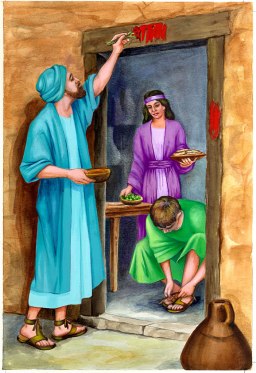
As our Jewish sisters and brothers will begin the Passover celebration this Friday, their rich faith heritage inspires us always to find God in the journey, no matter where it leads us.
In the Gospel’s Passover moment, Jesus walks toward the painful experience of Gethsemane. He invites us to come and receive the reassuring blessing of his Father even as the night shadows fall.
Poetry: The Garden of Gethsemane – by Boris Pasternak who won the Nobel Prize for Literature after writing Dr. Zhivago
Indifferently, the glimmer of stars Lit up the turning in the road. The road went round the Mount of Olives, Below it the Kedron flowed.
The meadow suddenly stopped half-way. The Milky Way went on from there. The grey and silver olive trees Were trying to march into thin air.
There was a garden at the meadow’s end. And leaving the disciples by the wall, He said: ‘My soul is sorrowful unto death, Tarry ye here, and watch with Me awhile.’
Without a struggle He renounced Omnipotence and miracles As if they had been borrowed things, And now He was a mortal among mortals.
The night’s far reaches seemed a region Of nothing and annihilation. All The universe was uninhabited. There was no life outside the garden wall.
And looking at those dark abysses, Empty and endless, bottomless deeps, He prayed the Father, in a bloody sweat, To let this cup pass from His lips.
Assuaging mortal agony with prayer, He left the garden. By the road he found Disciples, overcome by drowsiness, Asleep spreadeagled on the ground.
He wakened them: ‘The Lord has deemed you worthy To live in My time. Is it worthiness To sleep in the hour when the Son of Man Must give Himself into the hands of sinners?’
And hardly had He spoken, when a mob Of slaves, a ragged multitude, appeared With torches, sowards, and Judas at their head Shaping a traitor’s kiss behind his beard.
Peter with his sword resisted them And severed one man’s ear. But then he heard These words: ‘The sword is no solution. Put up your blade, man, in its scabbard.
Could not My Father instantly send down Legions of angels in one thunderous gust? Before a hair of my head was touched, My enemies would scatter like the dust.
But now the book of life has reached a page Most precious and most holy. What the pen Foretold in Scripture here must be fulfilled. Let prophecy come to pass. Amen.
The course of centuries is like a parable And, passing, can catch fire. Now, in the name Of its dread majesty, I am content To suffer and descend into the tomb.
I shall descend and on the third day rise, And as the river rafts float into sight, Towards My Judgement like a string of barges The centuries will float out of the night.’
Music: I Come to the Garden Alone – Sean Clive
I come to the garden alone while the dew is still on the roses, And the voice I hear falling on my ear, The Son of God discloses
And He walks with me and He talks with me, And He tells me I am his own; And the joy we share as we tarry there, None other has ever known
He speaks, and the sound of his voice is so sweet The birds hush their singing, And the melody that He give to me Within my heart is to ringing.
And He walks with me and He talks with me, And He tells me I am his own; And the joy we share as we tarry there, None other has ever known
I stay in the garden with Him, Though the night around me is falling. But He bids me go; through the voice of woe His voice to me is calling.
And He walk with me and He talks with me, And He tells me I am His own; And the joy we share as we tarry there, None other has ever known.
Today, in God’s Lavish Mercy, our Gospel tells the sad story of Jesus’s betrayal by his closest friends.
“Amen, amen, I say to you, one of you will betray me.” The disciples looked at one another, at a loss as to whom he meant. One of his disciples, the one whom Jesus loved, was reclining at Jesus’ side. So Simon Peter nodded to him to find out whom he meant. He leaned back against Jesus’ chest and said to him, “Master, who is it?” Jesus answered, “It is the one to whom I hand the morsel after I have dipped it.” So he dipped the morsel and took it and handed it to Judas, son of Simon the Iscariot. After Judas took the morsel, Satan entered him.
The Last Supper (1630–1631) is an oil painting by Peter Paul Rubens. The painting depicts Jesus and the Apostles during the Last Supper, with Judas dressed in blue turning back towards the viewer and away from the table. Other than Jesus, the most prominent figure is Judas. Judas holds his right hand to his mouth with his eyes avoiding direct contact with the other figures in the painting creating a nervous expression. (Wikipedia)
Pope Francis, in his 2020 Palm Sunday homily, reflected on the depth of these betrayals:
Jesus suffered betrayal by the disciple who sold him and by the disciple who denied him. He was betrayed by the people who sang hosanna to him and then shouted: “Crucify him!” He was betrayed by the religious institution that unjustly condemned him and by the political institution that washed its hands of him.
We can think of all the small or great betrayals that we have suffered in life. It is terrible to discover that a firmly placed trust has been betrayed. From deep within our heart a disappointment surges up that can even make life seem meaningless. This happens because we were born to be loved and to love, and the most painful thing is to be betrayed by someone who promised to be loyal and close to us. We cannot even imagine how painful it was for God who is love.
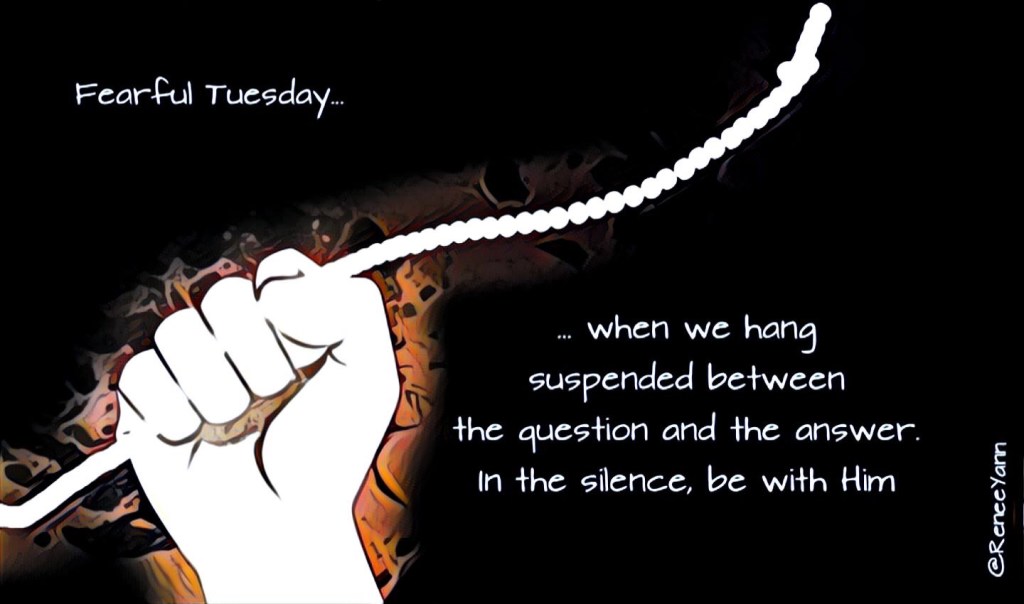
These first three days of Holy Week are like the days in our lives when we know there is a wave of suffering coming but it hasn’t quite broken over us. Something just isn’t right in our bodies, minds, spirits, or in the world around us. In such times, the actual pain might be muted, but the fear, loneliness, anxiety and dark imaginations can be acute.
It’s hard to be with ourselves or with another in this kind of suffering. We see in our Gospel how hard it was for the disciples.
All one really has in such moments are the faith and trust that God ever abides with us. It is the kind of assurance Jesus had with the Father.
As we walk beside Jesus on this Fearful Tuesday, let us confide our sufferings, current or remembered, asking to be gracefully transformed by them. Let us listen to Jesus’s pain and heart-break, asking to be a source of comfort and love to Him.
With Jesus, may we carry in our prayer all those throughout the world suffering abandonment, fear, loss, or betrayal at this painful time.
Saint Judas – James Wright
When I went out to kill myself, I caught
A pack of hoodlums beating up a man.
Running to spare his suffering, I forgot
My name, my number, how my day began,
How soldiers milled around the garden stone
And sang amusing songs; how all that day
Their javelins measured crowds; how I alone
Bargained the proper coins, and slipped away.
Banished from heaven, I found this victim beaten,
Stripped, kneed, and left to cry. Dropping my rope
Aside, I ran, ignored the uniforms:
Then I remembered bread my flesh had eaten,
The kiss that ate my flesh. Flayed without hope,
I held the man for nothing in my arms.
Music: I Will Carry You – Sean Clive You might hear this song in many ways. Perhaps Jesus comforts you with it. Or you might comfort Jesus in his escalating suffering. Or together, Jesus and you may sing it over a suffering world. (Lyrics below)
I will carry you when you are weak. I will carry you when you can’t speak. I will carry you when you can’t pray. I will carry you each night and day.
I will carry you when times are hard. I will carry you both near & far. I’ll be there with you whenever you fall. I will carry you through it all.
My arms are wider than the sky, softer than a little child, stronger than the raging, calming like a gentle breeze. Trust in me to hold on tight because
I will carry you when you can’t stand. I’ll be there for you to hold your hand. And I will show you that you’re never alone. I will carry you and bring you back home.
Not pain, not fear, not death, no nothing at all can separate you from my love. My arms and hands will hold you close. Just reach out and take them in your own. Trust in me to hold on tight. I will carry you.
Today, in God’s Lavish Mercy, our Gospel places a fundamental question before us. How should the precious oil be used – tenderly poured out or reasonably saved? It is a question that challenges us to balance justice with mercy, reality with hope, law with passion. How are we being asked to open our alabaster jar?
This poem by Malcolm Guite may offer inspiration for our prayer:
Come close with Mary, Martha, Lazarus so close the candles stir with their soft breath and kindle heart and soul to flame within us, lit by these mysteries of life and death. For beauty now begins the final movement in quietness and intimate encounter. The alabaster jar of precious ointment is broken open for the world’s true Lover.
The whole room richly fills to feast the senses with all the yearning such a fragrance brings. The heart is mourning but the spirit dances, here at the very center of all things, here at the meeting place of love and loss, we all foresee, and see beyond the cross.
(Malcolm Guite: The Anointing at Bethany)
Jesus, give us courage to accompany you in your final journey. May your passion, death and resurrection bring us new life.
As we make this Holy Week journey, may we prove our love by our actions. May we live generously, hopefully, and gratefully in the Mercy of God.
Music: Pour My Love on You by Craig and Dean Phillips
Today, in God’s Lavish Mercy, we begin a familiar journey.
In a warring, dystopian world, the rites of Holy Week offer us a reassuring pattern for our prayer. As we begin these rituals, we already know where we will joyfully finish. It is a feeling so opposite from our current global concerns which leave us questioning how peace and joy can be restored to the human family.
Through the solemnities of Holy Week, we are reminded that there is nothing we experience not already patterned in the Paschal Mystery. There is nothing we suffer or hope for not already etched on the heart of Jesus Christ.
These liturgies are an invitation to enter into that Sacred Heart, to place our experiences beside those of Jesus. No matter where we find ourselves on the journey, Jesus is with us:
In the confusion of Palm Sunday, tossed between loyalty and betrayal
In the suggestive silence of Holy Monday and Tuesday, when plotters whisper and friends weaken
In the discomfort of Spy Wednesday, when we realize suffering is inevitable
In the profound communion of Holy Thursday
In the loneliness of a decisive Garden and the angst of a resisted outcome
In the inexorable solitude of dying and death
In the other-worldly contemplation of a silent Saturday
In the sunrise of a promise, longed for and believed in
These are profound sacred mysteries which invite us to sink into their depths and be renewed. Let’s be intentional about the time and practices we will give to this invitation.
We are invited into the Life and Passion of Jesus Who, in turn, wants to be with us in our experience of this journey. Each day, let us listen – let us become “obedient” (which means “listening”) – for the very personal whisper of grace in our souls. And even though we may pray alone, let us pray for the whole world suffering and rising with our beloved Savior.
I think today’s reading from Philippians is the most beautiful and pregnant passage in all of scripture. May it guide our prayer during this Holy Week when we all so hunger for God’s presence and healing.
Music: Philippians Hymn – John Michael Talbot (Lyrics below)
And if there be therefore any consolation And if there be therefore any comfort in his love And if there be therefore any fellowship in spirit If any tender mercies and compassion
We will fulfill His joy And we will be like-minded We will fulfill His joy We can dwell in one accord And nothing will be done Through striving or vainglory We will esteem all others better than ourselves
This is the mind of Jesus This is the mind of Our Lord And if we follow Him Then we must be like-minded In all humility We will offer up our love
Though in the form of God He required no reputation Though in the form of God He required nothing but to serve And in the form of God He required only to be human And worthy to receive Required only to give
This is the mind of Jesus This is the mind of Our Lord And if we follow Him Then we must be like-minded In all humility We will offer up our love In all humility We will offer up our love
Today, in God’s Lavish Mercy, worlds are splitting apart, but the Word of God comes to heal them.
In our first reading, we share in the experience of the prophet Ezekiel.
Ezekiel and his wife lived during the Babylonian Captivity on banks of the Chenab River which is in modern day Iraq. He lived during the siege of Jerusalem in 589 BC. In Ezekiel’s day the northern kingdom had been conquered and destroyed 150 years earlier.
In other words, Ezekiel, like his contemporary Jeremiah, had his heart torn apart along with the homeland they cherished as God’s promise to them.
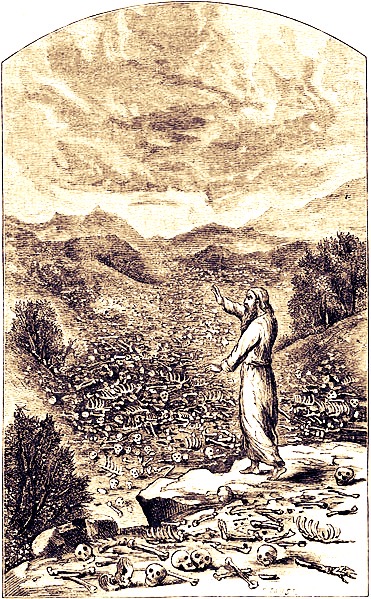
The Valley of the Dry Bones – artist unknown
In today’s reading, which comes immediately after his vision of the Dry Bones, Ezekiel prophesies a message of hope and restoration to a fragmented and devastated nation.
In our Gospel, Jesus is the new Ezekiel. He stands in the midst of the bigger “nation” of all God’s Creation which has been fragmented by the failure to love. Like Ezekiel, Jesus offers a message of hope and restoration to sinners.
In this Gospel, Jesus himself is the “Temple” about to destroyed. The prophecy of its destruction is unwittingly delivered by the high priest Caiaphas:
Caiaphas, who was high priest that year, said to the Pharisees and Sanhedrin, “You know nothing, nor do you consider that it is better for you that one man should die instead of the people, so that the whole nation may not perish.” He did not say this on his own, but since he was high priest for that year, he prophesied that Jesus was going to die for the nation, and not only for the nation, but also to gather into one the dispersed children of God.
John 11: 49-52
Within Christ’s new law of love, these “children of God” go far beyond the Jewish nation. They are you and me, and every other creature with whom we share this time and universe. The fragmentations which separate and alienate us are dissolved in the Passion, Death and Resurrection of Jesus Christ.
Holy Week will begin tomorrow when all believers will intensify their desire to join Christ in his final journey to Resurrection, to understand our own lives anew in the power of Paschal Grace.
Let’s pray for one another, dear friends, for the grace we need to be deepened in the life of Jesus, and for that deepening to bless and heal our suffering world.
Poetry: The New Ezekiel – Emma Lazarus
What, can these dead bones live, whose sap is dried By twenty scorching centuries of wrong? Is this the House of Israel, whose pride Is as a tale that’s told, an ancient song? Are these ignoble relics all that live Of psalmist, priest, and prophet? Can the breath Of very heaven bid these bones revive, Open the graves and clothe the ribs of death?
Yea, Prophesy, the Lord hath said. Again Say to the wind, Come forth and breathe afresh, Even that they may live upon these slain, And bone to bone shall leap, and flesh to flesh. The Spirit is not dead, proclaim the word, Where lay dead bones, a host of armed men stand! I ope your graves, my people, saith the Lord, And I shall place you living in your land.
Music: Make Us One – featuring James Loynes. Written by Sally DeFord (Lyrics below)
Lyrics
How shall we stand amid uncertainty? Where is our comfort in travail? How shall we walk amid infirmity, When feeble limbs are worn and frail? And as we pass through mortal sorrow, How shall our hearts abide the day? Where is the strength the soul may borrow? Teach us thy way.
Chorus: Make us one, that our burdens may be light Make us one as we seek eternal life Unite our hands to serve thy children well Unite us in obedience to thy will. Make us one! teach us, Lord, to be Of one faith, of one heart One in thee. Then shall our souls be filled with charity, Then shall all hate and anger cease And though we strive amid adversity, Yet shall we find thy perfect peace So shall we stand despite our weakness, So shall our strength be strength enough We bring our hearts to thee in meekness; Lord, wilt thou bind them in thy love?
(Repeat chorus)
Take from me this heart of stone, And make it flesh even as thine own Take from me unfeeling pride; Teach me compassion; cast my fear aside. Give us one heart, give us one mind Lord, make us thine Oh, make us thine! (Repeat chorus)
Today, in God’s Lavish Mercy, we pray with Psalm 69. The verses offered for today’s liturgy describe someone who is abused and abandoned by the community he depended on:
Insult has broken my heart, and I am weak, I looked for sympathy, but there was none; for consolers, not one could I find. Rather they put gall in my food, and in my thirst they gave me vinegar to drink.
Psalm 69: 21-22
The psalmist goes on, into today’s passage and throughout the whole psalm, to proclaim his innocence and call on God for justice – one might say even vengeance.
Heap punishment upon their punishment; let them gain from you no vindication. May they be blotted from the book of life; not registered among the just!
Psalm 69: 28-29
Several Gospel writers include parts of Psalm 69 to describe Jesus’s situation throughout his Passion and Death. However, we find Jesus not invoking divine vengeance but forgiving those who persecute him.
Does Christ’s forgiveness mean that he didn’t feel heart-broken, angry, perhaps even wishing, as the psalmist does, that the tables would be turned onto his harassers?
We don’t really know what he felt. We can only imagine. What we do know is what Jesus chose. Jesus chose forgiveness.
As we pray with Psalm 69 today, let us remember that we cannot help our feelings. They come unbidden. What we can control are our choices. In the sufferings of our lives, may we have the strength to choose as Jesus did.
Poetry: John Greenleaf Whittier, ‘Forgiveness’
My heart was heavy, for its trust had been Abused, its kindness answered with foul wrong; So, turning gloomily from my fellow-men, One summer Sabbath day I strolled among The green mounds of the village burial-place; Where, pondering how all human love and hate Find one sad level; and how, soon or late, Wronged and wrongdoer, each with meekened face, And cold hands folded over a still heart, Pass the green threshold of our common grave, Whither all footsteps tend, whence none depart, Awed for myself, and pitying my race, Our common sorrow, like a mighty wave, Swept all my pride away, and trembling I forgave!
Music: Antonio Vivaldi – Domine ad adjuvandum me festina (Psalm 69)
Deus, in adjutorium meum intende. Domine, ad adjuvandum me festina. Gloria Patri et Filio et Spiritui Sancto, sicut erat in principio et nunc et semper et in saecula saeculorum. Amen. Alleluia
O Lord, make speed to save me: O Lord, make haste to help me. Glory be to the Father, and to the Son, and to the Holy Spirit: As it was in the beginning, is now and ever shall be, World without end, Amen. Alleluia.











 Lavish Mercy