Radical Benediction

Monday, June 11, 2018

Readings: http://www.usccb.org/bible/readings/061118.cfm

Today, in Mercy, we begin several weeks of readings from Matthew’s Gospel. In today’s passage, Jesus starts out by turning the world upside-down!

Blessed 6_11_18

In the earlier chapters of his Gospel, Matthew has set the tone for the announcement of Jesus’ message – a new reign of grace and glory. The crowds gather in great anticipation. Most are overwhelmed and beleaguered by life under Roman occupation. Many hope for a political Messiah who will deliver them from their current circumstances, returning to them the material control of their lives. 

Instead, Jesus announces that:

“The kingdom of God can only be received by empty hands. Jesus warns against
(a) worldly self-sufficiency: you trust yourself and your own resources and don’t need God
(b) religious self-sufficiency: you trust your religious attitude and moral life and don’t need Jesus.”
~ Michael H. Crosby, Spirituality of the Beatitudes: Matthew’s Vision for the Church in an Unjust World

We are so used to hearing the Beatitudes that they may have become tamed for us — lovely consolations to the downtrodden that things will eventually be OK. On the contrary, the Sermon on the Mount proclaims a shocking message to those gathered with Jesus — AND to us. The radical blessedness of life is to be found within our ordinary joys and sorrows, embraced humbly, faithfully and joyfully.  It is to be found in right-relationship with all Creation, not in any kind of dominance by one over another – political, economic, or personal.

The poor in spirit, the meek, the bereaved, the justice-seekers, the merciful, the pure of heart, the peacemakers, the persecuted: Jesus says these people are blessed – even FORTUNATE – because there are no barriers between them and the fullness of God. Power, prestige and possessions block us, perhaps even cripple us, from our shared immersion in God’s ever-present love and grace.

It is likely that many who gathered on that Galilean Hill didn’t want to hear Jesus’ astonishing message. Their myopic vision of prosperity was turned upside down. They were challenged to an unexpected, comfort-shattering, radical blessedness. Would they accept the challenge? Will we?

Music:  Blessings ~ Laura Story

An Eternal Weight of Glory

Sunday, June 10, 2018

Readings: http://www.usccb.org/bible/readings/061018.cfm

Today, in Mercy,  is a powerful Sunday!

woke 6_10_18

In our readings, we encounter one of the more perplexing Gospel passages. Jesus, in the thick of controversy with the scribes and Pharisees, goes home to seek some respite. But the crowds follow, harassing him with questions and demands for signs. His friends and family are increasingly concerned for him, as the animosity to his challenging message rises. Some even think he is unhinged to jeopardize himself by confronting the evils and blindnesses of his society. His mother and brothers arrive, concerned for him. When Jesus learns this, he delivers what may seem a hard-hearted comment, “Who are my mother and my brothers?” — they are the ones who do the will of God.

With this question, Jesus is not disowning his family and those who love him. He is stating clearly that, rather than deter him from his redemptive work, they need to open their minds to the deeper purpose of his life. To use a contemporary phrase rooted in the socially conscious African-American community – they need to be “woke” people. 

How hard it must have been for them! How hard to love a prophet, to fear for their safety in times when truth and justice are assailed!

Walter Brueggemann, in my all-time favorite book Prophetic Imagination, says this:

“In both his teaching and his very presence, Jesus of Nazareth presented the ultimate criticism of the royal consciousness (or self-serving power of the dominant state). He has, in fact, dismantled the dominant culture and nullified its claims. The way of his ultimate criticism is his decisive solidarity with marginal people and the accompanying vulnerability required by that solidarity. The only solidarity worth affirming is solidarity characterized by the same helplessness they know and experience.” 

In today’s second reading, Paul is experiencing the same kind of vulnerability as Jesus. Paul says that he is not discouraged for:

“ … although our outer self is wasting away,
our inner self is being renewed day by day.
For this momentary light affliction
is producing for us an eternal weight of glory
beyond all comparison,
as we look not to what is seen but to what is unseen;
for what is seen is transitory, but what is unseen is eternal.”

As Christians, we are called to live prophetic lives in imitation of Jesus. We are called to foster that kind of witness in others, to work together for that “eternal weight of glory”.

The prophet Dorothy Day puts it this way:

“As we come to know the seriousness of the situation, the war, the racism, the poverty in our world, we come to realize that things will not be changed simply by words or demonstrations. Rather, it’s a question of living one’s life in a drastically different way.”

On this powerful Sunday, the message is this: we need to be “woke” people!

Music: Wake Up My Heart ~ The Afters

Corpus Christi

Sunday, June 3, 2018 ~ Corpus Christi

Readings:  http://www.usccb.org/bible/readings/060318.cfm

Pange 6_3_18


Today, in Mercy, we celebrate the Solemnity of the Most Holy Body and Blood of Christ. We just called it “Corpus Christi” when we were young. And I still do. Many of us, of a “certain age”, will remember the extravagant processions through our childhood neighborhoods, the garmented priest carrying the monstrance. Little children and adults accompanied the journeying Christ who blessed our neighbors, families, businesses and playgrounds.

Certainly, our neighborhoods today could use such a blessing. But the practice has become outdated in most parishes. Instead, it is we – the People of God and living Body of Christ – who must carry Christ’s Presence to our neighborhoods, workplaces, schools and commonplaces. How will you be Corpus Christi for the world today?

Music: Pange Lingua written by St. Thomas Aquinas

Let Your “Yes” Be “Yes!”

Friday, May 25, 2018

Readings: http://www.usccb.org/bible/readings/052518.cfm

Today, in Mercy, we once again are faced with “tough talk” readings. James is simply that kind of preacher. And, in the Gospel, Jesus takes on the gnarly topic of adultery. So it’s not going to be sweet inspiration today!

What both readings have in common is the quintessential call to integrity at the core of committed Christian life. Our word, given in compassion and mercy, should be our bond. Our loving care for ourselves and all Creation should be trustworthy and persevering. For a person of faith, “fake news” and “alternative facts” are simply code for the deceitful avoidance of our duty to love one another.

We should not allow deceit, indifference, pretense or abuse to ever adulterate our efforts to love. Respect for ourselves and for other human beings requires that we say “Yes” and “No” honestly. Our reverence for God demands that we offer the same loving veracity to God.

The covenant of marriage, or of religious profession, places this obligation in a particularly bright light. When we give ourselves in commitment to another, and receive their commitment in return, we imitate the Blessed Trinity who exist in the unity of selfless, creative love. This “Yes”or “I do” is tied to our very identity as a person capable of living in the mutuality of love as God does.

James and Jesus tell us today to take every care to treasure and protect such precious commitments by the deep integrity of our hearts.

Holy Trinity Icon by Andrej Rublëv, an Eastern Orthodox monk, considered to be one of the greatest medieval Russian painters of Orthodox icons and frescos.

Music: Russian Orthodox Chant ~ Srtensky Monastery Choir

https://m.youtube.com/watch?v=VyREJRz8wNI

What About the Other Guy?

Saturday, May 19, 2018

Readings: http://www.usccb.org/bible/readings/051918.cfm

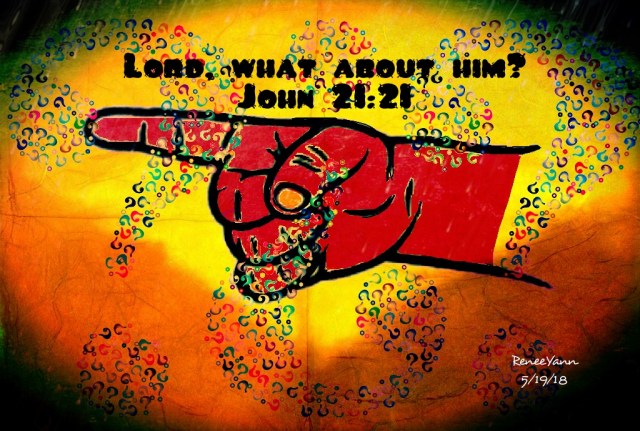
Today, in Mercy, we walk with the Risen Jesus and his dearest disciples along the seashore.  Jesus has just cooked breakfast for the fellas.  He then tells Peter that he is to take Jesus’ place as “shepherd of the lambs and sheep”. Jesus tells Peter that he is to follow in the way of Jesus.  That’s a pretty profound command! Peter knows full well what happened to Jesus.

And dear, earthy, impulsive Peter, turns aside distractedly and notices John.  Peter says, “What about him?” You can almost see Jesus take hold of Peter’s face, turn his eyes directly into Jesus’ own eyes and say, ”Pay attention.  I’m talking to YOU – not him.”

We can love Peter because we’ve all been like him numerous times in our lives.  God is calling, or giving us a message and we distract ourselves from its power by worrying about things that are unimportant or none of our business. We start asking a million questions when there is only one answer: respond with trust.

Jesus’ final words to Peter are ones we might ponder: ”You follow me.”  The implication is that, if we do, then God will take care of the other guy – and everything else.

John 21_21

Music: Follow Me  by Casting Crowns

In this song, you will hear echoes of Jesus’ call to many people throughout the Gospel: the first disciples, the woman taken in adultery, the good thief and, perhaps, even to us.

Do You Love Me?

Friday, May 18, 2018

Readings http://www.usccb.org/bible/readings/051818.cfm

Today, in Mercy, Jesus extracts a pledge from Peter with the question, “Do you love me?” This is a brave question on Jesus’ part. What if Peter’s answer is half-hearted?  But the full-spirited Peter does not disappoint. “Of course, I love You,” he avows. But then, Jesus ups the ante with some “prove it” clauses: “Feed my lambs and my sheep.”

This passage always reminds me of a wonderful scene from Fiddler on the Roof.


What about us? Do we really love Jesus? Pope Gregory the Great says this:

The proof of love is in the works.
Where love exists, it works great things.
But when it ceases to act, it ceases to exist.

Music: If You Love Me ~ Cyprian Consiglio, OSB

We Are God’s Gifts

Thursday, May 17, 2018

Readings: http://www.usccb.org/bible/readings/051718.cfm

Today, in Mercy, in John 17, we are folded into the prayer of Jesus as He talks to the Father about us. We are the humble, silent listeners to a Divine Conversation. Jesus prays that we may be part of His unity with the Father. He calls us His gifts and asks to keep us with Him in eternal life. He asks to live within us through the gift of the Father’s love. These are awesome prayers that may be too much for us to comprehend.

But picture this: a loving parent embracing a frightened or injured child. The parent looks up to heaven, asking God to keep this child safe; to never let them be lost; to fill them with love, joy and life. The praying parent promises to always protect and guide their cherished child like a precious gift and to hold them securely in times of trouble.

This is the way Jesus prays for us. Awesome, indeed!

John17_24

Music: He Will Hold Me Fast ~ Keith and Kristyn Getty

A Thimbleful of Metaphors

Saturday, May 12, 2018

Readings: http://www.usccb.org/bible/readings/051218.cfm

Today, in Mercy, our readings offer us two thoughts about communication. In the passage from Acts, Paul’s senior disciples Priscilla and Aquila need to work with a new young preacher Apollos to make sure he communicates the Word perfectly.

In the Gospel, John indicates that he has been communicating by metaphor, but that the post-Resurrection experience of the Holy Spirit will be clearer than metaphors.

Indeed, John’s writing is full of metaphor to the point that it can seem overwhelming – trying to press an infinite message into the thimble of our human minds. We need to read his Gospel not as we would read a newspaper, but as we would read a poem. This will open our minds to the suggested layers of meaning too big for human words. For example, Jesus was not really a shepherd. But the metaphor of “Good Shepherd” allows us to experience, in just two words, all Christ’s tender and protective love for His followers.

When reading John’s Gospel, it is good to savor it in thimblefuls, like a rich dessert.  Let its metaphorical sweetness sink in.

John16_25

Song: Word of God Speak – Mercy Me

Can Suffering and Sacrifice Lead to Glory?

Friday, May 11, 2018

Readings: http://www.usccb.org/bible/readings/051118.cfm

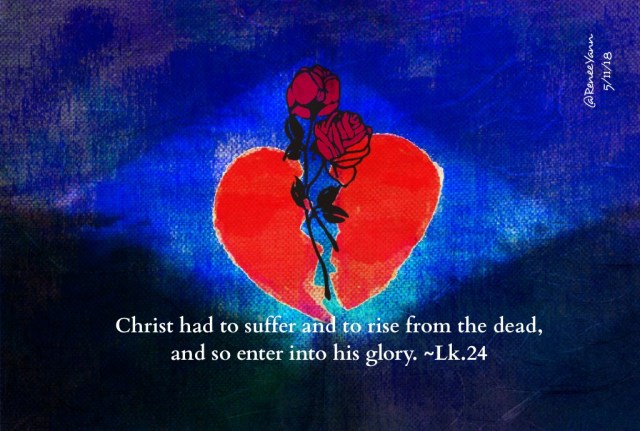
Today, in Mercy, Acts continues to describe the development of the early Church. Paul spends 18 months in Corinth, working with the new Christians through the many twists of a growing community. Luke’s Gospel reminds us of a key teaching for this, and our, community: If we really live like Christ, we will suffer, and die to ourselves before any hope of glory.

A true Christian life is not without sacrifice (which comes by choice) nor suffering (which comes by imposition). 

We sacrifice because we love. Consider all that parents sacrifice for their children’s sake.

When we suffer, we must also love, but add the hope for healing in ourselves and in anyone who causes our suffering.

This is to live like Christ.

Luke 24

To Love Like God

Sunday, May 6, 2018

Readings: http://www.usccb.org/bible/readings/050618.cfm

Today, in Mercy, in our readings from John’s letter and from his Gospel, we again see the reiteration of Jesus’ most important message: Love one another.  It sounds so easy and sweet, but it is so difficult to love as Jesus loves – without judgment or the expectation of recompense; without reserve and without preference. It is so hard to continue to love when love is met with indifference, arrogance or even hate. Still Jesus asks us to love as He does – to will the eternal good of every person and to foster it by our actions. May we have the grace to keep on trying.

as I have loved you