Gathered in God’s Name

Wednesday of the Nineteenth Week in Ordinary Time
August 16, 2023

Today’s Readings:

https://bible.usccb.org/bible/readings/081623.cfm


Today, in God’s Lavish Mercy, our readings confirm the power of call and community.

In this final reading from Deuteronomy, God shows Moses the Promised Land. The description is sweepingly triumphant in tone:

Moses went up from the plains of Moab to Mount Nebo,
the headland of Pisgah which faces Jericho,
and the LORD showed him all the land—
Gilead, and as far as Dan, all Naphtali,
the land of Ephraim and Manasseh,
all the land of Judah as far as the Western Sea,
the Negeb, the circuit of the Jordan
with the lowlands at Jericho, city of palms,
and as far as Zoar.

Deuteronomy 34:1-3

There in front of Moses is the entire vision of what his life’s call was all about. Moses’s journey is now complete and his death is memorialized by the Deuteronomist in the uttermost terms:

Since then no prophet has arisen in Israel like Moses,
whom the LORD knew face to face.
He had no equal in all the signs and wonders
the LORD sent him to perform in the land of Egypt
against Pharaoh and all his servants and against all his land,
and for the might and the terrifying power
that Moses exhibited in the sight of all Israel.

Deuteronomy 34: 10-12

Joshua now assumes a leadership role among the people who have been formed by God, under Moses’s mentorship, into the community of Israel. Joshua, with the people, will continue to shape Israel into a true “People of God”.


Our Gospel reading today describes how the power of community also shapes Christian life.

In Matthew 18, Jesus teaches his disciples a lesson in a particular element of community: fraternal correction. Fraternal correction is a concept often misinterpreted by its would-be practitioners. Here is a good description of what fraternal correction is and is not:

Fraternal correction is an ancient, Christian understanding of what it means to help each other grow in holiness. It is not a reaction to injury suffered, it is not vengeance, it is not revenge, it is not a reaction because I am hurting. But instead, it happens when I am moved by love for my brother or sister. It happens when I am moved to assist my brother or sister in growth or holiness.

Fr. Matthew Spenser, OSJ, Provincial of the Oblates of St. Joseph

Sisters of Mercy Community – Buffalo Founding Event, 1991


A community gathered in God’s Name depends on its members to exercise leadership, followership, sororal and fraternal correction, and unlimited goodwill for one another. Moses did it. Joshua did too. And Jesus certainly modeled and taught us how to live with and for one another in community.

Today’s readings might inspire us to consider the level of our own commitment to the communities which sustain our life: family, Church, religious community, as well as the civic, global, and universal contexts in which we live. We are leaders in some of these communities. We are followers in others. In all of them, we are members – a graced status that calls us to active and responsive love.


Prayer: Prayer for Community
This prayer comes from the same site as our readings – The USCCB: United States Conference of Catholic Bishops

Embracing Father,
You grace each of us with equal measure in your love.
Let us learn to love our neighbors more deeply,
so that we can create
peaceful and just communities.
Inspire us to use our creative energies
to build the structures we need
to overcome the obstacles
of intolerance and indifference.
May Jesus provide us the example needed
and send the Spirit to warm our hearts for the journey.
Amen

Music: even Sesame Street can offer a little community “theology” 🙂

Hidden Motives

Memorial of Saint Dominic, Priest
Tuesday of the Eighteenth Week in Ordinary Time
August 8, 2023

Today’s Readings:

https://bible.usccb.org/bible/readings/080823.cfm


Today, in God’s Lavish Mercy, we pray with Psalm 51 which expresses the ardent desire for forgiveness and reconciliation.

The psalm reflects back to our first reading – an episode of sibling rivalry, jealousy, and hidden motives.

Moses, favored of God and leader of the people, makes a questionable choice. He marries outside the tribe, after telling everyone else not to. Hmmm. His siblings, Aaron and Miriam, don’t like that. So they indignantly complain:

Is it through Moses alone that the LORD speaks?
Does God not speak through us also?

Numbers 12:2

God hears their complaint and sees through it. God sees that they are less concerned about the marriage and more concerned about themselves. They’re tired of Moses telling them what to do. They think God could have picked a better leader — one of them!

God sets them straight about how special Moses is, and their responsibility to support, not undermine, him.

Should there be a prophet among you,
in visions will I reveal myself to him,
in dreams will I speak to him;
not so with my servant Moses!
Throughout my house he bears my trust:
face to face I speak to him;
plainly and not in riddles.
The presence of the LORD he beholds.

Numbers 12:6-7

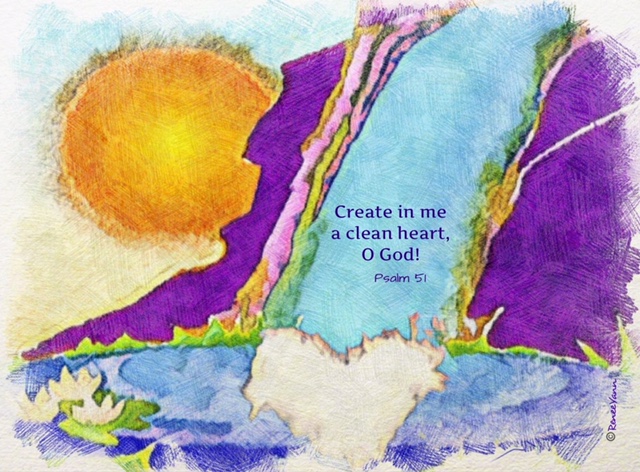
The whole story is really about motives. Everything we do must be done out of love – out of reverence for God, and out of respect and hope for ourselves and others. This is what it means to have a clean heart. And it is the plea of Psalm 51.

A clean heart create for me, O God,
and a steadfast spirit renew within me.
Cast me not off from your presence,
and your Holy Spirit take not from me.

Psalm 51: 12-13

Prose: This is a great piece by Sister Joyce Rupp on a clean heart (published in America magazine)

https://www.ncronline.org/blogs/clean-heart


Music: Psalm 51 – Chant of the Heart

Come Away Awhile

Memorial of Saint Alphonsus Liguori, Bishop and Doctor of the Church
Tuesday of the Seventeenth Week in Ordinary Time
August 1, 2023

Today’s Readings:

https://bible.usccb.org/bible/readings/080123.cfm


Today, in God’s Lavish Mercy, Moses goes on a rigorous forty day retreat:

So Moses stayed there with the LORD for forty days and forty nights,
without eating any food or drinking any water,
and he wrote on the tablets the words of the covenant,
the ten commandments.

Exodus 33:28

The purpose of this intense retreat was for Moses to codify God’s law in his own heart. He is to be a witness and leader for God among the people. It was a law of relationship, written in stone for the people, but written in fire for Moses. If God’s intentions are not embedded in Moses’s own heart, his ministry will fail.

In our Gospel, the disciples go on a kind of retreat too. The crowds have been dismissed, and Jesus’s close friends sit down with him for an in-depth instruction in the meaning of his parables. They want to understand the mind and heart of Christ so that they can pattern their own on his Word.


A good retreat is like a spiritual spa experience. It can provide us with rest, clarity, nourishment, and stabilization. And good retreat direction, either through a spiritual guide or through the discipline of solitude, is invaluable to such a pursuit.

But while we can’t be on a formal retreat every day of our lives, we still need a daily “coming away” with God to center our spirits and to keep alive the holy fire within them.


Today might be a good day to evaluate those processes in our lives. Are they working for us? Or might our prayer and reflection time have become so routine as to lose its snap. Have we let life’s concerns slip into our solitude to the point of no longer hearing God’s whisperings? Or have we even truncated that time to meet those ever-expanding concerns?

We may feel so overwhelmed by life that we think we don’t have time for deep prayer. That’s like saying we don’t have time to breathe! If we don’t make the time for both of them, we will die. It’s that simple.


Sixty years ago, my Novice Director gave me a wonderful book. I return to it frequently to consider the spiritual discipline of my life. Here are two excerpts which seem to have bearing on today’s reflection and might inspire your considerations today:

When silence takes possession of you; when far from the racket of the human highway the sacred fire flames up in the stillness; when peace, which is the tranquillity of order, puts order in your thoughts, feelings, and investigations, you are in the supreme disposition for learning; you can bring your materials together; you can create; you are definitely at your working point; it is not the moment to dwell on wretched trifles, to half live while time runs by, and to sell heaven for nothings.


Retirement (retreat) is the laboratory of the spirit; interior solitude and silence are its two wings. All great works were prepared in the desert, including the redemption of the world

A.D. Sertillanges, The Intellectual Life: Its Spirit, Conditions, Methods

Poetry: The Stolen Child – William Butler Yeats
Using his love for Celtic lore and fantasy, Yeats imagines a return to innocence at the hands of magical creatures, the faeries. With imagery rich in natural wonder, the reader is invited to “come away” from a world impossible to understand, and to be restored in spiritual truth. Sounds like a retreat to me!

Where dips the rocky highland
Of Sleuth Wood in the lake,
There lies a leafy island
Where flapping herons wake
The drowsy water rats;
There we've hid our faery vats,
Full of berrys
And of reddest stolen cherries.
Come away, O human child!
To the waters and the wild
With a faery, hand in hand,
For the world's more full of weeping than you can understand.
Where the wave of moonlight glosses
The dim gray sands with light,
Far off by furthest Rosses
We foot it all the night,
Weaving olden dances
Mingling hands and mingling glances
Till the moon has taken flight;
To and fro we leap
And chase the frothy bubbles,
While the world is full of troubles
And anxious in its sleep.
Come away, O human child!
To the waters and the wild
With a faery, hand in hand,
For the world's more full of weeping than you can understand.
Where the wandering water gushes
From the hills above Glen-Car,
In pools among the rushes
That scarce could bathe a star,
We seek for slumbering trout
And whispering in their ears
Give them unquiet dreams;
Leaning softly out
From ferns that drop their tears
Over the young streams.
Come away, O human child!
To the waters and the wild
With a faery, hand in hand,
For the world's more full of weeping than you can understand.
Away with us he's going,
The solemn-eyed:
He'll hear no more the lowing
Of the calves on the warm hillside
Or the kettle on the hob
Sing peace into his breast,
Or see the brown mice bob
Round and round the oatmeal chest.
For he comes, the human child,
To the waters and the wild
With a faery, hand in hand,
For the world's more full of weeping 
than he can understand.

Music: Inner Peace – Hennie Bekker

Yoked to God’s Name

Thursday of the Fifteenth Week in Ordinary Time
July 20, 2023

Today’s Readings:

https://bible.usccb.org/bible/readings/072023.cfm


Today, in God’s Lavish Mercy, God is actively at work in both our scripture passages.

In our reading from Exodus, God instructs Moses in the Divine plan for Israel’s deliverance. It’s as if they’re sitting together at a drawing table laying out the course of history! Moses has some trepidation about how the people will accept this audacious plan. He asks for more detail on the game plan and God gives him a powerful answer:

Moses, hearing the voice of the LORD from the burning bush, said to him,
“When I go to the children of Israel and say to them,
‘The God of your fathers has sent me to you,’
if they ask me, ‘What is his name?’ what am I to tell them?”
God replied, “I am who am.”
Then he added, “This is what you shall tell the children of Israel:
I AM sent me to you.”


Forever after God’s revelation to Moses, Moses is tied heart-to-heart with God in the unfolding plan of Creation. It is an image similar to the one Jesus uses in today’s Gospel.

Jesus asks us to be tied heart-to-heart with him, yoked to him as we seek our salvation. Jesus assures us that in that unity we will find rest and peace. The assumption might be that Jesus carries most of the weight and labor while we, conjoined with him in trust, benefit from his salvific action. The yoke is the sacred discipline of sincere openness to God’s Will wrought by prayer and Gospel living.

Jesus says all this within another “I am” statement – but this time God’s Name is given in descriptors rather than nomenclature: I am meek and humble of heart

Jesus said:
“Come to me, all you who labor and are burdened,
and I will give you rest.
Take my yoke upon you and learn from me,
for I am meek and humble of heart;
and you will find rest for yourselves.
For my yoke is easy, and my burden light.”

Matthew 11:28-30

Poem Prayer: from Prayer Seeds by Joyce Rupp

Unnameable God, I feel you
with me at every moment.
You are my food, my drink,
my sunlight, and the air I breath.
(Psalm 16; Stephen Mitchell)

with each refreshing rain
each slant of sunshine
each beam of moonlight
each whisper of wind

in every spiraling thought
every turning of the heart
every spoken and written word
every action large and small

you stead, you lead
you encourage, you guide
you embrace, you never let go

one with my soul, one with my life
one with me in the first breath
one with me in the last

you know me now
you will know me
always and forever

I remember
I rejoice


Music: Holy is God’s Name – John Michael Talbot

Angels Hidden in the Bushes

Wednesday of the Fifteenth Week in Ordinary Time
July 19, 2023

Today’s readings:

https://bible.usccb.org/bible/readings/071923.cfm


Today, in God’s Lavish Mercy, our readings lead us to consider how God is present in our lives, calling us to deeper spiritual awareness and vitality.


In Exodus 3, Moses has fled Egypt and taken up a new, uneventful life, working for his father-in-law, napping by the sheepfold in Midian.

Meanwhile, Moses was tending the flock
of his father-in-law Jethro, the priest of Midian.


The text makes no notation that Moses is contemplating the gravity of his past experiences, nor seeking spiritual meaning from them. As a matter of fact, the first three chapters of Exodus make little reference to God, except for God’s faithfulness to the resistant midwives who saved Moses’ life.

Left up to Moses, no great theophanic event would be recorded in Exodus. It would simply be a story about a Midian shepherd too scared to go back to his old hometown. It was God Who made the magic happen in Exodus, and oh, what magic it was!


We first have notice that God is about to act in the final verses of Exodus 2:

A long time passed (after Moses fled), during which the king of Egypt died. The Israelites groaned under their bondage and cried out, and from their bondage their cry for help went up to God.
God heard their moaning and God was mindful of the covenant with Abraham, Isaac and Jacob.
God saw the Israelites, and God knew….

Exodus 2: 23-25

Because God knew – and always knows – our sufferings and joys, God cares and is present to us in our lives. We are not always aware of that Divine Accompaniment, as perhaps Moses was unaware in his Midian field.

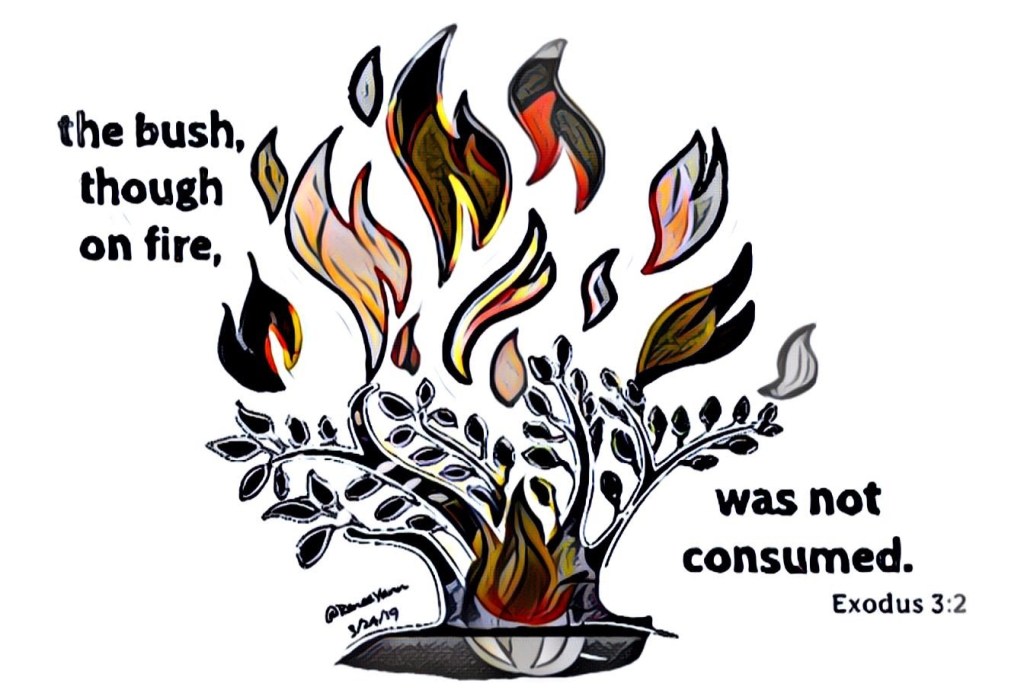
God woke Moses up with a burning bush. Then, by sharing his Name, God invited Moses to the deep spiritual intimacy which empowered him to act for God in the world.

God called out to him from the bush, “Moses! Moses!”
He answered, “Here I am.”
God said, “Come no nearer!
Remove the sandals from your feet,
for the place where you stand is holy ground.
I am the God of your father,” he continued,
“the God of Abraham, the God of Isaac, the God of Jacob.”


I think, for most of us, God is often hidden in our circumstances. I know I haven’t found too many buring bushes along life’s road. So what’s the secret to that deep spiritual awarnessthat allows us to live always in God’s Presence?

Jesus tells us in today’s Gospel that the secret is innocence.

At that time Jesus exclaimed:
“I give praise to you, Father, Lord of heaven and earth,
for although you have hidden these things
from the wise and the learned
you have revealed them to the childlike.


Spiritual innocence is not childish or uniformed. It is not faultless or naïve. The childlike quality Jesus describes is guileless, trusting, open, and wise. It waits in prayer and reflection for God’s time and movement. It believes despite doubt, and hopes despite setback.

Humble Moses – murderer, exile, and loafer on his in-law’s farm – had this kind of innocence. Like a wick awaiting kindling, Moses’s innocent heart caught fire with God. After that there was never an unnoticed “bush” in his life. After all, every one of them might contain angels!


Poetry: excerpt from Aurora Leigh by Elizabeth Barret Browning

But man, the two-fold creature, apprehends
The two-fold manner, in and outwardly,
And nothing in the world comes single to him.
A mere itself,–cup, column, or candlestick,
All patterns of what shall be in the Mount;
The whole temporal show related royally,
And build up to eterne significance
Through the open arms of God. 'There's nothing great
Nor small,' has said a poet of our day,
(Whose voice will ring beyond the curfew of eve
And not be thrown out by the matin's bell)
And truly, I reiterate, . . nothing's small!
No lily-muffled hum of a summer-bee,
But finds some coupling with the spinning stars;
No pebble at your foot, but proves a sphere;
No chaffinch, but implies the cherubim:
And,–glancing on my own thin, veined wrist,–
In such a little tremour of the blood
The whole strong clamour of a vehement soul
Doth utter itself distinct. Earth's crammed with heaven,
And every common bush afire with God:
But only he who sees, takes off his shoes,
The rest sit round it, and pluck blackberries,
And daub their natural faces unaware
More and more, from the first similitude.

Music: Burning Bush – Terrana and Manicardi

Burning bush You are, 
glowing and endless love. 
Living in Your midst, 
to live by You, 
to be alive in You. 

This Fire does not consume 
the essence of every person. 
You show Yourself in creation
in all of the beauty,  
that speaks and cries out Thee.

That You are Love 
in a flower, in the waves of the sea, 
in the dawn, in the song of a swan, 
in a kiss of a child to his mother 
in the farewell of a dying father. 

You are Love 
In a man who climbs the slope, 
In a woman who chooses life, 
In a star bursting with light, 
In the forgiveness that brings pain. 

You are earth, water, air and fire. 
Earth, water, air and fire. 

(Interlude)

Let’s take off our shoes 
in front of so much love. 
We need only to listen to 
the beautiful, the good, the true, 
That lies around us. 

For it’s Love
In a flower, in the waves of the sea,
in the dawn, in the song of a swan, 
in a kiss of a child to his mother
in the farewell of a dying father

It is Love
In a man who climbs the slope, 
In a woman who chooses life, 
In a star bursting with light,
In the forgiveness that costs pain

(Interlude)
repeat above
You are earth, water, air and fire
Earth, water, air and fire

Two Kinds of Silence

Tuesday of the Fifteenth Week in Ordinary Time
July 18, 2023

Today’s Readings:

https://bible.usccb.org/bible/readings/071823.cfm

Today, in God’s Lavish Mercy, silence plays a role in both our readings, but they are silences that differ profoundly from each other.

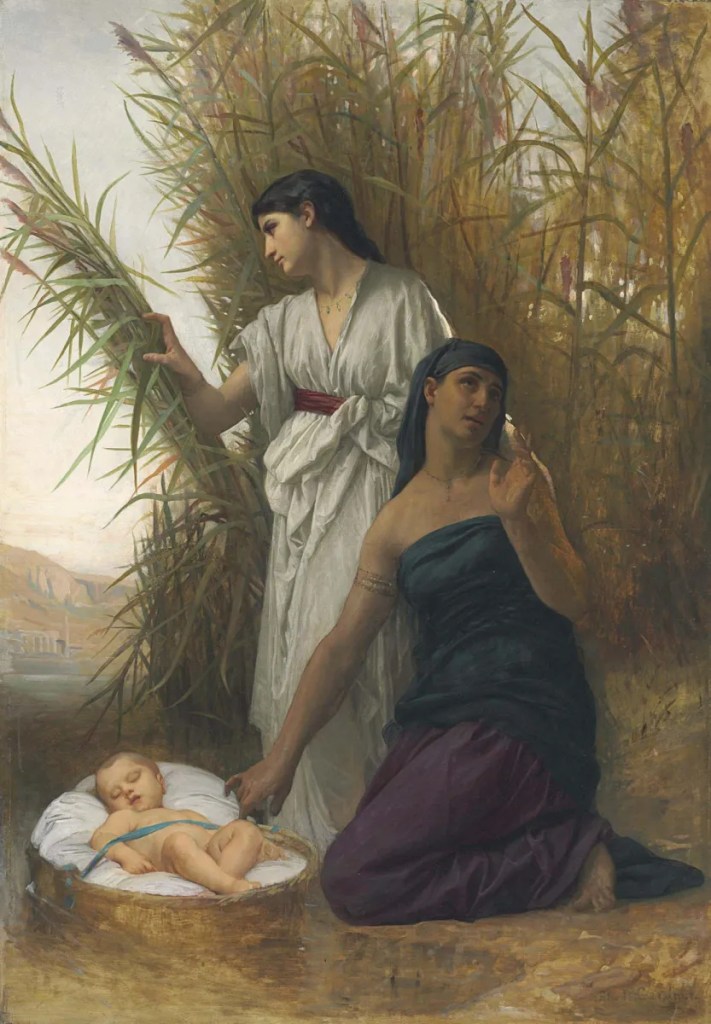
Moses in the Bulrushes – by Elizabeth Jane Gardner


In Exodus, we see the power of silent resistance to turn the tide of history. It is the resistance of righteousness.

Pharaoh, out of fear, has ordered all Hebrew boy babies drowned at birth. But Moses’s mother (Jochebed), aided by his sister (Miriam), silently resists.

A certain man of the house of Levi married a Levite woman,
who conceived and bore a son.
Seeing that he was a goodly child, she hid him for three months.
When she could hide him no longer, she took a papyrus basket,
daubed it with bitumen and pitch,
and putting the child in it,
placed it among the reeds on the river bank.
His sister stationed herself at a distance
to find out what would happen to him.

Her resistance, though silent, was nonetheless active. Look at all the intricate steps she took to assure the success of her plot.


The resistance cited in Matthew is of a different nature entirely. It reflects a hard heart not a determined heart. It is the resistance of indifference.

Christ Preaching at Capernaum – by Maurycy Gottlieb


Capernaum had become Jesus’s own home town. He had moved there as a young adult in order to begin his ministry after his own neighborhood had rejected him. But despite Jesus’s miracles and witness, Capernaum resisted the call of the Gospel:

Jesus began to reproach the towns
where most of his mighty deeds had been done,
since they had not repented.

And as for you, Capernaum:

Will you be exalted to heaven?
You will go down to the netherworld.

For if the mighty deeds done in your midst had been done in Sodom,
it would have remained until this day.
But I tell you, it will be more tolerable
for the land of Sodom on the day of judgment than for you.


We might find ourselves anywhere in these stories. We all experience resistances within, around, and toward us – sometimes for good reasons, sometimes not. We just have to fill in the blank to imagine all the resistances we are capable of:

I tend to resist ______________________________.

What did you come up with? Maybe some of these?

  • change
  • work
  • quiet
  • commitment
  • injustice
  • direction
  • strangers
  • programming
  • affection
  • cronyism, and on and on and on……

Jesus wanted to break through the negative resistance of his dearest communities.

Jocebed and her courageous women companions used positive resistance to break through abusive domination.

In our spiritual lives, we must, by prayer and informed reflection, lower our resistance to God’s transforming Word.

We must, at the same time, assume our role in resisting the injustice and violence of our times. Like Jocebed, we might consider our precious world and its peoples as if they were our own children, threatened by fear-blinded tyranny. In that case, what determined steps would we be willing to take to preserve its sacred life?


Poetry: Rosa Parks by Nikki Giovanni

This is for the Pullman Porters who organized when people said
they couldn’t. And carried the Pittsburgh Courier and the Chicago
Defender to the Black Americans in the South so they would
know they were not alone. This is for the Pullman Porters who
helped Thurgood Marshall go south and come back north to fight
the fight that resulted in Brown v. Board of Education because
even though Kansas is west and even though Topeka is the birth-
place of Gwendolyn Brooks, who wrote the powerful “The
Chicago Defender Sends a Man to Little Rock,” it was the
Pullman Porters who whispered to the traveling men both
the Blues Men and the “Race” Men so that they both would
know what was going on. This is for the Pullman Porters who
smiled as if they were happy and laughed like they were tickled
when some folks were around and who silently rejoiced in 1954
when the Supreme Court announced its 9—0 decision that “sepa-
rate is inherently unequal.” This is for the Pullman Porters who
smiled and welcomed a fourteen-year-old boy onto their train in
1955. They noticed his slight limp that he tried to disguise with a
doo-wop walk; they noticed his stutter and probably understood
why his mother wanted him out of Chicago during the summer
when school was out. Fourteen-year-old Black boys with limps
and stutters are apt to try to prove themselves in dangerous ways
when mothers aren’t around to look after them. So this is for the
Pullman Porters who looked over that fourteen-year-old while
the train rolled the reverse of the Blues Highway from Chicago to
St. Louis to Memphis to Mississippi. This is for the men who kept
him safe; and if Emmett Till had been able to stay on a train all
summer he would have maybe grown a bit of a paunch, certainly
lost his hair, probably have worn bifocals and bounced his grand-
children on his knee telling them about his summer riding the
rails. But he had to get off the train. And ended up in Money,
Mississippi. And was horribly, brutally, inexcusably, and unac-
ceptably murdered. This is for the Pullman Porters who, when the
sheriff was trying to get the body secretly buried, got Emmett’s
body on the northbound train, got his body home to Chicago,
where his mother said: I want the world to see what they did
to my boy. And this is for all the mothers who cried. And this is
for all the people who said Never Again. And this is about Rosa
Parks whose feet were not so tired, it had been, after all, an ordi-
nary day, until the bus driver gave her the opportunity to make
history. This is about Mrs. Rosa Parks from Tuskegee, Alabama,
who was also the field secretary of the NAACP. This is about the
moment Rosa Parks shouldered her cross, put her worldly goods
aside, was willing to sacrifice her life, so that that young man in
Money, Mississippi, who had been so well protected by the
Pullman Porters, would not have died in vain. When Mrs. Parks
said “NO” a passionate movement was begun. No longer would
there be a reliance on the law; there was a higher law. When Mrs.
Parks brought that light of hers to expose the evil of the system,
the sun came and rested on her shoulders bringing the heat and
the light of truth. Others would follow Mrs. Parks. Four young
men in Greensboro, North Carolina, would also say No. Great
voices would be raised singing the praises of God and exhorting
us “to forgive those who trespass against us.” But it was the
Pullman Porters who safely got Emmett to his granduncle and it
was Mrs. Rosa Parks who could not stand that death. And in not
being able to stand it. She sat back down.


Music: Soften My Heart, Lord – Maranatha Singers

Seek an Unjealous Heart

Twenty-Sixth Sunday in Ordinary Time

September 26, 2021

Today, in God’s Lavish Mercy, our reading from the Book of Numbers reveals a very human moment between Joshua and Moses.

Moses Blesses Joshua – James Tissot

Moses is getting older. He realizes that the time is approaching for him to hand over the leadership of his people. God seems to realize that too.

The LORD came down in the cloud and spoke to Moses.
Taking some of the spirit that was on Moses,
the LORD bestowed it on the seventy elders;
and as the spirit came to rest on them, they prophesied.


Joshua, ever since his youth, has been aide to Moses. Moses is his hero – the one, who having spoken with God, led the People out of Egypt. Now Joshua sees other ordinary guys assuming some of Moses’s roles. Joshua feels his own security and comfort shifting beneath him – hints of a spiritual earthquake.


An outraged Joshua alerts Moses, begging him to stop these supposed imposters. But Moses assures Joshua with words no hero-worshipper ever wants to hear:


Are you jealous for my sake?

Would that all the people of the LORD were prophets!
Would that the LORD might bestow his spirit on them all!


What a powerful question Moses poses. It searches Joshua’s heart:

Are you jealous for my sake? 

Are you fearful, biased, closed-hearted,
and self-protective because you fear
that you and I will lose position and power?

Surely Moses senses Joshua emerging as the next leader of Israel — even though Joshua might not share that awareness yet. Moses wants him to see that it is the Spirit of God Who leads the People through any human means She wishes.


When we presume to control the Spirit, or think to invest Her power only in our own particular “heroes”, we close ourselves to the amazing, surprising power of God. This Divine Power cannot be controlled and, like wildflowers through concrete, will bloom where She chooses.

We see the fruits of such presumption all over our histories: the falsely assumed superiority of men over women, whiteness over color, wealth over labor, or any form of dominance over mutuality. These assumptions become concretized in our culture, hardening us to the movements of the Spirit.

If we have any hold on privilege in our lives, we might be inclined to profit by these assumptions. It is just such an inclination that Moses nips in Joshua in this powerful exchange between revered teacher and apprentice.

The story offers us much to consider in prayer.


Music: An oldie, but goodie. Always brings me a deep peace.  I hope it does the same for you, dear reader.
Come Holy Ghost – The Singing Nuns

Memorial of Saint John Vianney

Wednesday, August 4, 2021

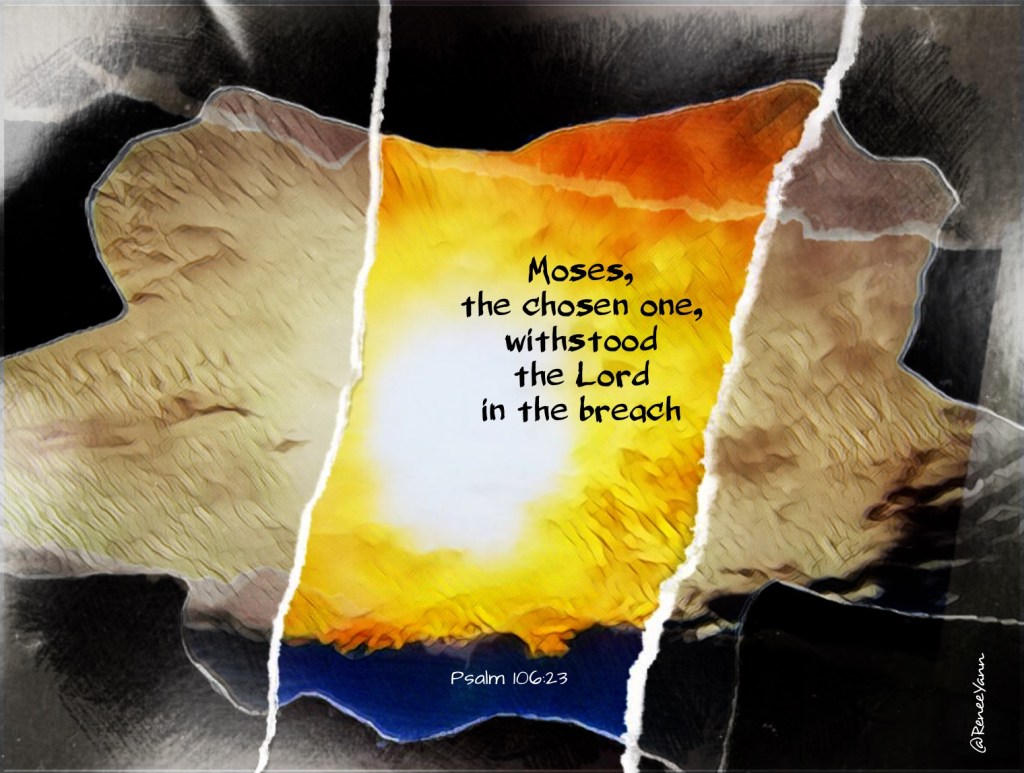
Today, in God’s Lavish Mercy, we pray with Psalm 106 which mirrors the story told in our first reading from Numbers.

It takes some doing to pray with these passages, at least for me. On the surface, they offer us spies and wars and a vengeful God whom Moses has to placate – images that don’t speak to my spiritual life.


But, as always with scripture, I ask if there is a meaning for me underneath that surface story? I found it in the word “breach”.

God is always trying to break through – to breach – the surface of our lives to teach us divine meaning. But we are often spiritually short-sighted like the spies who report back to Moses. We sometimes let our simplistic observations of life block us from its true depth and call.

But Moses, because of his unique relationship with God, has been cleared of those blockages. He opens up – breaches – the surface to help the people connect with God’s power.

Photo by Silvana Palacios on Pexels.com

What allows me to “breach” my limited understandings and to see all life as God, shining through experience? 

For me? Sweet silence. Faithful prayer. Reaching for the “dearest freshness” of an obedient heart and a resolute love.


Poetry: God’s Grandeur- Gerard Manley Hopkins

The world is charged with the grandeur of God.
    It will flame out, like shining from shook foil;
    It gathers to a greatness, like the ooze of oil
Crushed. Why do men then now not reck his rod?
Generations have trod, have trod, have trod;
    And all is seared with trade; bleared, smeared with toil;
    And wears man's smudge and shares man's smell: the soil
Is bare now, nor can foot feel, being shod.

And for all this, nature is never spent;
    There lives the dearest freshness deep down things;
And though the last lights off the black West went
    Oh, morning, at the brown brink eastward, springs —
Because the Holy Ghost over the bent
    World broods with warm breast and with ah! bright wings.

Music: from Freshness Green Soothing Relaxation 

Monday of the Eighteenth Week in Ordinary Time

Monday, August 2, 2021

Today, in God’s Lavish Mercy, we pray with Psalm 81, and today’s verses sound a little harsh. The Lord seems a bit fed up with Israel’s hungers:

My people heard not my voice,
    and Israel obeyed me not;
So I gave them up to the hardness of their hearts;
    they walked according to their own counsels.

Psalm 81:12-13

Translated to 21st century jargon that verse might sound like this:

I love them and all, but come on!
    They don’t follow my advice;
so the heck with their stubbornness.
    Let them stew in their own juices!

Renee’s unofficial imaginings 🙂

But see, here’s the thing. God is never like that with us. God is, instead, everlastingly patient with us. God stays with us until we – hopefully – respond to Grace.

And don’t we sometimes really test God’s patience! Moses was great at it — pushing and pushing for God to make things easier for him. 

I cannot carry all this people by myself,
for they are too heavy for me.
If this is the way you will deal with me,
then please do me the favor of killing me at once,
so that I need no longer face this distress.

Numbers 11:14-15

Picture Moses standing in front of God, hands on hips yelling, “I’ve had it! Why not just kill me now?!?!”

The verse actually makes me chuckle because I also picture God, smothering a smile at Moses’s tantrum, and thinking, “Maybe some quail will settle this guy down for the long haul.”


Today’s psalm and reading from Numbers remind us that each of our lives is an unfolding journey in relationship with God. It is a journey that requires us to listen and respond over and over again. At each response we move ever deeper into the heart of God, letting go of those things which impede us from our destination.

If only my people would hear me,
    and Israel walk in my ways,
Quickly would I humble their enemies;
    against their foes I would turn my hand.

Psalm 81: 14-15

God is our help
and is ALWAYS present with us.
If we can listen to our deep lives,
we will know that
and our spirits will sing.

Poetry: Moses by Alan Kanfer

Whatever residue of pride adhere
To eyes, to bones, to hair will shed like sand
When we discover the The Name is near
And fire is Light, and we are asked to stand.
That night my hair was like a fell of sheep,
My bones like water, I was weak and dumb:
My perfume reeked like camp whores that we keep.
I stood, receiving “I am that I am.”
How small the distance is between the root
And flower: the Name is near as our consent,
As our denial. Coming up the hill on foot
Long after, knowing we must be content
With shadow of The Name, I shed my will
But not my love: the final miracle.


Music: Frangeti – George Winston

Tuesday of the Seventeenth Week in Ordinary Time

Tuesday, July 27, 2021

Today, in God’s Lavish Mercy, we pray with Psalm 103 whose verses this morning remind us of God’s munificence.

Munificent – it’s a wonderful word whose Latin roots literally mean gift-making, abundant generosity.

Merciful and gracious is the LORD,
    slow to anger and abounding in kindness.

Psalm 103:8

Praying this morning, I realize that I can’t even begin to number the gifts God has given me.


But like Moses in today’s first reading, I want to visit God in the sacred tent of prayer – learning, thanking and awakening to the Mercy in my life.

… and, like Moses, to invite God into every moment, to ask God to keep company with me on my journey:

Moses at once bowed down to the ground in worship.
Then he said, “If I find favor with you, O LORD,
do come along in our company.


Poetry: Bearing the Light – Denise Levertov

Rain-diamonds, this winter morning, embellish the tangle
of unpruned pear-tree twigs;
each solitaire, placed, it appears,
with considered judgement,
bears the light beneath the rifted clouds —
the indivisible shared out in endless abundance.


Music: In the Garden – written by C. Austin Miles in 1912. Miles wrote nearly 400 hymns, this one the most famous.

And who doesn’t love Anne Murray’s mellow voice!