Let the Light In

Friday of the Eighteenth Week in Ordinary Time

August 9, 2019

Click here for readings

Today, in Mercy, we have the first of a few readings from the Book of Deuteronomy. In today’s passage, Moses gives the first of three speeches to the community. These speeches are a sort of manifesto a family patriarch might give before he dies, framing the family history and code to direct coming generations.

Ps77 crack


Dad


The reading falls on a most appropriate day for me.
Today would be my Dad’s 104th birthday.
The occasion invites me to recount all the blessings
given to him, me, and our family.


When we, as people of faith, step back from our lives in reverence, we realize God’s immense goodness to us. Moses encourages his people to do just such stepping back:

Ask now of the days of old, before your time,
ever since God created man upon the earth;
ask from one end of the sky to the other:
Did anything so great ever happen before?

We might ask ourselves the same thing. 

  • How has God been with me and my family through our lifetimes, and through the generations that preceded us?
  • In both our lights and darknesses, how has God continually called us to relationship?
  • How have we revealed God’s voice to one another by our love, honesty, support, patient accompaniment, generous correction and forgiveness?
  • How have these gifts to one another allowed us to become gifts to the larger world?
  • What am I passing on to the next generation of the fidelity and sacrifice which has blessed me?

When I think of my Dad, there are so many symbols that show how he answered those questions with his life. They aren’t big manifestos like those of Moses. Instead: 

  • a frayed prayer book that I watched him finger daily
  • an old receipt for my bicycle bought in incremental payments he could barely afford
  • his sincere distress one Assumption Day when he had forgotten to go to Mass
  • his steadfast attempt to work even when illness weakened him and his humble trust in God when that weakness appeared to triumph
  • a treasured conversation about his hope for heaven
  • the appreciation now, in my maturity, of his thousand quiet acts of faith and love

All of us might spend some time in gratitude for the legacy of faith and love we have received. No family is perfect, and the grace may come to us in clarity or in disguise. But it comes. 

There are fractures and tears in every family. There were some even in Moses’ “family” and Moses himself! And we cannot magically heal them all. But God asks us to remember that God abides with us even in any fragmentation. Just as the poet Leonard Cohen sings:

There is a crack in everything.
That’s how the light gets in.

Click here to listen to Cohen’s moving song

If what we remember in our family history are weaknesses, how have they made us stronger? If what we remember are strengths, how have they made us more generous? In either case, how have we heard God’s voice in our story? How have we let the Light in?

As Moses tells his people:

This is why you must now know, and fix in your heart,
that the LORD is God
in the heavens above and on earth below,

and that there is no other.

Music: As for Me and My House – Promise Keepers

Failure Is An Option!

Memorial of Saint Dominic, Priest

August 8, 2019

Click here for readings

Today, in Mercy, on this Memorial of St. Domenic, our first reading gives us a lesson in failure. It is a situation we all face in life. If you haven’t, then you aren’t trying hard enough.

Numbers20_13_Failure

In our reading today, even the great Moses fails. But, you might ask, hasn’t he failed a number of times already? The smashed commandments, the golden calf, the complaints about manna? These were all human frustrations and inadequacies Moses would not have chosen.

Today’s failure is different. It is a failure in leadership. Any leadership role we hold, we hold in the name of God. We are parents, employers, teachers, pastors, religious leaders, supervisors, captains, managers…and so on. The cloak of responsibility covers each one of us at various times in our lives. Wearing it, we put on God’s trust in us to honor Him and those he has given us.

Dore_Rock
Moses Striking the Rock in Horeb, engraving by Gustave Doré from “La Sainte Bible”

When Moses and Aaron asked God to give the people water, God said, 

Take your staff and assemble the community,
you and your brother Aaron,
and in their presence order the rock to yield its waters.
From the rock you shall bring forth water for the congregation
and their livestock to drink.

Moses, caught in his own frustrations, did as God said but not before castigating the community and striking the rock twice.

So what?, you might say. 

Here’s the “What”. These acts betray Moses’ failure to trust God and to give God honor before the community. Perhaps unwittingly, Moses made it look like he was the one who summoned the water.

This reading calls us to always give God the glory. We are never really in charge of anything. We just do our best to make a path for life, goodness, love and wholeness.

If, through a leadership role, we are called to assist God in re-creating the world, let us do it with exquisite humility, trust, reverence, intentionality and praise.

Music: Humble – Audrey Assad

Radical Joy

Memorial of Saint Ignatius of Loyola, Priest

Ignatius
by Francisco de Zubarán (1598–1664)

July 31, 2019

Click here for readings


Today, in Mercy, Exodus tells us:

Exodus34_29 Radiant

Obviously, I haven’t met Moses personally. 😂 But I have met many wonderful human beings who have reflected a similar radiance.

It is a mirrored glory that comes from friendship with God. 

It glows in the innocence of children and the layered wisdom of the elderly. It blazes in those seeking social justice and in those silently, unwaveringly praying for it. It lights the hope of the living and the dying. It is that mysterious, unquenchable candle shining in both joy and sorrow. Its other holy names are Faith, Hope and Love.

 No one need tell us. We know when we are in the presence of such Light. It needs no words.

Rumi radiant

Today, let’s pray for the blessing of this Radiance all over our shadowed world. Let’s pray for it to shine within us.

Music: Radiant God – Hannah Ford

Unconditional Love

Tuesday of the Seventeenth Week in Ordinary Time

July 30, 2019

Click here for readings

Today, in Mercy, we consider God’s unconditional love.

God and Moses and the People have been through it. The trail of complaints, the golden calf, the shattered tablets – these are relational dramas to the extreme! Exodus is definitely soap opera material! Does it feel a little bit like your life, or your family’s, or the families you read about in the news?

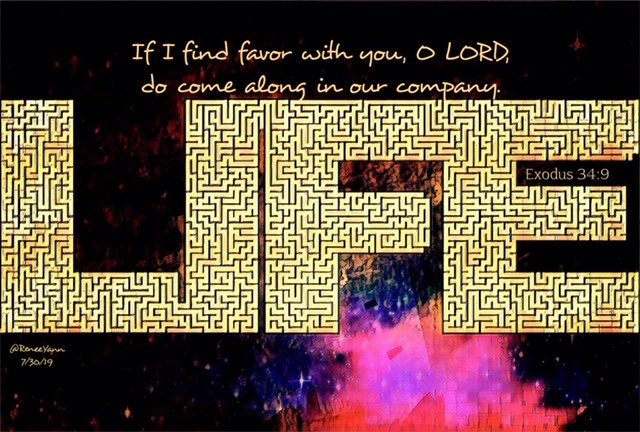
Ex34_9 Life

Life is indeed a drama! And our relationship with God is highlighted and shadowed with its twists and turns. For that reason, today’s passage offers us so much comfort and confidence. Even after all that has happened, God reveals himself to Moses like this:

The LORD, the LORD, a merciful and gracious God,
slow to anger and rich in kindness and fidelity,
continuing his kindness for a thousand generations.

Moses is so moved by this new knowledge of God’s unconditional love, that he welcomes God as part of their community:

If I find favor with you, O LORD,
do come along in our company.
This is indeed a stiff-necked people;
yet pardon our wickedness and sins,

and receive us as your own.

We are invited by this reading to open ourselves to that same unconditional love, to thank God for journeying with us through life’s convolutions. Stiff-necked at times, repentant at others, we are always God’s beloved.

As we negotiate the intricacies of our life today, we might trustingly say like Moses:

Lord, do come along in my company.

Music: Outrageous Grace – Godfrey Birtill

Idols!

Memorial of Saint Martha

July 29, 2019

Click here for readings

Today, in Mercy, our readings offer us a central question for our faith and spirituality: What do we really worship?

Ex32_19 calf

As we continue the Exodus story, Moses has been on the mountain receiving the Law from God. Meanwhile, back at the ranch, delegated leader Aaron is blowing his assignment. The Israelites tire of waiting for Moses. They want another god to lead them onward. Aaron comes up with idea of fashioning such a idol from all their molten jewelry.

When Moses descends the mountain with the newly-minted tablets in hand, he burns in anger at the scene, smashing the holy stones at his feet. More than a flared temper, this act symbolizes a fractured relationship with God.

The story suggests this for our prayer: we are in ever-deepening relationship with God through our own covenants – our creation, our baptism, our further professions of faith and commitment, our sacramental encounters. These are all living relationships, inviting us to new and deeper life in God.

Still, there may be times in our lives when our hearts lose focus on these covenants 

  • when we try to move somewhere without God’s companionship
  • when we substitute old baubles for moral or spiritual truth
  • when we return to weakening comforts rather than grow into a challenging grace
  • when we just get really mixed up about what is most important in our lives

The calf-worshippers had a big fail in this regard. Exodus tells the story of a merciful God trying to deal with their disloyalty and refashion them as God’s chosen people.

Our Gospel shows us Martha, also a little off target in terms of her spiritual priorities. While she is no where near idol worship, she still allows needless distractions to keep her from fully enjoying relationship with God.

Martha

Gentle, merciful Jesus turns her eyes toward him and she understands. Maybe that beautiful grace is what we want to pray for today.

Music:  You Alone – Sarah Hart

Our Story is God’s Story

Saturday of the Sixteenth Week in Ordinary Time

July 27, 2019

Click here for readings

Today, in Mercy, our Exodus reading describes momentous events in Israel’s life.

tabletsJPG

God has just invited Moses and several others up the mountain for a Divine conflab.  Moses returns to the people to announce “all the words and ordinances of the Lord”.The People receive these words wholeheartedly:

“We will do everything that the LORD has told us.”

Thus, a community of persons is formed with God at its heart.

Moses then engages the community in a series of formal rituals to highlight the significance and permanence of this deeper step in relationship with God.


The passage contains multiple points for our prayerful consideration.

The community of Israel is not unlike our own faith communities, those that gather in specific religious houses, or those we share in the universal community of all Creation. We are Catholics, Lutherans, Jews, Hindus, Muslims, Sikhs sharing a story of God in our particular religious traditions. We are also all children of the same God sharing that experience in our Common Home of Creation.

Just as with the ancient Israelites, God communicates and relates with us through the experiences of our lives. In our communities, that Divine Word is interpreted, codified, ritualized, and responded to. These actions create a story which is alive, deepening with each new generation, and still always rooted in the long history of promise and grace.

Today’s reading contains many elements of story and ritual which we can recognize in our own faith practice: written and announced word, altar or worship place, sacrifice or offering to God, acts of covenant, and celebratory meals.

Exodus24_3 sinai

These are the human ways in which we access relationship with God. These are the ways in which we keep our faith vital. We strengthen our faith by one another’s stories of love, mercy and hope. We commit to a shared law of love, not legalism – a heart-law which calls us to be life for one another, just as God is Life for us. In community, we reveal the face of God within ourselves.

For those of us who share the practice of a Eucharistic faith, the parallels in today’s reading call us to deeper awareness of how God becomes present in our lives.

May all of us – of whatever spirituality – who share life in God’s continuing Creation, obediently hear the command to cherish every human being as a revelation of God, as a critical and precious part of my own faith story – a part for whom I share the responsibility for life.

Music: Song of the Body of Christ – David Haas (Lyrics below)

Song of the Body of Christ
Refrain: We come to share our story. We come to break the bread.
We come to know our rising from the dead.
1. We come as your people. We come as your own.
United with each other, love finds a home.
2. We are called to heal the broken, to be hope for the poor.
We are called to feed the hungry at our door.
3. Bread of life and cup of promise, In this meal we all are one.
In our dying and our rising, may your kingdom come.
4. You will lead and we shall follow.
ou will be the breath of life; living water, we are thirsting for your light.

The Name

Thursday of the Fifteenth Week in Ordinary Time

July 18, 2010

Click here for readings

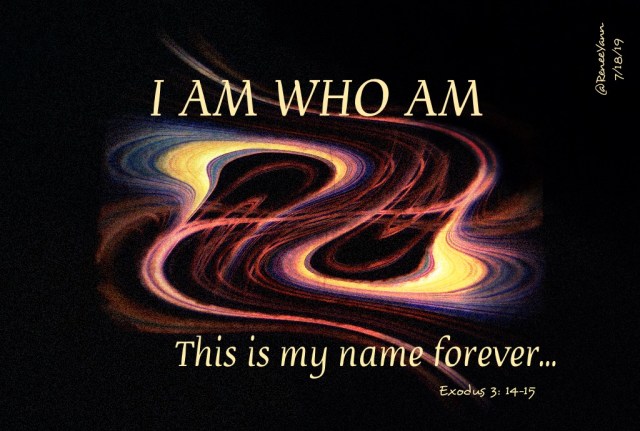
Today, in Mercy, God reveals God’s Name to Moses.

Ex3_14

Names are so important, aren’t they? Parents among you will remember how you labored over a name for each of your unborn children. Names carry roots to our history and hopes for our future. They suggest a shape for us to grow into and a way for us to be in the world.

In relationships, the giving of our name is a gift and an invitation. It is the first step in a mutual journey that may stop at the end of the encounter, or grow and blossom for years to come.

When God gives God’s name to Moses, it is all these things plus a Promise to abide forever in relationship. God hands Moses the key to call on God’s faithfulness forever. And God risks the hope that Moses will respond with fidelity and courage.

In prayer, and in our acts of mercy over a lifetime, God ever more deeply reveals the Holy Name to us. God promises to abide through our life with us and asks us to abide with Him. God risks that we will love, reverence, and respond to that amazing invitation with each successive moment and into eternity.

Today, in prayer, let us just rest in the Names we love to call God. Let us listen to the Love with which God names us.

Music:  Names of God – Laurell Hubick

The Burning Bush

Wednesday of the Fifteenth Week in Ordinary Time

July 17, 2019

Click here for readings

Today, in Mercy, we read about a “theophany” – a visible manifestation to humankind of God. Not your everyday occurrence, right? Well, let’s think about that.

Ex3_4 bush

In today’s passage from Exodus, Moses, self-exiled from Egypt because he murdered an abusive slave master, is shepherding his father-in-law’s flock through the desert. (Good practice for what will face him for the next forty years!) He’s basically out in the middle of nowhere, mindlessly daydreaming as the sheep dogs do most of the work.

All of a sudden, in the still, quiet spaciousness, a lonely bush combusts right in front of him! Theophany! God wants his attention.


For most of us, there are no burning bushes.
So what does God do when God wants our attention?


Just this morning, another Sister and I were praying in our quiet living room. In the stillness, I heard her very softly say, “Praise God”. She had noticed the clear, blue sky and gently swaying leaves outside our window. She had become instantly aware of how blessed she was by such beauty and life.

A theophany? I think so. And there are scores of them flowing past us daily if we can just open the inner heart to see them; if we can just pause to be grateful within their presence; if we can just acknowledge them by a simple prayer and wait to hear their message.

Some “theophanies” come gently like my friend’s this morning. Some come in an unexpected, and perhaps unwanted, explosion that disrupts our lives. But in each of their guises, they carry a God Who wants to speak with us. May we listen.

Music: jazzing it up today
Echoes from the Burning Bush – The Cathedral Singers

Moses stood on holy ground
Far from God descended down
Set the roadside bush on fire (bush on fire)

Then the Lord did there explain
Through His servant should remain
All the echoes from the bush on fire (the bush on fire)

Oh the echoes from the bush (I hear those lovely echoes from the burning bush)
How they thrill my soul (how they thrill my soul)
Oh the echoes from the bush (I hear those thrilling echoes from the burning bush)
Point me to the Lord (point me to the Lord)

I no more am doubting, but with joy I’m shouting
With no thought of shame to blush (no shame to blush)
This my song shall ever be, words that are so sweet to me
Echoes from the burning bush (the burning bush)

God sent down His only Son
Just to ransom everyone
By the echoes from the fire (from the fire)

God of every earthly land
Would not pick nor choose a man
For His blood will save us from the fire (eternal fire)

The Basket … The Women

Tuesday of the Fifteenth Week in Ordinary Time

July 15, 2019

Click here for readings

Today, in Mercy, little Moses is saved from the Pharaoh’s wrath against the Israelites. It is a theme we are familiar with, notably repeated in the New Testament when Herod orders the slaughter of the Holy Innocents. In that event Jesus, like Moses, is spared by clandestine human intervention.

Exodus2_3 basket

The interveners in Exodus are all women – Moses’ mother, sister, Pharaoh’s daughter, and maid. Each of them decides to practice what we, today, call “civil disobedience“ – to stand and act against an immoral government order. Each woman becomes an agent through whom God actualizes the promise of life and freedom. And their choices are interdependent. They need to be a community of holy resistance in order to succeed.

An apt symbol for this agency is the papyrus basket, fortified with bitumen and pitch, and set afloat in the very river where Pharaoh had ordered the babies to be drowned. The basket is reminiscent of Noah’s ark, that vessel which preserved the diversity of life for future generations.

Sadly, history often has repeated the drama in which soulless leaders set a policy to extinguish the innocent. Many perish in that savagery. But many also rise up to bravely weave a “basket” of solidarity and compassion for the persecuted. Even in our own time, we see this story unfolding on the borders of xenophobic nations, whose leaders are indifferent to shaping just and moral policies.

But God is always at work in the world to accomplish the Promise of Life for God’s Creatures. Often, as in the story of infant Moses, God is not named – but rather is  evident as a relentless, compassionate force in the courageous choices of caring human beings.

As we pray today, might we find ourselves somewhere in this story? How might this finding inspire us to be God’s agents for life in our own time?

Video Clip from “The Prince of Egypt” (Lyrics below)

Hush now, my baby. Be still love, don’t cry
Sleep as you’re rocked by the stream
Sleep and remember my last lullaby
So I’ll be with you when you dream
Drift on a river
That flows through my arms
Drift as I’m singing to you

I see you smiling
So peaceful and calm
And holding you, I’m smiling, too
Here in my arms
Safe from all harm
Holding you, I’m smiling, too

Hush now, my baby
Be still, love, don’t cry
Sleep like you’re rocked by the stream
Sleep and remember this river lullaby
So I’ll be with you when you dream
Here in my arms
Safe from all harm
Holding you, I’m smiling, too

Sleep and remember this river lullaby
And I’ll be with you when you dream
Sleep and remember this river lullaby
And I’ll be with you when you dream

The Name

Easter Wednesday, April 24, 2019

Click here for readings

Acts3_6

Today, in Mercy, our passage from Acts describes a sacred practice of the early Church – the invocation of the Name of Jesus as a source of spiritual power.

Peter said, “I have neither silver nor gold,
but what I do have I give you:
in the name of Jesus Christ the Nazorean, rise and walk.”

These first Christians were so invested in the Gospel of Jesus Christ that they claimed the right to act in his Name. They also clearly believed that they had no power themselves, but only in that blessed Name.

To call someone by their given name is an act of familiarity, if not intimacy. For those closest to us, we often have nicknames or pet names, conveying a unique understanding of each other.

Calling God by name is an act of both intimacy and worship. In the book of Exodus, God takes the first step in that deeper friendship:

God also said to Moses, “I am the Lord.
I appeared to Abraham, to Isaac and to Jacob
as God Almighty,
but by my name “the Lord”
I did not make myself fully known to them.

With the Incarnation of Jesus, God took the ultimate step in loving friendship with us. To help us understand the nature of this friendship, Jesus gives himself some “nicknames” throughout the Gospel:

  • Good Shepherd
  • Lamb of God
  • the Vine
  • the Way, the Truth, the Life
  • the Bread of Life
  • the Light of the World

Each of these names helps us to enter more deeply into the infinite love God has for us.

Do you have a special name for God? Sometimes, early in the morning when First Light touches my window, I pray with that Name. I ask my Bright God to light my life and the lives of those I love this day. At night, that same window is full of Sweet Darkness, a Name I call God as I ask that we all find a peaceful, protected sleep.

We might also ask if God has a special name for us. At different moments and moods of your life, does God speak to you with a personal, loving “nickname”? If you haven’t heard it yet, why not ask God to whisper it to you in your next prayer?

Music: Jesus the Lord – Roc O’Connor, SJ

Jesus, Jesus
Let all creation bend the knee to the Lord.

1. In Him we live, we move and have our being;
In Him the Christ, In Him the King!
Jesus the Lord.

2. Though Son, He did not cling to Godliness,
But emptied Himself, became a slave!
Jesus the Lord.

3. He lived obediently His Father’s will
Accepting His death, death on a cross!
Jesus the Lord.