Faithful Heart

January 17, 2022
Monday of the Third Week in Ordinary Time
Memorial of Saint Anthony. Abbot

Today, in God’s Lavish Mercy, our readings help us understand the basic process for spiritual growth – the evolution from self-centered practice to God-centered faith.

The passages highlight three elements of a deeply faithful life:

Obedience – a listening heart
Discipline – a right heart
Freedom – a selfless heart

Obedience – The Listening Heart

In our first reading, Saul has fulfilled all God’s commands regarding the mission against the Amalekites – but he has still missed the point. Saul was given a divine mandate through Samuel to completely destroy the Amalekites. Instead, Saul kept the plunder, using some as a burnt sacrifice to God.

According to Samuel, Saul messed up big time. He had an unlistening heart. God didn’t want sacrifice, but rather a fully listening obedience.

But Samuel said:
            “Does the LORD so delight in burnt offerings and sacrifices
            as in obedience to the command of the LORD?
            Obedience is better than sacrifice,
                        and submission than the fat of rams.
            For a sin like divination is rebellion,
                        and presumption is the crime of idolatry.
            Because you have rejected the command of the LORD,
                        the LORD too, has rejected you as ruler.”

1 Samuel 15: 22-23

Discipline – The Right Heart

Our Responsorial Psalm continues the theme:

Why do you recite my statutes,
            and profess my covenant with your mouth,
Though you hate discipline
            and cast my words behind you?”…

The ones that offers praise as a sacrifice glorifies me;
            and to them that go the right way I will show the salvation of God

Psalm 50: 16-17;23

Freedom – The Selfless Heart

Mark’s Gospel complements the lessons of our first two readings. It paints a joyful picture of Jesus and his disciples. 

They are in the “salad days” of Christ’s earth-shaking ministry. Listening to Jesus, these disciples are in the Presence of a new and radical Truth. They fill their hearts and minds with its transformative power. Cherishing God’s Presence with them allows the disciples to release a inner love and generosity to fuel their ministry.

The nosy Pharisees, seeing all this joyful exuberance, question their unpenitential attitude:

The disciples of John and of the Pharisees were accustomed to fast.
People came to Jesus and objected,
“Why do the disciples of John and the disciples of the Pharisees fast,
 but your disciples do not fast?”

MARK 2:18

Does all this mean that there is never a time in the spiritual life for sackcloth, ashes and fasting? No – even Jesus didn’t say that:

Jesus answered the Pharisees,
“Can the wedding guests fast while the bridegroom is with them?
As long as they have the bridegroom with them they cannot fast.
But the days will come when the bridegroom is taken away from them,
and then they will fast on that day.

Mark 2:20

What I think it does mean is that a healthy spiritual life is centered on the Presence of God with us, not the absence. There are times when we should take stock of those “absences” and open them to repentance and healing. But then our spiritual energy should be turned to God in praise not toward our own penitential achievements.


Poetry: Flickering Mind – Denise Levertov

Lord, not you
it is I who am absent.
At first
belief was a joy I kept in secret,
stealing alone
into sacred places:
a quick glance, and away -- and back,
circling.
I have long since uttered your name
but now
I elude your presence.
I stop
to think about you, and my mind
at once
like a minnow darts away,
darts
into the shadows, into gleams that fret
unceasing over
the river's purling and passing.
Not for one second
will my self hold still, but wanders
anywhere,
everywhere it can turn.  Not you,
it is I am absent.
You are the stream, the fish, the light,
the pulsing shadow.
You the unchanging presence, in whom all
moves and changes.
How can I focus my flickering, perceive
at the fountain's heart
the sapphire I know is there?

Music: Sapphire Days – Anne Sweeten
Psalm 116: Listen!

Second Sunday of Lent

February 28, 2021


Today, in God’s Lavish Mercy, we pray with Psalm 116 which Pope John Paul II called “A Prayer of Thanksgiving to the Lord”.

Praying the psalm today, in the context of our other Sunday readings, leads us deeper into the nature of that “thanksgiving” and its relationship to sacrifice.

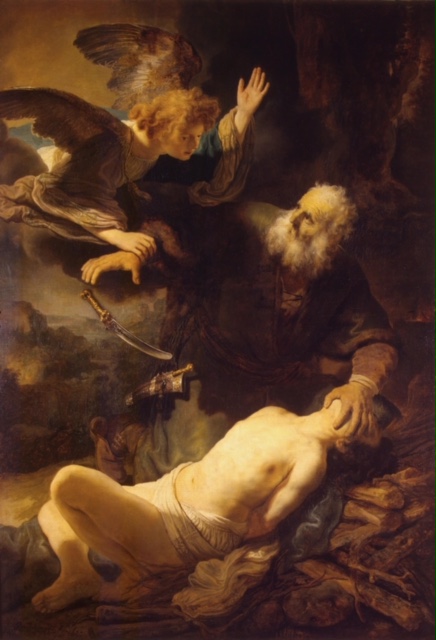
Abraham and Isaac by Rembrandt

In our first reading, we meet Abraham, full of thanks that God reconsidered the command to sacrifice his dear son.


But then our second reading expresses thanks that God was willing to sacrifice his own Son for our sakes.

The Transfiguration by Titian

Finally, our Gospel takes us to the Transfiguration where that Son who will be sacrificed is revealed in his true glory.

What is the thread binding these readings? I think it can be found in this Gospel verse:

This is my beloved Son.  
Listen to him.

True listening is obedience. The words come from the same root: obedience = listen to,” from ob “to” + audire “listen, hear”.

  • Abraham listens, no matter how hard, and finally hears God’s real command to love.
  • Jesus listens to the Will of the Father even through his suffering, and is led to Resurrection.
  • We, like Peter, James and John, are called to listen to Jesus who will transfigure our perceptions about what life is really calling us to.

In each case, intent “obedience” allows the listener to hear and see beneath circumstances to the deeper Grace beyond appearances. Deep spiritual listening transfigures us!

This is the whole point of the spiritual life. Our lives are so much more than mere circumstances or appearance. Our psalm calls us to believe this even in difficulty:

I believed, even when I said,
    “I am greatly afflicted.”
Precious in the eyes of the LORD
    is the death of his faithful ones.

Psalm 116:10

When we do this, we are freed to engage our lives at the level of God’s Will which is always for our good, which is always from Love. The long tradition of faith, learned from our forbearers, assures us of this:

O LORD, I am your servant;
    I am your servant, the child of your faithful ones;
    you have loosed my bonds.
To you will I offer sacrifice of thanksgiving,
    and I will call upon the name of the LORD.

Psalm 116:16-17

Some of us go through life continually angry, frustrated, or overwhelmed by our challenges. Others, experiencing similar or even greater challenges, reflect a spirit of joy, peace, and gratitude. Why is that? I think today’s readings give us a big clue. Let’s listen to them!


Poetry: Story of Isaac, written and chanted by the bard Leonard Cohen who also wrote the currently popular “Hallelujah “.


Music: Psalm 116: Steve Green

Lyrics

I love the Lord, He heard my voice
He heard my voice. He heard my voice
He heard my cry for mercy
Because He has turned His ear to me
I will call (I will call)
I will call on the Lord for as long as I live

I love the Lord, He heard my voice
He heard my voice. He heard my voice
He heard my cry
I love the Lord, He heard my voice
He heard my voice. He heard my voice
He heard my cry for mercy

Psalm 105: God at the Center

Saturday of the Twenty-seventh Week in Ordinary Time

October 10, 2020


Today, in God’s Lavish Mercy, we pray with Psalm 105, a recounting of the marvelous works God has done from the Abrahamic covenant to the Exodus.

Sing to God, sing praise,
proclaim all God’s wondrous deeds.
Glory in the Holy Name;
rejoice, O hearts that seek the LORD!

Psalm 105: 2-3

Our psalm today enjoins us to remember God’s faithful mercy to us and to praise God as we remember.

Such sacred “remembering” is an act of radical faith which, first, recognizes God as the Center of our life, and second, acts from that radical awareness.


The word “obedience”, so commonly misconstrued as subservience, is another way of describing this radical faith which hears, listens, acknowledges, responds and centers itself on the voice of God. The word “obedience” comes from the same root as the word “listen”.

This freely-given and continually deepened obedience allows us to hear and discern the loving truth God weaves through our lives.

The counter-world of the Psalms contradicts our closely held world of amnesia and mediates to us a world of lively remembering….
… In Psalm 105, a long recital of the great deeds climaxes, “in order that they might keep his statutes and observe his laws” (v. 45). The purpose of remembering is thus to evoke a contemporary practice of obedience in the wake of the memory. The implied negative is that when the inventory of miracles is forgotten, there will be no contemporary obedience .

Walter Brueggemann, From Whom No Secrets Are Hid

In the encyclical Fratelli Tutti, Pope Francis points out how this obedience, (this holy remembering, listening and acting), is tied to the course of human affairs. Francis quotes JPII here:

In this regard, I wish to cite the following memorable statement: “If there is no transcendent truth, in obedience to which the human person achieves full identity, then there is no sure principle for guaranteeing just relations between people. Their self-interest as a class, group or nation would inevitably set them in opposition to one another. If one does not acknowledge transcendent truth, then the force of power takes over, and each person tends to make full use of the means at their disposal in order to impose personal interests or opinion, with no regard for the rights of others… The root of modern totalitarianism is to be found in the denial of the transcendent dignity of the human person who, as the visible image of the invisible God, is therefore by very nature the subject of rights that no one may violate – no individual, group, class, nation or state.

St. John Paul II, Encyclical Letter Centesimus Annus (1 May 1991)

Rootedness in this “remembering obedience” begins with each person’s own sincere prayer. With the psalmist, let us remember God’s loving fidelity to us and, in grateful response, live that Love faithfully into our conflicted world:

Look to the LORD’s strength;
seek to serve the Lord constantly.
Recall the wondrous deeds that God has wrought,
the signs, and the graces God has spoken in your life.

Psalm 105: 4-5

Poem: Called to Become – Edwina Gateley

You are called to become
A perfect creation.
No one else is called to become
Who you are called to be.
It does not matter
How short or tall
Or thick-set or slow
You may be.
It does not matter
Whether you sparkle with life
Or are as silent as a still pool.
Whether you sing your song aloud
Or weep alone in darkness.
It does not matter
Whether you feel loved and admired
Or unloved and alone
For you are called to become
A perfect creation.
No one's shadow
Should cloud your becoming.
No one's light
Should dispel your spark.
For the Lord delights in you.
Jealously looks upon you
And encourages with gentle joy
Every movement of the Spirit
Within you.
Unique and loved you stand.
Beautiful or stunted in your growth
But never without hope and life.
For you are called to become
A perfect creation.
This becoming may be
Gentle or harsh.
Subtle or violent.
But it never ceases.
Never pauses or hesitates.
Only is—
Creative force—
Calling you
Calling you to become
A perfect creation.

Music: Psalm 105 – Give Thanks – Sean Dayton

Jesus, Humble Priest

Monday, January 21, 2019

Click here for readings

Today, in Mercy, our reading from Hebrews describes Jesus as the perfect high priest.  Through the Father’s call, Jesus took on our imperfect nature and transformed it by his life, death and Resurrection. In the Eucharist, Jesus left us a living memorial of this transformation so that we might participate in its saving mystery.

heb5_10 priest

Paul’s “perfected priest” is patient because his own weakness humbles him. He does not take honor upon himself, but receives it humbly from God.

Jesus, the model of this priesthood, 

… in the days when he was in the Flesh,
… offered prayers and supplications with loud cries and tears
to the one who was able to save him from death,
and he was heard because of his reverence.

The perfection of Christ’s priesthood was accomplished through suffering and obedience. This is how Jesus teaches us to live in reverence and humble service.

As I read and pray with this scriptural understanding of priesthood, I pray for our Church. The catastrophic scandals involving our priests and leaders have deeply shaken the faith of many Catholics, including my own.

Many of us are frustrated by the continued refusal of our Church to open itself to new models of priestly service which are grounded in mutuality, inclusivity and simplicity.

The accretions of institutionalization, hierarchical camouflage, and sexist rationale have mitigated the Church’s credibility to touch the lives of ordinary people, especially our emerging adults.

In our Gospel, Jesus talks about an old cloak that needs a patch to make it whole again. He talks about new wine that must be captured and preserved in new wine skins. For me, he is talking about our Church which must be continually renewed and transformed. 

May our present suffering and confusion be transformed by our humble obedience to God’s call – just as the high priest of our first reading was perfected.

Let us pray today for our good Pope, bishops, theologians and spiritual leaders – and for the whole People of God – that we may hear and respond.

Music: Even Death on a Cross ~ Jason Silver