Moses said to the people: “Ask now of the days of old, before your time, ever since God created man upon the earth; ask from one end of the sky to the other: Did anything so great ever happen before? Was it ever heard of? Did a people ever hear the voice of God speaking from the midst of fire, as you did, and live?
…This is why you must now know, and fix in your heart, that the LORD is God in the heavens above and on earth below, and that there is no other. Deuteronomy 4:32-33;39
Moses invites the people to fix their hearts on God Who amazes us in Divine Self-revelation.
With the solemn celebration of Trinity Sunday, the Church acknowledges the fullness of this revelation in Creator, Redeemer, and Sanctifier.
Today, in God’s Lavish Mercy:
Have you ever heard the expression, “I will cover you in prayer”? When a friend says that, we are blessed with the gifts of presence, comfort, accompaniment, hope, and love.
In revealing the Trinity to us, God has covered us with the same gifts. We are called to “fix” our faith and living on this indescribable blessing, the way one would fix a tent by placing the pegs with care and attention.
Prose: from Pope Francis
We can study the whole history of salvation,
we can study the whole of Theology,
but without the Spirit
we cannot understand.
It is the Spirit that makes us realize the truth
or — in the words of Our Lord —
it is the Spirit that makes us know
the voice of Jesus.
Music: O Lux Beata Trinitas – An Ambrosian Hymn, arranged by Ola Gjeilo, sung by ACJC Alumni Choir (Singapore)
The Ambrosian hymns are a collection of early hymns of the Latin liturgical rites, whose core of four hymns were by Ambrose of Milan in the 4th century. The hymns of this core were enriched with another eleven to form the Old Hymnal, which spread from the Ambrosian Rite of Milan throughout Lombard Italy, Visigothic Spain, Anglo-Saxon England and the Frankish Empire during the early medieval period (6th to 8th centuries); in this context, therefore, the term “Ambrosian” does not imply authorship by Ambrose himself, to whom only four hymns are attributed with certainty, but includes all Latin hymns composed in the style of the Old Hymnal.
Today, in God’s Lavish Mercy, our readings present us with two strikingly different forms of resistance to God’s Word.
In our first reading, we see that the community in Pisidian Antioch has responded positively to Paul’s inaugural preaching. He has returned, by invitation, for a second Sabbath to share the Good News. But the reaction is not so smooth this second time.
In a pattern very similar to what Jesus experienced when he preached in his home town synagogue, Paul meets initial approbation, cynicism, rejection and expulsion. And, like Jesus, he turns on his heel, leaving his rejectors tangled in their own faithless criticisms.
The resistance we see here is active. It is a choice not to believe.
On the following sabbath almost the whole city gathered to hear the word of the Lord. When the Jews saw the crowds, they were filled with jealousy and with violent abuse contradicted what Paul said. Both Paul and Barnabas spoke out boldly and said, “It was necessary that the word of God be spoken to you first, but since you reject it and condemn yourselves as unworthy of eternal life, we now turn to the Gentiles.
Acts 13:44-46
Today’s Gospel shows us another kind of resistance to the full embrace of faith.
Philip said to Jesus, “Master, show us the Father, and that will be enough for us.” Jesus said to him, “Have I been with you for so long a time and you still do not know me, Philip? Whoever has seen me has seen the Father. How can you say, ‘Show us the Father’? Do you not believe that I am in the Father and the Father is in me?
This is a passive resistance, one Philip didn’t even recognize in himself. What was it in him that made him impervious to the presence of God in Jesus? Was Philip dull, distracted, hyper-critical, unreflective?
I can’t speak for Philip, but I can tell you that when I miss a sacred point in my life, it is exectly for those reasons! When the moment of grace has passed me by, I do a swift re-take and realize that I had been caught in one or more of the following passive resistant behaviors:
too noisy
too opinionated
too sure of myself
too busy
too tired
too impatient
too scattered
If Philip was in the same boat, he did a good job getting out of it. He sailed on to be one of the great saints and teachers of the Church. Philip really heard Jesus’s answer to his oblivious question:
Jesus said: The words that I speak to you I do not speak on my own. The Father who dwells in me is doing his works. Believe me that I am in the Father and the Father is in me, or else, believe because of the works themselves. Amen, amen, I say to you, whoever believes in me will do the works that I do, and will do greater ones than these, because I am going to the Father. And whatever you ask in my name, I will do, so that the Father may be glorified in the Son. If you ask anything of me in my name, I will do it.”
John 14:10-14
May we not miss the point of Christ’s Presence in our lives. May we notice and lower our own resistances to hear the sacred answers right in front of us.
Poetry: After the Rain – Jared Carter
After the rain, it’s time to walk the field
again, near where the river bends. Each year
I come to look for what this place will yield—
lost things still rising here.
The farmer’s plow turns over, without fail,
a crop of arrowheads, but where or why
they fall is hard to say. They seem, like hail,
dropped from an empty sky,
Yet for an hour or two, after the rain
has washed away the dusty afterbirth
of their return, a few will show up plain
on the reopened earth.
Still, even these are hard to see—
at first they look like any other stone.
The trick to finding them is not to be
too sure about what’s known;
Conviction’s liable to say straight off
this one’s a leaf, or that one’s merely clay,
and miss the point: after the rain, soft
furrows show one way
Across the field, but what is hidden here
requires a different view—the glance of one
not looking straight ahead, who in the clear
light of the morning sun
Simply keeps wandering across the rows,
letting his own perspective change.
After the rain, perhaps, something will show,
glittering and strange.
Today, in God’s Lavish Mercy, our Gospel invites us to pray with the Apostle Philip on this his and James’ feast day.
St. James and St. Philip by Peter Paul Rubens
Philip is mentioned several times in John’s Gospel
In John 6:6, Jesus engages Philip regarding the feeding of the 5,000.
In John 12:21, Philip appears speaks for the Greek community, informing Andrew that they want to be introduced to Jesus.
In today’s Gospel, Philip asks Jesus to be shown the Father. Jesus responds with a simple and perfect instruction on one of the most profound mysteries of our faith – the nature of the Trinity.
“Master, show us the Father, and that will be enough for us.” Jesus said to him, “Have I been with you for so long a time and you still do not know me, Philip? Whoever has seen me has seen the Father. How can you say, ‘Show us the Father’? Do you not believe that I am in the Father and the Father is in me? The words that I speak to you I do not speak on my own. The Father who dwells in me is doing his works.
John 14:9-10
Jesus seems surprised at Philip’s question. Maybe he didn’t think it was that hard to understand the Blessed Trinity! But writers ever since have found it pretty complex. Most notably, St. Augustine took over 15 years to write his masterpiece De Trinitate (On the Trinity). An excellent current English translation by Edmund Hill, OP contains fifteen books in over five hundred pages!
But Jesus makes it pretty simple for Philip. Here’s my interpretation:
Philip, You see me, you see the Creator. We are perfectly One. Perfect Love does that. My words are the Creator’s Words. My works are completing the Creator’s works Who dwells in me. It’s not a problem, Philip. You don’t need an answer. It’s a beautiful Mystery. Just believe and be with it.
The noted 20th century Christian existentialist Gabriel Marcel wrote about the difference between a mystery and a problem.
Marcel worried that a technical ethos was reshaping how we see the world and ourselves. He especially worried about a tendency to reduce mysteries to problems. A problem, for Marcel, is something external to us that can be determinatively understood and solved with a generalizable technique. A mystery, on the other hand, is something in which we are inextricably involved. It has roots deep within us, but it also reaches beyond us. While a problem can be definitively solved, a mystery can only be navigated in light of the concrete situation and the people involved.
Gabriel Marcel: Mystery in an Age of Problems – Steven Knepper
True faith requires that we trust the Mystery of God. Like Philip, we may want answers to the great challenges of life and religion. But these things are not like math problems or scientific equations which can reach human resolution.
Life and faith are more like poetry or music – both of which enter into us and change something deep inside of us. It is a change that cannot be put into words but is nevertheless real. It is mystery.
Knowing and loving our Triune God is the same kind of mystery. We are made of God and God dwells within us. Each of our life experiences offers a small revelation of this overarching Mystery which is far too infinite to ever be packaged in a “solution” such as Philip requests in our Gospel.
Sometimes we may hear ourselves trying to turn the mystery of God into a solvable problem. Do you ever think or voice questions like these:
Why does God allow good people to suffer?
Why didn’t God just create everybody to be good, to erase evil from the world?
Why is God letting THIS (whatever it is) happen to me!
At different times in our spiritual lives, we all suffer from the Big WHY. Some people never get over it, turning atheist or agnostic in their approach to life when they can’t reach an answer. Some, by the grace of God, abide in the questions and come to a place of undefinable peace in the Mystery of God.
Let’s pray to St. Philip today to be granted a measure of the grace he obviously received as he went on to carry the Gospel to Greece, Syria, and Phrygia.
And, although we have concentrated on Philip today, here’s a word about St. James who was obviously very special to Jesus. James, along with his brother John and Peter, formed an informal triumvirate among the Twelve Apostles. Jesus allowed them to be the only apostles present at three quintessential events:
Mark 5:37: the Raising of Jairus’ daughter
Matthew 17:1: the Transfiguration of Jesus
Matthew 26:37: the Agony in the Garden of Gethsemane
Poetry: If Only – Rainer Maria Rilke from The Book of Hours
If only there were stillness, full, complete.
If all the random and approximate
were muted, with neighbors’ laughter, for your sake,
and if the clamor that my senses make
did not confound the vigil I would keep —
Then in a thousandfold thought I could think
you out, even to your utmost brink,
and (while a smile endures) possess you, giving
you away, as though I were but giving thanks,
to all the living.
Music: Lux Beata Trinitas – the hymn, ascribed to St. Ambrose in the 4th century, is sung here by Harry Christophers and the Sixteen whose mission is “… a performing arts charity which exists to take beautiful and inspiring choral music, from the Renaissance to today, to as wide and diverse an audience as possible.” (English translation of hymn below)
O TRINITY of blessed Light,
O Unity of sovereign might,
as now the fiery sun departs,
shed Thou Thy beams within our hearts.
To Thee our morning song of praise,
to Thee our evening prayer we raise;
Thee may our glory evermore
in lowly reverence adore.
All laud to God the Father be;
all praise, Eternal Son, to Thee;
all glory, as is ever meet,
to God the Holy Paraclete.
Today, in Mercy, our Gospel gives us the sense of Jesus claiming his inheritancefrom the Father. He makes it clear that the Father’s Will is the Redemption of all Creation. This is the divine charge given to Jesus. This is his mission.
Jesus continues to use the symbol of bread to teach the forming community.
Bread sustains life. God’s Word is eternal life.
Sharing bread is an act of community. In the Body of Christ, we are made One with God
and with one another.
Bread can stale and disintegrate. Within the Body of Christ, we become eternal and will be raised up unto the Last Day.
These are such BIG thoughts, amazing teachings. I always wonder how simple shepherds, fishermen and housekeepers were supposed to understand! I wonder how we, in our human limitations, could begin to comprehend the infinitely loving design of God revealed in Jesus Christ!
Today, as we celebrate the feast of the great Saint Catherine of Siena, we can learn from her spiritual wisdom. Without formal education, she grew by grace into a Doctor of the Church.
She was born Catherine Benincasa on March 25, 1347, in Siena, Italy, and was a twin, the 24th child of 25. She only lived to the age of 33, dying of a stroke in Rome in 1380. Catherine of Siena, often referred to as “great Kate,” is well known for her expressive life of prayer shared in three major sources of writings: over 400 letters, 26 prayers, and The Dialogue of Divine Providence, which she referred to as “the book,” written in the format of a conversation between herself and God. She was noted for her style of learning, not acquired from formal education and degrees, but gained from an interior wisdom that came from lived experiences and a mystical life of prayer. ( https://www.hprweb.com/2020/02/the-trinitarian-theology-of-the-eucharist-according-to-st-catherine-of-siena/)
Here are two selections from Catherine’s extensive writings which reveal her ever-deepening relationship with God through the gift of the Bread of Life.
Eternal God, Eternal Trinity, You have made the Blood of Christ so precious through His sharing in your Divine Nature. You are a mystery as deep as the sea; the more I search, the more I find, and the more I find the more I search for You. But I can never be satisfied; what I receive will ever leave me desiring more. When You fill my soul I have an ever-greater hunger, and I grow more famished for Your Light. I desire above all to see You, the true Light, as you really are.
St. Catherine of Siena, Prayer 12, V 124–157
And by the light of most holy faith
I shall contemplate myself in you.
And I shall clothe myself in your eternal will,
And by this light I shall come to know
That you, eternal Trinity,
Are table
And food
And waiter for us.
You, eternal Father,
Are the table
That offers us as food
The Lamb, your only-begotten Son.
He is the most exquisite of foods for us,
Both in his teaching,
Which nourishes us in your will,
And in the sacrament
That we receive in Holy Communion,
Which feeds and strengthens us
While we are pilgrim travelers in this life.
And the Holy Spirit
Is indeed a waiter for us,
For he serves us this teaching
By enlightening our mind’s eye with it
And inspiring us to follow it.
And he serves us charity for our neighbors
And hunger to have as food
Souls
And the salvation of the whole world
For the Father’s honor
So we see that souls enlightened in you,
True light,
Never let a moment pass
Without eating this exquisite food
For your honor.
Music:Ave Verum Corpus – words attributed to 14th century Pope Innocent VI, melody to Mozart, sung by King’s College Choir
Today, in Mercy, we celebrate the feast of the Blessed Trinity, a mystery of our faith beyond full human comprehension. Clearly realizing this, John Wesley, founder of the Methodist religion said this:
Bring me a worm that can comprehend a man, and then I will show you a man that can comprehend the Triune God.
Still, as we pray, we have some limited conceptualization of this Divine Mystery. We reshape it into human terms we can relate to:
Father, Son, Spirit Creator, Redeemer, Sanctifier
These give us some insight into the heart of the Triune God, but only from the limits of our human perspective. It is a mystery so infinite that even in heaven we may not plumb its depths.
Many theologians and philosophers have tried to stretch our perspectives. The great Swiss Catholic theologian Hans Urs von Balthasar writes:
The One, the Good, the True, and the Beautiful, these are
what we call the transcendental attributes of Being,
because they surpass all the limits of essences
and are coextensive with Being.
It may be helpful in our prayer to think of the Trinity in these terms- The Good, The True, and the Beautiful. These concepts, while we can experience them clearly in an individual or an object, far surpass that one particular presence or circumstance.
So it is with the nature of the Trinity. We perceive it simply in glimpses. Though Its totality far surpasses our comprehension, perhaps these glimpses are enough:
C.S. Lewis puts it this way:
Any patch of sunlight in a wood will show you something about the sun
which you could never get from reading books on astronomy.
These pure and spontaneous pleasures are ‘patches of Godlight’
in the woods of our experience.
What does all this mean in our daily spirituality? How can we find a Trinitarian spirituality in our daily encounter with God? How can we find the “patches of Godlight”?
Pope Francis brings it down to our experience of family:
All of the love that God has in Himself,
all the beauty that God has in Himself,
all the truth that God has in Himself,
He gives to the family.
So, in the sincere love – given and received – of a family or community, we find the reflection of this immense mystery.
And St. Catherine of Siena confidently prays about this truth in this way:
You, Eternal Trinity, are my Creator,
and I am the work of Your hands,
and I know through the new creation
which You have given me in the blood of Your Son,
that You are enamored of the beauty of Your workmanship.
Music: Amazing Love – Billy Martin, Peggy Dequesnel, Steve Hall
Today, in Mercy, our readings might make us burst out with, “Isn’t June a beautiful month!”
It is the month building up to Pentecost, when Christ again and again assures us of his love.Look at this from Revelations today:
The Spirit and the bride say, “Come.” Let the hearer say, “Come.” Let the one who thirsts come forward, and the one who wants it receive the gift of life-giving water.
And this from our Alleluia Verse:
I will not leave you orphans, says the Lord. I will come back to you, and your hearts will rejoice.
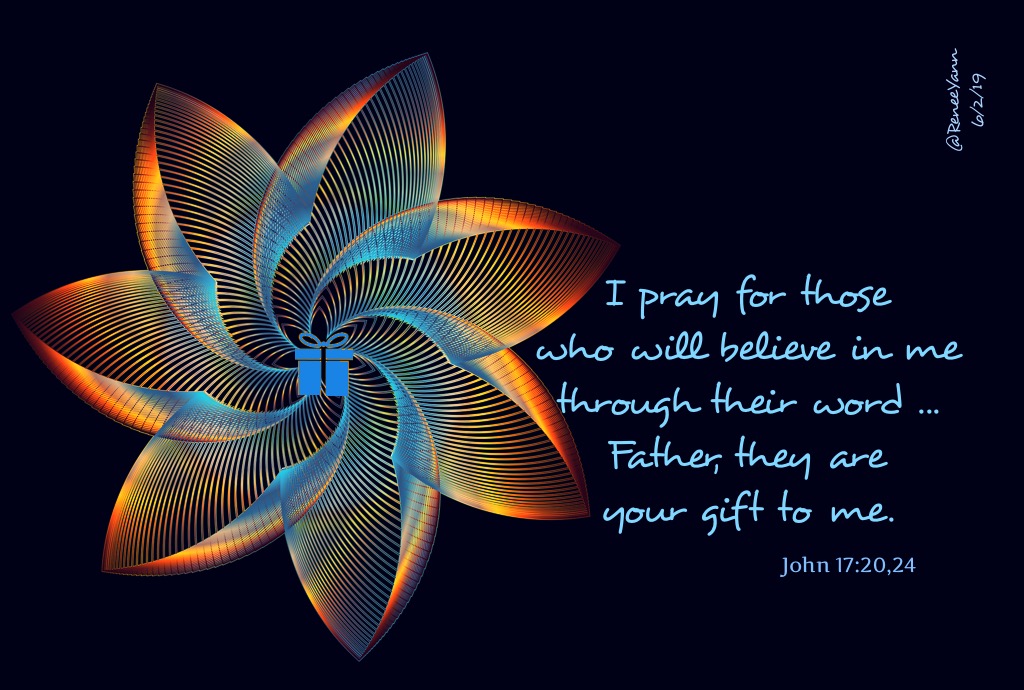
And this from our Gospel: Father, they are your gift to me. I wish that where I am they also may be with me, that they may see my glory that you gave me, because you loved me before the foundation of the world.
Oh, how Jesus loves us. And now, as He prepares to rejoin the Father, Jesus promises the Holy Spirit, so that we who believe may be embraced by the Infinitely Complete Love that is Trinity.
Friends, these are wonderful readings. On this warm June morning, let yourselves be loved by them.
Music: Cherubic Hymn to the Trinity- Tchaikovsky (English Lyrics below)
Let us represent the cherubim in mystic harmony, mystic harmony,
praise the Father, Son and Spirit,
raise our three-fold song, raise our three-fold song,
praise the Trinity, praise the Trinity, raise our three-fold song to the Trinity,
Let us now cast aside, cast aside, let us cast aside all this earthly life,
cast aside, cast aside, cast aside, all this earthly life. Amen.
King of all, we may receive God the King, we may receive Him!
He who in glory enters in with mighty hosts of angels,
with mighty hosts of angels. Alleluia!
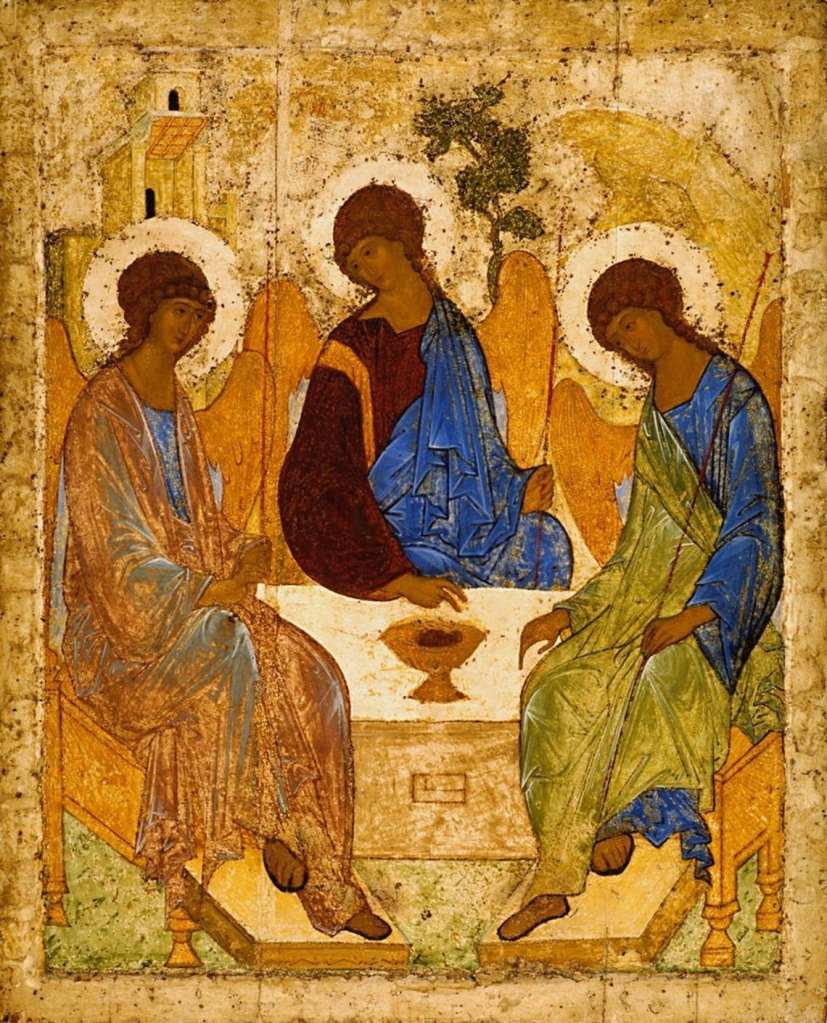
Today, in Mercy, we celebrate the Solemnity of the Most Holy Trinity, one of the most profound mysteries of our faith. The first reading shows us that human beings have been trying to understand this mystery ever since the time of Moses! The readings from both Romans and Matthew describe the power of God’s triune love in those who believe. But none of the readings really explain the Holy Trinity.
And that’s the whole point. “Mystery” cannot be explained.. We fumble around with human words in an attempt to capture a reality beyond words, beyond analysis – but not beyond faith. Mystery can only be encountered in humble and undemanding faith.
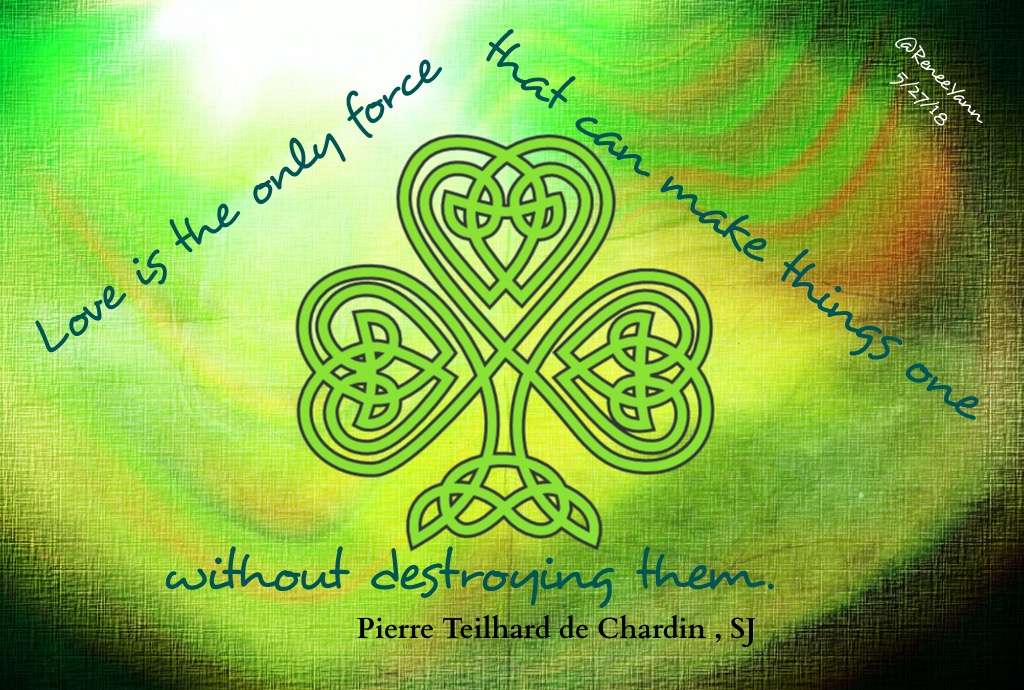
Today, as Christians, we profess our belief in a God Who is incomprehensible Infinite Love creating, redeeming and sanctifying all Creation. This Infinite Love is so pure and complete that, within its Unity, it both embraces and frees the three Persons of the Trinity.
Pope Francis has said, “The Christian community, though with all its human limitations, can become a reflection of the communion of the Trinity, of its goodness and beauty.”Our prayer today is to grow in our capacity to love in imitation of the Trinity. May we, as individuals and as a Church, increase in that merciful inclusivity and wholeness which reflects the triune love of God, at once embracing and freeing all that we love.
Music: Grace ~ Michael Hoppè – May this reflective piece offer us the space to enter into God’s Presence.






 Lavish Mercy