David’s Vocation

Tuesday of the Second Week in Ordinary Time
January 16, 2024

Today’s Readings:

https://bible.usccb.org/bible/readings/011624.cfm


Today, in God’s Lavish Mercy, our first reading introduces us to David, whose thrilling and passionate story unfolds and echoes throughout the rest of biblical history.

In today’s passage, David is called in from the fields to receive, quite unexpectedly, Samuel’s anointing:
David
Michelangelo’s David

“The LORD has not chosen any one of these.”
Then Samuel asked Jesse,
“Are these all the sons you have?”
Jesse replied,
“There is still the youngest, who is tending the sheep.”
Samuel said to Jesse,
“Send for him;
we will not begin the sacrificial banquet until he arrives here.”
Jesse sent and had the young man brought to them.
He was ruddy, a youth handsome to behold
and making a splendid appearance.
The LORD said,
“There–anoint him, for this is he!”  

1 Samuel 16: 10-12

Now, the passage doesn’t indicate which field David was in. But maybe he was out in proverbial “left field”, the place from which many human beings are called to do important things, to respond in courageous ways.

Most of us, like David, are just living our ordinary daily lives –relatively oblivious to grace – when the life-changing moments come. Those moments may not be as momentous as David’s, but they are big deals for us. 

  • We get a college acceptance (or rejection) letter.
  • We get a job offer (or we get laid off).
  • We get elected to a position (or we don’t)

Someone asks us:

  • Want to go steady?
  • Will you marry me?
  • Have you ever considered religious life?

Young people, like young David, seem to meet a lot of these obvious directional points in their unfolding lives. But, in reality, we continue to meet them as we move to full maturity. Until the day we die, God is always calling to become deeper, more honest, more loving, more gracefully beautiful, more fully in God’s image.


Where have the pivotal calls and turning points come in your life? What are the junctures at which everything would have been different had you made another choice? What made young, innocent David ready when his first, and ensuing, calls came? 

Here’s why:
David had an exquisite love and constant relationship with God.
And God loved him back, just like God loves us.


Every critical point in our life’s journey is charged with the power of God’s love. That power comes disguised in routine circumstances, like a parent calling his shepherd son home for dinner. But if our hearts are tuned to God, we hear the call deep within those ordinary appearances and we receive the moment’s anointing.

May it be so, until we meet the Beloved Face to face.


Poetry: Vocation – William Stafford

This dream the world is having about itself 
includes a trace on the plains of the Oregon trail,
a groove in the grass my father showed us all
one day while meadowlarks were trying to tell
something better about to happen.

I dreamed the trace to the mountains, over the hills,
and there a girl who belonged wherever she was;
but then my mother called us back to the car:
she was afraid; she always blamed the place,
the time, anything my father planned.

Now both of my parents, the long line through the plain,
the meadowlarks, the sky, the world's whole dream remain,
and I hear him say while I stand between the two,
helpless, both of them part of me:
"Your job is to find what the world is trying to be."

Music: Anoint Me, Lord – written by Vickie Yohe, sung by Jonathan Matthews

Universal Call

Friday of the Thirteenth Week in Ordinary Time
July 7, 2023

Today’s Readings:

https://bible.usccb.org/bible/readings/070723.cfm


Today, in God’s Lavish Mercy, each of our readings presents a story of vocation and how it is fulfilled in a lifespan.

Our reading from Genesis describes four people at different stages of their life’s vocation: Abraham and Sarah in its fulfillment, Isaac and Rebekah in its initial hope.


For my prayer, I focused on Abraham who is closing out his story in peace, prosperity, and active hope for a future he will not see:

Abraham had now reached a ripe old age,
and the LORD had blessed him in every way.
Abraham said to the senior servant of his household,
who had charge of all his possessions:
“Put your hand under my thigh,
and I will make you swear by the LORD,
the God of heaven and the God of earth, …
… that you will go to my own land and to my kindred
to get a wife for my son Isaac.”

Genesis 24:1-4

Both Abraham and Sarah lived long and fruitful lives, matured in faith, and died in peace. Through the extensive history of their lives, they listened to and trusted God (on and off!), acted for God’s glory, and guided their household in God’s way.

They listened, responded and connected their lives irrevocably to God’s vision.
It is at once a simple and a challenging formula for spiritual fulfillment.


In our Gospel, Matthew is called to the same formula which is the underpinning of any vocation:

As Jesus passed by,
he saw a man named Matthew sitting at the customs post.
He said to him, “”Follow me.””
And he got up and followed him.
While he was at table in his house,
many tax collectors and sinners came
and sat with Jesus and his disciples.
The Pharisees saw this and said to his disciples,
“”Why does your teacher eat with tax collectors and sinners?””
He heard this and said,
“Those who are well do not need a physician, but the sick do.
Go and learn the meaning of the words,
I desire mercy, not sacrifice.”

Matthew 9:9-12

Matthew listens to Jesus’ call, responds,
and connects his life irrevocably to Jesus’ vision.


The continuing call for each of us is clear. Each of our lives offers us a particular expression of “vocation”. It may be as religious, priest, parent, spouse, family member, teacher, caregiver, public servant, or any other role that places us in loving and responsible relationship with our neighbor.

In that role, can we/do we:

  • listen for God in every circumstance
  • respond in faith, hope, and love
  • witness a Christ-rooted life by our actions for Gospel justice and mercy

Poetry: Vocation by William E. Stafford

This dream the world is having about itself 
includes a trace on the plains of the Oregon trail, 
a groove in the grass my father showed us all 
one day while meadowlarks were trying to tell
something better about to happen. 

I dreamed the trace to the mountains, over the hills, 
and there a girl who belonged wherever she was; 
but then my mother called us back to the car: 
she was afraid; she always blamed the place,
the time, anything my father planned. 

Now both of my parents, the long line through the plain, 
the meadowlarks, the sky, the world's whole dream 
remain, and I hear him say while I stand between the two,
helpless, both of them part of me:
"Your job is to find what the world is trying to be."

Music: The Call – Celtic Women sing a song written by Anthony Downes


Thursday of the Fourth Week of Easter

May 12, 2022

Southover, St John the Baptist Church
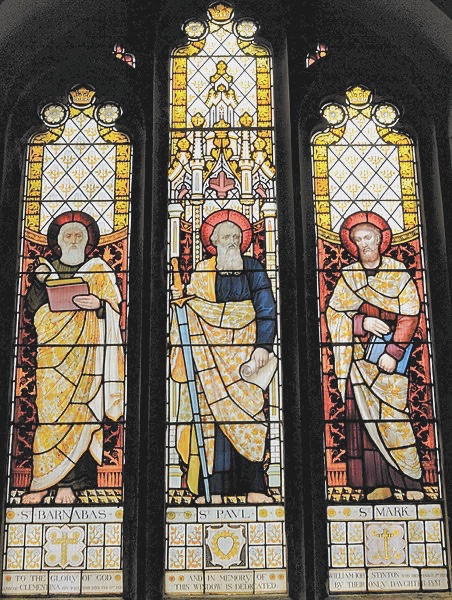
Barnabas, Paul and Mark window St. Patrick’s Church, Sussex, England

Today, in God’s Lavish Mercy, and for much of this and next week, we travel with Paul on his first missionary journey. Acts 13 and 14 make for some interesting historical reading, revealing how the early Church took form, how leadership emerged, and how various congregations sparked the spread of the Gospel.


These passages also offer at least two important thoughts to enrich our faith and spiritual life:

  1. They recount a compact synthesis of Salvation History, the story of God’s faithfulness to Israel and, through Jesus Christ, to us. It is a truly marvelous story. Praying with it can make us amazed and grateful that we are now a living part of its continuing grace.
  2. They clearly establish the Christian life as a missionary life – one meant to receive but also to share the Good News of the Gospel.

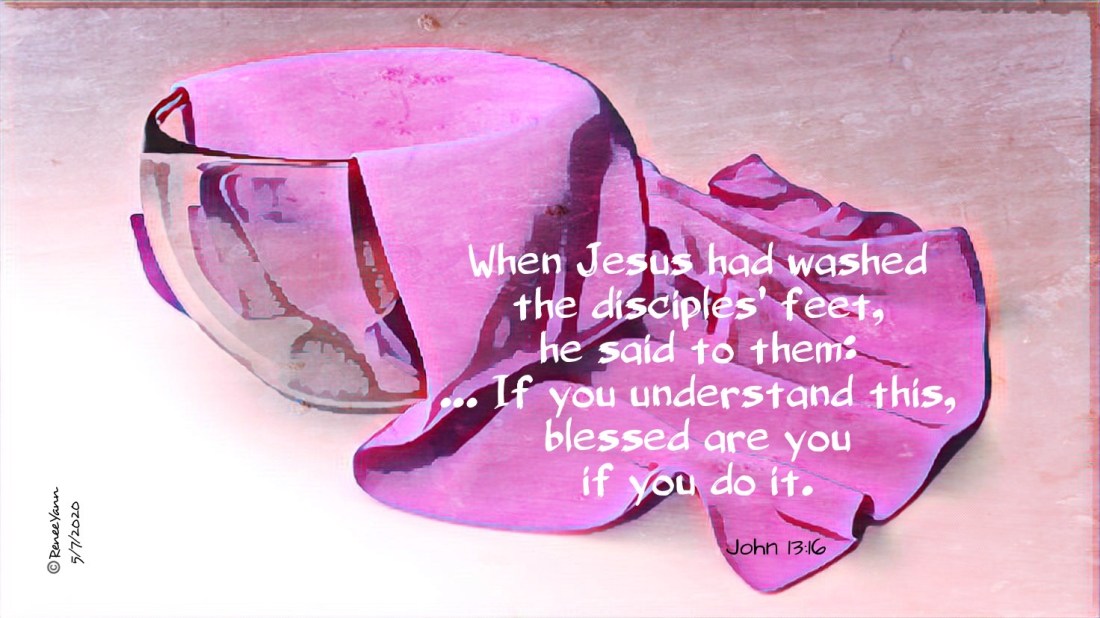
John13_16 wash

In our Gospel, Jesus, by washing the feet of his companions, clearly demonstrates the key characteristic of a true missionary disciple — sacrificial love rendered in humble service.

Amen, amen, I say to you, no slave is greater than his master
nor any messenger greater than the one who sent him.
If you understand this, blessed are you if you do it.

John 13: 16-17

Jesus commissions his disciples to imitate his love. He promises to be present with them as they minister in his name:

Amen, amen, I say to you, 
whoever receives the one I send receives me, 
and whoever receives me receives the one who sent me.

John 13:20

Jesus wasn’t just talking to
a little dinner party gathered long ago.
He was talking to us.
For our time and place in history,
we are the ones commissioned for Love. 


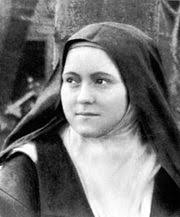
Our service of the Gospel may take us on exciting journeys like Paul. Or we may be missionaries of prayer and charity, like Thérèse of Lisieux who, though she never left her cloister, was declared Patroness of the Missions by Pope Pius XI.


therese


O Jesus, my Love, my Life … I would like to travel over the whole earth to preach Your Name and to plant Your glorious Cross on infidel soil. But O my Beloved, one mission alone would not be sufficient for me. I would want to preach the Gospel on all five continents simultaneously and even to the most remote isles. I would be a missionary, not for a few years only but from the beginning of creation until the consummation of the ages.”

Thérèse of Lisieux – Story of a Soul


In our prayer today, perhaps we might ask Paul, Barnabas, Thérèse or another of our favorite saints to help us see more clearly our own call to carry the mission in our lives.


Poetry: HERE I WILL STAYSister Carol Piette, M.M., also known as Sister Carla, entered Maryknoll Sisters in 1958. She was sent to Chile, where she was a teacher and a pastoral care worker and continued to serve the poor during Chile’s military coup in 1973. In 1980 she was assigned to El Salvador to accompany internal refugees who were fleeing violence. Piette died on August 24, 1980 while crossing a flooded river in an attempt to help a father return to his family. “Here I Will Stay” was published in her biography, Vessel of Clay: The Inspirational Journey of Sister Carla (2010), by Jacqueline Hansen Maggiore. (from https://vocationnetwork.org/en/articles/show/599-word-as-witness-to-the-word)

The Lord has guided me so far
And in His guidance, He has up and dropped me here,
at this time and in this place of history.
To search for and to find Him; Not somewhere else,
But here.

And so HERE I WILL STAY,
Until I have found that broken Lord, in all His forms,
And in all His various pieces,
Until I have completely bound-up His wounds and covered His whole Body,
His People, with the rich oil of gladness.

And when that has been done,
            He will up and drop me again—
Either into His Promised Kingdom, or into the midst
            Of another jigsaw puzzle of
His broken Body, His hurting People.


Music: Here I Am, Lord – St. Louis Jesuits

 Renee Yann, RSM  CharityChurchCommunityDiscipleshipEas

That Little White Book

Friday of the Third Week of Lent

March 20, 2020

Click here for readings

Wednesday-20-March-1963-tf79df128030699e87a485b4eb093700302fe62c25f3a5cfc651f117a49786663k-lq

Today, in Mercy, I’m going to tell you a story. But first …

In our first reading, the passionate prophet Hosea offers us this quintessential Lenten advice:

Return, O Israel, to the LORD, your God;
you have collapsed through your guilt.
Take with you words,
and return to the LORD

In our Gospel, Jesus is giving advice too. A sincere scribe seeks out Jesus’ wisdom:

One of the scribes came to Jesus and asked him,
“Which is the greatest of all the commandments?”

Jesus instructs the scribe:

The Lord our God is Lord alone!
You shall love the Lord your God with all your heart,
with all your soul,
with all your mind,
and with all your strength.

Then Jesus goes on to tell him the second greatest commandment:

You shall love your neighbor as yourself.

Assessing the scribe’s sincerity, Jesus promises him:

“You are not far from the Kingdom of God.”


Praying with these passages on this particular date took me back to March 20, 1963, Wednesday of the 3rd week of Lent that year. I was almost 18 years old and, while not wise as a scribe, I too sought answers to guide my faith.

One place I found that  wisdom was at the desk of a wonderful Sister of Mercy, Sister Mary Giovanni. Like many high school girls back then, I hung around Sister’s homeroom after school. Her good humor, gentle interest, and kind encouragement nourished all of us still slightly silly but ever-so-earnest young women.

On that particular afternoon, an unusual white book sat on Sister’s desk. Its gold letters attracted me and I asked what it was. Sister said it was her community’s centenary book and that, if I wanted, I could borrow it to read.

That little book changed my life. Well, I guess what it actually did was to capture many loose threads running through my mind and heart, and to tie them into a conviction.

I had been toying with a religious vocation ever since third grade. I did love God with my whole heart, just like the young scribe in today’s Gospel. And I loved the nuns and I always wanted to be like them. But actually becoming like them was another story. 

That little white book gave me the courage and will to make that commitment. Here’s what it said:

The Sisters of Mercy,
in addition to the vows of poverty, chastity and obedience,
take a fourth vow of service of the poor, sick, and ignorant.

That was it! That short sentence opened my understanding to see that loving God had to be demonstrated in love of neighbor. The two great commandments are always interdependent.

So I decided to “take my words”, as Hosea encourages, and to ask God if He would have me as a Sister of Mercy.
follow

Less than a week after reading that book, I signed up to become a Sister of Mercy. And I have continued to become one every day for almost 60 years. Because just as Jesus said to the scribe, I believe I am “not far from the Kingdom of Heaven”. But I’m not there yet. Everyday is a chance to grow deeper into the glorious gift that was opened to me back in March 1963.

novices'_dining_room

As you pray with these passages today, take a long view of God’s continuing call in your life. You may have been called to marriage and parenthood, priesthood, a generous single life, a profession which allowed you to serve others. 

In each individual call, we are invited to love God with all our hearts and to love others as God loves them. Let’s pray for one another’s continuing deepening in our particular call.

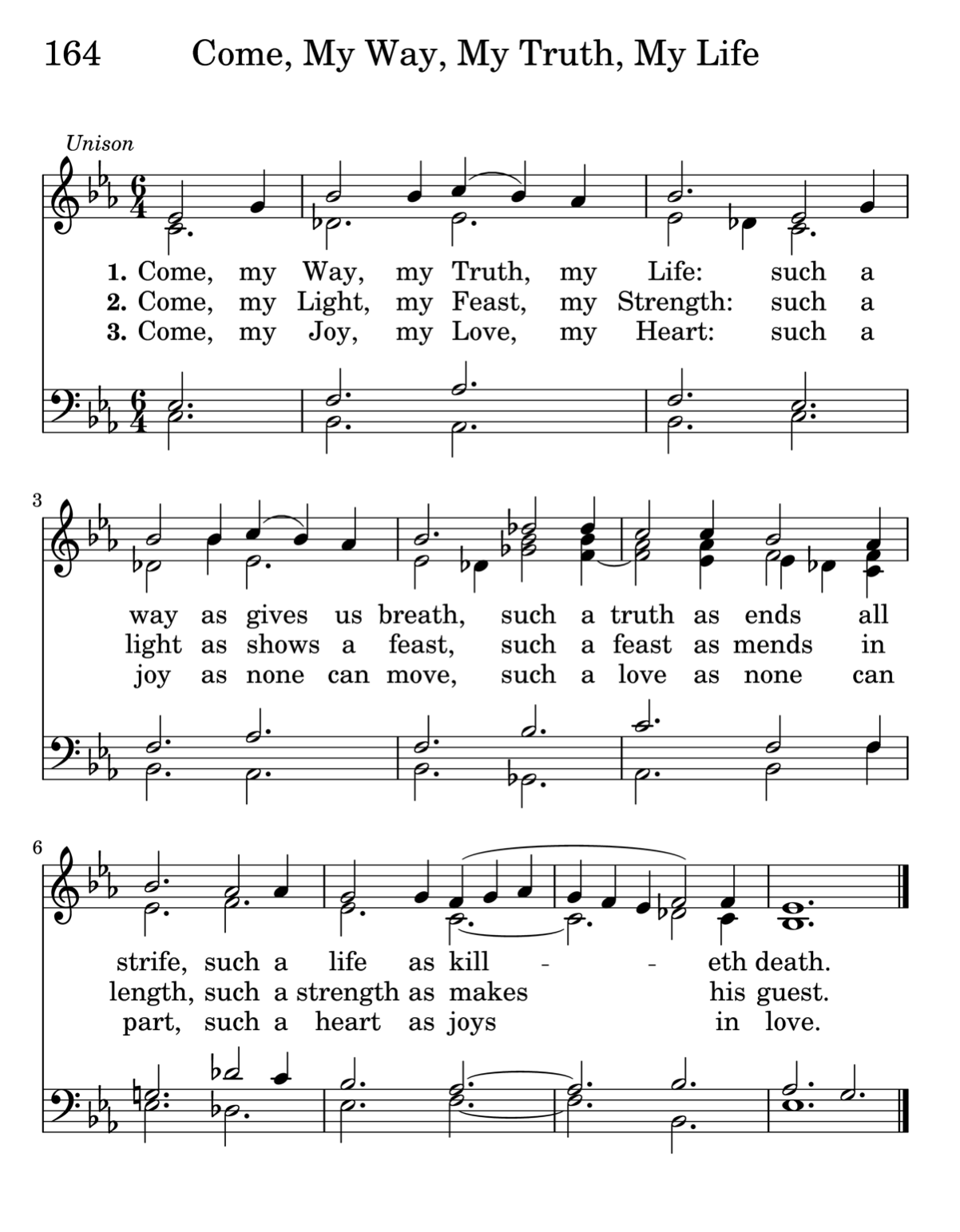
Music: The Call – written by Vaughn Williams from the poetry of George Herbert
(Lyrics below)


the call

The Burning Bush

Wednesday of the Fifteenth Week in Ordinary Time

July 17, 2019

Click here for readings

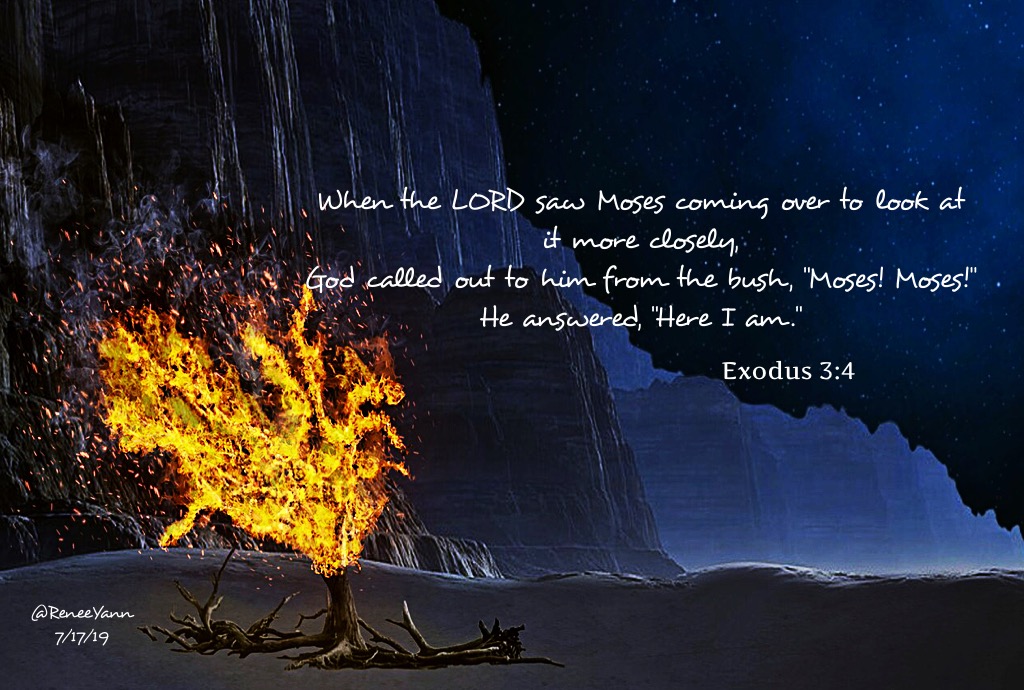
Today, in Mercy, we read about a “theophany” – a visible manifestation to humankind of God. Not your everyday occurrence, right? Well, let’s think about that.

Ex3_4 bush

In today’s passage from Exodus, Moses, self-exiled from Egypt because he murdered an abusive slave master, is shepherding his father-in-law’s flock through the desert. (Good practice for what will face him for the next forty years!) He’s basically out in the middle of nowhere, mindlessly daydreaming as the sheep dogs do most of the work.

All of a sudden, in the still, quiet spaciousness, a lonely bush combusts right in front of him! Theophany! God wants his attention.


For most of us, there are no burning bushes.
So what does God do when God wants our attention?


Just this morning, another Sister and I were praying in our quiet living room. In the stillness, I heard her very softly say, “Praise God”. She had noticed the clear, blue sky and gently swaying leaves outside our window. She had become instantly aware of how blessed she was by such beauty and life.

A theophany? I think so. And there are scores of them flowing past us daily if we can just open the inner heart to see them; if we can just pause to be grateful within their presence; if we can just acknowledge them by a simple prayer and wait to hear their message.

Some “theophanies” come gently like my friend’s this morning. Some come in an unexpected, and perhaps unwanted, explosion that disrupts our lives. But in each of their guises, they carry a God Who wants to speak with us. May we listen.

Music: jazzing it up today
Echoes from the Burning Bush – The Cathedral Singers

Moses stood on holy ground
Far from God descended down
Set the roadside bush on fire (bush on fire)

Then the Lord did there explain
Through His servant should remain
All the echoes from the bush on fire (the bush on fire)

Oh the echoes from the bush (I hear those lovely echoes from the burning bush)
How they thrill my soul (how they thrill my soul)
Oh the echoes from the bush (I hear those thrilling echoes from the burning bush)
Point me to the Lord (point me to the Lord)

I no more am doubting, but with joy I’m shouting
With no thought of shame to blush (no shame to blush)
This my song shall ever be, words that are so sweet to me
Echoes from the burning bush (the burning bush)

God sent down His only Son
Just to ransom everyone
By the echoes from the fire (from the fire)

God of every earthly land
Would not pick nor choose a man
For His blood will save us from the fire (eternal fire)

Yes, I’m Talkin’ to YOU!

Saturday of the Seventh Week of Easter 

June 8, 2019

Click here for readings

Today, in Mercy, our Gospel reveals a lot about the relationships and personalities among Jesus and his disciples.

John is described as “the one whom Jesus loved”, indicating that there was a unique affection shared between them. What was that like? John was younger than most of the other men. Perhaps he needed more overt direction and care from Jesus. We know from John’s later extensive contributions to scripture that he was a poet and a visionary, someone with heightened sensitivities. Perhaps John expressed his love for Jesus more openly, triggering a similar response in Jesus.

Peter, once again, appears as the questioner. Throughout the Gospels, he is always asking Jesus to explain, to define, to assure. In today’s reading, Jesus has given Peter the prime call to follow him. But Peter wants more. Looking at John, Peter wants to know, “What about him… will he follow?”

Maybe Peter is a lot like some of us, a little unsure of where we are in God’s love. Maybe he wants to know how he compares to John, the obvious “Beloved Disciple”.

Jesus doesn’t coddle Peter. He wants Peter to “man up”. Peter has immense leadership responsibilities ahead of him. He needs to rely totally on Jesus’s promise to him.

John21_22

So Jesus tells him not to worry about how others are loved and called by God. He tells Peter, “ You follow me!” – that’s all you have to be concerned about.

Everybody’s call to follow is personal and different. It comes dressed in our particular life circumstances, gifts and awarenesses. God wants Peter and God wants John. He doesn’t want clones of either.

And God wants and calls each one of us in our uniqueness. By entering deeply into our own spirit, we will find our answer to God’s call.

Teresa of Avila said this:

It is foolish to think that we will enter heaven
without entering into ourselves.

May dear, questioning Peter inspire us today to be brave, confident and complete in our own response to God’s call.

Music:  Follow Me – Ray Repp

Drop Everything for Christ

Thursday, September 6, 2018

       Readings: http://www.usccb.org/bible/readings/090618.cfm

Today, in Mercy, our readings lead us to consider our call.

Lk5_11 leftJPG

The call to discipleship comes to us within the other calls of our life: the call to be a good parent, spouse, sibling, child. It comes in the call to be a moral, values-driven employer; an honest, hard-working employee; a supportive, engaged co-worker. Christ asks us to mirror him as neighbor, friend, colleague, and citizen.

In whatever skill or profession we practice, Christ asks us to exercise it as he would – to choose, judge and behave as he would.

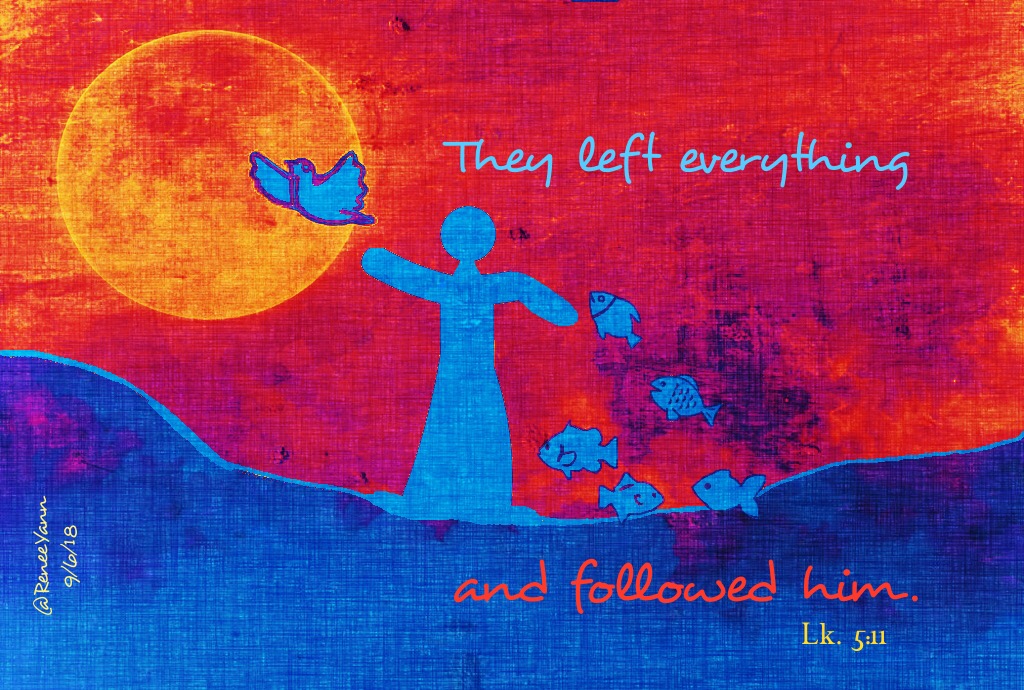
In our Gospel, the first disciples are astonished at the miracle of the fishes. Like a lightening bolt, that astonishment transforms their world view. They now see Christ as the Center of their lives. They drop their nets on the seashore. They leave everything to follow him.

What is it that we must leave to make Christ the center of our lives? What nets are we caught in that keep us from freeing the call within us?

We are challenged by a world filled with the entanglements of greed, destructive power, aggression, bigotry, lies, and political & social pretense. How much have these infected the purity of our desire to follow Jesus?

Music: Lord, You Have Come to the Seashore- Caesareo Gabarain

Lord, You have come to the seashore
Neither searching for…the rich nor the wise,…
desiring only…that I should follow
Refrain:
O Lord, with your eyes set upon me,
gently smiling, you have spoken my name;
all I longed for I have found by the water.
At your side, I will seek other shores.

Lord, see my goods, my possessions;
in my boat you find…no power, no wealth…
Will you accept then…my nets and labor?

Lord,…take my hands and direct them
Help me spend myself in seeking the lost,…
returning love for…the love you gave me.

Lord,…as I drift on the waters…
be the resting place…of my restless heart,…
my life’s companion,…my friend and refuge.