Today, in Mercy, we launch into about two weeks of readings from Genesis and from Mark.
The story of Genesis is one of the first Bible stories we learn as children. Because of this, some of us, myself included, tend to read Genesis on a simplistic level, picturing the now unattainable Garden, the first animals, and the humans ultimately dressed in their grassy outfits.
These two weeks offer us a great opportunity to take our understanding of this beautiful book up a notch.
Imagine what the Genesis story meant to the first community to hear it! Their faith had been invested in an array of gods, both friendly and inimical, who seemed to control their daily experiences. Many times, these gods were in competition among themselves with disastrous results for humans!
By contrast, the God of Genesis is One God, All-Powerful and All-Knowing – the Author of all Creation. Human beings are created in the image of this One God with Whom they are in unique and special covenant.
Roger Nam, Associate Professor of Biblical Studies at George Fox Evangelical Seminary in Portland, Oregon, summarizes this special character of Genesis. I found his description helpful to my prayer:
As you consider the wondrous nature of creation, it is important to recognize the radical, remarkable, and revolutionary nature of the Genesis creation in its original context. This presentation of God comes as a wonderful relief and assurance to the family of ancient Israel.
The God of Genesis 1-2:4a provides assurance to those who work to raise crops against their numerous natural challenges. The God of Genesis 1-2:4 brings peace to the nation struggling for survival against the numerous encroaching enemies from all sides. God is one. God is powerful. And God created us in his image. This opening passage of our Bible constitutes the essence of good news.
As we pray today, we might ask God to conform our hearts to the perfect order of Creation, the Law and Covenant of Mutual Love. We pray with today’s responsorial psalm:
Instead of music today, a reflective reading from Genesis:
Today, in Mercy, we celebrate the lovely feast of Our Lady of Lourdes, commemorating Mary’s appearance to St. Bernadette Soubirous in Lourdes, France, and her subsequent presence in the life of the faithful through devotion and miracles.
Therefore, today’s feast raises before us two important elements of our faith: our devotion to Mary, and our understanding of miracles.
MIRACLES Scripture and tradition are replete with miracles, occurrences when some extraordinary reality points us clearly to God. Michael O’Neill in his book, Exploring the Miracles, writes this:
“No matter how strong we think our faith is or want it to be, we always want to know that God is there for us, and miracles are that sort of element that bridges the gap between our faith and our connection with God.”
The Catholic Encyclopedia offers an extensive and erudite definition of miracles for those interested. But, leaving a theological discussion of miracles aside, I would offer this quote for our consideration:
“There are only two ways to live your life: as though nothing is a miracle, or as though everything is a miracle.” ~ Albert Einstein
MARY As we pray with Mary today, specifically in her role as loving intercessor for us, we reflect on Mary’s total openness to grace. Free from the “original sin” that limits all humanity, Mary possessed a faith without shadow of doubt, a hope without burden of uncertainty, a love without taint of self-interest. She was the means through which Divine Breath was restored to us in Jesus Christ.
Some of you may be familiar with the book “The Reed of God” described on Amazon this way: Caryll Houselander’s beautiful and profound mediation, The Reed of God, depicts the intimately human side of Mary, Mother of God, as an empty reed waiting for God’s music to be played through her. Houselander shares her insightful and beautiful vision of Mary on earth, Mary among us, Mary as a confused but trusting teenager whose holiness flowered with her eternal “Yes”.
Houselander says this about Mary, and it seems to capture perfectly Mary’s appearance to the world at Lourdes:
In the world as it is, torn with agonies and dissensions, we need some direction for our souls which is never away from us; which, without enslaving us or narrowing our vision, enters into every detail of our life. Everyone longs for some such inward rule, a universal rule as big as the immeasurable law of love, yet as little as the narrowness of our daily routine. It must be so truly part of us all that it makes us all one, and yet to each one the secret of his own life with God.
To this need, the imitation of Our Lady is the answer; in contemplating her we find intimacy with God, the law which is the lovely yoke of the one irresistible love.”
Music: Tota Pulchra Es is an ancient Catholic prayer, written in the fourth century. The title means “You are completely beautiful” (referring to the Virgin Mary). It speaks of her immaculate conception. It takes some text from the book of Judith and other text from Song of Songs. (Latin and English lyrics below.)
Tota pulchra Es Tota pulchra es, Maria. Et macula originalis non est in Te. Tu gloria Ierusalem. Tu laetitia Israel. Tu honorificentia populi nostri. Tu advocata peccatorum. O Maria, O Maria. Virgo prudentissima. Mater clementissima. Ora pro nobis. Intercede pro nobis. Ad Dominum Iesum Christum.
You are all beautiful, Mary,
and the original stain of sin is not in you.
You are the glory of Jerusalem,
you are the joy of Israel,
you give honour to our people.
You are an advocate of sinners.
O Mary,
Virgin most prudent,
Mother most merciful.
Pray for us,
Plead for us,
To the Lord Jesus Christ.
I bet I know the first word that popped into your mind when you read today’s headline:PROSECUTION!
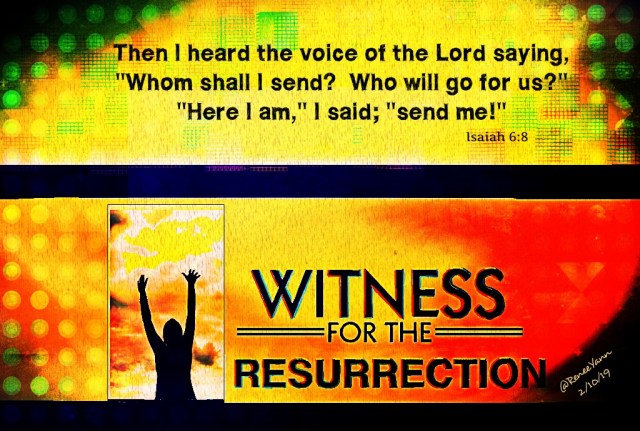
Today, in Mercy, our readings invite us to consider WITNESS — not for the prosecution, but for the RESURRECTION!
In our first reading, we see Isaiah dramatically commissioned to WITNESS to the vision of faith in his heart. He responds wholeheartedly:
Then I heard the voice of the Lord saying, “Whom shall I send? Who will go for us?” “Here I am,” I said; “send me!”
Our second reading, Paul describes how Christ appeared to him and commissioned him, “the least of the Apostles” to be his WITNESS. Paul, too, responds wholeheartedly:
He appeared to me. Therefore, … so we preach and so you believed.
In our Gospel, Simon Peter, James and John are awed by the miraculous power of Jesus as their nets pull hundreds of fish from the otherwise unproductive sea. Jesus tells them that, by their WITNESS, they will attract hundreds of souls to his message. They also respond wholeheartedly:
When they brought their boats to the shore, they left everything and followed him.
For the Word of God to live,
WITNESS is everything.
Macrina Wiederkehr, OSB, in her beautiful book, “Seven Sacred Pauses”, describes the level of WITNESS in the first disciples:
They were impelled to continue proclaiming the Gospel in the face of opposition. They were zealous in preaching because they felt passionate about being entrusted with the sacred message.
Think of this often-heard philosophical conundrum:
If a tree falls in the forest, and no one is there to hear it, does it make a sound?
Logic tells us that it does. But what does it matter if no one hears it?
If the Resurrection happened, and no one bears witness to it, what does it matter? That is the importance of our call to WITNESS – just like Isaiah, Paul, Peter, James, John, and two millennia of believers who carry on the sound of that tomb bursting open to eternal life.
How will we witness to our faith today – not by preachy words or empty opinions, but by our active passion for justice and mercy in the world, and in our own choices?
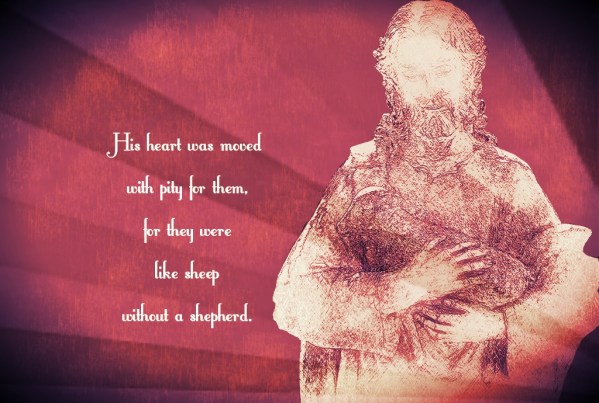
Today, in Mercy,our readings refer to Christ’s infinite compassion by using the image of a shepherd.
It is an image that, while not completely lost on us, is removed from our daily experience. Within the image, though, are elements which transcend time and culture. These elements become clear as we pray with our Responsorial Psalm 23:
Just as Jesus looked at the crowd with pity – (pietàs – a devoted, compassionate love), so he looks on us. It is love like that conveyed in Michaelangelo’s Pietà, where Mary looks on Jesus with a love we cannot imagine.
Psalm 23
(Jesus sees that we need rest from the things that harass our spirits.)
The LORD is my shepherd; I shall not want.
In verdant pastures he gives me repose.
Beside restful waters he leads me;
he refreshes my soul.
R. The Lord is my shepherd; there is nothing I shall want.
(Jesus sees that we need guidance in our complex and morally bereft world.)
He guides me in right paths
for his name’s sake.
Even though I walk in the dark valley
I fear no evil; for you are at my side
With your rod and your staff
that give me courage.
R. The Lord is my shepherd; there is nothing I shall want.
(Jesus sees that we are hungry for deeply spiritual nourishment.)
You spread the table before me
in the sight of my foes;
You anoint my head with oil;
my cup overflows.
R. The Lord is my shepherd; there is nothing I shall want.
(Jesus sees that we need to be assured that we are deeply loved and protected.)
Only goodness and kindness follow me
all wthe days of my life;
And I shall dwell in the house of the LORD
for years to come.
R. The Lord is my shepherd; there is nothing I shall want
What assurance, what pietàs, do we most need from God today?
Perhaps these modern images of Pietà will help us with our prayer.
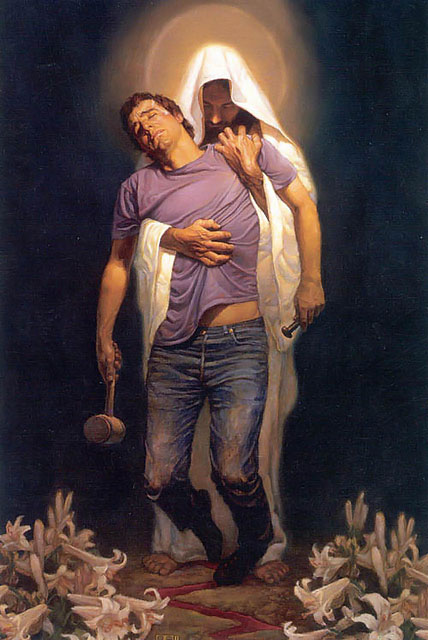
Modern Pietà – Michael BelkChrist Holds the Beloved – Thomas Blackshear
Music: Piè Jesu – Andrew Lloyd Webber
sung here by Lea Salonga & Daniel Rodriguez (note English translation in lower right)
Today, in Mercy, our Gospel recounts the dramatic story of John the Baptist’s death. John, the one who went before Christ, paving the way for him, precedes him even in death.
Jesus expressed great respect and gratitude for John when he said:
I tell you, among those born of women there is no one greater than John …
(Luke 7:28)
Today’s passage from Hebrews closes by exhorting us to:
Remember those who have gone before you,
who spoke the word of God to you.
Consider the outcome of their way of life
and imitate their faith.
Jesus Christ is the same yesterday, today, and forever.
The readings inspire us to gratefully remember and prayerfully honor the many people who have gone before us, leading us in faith. Parents and family, teachers, religious women and men, friends and mentors. Slowly naming these individuals in our prayer will remind us of our abundant blessings and encourage us to live lives worthy of their gifts to us.
Today, in Mercy, Jesus’s disciples set out on their first solo mission. Most of us can relate to their feelings that morning.
Remember your first real job? You had studied, trained, prepared. You had aced the interview. You bought a new blouse, shirt or pair of shoes. You were IN!
And you were scared. You might have done a dry run to make sure you wouldn’t be late your first day. You checked that your gas tank was topped off. You packed a lunch (or someone who loved you did), and wondered who would eat with you.
The disciples were probably scared too. Look at whose shoes they were following in! And Jesus sets out some tough dress code for their work life:
take nothing but a walking stick
no food, no sack, no money in their belts
wear sandals but not a second tunic.
The behavior code was just as lean:
take a buddy for support
when you enter a house, stay there the whole time
if they don’t welcome you or listen to you, don’t argue
leave there and shake the dust off your feet
As we set out to work each day, do we think of our labor as “ministry”? Do we see that our work in some way benefits the life of the community? Do our interactions with our peers encourage their contributions to the common good?
We all need jobs to earn the means to live. But if that’s all our job is, we will never find happiness in it. Meaningful work must benefit more than ourselves and, in that, it can become a ministry.
If Jesus were sending us out to our workday this morning, he might give instructions like these:
work responsibly, mutually and unselfishly
earn all that you need to be happy, but avoid greed
make sure your labors enhance life for others as well as yourself
if your job chokes your soul, move on
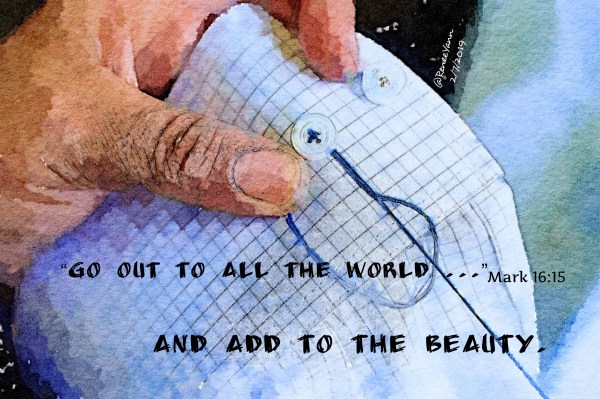
What we do does not determine our worth. How we do it does. We may be sewing buttons on shirts. If we do that with attention and pride, our work will have meaning for us and for others.
Every meaningful job gives us the chance to make the world better for those we serve, and for those with whom we work – to add to the beauty of the world already begun in the blessing of God. Does our work offer us that life-giving opportunity? Do we respond to it wholeheartedly?
See to it that no one
be deprived of the grace of God, that no bitter root spring up and cause trouble, through which many may become defiled.
In our Gospel, Luke writes to his community
So Jesus was not able to perform any mighty deed in his hometown, … He was amazed at their lack of faith.
So what is this bitter root that robs a heart of faith, forgiveness, trust, hope and love?
Think of the things we humans bury deep in our souls, before they can be seen, named and confronted. Naïvely, we think that hiding them will make them disappear.
We bury our:
These buried irritants never disappear. They thicken under the surface, choking the possibility of new life — of Grace. These “bitter roots” steal our spiritual health and cripple the Holy Spirit within us. They deprive the community of our vigor and life.
It is so necessary and important for us to bring these tangled undergrowths to light! It is so necessary and important for us to be the loving community that offers understanding, healing, listening and love.
How do we uncover and release these hidden poisons? Prayer, of course, can help us, and the gentle discipline of honesty with ourselves; the natural self-revelation of a trusted friendship, the insights of spiritual direction and retreat, and, sometimes, the professional accompaniment of a counselor.
Mary Oliver, beloved poet, describes a buried darkness in her own life in this poem “The Uses of Sorrow”:
Someone I loved once gave me a box full of darkness. It took me years to understand that this too, was a gift.
As part of the faith community, we need to contribute to that place of trust and friendship that invites others to work through their darknesses. Healing is not magic. It comes through the tenderness, patience, honesty, awareness and encouragement of the surrounding community, as well as through our own courage. We need that community ourselves, and we need to be that community for others.
Music: Ubi Caritas (Where Charity and Love prevail, there is God.)
Today, in Mercy, I would like to share a homily about today’s Gospel that I prepared for the Catholic Health Association in 2015. Even though it is a little long, I hope you find it fruitful for your prayer.
It is a soft, summer morning in Capernaum and Jesus is in the height of his ministry. Large crowds follow him wherever he goes, crowds hungry with hope; crowds fired by his counter-cultural words and miraculous deeds. This morning, Jesus prepares to speak to them, to translate into language they can comprehend the Eternal Life that lives in his heart. His back is to the gentle, sunlit sea. The hubbub softens to a murmur, finally stilled by the lapping waves.
But before Jesus can begin, a distressed man bursts through the gathered crowd. His robes fly about him as he runs to Jesus and falls at his feet. This man is important, so important that we all have known his name for two thousand years. This is Jairus who lives nearby and organizes the worship in the synagogue. Now breathless and swallowing sobs, Jairus pleads with Jesus: Please! My daughter! You can give her life!
Every loving father has been Jairus at least once in his life. We know these fathers. We are these fathers. They are the ones who burst into emergency rooms with a seizing infant in their arms. They are the ones who stare blankly at the pronouncement of a stillborn child. They are the old men in war-ravaged countries who kneel at the sides of their fallen sons and desecrated daughters. They are all the men throughout history rendered helpless by the forces of unbridled power, greed and death.
The merciful heart of Jesus understands this man and his desperate urgency. Without even a word, Jesus gets up and accompanies Jairus to the place of his pleading.
But there is another urgency pushing forward from the crowds: a woman, apparently of low importance for we have never known her name. She is a woman whom the ages have defined by her affliction. She is “The Woman with the Hemorrhage”. Without the status of Jairus, she approaches Jesus as such a woman must. She crawls behind him at his heels, reaching through the milling masses to even scrape the hem of his garment.
This is a troubled woman, a stigmatized woman. Her life has been spent, literally, in embarrassment, isolation, fatigue and, no doubt, abuse. For twelve years – coincidentally the life span of Jairus’ s daughter – her vitality has bled out of her. Her face is gaunt; her eyes sunken. Her soul’s light is all but extinguished. She is a woman who knows a particular kind of scorn.
We know these women. We are these women. They are the ones filled with remorse for an aborted baby. They are the ones who miscarry their longed-for child. They are the women whose beautiful young sons are profiled, stereotyped and hunted on the violent streets. They are the mothers of “The Disappeared”. They are the women who suffer disproportionately from war, poverty, hunger and violence. They are trafficked women, prostituted women, women victimized by the long saga of domination and dehumanization.
It is just such a broken woman who stretches her fingers through the Galilean dust in a last reckless reach for healing. She finds only the hem of his robe. Touching it, she is transformed, like a parched meadow in the spring rain. Her whole being reaches up to receive the holy restoration. She knows herself to be healed. And it is enough; it is everything. She retreats into the resignation of her otherwise lonely life.
But Jesus wants more for us than just the practical miracles we beg for. We ask for one healing; Jesus wants our eternal salvation. We ask for one blessing; Jesus wants our entire lives to be filled with grace. We ask for one prayer to be answered; Jesus wants our life to become a prayer.
Jesus feels the electrical touch of her hope. He feels the secret healing she has extracted from him. He turns to seek her. Can you see their eyes meet? Yes, the bleeding has been stemmed, but he sees the deeper wounds that scar her soul. His look of immense mercy invites her to tell him “the whole truth”. By her touch, she has commandeered a physical healing. But by his gracious turning toward her, her entire being is renewed. In this sacred glance, her history has been healed. Her future has been pulled from darkness into light. Her capacity to love has been rekindled. She now and forever will remember herself as a child of God.
Jairus waits, no doubt impatiently, at the edge of this miracle, anxious for such power to touch his daughter’s life. He fears they have lingered too long with the woman. His servants arrive, confirming his fears. He receives the dreaded report, “Your daughter has died.”
Jesus now pushes Jairus to the gauntlet of pure faith. In the face of this devastating news, Jesus tells him, “Do not be afraid; just have faith.” Is this not an almost impossible command? Like Jairus, we all know what it is to worry for our children:
Fathers of color teach their sons behaviors to protect them from profiling.
Immigrant parents fear their children will be ripped from them in a pre-dawn raid.
Famine-ravaged mothers watch their children disappear into hunger.
In hospitals and doctor’s offices, devastated parents summon the courage to accompany their critically ill child.
And Jesus says, “ Don’t be afraid. Have faith.”! What can he possibly mean?
Perhaps it is this simple. In Jairus’s home, Jesus takes the dead girl’s hand. He says, “Talitha, koumi – Little girl, arise.” His call to her heart tells her there is no darkness, devastation or death from which God cannot draw us into life. This is the truth Jesus brings to the little girl and to us. But it is a truth that, in our fear and need, we cannot always see.
For the moment, this girl lives. But at some time in history she, like all of us, will die. So the miracle is not the restoration of her life. The miracle is that her eyes, and her parents’ eyes, are opened to the power of God over death. Despite all appearances, God’s life endures eternally.
This is the revelation of this Gospel passage. If we live by faith, we live beyond cure into healing. If we live by faith, even death can bring life. If we live by faith, we are free to release all worry into the abundant mercy of God who grants us healing even beyond our asking or desire.
Man or woman, old or young, at some time in our lives each one of us has been Jairus. Each one of us has been one or the other of these two women. Within their stories of woundedness and deep faith, our stories shelter. Jairus and the afflicted women – unnamed like so many women throughout time – believed there was a way to new life. They reached for it. They begged for it. What is it in us that cries out for such healing? What is it in us that, without the touch of Jesus, teeters on the verge of death?
Simply by believing, these three Gospel figures became new beings. Simply by believing, their orientation changed from darkness to light. By their example, let us lift up those wounded and deadened places in our hearts and world before the loving gaze of Jesus.
To what suffering in our souls is God whispering the encouragement, “Talitha, koum”? What is the “whole truth” Jesus is inviting us to confide? Let us arise and respond to him in the full energy of our faith. Let us gaze with boundless confidence into the eyes of God’s mercy.
Today, in Mercy, our readings are all about God’s transforming power and our human ability to tap into that power by our faith.
Hebrews 11 references several heroes, named and unnamed, whose faith and perseverance were so great that, “The world was not worthy of them.”
Mark’s Gospel tells the story of the Gerasene demoniac, a story with many layers of meaning and challenge. In it, Jesus demonstrates an astounding power that both amazes and frightens his audience.
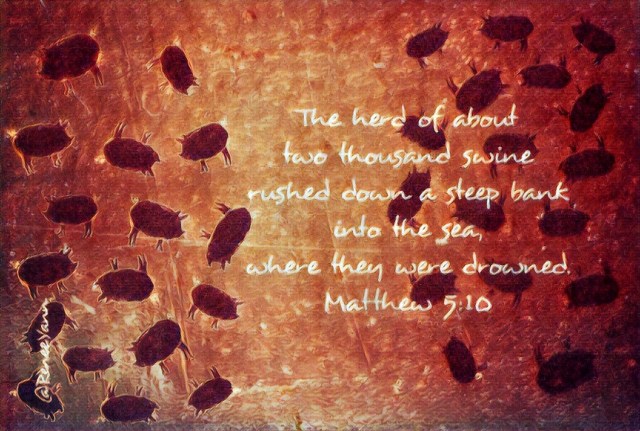
We have the very detailed description of the demoniac, a wild, unnaturally strong and violent man. We have the Gerasene community which doesn’t know what else to do to control the disruptive forces of this wretched man. And we have an innocent, unsuspecting herd of pigs.
Jesus is unafraid of the forces erupting from this troubled man. He approaches the man’s suffering on a whole different level from the unsuccessful tactics of the community.Jesus speaks to the man’s soul which has been shattered into many howling fragments by the evil dwelling inside him. Jesus then casts out that evil in a demonstration that both awes and angers his observers.
Imagine how the pig farmers felt. Their livelihood lay drowning at the bottom of a precipice! The food supply, water integrity, employment opportunities all took a steep drop in that one moment of Christ’s command. In healing this broken man, who is representative of all suffering humanity, Jesus disrupted the comfortable systems which had allowed him to be isolated and chained at the edge of this society.
Jesus challenged this whole community to see the world from a different perspective – a spiritual one in which human life and wholeness is at the heart of all our societal systems. This man was more important than a herd of 2000 pigs!
These readings challenge us who live in a surface world “not worthy” of our faith.
There is incredible suffering throughout this world. It is not enough to simply pray that it is alleviated. It is surely not enough to “chain” it by our indifference and acceptance.
Global suffering will be addressed only by confronting our comfortable systems (our herd of pigs). Our legal, political, economic and social systems must cherish the integrity of the human person. Otherwise, they should be challenged, changed, and maybe even cast away.
Our small part is to learn, understand, choose, vote and speak out for this kind of wholeness – both in our immediate, personal experiences as well as through the social justice structures available to us. For example:
(Because the sunset was so magnificent tonight, I thought I might share this prayer I wrote many, many years ago.)
Degreeing Prayer (To Yield Graciously to Life by Degrees – Like the Sun)
O God, my Beginning and my End,
I do not choose to “rage into the night”.
I choose to bleed into it,
graciously, as
Jesus bled…
by willing peace in face of curdled power,
by willing love in face
of irrational hate,
by willing acquiescence in the face of
time’s inexorable demand.
I want to be that strong…
to be so gentle, because
I think that
Jesus looked into the Dark
and saw Your Face
to learn antithesis of violence.
You are the Yielding One,
eschewing power for the sake of love.
You are Creator, granting
freedom in the will of those to whom
You bind Yourself by love.
You are the Contradiction
of control.
You are the Silent Source
of all
ennobled dying,
by those grafted to your Mystery
in the constant dark.
Absorb me,
as I near the forward edge of night.
Grade me,
like the colors of a yielding spectrum,
to softly welcome Your deepest darkness.








 Lavish Mercy