God Won’t Be Boxed!

Tuesday of the Fifth Week in Ordinary Time

February 11, 2020

Click here for readings

Today, in Mercy, our readings talk about how we try to “house” God.

Because God is bigger than BIG, our minds struggle. More than struggle, they actually fail, repeatedly, to define God. Yet we still try, don’t we?

Mk7_13 box god

We try to picture, describe, paint, quote, and interpret God. We even decide what God wants and create laws to insure God gets that.

We dilute Divinity to our human dimensions. We just can’t take it straight. We mix it and bottle it in our laws, and box it in our rituals — because we can’t manage Omnipotence. 

And let’s face it, most of us like to manage things. 😉At least the Pharisees in today’s Gospel liked that kind of control. And Jesus challenges them on it.


Praying with these thoughts today, I think of my Dad. He liked an occasional jigger of really fine bourbon – savored in its unadulterated state, without water or soda – what today’s purists call “sipping whisky”.

When the doctor informed him, unfortunately in my mother’s presence, that whisky was a no-no, Dad didn’t like it. But he acquiesced. At least we thought he did. 

After Dad died, my brother and I found his bottle of Kentucky bourbon wrapped in a towel in the basement dryer. You see, only Dad did the wash. Mom never liked machines.

I think Jesus would have really enjoyed my Dad as one of his original disciples. Dad liked life “straight”. His faith was simple, direct, complete and undiluted. Sitting with Jesus that Gospel day, Dad wouldn’t have washed his hands either. He would have been too busy listening to the pure, unbottled Word pouring over him.

The message I took from today’s prayer: 

  • Be very wary of anyone who thinks they know exactly what God wants.
  • Let God out of the boxes I put Him in.
  • Invite God’s Spirit to run free through my heart.
  • Don’t bottle God up; don’t box God in.
  • Enjoy sipping God’s surprising and infinite grace.

Music:  New Pharisees – Charlie Daniels Band (Lyrics below)

New Pharisees

They go walking into church every Sunday morning
They the self-appointed sin patrol
Well they whisper and they gossip behind the back
Of anybody that they can’t control

See that girl in the choir she’s got evil desires
She must be drinking from the devil’s well
She’s a downright disgrace with that paint on her face
She looks just like a Jezebel

And they’re running around putting everybody down
What are you trying to do?
You need to pick up the Book and take another look
‘Cause brother I’ve got the news for you

You know Jesus was sent with a new covenant
And he even died for you
New pharisees like a fatal disease
Always flapping your jaws trying to live by the law

You see that boy over there with that long shaggy hair
Ought to be ashamed of his self
He wearing hip-hop clothes got a ring in his nose
Don’t he know he going straight to hell

And then yesterday morning me and sister Johnson
Were talkin’ on the party line
She said that Deacon Brown was having dinner downtown
Somebody seen him with a glass of wine

And you act so righteous and you look so pious
You always pay your tithe
But there’s a rock in your heart and a fire on your tongue
And there ain’t no love in your eyes

Bad news is begotten and the devil is smiling
You gossip and you criticize
New pharisees like a fatal disease
Always flapping your jaws trying to live by the law

Well you can’t get by the law so quit flapping your jaws
New pharisees yes, you’re a lot like me
Heart Temple

Memorial of Saint Scholastica

February 10, 2020

Click here for readings

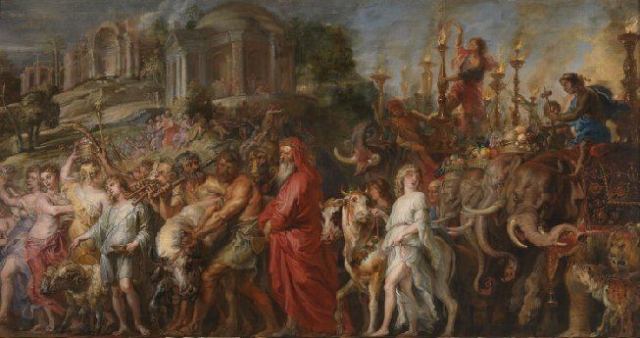
Today, in Mercy, we read about the massive celebration to dedicate Solomon’s Temple. It would have been a ceremony akin to the parades we view in movies like Ben Hur.

roman-triumph-58737a77-19e6-4606-bb0f-b3441f961b8-resize-750


This video gives us a good understanding of the magnificence of the building.


Praying with the passage today, core questions repeat themselves to me:

  • Can God be in a building?
  • Is there a legitimate spiritual purpose to the cathedrals, large or small, that we build?

For me, the answer is a fluid one. Certainly, beautiful churches inspire our faith and serve as a central symbol for the unity of believers.

But throughout history, these buildings have also symbolized individual and national power, pride and greed.

A recent initiative of Pope Francis converted a 19th century palace behind the Vatican into a homeless shelter. The Pope directed this rather than the site’s upgrade to a luxurious hotel. 

The building is described as having “carved wooden ceilings, frescoed walls and tiled floors — evidence of its aristocratic origins.” Sharing a meal with its first residents, Pope Francis said, “Beauty heals”.

Such healing is the real purpose of all such buildings – that their beauty heal hearts, communities, and nations. Where the purpose is lost, excess eviscerates the healing beauty.


At points in the Gospel, Jesus refers to himself as the Temple – instructing his disciples that God’s Presence now dwells in the world through him. Today’s Gospel shows us how this Presence manifests itself – through the power of compassion and justice for the poor:

Whatever villages or towns or countryside he entered,
they laid the sick in the marketplaces
and begged him that they might touch only the tassel on his cloak;
and as many as touched it were healed.

Where God is present there is always healing. May it be so in our churches and in our hearts.

Music: Dwelling Place – John Foley

https://www.youtube.com/watch?v=7f9bzXG2BF0&feature=youtu.be

Shine!

Fifth Sunday in Ordinary Time

February 9, 2020

Click here for readings

Today, in Mercy, our readings are threaded on a theme of light, justice, and healing.

Is58_8wound

Isaiah writes to a formerly exiled community trying to restore itself after returning to Jerusalem. Tensions, meanness, and dissatisfactions tear at the community. Focus on religious rituals becomes excessive while communitarian practices are ignored.

It is a sad and fractious time for Israel.

Isaiah tells them they are missing the whole point.  The path to healing their national soul is not through empty religious words and practices.

If you remove from your midst
oppression, false accusation and malicious speech;
if you bestow your bread on the hungry
and satisfy the afflicted;
then light shall rise for you in the darkness,
and the gloom shall become for you like midday.


In our second reading, Paul writes to the Corinthian community similarly disturbed. He reminds the Corinthians that he came to build Christian community among them humbly and open to the Holy Spirit. Like Isaiah in the first reading, Paul now reminds his community not to miss the point:

I came to you in weakness …
so that your faith might rest
not on human wisdom

but on the power of God.


Jesus tells his disciples to let that power of God shine in them by virtue of their good deeds — the very same deeds Isaiah recommends to his listeners:

Share your bread with the hungry,
shelter the oppressed and the homeless;
clothe the naked when you see them,
and do not turn your back on your own.


In sum, our readings caution us that failures in charity and mercy wound us, both as individuals and as a community. Meanness kills – not only its object, but its subject as well.

When we remove all meanness from our actions, the Light shines, healing all our wounds.

Music:  Let Your Light Shine – Mike Balhoff and Darryl Ducote

A Deserted Place

Saturday of the Fourth Week in Ordinary Time

February 8, 2020

Click here for reading

Today, in Mercy, in our readings, both Solomon and Jesus go off to quiet places to pray, reflect, recenter, and worship.

Mk6_31JPG

Read in the broader context of Kings, this Old Testament passage encapsulates Israel’s transition from shifting allegiances and worship places to a unified worship of one true God in Jerusalem.

But for us today, it is more about how we pray and what we pray for.

Solomon’s retreat is characterized by his sincere humility and gratitude. In this, his first documented encounter with God, Solomon hits a homer in relationship. God is pleased with Solomon’s self-abnegating request only for wisdom to benefit others.

In his prayer, Solomon has been able to get himself out of the way in order to really see and hear God.


In our Gospel, Jesus seeks retreat for himself and his disciples because of the pressures of their ministries and the recent gut-punch news of John the Baptist’s execution.

He said to them,
“Come away by yourselves
to a deserted place

and rest a while.”

Jesus_boat

Turns out, they don’t really get much of a chance to do that. As with many of us, the responsibilities are so pressing that they conspire to find us no matter what.


Can we change that? Perhaps.

By planning, asking for assistance, disciplining our time and choices. But we really have to want that precious deserted place for meeting God in a special way.

These “retreats” must be a way of life for us, consistent choices to bring our busy lives before God, lay them at his feet, humbly open our hearts, and ask to see ourselves in a new and graced way.

Our “going off to rest awhile” in God can be as short as a few minutes morning and evening, or as long as a 30 day retreat. They just have to be the repeated, consistent, and a discipline of our hearts.

dance


“Discipline” may seem like a hard word for it, especially if we think of our high school demerits🤪

But think instead of the elegant discipline of a beautiful dance and let God lead.


A treasured thought of the Jesuit Pedro Arrupe suggests itself here:

Nothing is more practical than
finding God, than
falling in Love
in a quite absolute, final way.
What you are in love with,
what seizes your imagination, will affect everything.
It will decide
what will get you out of bed in the morning,
what you do with your evenings,
how you spend your weekends,
what you read, whom you know,
what breaks your heart,
and what amazes you with joy and gratitude.
Fall in Love, stay in love,
and it will decide everything.

Music:  These Alone Are Enough – Dan Schutte 

Eulogy

Friday of the Fourth Week in Ordinary Time

February 7, 2020

Click here for readings

Today, in Mercy, Sirach gives us a beautiful eulogy for King David.

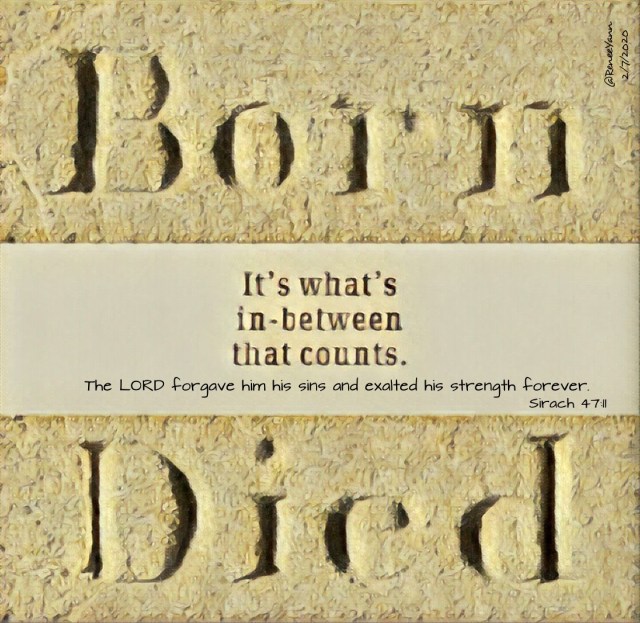
A eulogy sets a particular frame of remembrance around a person’s life. Like Sirach today, that frame tries to capture the positive accomplishments of the person who has died. We set aside any mistakes and negativity. Or we acknowledge them as Sirach has done for David by invoking God’s forgiveness:

The LORD forgave him his sins
and exalted his strength forever.


To tell the truth, I’ve attended a few funerals where I wondered what the speaker might come up with in a positive regard. You know, you need more than a sentence or two for a decent eulogy! Despite my wondering, every tribute has provided an enriching lesson on the sacred beauty of a human life.

Sir47_1 eulogy

There are times when I leave such a life celebration thinking, “Gosh, I never realized that about him!” or “Wow, there are so many things we don’t understand about someone’s life!” 

If only we could treat every living person with the same honor their eulogies inspire!


In our Gospel, we read the sad and violent story of John the Baptist’s martyrdom. It’s a passage filled with the best and the worst of the human heart. One would wonder what kind of eulogy could have eventually been crafted for the likes of Herod, Herodias, and Salome.

But for John the Baptist, Jesus had given him the perfect epitaph even before John died.

I say to you, among those born of women
there is no one greater than John;

In the verse, Jesus also reveals what it takes to earn greatest accolade in God’s eyes:

… yet the one who is least in the kingdom of God
is greater than John.

Luke 7:28


When Jesus spoke that verse, John had not yet died. If Jesus said anything about John after his death, the words are not recorded. All we have is this poignant response from Matthew:

Later, John’s disciples came for his body and buried it.
Then they went and told Jesus what had happened.
As soon as Jesus heard the news,
he left in a boat to a remote area to be alone.
But the crowds heard where he was headed
and followed on foot from many towns.
Jesus saw the huge crowd as he stepped from the boat,
and he had compassion on them and healed their sick.
Matthew 14: 12-14


As we pray today with the legacies of David and the Baptist, we might consider what we’d want to see engraved on our own tombstones. I’ve told my friends I’d like to see this:

She was kind.

Still working on it!😉

What about you?

Music: Lay Me Down – in this song, two icons of country music, Loretta Lynn and Willie Nelson sing their own kind of eulogy. (Lyrics below)

Lay Me Down
I raised my head and set myself
In the eye of the storm, in the belly of a whale
My spirit stood on solid ground
I’ll be at peace when they lay me down
When I was a child, I cried
Until my needs were satisfied
My needs have grown up, pound for pound
I’ll be at peace when they lay me down
When they lay me down someday
My soul will rise, then fly away
This old world will turn around
I’ll be at peace when they lay me down
This life isn’t fair, it seems
It’s filled with tears and broken dreams
There are no tears where I am bound
And I’ll be at peace when they lay me down
When they lay me down some day
My soul will rise, then fly away
This old world will turn around
I’ll be at peace when they lay down
When they lay me down some day
My soul will rise and fly away
This old world will turn around
I’ll be at peace when they lay me down
When I was a child, I cried

Got Baggage?

Memorial of Saint Paul Miki and Companions, martyrs

February 6, 2020

Click here for readings

Today, in Mercy, “journey” is a central theme. David takes his final journey after commissioning his son Solomon as his successor. In our Gospel, Jesus commissions the disciples for their first missionary journey.

Each of these journeys has its own “baggage requirements”.


David’s situation is easy and can be stated in a phrase we are all familiar with:

“You can’t take it with you.”

The writer of Job expresses the same sentiment:

chick-154490_960_720And Job said,
“Naked I came from my mother’s womb,
and naked shall I return.
The LORD gave,
and the LORD has taken away;
blessed be the name of the LORD.”
Job 1:2


It’s a lesson we seem to have a hard time learning. Whenever I pack for a trip, the challenge resurfaces.

baggage
For anyone wondering, yes this is actually me at the airport, except for the heels! 🙂

Back in my early days of flying, when there were no baggage fees, some passengers took everything but the kitchen sink on their journeys. I have a clear picture of petite women hauling suitcases bigger than themselves over to the check-in counter.

Often in life we carry a lot of baggage we don’t need. Some of it is good stuff we just can’t part with, and some of it is junk we should have tossed long ago. The point is that it’s all weight we don’t need if we want to reach our desired destination easily.


Mk6_8journey
Jesus drives that point home to his disciples in today’s Gospel:

He instructed them to take nothing for the journey but a walking stick
– no food, no sack, no money in their belts.


Now that’s a pretty stringent packing list! So what might it mean for our spiritual journey?

Let’s ask ourselves this:

  • What weighs me down from being a loving, generous, just and merciful person?
  • Are there things I won’t let go of because I am fearful, insecure, or selfish?

When the disciples heeded Jesus’s advice, their ensuing freedom made them capable of miracles. Might such courage do the same thing for us?


Music: Have a little fun this morning with this great old country song. Apologies to all grammarians who will spot the blatant contradiction in the title!
I Wouldn’t Take Nothing for My Journey Now – Goodman Revival

Refrain:
Well, I wouldn’t take nothin’ for my journey now
Gotta make it to Heaven somehow
Though the devil tempt me and he tried to turn me around
He’s offered everything that’s got a name
All the wealth I want and worldly fame
If I could still I wouldn’t take nothin’ for my journey now

Well, I started out travellin’ for the Lord many years ago
I’ve had a lot of heartache and I met a lot of grief and woe
But when I would stumble then I would humble down
And there I’d say, I wouldn’t take nothin’ for my journey now

Oh, there’s nothin’ in this world that’ll ever take the place of God’s love
All the silver and gold wouldn’t buy a touch from above
When the soul needs healin’ and I begin to feelin’ His power
Then I can say, thank the Lord, I wouldn’t take nothing for my journey now

Oh, I wouldn’t take nothin’ for my journey now
Gotta make it to Heaven somehow
Though the devil tempts me and he tried to turn me around
He’s offered everything that’s got a name
All the wealth I want and worldly fame
If I could still I wouldn’t take nothin’ for my journey now.

Mercy Surrounds Us

Memorial of Saint Agatha, virgin and martyr

February 5, 2020

Click here for today’s readings

Today, in Mercy, David gets himself in trouble once again.

In the later years of his kingship, David is pretty impressed with himself. The kingdom has grown exponentially. There is peace and prosperity. David wants a census taken so that he can assess his capacity for new expansion.

So why does God get so mad about this census? The Book of Exodus sets out that a person has the right to number only his own belongings. The People belong to God, not to David. David’s pride and self-satisfaction has taken him over.

Ps32_deep waters

However, as usual, David repents. This is probably the best lesson we can learn from him. Then, in a greatly allegorized treatment, God gives David a choice of three punishments.


Passages like this can confuse us if we interpret them literally. Does God really interact and punish like this? 

It helps to remember the purpose of these writings — not to relay a factual history, but rather to tell a story that helps us grow in relationship with God.

What I believe happened here is that a pestilence did fall upon the country. At the same time, David realized that his heart had grown selfish and graceless. He took the natural event as a sign to turn back to God. And then the writers told the story in a way that the ancient peoples could relate to – with a God that forgives but gets even.


In our Gospel, Jesus preaches another vision of God – a vision of Complete Mercy, especially toward the vulnerable, weak, and sinful. That pretty much includes all of us.

Jesus releases the power of this Divine Mercy by his words and miracles. But his own family and neighbors reject him. They are more comfortable with a God who behaves like they do – meting out more judgement and punishment (preferably toward others!😉) than mercy and inclusive benediction.

In this Gospel, we begin to see Jesus as One who asks not only for repentance but for conversion – for a new way of being with God and neighbor, the way of Love.

How might we have responded had we been in that neighborhood synagogue? How are we responding today?

Music: Today’s Responsorial Psalm 32 – Marty Goetz ( Lyrics below)

Psalm 32 – Marty Goetz

These are periled times we live in, trouble everywhere
Weary hearts will often give in to this world’s despair
But high and over all, our Father knows our every care
And in His Book, if you will look, you’ll find His promise there

(Chorus)
He who trusts in the Lord
Mercy shall surround him
He who trusts in the Lord
Mercy shall surround him
Be glad in the Lord and rejoice
You upright in heart, lift up your voice
For great is His mercy toward all who trust in the Lord

Soon will be the time when we will see the Holy One
Oh how sweet to know that He’ll complete what He’s begun
And blessed is the man who stands forgiven in God’s son
And blessed are they who in that day will hear Him say, “Well done”

(Chorus)

Gracious is He and slow to anger
His loving kindness has no end
With love to embrace both friend and stranger
Reaching out to one and all, who upon His name will call

(Chorus)

Mercy is His reward
For all who trust, for the pure and just
Who put their trust in the Lord
For all who trust for the pure and just who put their trust in the Lord

Regret

Tuesday of the Fourth Week in Ordinary Time

February 4, 2020

Click here for readings

Today, in Mercy, we read one of the saddest lines in Scripture.

2Sam18_32

You have followed the story in these daily passages. Absalom rebels, designing to usurp his father’s throne. A massive battle rises between them. David, as commander-in-chief, remains behind, but gives instructions to his generals to spare Absalom’s life. Joab ignores the command, killing Absalom in a moment of vulnerability.

David is devastated.

david mourns
David Mourning Absalom’s Death – Jean Colombe

I think there is no more wrenching human emotion than regret. When I ministered for nearly a decade as hospice chaplain, and later in the emergency room, I saw so much regret.

People who had waited too long to say “I’m sorry”, “I forgive you”, “Let’s start over”, “Thank you for all you did for me”, “I love you”…..

Instead, these people stood at lifeless bedsides saying things like, “I should have”, “I wish…”, “If only…”


Life is complex and sometimes difficult. We get hurt, and we hurt others — sometimes so hurt that we walk away from relationship, or stay but wall ourselves off.

We might think that what is missing in such times is love. But I think it is more likely truth. In times of painful conflict, if we can hear and speak our truth to ourselves and one another, we open the path to healing.


If you want the truth, I’ll tell you the truth.
Listen to the secret sound,
the real sound, which is inside you.
~ Kabir


That healing may demand adjustments, agreements, even a willingness to step apart in mutual respect. But if the changes emerge from shared truth, restoration and wholeness are possible.

David and Absalom never found that path because they were so absorbed in their own self-interests. Theirs was the perfect formula for regret – that fruitless stump that perpetually sticks in the heart.

I remember a trauma surgeon leaving the hospital late one night after an unsuccessful effort to save a young boy who had been shot. The doctor carried the loss so heavily as he walked into the night saying to me, “I’m just going to go home and hug my kids.”

As we pray over David and Absalom today, let us examine our lives for the fractures that are still healable and act on them. Let us “hug” the life we have. Regret is a useless substitute.

When David Heard – Eric Whitaker ( The piece builds. Be patient. Lyrics below)

When David heard that Absalom was slain,
he went up into his chamber over the gate and wept,
and thus he said;

My son, my son,
O Absalom my son,
would God I had died for thee!

When David heard that Absalom was slain,
he went up into his chamber over the gate and wept,
and thus he said;

My son, my son.

Outrageous Grace

Monday of the Fourth Week in Ordinary Time

February 3, 2020

Click here for readings

Today, in Mercy, we have two highly dramatic passages. If there were an Oscar category for “Best Biblical Drama”, these stories would definitely be nominees!

In our ongoing “David Saga”, the troubled king flees Jerusalem because his own son Absalom is plotting to overthrow him. David, at this point in time, is humbled and not a little wearied by the theatrics of his life. His sins continue to haunt him and wreak a recompense. 


dirt thrower
Shimei curses David by Julius Schnorr von Karolsfeld

In today’s passage, we meet Shimei who has his own little miniseries going on in the Bible. Shimei is part of Saul’s family and holds David responsible for Saul’s demise. When meeting David in this passage, Shimei dangerously, and we might say stupidly, sets on him, throwing dirt and stones at the King. David prevents the troops from responding to the wildly outraged man. David even suggests that God may be trying to teach David something in the attack.


In our Gospel, we meet another wildly outraged man. This one is tormented by his inner demons, causing him also to put himself in dangerous situations. Jesus names this man’s tormentor and casts it out, giving the man control of himself again.


Have you ever been so offended, humiliated or injured that you felt outrage for yourself or another? Such fury chains us, making rationality and reconciliation close to impossible. Sometimes, it renders us impotent to name and address the deep source of our indignation. Instead, we lash out with stones of anger and hate – throwing the dirt of condemnation rather than seeking inner balance and healing.

dementor

Most of us have encountered large or small “dementors” in our life. (Thanks for the term AND the image, Harry Potter) 


But when I think of those who have endured unbelievable degrees of torment, I am amazed at their stories of faith and resolution: Anne Frank, Victor Frankel, Nelson Mandela, Harriet Tubman …. Jesus Christ. How did they come through it whole and blessed?


Mk5_1_20demoniac

Maybe the possessed man in Mark’s Gospel was just lucky that day to run into Jesus. Or maybe he sought out Christ, trying to find stability in the midst of his derangement.

When we face our own imbalances can we stay still long enough to ask, as David did, “What is God teaching me in this. How can this lead me closer to God?” If we could, might we not be surprised to see our demons named, cast into the greater sea of God’s eternal wisdom, peace and love?

Music: Amazing Grace – Sean Clive

It’s All About the Temple

Feast of the Presentation of the Lord

February 2, 2020

Click here for readings

Today, in Mercy, we begin with a reading from the prophet Malachi, a hurler of fire and brimstone in the 4th-5th century before Christ. It’s an interesting choice and begs the question of how it relates to this Feast when a little baby comes to be blessed in the Temple.

Presentation of Our Lord
Presentation of Our Lord – Ambrogio Lorenzetti (Wikipedia.org_ not for commercial use)

Ah, perhaps that’s the hinge – the Temple, both actual and symbolic.

Malachi writes at a time when the second Temple has been restored. In other words, God is about giving the people a second chance to behave according to the Covenant. But they’re not doing such a good job — especially those in charge, the priests:

A son honors his father,
and a servant fears his master;
If, then, I am a father,
where is the honor due to me?
And if I am a master,
where is the fear due to me?
So says the LORD of hosts to you, O priests,
who disdain my name.
Malachi 1:6

A Little Extra Music: Handel – But Who May Abide (You know you have time to listen just before the Super Bowl!)

https://www.youtube.com/watch?v=gH1u5bwHyls&feature=youtu.be

Through a series of prophetic oracles, Malachi admonishes the people to repent before it is too late because no unrepentant soul will withstand the judgement.

Yes, he is coming, says the LORD of hosts.
But who will endure the day of his coming?
And who can stand when he appears?
For he is like the refiner’s fire,
or like the fuller’s lye.


In the passage from Hebrews, Paul presents the perfect priest, Jesus Christ. In taking flesh, Christ’s Body becomes the new Temple of our redemption. We stand before judgement already saved by his Passion, Death, and Resurrection.


In our Gospel, two aged and venerable prophets wait in the Temple for the Promised One. Their long years of prayer have already proven them faithful. Now, Simeon’s and Anna’s long and complete fidelity is rewarded by seeing their Savior. They know Him because they have already created a place for him in the Temple of their hearts. Now, they will meet their judgement in total peace. As Simeon’s prays:

“Now, Master, you may let your servant go
in peace, according to your word,
for my eyes have seen your salvation,
which you prepared in the sight of all the peoples:
a light for revelation to the Gentiles,
and glory for your people Israel.”

It’s a beautiful, total-hearted prayer!  Don’t we all hope to be able to offer it one day?

( I wrote an earlier reflection about dear Anna.  You might like to see it again here:

Music: Nunc Dimittis – Taizé (Latin and English text below)

Nunc dimittis servum tuum,
Now dismiss your servant
Domine, Domine,
Lord, Lord,
Secundum verbum tuum in pace.
according to your word in peace
Domine.
Lord.