Today, in God’s Lavish Mercy, we pray with Psalm 98, one of a small knot of psalms whose point is to shout praise over and over to God. It is a hymn psalm, and one of the ten Royal Psalms themed with “kingship”.
As we pray this exultant psalm, in Latin called “Cantate Domino” (Sing to the Lord), we can almost visualize the psalmist and fellow praisers clapping God on the back and chanting, “Great job! Nice work!”.
All the ends of the earth have seen the salvation by our God. Sing joyfully to the LORD, all you lands; break into song; sing praise.
Walter Brueggemann has written extensively about the Psalms. He says this about the act of praise:
Praise articulates and embodies our capacity to yield, submit, and abandon ourselves in trust and gratitude to the One whose we are. … We have a resilient hunger to move beyond self. God is addressed not because we have need, but simply because God is God. (Israel’s Praise: Doxology against Idolatry and Ideology)
We don’t have to be as articulate as the psalmist to weave praise into our prayer.
Sometimes when we catch the sunrise at a morning window, we might quietly say, “Great job! Thank You, Radiant God”
When we look at the magnificence of a natural wonder like the Grand Canyon, we might abandon words and simply let our breathing be praise.
When we study the finely-aged face of a beloved elder, we might praise the monument of grace God has worked in her/his life.
When we finger the strings of our own faith history, we might, in our own words, echo the psalmist:
I sing You a new song in every moment, Lord for You have done wondrous deeds; Your loving hand has strung grace through my life, your generous heart has blessed me amazingly.
Poetry today from Mary Oliver who rejoices in the redbird’s morning praise:
All night my heart makes its way however it can over the rough ground of uncertainties, but only until night meets and then is overwhelmed by morning, the light deepening, the wind easing and just waiting, as I too wait (and when have I ever been disappointed?) for redbird to sing
― A Thousand Mornings
Today, in God’s Lavish Mercy, we pray with Psalm 16.This Psalm is introduced as “A Michtam of David”. “Michtam” can be interpreted as either “golden” or “secret” by various translators.
For prayer this morning, I focused on “secret” because, in the psalm, David expresses what he considers the secret to a joyful, holy life even in difficulty.
O LORD, my allotted portion and cup, you it is who hold fast my lot. I set the LORD ever before me; with him at my right hand I shall not be disturbed.
The last line of this verse immediately brought to mind St. Teresa of Avila’s transcendent advice:
Nada te turbe nada te espante Todo se pasa Dios no we muda. La paciencia todo alcanza. Quien a Dios tiene nada le falta Solo Dios basta.
Let nothing disturb you, Let nothing frighten you, All things are passing. God alone is changeless. Patience obtains all things Whoever has God lacks nothing; God alone suffices.
Repeating this Psalm slowly and intentionally, let us pray for that kind of peace today:
for ourselves
our beloveds
our world, especially those from whom peace has been stolen by injustice, war, greed, and hate.
Music: Psalm 16 – Shane and Shane
There is fullness
Of joy
Of joy
At Your right hand
There are pleasures
Forevermore
Forevermore
My heart is glad and my soul rejoices
My flesh it dwells secure
Because You put on flesh
Lived a blameless life
My curse on the cross You bore
Then You ripped the doors off the City of Death
And the chains fell to the floor
Now the serpent’s crushed
It has been finished
And You reign forevermore
You are my portion
My cup and you make my lot secure
The lines have fallen
For me in pleasant places
A beautiful inheritance
Today, in God’s Lavish Mercy, we pray with Psalm 4, a lament written to be sung with stringed instruments.
The psalmist expresses confidence that God rewards the prayer of the just, warning the “dull of heart” to wake up!
When I call, answer me, O my just God, you who relieve me when I am in distress; Have pity on me, and hear my prayer! Men of rank, how long will you be dull of heart? Why do you love what is vain and seek after falsehood?
Surely, the psalmist’s sentiments echo in our hearts:
We all pray, in these conflicted times, for the grace to wake up to the justice and mercy of God.
We pray, like the psalmist, to see the face of God in ourselves and in our neighbor.
We pray to finally be able to break through the falsehood of racism to the Presence of our Creator in every person.
The poem I offer today was written by Shane McCrae, an American poet and recipient of a 2011 Whiting Award. McCrae earned a BA at Linfield College, an MA at the University of Iowa, an MFA at the Iowa Writers’ Workshop, and a JD at Harvard Law School. He currently teaches at Columbia University.
In this poem, the poet and his young daughter trace faces in the waves, the way many of us have in waves or clouds.
Like all great poems, this one allows us to find our own meaning within it. I see a father looking to find the reflection of his own face in our representations of God, and hoping that his little child might do so a well. We sense their hopes disappear in the waves and in a culture that has enthroned God’s image as a white male.
Still When I Picture It the Face of God Is a White Man’s Face
Before it disappears
on the sand his long white beard before it disappears
The face of the man
in the waves I ask her does she see it ask her does
The old man in the waves as the waves crest she see it does
she see the old man his
White his face crumbling face it looks
as old as he’s as old as
The ocean looks
and for a moment almost looks
His face like it’s all the way him
As never such old skin
looks my / Daughter age four
She thinks it might he might be real she shouts Hello
And after there’s no answer answers No
Music: The Whole Book of Psalmes: Psalm 4, “Oxford Tune”
written by – Thomas Ravenscroft (1588 – 1635)
rendered here by Richard Muenz
Today, in God’s Lavish Mercy, we pray with Psalm 121, another of the fifteen Psalms of Ascent.
(Placing the hymn early today. You might want to play it as you read the psalm.) Waldorf Davies: Psalm 121 St. John’s College Choir Cambridge
Picture the ancient pilgrims on their way up to Jerusalem. They carry in their hearts all the joys and burdens of their lives, just like everyone else in the world.
What blesses them particularly is that they have turned their eyes toward God as they journey, singing both their griefs and their delights in hope and thanksgiving.
The psalm moves from a plea for help in the beginning:
I lift up my eyes toward the mountains; whence shall help come to me?
To, at the close, a triumphant confidence in that help in perpetuity:
The LORD will guard you from all evil; he will guard your life. The LORD will guard your coming and your going, both now and forever.
May we, too, fix our eyes on God, vigilantly seeking God’s truth
at the core of our experiences. May our faithful, lifelong dialogue with God lead us, like the psalmist,
to the same blessed assurance.
Just for a little added joy, here is the glorious hymn Blessed Assurance
– sung by CeCe Winans honoring Cicely Tyson at the Kennedy Center Honors.
Poem: Prayer by David Gioia
(In this poem, we glimpse one particular pilgrim and the prayer he is carrying. The poet addresses God in lovely ways, ( I really loved “Jeweller of the spiderweb”). Finally he prays for protection for a beloved. I think we’ve all prayed that kind of prayer.)
Echo of the clocktower, footstep in the alleyway, sweep of the wind sifting the leaves. Jeweller of the spiderweb, connoisseur of autumn’s opulence, blade of lightning harvesting the sky. Keeper of the small gate, choreographer of entrances and exits, midnight whisper traveling the wires. Seducer, healer, deity or thief, I will see you soon enough— in the shadow of the rainfall, in the brief violet darkening a sunset— but until then I pray watch over him as a mountain guards its covert ore and the harsh falcon its flightless young.
Today, in God’s Lavish Mercy, we celebrate the Feast of the Holy Trinity.
For the Responsorial Psalm we have, not really a psalm, but an exultant canticle from the Book of Daniel – The Benedicite (Bless!)
Today’s segment of this extended and glorious canticle addresses God directly. The ensuing lines, not in today’s liturgy, invite all the elements of Creation to bless and glorify God.
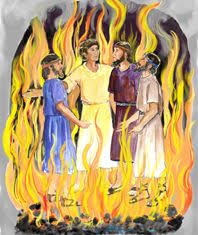
The prayers are those said by the three young men, rescued by an angel, and delivered from Nebuchadnezzer’s furnace.
As we pray for our country, and the world, to be delivered from the furnace of hate, racism, violence, militarism, and disease, let us call on all Creation to bless and beseech God – Creator, Redeemer, and Holy Spirit.
In God’s magnificent handiwork,
we see the perfection of peace,
the elegance of simplicity,
and the power of obedience to God’s design.
Focus on whatever in nature speaks most to you today. Enter the depth of that part of Creation. Let it speak healing and wholeness to you and to our aching world. Praise the Adorable Trinity who gave us the gift of life with all Creation.
Music: Benedictus es Domine – this Latin chant is today’s Responsorial Psalm.
For our poetry today, we have the remaining verses of Daniel’s Canticle with a musical rendition at the end.
Bless the Lord, all you works of the Lord,
sing praise to him and highly exalt him forever. Bless the Lord, you angels of the Lord, bless the Lord, you heavens.
Bless the Lord, all you waters above the heaven,
bless the Lord, all powers. Bless the Lord, sun and moon, bless the Lord, stars of heaven.
Bless the Lord, all rain and dew,
bless the Lord, all winds. Bless the Lord, fire and heat, bless the Lord, winter cold and summer heat.
Bless the Lord, dews and snows,
bless the Lord, ice and cold. Bless the Lord, frosts and snows, bless the Lord, nights and days.
Bless the Lord, light and darkness,
bless the Lord, lightnings and clouds. Let the earth bless the Lord; let it sing praise to him and highly exalt him forever.
Bless the Lord, mountains and hills,
bless the Lord, all that grows on the earth. Bless the Lord, you springs, bless the Lord, seas and rivers.
Bless the Lord, you whales and all that swim in the waters,
bless the Lord, all birds of the air. Bless the Lord, all beasts and cattle, Bless the Lord, you sons of men.
Bless the Lord, O Israel;
sing praise to him and highly exalt him forever. Bless the Lord, you priests of the Lord, bless the Lord, you servants of the Lord.
Bless the Lord, spirits and souls of the righteous,
Bless the Lord, you who are holy and humble in heart. Bless the Father, the Son and the Holy Spirit; sing praise to him and highly exalt him forever.
Music:Benedicite Omnia Opera Domini Domino – sung by Lionheart/Tydings True
BENEDICITE, omnia opera Domini, Domino;
laudate et superexaltate eum in saecula. BENEDICITE, caeli, Domino, benedicite, angeli Domini, Domino.
BENEDICITE, aquae omnes, quae super caelos sunt, Domino,
benedicat omnis virtutis Domino. BENEDICITE, sol et luna, Domino, benedicite, stellae caeli, Domino.
BENEDICITE, omnis imber et ros, Domino,
benedicite, omnes venti, Domino. BENEDICITE, ignis et aestus, Domino, benedicite, frigus et aestus, Domino.
BENEDICITE, rores et pruina, Domino,
benedicite, gelu et frigus, Domino. BENEDICITE, glacies et nives, Domino, benedicite, noctes et dies, Domino.
BENEDICITE, lux et tenebrae, Domino,
benedicite, fulgura et nubes, Domino. BENEDICAT terra Dominum: laudet et superexaltet eum in saecula.
BENEDICITE, montes et colles, Domino,
benedicite, universa germinantia in terra, Domino. BENEDICITE, maria et flumina, Domino, benedicite, fontes, Domino.
BENEDICITE, cete, et omnia, quae moventur in aquis, Domino,
benedicite, omnes volucres caeli, Domino. BENEDICITE, omnes bestiae et pecora, Domino, benedicite, filii hominum, Domino.
BENEDICITE, Israel, Domino,
laudate et superexaltate eum in saecula. BENEDICITE, sacerdotes Domini, Domino, benedicite, servi Domini, Domino.
BENEDICITE, spiritus et animae iustorum, Domino,
benedicite, sancti et humiles corde, Domino. BENEDICITE, Anania, Azaria, Misael, Domino, laudate et superexaltate eum in saecula. BENEDICAMUS Patrem et Filium cum Sancto Spiritu; laudemus et superexaltemus eum in saecula. BENEDICTUS es in firmamento caeli et laudabilis et gloriosus in saecula.
Today, in God’s Lavish Mercy, we pray with Psalm 71.
This is the psalm of someone who has loved God all their lives. Theirs is a proven love, a long faithfulness.
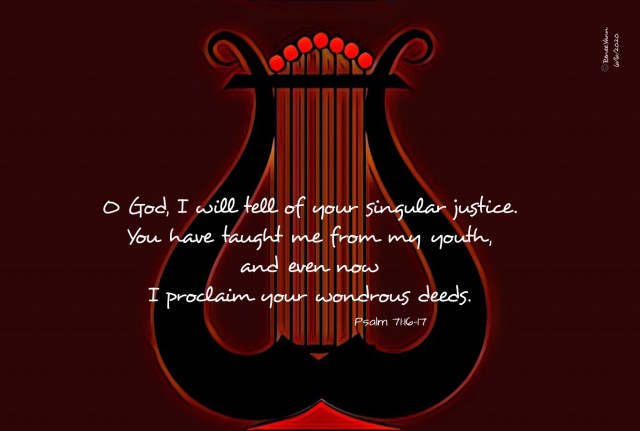
O God, you have taught me from my youth, and till the present I proclaim your wondrous deeds.
As we look back over our own lives in humility and gratitude, we might speak a similar prayer.
Some of us have been blessed with an early faith that has illuminated every page of our life story. Some of us have come by it a little harder, or a little later, or with frequent clouds around our light.
But we are still here praying, aren’t we – still reaching, like the psalmist, for God’s steadying hand.
My mouth shall be filled with your praise, with your glory day by day. Cast me not off in my old age; as my strength fails, forsake me not.
The psalmist’s enduring relationship with God is rooted in this understanding: that every moment of our lives reveals the face of a just and merciful God. Our part is to believe and trust enough to discover that Face and reveal it to others.
But I will always hope and praise you ever more and more. My mouth shall declare your justice, day by day your salvation.
The psalmist promises to witness to God’s faithfulness by singing with the lyre. In his letter today, Paul charges Timothy to do the same thing (sans lyre):
I charge you in the presence of God and of Christ Jesus, who will judge the living and the dead, and by his appearing and his kingly power: proclaim the word; be persistent whether it is convenient or inconvenient …
In our Gospel, Jesus says that the proclamation of our faith must be sincere, generous, and humble, never used to politicize and advance our stature over others, or as a tool for our personal aggrandizement:
Beware of the scribes, who like to go around in long robes and accept greetings in the marketplaces, seats of honor in synagogues, and places of honor at banquets. They devour the houses of widows and, as a pretext, recite lengthy prayers. They will receive a very severe condemnation.
Oh, so many modern applications come to mind regarding this advice! But, for today, let’s just examine our own hearts.
Music: Psalm 71 – Jason Silver
Poetry: For Light by John O’Donohue
Light cannot see inside things.
That is what the dark is for:
Minding the interior,
Nurturing the draw of growth
Through places where death
In its own way turns into life.
In the glare of neon times,
Let our eyes not be worn
By surfaces that shine
With hunger made attractive.
That our thoughts may be true light,
Finding their way into words
Which have the weight of shadow
To hold the layers of truth.
That we never place our trust
In minds claimed by empty light,
Where one-sided certainties
Are driven by false desire.
When we look into the heart,
May our eyes have the kindness
And reverence of candlelight.
That the searching of our minds
Be equal to the oblique
Crevices and corners where
The mystery continues to dwell,
Glimmering in fugitive light.
When we are confined inside
The dark house of suffering
That moonlight might find a window.
When we become false and lost
That the severe noon-light
Would cast our shadow clear.
When we love, that dawn-light
Would lighten our feet
Upon the waters.
As we grow old, that twilight
Would illuminate treasure
In the fields of memory.
And when we come to search for God,
Let us first be robed in night,
Put on the mind of morning
To feel the rush of light
Spread slowly inside
The color and stillness
Of a found word.
I forgot to include some poetry for today’s Psalm. These are two of mine. I hope they are helpful for your prayer. Thank you for receiving them.
Morning Prayer
I walk the earth, soft
from yesterday’s long rain.
Mists ascend like incense
under my indulgent footsteps.
Bird songs thin themselves
between the early light;
a chanting, contrapuntal, in
the well-laved trees.
Nothing grey is left now
in the wide sky.
Rinsed in light,
it spreads to dry
in sere, blue wind.
Momentarily, earth
is wholly God’s;
deep, true colors fall to it,
rich, unshadowed.
Your Word, Creator,
WaterGod, has penetrated.
It comes back to You in
crystal images
from an uncomplicated world.
As if within a lucent globe
I hold You still,
in perfect, silent love,
clear, inexplicable
like sunlit rain.
Reconciliation
The hands of God love me
when I cannot see God’s face.
Like salve, they warmly run
Over, in and out of me,
pausing where my hurt is knotted,
barbed to their approach…
mother’s hands, lover’s, friend’s,
my own hands all held in God’s hands,
healing self-estrangement.
I come to God’s hands
like parched earth
stretches for redeeming rain.
Even in the deep night,
where God will not speak,
those loving hands are words
which I answer in the darkness.
Today, in God’s Lavish Mercy, we pray with Psalm 119 which is considered a hymn psalm, meant for offering praise for God’s handiwork.
This psalm, the longest in the Bible, is an extended string of delight in God’s beauty, power, and tenderness. It reminds me of a mockingbird’s lovely, tireless song, lilting up into the morning or evening sky.
Though long, the psalm is a very simple yet profound prayer. Seeing its length, we might tend to set it aside for a shorter psalm. Instead, don’t tackle the whole thing. Pick one verse that speaks to you. Sit down beside it. Let it crawl into to your lap like a small child. Cradle it and let your soul hum with it.
I remember, as a young novice, learning to pray this beautiful psalm in Latin. Its innocent clarity echoed my desire simply to deepen in God’s ways. Psalm 119 has been one of my favorites for nearly sixty years now, carrying God’s Word to me in myriad ways.
Today in our prayer, we might want to contemplate what single word God is speaking most clearly to us in this moment. The words vary over the course and circumstances of our lives. Let us listen and respond to what we hear today in quiet prayer.
Today, in God’s Lavish Mercy, we pray with Psalm 25.
In today’s liturgy, this Psalm clearly ties together our first and second readings where both Timothy and a scribe seek clearer understanding of what faith requires:
Paul reminds Timothy that it takes perseverance and fidelity to live our faith
Jesus affirms for the scribe that there is no greater commandment than love
In Psalm 25, we find David working through his own faith challenges. He is asking God to show him the way, presumably out of some trouble or dilemma, one of the many faced by David over his lifetime.
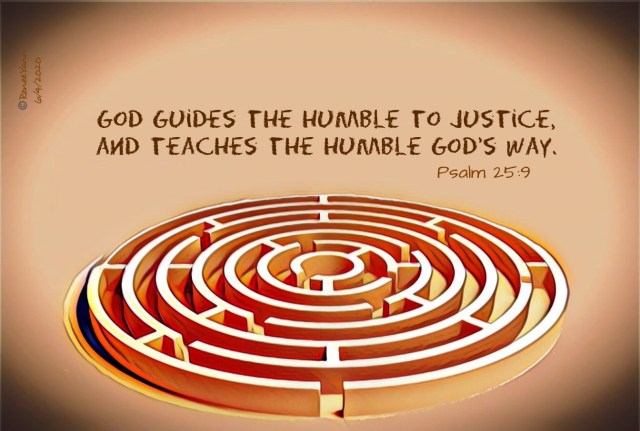
Like Paul, Timothy, and the Gospel scribe, David realizes that the pursuit of justice is a circuitous journey, one that requires the accompaniment of God.
In today’s excerpt, we have only a few verses of Psalm 25, but the entire psalm paints David as feeling a bit lost and overwhelmed. Nevertheless, in his prayer, he draws on his long, trusting relationship with God.
Walter Brueggemann calls Psalm 25 a “psalm of candor”, one in which the psalmist honestly lays out his confusion, need, or pain. Praying the psalm today, we might do the same, asking God’s merciful insight and direction for ourselves, our loved ones, our country or our world.
There is certainly enough need for a lot of candor on our part! I know that I am feeling more than a bit overwhelmed by our current realities. Racial injustice, pandemic, economic hurt, and political confusion have all combined to make these very troubling times.
But like David, we can lay down our fears, needs and concerns before a loving God.
Like David, we can trust God’s desire to lead us.
Like David, we can remember God’s mercies and be confident they will continue.
Like David, we can ask for and follow God’s direction to justice and peace.
King David at Prayer by Pieter deGrabberLet Us Beat Swords into Plowshares, a sculpture by Evgeniy Vuchetich in the United Nations Art Collection
In our poem today, Rudyard Kipling does much the opposite of what I suggest above. He is deeply angry after WWI has claimed the life of his son John. His poem speaks of “justice” but suggests revenge or retribution. The justice he describes is one that demands the last drop of the opponent’s blood before it is satisfied .
I read the poem to better understand my own feelings. What fragments of darkness still hide in my longing for light?
Kipling’s angry passion is completely understandable, rational, and politically powerful. But it is not the justice or “right relationship“ of the Gospel. The pursuit of such Gospel justice is an arduous and winding journey of the heart and soul. It is the trying walk of sacrificial love which Jesus taught us. May we have the courage to walk it for our time. Thus the cry of our Psalm 25:
Your ways, O LORD, make known to me; teach me your paths, Guide me in your truth and teach me, for you are God my savior.
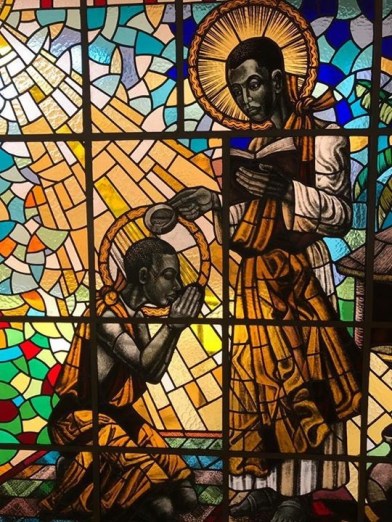
Memorial of Saint Charles Lwanga and Companions, Martyrs
St. Kizito being baptised by St. Charles Lwanga at Munyonyo – stained glass at Munyonyo Martyrs Shrine
Charles Lwanga (1860 – 1886) was a Ugandan convert to the Catholic Church, who was martyred for his faith and is revered as a saint by both the Catholic Church and the Anglican Communion.
Today, in God’s Lavish Mercy, we pray with Psalm 123. How fitting that this particular prayer should bless us at this time!
Psalm 123 is one of the fifteen Psalms of Ascent (120-134). It is thought that these prayer songs were sung by pilgrims ascending to Jerusalem, expressing the joys, sorrows, needs and sufferings of the community.
Among them Psalm 123 is a lament, particularly for the scorn and contempt the Israelites felt as they tried to live lives of faith in a hostile world. Verses 3 and 4, (not included in today’s passage) plead:
Show us favor, LORD, show us favor, for we have our fill of contempt. Our souls are more than sated with mockery from the insolent, with contempt from the arrogant.
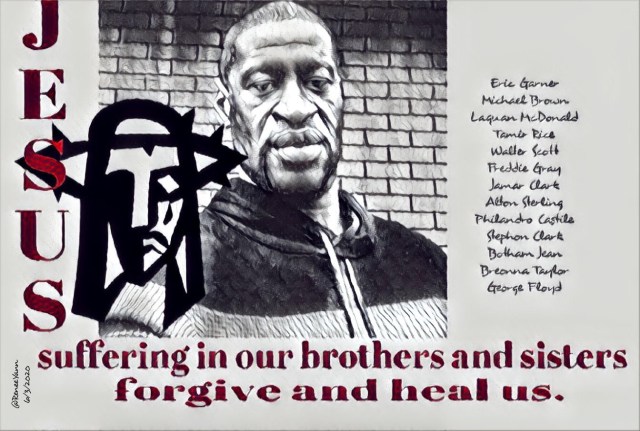
Praying with Psalm 123, we might think of today’s “pilgrims”, traveling the streets in protest of racial injustice. The integrity of their cause has been polluted by the rioters and looters infiltrating them, drawing contempt even from some who might otherwise have supported them.
Still, people of faith must not be distracted from the truth, nor should we hide from the reality of our own complicity in normalizing unjust systems. We must hear the lament of all those who long for justice. We must acknowledge that our current structures have grievously failed people of color, the poor and the refugee. We must make the choices that justice and mercy demand of us.
Today’s Responsorial verses may help us. In our hearts and souls, let us stand beside one another as we pray, each of us created to serve God by serving one another:
To you I raise my eyes, to you enthroned in heaven. Yes, like the eyes of servants on the hand of their masters,
Like the eyes of a maid on the hand of her mistress, So our eyes are on the LORD our God, till we are shown favor.
A poem to enrich your reflection:
Caged Bird
A free bird leaps
on the back of the wind
and floats downstream
till the current ends
and dips his wing
in the orange sun rays
and dares to claim the sky.
But a bird that stalks
down his narrow cage
can seldom see through
his bars of rage
his wings are clipped and
his feet are tied
so he opens his throat to sing.
The caged bird sings
with a fearful trill
of things unknown
but longed for still
and his tune is heard
on the distant hill
for the caged bird
sings of freedom.
The free bird thinks of another breeze
and the trade winds soft through the sighing trees
and the fat worms waiting on a dawn bright lawn
and he names the sky his own
But a caged bird stands on the grave of dreams
his shadow shouts on a nightmare scream
his wings are clipped and his feet are tied
so he opens his throat to sing.
The caged bird sings
with a fearful trill
of things unknown
but longed for still
and his tune is heard
on the distant hill
for the caged bird
sings of freedom.
~ Maya Angelou
Music: Giovanni Pierluigi da Palestrina: Ad te levavi oculos meos (Psalm 123)
Ad te levavi oculos meos, qui habitas in caelis.
Ecce sicut oculi servorum in manibus dominorum suorum;
sicut oculi ancillae in manibus dominae suae:
ita oculi nostri ad Dominum Deum nostrum,
donec misereatur nostri.
Miserere nostri, Domine, miserere nostri,
quia multum repleti sumus despectione;
quia multum repleta est anima nostra
opprobrium abundantibus, et despectio superbis.







 The psalmist promises to witness to God’s faithfulness by singing with the lyre. In his letter today, Paul charges Timothy to do the same thing (sans lyre):
 Beware of the scribes, who like to go around in long robes







 Lavish Mercy