Today, in God’s Lavish Mercy, our readings center on the themes of grief, honor, and mercy.
In the passage from 2 Samuel, Saul has been killed in battle. The news is brought to David by a scheming Amalekite who (later verses reveal) hopes to profit from his enterprise. He has stripped Saul’s dead body of its kingly insignia, obsequiously depositing it at David’s feet. The messenger expects David’s vengeful rejoicing and a hefty reward.
Instead David, with reverence and honor appropriate to a future king, launches a deep public mourning for Saul and Jonathan. It is a bereavement necessary to both cleanse and heal the community’s heart from all the strife leading up to it.
David seized his garments and rent them, and all the men who were with him did likewise. They mourned and wept and fasted until evening for Saul and his son Jonathan, and for the soldiers of the LORD of the clans of Israel, because they had fallen by the sword.
2 Samuel 1:11-12
David’s lament is profound; it is”splancha”, sprung from his innards, like the anguish Jesus felt for the suffering persons he encountered, as described in our Gospel.
A callous or indifferent heart cannot comprehend such pathos. Seeing it in Jesus, even his relatives thought him insane!
Jesus came with his disciples into the house. Again the crowd gathered, making it impossible for them even to eat. When his relatives heard of this they set out to seize him, for they said, “He is out of his mind.”
Mark 3:20-21
Our God is a God of boundless love and impractical mercy. David models a bit of that godliness. Jesus is its complete Incarnation.
Poem: David and Jonathan by Abraham Crowley, an English poet born in the City of London in 1618. He was one of the leading English poets of the 17th century.
Still to one end they both so justly drew,
As courteous Doves together yok'd would do.
No weight of Birth did on one side prevaile,
Two Twins less even lie in Natures Scale,
They mingled Fates, and both in each did share,
They both were Servants, they both Princes were.
If any Joy to one of them was sent;
It was most his, to whom it least was meant,
And fortunes malice betwixt both was crost,
For striking one, it wounded th'other most.
Never did Marriage such true Union find,
Or mens desires with so glad violence bind;
For there is still some tincture left of Sin,
And still the Sex will needs be stealing in.
Those joys are full of dross, and thicker farre
These, without matter, clear and liquid are.
Such sacred Love does he'avens bright Spirits fill,
Where Love is but to Understand and Will,
With swift and unseen Motions; such as We
Somewhat express in heightned Charitie.
O ye blest One! whose Love on earth became
So pure that still in Heav'en 'tis but the same
There now ye sit, and with mixt souls embrace,
Gazing upon great Loves mysterious Face,
And pity this base world where Friendship's made
A bait for sin, or else at best a Trade.
Music: Lascia Ch’io Pianga (Let Me Weep)- Georg Frideric Handel – a single piece of beautiful music today in two version, an aria and an instrumental interpretation.
Julia Lezhneva – soprano
Stjepan Hauser – cellist
Lascia ch’io pianga la cruda sorte, e che sospiri la libertà. Il duolo infranga queste ritorte de’ miei martiri sol per pietà.
Let me weep cruel fate, and sigh for liberty.
May sorrow break these chains Of my sufferings, for pity’s sake.
Today, in God’s Lavish Mercy, our readings are full of drama and meaning enveloped in two of the greatest speeches of the Hebrew Scriptures – one from David, the other from Saul. The use of speeches to unfold the narrative is characteristic of the high points of Scripture. And these are two winners.
In the passage from Samuel, David spares Saul’s life even though Saul is in murderous pursuit of him. The result is the final dissolution of Saul’s kingship. It is a scene that could be right out of MGM! (Here is a video for kids featuring the moment. But I thought it was pretty cool. Maybe you will too.)
Is David noble or naïve? Is he magnanimous or stupid? Is he sincere or clever? Various scripture scholars interpret these passages in a host of ways. But as I pray this morning, I ask myself what it is that God might be saying to me through this passage.
Two things rise up:
Above all else, David is motivated by a deep respect for God’s Will and Presence in his life. He doesn’t force God’s Will by seizing the kingship. David waits and listens for God’s intention.
David said to his men, “The LORD forbid that I should do such a thing to my master, the LORD’s anointed, as to lay a hand on him, for he is the LORD’s anointed.”
2. David engages Saul directly and respectfully, perhaps in the hope of reaching a resolution of their issues. This honesty appears to motivate Saul to see himself and his situation clearly. It is a consummate act of reconciliation.
When David finished saying these things to Saul, Saul answered, “Is that your voice, my son David?” And Saul wept aloud.
Reverence and honesty rooted in sincere love and respect for one another! What a world we would live in if each of us practiced these things unfailingly!
In our Gospel, Jesus calls his disciples to live in the world in just such a way – to bring healing and wholeness in the Name of Christ, for the sake of Love.
Our Alleluia Verse today captures the essence of Christ’s call to them —- and to us:
God was reconciling the world to himself in Christ, and entrusting to us the message of that reconciliation.
Poetry:Saul And David by Anthony Hecht, 1923 – 2004, was an American poet. His work combined a deep interest in form with a passionate desire to confront the horrors of 20th century history, with the Second World War, in which he fought, and the Holocaust being recurrent themes in his work.
It was a villainous spirit, snub-nosed, foul Of breath, thick-taloned and malevolent, That squatted within him wheresoever he went …….And possessed the soul of Saul.
There was no peace on pillow or on throne. In dreams the toothless, dwarfed, and squinny-eyed Started a joyful rumor that he had died …….Unfriended and alone.
The doctors were confounded. In his distress, he Put aside arrogant ways and condescended To seek among the flocks where they were tended …….By the youngest son of Jesse,
A shepherd boy, but goodly to look upon, Unnoticed but God-favored, sturdy of limb As Michelangelo later imagined him, …….Comely even in his frown.
Shall a mere shepherd provide the cure of kings? Heaven itself delights in ironies such As this, in which a boy’s fingers would touch …….Pythagorean strings
And by a modal artistry assemble The very Sons of Morning, the ranked and choired Heavens in sweet laudation of the Lord, …….And make Saul cease to tremble.
Music: To Fill the World with Love sung by Richard Harris (Lyrics below, but you will no doubt recall them from the fabulous film “Goodbye Mr. Chips”.)
In the morning of my life I shall look to the sunrise. At a moment in my life when the world is new. And the blessing I shall ask is that God will grant me, To be brave and strong and true, And to fill the world with love my whole life through.
(Chorus) And to fill the world with love And to fill the world with love And to fill the world with love my whole life through
In the noontime of my life I shall look to the sunshine, At a moment in my life when the sky is blue. And the blessing I shall ask shall remain unchanging. To be brave and strong and true, And to fill the world with love my whole life through
(Chorus)
In the evening of my life I shall look to the sunset, At a moment in my life when the night is due. And the question I shall ask only God can answer. Was I brave and strong and true? Did I fill the world with love my whole life through?
Today, in God’s Lavish Mercy, we read about the elements of a good and Godly friendship:
Trust Loyalty Courage
In our first reading, Saul, insecure because of David’s success where Saul had failed, becomes more obsessed with nullifying David’s popularity:
Saul discussed his intention of killing David with his son Jonathan and with all his servants. But Saul’s son Jonathan, who was very fond of David, told him: “My father Saul is trying to kill you. Therefore, please be on your guard tomorrow morning; get out of sight and remain in hiding. I, however, will go out and stand beside my father in the countryside where you are, and will speak to him about you. If I learn anything, I will let you know.”
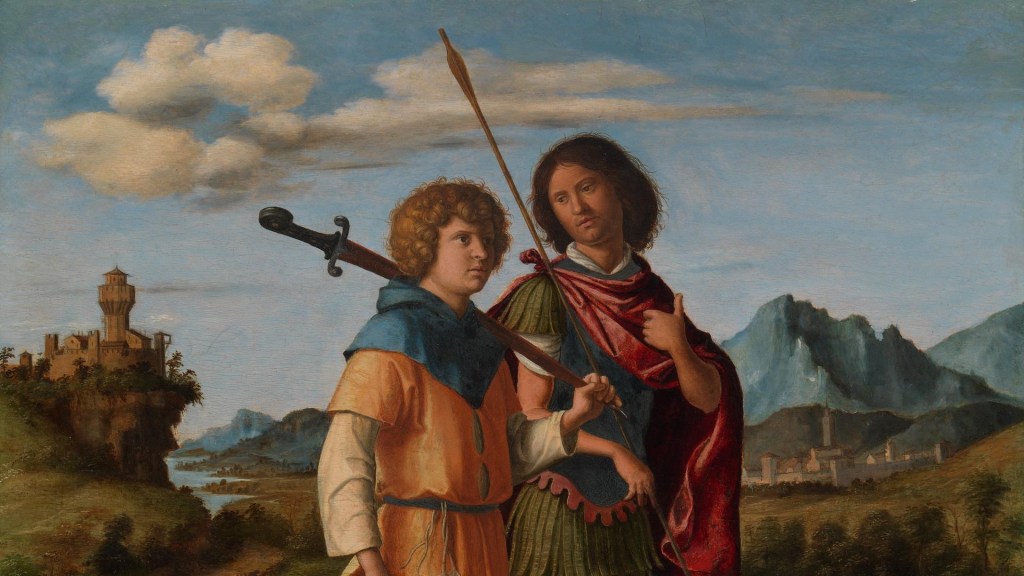
David and Jonathan – Giovanni Battista Cima de Conegliano
Jonathan had made a covenant of friendship with David right after David defeated Goliath. That friendship grew and Jonathan came to accept David as the divine choice for king.
At great risk to himself, Jonathan becomes David’s powerful advocate in the face of Saul. Jonathan should have been in solidarity with his father, if not out of duty, then out of self-interest (for the sake of his own chance at the throne). The narrative, however, presents Jonathan acting against both his duty and his self-interest… Jonathan could do that only if he trusted in how Yahweh would build his kingdom and if he aligned himself with it.
Walter Brueggemann: I and II Samuel
I read a line that captures all of this so perfectly:
Jonathan loved David and that love surely compelled him to act, but he found freedom and strength to act by putting his trust in God.
Joy Lockwood, Senior Pastor, Lakewood Presbyterian Church, Jacksonville, FL
While the story of Jonathan and David has much to teach us about the nature of devoted friendship, it – together with our psalm and Gospel – has more to say about our friendship with God.
I am bound, O God, by vows to you; your thank offerings I will fulfill. For you have rescued me from death, my feet, too, from stumbling; that I may walk before God in the light of the living.
Our trust grows as we reflect on God’s steadfast loyalty to us, rescuing us from all the big and small stumblings of our life. Recognizing that generous Omnipresence, we deepen in courage to live honest, holy, just and merciful lives.
In our Gospel, we see Jesus being that kind of devoted and divine friend of those unbefriended by the merciless world. It is obviously a stressful ministry for which Jesus depends on communion with his Father and the Holy Spirit to sustain him.
Let’s imagine that Triune Trust, Loyalty and Courage which we call the Holy Trinity. We can invite that Sacred Energy into our own hearts in a mutual friendship. This is the gift offered to us in our Baptism.
Poetry: You, neighbor God, if sometimes in the night – Rainer Maria Rilke
You, neighbor God, if sometimes in the night I rouse you with loud knocking, I do so only because I seldom hear you breathe and know: you are alone. And should you need a drink, no one is there to reach it to you, groping in the dark. Always I hearken. Give but a small sign. I am quite near.
Between us there is but a narrow wall, and by sheer chance; for it would take merely a call from your lips or from mine to break it down, and that without a sound.
The wall is builded of your images.
They stand before you hiding you like names. And when the light within me blazes high that in my inmost soul I know you by, the radiance is squandered on their frames.
And then my senses, which too soon grow lame, exiled from you, must go their homeless ways.
Music: O Lux Beata Trinitas – Slovenian Philharmonic Choir
O lux beata Trinitas, Et principalis unitas, Iam sol recedat igneus, Infunde lumen cordibus.
Te mane laudum carmine, Te deprecemur vespere: Te nostra supplex gloria Per cuncta laudet sæcula.
Deo Patri sit gloria, Ejusque soli Filio, Cum Spiritu Paraclito, Et nunc et in perpetuum.
O Trinity of blessed light, O Unity of princely might, The fiery sun now goes his way; Shed Thou within our hearts Thy ray.
To Thee our morning song of praise, To Thee our evening prayer we raise; Thy glory suppliant we adore Forever and forevermore.
All laud to God the Father be; All praise, Eternal Son, to Thee; All glory, as is ever meet, To God the Holy Paraclete.
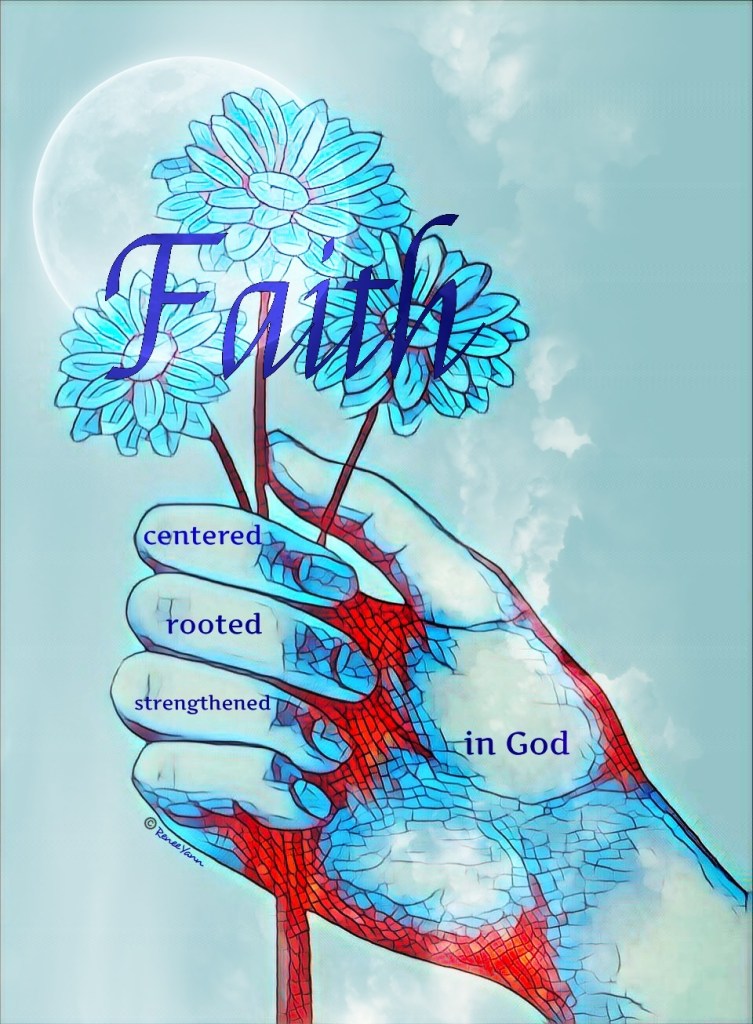
Today, in God’s Lavish Mercy, our readings present to us a faith that is
Centered Rooted Strengthened in God
The first reading has the making of a powerful action-adventure movie. Picturing young David facing the mighty giant might bring to mind images like Robin Hood and Indiana Jones.
We are now at David’s third point of entry into Israel’s narrative. Already he has been secretly anointed (16:1–13), and privately received by Saul (16:19–23). This story of David in chapter 17 is the best known of the David stories. Though the narrative may have had a complex prehistory, it now is a powerful, well-crafted narrative capable of sustaining our interest and imagination through its long telling. The story, deliberately paced, draws us slowly and steadily into the moment of high tension. It then resolves the tension quickly in the killing of the Philistine.
Walter Brueggemann: First and Second Samuel: Interpretation -A Biblical Commentary for Teaching and Preaching
David and Goliath – Guillaime Courtois
These chapters in Samuel offer a compelling story, masterfully written to impress itself on the readers’ minds. But unlike our action-adventure films, the purpose is not to entertain.
The purpose of the David-Goliath story is to teach Israel and us that:
faith places God at the center of all experience
faith is rooted in complete trust
faith is stronger than any fear or threat
David, the pure-hearted and faithful one, then uses his gifts and intelligence to accomplish his mission.
In our prayer today, we might talk with God about our own faith – its centeredness, roots and strength. May we too, like the person in Mark’s Gospel, stretch out to God’s healing power anything that might be withering in us.
Poetry: Five Smooth Stones – Eric K. Carr
Five smooth stones The future king Chose As his arsenal Against the giant
I have thrown far more Into the goliaths of the future Skipping across ponds Of sure uncertainty Hoping they may sink Into pools of grace Or at least a life well lived And that my children Will know they are loved Through And beyond Each missile’s reach
Music: God of the Impossible – Everfound
Just a boy with a sling and a stone, But the heart of a lion dared him to go. To hear the sound of the cynical, Die out with the sound of the giant’s fall. Ohhh, oh ohh! I dare to believe in incredible things. Ohhh, oh ohh! I’m ready to go, I’m ready to gooo-oh! Here I am! Lord send me! I won’t look back, cause I was made To be a part, of the, imposs-ible! You’re God, of the, imposs-ible! Here I am! Lord send me! I won’t back down, cause I believe You are the God, of the, imposs-ible! Here, I, am, send me! Empty bones and a thirsty soul, Dreamin’ for more than the life I have known. ‘Til I tasted a burning coal, And my guilt was erased, and my sin was atoned! Ohhh, oh ohh! I dare to believe in incredible things. Ohhh, oh ohh! I’m ready to go, I’m ready to gooo-oh! Here I am! Lord send me! I won’t look back, cause I was made To be a part, of the, imposs-ible! You’re God, of the, imposs-ible! Here I am! Lord send me! I won’t back down, cause I believe You are the God, of the, imposs-ible! Here, I, am, send me! Ohhh, oh ohh! I dare to believe in incredible things. Ohhh, oh ohh! Cause you’re the God of the impossible. Ohhh, oh ohh! I dare to believe in incredible things. Ohhh, oh ohh! I’m ready to go, I’m ready to gooo-oh! Here I am! Lord send me! I won’t look back, cause I was made To be a part, of the, imposs-ible! You’re God, of the, imposs-ible! Here I am! Lord send me! I won’t back down, cause I believe You are the God, of the, imposs-ible! Here, I, am, send me! Send me!
Today, in God’s Lavish Mercy, three themes suggest themselves for our prayerful consideration. At various points in our spiritual lives we are called to:
Release what binds us Reorient to what is good Recommit to hope and promise
Our first reading begins the narrative of David, key figure of the Hebrew Scriptures and the archetype king who prefigured the Messiah.
Release We read about Samuel’s commission to find a new kingly candidate and to anoint him. This is a big deal for Samuel, who first has to release his dream for Saul in whom he had misplaced his hope:
The LORD said to Samuel: “How long will you grieve for Saul,whom I have rejected as king of Israel?
Reorient God, Who already has a plan, encourages Samuel to pursue a new path:
Fill your horn with oil, and be on your way. I am sending you to Jesse of Bethlehem, for I have chosen my king from among his sons.
Recommit In a memorable series of attempts, Samuel tries to figure out who it is that God has set the kingly choice upon. After seven “not him”s, David appears – the unlikeliest of all the sons:
Then Samuel, with the horn of oil in hand, anointed him in the midst of his brothers; and from that day on, the Spirit of the LORD rushed upon David. When Samuel took his leave, he went to Ramah.
Throughout this entire process, God is at the wheel. Samuel’s job — and Jesse’s, and David’s, and the unchosen brothers— is to listen, hear, and respond even to the unlikely and improbable.
Believe it or not, he will be King!
The lesson, perhaps, for us: God is at the wheel in our lives too. Of course, we will have failures. Often, we will miss the “holy point”. But God is always with us, reiterating faith’s promise and inspiring a new path to its fulfillment.
Poetry: Let God – Meister Eckhart
Let God work in you,
give the work to God,
and have peace.
Don’t worry if God works
through your nature
or above your nature,
because both are God’s,
nature and grace.
Today, in God’s Lavish Mercy, our readings help us understand the basic process for spiritual growth – the evolution from self-centered practice to God-centered faith.
The passages highlight three elements of a deeply faithful life:
Obedience – a listening heart Discipline – a right heart Freedom – a selfless heart
Obedience – The Listening Heart
In our first reading, Saul has fulfilled all God’s commands regarding the mission against the Amalekites – but he has still missed the point. Saul was given a divine mandate through Samuel to completely destroy the Amalekites. Instead, Saul kept the plunder, using some as a burnt sacrifice to God.
According to Samuel, Saul messed up big time. He had an unlistening heart. God didn’t want sacrifice, but rather a fully listening obedience.
But Samuel said: “Does the LORD so delight in burnt offerings and sacrifices as in obedience to the command of the LORD? Obedience is better than sacrifice, and submission than the fat of rams. For a sin like divination is rebellion, and presumption is the crime of idolatry. Because you have rejected the command of the LORD, the LORD too, has rejected you as ruler.”
1 Samuel 15: 22-23
Discipline – The Right Heart
Our Responsorial Psalm continues the theme:
Why do you recite my statutes, and profess my covenant with your mouth, Though you hate discipline and cast my words behind you?”…
The ones that offers praise as a sacrifice glorifies me; and to them that go the right way I will show the salvation of God
Psalm 50: 16-17;23
Freedom – The Selfless Heart
Mark’s Gospel complements the lessons of our first two readings. It paints a joyful picture of Jesus and his disciples.
They are in the “salad days” of Christ’s earth-shaking ministry. Listening to Jesus, these disciples are in the Presence of a new and radical Truth. They fill their hearts and minds with its transformative power. Cherishing God’s Presence with them allows the disciples to release a inner love and generosity to fuel their ministry.
The nosy Pharisees, seeing all this joyful exuberance, question their unpenitential attitude:
The disciples of John and of the Pharisees were accustomed to fast. People came to Jesus and objected, “Why do the disciples of John and the disciples of the Pharisees fast, but your disciples do not fast?”
MARK 2:18
Does all this mean that there is never a time in the spiritual life for sackcloth, ashes and fasting? No – even Jesus didn’t say that:
Jesus answered the Pharisees, “Can the wedding guests fast while the bridegroom is with them? As long as they have the bridegroom with them they cannot fast. But the days will come when the bridegroom is taken away from them, and then they will fast on that day.
Mark 2:20
What I think it does mean is that a healthy spiritual life is centered on the Presence of God with us, not the absence. There are times when we should take stock of those “absences” and open them to repentance and healing. But then our spiritual energy should be turned to God in praise not toward our own penitential achievements.
Poetry: Flickering Mind – Denise Levertov
Lord, not you
it is I who am absent.
At first
belief was a joy I kept in secret,
stealing alone
into sacred places:
a quick glance, and away -- and back,
circling.
I have long since uttered your name
but now
I elude your presence.
I stop
to think about you, and my mind
at once
like a minnow darts away,
darts
into the shadows, into gleams that fret
unceasing over
the river's purling and passing.
Not for one second
will my self hold still, but wanders
anywhere,
everywhere it can turn.  Not you,
it is I am absent.
You are the stream, the fish, the light,
the pulsing shadow.
You the unchanging presence, in whom all
moves and changes.
How can I focus my flickering, perceive
at the fountain's heart
the sapphire I know is there?
Today, in God’s Lavish Mercy, we read about Jesus’s first public miracle at Cana. It is a story that has always fascinated me, mostly because of what is left unsaid – what is written between the lines.
The Gospel begins by telling of a wedding and “the mother of Jesus was there”. The suggestion is that Mary had been staying at the wedding site and that she had a special role in the preparations. Perhaps she was the aunt or good friend of the bride or groom. Whatever the case, Mary seems to have had some unique responsibility for the ceremony’s success.
This responsibility motivates her to solicit Jesus’s help when she notices the wine is running out. Did she expect a miracle in return for her remark? We don’t know. Perhaps she just wanted Jesus and his young friends to run down to the local wine store for replenishments.
It was Jesus who decided to turn the request into an occasion for a miracle. Why? It seems like a frivolous miracle when there were sick to be cured and dead to be raised!
The final lines of this section might help answer that question:
Jesus did this as the beginning of his signs at Cana in Galilee and so revealed his glory, and his disciples began to believe in him.
John 2:11
Jesus decided to first reveal his glory at a wedding feast, a party, an ordinary celebration of life and love. The dramatic, life-saving miracles would come – demons grabbing pigs and diving headlong into the sea.
But this first one, the one his closest family and friends would especially remember, was all about joy, dancing, music, friendship – the divine strength of our shared and graced humanity.
Probably most of us don’t expect to encounter a really eye-popping miracle in our lives. But maybe in our challenges we, like Mary, could walk up behind Jesus and whisper, “This situation needs your touch”.
Oh, how Jesus might surprise us – by letting us pour out an everyday miracle right before our eyes! Let’s be aware today of the miracles we might take for granted – life, laughter, love, friendship, hope, courage, delight in nature ….
Poetry: The Gourd – Paul Laurence Dunbar The poet suggests in these lines that it is in simplicity, and poverty of spirit, that life’s true miracles are revealed to us.
In the heavy earth the miner Toiled and laboured day by day, Wrenching from the miser mountain Brilliant treasure where it lay. And the artist worn and weary Wrought with labour manifold That the king might drink his nectar From a goblet made of gold.
On the prince’s groaning table Mid the silver gleaming bright Mirroring the happy faces Giving back the flaming light, Shine the cups of priceless crystal Chased with many a lovely line, Glowing now with warmer colour, Crimsoned by the ruby wine.
In a valley sweet with sunlight, Fertile with the dew and rain, Without miner’s daily labour, Without artist’s nightly pain, There there grows the cup I drink from, Summer’s sweetness in it stored, And my lips pronounce a blessing As they touch an old brown gourd.
Why, the miracle at Cana In the land of Galilee, Tho’ it puzzles all the scholars, Is no longer strange to me. For the poorest and the humblest Could a priceless wine afford, If they’d only dip up water With a sunlight-seasoned gourd.
So a health to my old comrade, And a song of praise to sing When he rests inviting kisses In his place beside the spring. Give the king his golden goblets, Give the prince his crystal hoard; But for me the sparkling water From a brown and brimming gourd!
Today, in God’s Lavish Mercy, we are introduced to Saul and Matthew. Both these friends of God went through a spiritual process to confirm that Friendship. The process included:
Seeing Trusting Choosing
Seeing
In our first reading, Saul first appears chasing a bunch of asses. (I’m not even going there. Draw your own parallels 🤣)
But in his heart of hearts, Saul had another agenda. He wanted to confirm that a growing vision within him was also God’s vision:
Saul met Samuel in the gateway and said, “Please tell me where the seer lives.” Samuel answered Saul: “I am the seer. Go up ahead of me to the high place and eat with me today. In the morning, before dismissing you, I will tell you whatever you wish.”
1 Samuel 9:1-19
Trusting
Once our inner horizon begins to clear, our greatest challenge may be to trust what we see. For Saul, that power to trust came by benefit of Samuel’s anointing with oil.
As our jubilant psalm exerts, when we recognize God as our strength, our trust is confirmed:
O LORD, in your strength the king is glad; in your victory how greatly he rejoices! You have granted him his heart’s desire; you refused not the wish of his lips.
Psalm 21: 2-3
Choosing
Each one of us, in our own way, experiences this spiritual process. Certainly we see it in how we find our life’s vocation. But we see it in smaller, daily ways as well. Each choice we make in life is a step toward or away from God – toward or away from Love, Mercy, Wholeness and Justice as we learn it in the Gospel.
In our reading from Mark, we witness Matthew in a critical process of “seeing-trusting-choosing”.
Could more hidden drama be packed in two simple lines than in these!
Jesus said to him, “Follow me.” And he got up and followed Jesus.
Wrapped in those verses is Matthew’s whole life up to this point – all the choices that left him leaning so toward God that he could drop everything in one transforming moment to follow God’s call.
Ah, what might Saul and Matthew inspire in us today?
The Calling of St. Matthew – Caravaggio
Poetry: The Calling of the Apostle Matthew – James Lasdun
Not the abrupt way, frozen
In the one glance of a painter’s frame,
Christ in the doorway pointing, Matthew’s face
Bright with perplexity, the glaze
Of a lifetime at the counting house

Cracked in the split-second’s bolt of being chosen,
But over the years,slowly, Hinted at, an invisible curve;
Persistent bias always favoring
Backwardly the relinquished thing
Over the kept, the gold signet ring
Dropped in a beggar’s bowl, the eye not fully

Comprehending the hand, not yet;
Heirloom damask thrust in passing
Stranger’s hand, the ceremonial saddle
(Looped coins, crushed clouds of inlaid pearl)
Given on an irresistible
Impulse to a servant. Where it sat,

A saddle-shaped emptiness
Briefly, obscurely brimming … Flagons
Cellars of wine, then as impulse steadied
Into habit, habit to need,
Need to compulsion, the whole vineyard,
The land itself, groves, herds, the ancestral house,

Given any, each object’s
Hollowed-out void successively
More vivid in him than the thing itself,
As if renouncing merely gave
Density to having, as if
He’d glimpsed in nothingness a derelict’s

Secret of unabated
Inverse possession … And only then
Almost superfluous, does the figure
Step softly to the shelter door,
Casual, foreknown, almost familiar,
Calmly received, like someone long awaited.
Music: The Call – Vaughn Williams from a poem by George Herbert
Herbert’s short poem is simple and direct. It is almost completely composed of words of one syllable. Allusions to the Old and New testaments, as well as to the Church of England liturgy, abound in Herbert’s poetry. In this short poem there are references to Revelations 22:26: ‘Come, Lord Jesus..’ and to John 14:6, where Jesus is described as ‘the way, the truth and the life’. ‘Come’ is the call of the poet to God, but it is also the response of the poet to a call from God.
This poem has been set to music several times, notably by Ralph Vaughan Williams in his ‘Five Mystical Songs’.
Come, my Way, my Truth, my Life: Such a Way, as gives us breath: Such a Truth, as ends all strife: Such a Life, as killeth death.
Come, My Light, my Feast, my Strength: Such a Light, as shows a feast: Such a Feast, as mends in length: Such a Strength, as makes his guest.
Come, my Joy, my Love, my Heart: Such a Joy, as none can move: Such a Love, as none can part: Such a Heart, as joys in love.
Today, in God’s Lavish Mercy, our readings burst with lessons for our faith. We might center our prayer on these three dynamic elements:
Power Praise Perseverance
Power
In our first reading, Israel is in the midst of a profound power shift. Until this time, Israel has thrived in “covenantal localism” which released possibility and initiative within the broad community. But now, perhaps stressed by the Philistine threat, the elders lobby for the establishment of a kingship – a centralization of power, wealth, land control, and local self-determination. ( based on Walter Brueggemann: First and Second Samuel: Interpretation: A Bible Commentary for Teaching and Preaching)
The Elders Ask Samuel for a King
Samuel isn’t happy with the elders’ suggestion and, apparently, neither is God. Samuel tells the elders so in a passionate speech against regalism. He pronounces that when the king has usurped all their rights, God will not deliver them as they once were delivered from a similar bondage in Egypt:
When this takes place, you will complain against the king whom you have chosen, but on that day the LORD will not answer you.
1 Samuel 8:18
The lesson for us is that the use and organization of power must always be for the sake of communal justice and well-being. Fostering these universal goods is the perpetual struggle of nations and institutions. As part of any community, we are called advocate for a just distribution of power for all people.
Praise Our Responsorial Psalm counsels that in all such human interactions, our focus must be on God and God’s Will for universal wholeness and peace – a peace evidenced in justice, joy, and praise.
Blessed the people who know the joyful shout; in the light of your countenance, O LORD, they walk. At your name they rejoice all the day, and through your justice they are exalted.
Psalm 89:16-17
Perseverance
Mark’s story of the cure of a paralyzed man demonstrates the power of faithful perseverance. This man’s community – his friends – persist until he fully benefits from God’s desire for his wholeness.
Unable to get near Jesus because of the crowd, they opened up the roof above him. After they had broken through, they let down the mat on which the paralytic was lying. When Jesus saw their faith, he said to him, “Child, your sins are forgiven.”
Mark 2:4-5
Such is our responsibility to pursue our own wholeness and the wholeness of our global community.
Poetry: Ozymandias – Percy Bysshe Shelley
(The poem explores the fate of history and the ravages of time: even the greatest men and the empires they forge are impermanent, their legacies fated to decay into oblivion. (Wikipedia)
I met a traveller from an antique land
Who said: ‘Two vast and trunkless legs of stone
Stand in the desert. Near them, on the sand,
Half sunk, a shattered visage lies, whose frown,
And wrinkled lip, and sneer of cold command,
Tell that its sculptor well those passions read
Which yet survive, stamped on these lifeless things,
The hand that mocked them and the heart that fed:
And on the pedestal these words appear:
“My name is Ozymandias, king of kings:
Look on my works, ye Mighty, and despair!
”Nothing beside remains. Round the decay
Of that colossal wreck, boundless and bare
The lone and level sands stretch far away.’
Music: Aria – composed by Friedrich Gulda, played by Tomoko Inoue
Today, in God’s Lavish Mercy, our readings present a human cycle with which we all are familiar- the experience of falling and being lifted up again.
Failure then Mercy then Redemption
In our first reading, we hear about Hophni and Phinehas, sons of old Eli. They were not nice guys. They represent everything that happens when politics and power corrupt religion.
Now the sons of Eli were wicked; they had respect neither for the LORD nor for the priests’ duties toward the people.
1 Samuel 2: 13-14
After a first defeat by the Philistines, the elders of Israel sent for the Ark of the Covenant to fortify them in battle. Hophni and Phineas, being the Ark’s tenders, accompanied it from Shiloh. But the presence of the Ark, representing God, didn’t bring victory. Israel lost a second battle.
The Philistines fought and Israel was defeated; every man fled to his own tent. It was a disastrous defeat, in which Israel lost thirty thousand foot soldiers. The ark of God was captured, and Eli’s two sons, Hophni and Phinehas, were among the dead.
1 Samuel 4:11
Wow! You know it’s bad enough when we fail a first time! But after asking God to step in, we still fail??? Uh Oh!
Extraordinary Failure
Our Responsorial Psalm is the prayer of those recognizing themselves as utterly defeated, confused, and begging for redemption – the “Uh Oh People”!
Why do you hide your face, forgetting our woe and our oppression? For our souls are bowed down to the dust, our bodies are pressed to the earth. Redeem us, Lord, because of your mercy.
Psalm 44:24-25
Extraordinary Redemption
Mark’s Gospel tells the story of one devastated and utterly dependent on God to be restored, — a story of the immediacy of God’s Mercy when we open our hearts to it:
A leper came to him and kneeling down begged him and said, “If you wish, you can make me clean.” Moved with pity, he stretched out his hand, touched the leper, and said to him, “I do will it. Be made clean.”
Mark 1:40
Extraordinary Mercy
Listen, I’ve been an “uh oh person” many times in my life. Probably you have too. As we pray with these passages, our own failures and defeats may speak to us. Whether we are in their midst or simply wrapped in their recollection, let’s open our spirits to these extraordinary gifts:
honest recognition of our failures
a request for healing redemption
gratitude for God’s Lavish Mercy
Poetry: The Leper – by Nathaniel Parker Willis
It’s a rather long poem, and may delight only the literary nerds like me. But it paints a wonderful story if you can take time to read it sometime.
“ROOM for the leper! room!” And, as he came, The cry passed on—“Room for the leper! Room!” Sunrise was slanting on the city gates Rosy and beautiful, and from the hills The early risen poor were coming in, 5 Duly and cheerfully to their toil, and up Rose the sharp hammer’s clink and the far hum Of moving wheels and multitudes astir, And all that in a city murmur swells— Unheard but by the watcher’s weary ear, 10 Aching with night’s dull silence, or the sick Hailing the welcome light and sounds that chase The death-like images of the dark away. “Room for the leper!” And aside they stood— Matron, and child, and pitiless manhood—all 15 Who met him on his way—and let him pass. And onward through the open gate he came, A leper, with the ashes on his brow, Sackcloth about his loins, and on his lip A covering, stepping painfully and slow, 20 And with a difficult utterance, like one Whose heart is with an iron nerve put down, Crying, “Unclean! unclean!”
’Twas now the first
Of the Judean autumn, and the leaves, Whose shadows lay so still upon his path, 25 Had put their beauty forth beneath the eye Of Judah’s palmiest noble. He was young, And eminently beautiful, and life Mantled in eloquent fulness on his lip, And sparkled in his glance; and in his mien 30 There was a gracious pride that every eye Followed with benisons—and this was he! With the soft airs of summer there had come A torpor on his frame, which not the speed Of his best barb, nor music, nor the blast 35 Of the bold huntsman’s horn, nor aught that stirs The spirit to its bent, might drive away. The blood beat not as wont within his veins; Dimness crept o’er his eye: a drowsy sloth Fettered his limbs like palsy, and his mien, 40 With all its loftiness, seem’d struck with eld. Even his voice was changed; a languid moan Taking the place of the clear silver key; And brain and sense grew faint, as if the light And very air were steeped in sluggishness. 45 He strove with it awhile, as manhood will, Ever too proud for weakness, till the rein Slacken’d within his grasp, and in its poise The arrowy jeered like an aspen shook. Day after day, he lay, as if in sleep. 50 His skin grew dry and bloodless, and white scales, Circled with livid purple, cover’d him. And then his nails grew black, and fell away From the dull flesh about them, and the hues Deepen’d beneath the hard unmoisten’d scales, 55 And from their edges grew the rank white hair, —And Helon was a leper!
Day was breaking,
When at the altar of the temple stood The holy priest of God. The incense lamp Burn’d with a struggling light, and a low chant 60 Swell’d through the hollow arches of the roof Like an articulate wail, and there, alone, Wasted to ghastly thinness, Helon knelt. The echoes of the melancholy strain Died in the distant aisles, and he rose up, 65 Struggling with weakness, and bow’d down his head Unto the sprinkled ashes, and put off His costly raiment for the leper’s garb: And with the sackcloth round him, and his lip Hid in a loathsome covering, stood still, 70 Waiting to hear his doom:—
Depart! depart, O child Of Israel, from the temple of thy God! For He has smote thee with His chastening rod; And to the desert-wild, 75 From all thou lov’st away, thy feet must flee, That from thy plague His people may be free.
Depart! and come not near The busy mart, the crowded city, more; Nor set thy foot a human threshold o’er; 80 And stay thou not to hear Voices that call thee in the way; and fly From all who in the wilderness pass by.
Wet not thy burning lip In streams that to a human dwelling glide; 85 Nor rest thee where the covert fountains hide; Nor kneel thee down to dip The water where the pilgrim bends to drink, By desert well or river’s grassy brink;
And pass thou not between 90 The weary traveller and the cooling breeze; And lie not down to sleep beneath the trees Where human tracks are seen; Nor milk the goat that browseth on the plain, Nor pluck the standing corn, or yellow grain. 95
And now, depart! and when Thy heart is heavy, and thine eyes are dim, Lift up thy prayer beseechingly to Him Who, from the tribes of men, Selected thee to feel His chastening rod, 100 Depart! O Leper, and forget not God!
And he went forth—alone! not one of all The many whom he loved, nor she whose name Was woven in the fibres of the heart Breaking within him now, to come and speak 105 Comfort unto him. Yea—he went his way, Sick, and heart-broken, and alone—to die! For God had cursed the leper!
It was noon,
And Helon knelt beside a stagnant pool In the lone wilderness, and bathed his brow, 110 Hot with the burning leprosy, and touched The loathsome water to his fever’d lips, Praying that he might be so blest—to die! Footsteps approach’d, and with no strength to flee, He drew the covering closer on his lip, 115 Crying, “Unclean! unclean!” and in the folds Of the coarse sackcloth shrouding up his face, He fell upon the earth till they should pass. Nearer the Stranger came, and bending o’er The leper’s prostrate form, pronounced his name— 120 “Helon!” The voice was like the master-tone Of a rich instrument—most strangely sweet; And the dull pulses of disease awoke, And for a moment beat beneath the hot And leprous scales with a restoring thrill. 125 “Helon! arise!” and he forgot his curse, And rose and stood before Him.
Love and awe
Mingled in the regard of Helon’s eye As he beheld the Stranger. He was not In costly raiment clad, nor on His brow 130 The symbol of a princely lineage wore; No followers at His back, nor in His hand Buckler, or sword, or spear,—yet in His mien Command sat throned serene, and if He smiled, A kingly condescension graced His lips, 135 The lion would have crouch’d to in his lair. His garb was simple, and His sandals worn; His stature modell’d with a perfect grace; His countenance, the impress of a God, Touch’d with the open innocence of a child; 140 His eye was blue and calm, as is the sky In the serenest noon; His hair unshorn Fell to His shoulders; and his curling beard The fulness of perfected manhood bore. He looked on Helon earnestly awhile, 145 As if His heart were moved, and stooping down, He took a little water in His hand, And laved the sufferer’s brow, and said, “Be clean,” And lo! the scales fell from him, and his blood Coursed with delicious coolness through his veins, 150 And his dry palms grew moist, and his lips The dewy softness of an infant’s stole, His leprosy was cleansed, and he fell down Prostrate at Jesus’ feet and worshipped Him.







 Lavish Mercy