Sister Renee Yann, RSM, D.Min, is a writer and speaker on topics of spirituality, mission, and ethical business practice. After twenty years in teaching and social justice ministry, she served for over thirty years in various mission-related roles in Mercy Health System of Southeastern Pennsylvania.
Hello, friends.
You will notice a few extra Lavish Mercy postings in the next few hours. Here’s why:
Sister Kate and I are sharing a retreat with a small group of Mercy Associates.
We are doing this by way of Lavish Mercy.
I could have made the retreat private for Associates only,
but I could not prevent WordPress from sending all followers an email notification of the postings.
I thought that would make you all curious about the contents.
So I have left the postings public.
Feel free to enjoy them if you wish.
And thanks so much for your daily support.
Sister Renee
Today, in God’s Lavish Mercy, we pray with Psalm 48 which has been called “a celebration of the security of Zion”.
Great is the LORD and wholly to be praised in the city of our God. His holy mountain, fairest of heights, is the joy of all the earth.
Indeed, the Temple is a symbol of God’s favor and protection for Israel. Some scholars believe that the outburst of praise in Psalm 48 comes after the Jewish victory over the Assyrians. This victory is interpreted as a sign of God’s special favor symbolized in the power and permanence of the Temple.
As we had heard, so have we seen in the city of the LORD of hosts, In the city of our God; God makes it firm forever.
Psalm 48:9
In our own lives, that kind of interpretation can be a slippery slope. Does God love and protect us only in our victories? What about when we fail, suffer, or collapse? Does God still favor us then?
The psalmist invites to look deeper than the visible signs of triumph. God’s mercy is expressed in the glorious “temples”, but it also reaches to “the ends of the earth” – to all our experiences.
O God, we ponder your mercy within your temple. As your name, O God, so also your praise reaches to the ends of the earth. Of justice your right hand is full.
Psalm 48: 10-11
But we must ponder God’s mercy to fully recognize and appreciate it. We must pray God’s mercy into full expression in our lives by our trusting and grateful awareness.
Poetry: Washed Up – Laurie Klein
Some tunes move the foot, inside a shoe,
some elevate the soul, while others,
numinous as the song of Zion, play on
without us.
     Remember winging it?
Fingers and toes and spirits
surrendered to more than the moment,
hearts drafting off each other,
     daring
as swifts, weaving aerial fractals, our voices
ascending a groove, a line of thought,
into the upper reaches, then coasting
into rarified silence—the Mystery
humming within and
     beyond all things.
No one leads the singing as you did, love.
No one else intuits my pulse
and impulse, improvising
new settings befitting
     the inner lark.
Old friends ask about you, tender
their prayers. I am counting on this:
how greatly you’re loved,
and the kingdom emerging
in guises we never knew.
Music: Beautiful Zion Built Above – George Gill
Beautiful Zion, built above; Beautiful city that I love; Beautiful gates of pearly white; Beautiful temple—God its light; He who was slain on Calvary Opens those pearly gates for me. Zion, Zion, lovely Zion; Beautiful Zion; Zion, city of our God!
Beautiful heav’n, where all is light; Beautiful angels clothed in white; Beautiful strains that never tire; Beautiful harps thru all the choir; There shall I join the chorus sweet, Worshiping at the Savior’s feet. Zion, Zion, lovely Zion; Beautiful Zion; Zion, city of our God!
Beautiful crowns on ev’ry brow; Beautiful palms the conq’rors show; Beautiful robes the ransomed wear; Beautiful all who enter there; Thither I press with eager feet; There shall my rest be long and sweet. Zion, Zion, lovely Zion; Beautiful Zion; Zion, city of our God!
Today, in God’s Lavish Mercy, we pray with Psalm 103, an extended exhortation to bless and praise the Lord.
Bless the LORD, O my soul; and all my being, bless his holy name. Bless the LORD, O my soul, and forget not all his benefits.
Psalm 103: 1-2
Running through all of Psalm 103, the psalmist creates a list of reasons to bless God.
For me, it was a good morning to create my own list and simply pray with that opening phrase:
I bless you, Lord and thank you…for …
The beauty outside my window was a good place to start.
Where would you start your “praise list” today?
Poetry: Stopping by Woods on a Snowy Evening – Robert Frost Appreciating God’s beauty and blessings may lead us to act on our prayer, as it seems to for the poet:
Whose woods these are I think I know.
His house is in the village though;
He will not see me stopping here
To watch his woods fill up with snow.

My little horse must think it queer
To stop without a farmhouse near
Between the woods and frozen lake
The darkest evening of the year.

He gives his harness bells a shake
To ask if there is some mistake.
The only other sound’s the sweep
Of easy wind and downy flake.

The woods are lovely, dark and deep,
But I have promises to keep,
And miles to go before I sleep,
And miles to go before I sleep.
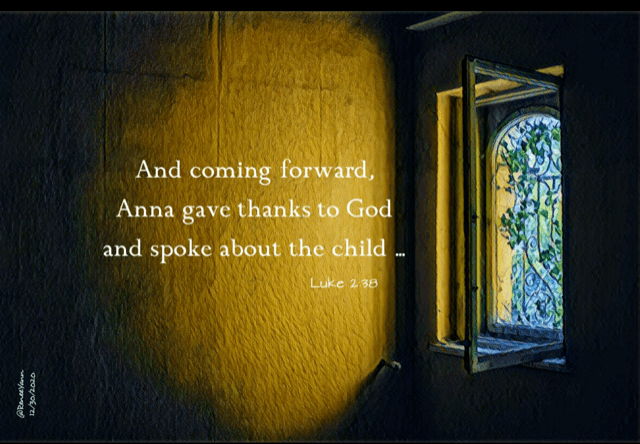
Today, in God’s Lavish Mercy, we pray once more with Psalm 24, still knocking on God’s door. As it is the Feast of the Presentation, we might picture Anna and Simeon murmuring this psalm as they await the appearance of their Savior.
Lift up, O gates, your lintels; reach up, you ancient portals, that the king of glory may come in!
Psalm 24: 7
Anna and Simeon longed for the promised Redemption. They hoped and believed that Creation would be restored by the Messiah. They waited faithfully in the dark for the Light to come. And on that wondrous morning, sparks flew through the Temple door wrapped in a baby blanket!
In pre-Vatican II days, we nuns had sparse communication with our families. Throughout my over 1000 days of initial formation, I spoke with my mother fewer than 30 times. I stood it well because I was all wrapped up in my new life. But Mom languished. She pined for me and for our little daily chats.
So when the post-Vatican II era hit, Mom got on that phone. She called me every night just about seven o’clock – a brief, but treasured, check-in. Mom likened our phone calls to Stevie Wonder’s popular song at that time. Every now and again, even though it has been over thirty years, I still long for that ring.
For Mom and me, the gates had been unlocked, the lintels lifted up. The ancient portals had opened at the touch of John XXIII and his like-minded buddies. A mother-child light flowed back into us. We were both renewed by the reconnection.
On the Feast of the Presentation, we pray with Anna and Simeon, two so deeply practiced in prayer. As the child Jesus was carried into the Temple that morning, the plea of Psalm 24 was answered before their eyes. In our prayer today, let us joyfully welcome God into our hearts. Let us talk and walk with God as easily as we might with a beloved parent or a dearest friend on any given evening.
Lift up, O gates, your lintels; reach up, you ancient portals, that the God of glory may come in!
Poem: You, neighbor God, if sometimes in the night — Rainer Maria Rilke
You, neighbor God, if sometimes in the night
I rouse you with loud knocking, I do so
only because I seldom hear you breathe
and know: you are alone.
And should you need a drink, no one is there
to reach it to you, groping in the dark.

Always I hearken. Give but a small sign.
I am quite near.
Between us there is but a narrow wall,
and by sheer chance; for it would take
merely a call from your lips or from mine
to break it down,
and that without a sound.

The wall is builded of your images.
They stand before you hiding you like names.
And when the light within me blazes high
that in my inmost soul I know you by,
the radiance is squandered on their frames.

And then my senses, which too soon grow lame,
exiled from you, must go their homeless ways.
Music: He Walks with Me – Anne Murray
I come to the garden alone While the dew is still on roses And the voice I hear falling on my ear The son of God discloses
And he walks with me and he talks with me And he tells me I am his own And the joy we share as we tarry there None other has ever known
He speaks and the sound of his voice Is so sweet, the birds hush their singing And the melody that he gave to me Within my heart is ringing
And he walks with me and he talks with me And he tells me I am his own And the joy we share as we tarry there None other has ever known
Today, in God’s Lavish Mercy, we pray with Psalm 31 which assures us that we can rest in God’s love if we will just hope.
Let your hearts take comfort, all who hope in the Lord.
Psalm 31: 25
Hope can be a complex virtue to understand. The Catholic Catechism describes Hope in this way: Hope is the theological virtue by which we desire the kingdom of heaven and eternal life as our happiness, placing our trust in Christ’s promises and relying not on our own strength, but on the help of the grace of the Holy Spirit. (CCC 1817)
This definition offers an important key. The kind of hope we are praying about in our psalm is a “virtue”, not a feeling. And in particular, hope is one of the three theological virtues which, according to the brilliant Thomas Aquinas means this:
… these virtues are called theological virtues “because they have God for their object, both in so far as by them we are properly directed to Him, and because they are infused into our souls by God alone, as also, finally, because we come to know of them only by Divine revelation in the Sacred Scriptures”.
Now, you know, Thomas wasn’t probably that fun to talk with, given all that theological Latin. But, wow, he nailed this one.
What I think he meant, in other words, is that we are not talking about the feeling of hope, as when we put a soufflé in the oven and hope it doesn’t collapse. Or when we study like crazy and hope the right questions are on the exam. Or even when, more importantly, we make a life choice like marriage or religious life and hope it will bring us a fulfilling, lasting joy.
These kinds of “hopes” might be better defined as optimistic expectations. If they fail to be fulfilled, we might give up on them, perhaps even stop trying to achieve the kind of joy they promised. (That’s a whole other reflection! 🙂 )
Instead, the Hope we are praying about today is not a feeling. It is a gift, given by God and nurtured by our faithful practice of scriptural prayer.
Just like “Life” which is breathed into us by God without any cooperation of our own, the virtue of Hope – along with Faith and Love – is infused into our souls in God’s loving act of creation.
And just like the principle of life, Faith, Hope, and Love reside in us forever.
These theological realities can be hard to grasp. To make it easier, I turn them into images for my prayer. I picture Faith, Hope and Love as three small but inextinguishable candle flames deep in my spirit. God is the One who fires their light and warmth.
The circumstances of my life, chosen or imposed, can affect my ability to see and feel the power of these gifts. But circumstances cannot extinguish them because they belong to God not to me.
Once I said in my anguish, “I am cut off from your sight”; Yet you heard the sound of my pleading when I cried out to you.
Psalm 31: 23
By prayer, and the faithful effort to be open to God’s Presence in my life, these virtues deepen in me. I can rest assured in their divine constancy. Their power and energy fuel my life both in the favorable and unfavorable “winds” of my circumstances.
Love the LORD, all you his faithful ones! The LORD keeps those who are constant, but more than requites those who act proudly.
Psalm 31: 24
I found this tender transliteration of Psalm 31 by Christine Robison helpful for my prayer:
I have come to you, O God, please, take me in.
Hear my prayers, be my rock, my stronghold, my castle.
Help me untangle myself from the web of confusions
and self-deceptions that I’m stuck in.

I put my trust in you—I give you my life.
I have turned
from the temptation to trust the ten thousand things.
I have turned
from the temptation to despair of your love and help.

I have learned
to see you in my sorrows and afflictions
A lot of my life went by before I managed this,
which makes me sad.

Now, I practice trust and open-hearted acceptance
of my life as it is.
Now I practice trust and open-hearted acceptance
of You as You are.
Poetry: Hope – Lisel Mueller
It hovers in dark corners
before the lights are turned on,
it shakes sleep from its eyes
and drops from mushroom gills,
it explodes in the starry heads
of dandelions turned sages,
it sticks to the wings of green angels
that sail from the tops of maples.

It sprouts in each occluded eye
of the many-eyed potato,
it lives in each earthworm segment
surviving cruelty,
it is the motion that runs
from the eyes to the tail of a dog,
it is the mouth that inflates the lungs
of the child that has just been born.

It is the singular gift
we cannot destroy in ourselves,
the argument that refutes death,
the genius that invents the future,
all we know of God.
It is the serum which makes us swear
not to betray one another;
it is in this poem, trying to speak.
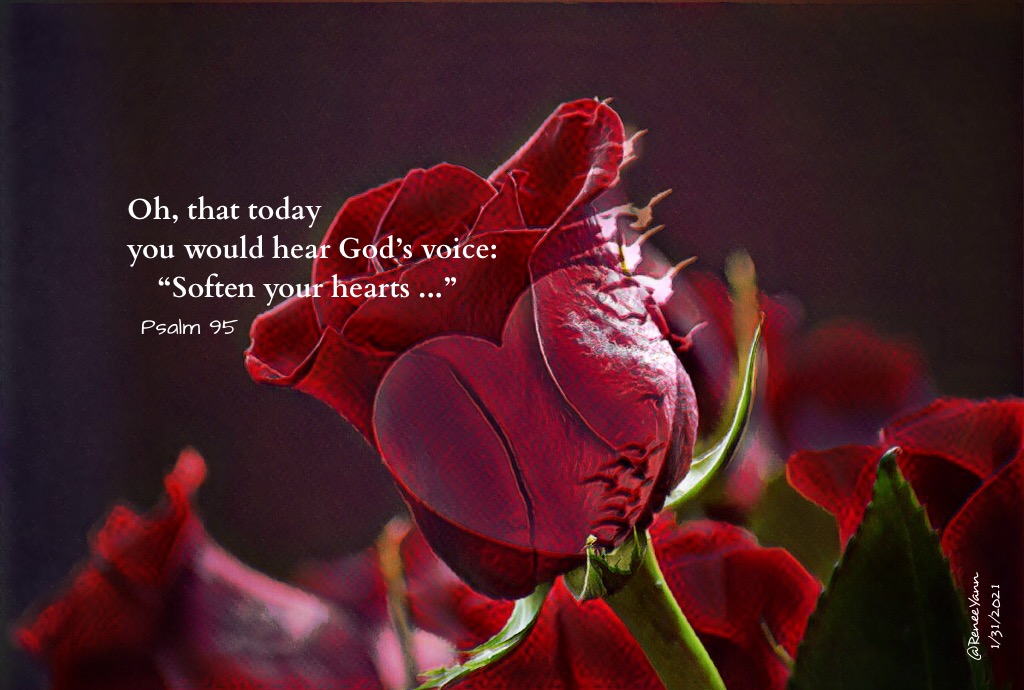
Today, in God’s Lavish Mercy, we pray with Psalm 95, once again a call to a holy tenderheartedness – that mix of love, discernment, and generosity that magnetizes us into dynamic relationship with God.
Oh, that today you would hear his voice: “Harden not your hearts as at Meribah, as in the day of Massah in the desert, Where your fathers tempted me; they tested me though they had seen my works.”
Psalm 95: 7-9
Our other Sunday readings, which Psalm 95 anchors, clarify the reason we seek this tenderheartedness. It is so that we might not only hear, but really listen and respond to the Truth of God in our lives.
Those who will not listen to my words which a prophet speaks in my name, I myself will make them answer for it.
Deuteronomy 18:18
In our first reading from Deuteronomy, the people were confused. They were passing into a new land with lots of rivaling religions and spiritualities. Moses was nearing the end of his life and leadership over them. They wanted to know who to listen to and how to behave in order to stay in God’s favor.
God promises that God’s voice will come through a prophet like Moses:
I will raise up for them a prophet like you from among their kin, and will put my words into his mouth; he shall tell them all that I command him.
Deuteronomy 18: 19
In our Gospel, we see Jesus – the fulfillment of the Deuteronomic Promise. The people witnessing his power are amazed. They struggle with whether they can believe in him when he seems just one of them, a Nazarene, Joseph’s son.
But some could believe – readily. Some, like the disciples, discerned quickly the Truth Jesus was. They heard, listened, believed and obeyed the Word.
Our psalm suggests that such readiness, such tenderheartedness comes from the consistent practice of relationship with God through praise, witness, thanksgiving, prayer, worship, humility, and obedience.
To me, it boils down to this:
let your life unfold in God’s Presence
be silent under God’s loving gaze
thank God for all you have been given
realize you are nothing without God
listen to your life as God speaks it to you
act on what you hear
Come, let us sing joyfully to the LORD;
    let us acclaim the rock of our salvation.
Let us come into God’s presence with thanksgiving;
    let us joyfully sing psalms to the Lord.
R. If today you hear God’s voice, harden not your hearts.
Come, let us bow down in worship;
    let us kneel before the LORD who made us.
For the Lord is our God,
    and we are the people God shepherds, the flock God guides.
Poetry: Rumi
I keep telling my heart,
“Go easy now.
I am submerged in golden treasure.”
It replies,
“Why should I be afraid of love?”
Today, in God’s Lavish Mercy, our Responsorial Psalm is the glorious Benedictus which is one of the three canticles in Luke’s first two chapters, the other two being the “Magnificat” and the “Nunc Dimittis”. The Benedictus was the song of thanksgiving uttered by Zechariah on the occasion of the circumcision of his son, John the Baptist.
Rembrandt: The Circumcision of John
Can you imagine Zechariah that morning, holding his little boy, eight days old? This unexpected, miraculous child would be named in a ceremony marking the ancient covenant between God and God’s People.
The little group gathered for the ritual expected the name to be an honorary repetition, probably his grandfather’s name. Instead, it is a name delivered by an angel: John, which means “Yahweh has shown favor,” — announcing John’s role in salvation history.
When Zechariah, still struck deaf and mute, indicates his agreement with Elizabeth on John’s name, his tongue is loosed. He immediately praises God and proclaims a framework for the miracles about to come – the Benedictus.
Praying with this Canticle this morning, I treasure its lovely phrases and its succinct recounting of Israel’s “God Story” even as it reflects my own.
Prose: This past Advent, one of our Sisters of Mercy offered a profound reflection on Zechariah’s song. It blessed my prayer once again today.
Blessed be the Lord, the God of Israel,
for he has visited and brought redemption to his people.
He has raised up a horn for our salvation
within the house of David his servant,
even as he promised through the mouth of his holy prophets from of old:
salvation from our enemies and from the hand of all who hate us,
to show mercy to our fathers
and to be mindful of his holy covenant
7and of the oath he swore to Abraham our father,
and to grant us that, rescued from the hand of enemies,
without fear we might worship him in holiness and righteousness
before him all our days.
And you, child, will be called prophet of the Most High,
for you will go before the Lord to prepare his ways,
to give his people knowledge of salvation
through the forgiveness of their sins,
because of the tender mercy of our God
by which the daybreak from on high* will visit us
to shine on those who sit in darkness and death’s shadow,
to guide our feet into the path of peace.”
Today, in God’s Lavish Mercy, we pray with Psalm 37 which some interpret as a response to the problem of evil. The Hebrew scriptures often express this problem as a question: why do the wicked prosper and the good suffer?
The valiant one whose steps are guided by the LORD, who will delight in his way, May stumble, but he will never fall, for the LORD holds his hand.
Psalm 37: 23-24
I think many of us see the evil in the world and are saddened, stunned, and confused by it. We share the disillusionment posed in Rabbi Harold Kushner’s classic book, “When Bad Things Happen to Good People”.
I don’t know about you, but I even have gotten angry with God over the question. When I ministered as hospice chaplain, there were many nights I spent in tearful, protesting astonishment at God’s so-called “Will”.
I have a dear and abundantly faithful friend who swears she will tell God off when she gets to heaven. Ever been like her?😉
Over the years I’ve come to understand that, well actually, we just don’t understand. I have also come to trust that God mysteriously abides with us in our suffering, drawing us ever deeper into that ineffable mystery.
Psalm 37 encourages that trust, and its ensuant behavior, within our own lives:
Trust in the LORD and do good, that you may dwell in the land and be fed in security. Take delight in the LORD, and he will grant you your heart’s requests. Commit to the LORD your way; trust in him, and he will act. He will make justice dawn for you like the light; bright as the noonday shall be your vindication.
Psalm 37: 3-6
Psalm 37 acknowledges that, though we trust, our trust is often tested by what we see in the world.
The salvation of the just is from the LORD; who is their refuge in time of distress. And the LORD helps them and delivers them; the Lord delivers them from the wicked and saves them, because they take refuge in God.
Psalm 37: 39-40
Perhaps for our prayer today, we would like to test our hearts against this trust, given the circumstances and awarenesses of our own lives. Where is it that we “take refuge” when “bad things happen”?
Poetry: “Talking to Grief” by Denise Levertov
Ah, grief, I should not treat you
like a homeless dog
who comes to the back door
for a crust, for a meatless bone.
I should trust you.

I should coax you
into the house and give you
your own corner,
a worn mat to lie on,
your own water dish.

You think I don’t know you’ve been living
under my porch.
You long for your real place to be readied
before winter comes. You need
your name,
your collar and tag. You need
the right to warn off intruders,
to consider my house your own
and me your person
and yourself
my own dog.
Music: You Want It Darker – by Leonard Cohen who was a Canadian singer-songwriter, poet, and novelist. His work explored religion, politics, isolation, depression, sexuality, loss, death and romantic relationships. Many will be familiar with his highly popularized and beautifully haunting song
Cohen invokes in the song what seem to be phrases from the story of the “binding of Isaac” in Genesis 22, when God commanded Abraham to slaughter his beloved son, Isaac. The Hebrew word Hineni, which means “Here I am,” is repeated thrice in the “You Want It Darker” song and in Genesis 22 (vs. 1, 7, 11). …
“Hineni” resonates with obedient readiness. It is what a faithful Jew says to God when summoned and called, even in the face of the “valley of the shadow of death.” But Cohen is not so willing to embrace this word in the face of such deep darkness. Indeed, he “wants out” if thus is how the Dealer deals. He will not simply submit without protest against death, without shouting out from within the dark mystery that enfolds humanity.
Dr. Tom Neal – Academic Dean and Professor of Spiritual Theology, Notre Dame Seminary, New Orleans, LA
Memorial of Saint Thomas Aquinas, Priest and Doctor of the Church
Grant me, O Lord my God, a mind to know you, a heart to seek you, wisdom to find you, conduct pleasing to you, faithful perseverance in waiting for you, and a hope of finally embracing you. Amen. – St. Thomas Aquinas
Today, in God’s Lavish Mercy, we pray with Psalm 24 which expresses our longing to be in God’s Presence.
Lord, this is the people that longs to see your face.
Psalm 24:6
Of course, we know that we are always in God’s Presence. What the prayer really asks for is to recognize that we are in God’s Presence and to feel that accompanying comfort.
Psalm 24 may have been written by David after he acquired the Temple Mount, intending for it to be sung at the dedication of the Temple by his son, Solomon. In verses 7 and 9, David instructs the gates of the Temple to open to receive God’s glory at that time.
The complete psalm is divided into three parts which:
acknowledge God as Supreme Creator and Lord of All
The earth is the LORD’s and all it holds
2. describe who may come into God’s Presence
Who may go up the mountain of the LORD? Who can stand in his holy place? The clean of hand and pure of heart, who has not given his soul to useless things, what is vain.
3. implore admission into that Presence
Lift up your heads, O gates; be lifted, you ancient portals, that the king of glory may enter.
Psalm 24 presents a great pattern for our own prayer:
say “Hello” to God in greetings of praise and gratitude
talk to God about the disposition of our souls, asking to be transparent before God
express our deep desire to be always aware of and attuned to God’s Presence in our lives
With Psalm 24, we are asking God to bring us, every moment, into the joy of the Divine Presence. We are asking to be admitted to God’s “party of unending grace”. As I prayed the psalm, I couldn’t help hearing today’s song in my mind. I think it was received by God as a playful prayer to deepen our friendship, love, and joy.😉 (I think God likes to play sometimes too.)
Poetry: Letter to Lewis Smedes about God’s Presence – Rod Jellema
Dear Lew,
I have to look in cracks and crevices.
Don't tell me how God's mercy
is as wide as the ocean, as deep as the sea.
I already believe it, but that infinite prospect
gets farther away the more we mouth it.
I thank you for lamenting His absences —
from marriages going mad, from the deaths
of your son and mine, from the inescapable
terrors of history: Treblinka. Viet Nam.
September Eleven. It's hard to celebrate
His invisible Presence in the sacrament
while seeing His visible absence from the world.
This must be why mystics and poets record
the slender incursions of splintered light,
echoes, fragments, odd words and phrases
like flashes through darkened hallways.
These stabs remind me that the proud
and portly old church is really only
that cut green slip grafted into a tiny nick
that merciful God Himself slit into the stem
of His chosen Judah. The thin and tenuous
thread we hang by, so astonishing,
is the metaphor I need at the shoreline
of all those immeasurable oceans of love.
(Adapted from an e-mail discussion, summer 2002)
Music: Let Me In – The Sensations
Let me in whee-ooh (whee-ooh, whee-ooh, hoop-whee-ooh) (Whee-ooh, whee-ooh, hoo-ooh-oop-whee-ooh, whee-ooh) I can see the dancin’ (let me in) The silhouettes on the shade I hear the music (music), all the lovers on parade Open up (let me in), I want to come in again I thought you were my friend Pitter patter of those fee-ee-ee-ee-eet Movin’ and a-groovin’ with that be-eat Jumpin’ and stompin on the flo-o-o-o-oor (Lemme in) Let me in! (Open up) Open up! Why don’t you open up that door? (let me in) I-uh (open up) hear music let me in (music) I want to come in again Let me in (let me in), a-well I heard it just then I thought you were my friend Pitter patter of the fee-ee-ee-ee-eet Movin’ and a-groovin’ with that be-eat Jumpin’ and stompin on the flo-o-o-o-oor (Lemme in) Let me in! (Open up) Open up! Why don’t you open up that door? (let me in) I-uh-I-uh-I (open up) hear music, let me in (music) Oh I heard it just then Let me in (let me in) I want to come in again I thought you were my friend
Today, in God’s Lavish Mercy, we pray with Psalm 110, but through the lens of our first reading from Hebrews.
We have prayed with this psalm a few times recently, exploring its links to priesthood, ministry, and good old Melchizedek. When I saw it again this morning, I was at little exhausted by it. Then I read Hebrews and got a new perspective on Psalm 110.
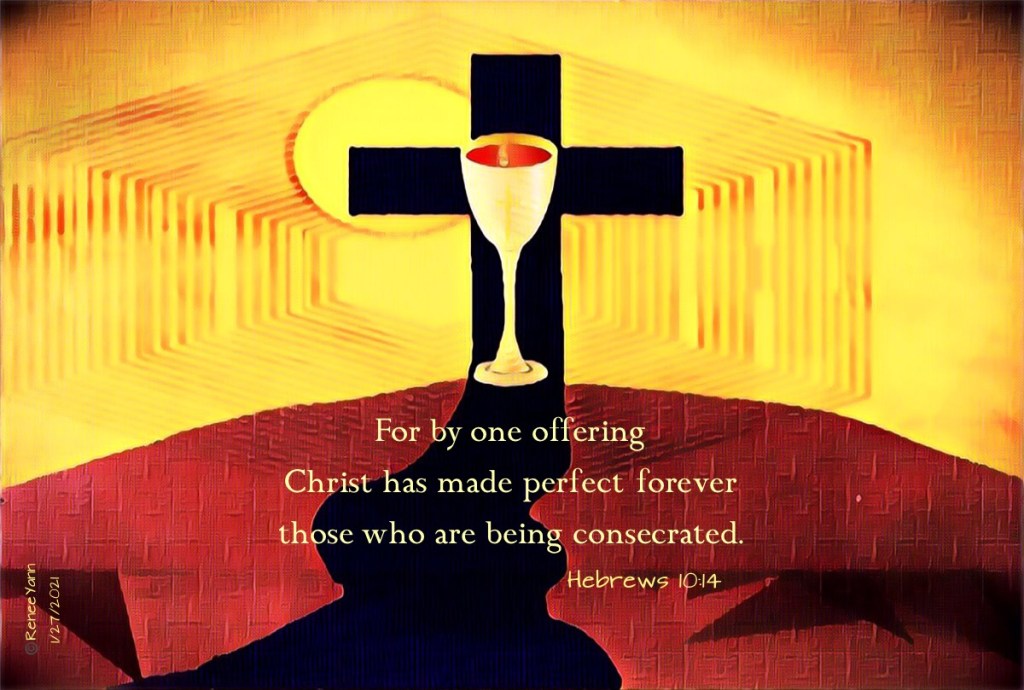
For by one offering Christ has made perfect forever those who are being consecrated. The Holy Spirit also testifies to us, for after saying: This is the covenant I will establish with them after those days, says the Lord: “I will put my laws in their hearts, and I will write them upon their minds,”
Hebrews 10:14-16
This passage from Hebrews is a testament to Jesus Christ, the ultimate High Priest, the Complete Melchizedek. That which Christ sanctifies or consecrates is us – his Body, the Church.
This consecration places in our hearts the covenant once spoken of by Jeremiah:
See, days are coming says the LORD— when I will make a new covenant with the house of Israel and the house of Judah. It will not be like the covenant I made with their ancestors the day I took them by the hand to lead them out of the land of Egypt. They broke my covenant, though I was their master. But this is the covenant I will make with the house of Israel after those days. I will place my law within them, and write it upon their hearts; I will be their God, and they shall be my people.
Jeremiah 31:31-33
Praying with Psalm 110 in this light, I give thanks for the Covenant expressed in my own life:
for my Baptism into Christ,
for the grace to witness to Christ’s law of love
for my inclusion into Christ’s ongoing ministry through the Holy Spirit
Poetry: The Covenant Prayer of John Wesley (1703–1791)
I am no longer my own, but thine.
Put me to what thou wilt, rank me with whom thou wilt.
Put me to doing, put me to suffering.
Let me be employed for thee or laid aside for thee,
exalted for thee or brought low for thee.
Let me be full, let me be empty.
Let me have all things, let me have nothing.
I freely and heartily yield all things to thy pleasure and disposal.
And now, O glorious and blessed God, Father, Son and Holy Spirit,
thou art mine, and I am thine.
So be it.
And the covenant which I have made on earth,
let it be ratified in heaven.
Amen.
Music: A New and Living Way – Michael Card
Year after year there the priest would stand
 An offering of blood held out in in his hand
 Before the curtain there he would stand in fright
 It hung there to hold in the holy ~ to keep in the light

A new and living way
 Through the curtain that was torn
 The climax of the cross
 The moment our hope was born
 By a new and living way

 And when time was full another Priest came to save
 He would offer forgiveness for He was the Offering He gave
 From the sacrifice ~ from that dark disgrace
 Came the power to make anywhere a Most Holy Place

 A new and living way
 Through the curtain that was torn
 The climax of the cross











 Lavish Mercy