Psalm 96: There Are No Others

Memorial of Saints Timothy and Titus, bishops

January 26, 2021


Today, in God’s Lavish Mercy, we pray with Psalm 96, a call to witness God’s sovereignty over and faithfulness to the whole world.

The tone of Psalm 96 is slightly different from some other psalms which call for national rejoicing. It does not suggest that God loves Israel better than other nations, therefore taking their side in history. Psalm 96 simply encourages gratitude for and witness to God’s saving power:

Sing to the LORD a new song;
    sing to the LORD, all you lands.
Sing to the LORD; bless his name.
R.    Proclaim God’s marvelous deeds to all the nations.
Announce his salvation, day after day.
Tell his glory among the nations;
    among all peoples, his wondrous deeds.

Psalm 96: 1-3

Like Israel, we walk a fine line in discerning how God loves us, both individually and as a member of the many “tribes” with which we align ourselves. Does God love Americans more? Or white people? Or Black people? Or Italians? Or the Irish? Or straight people? Or Christians? Or the wealthy? Or Phillies fans? (Well, yeah, probably Phillies fans 🙂 )


Ramana Maharshi (1879 – 1950) was an Indian Hindu sage. He is regarded by many as an outstanding enlightened being. He was a charismatic person, and attracted many devotees,
some of whom saw him as an avatar and the embodiment of Shiva.

He was once asked,
“How should we treat others?”
He replied,
“There are no others.”


It seems that we have some innate need to compare ourselves favorably against “others”. That need, unchecked and fed by fear, is at the root of any oppressive nationalism, such as the white Christian nationalism we saw displayed in the assault on the U.S. Capitol.

Jason Meyer, Pastor for Preaching and Vision in Minneapolis, writes this:
” We must always reject any attempt to fuse together one’s national/political identity with one’s Christian identity in a way that equates or conflates allegiance to country with allegiance to God.”


In an excellent article from Sojourners, Walter Brueggemann elucidates the prophet’s role in contradicting the forces that enshrine the totalism which leads to idolatries like distorted nationalism.
(totalism: the practice of a dictatorial one-party state that regulates every form of life such as that which existed under King Solomon in ancient Israel)


Psalm 96 gives us another view of what really made Israel “chosen” – their example to all nations to praise our shared Creator as the Source of all stability and equity.

Give to the LORD, you families of nations,
    give to the LORD glory and praise;
    give to the LORD the glory due his name!
R.    Proclaim God’s marvelous deeds to all the nations.
Say among the nations: The LORD is king.
Who made the world firm, not to be moved;
    who governs the peoples with equity.

Psalm 96: 7-8

Poetry: For Whom the Bell Tolls – John Donne

No man is an island,
Entire of itself.
Each is a piece of the continent,
A part of the main.
If a clod be washed away by the sea,
Europe is the less.
As well as if a promontory were.
As well as if a manor of thine own
Or of thine friend's were.
Each man's death diminishes me,
For I am involved in mankind.
Therefore, send not to know
For whom the bell tolls,
It tolls for thee.

Music: Imagine – John Lennon

Psalm 117: As We Pray with Paul

Feast of the Conversion of Saint Paul, Apostle

January 25, 2021


Today, in God’s Lavish Mercy, we pray with Psalm 117, a psalm used for the feast of an Apostle, reflecting his/her role to: 

Luke tells us how Jesus summarized the “Good News”:

The Spirit of the Lord God is upon me,
because the Lord has anointed me
to bring good news to the poor;
he has sent me to bind up the brokenhearted,
to proclaim liberty to the captives,
and the opening of the prison to those who are oppressed,
to proclaim the year of the Lord’s favor.
Luke 4:18-19


from the Palatine Chapel in Sicily

As we celebrate St. Paul, the Apostle to the Gentiles, Psalm 117 gives voice to the indescribable gratitude we feel for the call we share with the Apostles to live and witness to the “Good News”.

Praise the LORD, all you nations;
    glorify him, all you peoples!
For steadfast is God’s Mercy toward us,
   and the fidelity of the Lord endures forever.

Psalm 117: 1

Praying with Psalm 117, and with Saint Paul today, we may find inspiration in Paul’s self-description as an Apostle – a “servant”:

Paul, a servant of Christ Jesus, called to be an apostle and set apart for the gospel of God— the gospel he promised beforehand through his prophets in the Holy Scriptures regarding his Son, who as to his earthly life was a descendant of David, and who through the Spirit of holiness was appointed the Son of God in power by his resurrection from the dead: Jesus Christ our Lord.

Romans 1: 1-4

Poetry: A Thanksgiving -John Henry Newman (1801-1890)
I think this poem by Newman expresses sentiments similar to some of Paul’s thoughts on his life and vocation as found in his letters and in Acts.

LORD , in this dust Thy sovereign voice
First quicken’d love divine;
I am all Thine,–Thy care and choice,
My very praise is Thine.

I praise Thee, while Thy providence
In childhood frail I trace,
For blessings given, ere dawning sense
Could seek or scan Thy grace;

Blessings in boyhood’s marvelling hour,
Bright dreams, and fancyings strange;
Blessings, when reason’s awful power
Gave thought a bolder range;

Blessings of friends, which to my door
Unask’d, unhoped, have come;
And, choicer still, a countless store
Of eager smiles at home.

Yet, LORD , in memory’s fondest place
I shrine those seasons sad,
When, looking up, I saw Thy face
In kind austereness clad.

I would not miss one sigh or tear,
Heart-pang, or throbbing brow;
Sweet was the chastisement severe,
And sweet its memory now.

Yes! let the fragrant scars abide,
Love-tokens in Thy stead,
Faint shadows of the spear-pierced side
And thorn-encompass’d head.

And such Thy tender force be still,
When self would swerve or stray,
Shaping to truth the froward will
Along Thy narrow way.

Deny me wealth; far, far remove
The lure of power or name;
Hope thrives in straits, in weakness love,
And faith in this world’s shame

Music: Saul’s Transformation – one of many lovely pieces from the film, Paul Apostle of Christ by Jan A. P. Kaczmarek

Psalm 25: Let Your Word Teach Me

Third Sunday in Ordinary Time 

Sunday of the Word of God

January 24, 2021


Today, in God’s Lavish Mercy, we pray with Psalm 25, a simple, heartfelt plea to learn God’s ways and to be blessed by that learning.

Your ways, O LORD, make known to me;
    teach me your paths,
Guide me in your truth and teach me,
    for you are God my savior.

Psalm 25: 4-5

The psalmist’s prayer is so fitting
for this special Sunday
which is dedicated as the
“Sunday of the Word of God”.

Pope Francis called for this commemoration with his Apostolic Letter “Aperuit illis”. The Latin words come from Luke 24:45, referring to Jesus’s post-Resurrection appearance to his confused disciples.

Then he opened their minds
to understand the scriptures.

While they were still speaking about this, he stood in their midst and said to them, “Peace be with you.” But they were startled and terrified and thought that they were seeing a ghost.
Then he said to them, “Why are you troubled? And why do questions arise in your hearts?
Look at my hands and my feet, that it is I myself. Touch me and see, because a ghost does not have flesh and bones as you can see I have.” And as he said this, he showed them his hands and his feet.

While they were still incredulous for joy and were amazed, he asked them, “Have you anything here to eat?” They gave him a piece of baked fish; he took it and ate it in front of them.
He said to them, “These are my words that I spoke to you while I was still with you, that everything written about me in the law of Moses and in the prophets and psalms must be fulfilled.”
Then he opened their minds to understand the scriptures.

Luke 24: 36-45

The Pope’s letter institutes the annual observance
of the 3rd Sunday of Ordinary Time
as “Sunday of the Word of God”,
devoted to the celebration, study and
dissemination of the Word of God.

Pope Francis wrote this:

A profound bond links sacred Scripture and the faith of believers. Since faith comes from hearing, and what is heard is based on the word of Christ (cf. Rom 10:17), believers are bound to listen attentively to the word of the Lord, both in the celebration of the liturgy and in their personal prayer and reflection.

Aperuit Illis, 7

If you are reading this blog, you already seek an ever deeper, more loving relationship with God through sacred scripture. But with our Infinite God, there is always more.

Let us use today’s Psalm 25 to reflect on and reaffirm that core relationship in our lives. Let’s re-examine the dedicated time we give to scriptural prayer and “lectio divina” to make it more intentional, quiet, and consistent.


For a good explanation of lectio divina, see the Transforming Center’s website:


In the spirit of Psalm 25, we pray to always be held in God’s merciful attention, and to hold God in ours through prayer and desire.

Remember that your compassion, O LORD,
    and your love are from of old.
In your kindness remember me,
    because of your goodness, O LORD.

Psalm 25: 6-7

These are two books that I love, and have mentioned before, to help deepen our scriptural prayer:

Too Deep for Words – Thelma Hall

The Flowing Grace of Now – Macrina Wiederkehr – (Kindle edition on sale now for just $2.99)


Poetry: The Opening of Eyes – David Whyte

That day I saw beneath dark clouds 
the passing light over the water
and I heard the voice of the world speak out,
I knew then, as I had before
life is no passing memory of what has been
nor the remaining pages in a great book
waiting to be read.
It is the opening of eyes long closed.
It is the vision of far off things
seen for the silence they hold.
It is the heart after years
of secret conversing
speaking out loud in the clear air.
It is Moses in the desert
fallen to his knees before the lit bush.
It is the man throwing away his shoes
as if to enter heaven
and finding himself astonished,
opened at last,
fallen in love with solid ground.

Music: Word of God Speak – MercyMe 

Psalm 47: Imagining God

Saturday of the Second Week in Ordinary Time

January 23, 2021


Today, in God’s Lavish Mercy, we pray with Psalm 47 which describes God as a King ascending to the throne amid shouts of joy.

God mounts the throne amid shouts of joy;
the LORD, amid trumpet blasts.
Sing praise to God, sing praise;
sing praise to our king, sing praise.

Psalm 47: 6-7

This description reminds me of a pageant like the recent inauguration, where fanfare horns announce the President’s arrival. For the psalmist, the horn might have been a shofar.

It’s a beautiful and triumphant way to imagine what God might be like. But that’s all it is – an image, a product of human imagination. Like the psalmist, we all engage in that creative effort – we picture God. We draw God out of the media stored in our own hearts and spirits.


The freedom we have to imagine God can be both a blessing and a curse. As a blessing, it has allowed us to create tender, triumphant, and splendid constructs of an otherwise unimaginable Love. As a curse, it has given us the power to distort God’s image for our own selfish ends.


It is an awesome power. Even the great Saint Augustine struggled with it:

Augustine by Philippe de Champaigne

What art Thou then, my God? 
Most highest, most good, 
most potent, most omnipotent; 
most merciful and most just; 
most hidden and most present; 
most beautiful and most strong, 
standing firm and elusive, 
unchangeable and all-changing; 
never new, never old; 
ever working, ever at rest; 
gathering in and [yet] lacking nothing; 
supporting, filling, and sheltering;
creating, nourishing, and maturing; 
seeking and [yet] having all things. 
And what have I now said,

my God, my life, my holy joy? 
or what says anyone who speaks of Thee? 
And woe to the one who keeps silent about you, 
since many babble on and say nothing.


Praying with Psalm 47, I consider my own “photo album” of the Holy One. I talk with God about those pictures. I ask to know and love God more clearly, so that, made in God’s image, I may more honestly reflect it.

God has given us the ultimate self-portrait in the Person of Jesus who is:

… the image of the unseen God,
the firstborn over all creation.

Colossians 1: 15

Poetry: from Paul’s letter to the Philippians 

Have among yourselves the same attitude
that is also yours in Christ Jesus,
Who, though he was in the form of God,
did not regard equality with God something to be grasped.
Rather, he emptied himself,
taking the form of a slave,
coming in human likeness;
and found human in appearance,
he humbled himself,
becoming obedient to death, even death on a cross.
Because of this, God greatly exalted him
and bestowed on him the name
that is above every name,
that at the name of Jesus
every knee should bend,
of those in heaven and on earth and under the earth,
and every tongue confess that
Jesus Christ is Lord,
to the glory of God the Father.

Philippians 2: 6-11

Music: Philippians Hymn – John Michael Talbot

Psalm 85: Be A Neighbor

Day of Prayer for the Legal Protection of Unborn Children

“A great prayer for life is urgently needed, a prayer which will rise up throughout the world. Through special initiatives and in daily prayer, may an impassioned plea rise to God, the Creator and lover of life, from every Christian community, from every group and association, from every family and from the heart of every believer.”

Evangelium vitae, 100

January 22, 2021

Today, in God’s Lavish Mercy, we pray with Psalm 85, a Psalm we have prayed with seven times in the past six months. Have we wrung it dry, do you think?😉

Never! That’s the beauty of scripture and particularly of the Psalms. They speak to us in a new voice with each new day’s blessings and challenges.

The verse that grasps my heart this morning is this:

Near indeed is salvation to those who fear God
glory dwelling in our land.

Psalm 85: 10

What will “glory”, or well-being,
look like when it dwells in our land,
throughout our earth?


Walter Brueggemann, in his many writings about the Old Testament and the Psalms, stresses the concept of “neighborliness” as integral to communal well-being.

The well-being of the neighborhood, inspired by the biblical texts, makes possibleand even insists uponan alternative to the ideology of individualism that governs our society’s practice and policy. This kind of community life returns us to the arc of God’s giftsmercy, justice, and law. The covenant of God in the witness of biblical faith speaks now and demands that its interpreting community resist individualism, overcome commoditization, and thwart the rule of empire through a life of radical neighbor love.
(Description of Brueggemann’s book, God, Neighbor, Empire: The Excess of Divine Fidelity and the Command of Common Good)

Praying with Psalm 85, we might hear echos of President Biden’s Inaugural Address which called on our capacity for “neighborliness”:

History, faith, and reason show the way, the way of unity.
We can see each other not as adversaries but as neighbors.
We can treat each other with dignity and respect.
We can join forces, stop the shouting, and lower the temperature.
For without unity, there is no peace, only bitterness and fury.
No progress, only exhausting outrage.
No nation, only a state of chaos.


The President also said this:

Many centuries ago, Saint Augustine, the saint of my church, wrote that a people was a multitude defined by the common objects of their love.
What are the common objects we love that define us as Americans?
I think I know.
Opportunity.
Security.
Liberty.
Dignity.
Respect.
Honor.
And, yes, the truth.


Thousands of years ago, the psalmist clearly described the glorious community which God promises to those who live in mercy, truth, justice and peace:

Mercy and truth shall meet;
justice and peace shall kiss.
Truth shall spring out of the earth,
and justice shall look down from heaven.

The LORD  will give benefits;
our land shall yield its increase.
Justice shall walk before the Lord,
and salvation, along the way of God’s pattern.

Psalm 85

Prose: Here is the quote from St. Augustine referenced by President Biden, as well as the passage from Cicero which inspired Augustine

If one should say, ‘a people is the association of a multitude of rational beings united by a common agreement on the objects of their love,’ then it follows that to observe the character of a people we must examine the objects of its love.”

St. Augustine, City of God 19.24

A republic is a numerous gathering brought together by legal consent and community of interest. The primary reason for this coming together is not so much weakness as a sort of innate desire on the part of human beings to form communities. For our species is not made up of solitary individuals.

Cicero, Republic, 1.39-40 

Music: After Cicero and Augustine, a little music from our own modern philosopher, Mr. Rogers❤️

… my whole soul is in this

January 21, 2021

Today, in God’s Lavish Mercy, reflecting on these words of President Biden, there is just 

  • one prayer
  • one benediction
  • one poem
  • one call
  • one hymn filling my spirit on this deeply desired new morning!

Perhaps you would like to pray with these blessings too.


Prayer:
Be with us, Holy Mystery of Love, as we dream together.
Help us under our new President to reconcile the people of our land,
restore our dream,
and invest it with peace and justice
and the joy that is the overflow of love.
To the glory of your name forever. Amen.

Father Leo O’Donovan – Inauguration Prayer

Benediction:
This is our benediction, that from these hallowed grounds,
where slaves labored to build this shrine to liberty and democracy,
let us all acknowledge from the indigenous Native Americans
to those who recently received their citizenship,
from the African-American,
to those whose parents came from Europe and every corner of the globe,
from the wealthy to those struggling to make it,
from every human being regardless of their choices,
that this is our country as such, teach us, oh God.
Teach us to live in it, loving it, be healed in it,
and reconciled to one another in it,
lest we miss Kingdom’s goal.
Dear Glory, Majesty, Dominion and Power forever.
Hallelujah. Glory, Hallelujah.
And the strong name of our collective faith, Amen.

Reverend Silvester Beaman – Inauguration Benediction

Poem: The Hill We Climb – Poet Laureate Amanda Gorman

And together we shall write an American story of hope, not fear.
Of unity, not division. Of light, not darkness.
A story of decency and dignity, love and healing,
greatness and goodness.

May this be the story that guides us,
the story that inspires us,
and the story that tells ages yet to come
that we answered the call of history,
we met the moment.
Democracy and hope, truth and justice,
did not die on our watch, but thrived,
that America secured liberty at home
and stood once again as a beacon to the world.
That is what we owe our forebears,
one another, and generations to follow.

So, with purpose and resolve,
we turn to those tasks of our time,
sustained by faith,
driven by conviction,
and devoted to one another
and the country we love with all our hearts.
May God bless America
and may God protect our troops.

(Inaugural Address – President Joseph Biden)


Song: The Star Spangled Banner – Lady Gaga

Psalm 110:

Wednesday of the Second Week in Ordinary Time

January 20, 2021


Today, in God’s Lavish Mercy, we pray with Psalm 110, familiar from last week. Its use again today reminds us that our readings, early in the liturgical year, are focused on the emerging ministry of Jesus and what his “priesthood” or ministry teaches us about God.

Psalm 110 is a David psalm affirming God’s choice and support of David as God’s shepherd and king of the Israelites. David’s leadership is through a “priesthood” beyond that of lesser religions and deities. David has inherited the same blessing as Abram, delivered by the arcane figure of Melchizedek.

The LORD has sworn, and will not repent:
    “You are a priest forever, according to the order of Melchizedek.”

Psalm 110: 1

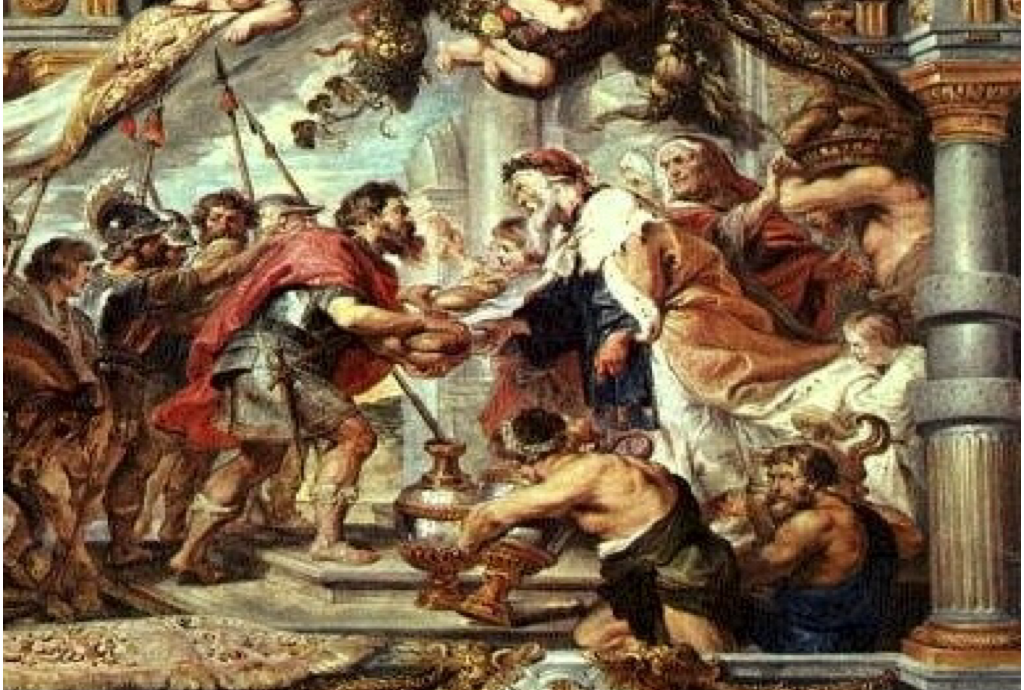
Abram Meets Melchizedek – Peter Paul Rubens

Psalm 110 is the only other reference in the Hebrew Scriptures to Melchizedek, first described in Genesis 14. In Genesis, Melchizedek comes out of nowhere to bestow a blessing on Abram.

As our first reading from Hebrews describes him:

Melchizedek’s name first means righteous king,
and he was also “king of Salem,” that is, king of peace.
Without father, mother, or ancestry,
without beginning of days or end of life,
thus made to resemble the Son of God, he remains a priest forever.

Hebrews 7: 1-3

Jesus is the new Melchizedek, the human expression of God’s Blessing. As our Gospel reveals, his “priesthood” – his ministry – will supersede the Law with love. His “righteousness” will be defined by mercy not statute.


Through our Baptism, we share in the ministry of Jesus. We are graced to live a new righteousness of love and mercy. We are called to bring a blessing to the world in the name of Christ.

Let us rejoice then and give thanks
that we have become not only Christians,
but Christ himself.

Augustine of Hippo: Tractates on the Gospel of John

The blessing of Melchizedek was a confirmation to Abram that he was uniquely loved and chosen by God. Our ministry to others should confirm them in the same blessing, calling both them and us to full life in Christ, our High Priest.

Yours is sacred power in the day of your birth, in holy splendor;
    before the daystar, like the dew, I have begotten you.

Psalm 110: 3

Poem: Melchizedek – John Henry Newman
(This poem tapped into the loneliness Newman felt as he was away from home for an extended period of time.
THRICE bless’d are they, who feel their loneliness;
To whom nor voice of friends nor pleasant scene
Brings aught on which the sadden’d heart can lean; 


All that was left for the ageless Melchizedek was to seek “His presence, who alone can bless.” Newman, who had been at sea for almost a month, was keenly aware of the pains of absence. He saw in his longing for home an analog of the deeper longing for the presence of God at the heart of his being. Newman, like Melchizedek, was lost in foreign lands for what seemed like several lifetimes.
( – Rev. Michael T. Wimsatt, in his dissertation Ecclesial Themes in the Mediterranean Writings of John Henry Newman (December 1832-July 1833))


Thrice bless’d are they, who feel their loneliness; 
To whom nor voice of friends nor pleasant scene 
Brings that on which the sadden’d heart can lean; 
Yea, the rich earth, garb’d in her daintiest dress 
Of light and joy, doth but the more oppress, 
Claiming responsive smiles and rapture high; 
Till, sick at heart, beyond the veil they fly, 
Seeking His Presence, who alone can bless. 
Such, in strange days, the weapons of Heaven’s grace; 
When, passing o’er the high-born Hebrew line, 
He forms the vessel of His vast design; 
Fatherless, homeless, reft of age and place, 
Sever’d from earth, and careless of its wreck, 
Born through long woe His rare Melchizedek.


Music: The Spirit of the Lord Is Upon Me – Marty Goetz

The Spirit of the Lord is upon me, The Spirit of the Lord is upon me
For the Lord has anointed me, yes the Lord has anointed me
He sent me to preach good news to the poor
And to bind up the broken in heart
To proclaim His freedom to all who are bound, all who are bound

The Spirit of the Lord is upon me, The Spirit of the Lord is upon me
For the Lord has anointed me, yes the Lord has anointed me
He sent me to preach the year of His grace 
And that vengeance belongs to our God
And to comfort all those who mourn and who grieve, all those who grieve

To give them beauty for ashes, for mourning the oil of joy
And for the spirit of sorrow the garment of praise
And they will be called the trees of righteousness
Planted by God’s own hand that He may be glorified.

The Spirit of the Lord is upon me (And I will greatly rejoice in the Lord)
The Spirit of the Lord is upon me (And my soul shall exult in my God)
For the Lord has anointed me, yes the Lord has anointed me
He sent me to preach good news to the poor and to bind up the broken in heart
To proclaim His freedom to all who are bound, all who are bound.

And I will greatly rejoice in the Lord and my soul shall exult in my God
For He’s clothed me with garments of His salvation 
And wrapped me with robes of His righteousness
Yes upon me is the Spirit of the Lord, Upon me is the Spirit of the Lord
He’s anointed me with the Spirit of the Lord

Psalm 111: Keeping the Promise

Tuesday of the Second Week in Ordinary Time

January 19, 2021

Today, in God’s Lavish Mercy, we pray with Psalm 111, a song of reassurance and hope.

God, renowned for grace and mercy,
Who gives to those living in awe,
will forever be mindful
of the covenant once promised.

Psalm 111: 4-5

It is a wonderful thing when we can trust someone to remember a promise made to us. Psalm 111 tells us we can trust God like that.

Maybe some of you share this experience. When I was a little girl, my Dad often did the food shopping. Sometimes, he went to the new “big store” (supermarkets were the new thing in the early ‘50s). When he did, I always asked him to remember to bring me a surprise, and he never forgot. 

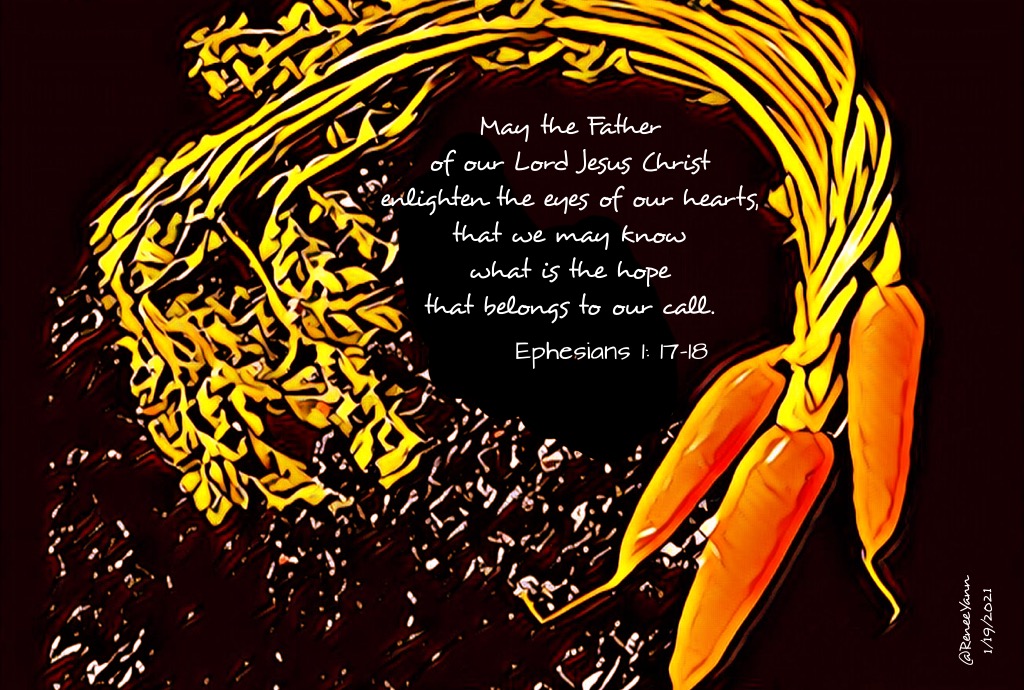
Usually the surprise would be a little bag of M&Ms or Hershey kisses. But once it was a carrot- remarkably like the carrots he bought for the week’s cooking!

Had Dad forgotten his promise,
or was he just in to a healthier form of surprise?😂😉


Sometimes it feels like that with God’s Promise. Its fulfillment doesn’t always come to us in the ways we expect or pray for. Instead of special, surprising sweetness, God’s signs feel like carrots … ordinary carrots that we see every day, that we mix into the soup of our daily unsurprising lives.

Our Alleluia Verse today is a good prayer when our life seems full of “carrots”:

May the Father of our Lord Jesus Christ
enlighten the eyes of our hearts,
that we may know what is the hope
that belongs to our call.

Ephesians 1: 17-18

May our eyes be enlightened to see God’s Promise fulfilled in the amazing blessings of our lives:

I will give thanks to the LORD with all my heart
    in the company and assembly of the just.
Great are the works of the LORD,
  exquisite in all their delights.

Psalm 111: 1-2

My Dad loved me with all his heart and would have given me anything good that was in his power to give.

We can be assured, as in Psalm 111, that all- powerful God is like that too. It’s just that sometimes those good things look like ordinary carrots and we need enlightened eyes to recognize their exquisiteness.


Poetry: Mindful – Mary Oliver

Everyday
I see or hear
something
that more or less

kills me
with delight,
that leaves me
like a needle

in the haystack
of light.
It was what I was born for —
to look, to listen,

to lose myself
inside this soft world —
to instruct myself
over and over

in joy,
and acclamation.
Nor am I talking
about the exceptional,

the fearful, the dreadful,
the very extravagant —
but of the ordinary,
the common, the very drab,

the daily presentations.
Oh, good scholar,
I say to myself,
how can you help

but grow wise
with such teachings
as these —
the untrimmable light

of the world,
the ocean’s shine,
the prayers that are made
out of grass?

Music: Blessed Assurance

Blessed assurance, Jesus is mine!
Oh, what a foretaste of glory divine!
Heir of salvation, purchase of God,
Born of His Spirit, washed in His blood
Chorus:
This is my story, this is my song,
Praising my Savior all the day long;
This is my story, this is my song,
Praising my Savior all the day long.
Perfect submission, perfect delight,
Visions of rapture now burst on my sight;
Angels, descending, bring from above
Echoes of mercy, whispers of love.
Perfect submission, all is at rest,
I in my Savior am happy and blest,
Watching and waiting, looking above,
Filled with His goodness, lost in His love.

Psalm 110: A Chasuble of Justice

Monday of the Second Week in Ordinary Time

January 18, 2021


Today, in God’s Lavish Mercy, we pray with Psalm 110 where we are re-introduced to Melchizedek, the first priest mentioned in Genesis 14.


Yours is princely power in the day of your birth, in holy splendor;
    before the daystar, like the dew, I have begotten you.”
The LORD has sworn, and will not repent:
    “You are a priest forever, according to the order of Melchizedek.”

Psalm 110: 3-4

And our two readings today show us Jesus, the one High Priest, through whom we are fully redeemed.

In the days when he was in the Flesh,
Jesus offered prayers and supplications with loud cries and tears
to the one who was able to save him from death,
and he was heard because of his reverence.
Son though he was, he learned obedience from what he suffered;
and when he was made perfect,
he became the source of eternal salvation for all who obey him.

Hebrews 5: 7-9

It is so appropriate to consider the meaning of priesthood as we commemorate the life of Rev. Dr. Martin Luther King. In the image of Christ, Dr. King wore a chasuble of justice for our time.

A priest is one :

  • who is set apart
  • who mediates the Divine
  • who bears witness
  • who ministers
  • who offers sacrifice
  • who transforms through prophetic hope

As a Catholic priest vests with the chasuble for Mass, this prayer is said:

Domine, qui dixisti:
Jugum meum suave est et onus meum leve:
fac, ut istud portare sic valeam,
quod consequar tuam gratiam.

Lord, you have said:
My yoke is sweet and my burden is light.
Grant that I may carry your yoke well
so as to obtain your grace.

Indeed, Martin Luther King “carried the yoke well”
to obtain the grace of justice for all of us.


Poetry: two poems in which the poet, Margaret Walker, uses the persona of Amos the Prophet to describe Martin Luther King. One poem is written before, and one after, Dr. King’s assassination.

Amos, 1963 – Margaret Walker – 1914-1997

Amos is a Shepherd of suffering sheep;
A pastor preaching in the depths of Alabama
Preaching social justice to the Southland
Preaching to the poor a new gospel of love
With the words of a god and the dreams of a man
Amos is our loving Shepherd of the sheep
Crying out to the stricken land
“You have sold the righteous for silver
And the poor for a pair of shoes.
My God is a mighty avenger
And He shall come with His rod in His hand.”
Preaching to the persecuted and the disinherited millions
Preaching love and justice to the solid southern land
Amos is a Prophet with a vision of brotherly love
With a vision and a dream of the red hills of Georgia
“When Justice shall roll down like water
And righteousness like a mighty stream.”
Amos is our Shepherd standing in the Shadow of our God
Tending his flocks all over the hills of Albany
And the seething streets of Selma and of bitter Birmingham.

Amos (Postscript, 1968)

From Montgomery to Memphis he marches
He stands on the threshold of tomorrow
He breaks the bars of iron and they remove the signs
He opens the gates of our prisons.
He speaks to the captive hearts of America
He bares raw their conscience
He is a man of peace for the people
Amos is a Prophet of the Lord
Amos speaks through Eternity
The glorious Word of the Lord!

Music: American Dream – Bobby Womack

Psalm 40: God’s Whisper

Second Sunday in Ordinary Time

January 17, 2021


Today, in God’s Lavish Mercy, we pray with Psalm 40, the prayer of one at home with God:

I delight to do your will, my God;
your law is in my inner being!

Psalm 40:9

We are reminded that we find this kind of peace by believing and listening to our experience:

Throughout our readings today, God leans over heaven’s edge to whisper into human experience.


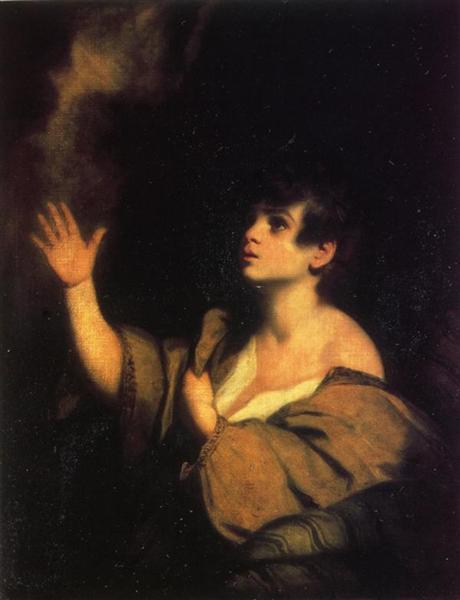
Samuel’s Call by Joshua Reynolds

In our first reading, that whisper comes in a sacred call to a listening Samuel:

When Samuel went to sleep in his place,
the LORD came and revealed his presence,
calling out as before, “Samuel, Samuel!”
Samuel answered, “Speak, for your servant is listening.”

1 Samuel 3: 9-10

In our second reading, Paul reminds us that the
Whispering Spirit is already resident within us:


Do you not know that your body
is a temple of the Holy Spirit within you,
whom you have from God, 
and that you are not your own?

1 Corinthians 6: 19

In our Gospel, Jesus – the Word, the Divine Whisper – invites us to come to him, to see his power with us in our ordinary lives.

The two disciples said to Jesus,
“Rabbi, where do you live?”
He said to them, “Come, and you will see.”

John 1: 39

Praying with Psalm 40 can turn our hearts
to listening for God’s voice
under and within our experiences. 

  • It can wake us up, as Samuel was awakened.
  • It can attune us to the melody deep within our hearts.
  • It can reiterate God’s invitation to live our lives so fully in the Beloved’s Presence that, even without a sound, we know each other’s thoughts.

Poetry: from Whispers of the Beloved by Rumi

Do you know what the music is saying?
“Come follow me and you will find the way.
Your mistakes can also lead you to the Truth.
When you ask, the answer will be given.”

Music: All Praise to Him – Sovereign Grace Music