Sister Renee Yann, RSM, D.Min, is a writer and speaker on topics of spirituality, mission, and ethical business practice. After twenty years in teaching and social justice ministry, she served for over thirty years in various mission-related roles in Mercy Health System of Southeastern Pennsylvania.
Today, in God’s Lavish Mercy, we pray with another glance at Psalm 72. The verses offered us today jarred me when I first read them. And then they began to speak, even shout, to my spirit.
Praying with the Psalms will not benefit us if they do not speak to our experience. Today, Psalm 72 clearly spoke to mine.
I am outraged that my country finds itself continually at the edge of violence and unrest solely on the bidding of one to whom we have entrusted our well-being.
I am beyond sick of normalizing the outrageous irresponsibility of Donald Trump. The sickness has seeped into my prayer and my peace. It causes me sleepless concern for my country and our world.
As I pray Psalm 27 today, I seek a grace from its ancient words. I seek a blessing for our own time.
O God, with your judgment endow the leaders, and with your justice, those who legislate; Let your people be governed with justice and your afflicted ones with mercy.
Psalm 72:1-2
As we move through these final fractious days of a deeply disturbing presidency, let us pray for civility, justice, honor, and peace not only for America but for all throughout the world who depend on our integrity.
Poetry: Beclouded by Emily Dickinson
The sky is low, the clouds are mean,
A travelling flake of snow
Across a barn or through a rut
Debates if it will go.
A narrow wind complains all day
How some one treated him;
Nature, like us, is sometimes caught
Without her diadem.
Music: Be a Blessing (Psalm 72) Richard Bruxvoort Colligan
Today, in God’s Lavish Mercy, as we once again pray with Psalm 27, we do so in the light of our seminal first reading from John:
God is love, and when we remain in love we remain in God and God in us.
1 John 4:16
How can we love like that?
Psalm 27 tells us how God does it:
For the Lord rescues the poor who cry out, and the afflicted who have no other help. The Lord has pity for the lowly and the poor; and saves the lives of the poor.
Psalm 27: 12-13
Our psalm gives us the measure for love in our lives. Who are the suffering ones in the circle of our experience? How are we widening that circle to offer loving mercy with greater energy and fidelity?
The Spiritual and Corporal Works of Mercy can be our guide as we seek to stretch our love in ever-widening circles.
The Corporal Works of Mercy
To feed the hungry To give water to the thirsty To clothe the naked To shelter the homeless To visit the sick To visit the imprisoned, and ransom the captive To bury the dead
The Spiritual Works of Mercy
To instruct the ignorant. To counsel the doubtful. To admonish sinners. To bear patiently those who wrong us. To forgive offenses. To comfort the afflicted. To pray for the living and the dead.
Poetry: Widening Circles – Rainer Maria Rilke
I live my life in widening circles
that reach out across the world.
I may not complete this last one
but I give myself to it.
I circle around God, around the primordial tower.
I’ve been circling for thousands of years
and I still don’t know: am I a falcon,
a storm, or a great song?
Today, in God’s Lavish Mercy, we pray with Psalm 72 which will be familiar to us because it is used six times throughout the Advent and Christmas seasons.
O God, with your judgment endow the king, and with your justice, the king’s son; He shall govern your people with justice and your afflicted ones with judgment.
Psalm 72: 1-2
This short post-Epiphany season is all about “manifestation” – how Jesus begins to show us the face of God-become-flesh.
The core message, conveyed to us in the daily progressive reading of 1 John, is that God is Love.
Our Gospel today, the feeding of the 5000, shows how that Love is expressed – merciful action for those in need.
Our psalm, written a thousand years before Christ, exults in the expectation of such a merciful Messiah:
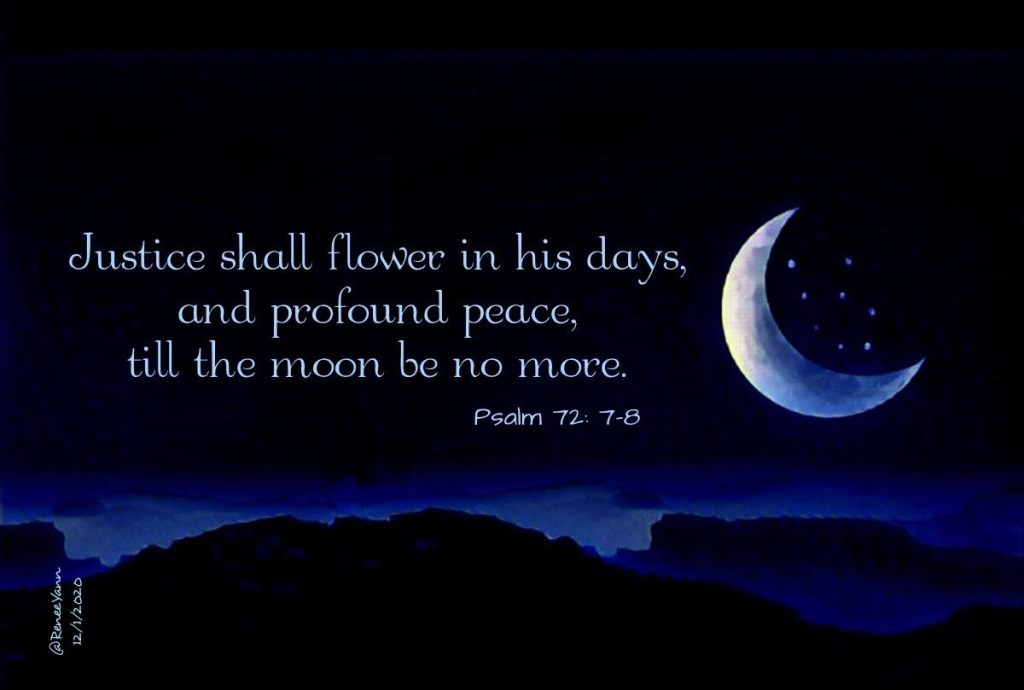
The mountains shall yield peace for the people, and the hills justice. He shall defend the afflicted among the people, save the children of the poor. Justice shall flower in his days, and profound peace, till the moon be no more. May he rule from sea to sea, and from the River to the ends of the earth.
Let us begin once again, in this new year, to soak in the words and images describing this longed-for and loving Savior.
Poetry: When Little Was Enough – Irene Zimmerman, OSF
(LUKE 9:10–17)
“Send the people away from this deserted place to find food and lodgings,” the twelve urged Jesus, “for the day is advanced and it is almost evening.”
Jesus looked at the crowd (there were about five thousand) and looked at his disciples, still excited and tired from their first mission journey.
What had they learned from the villagers of Galilee who shared bread and sheltered them from cold night winds? What had they learned of human coldness on the way?
He remembered the pain in his mother’s voice as she told of his birth night when they found no room in all of Bethlehem, House of Bread.
“You give them something to eat!” he said.
“We have only five loaves and two fish!” they protested. “How can we feed so many with so little?” He understood their incredulity.
They had yet to learn that a little was enough when it was all they had— that God could turn these very stones to bread.
“Have the crowd sit down in groups of fifty,” he said. Jesus took the food and looked up to heaven. He blessed it, broke it, gave it to the disciples to distribute to the new-formed churches.
Afterwards, when everyone was satisfied, the twelve filled twelve baskets of bread left over— as faith stirred like yeast within them.
Today, in God’s Lavish Mercy, we pray with Psalm 2. The prayer seems a fitting reminder to all of us, and especially US citizens, as our new political season opens.
And now, O rulers, give heed; take warning, you rulers of the earth. Serve the LORD with fear, and rejoice before God; with trembling rejoice… Blessed are all who take refuge in God!
Although I was relieved to lessen my political attention after the November election, I realize that we always have a moral imperative both to pray for our leaders and to measure their efforts, and our own, against the standards of social justice.
Click right triangle above to hear how Handel felt about it as he uses Psalm 2 in his Messiah.
Why do the nations so furiously rage together,
and who do the people imagine a vain thing?
The kings of the earth rise up,
and the rulers take counsel together against the Lord,
and against His Anointed.
George Frederic Handel: Messiah
Psalm 2: 1-2
The interplay of politics and morality is on-going, and its energy rises once again with this month’s seating of the new Congress and inauguration of President Biden.
The U.S. and the world has been given stark lessons under the tenure of the exiting president. Some have learned from these experiences. Some have allowed their ignorances to be confirmed.
It has not been easy. We live in an age when truth and morality have been rendered elastic – seemingly malleable to multiple alternative narratives.
Another verse of Psalm 2 from Handel’s Messiah
Let us break their bonds asunder, and cast away their yokes from us.
(Psalm 2:3)
Psalm 2 reminds us of the one true narrative: we are all creatures of God charged to live in harmony with one another and with the Creator.
Seen in a political light, we are a long way from achieving that charge.
Our elected leaders have an almost impossible job to guide this fractured nation closer to our moral hope. But our prayer, and our sincere contribution to the effort, can make a huge difference in the result.
Despite any partisan leanings, can we pledge that contribution?
Poetry: The Paths of Love and Justice – Christine Robinson
Why are the nations in an uproar? Why do the peoples mutter and threaten? Why do the rich plot with the powerful? They are rebelling against the demands of Love and Justice. God laughs, cries, and says with anger: I have set my Love in your hearts and my Justice in your minds. You are my children and I have given you the universe your lives, and the tasks of your days. Be wise Be warned Stick to the paths of Love and Justice. Your restless hearts will find me there.
Today, in God’s Lavish Mercy, and on this glorious feast, we pray with Psalm 72.
It is a gorgeous psalm that fills our senses with lights, and scents, and the tactile experience of an ancient and sacred world:
we inhale the flower of justice
wrap ourselves in its profound peace
gaze on a distant, moonless universe
stretch our prayer from sea to sea,
and our praise to the ends of the earth
We see the ancient nations gather in homage, carrying the gems, spices and bounty of their homelands.
We, too, kneel in astounded wonder that this vulnerable child, hidden in the far reaches of both geography and imagination, carries to us the Promise of the Ages.
We, too, trust the star, rising in our own hearts.
Psalm 72 echoes our beautiful first reading from Isaiah, another masterpiece that, in itself, is enough simply to read and savor:
Rise up in splendor, Jerusalem! Your light has come, the glory of the Lord shines upon you. See, darkness covers the earth, and thick clouds cover the peoples; but upon you the LORD shines, and over you appears his glory.
Isaiah 60: 1-2
In Isaiah, these magnificent verses follow two chapters of gloom and darkness. They break forth in true epiphany to say, “Your Light has come!” – now your life must begin to shine as well.
Epiphany is not simply about kings and camels. It is not simply about a crèche and a star.
It is about Divine Revelation hovering over our dailyness. It is about us, opening our eyes in faith and responsiveness to our ever-present God.
The feast of Epiphany reminds us:
Look at your life today. The star did not pass you by. Open your eyes and find it. Once you have seen it, live in its Light.
Poetry: The Journey of the Magi – T.S. Eliot
Eliot wrote the poem after his conversion to Anglicanism ( He had been a Unitarian.) The poem conveys his struggle to grow in the light of his new faith. The “journey” is life-long and demanding in a world that often contradicts that faith.
“A cold coming we had of it, Just the worst time of the year For a journey, and such a long journey: The ways deep and the weather sharp, The very dead of winter.” And the camels galled, sore-footed, refractory, Lying down in the melting snow. There were times we regretted The summer palaces on slopes, the terraces, And the silken girls bringing sherbet. Then the camel men cursing and grumbling And running away, and wanting their liquor and women, And the night-fires going out, and the lack of shelters, And the cities hostile and the towns unfriendly And the villages dirty and charging high prices: A hard time we had of it. At the end we preferred to travel all night, Sleeping in snatches, With the voices singing in our ears, saying That this was all folly.
Then at dawn we came down to a temperate valley, Wet, below the snow line, smelling of vegetation; With a running stream and a water-mill beating the darkness, And three trees on the low sky, And an old white horse galloped away in the meadow. Then we came to a tavern with vine-leaves over the lintel, Six hands at an open door dicing for pieces of silver, And feet kicking the empty wine-skins. But there was no information, and so we continued And arrived at evening, not a moment too soon Finding the place; it was (you may say) satisfactory.
All this was a long time ago, I remember, And I would do it again, but set down This set down This: were we led all that way for Birth or Death? There was a Birth, certainly, We had evidence and no doubt. I had seen birth and death, But had thought they were different; this Birth was Hard and bitter agony for us, like Death, our death. We returned to our places, these Kingdoms, But no longer at ease here, in the old dispensation, With an alien people clutching their gods. I should be glad of another death.
Music: The People that Walk in Darkness – Bob Dufford, SJ
The people that walk in darkness
 have seen, have seen a great light.
 And on those who dwell in endless gloom,
 a light has shone.

Refrain:
For a Child is born this day:
Rejoice, rejoice.
Daughter of Zion, awake.
The glory of God is born.

And they shall name Him counselor,
shall call Him mighty God.
And He shall rule from age to age:
Prince of Peace.

Refrain

Darkness covers the earth;
thick clouds govern its pe0ple.
But the Lord will bring them light;
the Lord will bring them light.

Refrain

The people that walk in darkness
have seen, have seen a great light.
And on those who dwell in endless gloom,
a light has shone.


Refrain
Today, in God’s Lavish Mercy, we pray with Psalm 98 which, once again, enjoins us to “sing a new song”.
Sing to the LORD a new song, Who has done wondrous deeds; Whose right hand has won victory, by the holy arm.
You know what? We’re trying, aren’t we? God knows, we need a new song! And the coming of the New Year gives us the push to find it in ourselves. Right?
Because that’s where it has to come from — within each one of us.
Other people can sing with us, accompany our song, or applaud our a cappellas. But our song is not out there somewhere. Our song is deep within us, breathed there by a virtuoso God at our creation. It was meant to be sung – and sung by us.
Sing praise to the LORD with the lyre, with the lyre and melodious song.
With trumpets and the sound of the horn shout with joy to the King, the LORD.
Let the sea and what fills it resound, the world and those who dwell there.
Let the rivers clap their hands, the mountains shout with them for joy,
Psalm 98:7-9
The beauty of our song is that it can change to adapt to the tone of our days – sometimes an aria, sometimes a dirge. Sometimes an anthem, sometimes a ballad. Sometimes a canticle, sometimes a lullaby. A requiem, a Kyrie, a Sanctus, an Alleluia!
Each song is inspired by the One Divine Song, whose voice is sounded in Creation by the consecration of our own song, given in sincerity and love.
The Lord has remembered us In mercy and faithfulness All the ends of the earth have seen the power of our God. So shout with joy to the LORD, all the earth; break into song; sing praise.
Psalm 98: 3-5
Let’s listen to God singing over us today, so that we can respond with our own heart-song:
The Lord your God is in your midst, a mighty one who will save; The Lord will rejoice over you with gladness; will quiet you with love; will exult over you with passionate singing.
Zephaniah 3:17
Poetry: Every Riven Thing by Christian Wiman
Listen.
God goes, belonging to every riven thing he’s made
sing his being simply by being
the thing it is:
stone and tree and sky,
man who sees and sings and wonders why

God goes. Belonging, to every riven thing he’s made,
means a storm of peace.
Think of the atoms inside the stone.
Think of the man who sits alone
trying to will himself into a stillness where

God goes belonging. To every riven thing he’s made
there is given one shade
shaped exactly to the thing itself:
under the tree a darker tree;
under the man the only man to see

God goes belonging to every riven thing. He’s made
the things that bring him near,
made the mind that makes him go.
A part of what man knows,
apart from what man knows,

God goes belonging to every riven thing he’s made.
( I was invited to offer a reflection for my community for the celebration of New Year’s. I wanted to share it with our larger community here.)
Over the threshold of midnight, we step into the New Year 2021.
And, oh, how we have longed for it
⁃ run toward it
⁃ run away from what the old year pressed on us
⁃ from what we heard unceasingly referred to as “these unsettling times”
Dear friends the phrase puts it mildly, doesn’t it?
Every one of us- to some degree-has felt the
loss
sadness
fear
anxiety
loneliness
We have been tested in our faith
our hope
our love
and, surely, our courage
Some have walked through the middle of hell and some only on the edge. But we have all felt its fire.
We are a world truly brought to its knees as we clothe ourselves in 2021’s first morning.
We come to our prayer to do as our reading from Numbers encourages us, emboldens us to do – to seek a blessing for the New Year:
May the Lord bless us and keep us shine the face of mercy on us be gracious to us look upon us kindly give us peace
But how will we find such a blessing, my friends, when we know that its hope is hidden in the unrelenting circumstances of our lives?
Let’s consider our Gospel today. Just as Christ lay shining but in the damp hay of a dark manger… Just as the word of his coming was announced but by rude shepherds who carried the angelic words, so the blessing will come to us….clothed in the ordinariness of what we already know.
And it is this:
The power of God is always hidden in the flesh of our daily lives.
Let us turn to Mary today to remind ourselves of this mystery.
Before the Annunciation, when young Mary imagined the Messiah’s coming, do you think she pictured a godforsaken manger and a birth in a barn?
Do you think she imagined herself receiving ponderable angelic words through the mouths of illiterate shepherds?
Our inscrutable God comes to us in ways we never imagine …yes, dear friends, even through pandemic suffering, and the painful graces it breaks open in our hearts.
Mary, whom we celebrate and invoke today, shows us how to take the next step into a new year —a year that will not perceptibly change in its challenges for some time to come.
It, too, will be filled with what looks like mangers and shepherds rather than the heavenly palaces and angels we might desire.
But Mary shows us that faith finds God by surrender to the graceof our ordinary lives.
Today, what we pray for one another through Mary’s intercession, is the grace to find the blessing in this mystery.
We pray to be encouraging witnesses for one another of:
faith even in darkness
resilience and courage during extraordinary challenge
hope in the face of discouragement
perseverance when we languish
loving service despite fear
Mercy pouring over pain
When we do these things, we become the blessing that we seek.
When we, like Mary, keep these things in our heart, we allow Christ to be born again even in our “unsettling” times.
Maria de Mercede, fresco by Domenico Ghirlandaio (c. 1472)
The most ancient prayer to Mary is the Sub Tuum Praesidium, dating from the 2nd century. It seems a perfect way to close our reflection today, and to open our hearts to hope for the New Year:
Under your protection, we take our refuge, O Holy Mother of God: despise not our petitions in our necessities, but deliver us from all evil, O pure and blessed one. Amen.
A truly blessed and joyful New Year to you all, Beloveds.
Music: Sub Tuum Praesidium in Latin (see above for English)
Today, in God’s Lavish Mercy, we pray with Psalm 96, which set the tone for us to more deeply appreciate our beautiful Gospel today on this New Year’s Eve.
The LORD comes, comes to align the earth in Grace. The LORD shall tender the world with merciful justice and the peoples with divine constancy.
Psalm 96: 13
Who is this Lord Who comes, comes to each of us and all of us?
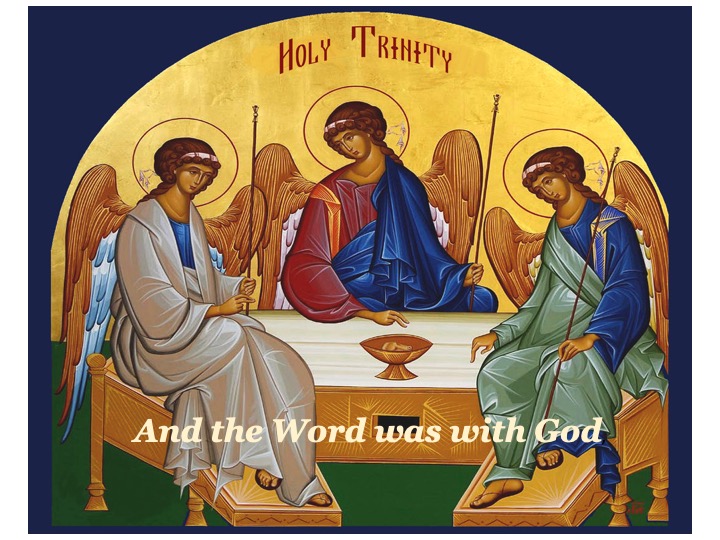
I think no one describes this mysterious, yet enfleshed, God more beautifully that the writer of John’s Gospel and Epistles.
For our prayer, let’s savor that beauty from today’s Gospel.
Click the little white triangle in the grey bar above to hear some lovely accompanying music as you slowly move through the slides below by pressing the right arrow on the slide.
Poetry: a prayer from Hildegard of Bingen (1098–1179 – O Eternal Lord
Dear Friends, perhaps we might pray Hildegard’s prayer for one another as we leave this painful year and move toward New Hope.
O eternal Lord,
it is pleasing to you
to burn in that same fire of love,
like that from which our bodies are born,
and from which you begot your Son
in the first dawn before all of Creation.
So consider this need which falls upon us,
and relieve us of it for the sake of your Son,
and lead us in joyous prosperity.
Today, in God’s Lavish Mercy, since our Responsorial is again Psalm 96, let’s pray with Anna the Prophetess from today’s Gospel.
We have so much to learn from Anna, a woman completely wrapped in mystery until she bursts through these verses in the brilliance of prophecy!
Anna:
advanced in years – yet still vitally engaged in the search for God
widowed early – then giving the long, solitary years to a Messianic Hope
a faster and a prayer – witnessing the fruitfulness of a contemplative life
Even in today’s brief Gospel appearance, Anna calls us to spiritual depths by her
Steely fidelity
Pregnant solitude
Eternal hope
Quiet intimacy with God
Anna spent decades, waiting in her own “Cloud of Unknowing”. In the miraculous inverse of the spiritual life, her shadows were filled with Light.
When you first begin, you find only darkness, and as it were a cloud of unknowing. You don’t know what this means except that in your will you feel a simple steadfast intention reaching out towards God. Do what you will, and this darkness and this cloud remain between you and God… Reconcile yourself to wait in this darkness as long as is necessary, but still go on longing after him whom you love.
from “The Cloud of Unknowing”
In today’s Gospel, we meet Anna, a First Witness, stepping out of the deepened shadows and sharing her long-nurtured Light:
And coming forward at that very time, Anna gave thanks to God and spoke about the child to all who were awaiting the redemption of Jerusalem.
Luke 2:38
In our prayer today, let’s listen to what Anna might reveal to us.
Reflective Prose: from The Cloud of Unknowing, an anonymous 14th century work on mysticism and prayer.
The nature of love
is that it shares everything.
Love Jesus, and everything he has is yours.
…He may, perhaps,
send out a shaft of spiritual light,
which pierces this cloud of unknowing beteween you,
and show you some of his secrets…
then will you feel your affection flame
with the fire of his love,
far more than I could possibly describe…
In place of music today: Anna the Prophetess by Leddy Hammock and Sue K. Riley
Now, in this moment I close my outer eyes and look within with my inner eyes. I see a vision of wonder, for I am the daughter of the vision of God, of the tribe of the blessed ones, a soul under grace. I judge not by appearances. I believe in God’s promises. I fast from shadows and I live on light.
From my youth, I have served at the temple, a vessel to a holy purpose. Prayer is the temple where I dwell Here I behold the image of the Lord. I close my eyes and behold that image, the eyes of the Infinite beholding me all through the ages, so tenderly gazing with love and compassion, enfolding me.
Prayer is the temple where I dwell. Here, I behold the image of the Lord. The thoughts held in mind are mirrored in kind all around me, reflecting through all that I see. Now, I behold with inner vision the wonders that will be in the fullness of time.
The dreams of all my days and nights are incensed in the inner sanctum. My thoughts of truth are flowers on the altar of light. In the presence of the Holy of Holies, I keep the high watch. Gifted with the inner sight, I see beyond the present.
I am an old, old soul, yet ageless in eternity. Though outer eyes may seem to dim with time, the inner eyes are crystal clear. Though outer vision may seem obscured by time and place,
or clouded by the sorrows and the slavery of sense, another world’s revealed so clear. And what I see will be. My thoughts are giving form, And held in mind, shall reproduce in kind.
O Lord, I take a long loving look at the real. I prophesy. Christ is here. I have seen the Lord, Thine image, and held that image to my own heart. I am the Spirit of Imagination. I am Anna, the prophetess, woman of power.
Today, in God’s Lavish Mercy, we pray with Psalm 96, an exuberant song of praise and an imperative to radical hope.
Sing to the LORD a new song; sing to the LORD, all you lands. Sing to the LORD; bless the Holy Name.
In the scriptures, hope is both a spiritual and political act. Hope stands up in the midst of pressing contradictions and declares, “God is with us. We give praise because of this conviction”.
Walter Brueggemann defines these elements in true praise:
First, praise is an act of imagination, not description. It sees the world through the lens of faith and dares to line out a world engaged in dialogical transactions between Creator and Creation.
Second, hymns of praise are acts of devotion with political and polemical overtones. Their work is to engage in “world making.” The very act of praise itself envisions a new world, a different world, a world alternative to the one in front of us.
Third, the Psalms voice and are embedded in a larger narrative in which YHWH (God) is the key character and lively agent.
Fourth, doxology (praise) is the exuberant abandonment of self over to God. In singing praise, all claims for the self are given up as the self is ceded over to God.
And fifth, such songs do not passively accommodate to an economic, political, and psychological status quo. They run the risks of being disruptive for the sake of another world —
—- a “Christed” world in which God is intimately engaged with our lives.
Thus we can rejoice in the closing verses of this dynamic psalm:
Let the heavens be glad and the earth rejoice; let the sea and what fills it resound;g let the plains be joyful and all that is in them. Then let all the trees of the forest rejoice before the LORD who comes, who comes to govern the earth, To govern the world with justice and the peoples with faithfulness.
Psalm 96: 12-14
As the new week unfolds, and we move lingeringly away from Christmas comforts, we may forget what we have just commemorated…
Emmanuel- God With Us
As we re-enter a world still in frightening shadows, we must believe in the Light. As we slowly re-robe in the clothing of our daily responsibilities, we must not forget the Garment of Salvation we have just celebrated and received.
Our Psalm calls us to be a daily witness to the Love we have been given:
Announce the Lord’s salvation, day after day. Tell the Lord’s glory among the nations; among all peoples, God’s wondrous deeds.
Psalm 96:2-3
Poetry: Hope by Philip Booth
Old spirit, in and beyond me,
keep and extend me. Amid strangers
friends, great trees and big seas breaking,
let love move me. Let me hear the whole music,
see clear, reach deep. Open me to find due words,
that I may shape them to ploughshares of my own making.
After such luck, however late, give me to give to
the oldest dance… Then to good sleep,
and - if it happens - glad waking.
Music: Sing a New Song – J.P. Putnam, sung here by the Brooklyn Tabernacle Choir
I wanna sing a new song
Shout it out louder than before
Let the whole earth sing
The whole earth sing
Yeah yeah
Oh-oh-oh...

There is a place
We can seek his face
Changed in his presence
Touched by his grace

There is a sound
I hear it all around
Worship is rising
And people crying out

I wanna sing a new song
Shout it out louder than before
Let the whole earth sing
The whole earth sing

It's a song of praise
A song for all of the redeem
Let the whole earth sing
The whole earth sing

Never the same
He's taken my chains
There's freedom in Jesus
Power to save
There is a name
Like no other name (like no other name)
There's freedom in Jesus

(Come on, let's shout it)
Shout out his name
I wanna sing a new song
Shout it out louder than before
Let the whole earth sing
The whole earth sing
It's a song of praise
A song for all of the redeemed

Let the whole earth sing
The whole earth sing
Hallelujah
Hallelujah, Hallelujah, Hallelujah
Hallelujah
Hallelujah, Hallelujah, Hallelujah

I wanna sing a new song
Shout it out louder than before
Let the whole earth sing
The whole earth sing
It's a song of praise
A song for all of the redeem

Let the whole earth sing
The whole earth sing
Hallelujah, Hallelujah, Hallelujah
Hallelujah
Hallelujah, Hallelujah, Hallelujah
Hallelujah
Hallelujah, Hallelujah, Hallelujah
Oh yes, Hallelujah
Hallelujah, Hallelujah, Hallelujah
Hallelujah, Hallelujah, Hallelujah, Hallelujah
Hallelujah, Hallelujah, Hallelujah
Hallelujah say
(Hallelujah, Hallelujah, Hallelujah)

One more time sing
(Hallelujah, Hallelujah, Hallelujah)
Somebody say God, you're glorious
(God, you are glorious)
God, you are glorious
(God, you are glorious)


















 Lavish Mercy