Ask and Receive

Seventeenth Sunday in Ordinary Time

July 28, 2019

Click here for readings

Today, in Mercy, our readings are connected by two often oppositional themes: BARGAINING and TRUST.

The Genesis passage is a familiar story, mainly because “Mrs. Lot” later gets turned into a pillar of salt. But the beginning of the story, today’s reading, is all about Moses bargaining with God to spare the inhabitants of sinful Sodom and Gomorrah. 

The Divine conversation is painted in very human terms, a ping-pong match of “what if”s and “OK”s between Moses and God. Moses finally bargains God down to the hope of finding just ten good men in these depraved cities. And Moses trusts God to be merciful, a trust delivered in the salvation of Lot and his family.

In the second reading from Colossians, Paul reminds us of our own deliverance through baptism and sharing in the Resurrection of Christ. This is the infinite gift in which we put our hope and trust as believers.

Our Gospel reading from Luke opens with the Our Father, the ultimate prayer of trust. Jesus goes on to tell us that we can always trust God’s care for us.

Ask and you will receive;
seek and you will find;
knock and the door will be opened to you.
For everyone who asks, receives;

and the one who seeks, finds;
and to the one who knocks, the door will be opened.

Jesus isn’t talking about magic, where we just say the word and automatically get what we imagined, or where we bargain with God as if we had something to offer. 

Lk11_12 Ask_Egg

Jesus is talking about that fundamental trust which believes in God’s faithfulness to us in all circumstances. He will not “hand us a serpent when we ask for an egg”. But it may be a very different “egg” (outcome) from the one we expected. Trust allows us to crack it open to find the unimagined grace inside.

Music: I Will Trust in You – Lauren Daigle

Our Story is God’s Story

Saturday of the Sixteenth Week in Ordinary Time

July 27, 2019

Click here for readings

Today, in Mercy, our Exodus reading describes momentous events in Israel’s life.

tabletsJPG

God has just invited Moses and several others up the mountain for a Divine conflab.  Moses returns to the people to announce “all the words and ordinances of the Lord”.The People receive these words wholeheartedly:

“We will do everything that the LORD has told us.”

Thus, a community of persons is formed with God at its heart.

Moses then engages the community in a series of formal rituals to highlight the significance and permanence of this deeper step in relationship with God.


The passage contains multiple points for our prayerful consideration.

The community of Israel is not unlike our own faith communities, those that gather in specific religious houses, or those we share in the universal community of all Creation. We are Catholics, Lutherans, Jews, Hindus, Muslims, Sikhs sharing a story of God in our particular religious traditions. We are also all children of the same God sharing that experience in our Common Home of Creation.

Just as with the ancient Israelites, God communicates and relates with us through the experiences of our lives. In our communities, that Divine Word is interpreted, codified, ritualized, and responded to. These actions create a story which is alive, deepening with each new generation, and still always rooted in the long history of promise and grace.

Today’s reading contains many elements of story and ritual which we can recognize in our own faith practice: written and announced word, altar or worship place, sacrifice or offering to God, acts of covenant, and celebratory meals.

Exodus24_3 sinai

These are the human ways in which we access relationship with God. These are the ways in which we keep our faith vital. We strengthen our faith by one another’s stories of love, mercy and hope. We commit to a shared law of love, not legalism – a heart-law which calls us to be life for one another, just as God is Life for us. In community, we reveal the face of God within ourselves.

For those of us who share the practice of a Eucharistic faith, the parallels in today’s reading call us to deeper awareness of how God becomes present in our lives.

May all of us – of whatever spirituality – who share life in God’s continuing Creation, obediently hear the command to cherish every human being as a revelation of God, as a critical and precious part of my own faith story – a part for whom I share the responsibility for life.

Music: Song of the Body of Christ – David Haas (Lyrics below)

Song of the Body of Christ
Refrain: We come to share our story. We come to break the bread.
We come to know our rising from the dead.
1. We come as your people. We come as your own.
United with each other, love finds a home.
2. We are called to heal the broken, to be hope for the poor.
We are called to feed the hungry at our door.
3. Bread of life and cup of promise, In this meal we all are one.
In our dying and our rising, may your kingdom come.
4. You will lead and we shall follow.
ou will be the breath of life; living water, we are thirsting for your light.

Honor Those Who Bore You Life

Memorial of Saints Joachim and Anne, Parents of the Blessed Virgin Mary

July 26, 2019

Click here for readings

Today, in Mercy, our Exodus reading coincides perfectly with today’s Memorial Feast for Anne and Joachim, grandparents of Jesus.

Exodus20_5

In the passage, we have one of many Old Testament formulations of the Ten Commandments. We learned these codes as children, and perhaps have always interpreted them as laws which, when broken, marked us as sinners.

While this is one approach, a more mature and life-giving one is offered by the Biblical scholar Terence E. Fretheim:

The focus (of these directives) is on
protecting the health of the community,

to which end the individual plays such an important role.
Exodus: Interpretation: A Biblical Commentary for Teaching and Preaching

The command to honor one’s father and mother clearly demonstrates this approach. It is a command not only for children to be docile and obedient. Rather it denotes a life-long responsibility to care for parents and other  nurturers of our lives. The command also suggests the responsibility of these nurturers to live honorably so that their children may respond to their example with equal honor.

Today is a day to pray for our own families and for all families, for the young and the elderly, and for those walking the tenuous bridge in between.  It is a day to assess how well we carry our responsibilities to honor, obey, bless and foster life for one another.

It is a day to be deeply grateful for the love of family which we are blessed to experience; a day to pray for healing for those not equally blessed. Let us pray for families distressed by the necessity to migrate, and further burdened by nations’ failures to keep the commandment of neighborly love.

Like Mary, may we embrace the elders in our lives who love and need us, be these parents, mentors, community members, or neighbors. Scripture promises us that, in doing so, we shall have “mercy bestowed on us down to the thousandth generation.”

Music: Love Remains – Hillary Scott

from Henri Nouwen

Quotation-Henri-Nouwen-Pay-attention-to-the-people-God-puts-in-your-path-89-60-70

Spiritual greatness has nothing to do with being greater than others. It has everything to do with being as great as each of us can be. True sanctity is precisely drinking our own cup and trusting that by thus fully claiming our own, irreplaceable journey, we can become a source of hope for many. 


Drinking the cup is an act of selfless love, an act of immense trust, an act of surrender to a God who will give what we need when we need it.


Drinking our cup is not simply adapting ourselves to a bad situation and trying to use it as well as we can. Drinking our cup is a hopeful, courageous, and self-confident way of living. It is standing in the world with head erect, solidly rooted in the knowledge of who we are, facing the reality that surrounds us and responding to it from our hearts.


Drinking the cup that Jesus drank is living a life in and with the spirit of Jesus, which is the spirit of unconditional love. The intimacy between Jesus and Abba, his Father, is an intimacy of complete trust, in which there are no power games, no mutually agreed upon promises, no advance guarantees. It is only love—pure, unrestrained, and unlimited love. Completely open, completely free. That intimacy gave Jesus the strength to drink his cup. That same intimacy Jesus wants to give us so that we can drink ours.

All quotes from Henri J.M. Nouwen, Can You Drink the Cup?

home-in-larche
Henri Nouwen at home in L’Arche

Mrs. Zebedee, Again

Feast of Saint James, Apostle

July 25, 2019

Click here for readings

( I am republishing last year’s post for this feast. I think it is worth another read. But to make up for my little bit of laziness, I will send another post today with a few profound quotes from Henri Nouwen’s book Can You Drink the Cup? – Ave Maria Press; 10th Anniversary edition (October 1, 2012))


Today, in Mercy, we learn a lesson in humble leadership, thanks to “Mrs. Zebedee”. Our Gospel recounts the story of the mother of James and John interceding for her sons with Jesus. Like many overprotective mothers, she intervenes in their adult lives. She wants to make sure they get the best deal for their investment with Jesus.

Veronese-Le-Christ-rencontrant-la-femme-et-les-fils-de-zebedee_-_Grenoble
Veronese-Le-Christ-Rencontrant La Femme Et Les Fils de Zebedee By Paolo Veronese

Unfortunately, “Mrs. Zebedee” has missed the whole point of Christian discipleship. Her boys have decided to follow a man who says things like this:

  • The last shall be first and the first, last.
  • Unless you lay down your life, you cannot follow me.
  • Whoever takes the lowly position of a child is the greatest in the Kingdom of Heaven.

The seats at Christ’s right and left, which she requests for her sons, will bring them rewards only through humility and sacrificial service.

Jesus is gentle with “Mrs. Zebedee”. He understands how hard it is for any of us to comprehend the hidden glory of a deeply Christian life. We are surrounded by a world that screams the opposite to us:

  • Me first!
  • Stand your ground!
  • Good guys finish last!

Mk 10_38 cup

So Jesus turns to James and John. One can imagine the bemused look on his face. He knows the hearts of these two men. He knows they have already given themselves to him. So he asks them for a confession of faith, “Can you drink the cup that I will drink?”

Their humble, faith-filled answer no doubt stuns their mother. She is left in wonder at the holy men her sons have become. Perhaps it is the beginning of her own deep conversion to Christ.

As we pray with this passage on the feast of St. James the Apostle, where do find ourselves in this scene? How immediate, sincere, and complete is our response to Jesus’ question: “Can you drink the cup….?”

Music: Can You Drink the Cup? (Be patient. The song has a slightly delayed start. You may have to click the white arrowhead in the orange circle- upper left. Lyrics below.😀)

Can You Drink The Cup?

Lyrics by Pamela Martin, Music by Craig Courtney
Copyright 2001, Beckenhorst Press, Inc.

Can you dring the cup,
embrace it in your hands?
Can you look inside
and face what it demands?
In the wine you see
reflections of your soul.
No one else can drink
this cup that you must hold.

Can you drink the cup?
Then you must lift it high
though this cup of joy
holds pain and sacrifice.
When you lift your cup,
raise it unafraid.
Lift it up, this cup
of life, and celebrate.

Can you drink the cup
until there is no more?
When the wine is gone,
Christ Himself will pour.
Though you drink it all
the cup is never dry,
God keeps filling it
with everlasting life.

It’s Raining Bread!

Wednesday of the Sixteenth Week in Ordinary Time

July 24, 2019

Click here for readings

Today, in Mercy, our readings are all about food in the many forms and senses of that word.

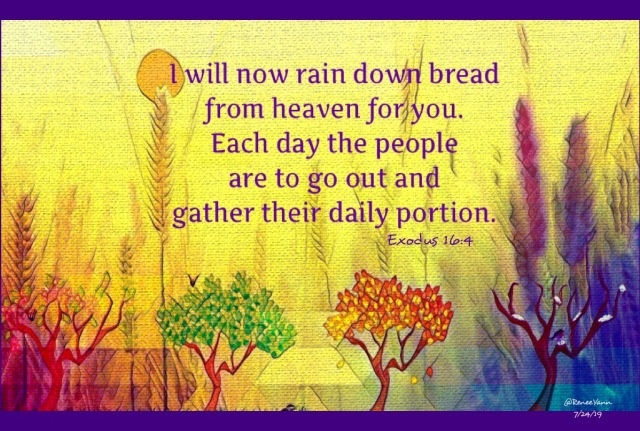
Exodus16_4

The Israelites have been in the desert for a while.  The burden of travel is beginning to weigh upon them.  Food is short, tempers even shorter.  Things seem so bad that, in a fit of stupendous forgetfulness, they tell Moses they were better off as slaves in Egypt.

Moses asks God to intervene, which God does with the gifts of manna and quail.

The folks in today’s reading remind me a lot of people I know — even myself.  Haven’t we all heard, and maybe uttered, the complaint that things were so much better in “the old days”.  Haven’t we critiqued a challenging situation with the unhelpful assessment, “Well, it’s not like it used to be!”

But the God of Exodus is so patient, as is Moses.  God doesn’t become angry with the complainers. Instead God promises to take care of them and to stay with them forever on their journey. God makes good on this word by initiating the naturally occurring phenomena of morning manna and migrating quail so that the community is fed.

Some areas to focus on as we pray with this passage:

God does not deliver the Israelites immediately to their destination. Life is a journey, not an arrival.

God intervenes to meet their needs, but through ordinary occurrences rather than miracles. God uses manna and quail, surprising but nonetheless naturally occurring events in the Sinai desert.

God expects the Israelites to interact with grace, to recognize that God is about the continuing work of Creation and Covenant, even within the natural circumstances of our lives.

For us, the profound reminder that God accompanies us in drought and abundance, in joy and sorrow, in wilderness and stability; that God is listening under our hungers; that God is sustaining us in graces we may be slow to recognize.

Music: Panis Angelicus – Luciano Pavarotti

Panis angelicus
fit panis hominum;
Dat panis caelicus
figuris terminum:
O res mirabilis!
manducat Dominum
Pauper, servus, et humilis. 

Te trina Deitas
unaque poscimus:
Sic nos tu visita,
sicut te colimus;
Per tuas semitas
duc nos quo tendimus,
Ad lucem quam inhabitas.
Amen.

Bread of Angels,
made the bread of men;
The Bread of heaven
puts an end to all symbols:
A thing wonderful!
The Lord becomes our food:
poor, a servant, and humble.

We beseech Thee,
Godhead One in Three
That Thou wilt visit us,
as we worship Thee,
lead us through Thy ways,
We who wish to reach the light
in which Thou dwellest.
Amen.

Exultet!

Tuesday of the Sixteenth Week in Ordinary Time

July 23, 2019

Click here for readings

Ex15_1chariots

Today, in Mercy, we read that triumphant Exodus passage in which the Israelites pass through the walled-up waters of the Red Sea. The images and exultations abound!

Here are the obvious ones:

  • Sea (the agent of delivery/salvation)
  • Wind (the grace of change)
  • Chariots (the inevitable challenges/obstacles)
  • Night (the mystery in which faith operates)
  • Fiery Cloud/The Lord’s Glance (God’s intervention)
  • Song (humble acknowledgement and thanksgiving)

Just as the newborn is carried through the birth canal on the waters of life, so too God’s neonate people finally begin the fullness of life promised to Abraham. God accomplishes this great “delivery” by a masterful intertwining of omnipotence, human choices, and natural phenomena. The result is breathtaking!

Just as it is in our lives!

Like any great Bible story, this one invites us to find ourselves somewhere within it. At the least, we are all making a sometimes treacherous passage through life. And at particular times, maybe even now, the threats may be intense.


At times, we stand at the edge of intimidating seas, wondering how we will make it to the other side. But if we reflect on our history, we must acknowledge that – with prayer and patience – the parting wind does come. Those “chariots” at our heels become mired in our resilience, hope and trust in God. Even through the dark night of faith, the Bright Mystery speaks to us. In moments of astounding though quiet grace, we catch the glance of God. And we sing in thanksgiving.


The glory of this magnificent reading is captured in the Exultet, sung at the Easter Vigil. You may wish to pray with it today. (sung Latin version in interesting article below)

English text

Exult, let them exult, the hosts of heaven,

exult, let Angel ministers of God exult,

let the trumpet of salvation

sound aloud our mighty King’s triumph!

Be glad, let earth be glad, as glory floods her,

ablaze with light from her eternal King,

let all corners of the earth be glad,

knowing an end to gloom and darkness.

Rejoice, let Mother Church also rejoice,

arrayed with the lightning of his glory,

let this holy building shake with joy,

filled with the mighty voices of the peoples.

(Therefore, dearest friends,

standing in the awesome glory of this holy light,

invoke with me, I ask you,

the mercy of God almighty,

that he, who has been pleased to number me,

though unworthy, among the Levites,

may pour into me his light unshadowed,

that I may sing this candle’s perfect praises).

(Deacon: The Lord be with you.

People: And with your spirit.)

Deacon: Lift up your hearts.

People: We lift them up to the Lord.

Deacon: Let us give thanks to the Lord our God.

People: It is right and just. 

It is truly right and just,

with ardent love of mind and heart

and with devoted service of our voice,

to acclaim our God invisible, the almighty Father,

and Jesus Christ, our Lord, his Son, his Only Begotten.

Who for our sake paid Adam’s debt to the eternal Father,

and, pouring out his own dear Blood,

wiped clean the record of our ancient sinfulness.

These, then, are the feasts of Passover,

in which is slain the Lamb, the one true Lamb,

whose Blood anoints the doorposts of believers.

This is the night,

when once you led our forebears, Israel’s children,

from slavery in Egypt

and made them pass dry-shod through the Red Sea.

This is the night

that with a pillar of fire

banished the darkness of sin.

This is the night

that even now throughout the world,

sets Christian believers apart from worldly vices

and from the gloom of sin,

leading them to grace

and joining them to his holy ones.

This is the night

when Christ broke the prison-bars of death

and rose victorious from the underworld.

Our birth would have been no gain,

had we not been redeemed.

O wonder of your humble care for us!

O love, O charity beyond all telling,

to ransom a slave you gave away your Son!

O truly necessary sin of Adam,

destroyed completely by the Death of Christ!

O Happy Fault

that earned for us so great, so glorious a Redeemer!

O truly blessed night,

worthy alone to know the time and hour

when Christ rose from the underworld!

This is the night

of which it is written:

The night shall be as bright as day,

dazzling is the night for me, and full of gladness.

The sanctifying power of this night

dispels wickedness, washes faults away,

restores innocence to the fallen, and joy to mourners,

drives out hatred, fosters concord, and brings down the mighty.

On this, your night of grace, O holy Father,

accept this candle, a solemn offering,

the work of bees and of your servants’ hands,

an evening sacrifice of praise,

this gift from your most holy Church.

But now we know the praises of this pillar,

which glowing fire ignites for God’s honour,

a fire into many flames divided,

yet never dimmed by sharing of its light,

for it is fed by melting wax,

drawn out by mother bees

to build a torch so precious.

O truly blessed night,

when things of heaven are wed to those of earth,

and divine to the human.

Therefore, O Lord,

we pray you that this candle,

hallowed to the honour of your name,

may persevere undimmed,

to overcome the darkness of this night.

Receive it as a pleasing fragrance,

and let it mingle with the lights of heaven.

May this flame be found still burning

by the Morning Star:

the one Morning Star who never sets,

Christ your Son,

who, coming back from death’s domain,

has shed his peaceful light on humanity,

and lives and reigns for ever and ever.

Amen.

Click here for Latin version and article

Mary Magdalen

Readings for Feast of Mary Magdalen:

Click here for readings

Today, in Mercy, we pray with St. Mary Magdalen whose feast would have been celebrated yesterday, July 22, had it not been superseded by the Sunday feast.

Massimo_Stanzione,_Mary-Magdalene_in_meditation
Magdalen in Meditation by Massimo Stanzione –


Modern scripture scholarship recognizes Mary Magdalen as a disciple and companion of Jesus.  She is present in stories throughout all four Gospels, and most notably, as one who remained with Jesus at the foot of the Cross. Mary is the first witness to the Resurrection who then announces the Good News to the other disciples.

Over the centuries, Mary Magdalen has been confused with the many other Marys in the Gospel, as well as with the unnamed repentant woman who washes Jesus’ feet with her tears. These confusions have inclined us to think of Mary Magdalen as a reformed prostitute. This erroneous concept has supported a diminished understanding of the role of women in the ministry of Jesus and done a huge disservice to Mary’s vital role as beloved disciple.

The Gospel passage for the feast captures the powerful moment when the Resurrected Jesus is first revealed to the world. The scene also portrays the deep love, trust and friendship between Jesus and Mary Magdalen – a relationship which serves as a model for all of us who want to be Christ’s disciples. I imagined the scene like this in an earlier Easter reflection:

 Rabbouni

 The Upper Room on Holy Saturday evening: a place filled with sadness, silence and seeking. Jesus was dead. Jerusalem, scattered to their various houses to keep Shabbat, murmur their shocked questions under their shaky prayers.

 We have all been in rooms like this. They enclose a special kind of agony – one teetering between hope and doubt, between loss and restoration. It may have been a surgical waiting room or the hallway outside the courtroom. Sometimes, such a space is not bricks and mortar.  It is the space between a sealed envelope and the news inside. It is the hesitant pause between a heartfelt request and the critical response. In each of these places, we exist as if in a held breath, hoping against hope for life, freedom, and wholeness.

 It was from such a room that Mary Magdalene stole away in the wee hours. A woman unafraid of loneliness, she walked in tearful prayer along the path to Jesus’ tomb. Scent of jasmine rose up on the early morning mist. Hope rose with it that his vow to return might be true. Then she saw the gaping tomb, the alarm that thieves had stolen him to sabotage his promise. She ran to the emptiness seeking him. She was met by angels clothed in light and glory, but they were not enough to soothe her.

 Turning from them, she bumped against a gardener whom she begged for word of Jesus, just so she might tend to him again. A single word revealed his glory, “Mary”. He spoke her name in love.

 As we seek the assurance of God’s presence in our lives, we too may be unaware that God is already with us. The deep listening of our spirit, dulled with daily burdens, may not hear our name lovingly spoken in the circumstances of our lives. God is standing behind every moment. All we need do is turn to recognize him.

 Turn anger into understanding. Turn vengeance into forgiveness. Turn entitlement into gratitude. Turn indifference into love. All we need do is turn to recognize him.

For a comprehensive and enlightening lecture on the current theological and scriptural thinking on Mary Magdalen, follow this link to an Elizabeth Johnson, CSJ lecture at Fordham.

Click here for lecture

Music: I Know That My Redeemer Liveth

Promise


Sixteenth Sunday in Ordinary Time

July 21, 2019

Click here for readings

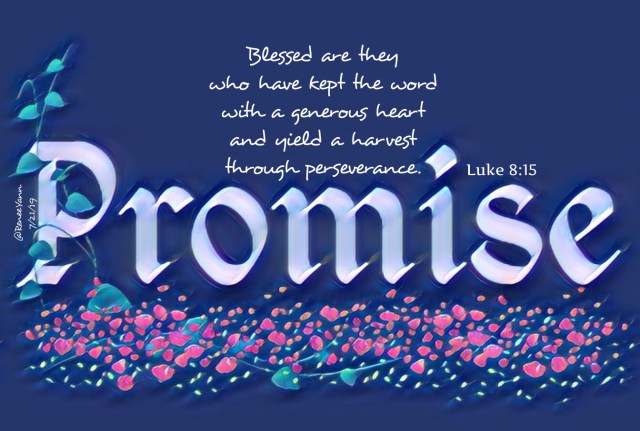
Today, in Mercy, our readings are all about making and keeping promises.

Our first reading refers to Genesis and God’s promise to Abraham of land and posterity. Through his hospitality to three disguised angels, Abraham secures God’s promise to bless Sara and him with a child.

Luke8_15 promise

In today’s second reading from Colossians, Paul assures us that God has brought that promise to its full completion in the gift of Jesus Christ living in us.

…the mystery hidden from ages and from generations past
has now been manifested to his holy ones,
to whom God chose to make known the riches of the glory
of this mystery among the Gentiles;
it is Christ in you, the hope for glory. 

In our Gospel, Jesus encourages Martha to give her attention to the presence of this promise revealed in her life. Mary sees the promise fulfilled in Jesus, the living presence of God. She gives her full heart to it. Martha, maybe like us sometimes, is preoccupied by other distractions.


Our readings invite us to rejoice in God’s promise to us
of “land” and “posterity”.

In Jesus, we are brought home to God.
In Jesus, the fruitfulness of our life is eternally secured.


We make promises to God too.

vowsAs I think about my vows today, I am so aware of the recent deaths of two of our Sisters. At all of our funerals, our vows rest near us for our wakes – a profound symbol of promises given and promises fulfilled. God bless you, Margaret and Mary Ellen! Thank you for your witness among us!
Today, as we pray about God’s faithful promises to us, we might want to reflect on and deepen the commitments of our Baptism, our religious profession, our marriage, our covenants to communities of faith and service.

Like Martha, we might hear Jesus encourage us to give our fullest heart to that which is most important.

Music: God’s Promise – Brooklyn Tabernacle Choir  (Lyrics below)

God’s Promise

Chorus:
Everything He said
In His word
He will do it for you.
Every prophecy He gave
Every promise he made

He will do it for you.
If you only trust Him
And let Him have his way
He’ll work things out for you.

If you only believe and
You will see
That He will do it
For you.

(Repeated several times)

He’ll do it
He will do it/
My God is a faithful God
He will do it

And He’s always there
To answer every payer
He will do it.
He’ll do it.

No matter what you’re going through.
He’ll do it.
Remember His word is true.
He’ll do it.

Cause He understands
He’ll do it.
You can always trust and lean on Him
My God will do it
For you….

Vigil

Saturday of the Fifteenth Week in Ordinary Time

July 20, 2019

Click here for readings

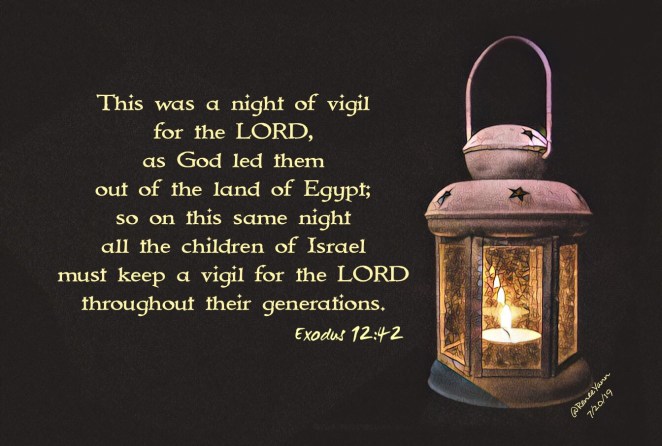
Today, in Mercy, we keep vigil with the “Children of Israel” as they begin the great Exodus.

Ex12_42 Vigil

Even the youngest of us understands what it means to “keep vigil”. Toddlers, on Christmas Eve, keep vigil for the sound of Santa’s footsteps on the roof.

Throughout our lives, the kinds of vigils we keep deepen in meaning. Any given night holds an array of vigil-keepers:

  • A nervous student pulls an all-nighter before a big exam.
  • An anxious parent watches over a feverish child.
  • A faith-filled soul sits in pre-dawn prayer.
  • A vigilant elder prays quietly at the death bed of a long-beloved.

As families and communities, we wait together for each other’s lives.

  • Together, we expect the births of each generation’s babies.
  • We wait and hope for college acceptances and new jobs.
  • We wait for test results of all kinds.
  • We wait to listen to one another’s stories of success or disappointment.
  • We wait and prepare for the dawning of great feasts like Christmas and Easter

When we keep vigil, we live in expectation of something or someone coming to us. But there is another important aspect to every vigil.

As we wait, something is also happening within us.
In the deep quiet of our waiting, we are transformed.

Thomas Merton, monk of Gethsemane, was assigned to keep a particular type of vigil at the abbey. It was called “fire watch”, a night-long lookout to ensure that no fire erupted in the old wooden buildings as the other monks slept.  Merton writes about that watch at the end of his book The Sign of Jonas:

The fire watch is an examination of conscience in which your task as watchman suddenly appears in its true light:  a pretext devised by God to isolate you, and to search your soul with lamps and questions, in the heart of darkness.
“Fire Watch, July 4, 1952”

Today, as we pray with Israel’s Passover vigil, let us consider our own vigils – current or past. Beyond their apparent meaning, to what secret transformation might God be inviting us? What is happening deep in our soul as we watch far out to the horizon of our hope?

Music: Firewatch – Chris Remo