A Personal “Annunciation”

(Some of you may enjoy my reminiscence on this Feast of the Annunciation.)

March 25th, fifty-five years ago, was a pleasantly warm day in Philly, with a strong hint of spring in the air. I remember the day as clearly as if it dawned just this morning.

window
St. Hubert’s HS Windows

I sat in 2nd period senior year math class, glancing at the greening cherry tree at the window, and yearning for graduation. Sister Helen Mary, IHM ( I still remember her even though she thought I was pretty forgettable in math) decided to set the formulas aside and talk about Mary and the feast of the Annunciation.

For several years, I had been toying with the thought of a religious vocation – but I hadn’t really given my heart to it. But, just three days before, while meeting up with one of my friends in her home room, I had noticed the Centenary Book of the Sisters of Mercy on Sister Mary Giovanni’s desk. I liked the pictures in it so I asked if I could borrow the book for a night or two.
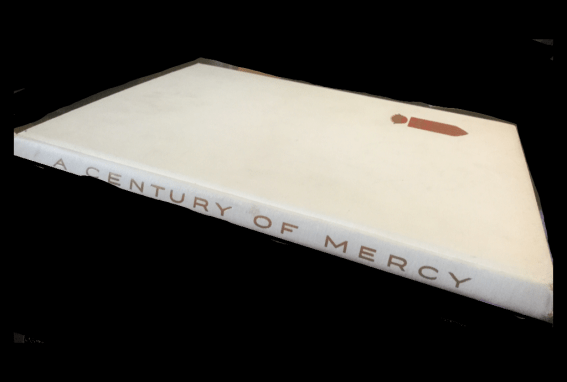
book

It had never crossed my mind to consider becoming a Sister of Mercy. I hadn’t really known any until high school. But as soon as I met them I liked them. They were friendly, joyful people with a beautiful mix of humanity and spirituality.

Blissfully reading that book on the evening of March 24th, I opened to the magnificent center page. It is hard to decipher it in the picture, but the motto written above the painting of the Crucifixion deeply touched me, “Love One Another”.

page

Another page offered a phrase that grabbed my heart and, to this day, has never let it go:

The Sisters of Mercy take a fourth vow
of service of the poor, sick and ignorant.

I suppose that, during trig class the next morning, I was already primed for Sister Helen Mary’s talk. She said that Mary responded fully and joyfully when God called her. In a flash as quick as an Angel-wing, I decided to do the same.

I left class, found Sister Giovanni and, before 3rd period, I had committed to become a Sister of Mercy.

Now I look back over those fifty-five glorious years, and my heart sings in thanksgiving for my vocation, my beloved Sisters and the precious people I have served. I turn the ring, given at my profession, and read the cherished motto, “Love One Another “. Our God is a faithful God. He took a young girl’s gossamer promise and turned it into a divine love story.

This year, as I anticipated this special feast, it gave me such tremendous joy to read that, in June, four young women will profess their final vows in this Community. I hope and pray for each of them that, fifty-five years from now, they will tell their joy-filled stories with a graced reminiscence too.

Here I Am

I love this powerful poem about Annunciation by Denise Levertov. May it enrich us on this sacred feast. Great song after.

Annunciation
by Denise Levertov

 ‘Hail, space for the uncontained God’
From the Agathistos Hymn, Greece, Sixth Century

   We know the scene: the room, variously furnished,
almost always a lectern, a book; always
the tall lily.

                   Arrived on solemn grandeur of great wings,
the angelic ambassador, standing or hovering,
whom she acknowledges, a guest.

 But we are told of meek obedience. No one mentions
courage.

                  The engendering Spirit
did not enter her without consent.

                                            God waited.

 She was free
to accept or to refuse, choice
integral to humanness.
          ____________________________

 Aren’t there annunciations
of one sort or another
in most lives?

                   Some unwillingly
undertake great destinies,
enact them in sullen pride,
uncomprehending.

             More often
those moments
     when roads of light and storm
     open from darkness in a man or woman,
are turned away from
in dread, in a wave of weakness, in despair
and with relief.
Ordinary lives continue.
                                 God does not smite them.
But the gates close, the pathway vanishes. 

         ______________________________

 She had been a child who played, ate, slept
like any other child – but unlike others,
wept only for pity, laughed
in joy not triumph.

Compassion and intelligence
fused in her, indivisible.

 Called to a destiny more momentous
than any in all of Time,
she did not quail,
                          only asked
a simple, ‘How can this be?’
and gravely, courteously,
took to heart the angel’s reply,
perceiving instantly
the astounding ministry she was offered:

 to bear in her womb
Infinite weight and lightness; to carry
in hidden, finite inwardness,
nine months of Eternity; to contain
in slender vase of being,
the sum of power –
in narrow flesh,
the sum of light.

                   Then bring to birth,
push out into air, a Man-child
needing, like any other,
milk and love –

 but who was God.
 From: The Stream & the Sapphire: Selected Poems on Religious Theme

Music: To God Be the Glory – Sandi Patty


According to Thy Word

Monday, March 25, 2019

Click here for readings

Today, in Mercy, we celebrate the Solemnity of the Annunciation of the Lord. It is a sacred and beloved feast.  Have we not come to love its phrases, ringing in our hearts like treasured memories? Let us pray with them today, asking to welcome the astonishing Will of God in our own life as Mary did.

The angel Gabriel was sent from God
to a town of Galilee called Nazareth…

Annunciation,_Rome_-_Fra_Lippi
by Fra Filippo Lippi

And the angel said:
“Hail, full of grace! The Lord is with you.”

Botticelli,_annunciazione_di_cestello_02
by Botticelli

Behold, you will conceive in your womb and bear a son, and you shall name him Jesus, for nothing is impossible for God.

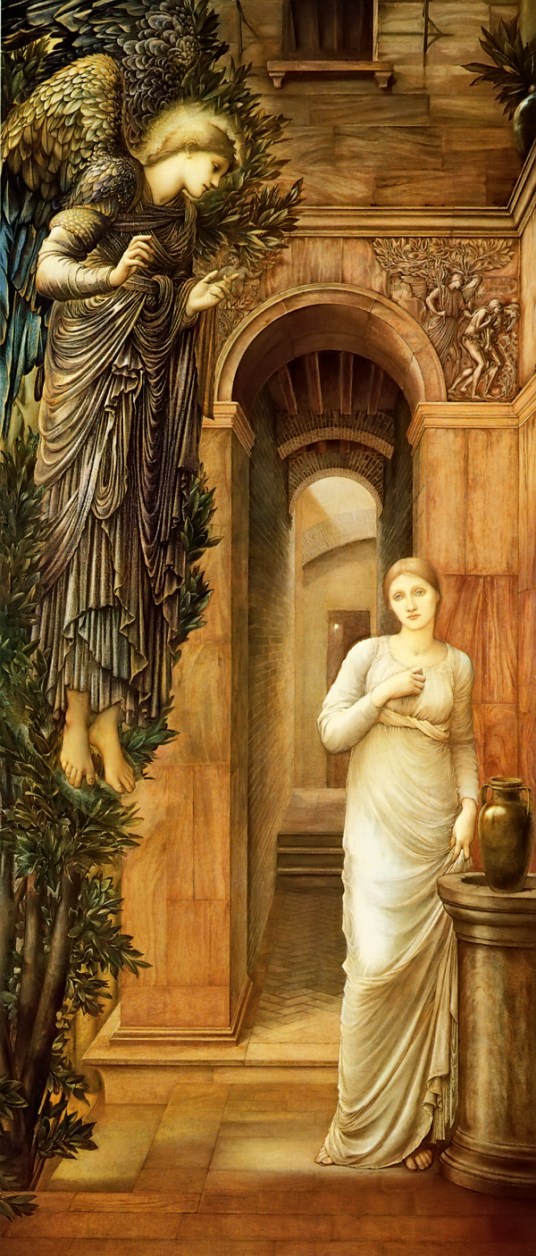
BURNE-Jones,_Edward_The_Annunciation_1876-79
by Edward Burne-Jones

Mary said, “Behold, I am the handmaid of the Lord.
May it be done to me according to your word.”

The Annunciation by Henry Ossawa Tanner 1896
by Henry Ossawa Tanner

Music: Ave Maria – Franz Schubert

Heart-Burn?

Sunday, March 24, 2019

Click here for readings

Today, in Mercy, we have powerful readings – they get really serious about repentance!

Ex3_2 bush

In our first reading, Moses has been on a kind of decades-long sabbatical on his father-in-law’s homestead. After the young glory days of Egypt, and the ensuing drama that exiled him, Moses had settled into being a humble shepherd in Midian. He probably wasn’t expecting a fiery, direct telegram from God.

But God never gives up on his plan for us. So God, divinely expert at getting our attention, conflagrates a bush right in front of Moses.  Supposedly, it was not that unusual for this type of bush to spontaneously combust in the desert heat. What was unusual was for it not to be consumed by the fire.

God then delivers a message of overwhelming fidelity to Moses:

Thus shall you say to the Israelites:
The LORD, the God of your fathers,
the God of Abraham, the God of Isaac, the God of Jacob,
has sent me to you.
This is my name forever;
thus am I to be remembered through all generations.

Because of God’s mercy and fidelity, the Israelites – and Moses – are getting another chance to live in covenant with God.

In our Gospel, Jesus tells his followers not to ignore such chances. He reminds his listeners that life is fragile and transitory. If we haven’t acted on God’s invitation to grace, we might lose the opportunity.

If we look back over our lives, we might realize that there have been burning bushes all over the place – times and events where life offered us a choice between grace and sin, smallness of heart, selfishness. When we chose grace, the bush kept burning and was not consumed. It lit our way to deeper covenant with God.

These final weeks of Lent offer us countless encouragements to look for God’s Fire in our hearts and to go deeper toward the Light. Let’s not ignore them.

Music: Fire of God – Craig Musseau

None like You, Merciful God

Saturday, March 23, 2019

Click here for readings

Today, in Mercy, our readings pour out the lavish mercy of God. Our prayer invites us bask in that warmth and understanding.

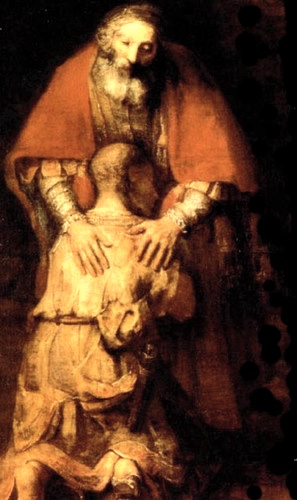
Prodigal son

The prophet Micah asks,

“Who is there like You … the God who delights in clemency?”

Our Psalm reminds us that “the Lord is kind and merciful”:

For as the heavens are high above the earth,
so surpassing is his kindness toward those who fear him.
As far as the east is from the west,
so far has he put our transgressions from us.

(Two musical selections today.)

Then Jesus tells us the tender parable of the Prodigal Son, which is really more about the Merciful Father. He receives his contrite child in the same way that God receives us in our repentance.

Sometimes we become so content with ourselves that we fail to realize our need for contrition. Sometimes our failures are buried so deep and so long in us that we become blind to them. Repentance is the grace to break through that blindness.

We were created to be an image of the merciful God we meet in today’s scripture. Where we are short of that in our actions, words, choices and attitudes – that’s where we have need of repentance.

Rembrandt’s magnificent painting captures a sacred feeling that might help our prayer. Sometimes we are the gracious Father – loving, forgiving, hoping and working for life in others. Sometimes we are the son, returning from our own destructive selfishness to seek a new beginning. Sometimes we are a little bit of each.

Music: Father, I Have Sinned – Eugene O’Reilly

Skies Darken for Jesus

Friday, March 22, 2019

Click here for readings

Agnus Dei

Today, in Mercy, we begin with the powerful and moving story of Joseph – sweet, innocent son of of Jacob who was betrayed by his brothers. Jacob sends Joseph to work with his brothers, believing they love him. He was wrong.

Our Gospel then tells the story of the frustrated landowner who sent his son on mission to settle his accounts. though the landowner’s servants had been abused by the tenants, he believed his son would be respected. He was wrong.

Both these stories are prototypes of the Father sending Jesus to redeem us. The intention is the same. The hope is the same. Unfortunately, the result is the same.

In our Gospel, Jesus realizes that the Father’s hope for him will not be met with openness and acceptance. He sees the Pharisees milling around in hateful conversation.  Referencing the parable, Jesus says:

“The Kingdom of God will be taken away from you
and given to a people that will produce its fruit.”
When the chief priests and the Pharisees heard his parables,
they knew that he was speaking about them.
And although they were attempting to arrest him,
they feared the crowds, for the crowds regarded him as a prophet.

This morning, let’s pray for all those who send their beloveds out in hope to do good in the world:

  • for police officers, firefighters, first responders whose families send them out each day always fearing for their safety
  • for medical personnel who risk sickness in their care for others
  • for missionaries and justice workers who encounter threat and danger in helping others
  • for peacekeepers and military who work to end war and tyranny
  • for all of us when we reach out in justice and courage, hoping to be received with respect and mutuality

May the example of Christ inspire and sustain us to do our part for God’s continuing redemption of the world.

Music: Agnis Dei – Michael Hoppè

A Warning Sign

Thursday, March 21, 2019

Click here for readings

generous impulse

Today, in Mercy, our Gospel gives us the disturbing parable of the rich man, sometimes called Dives, and Lazarus, a very poor man.

The story is disturbing because 

  • Lazarus suffers so desperately 
  • Dives is impervious to that suffering 
  • God won’t give Dives a break after his death
  • We fear being in either of these guys’ situations 

Probably, like most people, we’d rather be rich than poor. But would we rather be generous with that wealth or selfish? Do we ever find ourselves thinking thoughts like this, deciding we’re not responsible for the gap between rich and poor:

“I worked hard for what I have. Let everybody else do the same!”

That wealth gap cannot be mended simply by giving a dollar to a corner beggar nor by donating our wornout clothes to Goodwill. This kind of re-balancing requires a conversion of heart which touches our economic, political and moral understanding.

I was struck this morning by this headline from The Economist, a British weekly magazine.

economist

How can today’s Gospel inspire and encourage us in a global culture that infcreasingly marginalizes persons who are poor, resourceless, and politically oppressed?

May the story of Lazarus and Dives influence us to use the powers we have to make just and generous decisions.

  • We can vote for just, generous and moral leaders. 
  • We can advocate for universally just policies. 
  • We can donate to compassionate causes. 
  • We can confront hateful speech and stereotyping. 
  • We can speak and act for justice, peace, inclusivity and mercy.

We just have to be courageous before, like Dives, it is too late for us.

Music:  Act Justly

Can You Drink the Cup?

Wednesday, March 20, 2019

Click here for readings

Mt20_22 cup

Today, in Mercy, our Gospel tells the story of Mrs. Zebedee, who sought a prejudiced advantage for her two disciple sons.

Jesus said to her, “What do you wish?”
She answered him,
“Command that these two sons of mine sit,
one at your right and the other at your left, in your kingdom.”

Sounds a little like something ripped from today’s headlines, doesn’t it.

headline

There is a natural inclination to advantage those we love. But when we do so to the unjust disadvantage of others, that’s a problem.

We know from experience that people use various points of leverage to gain advantage in life. We see people use money, power, political connections, and other influences to get a job, choose a school, land an important invitation, get a traffic ticket written off, etc., etc. Maybe, on occasion, we are one of those people.

Today’s Gospel teaches us a lesson. In gaining such advantage, we may, as Jesus says, “not know what we are asking for”. Can we actually DO the job, succeed in the school, … become a better person by what we have maniputively gained?

The Gospel also brings before us the “other people” who lost the right to what we unjustly claimed. How do they begin to see us? What do we lose in respect and mutuality within our community? How do we begin to see ourselves in relationship to justice, honesty, sincerity and truth?

Jesus hopes that we will love every person to the extent that we want her/his just advantage as much as we want our own? That is the “cup” He drinks through his Passion and Death.

Let us ponder Jesus’s question to us: Can you drink the cup that I will drink?

Music:  The More I Seek You ~ Gateway Worship

Saint Joseph, Silent Strength

Tuesday, March 19, 2019

Click here for readings

Today, in Mercy, we celebrate the Solemnity of St. Joseph, husband of the Blessed Virgin Mary.

St Joseph
St. Theresa of Avila wrote, “I took for my patron the glorious St. Joseph and recommended myself earnestly to him. It is now very many years since I began asking St. Joseph for something on his feast, and I always received it. If the petition was in any way amiss, he rectified it for my greater good.”

The very way the Church defines the Feast tells us a great deal about Joseph. Men are seldom described by their relationship to a woman.  It is more often the other way around. Consider our lingering custom of wives assuming their husband’s surnames, for example.

But Joseph is known because of his connection to Mary. He is a steady force in the background of her life and the life of Jesus. Joseph is the kind, generous and faithful one who nurtures and protects them.

And he is the silent one. Not a single word was ever recorded from him. What we know of Joseph issues from his actions. For example, before he knew that Mary had conceived through the Holy Spirit:

Joseph her husband, since he was a righteous man,
yet unwilling to expose her to shame,
decided to divorce her quietly.

This virtue of righteousness sums up the character of Joseph as we find him in scripture. Righteousness is complementary to justice.

Walter Brueggemann in his book, Journey to the Common Good, says this about the relationship between justice and righteousness:

“Justice in the Old Testament concerns distribution in order to make sure that all members of the community have access to resources and goods for the sake of a viable life of dignity…. Righteousness concerns active intervention in social affairs, taking an initiative to intervene effectively in order to rehabilitate society, to respond to social grievance, and to correct every humanity-diminishing activity.”

Joseph exercised such righteousness not only in responding to Mary’s unexpected pregnancy. He took the risk of becoming a refugee family in order to save Jesus’s infant life. After the finding in the Temple, he stepped into the background in order to allow young Jesus to assume his teaching vocation. No doubt, during the silent years which then surround Joseph, he continued to live an active life doing good for his family and community, and quietly fostering the ministry of Jesus.

Despite the scarcity of recorded knowledge about Joseph, there is an ample devotional treasury describing him. It is captured in outline form in the Litany to St. Joseph, a prayer I learned to love because it was one of my father’s favorites. I sometimes say just a few lines, slowly, to let the holiness of Joseph call me deeper into my own spiritual life.
(Music is below the Litany.)

Lord, have mercy.
Christ, have mercy.
Lord, have mercy.
Christ, hear us.
Christ, graciously hear us. 

God, the Father of Heaven, have mercy on us. 
God the Son, Redeemer of the world, have mercy on us. 
God the Holy Spirit, have mercy on us. 
Holy Trinity, One God, have mercy on us. 

Holy Mary, pray for us (after each line)
Saint Joseph,
Renowned offspring of David,
Light of Patriarchs,
Spouse of the Mother of God,
Chaste guardian of the Virgin,
Foster-father of the Son of God,
Diligent protector of Christ,
Head of the Holy Family,
Joseph most just,
Joseph most chaste,
Joseph most prudent,
Joseph most strong,
Joseph most obedient,
Joseph most faithful,
Mirror of patience,
Lover of poverty,
Model of artisans,
Glory of home life,
Guardian of virgins,
Pillar of families,
Solace of the wretched, Hope of the sick,
Patron of the dying,
Protector of Holy Church, 

Lamb of God, who take away the sins of the world,
Spare us, O Lord. 
Lamb of God, who take away the sins of the world,
Graciously hear us, O Lord. 
Lamb of God, who take away the sins of the world,
Have mercy on us. 

V. He made him the lord of His house:
R. And ruler of all His substance. 

Let us pray.
O God, who in Your unspeakable providence chose blessed Joseph to be the spouse of Your own most holy Mother: grant, we ask, that we may deserve to have him for our intercessor in heaven, whom we reverence as our defender on earth. Amen.

Music: I Am a Carpenter – Cher & Gene Klosner 

This One’s Pretty Difficult!

Monday, March 18, 2019

Click here for readings

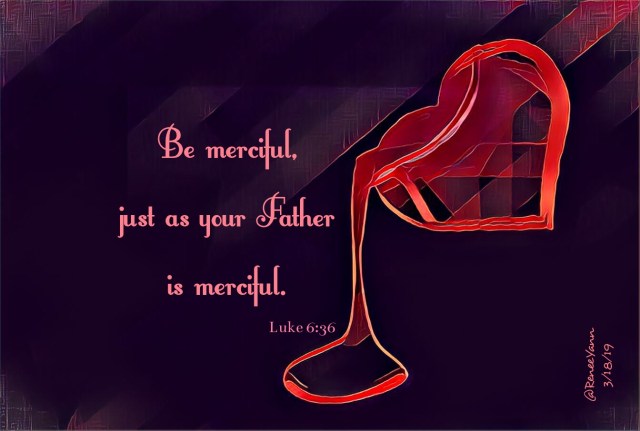
Today, in Mercy, Jesus tells us to be merciful, as God is merciful.

I think that’s really hard.

Lk6_36 be merciful

Being merciful is not too hard with poor, unfortunate souls for whom life is one tragedy after another.

It’s not too hard when someone innocent is suffering unjustly.

But, gosh, it’s difficult to be merciful in the face of meanness, stupidity, selfishness and arrogance.

Yet God is merciful to me when I’m like that.

The Gospel’s message is painfully straightforward. It calls me to examine all my judgmental thoughts and actions and to reverse them.

I don’t know about you, but I’m going to be busy for a while working on this one.

Music: The Mercy Song – Paul Alexander

Great and Glorious St. Patrick

Sunday, March 17, 2019

Click here for readings


St. PAddyToday, in Mercy, our readings are about types of citizenship.

  • In Deuteronomy , Abraham is given a land for himself and his descendants.
  • In Philippians, Paul tells us the “our citizenship is in heaven”.
  • In Luke, the transfigured Jesus shows us that heavenly reality.

These readings confirm that, in God, we are not a people bound by borders, ethnicities, religious cult, or any other human categorization.

Every human being belongs to God and is called to live in the fullness of that Creation.  This is our Divine citizenship.

Think about that in contrast to talk of border walls, ethnic and religious bans, white supremacy, anti-semitism, islamophobia and all the other multiple ways we try to isolate people from this Divine citizenship which makes us brothers and sisters in God.

Friends, on this blessed St. Patrick’s Day, when so many of us rejoice in our Hibernian heritage, let us pray for a world where every human being is respected and celebrated for the particular gifts she/he brings to Creation.

Music: Two Irish hymns today. What can I say? We Irish are noted for our loquaciousness. 😀☘️💚🇨🇮 (Keep scrolling. 2nd hymn way down.)

Hymn to Our Lady of Knock sung by Frank Patterson, “Ireland’s Golden Tenor”
(Lyrics below)

There were people of all ages gathered ’round the gable wall
poor and humble men and women, little children that you called
we are gathered here before you, and our hearts are just the same
filled with joy at such a vision, as we praise Your Name
Golden Rose, Queen of Ireland, all my cares and troubles cease
as we kneel with love before you, Lady of Knock, my Queen of Peace

Though your message was unspoken, still the truth in silence lies
as we gaze upon your vision, and the truth I try to find
here I stand with John the teacher, and with Joseph at your side
and I see the Lamb of God, on the Altar glorified
Golden Rose, Queen of Ireland, all my cares and troubles cease
as we kneel with love before you, Lady of Knock, my Queen of Peace

And the Lamb will conquer and the woman clothed in the sun
will shine Her light on everyone
and the lamb will conquer and the woman clothed in the sun,
will shine Her light on everyone

Hymn: Be Thou My Vision – Gaelic version by Maire Brennan

(English below)

Be Thou my Vision, O Lord of my heart
Naught be all else to me, save that Thou art
Thou my best Thought, by day or by night
Waking or sleeping, Thy presence my light
Be Thou my Wisdom, and Thou my true Word
I ever with Thee and Thou with me, Lord
Thou my great Father, I Thy true Child
Thou in me dwelling, and I with Thee one
Riches I heed not, nor man’s empty praise
Thou mine Inheritance, now and always
Thou and Thou only, first in my heart
High King of Heaven, my Treasure Thou art
High King of Heaven, my victory won
May I reach Heaven’s joys, O bright Heav’n’s Sun
Heart of my own heart, whate’er befall
Still be my Vision, O Ruler of all