Peaceful Defiance

Monday, June 18, 2018

Readings: http://www.usccb.org/bible/readings/061818.cfm

Today, in Mercy, we encounter one of the most difficult passages of the Gospel – the admonitions to turn the other cheek, and go the extra mile. 

Wow, these go against every natural instinct (at least mine! 👿) If someone slaps me, I’m slapping back! If someone grabs my goods, forces my labor, or has the guts to borrow my necessities, I’m gonna’ resist! What about you? Even the Book of Exodus supports “an eye for an eye” kind of justice, right? Well, Jesus says, “No, not right!”. 

In this passage, Jesus shatters our natural inclinations for retribution, retaliation and even self-preservation. 

He says that when we are struck or insulted, we should not respond in kind. Rather we should continue to stand our ground without being diverted into the violence of the attacker.  

He says that when laws are used unjustly against us, we should not respond in kind. Rather, we should stand our ground and expose the unjust law by our willingness to engage it in the public forum.

He says that when unrecompensateded work is demanded of us, we should give it and more, thus doubly exposing the demander’s offense.

He says that to turn our back on a borrower, no matter how inopportune, is a form of violence against the borrower.

What Jesus is asking of us is a non-violent response to the insults and outrages thrown at us. But He is not asking us to be victims or doormats. Each of the admonitions instructs us not to ignore evil, but to respond to it with positive, peaceful strength.

defiant

Jesus himself is the quintessential example of this prophetic, non-violent lifestyle. He condemned evil for what it was, but he did not adopt its methods to do so.

Eileen Campbell

Sister of Mercy Eileen Campbell, arrested at the White House
for peaceful protest of inhumane immigration policies.

Recent history offers us stellar examples of individuals who have understood and practiced this Gospel passage: Mahatma Gandhi, Martin Luther King, Dorothy Day, Oscar Romero, Berta Cáceres, and other modern peace activists – ordinary Christians like you and me.

They have heard and responded to today’s Gospel. Can we?

On This Father’s Day

Sunday, June 17, 2018

Readings: http://www.usccb.org/bible/readings/061718.cfm

2 Cor 5_7 faith

Today, in Mercy, our Sunday readings are filled with the hope of new life, spoken out of the abyss of suffering.

Both Ezekiel’s and Paul’s communities were suffering under exile or persecution. In both cases, a powerful state has dehumanized and enslaved them – rendering them as “other”, unworthy of fraternal compassion.

These suffering communities hunger for the encouragement of their prophets, Ezekiel and Paul.

They long for Ezekiel’s majestic cedar, born from a single, hopeful branch – a life-giving tree where all can dwell in fullness and joy. It is a precursor of heaven, where they will be free and restored to honor.

They draw hope from Paul’s example of courage, believing with him that there is a new day coming where they will be known as precious and worthy in God’s sight.

What might these readings suggest to us, as we celebrate Father’s Day today?

As we contemplate the gift of fatherhood from the perspective of our own experience, let us be mindful of fathers and families experiencing exile and persecution similar to Ezekiel’s and Paul’s communities.

migrant fathers

The Bible tells us stories of our ancestors in faith, but it is also a living Word – speaking to our current experiences. Just this week, we have heard some in power positions use the Bible to justify the infliction of pain and hardship on other human beings. God must weep at such sinful arrogance!

Let us, instead, be inspired by these Scriptures to open our hearts in mercy. Let us pray for suffering migrant communities throughout the world, forced from their homes by war, crime, and greed. Let us pray for children torn from their families by blind, inhumane policies. 

Today, let us pray especially for these refugee fathers as their hopes are crushed and their families broken. And, where we can, let us do more than pray. Let us act for justice and mercy. Let us, at the very least, not rally behind a power that subverts the preciousness of human life and family.

Music: One Day When We All Get To Heaven written by Eliza Hewitt (1851-1920).

The Tangled Web

Saturday, June 16, 2018

Readings: http://www.usccb.org/bible/readings/061618.cfm

Why do we lie? It gets us so mixed up!

I vividly remember a quotation painted along the chalkboard border of my 6th grade classroom. It is from Sir Walter Scott’s poem Marmion:

“O what a tangled web we weave
when first we practice to deceive.”

Perhaps the quote impressed me so much because I was entangled in a juvenile drama over smoking in the girls’ bathroom. Some supposed friend had reported two of us to the principal, a tiny nun who kept an unused  (but nonetheless threatening) cat-o-nine tails in her desk drawer. When confronted, what was there to do but lie?

Mt 5_37 yes_no

But, oh the complexity of it! Would my partner in crime tell the same story? Would any slight discrepancy render us convicted? Would she instead take the part of the informant? Would my smoker parents be brought in as investigators of the behavior they had inspired? Where would the whole quagmire end!

Wouldn’t it have been so much simpler to just tell the truth? So why do we lie? Why do we swear to what is not true? Why do we boast of things we cannot claim? This is the same challenge Jesus puts to his followers in our Gospel passage.

In my young case, as in many others, we lie because our behavior has fractured us from the image of who we are expected to be. We want to be respected, loved, powerful and right. These are conditions that should be earned by the integrity of our behavior. But when our actions cheat, we often lie, pretend, avoid, distract or otherwise compromise the truth.

Our world is full of this kind of lying. Our politics are crippled with it; our leaders unashamedly expert at it. Our culture is so poisoned with a lack integrity, that it seeps into our own relationships and choices almost unnoticed. Lying becomes normalized.

And the situation is not new. In today’s Gospel, Jesus is warning his disciples to avoid just such corruption.

A remedy? Here’s what Jesus says:

“Let your ‘Yes’ mean ‘Yes,’ and your ‘No’ mean ‘No.’
Anything more is from the Evil One.”

It sounds simple enough. But it requires the hard work of prayerful self-examination, loving mutual correction, forgiveness (even of ourselves), and a good old “firm purpose of amendment”. (Remember that one from the Act of Contrition?)

It was a heck of a lesson I was taught in sixth grade – and, like most great lessons – it wasn’t in any textbook! I only hope I learned it somewhat well.

Music: Tell the Truth ~ Eric Clapton (Get ready to jam! Lyrics below.)

Tell the truth.
Tell me who’s been fooling you?
Tell the truth.
Who’s been fooling who?

There you sit there, looking so cool
While the whole show is passing you by.
You better come to terms with your fellow men soon, cause
The whole world is shaking now. Can’t you feel it?
A new dawn is breaking now. Can’t you see it?

Tell the truth.
Tell me who’s been fooling you?
Tell the truth.
Who’s been fooling who?

It doesn’t matter just who you are,
Or where you’re going or been.
Open your eyes and look into your heart.

The whole world is shaking now. Can’t you feel it?
A new dawn is breaking now. Can’t you see it?
I said see it, yeah, can’t you see it?
Can’t you see it, yeah, can’t you see it?
I can see it, yeah.

Tell the truth.
Tell me who’s been fooling you?
Tell the truth.
Who’s been fooling who?

Hear what I say, ’cause every word is true.
You know I wouldn’t tell you no lies.
Your time’s coming, gonna be soon, boy.
It doesn’t matter just who you are,
Or where you’re going or been.
Open your eyes and look into your heart.

Songwriters: Bobby Whitlock / Eric Patrick Clapton / Robert S. WhitlockTell the Truth lyrics © Warner/Chappell Music, Inc, Music Sales Corporation

Whispers of God

Friday, June 15, 2018

Readings: http://www.usccb.org/bible/readings/061518.cfm

Whisper 6_15_18

Today, in Mercy, our first reading continues to follow the journey of Elijah, one wild and crazy guy – with a holy obsession for God.  Elijah is so frustrated with the hard-heartedness of the Israelites, that he whines constantly to God about it. God calls Elijah to Mt. Horeb (the same place where He first chatted with Moses) to talk the situation over. Elijah tries to find God’s voice there in a howling wind, an earthquake and a huge fire. No dice!

Elijah is so like us in this! Don’t we call on God in our troubled times, asking Him to fix things in a flash and glam? It is one of the ways we try to deal with the presence of evil in the world. We would love the security of a “Superman” God Who dramatically intervenes to reverse reality according to our comfort.

But how rare are such miracles! Instead, God abides quietly and steadily in the unfolding of our life, both in sorrow and joy. God whispers the directions to eternal life, deep under the noise of our human challenges – even evil, even death.

God’s word did come to Elijah eventually, not in the fiery demonstration he expected. It came in the gentle breeze of mercy, patience, fidelity and hope which most truly reflects the omnipotent nature of God.

Divinity is so quietly vibrant in all life. We must become equally quiet in our prayer and awareness to hear God’s whispers for us.

Music:  The Whispers of God ~ Marilyn Baker

Righteousness

Thursday, June 14, 2018

Readings: http://www.usccb.org/bible/readings/061418.cfm

Today, in Mercy, Jesus expounds on what a true, faithful life looks like. He uses the word “righteousness”, a word that occurs frequently throughout the Bible. 

“Righteousness” describes the perfect, balanced goodness of the heart of God. It is a balance in which Mercy and Justice complement and infuse each other; a balance of Love so exquisite that it generates the Eternal Life of the Trinity.

Righteousness 6_14_18

Jesus says that we must pattern our lives on that Divine Balance, not on a proud self-righteousness like that of the scribes and Pharisees. If our faith and religious practice do not generate reverence, love, mercy, justice and peace for ourselves and others, then we are skewed in our relationship with God.

Jesus says it is not enough to obey the letter of Law, and certainly not enough to boast about it. We must respond generously to the spirit of the Law which brings the soul into reconciliation with itself and all Creation. This is the new law of love …the true righteousness of a humble, faithful heart.

If I speak in the tongues of men or of angels, but do not have love, I am only a resounding gong or a clanging cymbal. If I have the gift of prophecy and can fathom all mysteries and all knowledge, and if I have a faith that can move mountains, but do not have love, I am nothing. If I give all I possess to the poor and give over my body to hardship that I may boast,but do not have love, it does nothing.
1 Corinthians 13: 1-3

Music: Lead Me Lord ~ Samuel Wesley (1861) A lovely old hymn that can serve as a mantra for prayer throughout your day.  Just let your heart sing it gently.

Fired by Love

Wednesday, June 13, 2018

Readings: http://www.usccb.org/bible/readings/061318.cfm

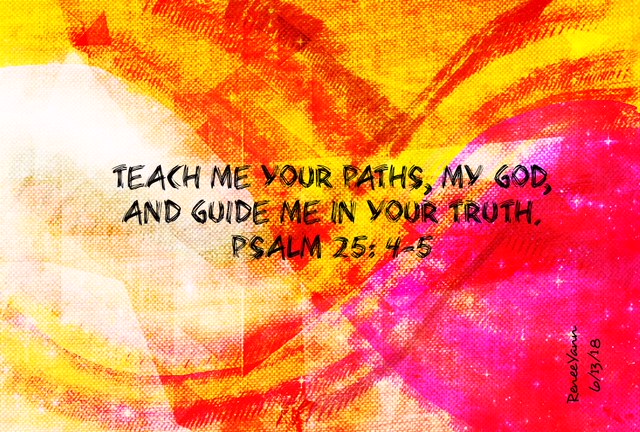
Ps 25 6_13_18

Today, in Mercy, when reading the passage about Elijah and the prophets of Baal, I was reminded of the Irving Berlin song, “Anything You Can Do, I Can Do Better”. In the reading, Elijah tests and even taunts Baal’s 450 prophets in a contest to prove whose God is true. Of course, Elijah wins in a stunning blast of fire. It is a religious exercise of “eradicate and supplant”.

The Gospel reading carries a similar theme.  Jesus’ followers seem to conclude that, because he is teaching something new, he is nullifying the customary Hebrew teachings. But Jesus says that, to the contrary, He is here to fulfill the Law, not to abolish it.

Religion, like any entrenched practice, tends over time to suffer the ill effects of institutionalization. Our rituals and devotions may become lifeless; our scriptures become rote. The power of our sacraments may be carelessly invoked and distractedly attended. A chasm grows between what we profess and what we live. We may become frozen. Sometimes, it might seem best to set the whole thing aflame and start all over again, like Elijah.

But Jesus challenges to us to go deeper than “practice”. Mere practice can easily become empty. Jesus shows us in his life what a fulfilled faith looks like. It is a faith expressed in service, sacrifice and inclusive mercy. It is a faith that, when brought to the pulpit and altar, carries the lives of those we love and serve. It is a faith, like the Psalmist’s, that listens for God’s direction deep in the experiences of life. It is a faith, not in contradiction to Law, but beyond it. It is a faith fired – transformed – by Love.

Music: Living Spirit, Holy Fire ~ David Haas

Live from Your Abundance

Tuesday, June 12, 2018

Readings: http://www.usccb.org/bible/readings/061218.cfm

Today, in Mercy, we read the wonderful story of Elijah and the Widow. Both were in “drought and darkness” situations, but they did not lose hope. Trusting in the Lord, they chose to live out of their abundance rather than their scarcity. And their small, shared abundance sustained them.

In Matthew’s Gospel, Jesus encourages us to live from and to share our abundance, whatever that might be. Sometimes we may feel that we don’t have much to offer to the world. Our personal difficulties may thwart our spiritual energy. But we are children of God, filled with Divine potential. Life will always break through if we live with faith, hope and love. It just may look different from what we had planned or expected.

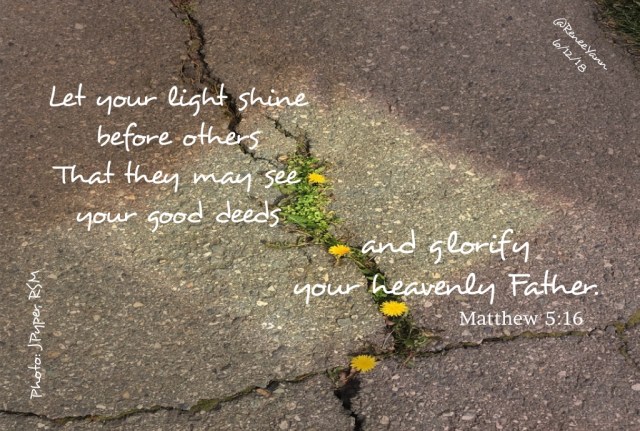
Light 6_12_18

There is a modern school of “abundance vs. scarcity” thinking, a self-improvement practice presented by the late Steven Covey, author of The 7 Habits of Highly Effective People. Whether or not he intended it, Mr. Covey delivers scriptural truths in secular language:

“ An abundance mentality springs from internal security, not from external rankings, comparisons, opinions, possessions, or associations.”

“ People with a scarcity mentality tend to see everything in terms of win-lose. There is only so much; and if someone else has it, that means there will be less for me. The more principle-centered we become, the more we develop an abundance mentality, the more we are genuinely happy for the successes, well-being, achievements, recognition, and good fortune of other people. We believe their success adds to…rather than detracts from…our lives.”

Bottom line from 1 Kings, Matthew 5, Covey? Trust, and live generously. Be light. Be salt. Doing so will open the space for God’s abundance.

Music: A New Age piece that may be helpful if some negativity is blocking our Light.

I Am Light ~ India Arie


Radical Benediction

Monday, June 11, 2018

Readings: http://www.usccb.org/bible/readings/061118.cfm

Today, in Mercy, we begin several weeks of readings from Matthew’s Gospel. In today’s passage, Jesus starts out by turning the world upside-down!

Blessed 6_11_18

In the earlier chapters of his Gospel, Matthew has set the tone for the announcement of Jesus’ message – a new reign of grace and glory. The crowds gather in great anticipation. Most are overwhelmed and beleaguered by life under Roman occupation. Many hope for a political Messiah who will deliver them from their current circumstances, returning to them the material control of their lives. 

Instead, Jesus announces that:

“The kingdom of God can only be received by empty hands. Jesus warns against
(a) worldly self-sufficiency: you trust yourself and your own resources and don’t need God
(b) religious self-sufficiency: you trust your religious attitude and moral life and don’t need Jesus.”
~ Michael H. Crosby, Spirituality of the Beatitudes: Matthew’s Vision for the Church in an Unjust World

We are so used to hearing the Beatitudes that they may have become tamed for us — lovely consolations to the downtrodden that things will eventually be OK. On the contrary, the Sermon on the Mount proclaims a shocking message to those gathered with Jesus — AND to us. The radical blessedness of life is to be found within our ordinary joys and sorrows, embraced humbly, faithfully and joyfully.  It is to be found in right-relationship with all Creation, not in any kind of dominance by one over another – political, economic, or personal.

The poor in spirit, the meek, the bereaved, the justice-seekers, the merciful, the pure of heart, the peacemakers, the persecuted: Jesus says these people are blessed – even FORTUNATE – because there are no barriers between them and the fullness of God. Power, prestige and possessions block us, perhaps even cripple us, from our shared immersion in God’s ever-present love and grace.

It is likely that many who gathered on that Galilean Hill didn’t want to hear Jesus’ astonishing message. Their myopic vision of prosperity was turned upside down. They were challenged to an unexpected, comfort-shattering, radical blessedness. Would they accept the challenge? Will we?

Music:  Blessings ~ Laura Story

An Eternal Weight of Glory

Sunday, June 10, 2018

Readings: http://www.usccb.org/bible/readings/061018.cfm

Today, in Mercy,  is a powerful Sunday!

woke 6_10_18

In our readings, we encounter one of the more perplexing Gospel passages. Jesus, in the thick of controversy with the scribes and Pharisees, goes home to seek some respite. But the crowds follow, harassing him with questions and demands for signs. His friends and family are increasingly concerned for him, as the animosity to his challenging message rises. Some even think he is unhinged to jeopardize himself by confronting the evils and blindnesses of his society. His mother and brothers arrive, concerned for him. When Jesus learns this, he delivers what may seem a hard-hearted comment, “Who are my mother and my brothers?” — they are the ones who do the will of God.

With this question, Jesus is not disowning his family and those who love him. He is stating clearly that, rather than deter him from his redemptive work, they need to open their minds to the deeper purpose of his life. To use a contemporary phrase rooted in the socially conscious African-American community – they need to be “woke” people. 

How hard it must have been for them! How hard to love a prophet, to fear for their safety in times when truth and justice are assailed!

Walter Brueggemann, in my all-time favorite book Prophetic Imagination, says this:

“In both his teaching and his very presence, Jesus of Nazareth presented the ultimate criticism of the royal consciousness (or self-serving power of the dominant state). He has, in fact, dismantled the dominant culture and nullified its claims. The way of his ultimate criticism is his decisive solidarity with marginal people and the accompanying vulnerability required by that solidarity. The only solidarity worth affirming is solidarity characterized by the same helplessness they know and experience.” 

In today’s second reading, Paul is experiencing the same kind of vulnerability as Jesus. Paul says that he is not discouraged for:

“ … although our outer self is wasting away,
our inner self is being renewed day by day.
For this momentary light affliction
is producing for us an eternal weight of glory
beyond all comparison,
as we look not to what is seen but to what is unseen;
for what is seen is transitory, but what is unseen is eternal.”

As Christians, we are called to live prophetic lives in imitation of Jesus. We are called to foster that kind of witness in others, to work together for that “eternal weight of glory”.

The prophet Dorothy Day puts it this way:

“As we come to know the seriousness of the situation, the war, the racism, the poverty in our world, we come to realize that things will not be changed simply by words or demonstrations. Rather, it’s a question of living one’s life in a drastically different way.”

On this powerful Sunday, the message is this: we need to be “woke” people!

Music: Wake Up My Heart ~ The Afters

Immaculate Heart of Mary

Saturday, June 9, 2018

Readings: http://www.usccb.org/bible/readings/060918.cfm

Today, in Mercy, we celebrate the feast of the Immaculate Heart of Mary.  

Concepts of Mary, and her role in Salvation History, abound in theology and culture.  

madonna-della-seggiola-artwork-photo-1Madonna della Seggiola ~ Raphael


While many of these images introduce us to a particular understanding of Mary, some can also limit her to deficient descriptions as sweet, passive, limited in her role as young mother and wife.

immaculate heart

The hope is that Christians today will look beyond any limited definition to find the Mary who voices a strong, faithful witness to Christ and to his Gospel for the poor and disenfranchised – a Mary whose life offers inspiration for the challenges we face in our own lives.

The Annunciation by Henry Ossawa Tanner 1896

The Annunciation ~ Henry Ossawa Tanner


Dr. Elizabeth Johnson, a Sister of St. Joseph, is distinguished Professor Emerita at Fordham University. In her ground-breaking book on Mary, Truly Our Sister, she says:

“Remembering Mary as a friend of God and prophet in the communion of saints, a woman who is truly sister to our strivings, allows the power of her life to play in the religious consciousness of the church, encouraging ever-deeper relationship with the living God in whom our spirits rejoice, and allying us with God’s redemptive designs for the hungry, the lowly, and all those who suffer, including in an unforgettable way women with their children in situations of poverty, prejudice, and violence.”

Today, in our prayer, let’s invite ourselves to an ever deeper understanding and relationship with Mary who, with her Immaculate Heart, is nevertheless truly our sister.

windsock visitation

Windsock Visitation ~ Michael O’Neil McGrath, OSFS

Music:  Behold ( A modern Magnificat) ~ David Kauffmann ( Lyrics Below)

Behold, Behold
The mighty one has done great things for me
Behold, Behold
The mighty one has done great things for me
And Holy is your name

My soul exalts you
Behold my Lord whose mercy lies on me
My soul magnifies the Lord
My spirit rejoices in my savior
He looks at me with kindness
As with holy eyes of blindness
and all will call me blessed
Refrain

My soul exalts you
Behold my Lord whose mercy lies on me
Compassion inhabits those who fear him
He has done great deeds with is arms
Scattered the proud. Rulers are brought down,
and he has lifted the humble
Refrain

My soul exalts you
Behold my Lord whose mercy lies on me
He has filled the hungry with good things
and sent away the selfish empty handed
He has sent his servant, in remembrance of his mercy
and he has kept his promise
Refrain

My soul exalts you
Behold my Lord whose mercy lies on me
Whose mercy lies on me.