Living Gratitude

Memorial of Saint Francis of Assisi
October 4, 2023

Today’s Readings:

https://bible.usccb.org/bible/readings/1004-memorial-francis-assisi.cfm

(I chose to offer a reflection on the readings for the Memorial of St. Francis rather than for Wednesday of the Twenty-sixth Week)


Today, in God’s Lavish Mercy, we pray with St. Francis of Assisi (1181-1226) , one of the most revered figures in Christianity, an Italian mystic and Catholic friar who founded the Franciscans.

The simple holiness of St. Francis has had an immeasurable effect not only on Christianity but even on secular culture. No matter their religious interest, most people would recognize this humble, medieval itinerant preacher and understand the witness of his life.


Our current Holy Father, in a surprise move, chose St. Francis as his patron and model:

When the former Cardinal Jorge Mario Bergoglio went over the 77 votes needed to become pope, he said that his friend Cardinal Hummes “hugged me, kissed me and said, ‘Don’t forget the poor.’”
At the time of his election, Pope Francis told thousands of journalists that he took to heart the words of his friend and chose to be called after St. Francis of Assisi, “the man of poverty, the man of peace, the man who loves and protects creation.”


In our readings today, both the Responsorial Psalm and the Gospel echo a spirituality deeply compatible with the Franciscan spirit.

Francis, who renounced his wealthy lifestyle and inheritance for the riches of Christ, surely found inspiration when he prayed Psalm 16:

You are my inheritance, O Lord.
Keep me, O God, for in you I take refuge.
I say to the LORD, “My Lord are you.”
O LORD, my allotted portion and my cup,
you it is who hold fast my lot.

I bless the LORD who counsels me;
even in the night my heart exhorts me.
I set the LORD ever before me;
with him at my right hand I shall not be disturbed.

You will show me the path to life,
fullness of joys in your presence,
the delights at your right hand forever.


Most of us reading this reflection have so much in life. We are blessed beyond description with everything we need and even want. Praying in the spirit of St. Francis can help us discern how to honor and use what we have in a way that pleases God.

Keep a clear eye toward life’s end. Do not forget your purpose and destiny as God’s creature. What you are in God’s sight is what you are and nothing more. Remember that when you leave this earth, you can take nothing that you have received…but only what you have given; a full heart enriched by honest service, love, sacrifice, and courage.

Francis of Assisi

Poetry: ST. FRANCIS OF ASSISI – A SERMON TO THE BIRDS
Francis made his deep spirituality and radical teaching easily accessible with unpretentious parables like this one. He imitated Jesus himself who taught us how to live by telling simple stories in which we could find ourselves. So let’s learn from this one, my little “birds”.

My little sisters the birds,
Ye owe much to God, your Creator,
And ye ought to sing his praise at all times and in all places, 
Because he has given you liberty to fly about into all places; 
And though ye neither spin nor sew,
He has given you a twofold and a threefold clothing
For yourselves and for your offspring.
Two of all your species He sent into the Ark with Noah
That you might not be lost to the world;
Besides which, He feeds you, though ye neither sow nor reap.
He has given you fountains and rivers to quench your thirst, 
Mountains and valleys in which to take refuge,
And trees in which to build your nests;
So that your Creator loves you much,
Having thus favored you with such bounties.
Beware, my little sisters, of the sin of ingratitude, 
And study always to give praise to God.” Amen

Music: St. Francis of Assisi by Mendoza Musicals

Synod Retreat

Sessions 5 and 6

October 3, 2023

Thanks to all of you who let me know you were pleased to receive the links to the Synod Retreat. Below, you will see the official Synod Prayer, and Sessions 5 and 6 of the Retreat.

I have also included, at the end, Pope Francis’s response to a questioning letter sent to him by five retired conservative Cardinals, Walter Brandmüller and Raymond Leo Burke supported by three other Cardinals, Juan Sandoval Íñiguez, Robert Sarah, and Joseph Zen Ze-kiun. On the threshold of this momentous gathering, the men’s questions express their fears rather than their hopes for the Church, and attempt to limit the dynamism of the Synod solely to specific moral and doctrinal concerns. Their letter and questions may confuse and distract people from the real power and purpose of a synod. I found Pope Francis’s thoughtful, pastoral, and eloquent response most inspiring.

Session 5: Authority

https://www.vaticannews.va/en/church/news/2023-10/synod-retreat-meditation-authority.html


Session 6: The Spirit of Truth

https://www.vaticannews.va/en/church/news/2023-10/synod-retreat-meditation-the-spirit-of-truth-radcliffe.html


Response to the Dubia (Doubts)

https://www.vaticannews.va/en/pope/news/2023-10/pope-francis-responds-to-dubia-of-five-cardinals.html

Toward Jerusalem

Tuesday of the Twenty-sixth Week in Ordinary Time
October 3, 2023

Today’s Readings:

https://bible.usccb.org/bible/readings/100323.cfm


Today, in God’s Lavish Mercy, we pray with Psalm 87, a Song of Zion which imagines the future Jerusalem as the world’s center of worship.

The foundation upon the holy mountains
    the LORD loves:
The gates of Zion,
    more than any dwelling of Jacob.
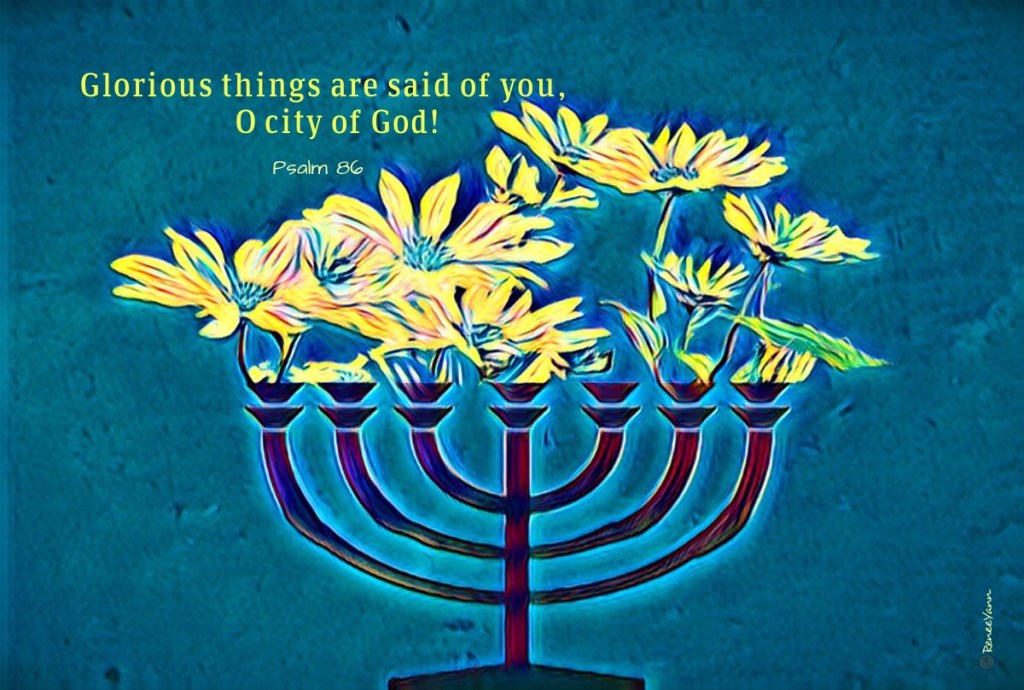
Glorious things are said of you,
    O city of God!

Psalm 87: 1-3

For centuries, the Jews had been scattered through many alien countries. Some had lost their ties to their inherited faith. The psalm calls all people “home” to the worship of the one, true God.

Jerusalem from the Mount of Olives by Frederic Edwin Church

Jerusalem is a profoundly unifying symbol for Jews. That is why it is so important for Jesus to “go up to Jerusalem” in order to accomplish our redemption. As today’s Gospel tells us:

When the days for Jesus to be taken up were fulfilled,
he steadfastly turned his face to Jerusalem.

Luke 9:51

Praying with these passages may seem difficult for Christians if we have no emotional ties to the city of Jerusalem. But for us too, the concept of “Jerusalem” serves as a symbol of that stable and committed faith that allows us to live our lives in the pattern of Jesus.

We journey too, as Jesus did toward the fullness of life in God. Our journey takes singular steadfastness, just as his did, a commitment rooted in faith and grace.

Together in faith, we form a New Jerusalem, glorious in each one of us through our Baptism into Christ.


Poetry: A Sonnet – Malcolm Guite

Now to the gate of my Jerusalem,
The seething holy city of my heart,
The saviour comes. But will I welcome him?
Oh crowds of easy feelings make a start;
They raise their hands, get caught up in the singing,
And think the battle won. Too soon they’ll find
The challenge, the reversal he is bringing
Changes their tune. I know what lies behind
The surface flourish that so quickly fades;
Self-interest, and fearful guardedness,
The hardness of the heart, its barricades,
And at the core, the dreadful emptiness
Of a perverted temple. Jesus  come
Break my resistance and make me your home.


Music: Jerusalem, My Destiny – Rory Cooney

Extra: Pearls from the Synod

Monday, October 2, 2023

Last night, I fell asleep reading a passably written book with a yet undisclosed mystery. I wanted to solve that mystery before sleeping, but Sandman prevailed. This morning, which I consider the most precious time of my day, I was tempted to pick up that book and satisfy my curiosity.

Then I said to myself, “What are you doing! This time belongs to the Holy Spirit.” So I picked up instead one of the beautiful reflections from the Synod Retreat.


As many of you know, the Synod on Synodality has begun in Rome. Currently, the invited participants are on a short retreat to prepare their hearts, minds, and spirits for the sessions which open on October 4 – the Feast of St. Francis of Assisi.

The retreat is being offered by Dominican Friar and former Master of the Order of Preachers, Father Timothy Radcliffe, and is available on the internet.

https://en.wikipedia.org/wiki/Timothy_Radcliffe


In my own prayer, I have been following the sessions and have found them deeply enriching. The session I prayed with today (meditation 3) particularly touched me.

I thought some of you might like to benefit from these sessions.  They are rich, direct, and profoundly simple with the deep simplicity of holiness. Certainly, they bear directly on the Synod itself, but they are universal in their wisdom and inspiration.

If you are not already familiar with the Vatican News website, I have included links to the sessions below. Even if you don’t have time now, the message they convey is timeless. You might like to access them some time at your leisure. But maybe, like me this morning, you might choose to use your current leisure for one of these transformative sessions instead of a middling book or a game of Candy Crush.


Meditation 1:

https://www.vaticannews.va/en/church/news/2023-10/retreat-day-1-radcliffe-first-meditation.html


Meditation 2:

https://www.vaticannews.va/en/church/news/2023-10/synod-retreat-meditation-conversation-on-the-way-to-emmaus.html


Meditation 3:

https://www.vaticannews.va/en/church/news/2023-10/synod-retreat-meditation-friendship.html


Meditation 4:

https://www.vaticannews.va/en/church/news/2023-10/synod-retreat-meditation-conversation-on-the-way-to-emmaus.html


In our leisure
we reveal
what kind of people we are.

Ovid
(Ovid a Roman poet who lived during the reign of Augustus.
He  is most famous for the Metamorphoses
one of the most important sources of classical mythology today.)

Ovid

Angels

Memorial of the Guardian Angels
October 2, 2023

Today’s Readings:

https://bible.usccb.org/bible/readings/1002-memorial-guardian-angels.cfm

Today, in God’s Lavish Mercy, pray with Psalm 91 from the readings for the Mass of the Guardian Angels – those magnificent beings who carry God’s Presence to us in every situation of our lives.

The Lord shall deliver you from the snare of the hunter
and from the deadly pestilence. 
The wings of the Lord shall cover you,
and you shall find refuge under them;
the faithfulness of God shall be a shield and buckler.

Psalm 91: 3-4

Maybe the only angels we ever think about are chubby little cherubs on Christmas cards. The cultural tendency to represent angels in that way diminishes the real power of these mighty and loving beings to inspire and guide us. Today might be a day to rethink our relationship with our Guardian Angels – to talk with them and to listen to the good things they tell us even without words.

Praying with the angels requires the unembarrassed simplicity of deep faith. Our culture has painted the angels with a patina of childishness, but that is far from their biblical representation. Angels are supernaturally powerful beings throughout both the Hebrew and Christian scriptures. If you meet a personal block in praying with your own guardian angels, pick one of the only three named in the Bible and consider that angel’s dynamic presence.

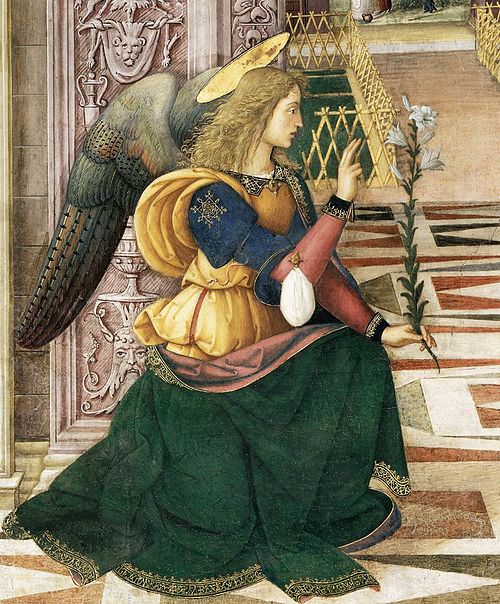
Gabriel: The angel Gabriel is an angel of God who is mentioned by name three times in the Bible when he brought messages from God to Daniel, Zechariah, and Mary.

Michael: the only one called “archangel” in the Bible. In the books of Daniel, Jude, and Revelation, Michael is described as a warrior angel who engages in spiritual combat.

Raphael: mentioned only in the Catholic canon of the Bible, Raphael has a key role in the Book of Tobit

Poem: Touched by an Angel by Maya Angelou 

We, unaccustomed to courage,
exiles from delight,
live coiled in shells of loneliness
until love leaves its high holy temple
and comes into our sight
to liberate us into life.
Love arrives
and in its train come ecstasies
old memories of pleasure
ancient histories of pain.
Yet if we are bold,
love strikes away the chains of fear
from our souls.
We are weaned from our timidity
In the flush of love’s light
we dare be brave
And suddenly we see
that love costs all we are
and will ever be.
Yet it is only love
which sets us free


Music: Angel’s Serenade – Gaetano Braga

Welcome, October!

For my friends in the Northern Hemisphere:

Music:


For my friends in the midst of Australian Spring:

Spring in Australia: S.D. Tiwari

In the months of September and October,
glimpse freshness and exquisiteness allover.
Their winter ends, God of the nature sends,
the queen of seasons to the Australian land.

Cuckoo and magpie sing, songs of spring.
Butterflies bring amazing colours on wings.
Purple carpets spread on the road side,
Under showering petals, walkers feel pride.

Temperature of land is pleasant and mild.
Bloomed in jungles, millions of flowers wild.
Trail of purple Jakaranda under the blue sky.
In the gardens stunning, vivid colours sigh.

When Europe is heading to the autumn fall.
Aussies prepare them to welcome the rainfall.
At winter’s door, Europe celebrates Halloween,
Aussies taste in spring, their pie of pumpkin.

The days are spectacular, bright and pleasant.
Queen of seasons makes jovial the peasants.
Kangaroos hop happy, birds and bees are proud.
During the spring, vineyards are full of crowd.

God’s Will?

Twenty-sixth Sunday in Ordinary Time
October 1, 2023

Today’s Readings:

https://bible.usccb.org/bible/readings/100123.cfm

Today, in God’s Lavish Mercy, we pray with Psalm 25, set perfectly in the midst of a few readings that speak to us about, among other things , “the Father’s Will”.

I think there is no greater spiritual mystery than the meaning of  “God’s Will”, (and not wanting to show up Thomas Aquinas, I’ll resist explaining it here. 😂🧐)

But we’ve all heard attempts at explaining it, haven’t we, especially as it relates to suffering— as in:

  • everything that happens is God’s Will, so we must accept it
  • God wills our suffering to test us
  • if God wills that we suffer, He will give us the strength to endure it

I just don’t think so … not the God I love and Who loves me.

But these attempts to explain suffering are understandable because we want to rationalize the things we fear. Most of us, I think, struggle with the problem of evil and suffering in the world. We want to know what to do when, as Rabbi Kushner wrote, “… Bad Things Happen to Good People”.


Our first reading from Ezekiel shows us that even the ancient peoples met this struggle. The prophet seems to suggest that if you’re bad, you’ll suffer. If you repent, you won’t. Well, we all know that’s not quite the reality! But nice try, Ezekiel.

Our psalm gently leads to another way of facing suffering as the psalmist prays for wisdom, compassion and divine guidance. In the Garden of Gethsemane, Jesus himself prayed like this as he confronted his impending suffering.


In our second reading, Paul places before us the example of Jesus who, in the face of suffering, was transformed by love:

Praying with these readings, each one of us must come to our own peace with the mystery of suffering. What we can be sure of is this: God’s Will is always for our wholeness and joy as so simply taught to us when we were little children:

God made me to know, love, and serve God, 
and to be happy with God in this world and forever.

Our Gospel tells us that such happiness comes through faith and loving service, through responding to “the Father’s Will”.  May we have the insight, the love, and the courage!


Poetry: Of Being by Denise Levertov 

I know this happiness is provisional:
the looming presences
— great suffering, great fear—
withdraw only into peripheral vision:
but ineluctable this shimmering of wind
in the blue leaves: this flood of stillness
widening the lake of sky:
this need to dance,
this need to kneel:
this mystery:


Music: To You, O Lord (Psalm 25) Graham Kendrick

God’s Firewall

Memorial of Saint Jerome, Priest and Doctor of the Church
September 30, 2023

Today’s Readings:

https://bible.usccb.org/bible/readings/093023.cfm


Today, in God’s Lavish Mercy, we begin the first of three passages from the prophet Zechariah to be read over the next few days. These are the only times we meet Zechariah in our cycle of readings, other than December 12th, the Feast of Our Lady of Guadalupe.

For that reason, we could easily overlook Zechariah, a minor prophet whose visions, so specifically directed to the post-exilic Israelite community, may seem alien and extraneous to our own spirituality.


But we should not overlook Zechariah. Here’s why.

These two prophets (Zechariah and Haggai) seek to rally the identity and vocation of Jews in a time when faith is hard and prospects are lean. Such a time, they assert, is a time for vigorous action. The rebuilding of the temple is thus an act of faith, confident in the reality of God, and an act of defiance against the established imperial order of the world, even the imperial order that funded the project. We might well read these prophets in our own time of “small things” when the church seems to lack energy, courage, and imagination. In just such a time it is urgent to enact visible faithful gestures (like the temple building) that defy business as usual. Thus the prophetic imagination given here outruns historical possibility. That is the quality and depth of faith held here to which we are invited.

Walter Brueggeman: From Judgement to Hope

Zechariah invites the people to imagine a world vastly beyond their present perceptions. It is a world where the Temple is rebuilt as a symbol of God’s Presence, central to their identity. That Divine Presence provides any protection needed, thus removing the need for “walls” of isolation, fear, oppression, defensiveness, and exclusion.

People will live in Jerusalem as though in open country,
because of the multitude of men and beasts in her midst.
But I will be for her an encircling wall of fire, says the LORD,
and I will be the glory in her midst.

Zechariah 2:8-9

Surely we could use such holy imagination in our times! And surely this is the sacred energy Pope Francis seeks as he leads the Church in synodality.

As our shared geopolitical world seems daily to become more fragmented and hostile, the power of our communal, Resurrection faith is crucial to its graceful restoration.


Zechariah calls the people to sing, even in the midst of their disheartening exile, and to dream of a world without vicious walls. We are called to the same hope even in a world that conspires to feed cynicism and indifference rather than justice and mercy.

Sing and rejoice, O daughter Zion!
See, I am coming to dwell among you, says the LORD.
Many nations shall join themselves to the LORD on that day,
and they shall be his people and he will dwell among you.

Zechariah 2:14

Prose: The Monk Manifesto – Christine Valtners Paintner

Monk Manifesto is a public expression of one’s commitment to live a compassionate, contemplative, and creative life. When I read it, I find encouragement to act for a more integrated world, one without dissociative walls.

  • I commit to finding moments each day for silence and solitude, to make space for another voice to be heard, and to resist a culture of noise and constant stimulation.
  • I commit to radical acts of hospitality by welcoming the stranger both without and within. I recognize that when I make space inside my heart for the unclaimed parts of myself, I cultivate compassion and the ability to accept those places in others.
  • I commit to cultivating community by finding kindred spirits along the path, soul friends with whom I can share my deepest longings, and mentors who can offer guidance and wisdom for the journey.
  • I commit to cultivating awareness of my kinship with creation and a healthy asceticism by discerning my use of energy and things, letting go of what does not help nature to flourish.
  • I commit to bringing myself fully present to the work I do, whether paid or unpaid, holding a heart of gratitude for the ability to express my gifts in the world in meaningful ways.
  • I commit to rhythms of rest and renewal through the regular practice of Sabbath and resist a culture of busyness that measures my worth by what I do.
  • I commit to a lifetime of ongoing conversion and transformation, recognizing that I am always on a journey with both gifts and limitations.

Music: One World – Toby Mac

I’m not a big fan of rap, but I think this song is pretty good for today’s reflection.

With My Whole Being

Feast of Saints Michael, Gabriel, and Raphael, archangels
September 29, 2023

Today’s Readings:

https://bible.usccb.org/bible/readings/092923.cfm


Today, in God’s Lavish Mercy, we pray with Psalm 138 which begins with the beautiful  verse:

I will praise You with my whole heart…

Abraham with the Three Angels – Rembrandt

As we celebrate the feast of the three great archangels, known to us by name because of their appearances in the Bible, we are invited to explore all the aspects of our spirituality – our whole being.

I will give thanks to you, O LORD, with all my heart,
for you have heard the words of my mouth;
in the presence of the angels I will sing your praise;
I will worship at your holy temple
and give thanks to your name.

Psalm 138: 1-2

As bodily beings, we might most often pray by using our senses:

  • with what we read and see with our eyes
  • with vocal prayer or soulful music
  • with the transporting aroma of incense
  • with the tactile assurance of a rosary over our fingertips

But we are also spiritual beings. There are dimensions of our experience that could never be put into words. There are melodies playing within us too profound to be rendered in notes.

There is a Presence within us beyond and greater than ourselves, breathed into us at our creation, and longing for the fulfillment of Heaven. Our human experience is like a shadow cast, over time, by the Great Light Who lives and loves in us.


The angels are beings released from that shadow. They completely dwell in and radiate the One Who breathed them forth in the fullness of Light. They are the ones who companion us to the wondrous edges of our own possibility –

as Raphael did for Tobit (Tobit 12:1-22)
as Michael did for Daniel (Daniel 10:13-21)
as Gabriel did for Mary (Luke 1:26-38)

These stories might inspire us today to speak and listen to our angels, one of whom is particularly charged to guide us.


Poetry: A Sonnet for St. Michael the Archangel – Malcolm Guite

Michaelmas gales assail the waning year,
And Michael’s scale is true, his blade is bright.
He strips dead leaves; and leaves the living clear
To flourish in the touch and reach of light.
Archangel bring your balance, help me turn
Upon this turning world with you and dance
In the Great Dance. Draw near, help me discern,
And trace the hidden grace in change and chance.
Angel of fire, Love’s fierce radiance,
Drive through the deep until the steep waves part,
Undo the dragon’s sinuous influence
And pierce the clotted darkness in my heart.
Unchain the child you find there, break the spell
And overthrow the tyrannies of Hell.


Music: Confitebor Tibi Domine – Francisco Valls

Psalmus 138Psalm 138
1 Confitebor tibi Domine in toto corde meo quoniam audisti verba oris mei in conspectu angelorum psallam tibi1 I will praise thee, O lord, with my whole heart: for thou hast heard the words of my mouth. I will sing praise to thee in the sight of his angels:
2 Adorabo ad templum sanctum tuum et confitebor nomini tuo super misericordia tua et veritate tua quoniam magnificasti super omne nomen sanctum tuum2 I will worship towards thy holy temple, and I will give glory to thy name. For thy mercy, and for thy truth: for thou hast magnified thy holy name above all.
3 In quacumque die invocavero te exaudi me multiplicabis me in anima mea virtute3 In what day soever I shall call upon thee, hear me: thou shall multiply strength in my soul.
4 Confiteantur tibi Domine omnes reges terrae quia audierunt omnia verba oris tui4 May all the kings of the earth give glory to thee: for they have heard all the words of thy mouth.
5 Et cantent in viis Domini quoniam magna gloria Domini5 And let them sing in the ways of the Lord: for great is the glory of the Lord.
6 Quoniam excelsus Dominus et humilia respicit et alta a longe cognos cit6 For the Lord is high, and looketh on the low: and the high he knoweth afar off.
7 Si ambulavero in medio tribulationis vivificabis me super iram inimicorum meorum extendisti manum tuam et salvum me fecit dextera tua7 If I shall walk in the midst of tribulation, thou wilt quicken me: and thou hast stretched forth thy hand against the wrath of my enemies: and thy right hand hath saved me.
8 Dominus retribuet propter me Domine misericordia tua in saeculum opera manuum tuarum ne dispicias8 The Lord will repay for me: thy mercy, O Lord, endureth for ever: O despise not the work of thy hands

Turn to Tenderness, Turn to God

Thursday of the Twenty-fifth Week in Ordinary Time
September 28, 2023

Today’s Readings:

https://bible.usccb.org/bible/readings/092823.cfm


Today, in God’s Lavish Mercy – and tomorrow – we will hear from Haggai, one of the twelve minor prophets of the Hebrew Scriptures. These dozen writers are referred to as “minor” because of the length of their writings, not their value.

So Haggai, even though many of us have never heard of him, has something important to say for Judeo-Christian tradition and for each of us who read him. Let’s see what that might be.

Hag1_9JPG

Haggai is prophesying during the Persian period of Jewish history, around the middle of the 6th century, BC. The Jewish people had been back home from the Babylonian captivity for almost 20 years. When they first returned they were passionate about rebuilding the Temple. But as the decades passed, and opposition from their non-Jewish neighbors increased, their commitment waned.


The building of worship places has always been an activity with fans on both sides of the aisle. Some argue that God needs a spot where the Divine Presence can be recognized and revered. Others believe that the effort and resources expended in such building could better be used in human services for God’s poor and needy people. Haggai’s community had people in both camps. (Sound familiar?)

Haggai offers a turning point for their arguments. He tells the people they are a mess. The absence of a central symbol for their faith has weakened and scattered them to their own selfish pursuits. He tells them to look at themselves:

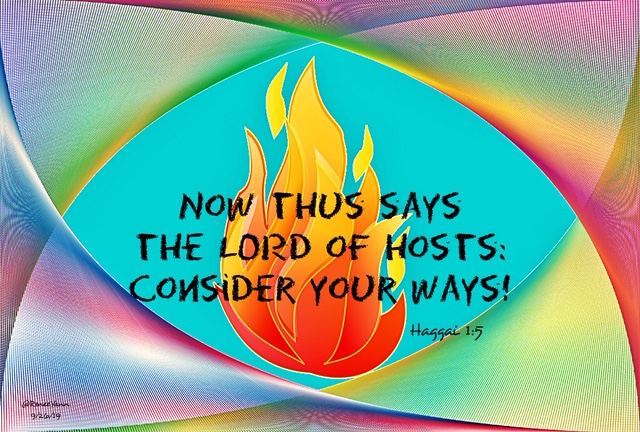
Consider your ways!
You have sown much, but have brought in little;
you have eaten, but have not been satisfied;
You have drunk, but have not been exhilarated;
have clothed yourselves, but not been warmed;
And whoever earned wages
earned them for a bag with holes in it.


The Temple, while it is important, isn’t the most important part of Haggai’s prophecy. He tells the people they have lost their souls. The lack of a central, shared faith has caused them to forget who they are. They will remember only when they remember God’s centrality in their lives.

Haggai appeals to the people to restore a public life which gives honor to God. For their time and circumstance, such a return is symbolized by the rebuilding of the Temple which had been destroyed at the time of their enslavement by Babylon.


We humans often forget what’s important. We chip away at, and ultimately destroy, what makes us who we are by little acts of faithlessness, deceit, covetousness, and envy. These small treacheries grow into big ones redeemable only by an impeachment of the soul and the renewal of a common moral purpose. Haggai offered that conversion to Israel. Pope Francis is offering it to us today.


Video: TED Talk by Pope Francis given at the Annual TED Conference in 2017 and pleading for a “Revolution of Tenderness”. (Yes, it’s long, but it is profound. When he delivered this talk, the Pope was given a standing ovation by some of the most prestigious business people of our time.)

https://www.npr.org/sections/thetwo-way/2017/04/26/525699847/in-surprise-ted-talk-pope-francis-asks-the-powerful-for-revolution-of-tenderness


Music: Come Back to Me – by Gregory Norbet, sung by John Michael Talbot