The Word Takes Root

Fifteenth Sunday in Ordinary Time
July 16, 2023

Today’s Readings:

https://bible.usccb.org/bible/readings/071623.cfm


Today, in God’s Lavish Mercy, we have three iconic readings from the rich store of Scripture. Any one of them, taken in itself, offers depths for study and prayer. As on all Sundays in the Liturgical Year, there is a theme that ties the readings together and helps us find entrance into their infinite wisdom.

Isaiah, in rich imagery, describes the generative power of God’s Word planted in us and in all Creation:

Thus says the LORD:
Just as from the heavens
the rain and snow come down
and do not return there
till they have watered the earth,
making it fertile and fruitful,
giving seed to the one who sows
and bread to the one who eats,
so shall my word be
that goes forth from my mouth;

Isaiah 55:10-11

For our second reading, Paul inspires us with one of his most magnificent passages – Romans 8:

All commentators agree that Romans 8 is something special. If Romans is a breathtaking landscape, this chapter is a majestic peak towering above its surroundings. …
… Paul’s focus in this chapter is threefold: the divine work of the Spirit, the divine gift of sonship, and the divine purpose of suffering, each in relation to the practical realities of Christian living.

Scott W. Hahn – Romans (Catholic commentary on Sacred Scripture

In today’s verses, Paul describes Creation being transformed by the omnipotent Word foretold in Isaiah. As we read this passage, we must be mindful that we, our experiences, and our material world are the “creation” to which Paul refers:

For creation awaits with eager expectation
the revelation of the children of God;
for creation was made subject to futility,
not of its own accord but because of the one who subjected it,
in hope that creation itself
would be set free from slavery to corruption
and share in the glorious freedom of the children of God. 

Romans 8:9-21

Indeed, we experience that worldly “futility” every day in our own bodies and in the body of the universe. Life, both within and around us, may sometimes feel like an barren field longing for tillage and rain. We yearn for the healing, wholeness, and fulfillment that Paul calls “the glorious freedom of the children of God”.

In our Gospel, Jesus tells us that this fulfillment will come only through a spiritual patience and discipline like that of the sower sowing his seed. In this detailed parable, Jesus clearly equates effective “seeding” to receptive hearing of the Word.

For God’s harvest to be accomplished in us, we must hear the Word as described in Isaiah, and act in hope as described in Paul. We can do this in two ways:

  • by our prayerful, informed study of the Scriptures
  • our merciful action for the healing of suffering Creation.

But the seed sown on rich soil
is the one who hears the word and understands it,
who indeed bears fruit and yields a hundred or sixty or thirtyfold.

Matthew 13:9

Poetry: God Speaks to Each of Us – Rainer Maria Rilke

God speaks to each of us as he makes us,
then walks with us silently out of the night.
These are the words we dimly hear:
You, sent out beyond your recall,
go to the limits of your longing.
Embody me.
Flare up like a flame
and make big shadows I can move in.
Let everything happen to you: beauty and terror.
Just keep going. No feeling is final.
Don’t let yourself lose me.
Nearby is the country they call life.
You will know it by its seriousness.
Give me your hand.

Music: Spirit of the Living God – Daniel Iverson

Legacies

Memorial of St. Bonaventure
Saturday of the Fourteenth Week in Ordinary Time
July 15, 2023

Today’s Readings:

https://bible.usccb.org/bible/readings/071523.cfm


Today, in God’s Lavish Mercy, both our readings express the character of farewells or life testaments.

In our first reading, we close out our few weeks’ journey through Genesis with Jacob’s instructions to his posterity. These directives attach his passing and their future to Israel’s ancestral roots:

Jacob gave his sons this charge:
“Since I am about to be taken to my people,
bury me with my fathers in the cave that lies
in the field of Ephron the Hittite,
the cave in the field of Machpelah,
facing on Mamre, in the land of Canaan,
the field that Abraham bought from Ephron the Hittite
for a burial ground.

Genesis 49:29-30

Reading these verses, I remembered two sets of similar instructions that I had once received.

The first set was given to me and my brother.

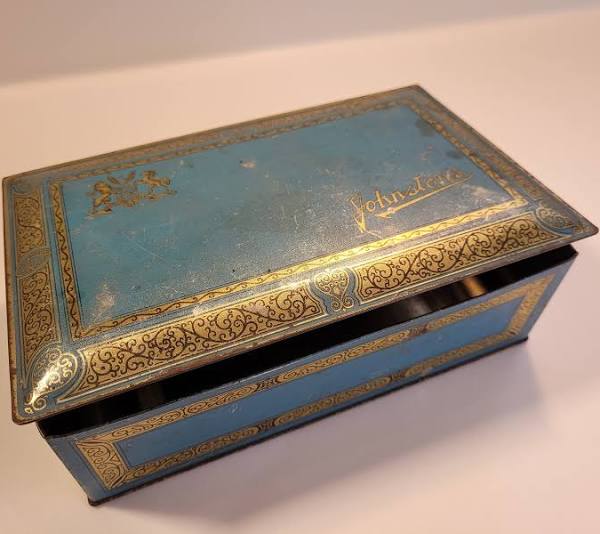
Our beloved mother had just died after a few months’ illness. We were about the business of preparing for her burial. Our family storage systems were very simple but definite. Confident that no thief would want to do any tailoring while burglarizing the house, we kept important documents in an old tin sewing box. Jim and I knew the cemetery deed would be there, top shelf of the living room closet, under a couple of afghans.


What we didn’t know was that Mom, never much for sad or purple prose, had left us a letter in that box. The letter, penned in a strong hand, anticipated her death and counseled us for a future without her. Surprisingly, her letter had been written long before her terminal diagnosis, prompted no doubt by my Dad’s sudden death about a decade before.

Mom was brief but direct in her hopes and instructions, the core of which was this:

Know that I loved the two of you
more than anything in the world.
Love and care for each other when I am gone.


The second set of instructions was not the fruit of a bloodline inheritance, but of a spiritual one: my call to Mercy. My dear sponsor, realizing at my Silver Jubilee that the years were passing for us both, offered this wisdom so typical of her direct and good-natured style:


In our Gospel, Jesus anticipates a time when his disciples will be without his guiding presence. Like Jacob, and like my Mom and my sponsor, Jesus wants his beloved descendants to recognize, and find courage in, the amazing love which is their inheritance.

Are not two sparrows sold for a small coin?
Yet not one of them falls to the ground without your Father’s knowledge.
Even all the hairs of your head are counted.
So do not be afraid; you are worth more than many sparrows.
Everyone who acknowledges me before others
I will acknowledge before my heavenly Father.

Matthew 10:29-32

As we pray with today’s scriptures, we might give thanks for the blessings we have received from our ancestors, be they of blood or spirit.

Further, we might prayerfully consider those who need and deserve our blessing as they assume the future we will not see — our children, nieces, nephews, sisters and brothers in religious formation — any number of disciples and pupils who look to us for hopeful and grateful witness.


Poetry: My Legacy – Lucy Maude Montgomery
Lucy Maud Montgomery OBE (1874 – 1942), was a Canadian author best known for a collection of novels, essays, short stories, and poetry beginning in 1908 with Anne of Green Gables.

My friend has gone away from me
From shadow into perfect light,
But leaving a sweet legacy.
My heart shall hold it long in fee­
A grand ideal, calm and bright,
A song of hope for ministry,
A faith of unstained purity,
A thought of beauty for delight­
These did my friend bequeath to me;
And, more than even these can be,
The worthy pattern of a white,
Unmarred life lived most graciously.
Dear comrade, loyal thanks to thee
Who now hath fared beyond my sight,
My friend has gone away from me,
But leaving a sweet legacy.

Music: Standing on the Shoulders – Joyce Rouse

Coming to Forgiveness

Memorial of Saint Kateri Tekakwitha, Virgin
Friday of the Fourteenth Week in Ordinary Time
July 14, 2023

Today’s Readings:

https://bible.usccb.org/bible/readings/071423.cfm


Today, in God’s Lavish Mercy, our Gospel describes the suffering to be encountered by disciples as they live and preach the Gospel.

Jesus said to his Apostles:
“Behold, I am sending you like sheep in the midst of wolves;
so be shrewd as serpents and simple as doves.
But beware of men,
for they will hand you over to courts
and scourge you in their synagogues,
and you will be led before governors and kings for my sake
as a witness before them and the pagans.

Matthew 10:16-18

The suffering is predicted to come from many quarters, but perhaps the most heart-breaking is persecutioin within families:

Brother will hand over brother to death,
and the father his child;
children will rise up against parents and have them put to death.
You will be hated by all because of my name,
but whoever endures to the end will be saved.

Matthew 10:21-22

Our reading from Genesis, on the other hand, describes the loving resolution of a long-standing family rupture as Jacob (now called “Israel”) reunites with his long-lost son:

Israel had sent Judah ahead to Joseph,
so that he might meet him in Goshen.
On his arrival in the region of Goshen,
Joseph hitched the horses to his chariot
and rode to meet his father Israel in Goshen.
As soon as Joseph saw him, he flung himself on his neck
and wept a long time in his arms.
And Israel said to Joseph, “At last I can die,
now that I have seen for myself that Joseph is still alive.”

Genesis 46:28-30

Many of us have borne the pain of similar fractures in our various “families”: family of origin, community, church or friends. Sometimes the cause of these breaks may be contradictions in faith and moral practice. At other times, loving bonds break because of willfulness, arrogance, ignorance, small-heartedness or the many other forms of human limitation.

The outrageous jealousy of Joseph’s brothers cleft their otherwise contented family. But into that chasm, God poured time’s grace and Joseph’s healing. From these gifts, Joseph was able to step into reconciliation, inviting his repentant brothers to join him.


In our own lives, such a step can be inordinately huge. The longer we hesitate to take it, the more it widens, sometimes to the point of apparent no return. But the grace of forgiveness is always available to us even if actual reconciliation is impossible because of the recalcitrance, inaccessibility, or perhaps even death of the other party.

When they hand you over,
do not worry about how you are to speak
or what you are to say.
You will be given at that moment what you are to say.
For it will not be you who speak
but the Spirit of your Father speaking through you.

Matthew 10:19-20

Psalm Poem: Psalm 37 – interpreted by Christine Robinson

The evil prosper, but don’t you wallow in anger.
Do what you can and let it go.
Remember the long arc of the universe
and how it bends towards justice.
Set your feet on that path; it is True.
Be still.
Wait for God’s word to speak to your heart.
Enjoy your life as it is, find your work, love those around you.
Hold your head up and teach your children.
Notice those who are honest.
Join the upright
Make peace where you can
Trust in God.

Music: excerpts from Joseph and the Amazing Technicolor Dreamcoat – Andrew Llyod Webber

These two videos capture the story of Jacob’s arrival in Egypt and Joseph’s self-reconciliation. The first ends rather abruptly, but thesecond picks up the action. All lyrics are below.

[NARRATOR]
Joseph knew by this his brothers now were honest men
The time had come at last to reunite them all again

[JOSEPH]
Can’t you recognize my face? Is it hard to see
That Joseph, who you thought was dead, your brother
It’s me?

[ENESMBLE]
Joseph, Joseph, is it really true?
Joseph, Joseph, is it really you?

[NARRATOR & ENESMBLE]
Joseph! Joseph!

——————-

So Jacob came to Egypt
No longer feeling old
And Joseph came to meet him
In his chariot of gold
Of gold
Of gold
Of gold!

————-

[JOSEPH]
I closed my eyes, drew back the curtain
To see for certain what I thought I knew
Far, far away, someone was weeping
But the world was sleeping
Any dream will do

[JOSEPH & CHILDREN]
I wore my coat with golden lining
Bright colors shining, wonderful and new
And in the east, the dawn was breaking
And the world was waking
Any dream will do
A crash of drums

[NARRATOR]
A flash of light

[JOSEPH]
My golden coat flew out of sight

[JOSEPH & NARRATOR]
The colors faded into darkness
I was left alone

[JOSEPH, NARRATOR & CHILDREN]
May I return to the beginning?
The light is dimming, and the dream is too
The world and I, we are still waiting
Still hesitating
Any dream will do

Blessed Retrospect!

Thursday of the Fourteenth Week in Ordinary Time
July 13, 2023

Today’s Readings:

https://bible.usccb.org/bible/readings/071323.cfm


Joseph Forgives His Brothers – Joseph Von Cornelius

Today, in God’s Lavish Mercy, Joseph forgives his brothers and Jesus commissions his disciples.

The story of Joseph’s forgiveness makes a tender and indelible mark on the prayerful reader. How we wish we could be as magnanimous as Joseph in our forbearance!


Joseph’s experience is one of a long-held hurt that he sets aside to pursue another life. But even though he achieves tremendous success in his new environment, hurts like this are never forgotten. Joseph’s sobs at verse four indicate the painful memory’s depth.

Joseph could no longer control himself
in the presence of all his attendants,
so he cried out, “Have everyone withdraw from me!”
Thus no one else was about when he made himself known to his brothers.
But his sobs were so loud that the Egyptians heard him,
and so the news reached Pharaoh’s palace.
“I am Joseph,” he said to his brothers.
“Is my father still in good health?”
But his brothers could give him no answer,
so dumbfounded were they at him.

Genesis 45:1-3

“To forgive is to set a prisoner free
and discover that the prisoner was you.”

Lewis B. Smedes

So many lessons can be drawn from this passage, but clearly the power of forgiveness is most evident. Joseph has been able to live a fruitful life in Egypt because he has already forgiven his brothers’ treachery, long before they unexpectedly arrive at his palace doorstep. He has chosen not to live under the burden of their treacherous choice.

In the wider perspective of God’s timing, we see that the treachery actually yielded a blessing not only for Joseph, but for all of Israel. We ask for the grace to see how our own need to give and receive forgiveness holds a larger blessing for our lives.


Poetry: Let It Go – e.e.cummings

Let it go – the
smashed word broken
open vow or
the oath cracked length
wise – let it go it
was sworn to
go
 
let them go – the
truthful liars and
the false fair friends
and the boths and
neithers – you must let them go they
were born
to go
 
let all go – the
big small middling
tall bigger really
the biggest and all
things – let all go
dear
 
so comes love

Music: Remember Not the Things of the Past – Bob Hurd

Remember not the things of the past;
now I do something new,
do you not see it?
Now I do something new, says the Lord.
 
In our distress God has grasped us by the hand,
opened a path in the sea, and we shall pass over,
we shall pass over, free at last.
 
In our parched land of hypocrisy and hate,
God makes a river spring forth,
a river of mercy, truth and compassion;
come and drink.
 
And who among us is sinless in God’s sight?
Then who will cast the first stone,
when he who was sinless
carried our failings to the cross?
 
Pressing ahead, letting go what lies behind,
may we be found in the Lord, and sharing his dying,
share in his rising from the dead.

Twelve

Wednesday of the Fourteenth Week in Ordinary Time
July 12, 2023

Today’s Readings:

https://bible.usccb.org/bible/readings/071223.cfm


Today, in God’s Lavish Mercy, we have the stories of two sets of twelve men:

  • Joseph and his brothers, heads of the twelve tribes of Israel
    (Reuben, Simeon, Levi, Judah, Dan, Naphtali, Gad, Asher, Issachar, Zebulun, Joseph, and Benjamin)
  • the twelve Apostles chosen by Jesus
    (Simon Peter, Andrew, James, John, Philip, Bartholomew, Thomas, Matthew, James, Thaddeus, Simon, Judas)

Joseph Oversees Egypt’s Granaries – Lawrence Alma-Tadema


Each of these pillars of the Judea-Christian tradition had their individual faith stories which have called generations either to imitate or contradict them. We want to be like faithful, fumbling Peter but not like clever, devious Judas. We abhor the muderous jealousy of the 10 brothers, but admire the generous forgiveness of Joseph.

These ageless stories present us with the mysterious beauty of the Scriptures which allow us to find our best and worst selves within them. But more significantly, beyond mirroring all human experience, these stories reflect God’s abiding Presence in the unfolding of human and individual history.


The Joseph narrative, which we have a small part of today, presents a whole new way of looking at God’s relationship with Israel. God is not an overt actor in the narrative as in the early Pentateuch accounts, but rather the hidden Agency in a long and sustained drama.

(The Joseph narrative) urges that in the contingencies of history, the purposes of God are at work in hidden and unnoticed ways. But the ways of God are nonetheless reliable and will come to fruition….
The purposes of God are not wrought here by abrupt action or by (heavenly) intrusions, but by the ways of the world which seem to be natural and continuous.

Walter Brueggemann: Genesis, A Bible Commentary for Teaching and Preaching

As I read Bruggemann’s commentary, I think of the many times my religious community has come together for story-telling during a Sister’s funeral rites. Within an inspirational hour, the extended history of this Sister’s life is gathered into a powerful statement reflecting both God’s and her long fidelity.

As in Joseph’s story, God has not spoken aloud, but has spoken nonetheless clearly, in and through each remembered life. The grateful community is left in quiet and joyful awe at the end of each ritual, amazed and convinced that God is silently present in every person’s story, even one’s own.


Today’s Responsorial Psalm may capture our sentiments as we consider our own lives in the light of today’s readings. We can take great comfort in the belief that, in the eternal design, all things come to wholeness for those who trust God.

The LORD brings to nought the plans of nations;
and foils the designs of peoples.
But the plan of the LORD stands forever;
the design of God’s heart, through all generations.

Psalm 33:10-11

Poetry: The Thread of Life – Christina Rossetti

The irresponsive silence of the land,
The irresponsive sounding of the sea,
Speak both one message of one sense to me: —
Aloof, aloof, we stand aloof, so stand
Thou too aloof bound with the flawless band
Of inner solitude; we bind not thee;
But who from thy self-chain shall set thee free?
What heart shall touch thy heart? what hand thy hand?—
And I am sometimes proud and sometimes meek,
And sometimes I remember days of old
When fellowship seemed not so far to seek
And all the world and I seemed much less cold,
And at the rainbow's foot lay surely gold,
And hope felt strong and life itself not weak.

2

Thus am I mine own prison. Everything
Around me free and sunny and at ease:
Or if in shadow, in a shade of trees
Which the sun kisses, where the gay birds sing
And where all winds make various murmuring;
Where bees are found, with honey for the bees;
Where sounds are music, and where silences
Are music of an unlike fashioning.
Then gaze I at the merrymaking crew,
And smile a moment and a moment sigh
Thinking: Why can I not rejoice with you ?
But soon I put the foolish fancy by:
I am not what I have nor what I do;
But what I was I am, I am even I.

3

Therefore myself is that one only thing
I hold to use or waste, to keep or give;
My sole possession every day I live,
And still mine own despite Time's winnowing.
Ever mine own, while moons and seasons bring
From crudeness ripeness mellow and sanative;
Ever mine own, till Death shall ply his sieve;
And still mine own, when saints break grave and sing.
And this myself as king unto my King
I give, to Him Who gave Himself for me;
Who gives Himself to me, and bids me sing
A sweet new song of His redeemed set free;
He bids me sing: O death, where is thy sting?
And sing: O grave, where is thy victory?

Music: Air on the G String – J.S.Bach, played by Hauser


Unbound by Mercy

Memorial of Saint Benedict, Abbot
Tuesday of the Fourteenth Week in Ordinary Time
July 11, 2023

Today’s Readings:

https://bible.usccb.org/bible/readings/071123.cfm


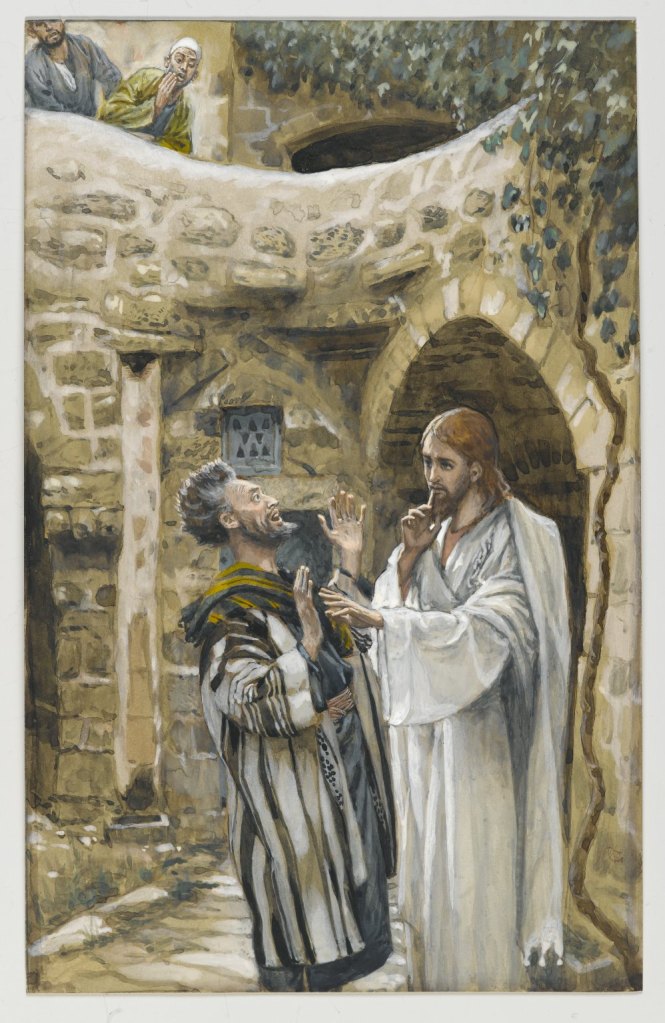
Today, in God’s Lavish Mercy, Jacob wrestles with an angel and Jesus cures a man muted by demons.

Jesus Cures a Deaf Mute – Tissot Jacob Wrestles with an Angel – Bonnat

Thinking of these two figures this morning, I was reminded of one of my all-time most influential books, “Womanspirit Rising“. In the late 1970s, I first read this now classic anthology of feminist theology. It changed the whole framework of how I saw the world.


A key concept in the collection is a phrase written by theologian Nelle Morton which describes how women, despite the obstructions of patriarchy, can help one another to self-realization by practicing deep listening to one another. Morton calls this ministry:

“hearing one another into speech”

The point is that when our pain and struggles are truly listened to, we can begin to name and explore our own healing.


I think this is exactly what Jesus did for the man muted by demons. Jesus heard this man’s pain before the man could speak it. The Spirit of Jesus was one so attuned to all Creation that he could hear the “Sound beyond sound” within this man’s suffering.

Jesus’ unspoken response to the speechless man is the same that he offers to all of us …. Infinite, Lavish Mercy:

At the sight of the crowds,
his heart was moved to breaking for them
because they were troubled and abandoned,
like sheep without a shepherd.

Matthew 9:32-36

In our Genesis passage, Jacob is fighting his own form of “demons” — one that, in this case, turns out to be an angel, a giver of blessing!

Some man wrestled with him until the break of dawn.
When the man saw that he could not prevail over him,
he struck Jacob’s hip at its socket,
so that the hip socket was wrenched as they wrestled.
The man then said, “Let me go, for it is daybreak.”
But Jacob said, “I will not let you go until you bless me.”
The man asked, “What is your name?”
He answered, “Jacob.”
Then the man said,
“You shall no longer be spoken of as Jacob, but as Israel,
because you have contended with divine and human beings
and have prevailed.”

Genesis 32:25-29

The entire night’s struggle is executed in silence. It is not until dawn that the combatants speak. Like the Gosple mute, Jacob’s true self is liberated by a silent hearing. As a result, he is blessed with a new identity and a new name – “Israel”.


When we were very young nuns, our Mistress of Postulants was filled with unexpected, old-fashioned wisdom. For example, her recommendation to our vocational doubts was to “sleep on them”. She counseled that “everything looks better in the morning.” Simplistic though it may have sounded, she was right!

Some of the turbulent adjustments, which could not be articulated in the dark hours, found expression and resolve in morning light – when we could see one another clearly and listen heartily to each other’s confusions. Such listening helped to either evaporate the troubles or to suggest a clear path through them.


That early experience was a simple time for me of growing in self-understanding. But it offered a more complex truth – that, not only we, but all the suffering world needs to be “heard into speech“. This is the work of Mercy as we see it so tenderly expressed in today’s Gospel.


In such times of deep listening and new naming, the God of miracles is with us. These times in our lives can help us become deep listeners to the world’s pain, re-christeners of the world’s hope, humble architects of God’s tender design for our wholeness:

For Professor Nelle Morton, the hearing to speech is not just a human phenomenon, but one that occurs because of a prior divine hearing and listening. We are able to hear one another into speech (and thus, perhaps, into full humanity) because we are first heard by “a prior great Listening Ear . . . an ear that hears . . . our own”

Dr. Elaine Graham – Professor of Social and Pastoral Theology at the University of Manchester.

Poetry: Listening – from Rumi

What is the deep listening? Sama is
a greeting from the secret ones inside
the heart, a letter. The branches of
your intelligence grow new leaves in
the wind of this listening. The body
reaches a peace. Rooster sound comes,
reminding you of your love for dawn.
The reed flute and the singer's lips:
the knack of how spirit breathes into
us becomes as simple and ordinary as
eating and drinking. The dead rise with
the pleasure of listening. If someone
can't hear a trumpet melody, sprinkle
dirt on his head and declare him dead.
Listen, and feel the beauty of your
separation, the unsayable absence.
There's a moon inside every human being.
Learn to be companions with it. Give
more of your life to this listening. As
brightness is to time, so you are to
the one who talks to the deep ear in
your chest. I should sell my tongue
and buy a thousand ears when that
one steps near and begins to speak.

Music: Whispering Sea – Tony O’Connor


“Ifs” and “In-Betweens”

Monday of the Fourteenth Week in Ordinary Time
July 10, 2023

Today’s Readings:

https://bible.usccb.org/bible/readings/071023.cfm


Today, in God’s Lavish Mercy, Genesis takes us deeper into the story of Jacob, and Matthew tells of a faith-filled centurion and a hope-filled woman. These are a wonderful narratives painted in images so intense that they have infused the prayers of generations.


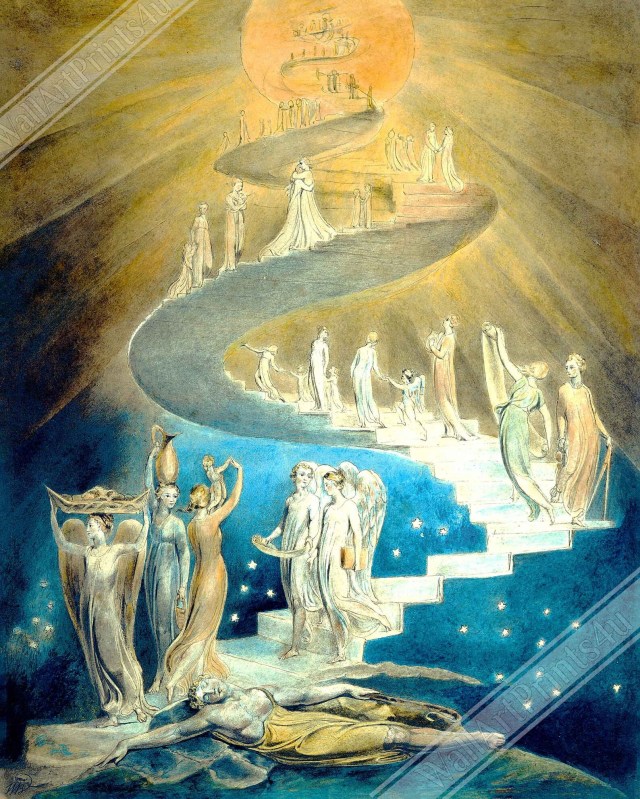
Jacob’s Ladder by William Blake

Jacob and his mother have successfully stolen the birthright from Esau. But now Jacob, threatened with muder by his wronged brother, is an exile seeking a place to live out his life.

Jacob is on a journey in between his past and his future, between his choices and his regrets, between his security and his hope. He is in a place of momentous “ifs” because he has no “for sures” in hand.

Pausing at a shrine, Jacob sleeps and dreams of angels, of a laddered freeway to heaven. God appears and speaks to him, reiterating the essence of the Abrahamic promises.


By Divine Graciousness, God has intruded on Jacob’s “in-betweeness”

In you and your descendants
all the nations of the earth shall find blessing.
Know that I am with you;
I will protect you wherever you go,
and bring you back to this land.
I will never leave you until I have done what I promised you.”

Genesis 28:14-15

The experience moves Jacob to make a vow, hinged on a particular word of hope : IF

If God remains with me,
to protect me on this journey I am making
and to give me enough bread to eat and clothing to wear,
and I come back safe to my father’s house, the LORD shall be my God.
This stone that I have set up as a memorial stone shall be God’s abode.”

Genesis 28:20-22

If I But Touch the Hem by James Tissot

In our Gospel, the suffering woman pivots her hope on the same word: IF

A woman suffering hemorrhages for twelve years came up behind him
and touched the tassel on his cloak.
She said to herself, “If only I can touch his cloak, I shall be cured.”
Jesus turned around and saw her, and said,
“”Courage, daughter! Your faith has saved you.””
And from that hour the woman was cured.

Matthew 9:20-22

It is clear from God’s spontaneous generosity in both these passages that Divine Mercy does not swing on an “IF“. God waits for us to open our hearts. God’s Promise is constant, and God’s Will for our wholeness in immutable. The “IFs” are our constructions, not God’s. God is with us no matter what, not if.


Most of our life is spent atwix one thing and another – between youth and old age, sickness and healing, security and contentment, courage and fear, indifference and awareness … beginnings and endings in a thousand forms. It is at these in-between places that God waits for us, as God did for Jacob, as Jesus did for the suffering woman.

“In-between” is usually an uncomfortable place because we are stretched between growth and passivity. But in the stretch, we may find a holy place, as Jacob did. In the reach of our heart for the hem of God’s garment we, like the extravasating woman, may find new life.


Poetry: That Passeth All Understanding – Denise Levertov

An awe so quiet 
I don’t know when it began. 

A gratitude 
had begun 
to sing in me. 

Was there 
some moment 
dividing 
song from no song? 

When does dewfall begin? 

When does night 
fold its arms over our hearts 
to cherish them? 

When is daybreak?

Music: In Between – J.J. Pfeifer (lyrics below)

In between the day and the night
In between the dark and the light
In between what′s wrong and what’s right
I′ll find you

I’m not really sure just why I care
My heart is broken and I’m scared
Walls are coming down
My defense is on the ground
I′m falling

In between the day and the night
In between the dark and the light
In between what′s wrong and what’s right
I′ll find you

I don’t want to lose you
Can′t stand the pain
I wanna feel the sun
Not always feel the rain
Walls are coming down
My defense is on the ground
I’m falling

In between the day and the night
In between the dark and the light
In between what′s wrong and what’s right
I’ll find you (find you)

I′ll find you
Forever beside you (beside you)
I′ll find you
Breathing inside you
I’ll find you

I′ll find you
I’ll find you

God’s Silent Power

Fourteenth Sunday in Ordinary Time
July 9, 2023

Today’s Readings:

https://bible.usccb.org/bible/readings/070923.cfm


Today, in God’s Lavish Mercy, our readings lead us to a converted understanding of life, one that couterposes war and peace, flesh and spirit, labor and rest.

Zechariah describes it.
He shall banish the chariot from Ephraim,
and the horse from Jerusalem;
the warrior’s bow shall be banished,
and he shall proclaim peace to the nations.

Paul preaches it.
We are not debtors to the flesh,
to live according to the flesh. 
For if you live according to the flesh, you will die,
but if by the Spirit you put to death the deeds of the body,
you will live.

Jesus invites us to it.
Come to me, all you who labor and are burdened,
and I will give you rest.
Take my yoke upon you and learn from me,
for I am meek and humble of heart;
and you will find rest for yourselves. 
For my yoke is easy, and my burden light.


What do the prophet, the preacher, and the Messiah ask of us in these readings? What does the Church ask by grouping them for this Fourteenth Sunday?

These readings ask us to turn our lives upside down. By describing what the Reign of God is like, these readings challenge us to confront the commonly accepted misperceptions of our world and turn them inside out.

Zechariah tells us that the Reign of God is not accomplished by war or any other expression of human power over Creation. It is accomplished by the meek and humble justice which pours mercy over all of us:

Rejoice heartily, O daughter Zion,
shout for joy, O daughter Jerusalem!
See, your king shall come to you;
a just savior is he,
meek, and riding on a donkey,
on a colt, the foal of a donkey.

Zechariah 9:9

Paul tells us that the Reign of God blossoms from the Spirit of Christ within us and not from any material appearance of success – be it beauty, wealth, physical strength, or wrested power.

If the Spirit of the one who raised Jesus from the dead dwells in you,
the one who raised Christ from the dead
will give life to your mortal bodies also,
through his Spirit that dwells in you.
Consequently, brothers and sisters,
we are not debtors to the flesh,
to live according to the flesh.
For if you live according to the flesh, you will die,
but if by the Spirit you put to death the deeds of the body,
you will live.

Romans 8: 11-13

Jesus, reminiscent of Zechariah, invites us to rest in the mystery of God’s humble love for us – expressed in the very Person of Christ given for our redemption.

Come to me, all you who labor and are burdened,
and I will give you rest.
Take my yoke upon you and learn from me,
for I am meek and humble of heart;
and you will find rest for yourselves.
For my yoke is easy, and my burden light.

Matthew 11:28-30

These passages are dense with meaning and mystery. In holy contradiction to a soulless world, they call us to live in, and witness to God’s Silent Power underlying life’s visible appearances. Within this Power, the peacful are the conquerers, the spiritual are the fulfilled, and those bearing the yoke of Christ are freed.


Poetry: The Ponds ― Mary Oliver, from House of Light

Every year
the lilies
are so perfect
I can hardly believe

their lapped light crowding
the black,
mid-summer ponds.
Nobody could count all of them --

the muskrats swimming
among the pads and the grasses
can reach out
their muscular arms and touch

only so many, they are that
rife and wild.
But what in this world
is perfect?

I bend closer and see
how this one is clearly lopsided --
and that one wears an orange blight --
and this one is a glossy cheek

half nibbled away --
and that one is a slumped purse
full of its own
unstoppable decay.

Still, what I want in my life
is to be willing
to be dazzled --
to cast aside the weight of facts

and maybe even
to float a little
above this difficult world.
I want to believe I am looking

into the white fire of a great mystery.
I want to believe that the imperfections are nothing --
that the light is everything -- that it is more than the sum
of each flawed blossom rising and fading. And I do.

Music: Invisible Peace – F.C. Perini


The Promise Survives Deception

Saturday of the Thirteenth Week in Ordinary Time
July 8, 2023

Today’s Readings:

https://bible.usccb.org/bible/readings/070823.cfm

Today, in God’s Lavish Mercy, Genesis presents us with a story that may make us pick sides.

Jacob Deceives Isaac (Rebekah in back). James Jacques Joseph Tissot. c. 1896-1902.

(All I can say is that Esau must have been one hairy dude!)


Old, blind Isaac, sensing death on the horizon, dramatically prepares to hand over the promise to Esau. But his wife Rebekah has other ideas:

Rebekah then took the best clothes of her older son Esau
that she had in the house,
and gave them to her younger son Jacob to wear;
and with the skins of the kids she covered up his hands
and the hairless parts of his neck.
Then she handed her son Jacob the appetizing dish
and the bread she had prepared.

Genesis 27:15-17

It’s a fascinating and powerful narrative. I can see the movie trailer in my mind’s eye:

Watch as “The Promise” is passed to the wrong son
by means of his mother’s deception.


So is that what the story is about? Well, only on the surface.

The real story stars an Actor who is never mentioned in the script:

God, the Promise Keeper

This Bible passage teaches that God does not deviate from the Promise, no matter how the other players manipulate its unfolding. God performs the Promise despite human fiddling.


Friends, aren’t we just a little bit like Rebekah and Jacob? When our life’s dramas swirl around us, don’t we make every effort possible to salvage our own designs? It’s human nature, and it’s all good.

But all the same, God must smile at us and our sometimes frenzied efforts to control our lives. I think God smiled like that at Rebekah, covering her favorite son with smelly sheepskins so as to deceive her hungry husband.

Rebekah thought she had a better plan, but it was God’s plan all the time!

It takes some of us so long to realize that we can’t control much of our life. We can only engage our days, trusting that, as they unfold for us, they carry the promise and will of God for our hallowing.

By grace, we can learn to receive our lives as an infinite river of blessing, with all its natural turns. We can pray to trust that blessing when it is hidden in the curve of life’s shadows.


In our Gospel, the Baptist’s disciples are confused by Jesus’ behavior because it contradicts the old Law which offered them a controllable path to holiness.

Jesus tells them that the Law of Requirements is no longer sufficient. It is an old wineskin.
With the new wine of the Gospel, He is calling them to trust and enfold themselves in the Law of Love.

No one patches an old cloak with a piece of unshrunken cloth,
for its fullness pulls away from the cloak and the tear gets worse.
People do not put new wine into old wineskins.
Otherwise the skins burst, the wine spills out, and the skins are ruined.
Rather, they pour new wine into fresh wineskins, and both are preserved.

Matthew 9:16-17

Poetry: Late Ripeness – Czeslaw Milosz

Not soon, as late as the approach of my ninetieth year,
I felt a door opening in me and I entered
the clarity of early morning.
One after another my former lives were departing,
Like ships, together with their sorrow.
And the countries, cities, gardens, the bays of seas
assigned to my brush came closer,
ready now to be described better than they were before.
I was not separated from people,
grief and pity joined us.
We forget -- I kept saying -- that we are all children of
the King.
For where we come from there is no division
Into Yes and No, into is, was, and it will be.
We were miserable, we used no more than a hundredth part
of the gift we received for our long journey.
Moments from yesterday and from centuries ago --
a sword blow, the painting of eyelashes before a mirror
of polished metal, a lethal musket shot, a caravel
staving its hull against a reef -- they dwell in us,
waiting for a fulfillment.
I knew, always, that I would be a worker in the vineyard,
as are all men and women living at the same time,
whether they are aware of it or not.

Music: Piano and Flute Meditation – by Laura Sullivan


Universal Call

Friday of the Thirteenth Week in Ordinary Time
July 7, 2023

Today’s Readings:

https://bible.usccb.org/bible/readings/070723.cfm


Today, in God’s Lavish Mercy, each of our readings presents a story of vocation and how it is fulfilled in a lifespan.

Our reading from Genesis describes four people at different stages of their life’s vocation: Abraham and Sarah in its fulfillment, Isaac and Rebekah in its initial hope.


For my prayer, I focused on Abraham who is closing out his story in peace, prosperity, and active hope for a future he will not see:

Abraham had now reached a ripe old age,
and the LORD had blessed him in every way.
Abraham said to the senior servant of his household,
who had charge of all his possessions:
“Put your hand under my thigh,
and I will make you swear by the LORD,
the God of heaven and the God of earth, …
… that you will go to my own land and to my kindred
to get a wife for my son Isaac.”

Genesis 24:1-4

Both Abraham and Sarah lived long and fruitful lives, matured in faith, and died in peace. Through the extensive history of their lives, they listened to and trusted God (on and off!), acted for God’s glory, and guided their household in God’s way.

They listened, responded and connected their lives irrevocably to God’s vision.
It is at once a simple and a challenging formula for spiritual fulfillment.


In our Gospel, Matthew is called to the same formula which is the underpinning of any vocation:

As Jesus passed by,
he saw a man named Matthew sitting at the customs post.
He said to him, “”Follow me.””
And he got up and followed him.
While he was at table in his house,
many tax collectors and sinners came
and sat with Jesus and his disciples.
The Pharisees saw this and said to his disciples,
“”Why does your teacher eat with tax collectors and sinners?””
He heard this and said,
“Those who are well do not need a physician, but the sick do.
Go and learn the meaning of the words,
I desire mercy, not sacrifice.”

Matthew 9:9-12

Matthew listens to Jesus’ call, responds,
and connects his life irrevocably to Jesus’ vision.


The continuing call for each of us is clear. Each of our lives offers us a particular expression of “vocation”. It may be as religious, priest, parent, spouse, family member, teacher, caregiver, public servant, or any other role that places us in loving and responsible relationship with our neighbor.

In that role, can we/do we:

  • listen for God in every circumstance
  • respond in faith, hope, and love
  • witness a Christ-rooted life by our actions for Gospel justice and mercy

Poetry: Vocation by William E. Stafford

This dream the world is having about itself 
includes a trace on the plains of the Oregon trail, 
a groove in the grass my father showed us all 
one day while meadowlarks were trying to tell
something better about to happen. 

I dreamed the trace to the mountains, over the hills, 
and there a girl who belonged wherever she was; 
but then my mother called us back to the car: 
she was afraid; she always blamed the place,
the time, anything my father planned. 

Now both of my parents, the long line through the plain, 
the meadowlarks, the sky, the world's whole dream 
remain, and I hear him say while I stand between the two,
helpless, both of them part of me:
"Your job is to find what the world is trying to be."

Music: The Call – Celtic Women sing a song written by Anthony Downes