We Begin Again

Palm Sunday of the Lord’s Passion
April 2, 2023

Today’s Readings:

https://bible.usccb.org/bible/readings/040223.cfm

Today, in God’s Lavish Mercy, we begin once again – and we know the journey so well.

When Jesus and the disciples drew near Jerusalem
and came to Bethphage on the Mount of Olives,
Jesus sent two disciples, saying to them,
“Go into the village opposite you,
and immediately you will find an ass tethered,
and a colt with her.
Untie them and bring them here to me.
Matthew 21:1-2

We have traveled this story many times with Jesus. We have seen the Sunday-green palms shrivel and darken by Friday. We have heard the careless cheers turn to frightened whispers. We have seen the thick crowd thin with fear and faithlessness.

The very large crowd spread their cloaks on the road,
while others cut branches from the trees
and strewed them on the road.
The crowds preceding him and those following
kept crying out and saying:
“Hosanna to the Son of David;
blessed is he who comes in the name of the Lord;
hosanna in the highest.”
And when he entered Jerusalem
the whole city was shaken and asked, “Who is this?”
And the crowds replied,
“This is Jesus the prophet, from Nazareth in Galilee.”

Matthew 21: 8-11

With each succeeding Holy Week, if we give ourselves to grace, Love maps itself more deeply in our souls. Our own lives, laid beside his in prayer, align us more closely to our own unique Redemption, as we can pray in this most beautiful of scripture passages:

Christ Jesus, though he was in the form of God,
    did not regard equality with God
    something to be grasped.
Rather, he emptied himself,
    taking the form of a slave,
    coming in human likeness;
    and found human in appearance,
    he humbled himself,
    becoming obedient to the point of death,
    even death on a cross.
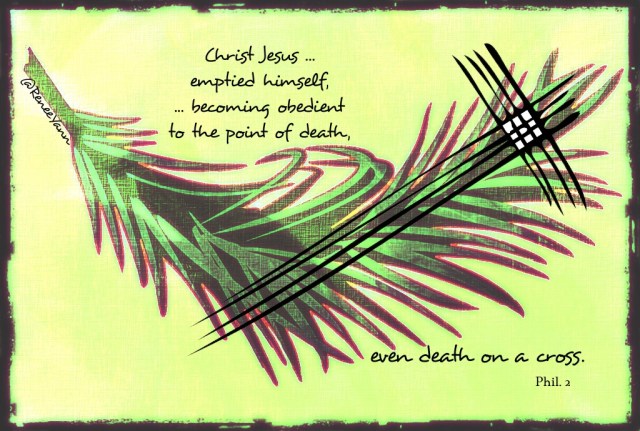
Philippians 2:6-8

The rich treasures of our Holy Week readings and rituals carry us deeper into the eternal current of Love Who is Jesus Christ. We are changed, if we let ourselves, because we witness and believe the Divine Contradiction of the Cross and Resurrection – and we let it happen within our own souls.

Indeed, we are privy to the profound intimacy between Jesus and his Father … between Love Incarnate and Love Enlivening. It is an intimacy we pray to be part of because it changes everything to Love.

Because of this, God greatly exalted him
    and bestowed on him the name
    which is above every name,
    that at the name of Jesus
    every knee should bend,
    of those in heaven and on earth and under the earth,    
    and every tongue confess that
    Jesus Christ is Lord,
    to the glory of God the Father.

Philippians 2: 9-11

In our readings today, and each day this week, try to find the small phrase where your life meets Christ’s journey. Listen with Jesus to the Father’s stunning revelation that Life is accomplished through death to all that is not born of God.

But Jesus cried out again in a loud voice,
and gave up his spirit.
And behold, the veil of the sanctuary
was torn in two from top to bottom.
The earth quaked, rocks were split, tombs were opened,
and the bodies of many saints who had fallen asleep were raised.
And coming forth from their tombs after his resurrection,
they entered the holy city and appeared to many.
The centurion and the men with him who were keeping watch over Jesus
feared greatly when they saw the earthquake
and all that was happening, and they said,
“Truly, this was the Son of God!”

Matthew 27:50-54

Poetry: Primary Wonder – Denise Levertov

Days pass when I forget the mystery.
Problems insoluble and problems offering
their own ignored solutions
jostle for my attention, they crowd its antechamber
along with a host of diversions, my courtiers, wearing
their colored clothes; cap and bells.
                                                        And then
once more the quiet mystery
is present to me, the throng's clamor
recedes: the mystery
that there is anything, anything at all,
let alone cosmos, joy, memory, everything,
rather than void: and that, O Lord,
Creator, Hallowed One, You still,
hour by hour sustain it.

Music: Jerusalem, My Destiny by Rory Cooney

The Other Side of Light

April 1, 2023

Dear Friends,

It feels appropriate that, before we resume gathering together in Lavish Mercy tomorrow, I comment a bit on my time away from the blog.

First, I sincerely thank you all for your prayers and encouragement. In a shadowy time, you gave me the generous lights of comfort and joy. I am deeply grateful.

Now, as I continue to heal from a time of unexpected vulnerability, I have the advantage of being able to reflect in peace on what has happened to me. 

Part of that peace and healing has been a move to our Motherhouse, a loving community where I have the support and care I need right now. I am blessed beyond words by this gift.


This photo was taken in the early 1900s for the Merion Historical Society


My new room is on the very western end of the building (See blue arrow above.) However, I look out my ample windows not to a sunset horizon – but instead to the imposing wall of our magnificent chapel. Some were concerned that the “wall view” might not be optimal. They didn’t realize that the wall housed an unexpected gift – a bird’s eye view of the glorious rose window that, for over a century, has blessed our chapel with dawn Light.

And I am now on the other side of that Light as it flows over my beloved community – a place that feels ever closer to God with each sunrise.


Sometimes, especially in the evening, I will catch a lovely glow within chapel on one of the several stained glass windows. I consider these my own special sunsets given only to me for my unique reflection. These windows are icons for me as I pray and learn from my own little “passover experience” this winter. 

Evening Window from the Outside!

During times of suffering, loss, or unchosen change in our lives, it is hard to turn to the Light. As we begin our Holy Week walk, consider that Jesus faced this struggle in the shadows of Gethsemane. There, he taught us what it takes not only to turn toward Light, but to become It.

Then going out he went, as was his custom, to the Mount of Olives, and the disciples followed him. 

When he arrived at the place he said to them, “Pray that you may not undergo the test.”

After withdrawing about a stone’s throw from them and kneeling, he prayed, saying, “Father, if you are willing, take this cup away from me; still, not my will but yours be done.”

And to strengthen him an angel from heaven appeared to him.

Matthew 22: 40-43

As it was with Jesus, a “Gethsemane moment” in any of our lives is an invitation to abandon ourselves in trust to God’s inscrutable Love — a falling helplessly, but hopefully, into a Love that changes everything.

For Jesus, his embrace of God’s Will in that tenebrous garden opened his heart to the glory of the Resurrection and led him to the other side of Light. How might such self-giving open and lead us?


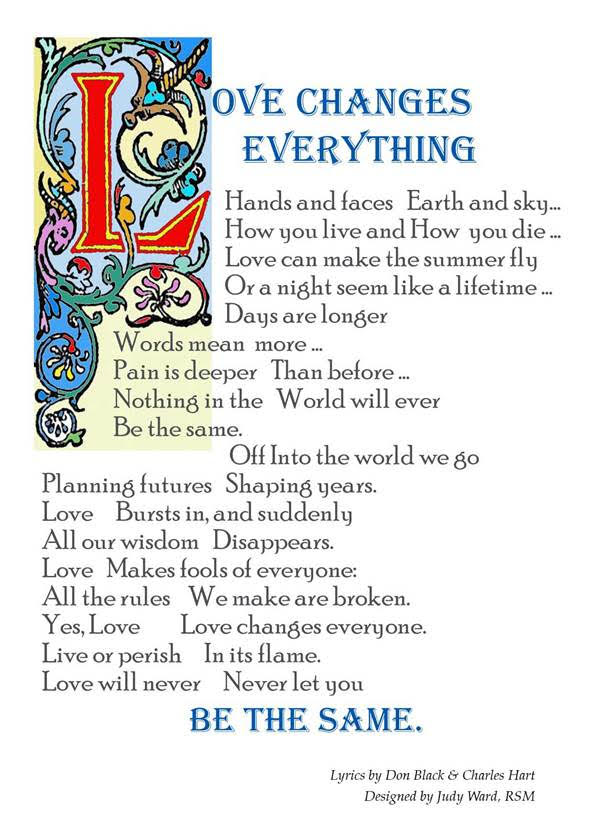
Love Changes Everything – Andrew Lloyd Webber, Don Black, and Charles Hart

Who art Thou, my God…..

Saturday of the Second Week in Ordinary Time

Today’s Readings

https://bible.usccb.org/bible/readings/012123.cfm

Memorial of St. Agnes – January 21, 2023


Today, in God’s Lavish Mercy, we pray with Psalm 47 which describes God as a King ascending to the throne amid shouts of joy.

God mounts the throne amid shouts of joy;
the LORD, amid trumpet blasts.
Sing praise to God, sing praise;
sing praise to our king, sing praise.PSALM 47: 6-7


This description reminds me of a pageant like an inauguration, where fanfare horns announce the President’s arrival. For the psalmist, the horn might have been a shofar.

It’s a beautiful and triumphant way to imagine what God might be like. But that’s all it is – an image, a product of human imagination. Like the psalmist, we all engage in that creative effort – we picture God. We draw God out of the media stored in our own hearts and spirits.


The freedom we have to imagine God can be both a blessing and a curse. As a blessing, it has allowed us to create tender, triumphant, and splendid constructs of an otherwise unimaginable Love. As a curse, it has given us the power to distort God’s image for our own selfish ends.


It is an awesome power. Even the great Saint Augustine struggled with it:

Augustine by Philippe de Champaigne

What art Thou then, my God? 
Most highest, most good, 
most potent, most omnipotent; 
most merciful and most just; 
most hidden and most present; 
most beautiful and most strong, 
standing firm and elusive, 
unchangeable and all-changing; 
never new, never old; 
ever working, ever at rest; 
gathering in and [yet] lacking nothing; 
supporting, filling, and sheltering;
creating, nourishing, and maturing; 
seeking and [yet] having all things. 
And what have I now said, 

my God, my life, my holy joy? 
or what says anyone who speaks of Thee? 
And woe to the one who keeps silent about you, 
since many babble on and say nothing.


Praying with Psalm 47, I consider my own “photo album” of the Holy One. I talk with God about those pictures. I ask to know and love God more clearly, so that, made in God’s image, I may more honestly reflect it.

God has given us the ultimate self-portrait in the Person of Jesus who is:

… the image of the unseen God, 
the firstborn over all creation.COLOSSIANS 1: 15

Poetry: from Paul’s letter to the Philippians 

Have among yourselves the same attitude 
that is also yours in Christ Jesus,
Who, though he was in the form of God,
did not regard equality with God something to be grasped.
Rather, he emptied himself,
taking the form of a slave,
coming in human likeness;
and found human in appearance,
he humbled himself,
becoming obedient to death, even death on a cross.
Because of this, God greatly exalted him
and bestowed on him the name
that is above every name,
that at the name of Jesus
every knee should bend,
of those in heaven and on earth and under the earth,
and every tongue confess that
Jesus Christ is Lord,
to the glory of God the Father.PHILIPPIANS 2: 6-11


Music: Philippians Hymn – John Michael Talbot

The Glorious Community

Friday of the Second Week in Ordinary Time

January 20, 2023

Today’s Readings:

https://bible.usccb.org/bible/readings/012023.cfm

Today, in God’s Lavish Mercy, we pray with Psalm 85, a Psalm we have prayed with so often in our daily liturgy.. Have we wrung it dry, do you think?

Never! That’s the beauty of scripture and particularly of the Psalms. They speak to us in a new voice with each new day’s blessings and challenges.

The verse that grasps my heart this morning is this:

Near indeed is salvation to those who fear God
glory dwelling in our land.PSALM 85: 10


What will “glory”, or well-being, 
look like when it dwells in our land, 
throughout our earth?


Walter Brueggemann, in his many writings about the Old Testament and the Psalms, stresses the concept of “neighborliness” as integral to communal well-being.

The well-being of the neighborhood, inspired by the biblical texts, makes possibleand even insists uponan alternative to the ideology of individualism that governs our society’s practice and policy. This kind of community life returns us to the arc of God’s giftsmercy, justice, and law. The covenant of God in the witness of biblical faith speaks now and demands that its interpreting community resist individualism, overcome commoditization, and thwart the rule of empire through a life of radical neighbor love.
(Description of Brueggemann’s book, God, Neighbor, Empire: The Excess of Divine Fidelity and the Command of Common Good)


Thousands of years ago, the psalmist clearly described the glorious community which God promises to those who live in mercy, truth, justice and peace:

Mercy and truth shall meet;
justice and peace shall kiss.
Truth shall spring out of the earth,
and justice shall look down from heaven.

The LORD  will give benefits;
our land shall yield its increase.
Justice shall walk before the Lord,
and salvation, along the way of God’s pattern.PSALM 85


Prose: In his Inaugural Address, President Biden referenced the concept of neighborliness. Here is the quote from St. Augustine used by the President, as well as the passage from Cicero which inspired Augustine.

If one should say, ‘a people is the association of a multitude of rational beings united by a common agreement on the objects of their love,’ then it follows that to observe the character of a people we must examine the objects of its love.” ST. AUGUSTINE, CITY OF GOD 19.24

A republic is a numerous gathering brought together by legal consent and community of interest. The primary reason for this coming together is not so much weakness as a sort of innate desire on the part of human beings to form communities. For our species is not made up of solitary individuals. CICERO, REPUBLIC, 1.39-40 


Music: After Cicero and Augustine, a little music from our own modern philosopher, Mr. Rogers

Finding Jesus

Thursday of the Second Week in Ordinary Time

January 19, 2023

Today’s Readings

https://bible.usccb.org/bible/readings/011923.cfm

Today, in God’s Lavish Mercy, Mark’s Gospel portrays Jesus in his “heyday”.

heydayjpg

It is early in his ministry. Word is spreading about his teaching and his miracles. He is the “hot ticket” in any town he visits. But what was Jesus thinking in the midst of all the hubbub?

We get a few good hints in our Gospel.

  • Jesus withdrew toward the sea
  • He wanted a boat ready lest the crowd would crush him
  • He warned the unclean spirits not to make him known

These phrases suggest that Jesus was a bit overwhelmed by the furor. No doubt he realizes that his identity and message go far beyond the show of miracles. Can the “fandom” of these early crowds be converted to deep and committed discipleship?

This reading might incline me to consider my own faith. 

Do I love and follow just the “heyday Jesus” – the One who is powerful over the demons and deaths I fear?

Or have I learned to love and follow the deeper Jesus, the One who suffers and dies for justice, goodness and love – the One Who lives in the poor?

One way to answer these questions is to ask ourselves where we find Jesus in our daily lives.

Is he confined to our Bible, our church, our prayerbooks and our moral judgments?

Or is our faith deep enough to see and love him in the suffering face of humanity – perhaps where it is inconvenient, costly and sometimes unsettling to find him?

Poetry: Viriditas by Hildegard of Bingen

I am the one whose praise echoes on high.
I adorn all the earth.
I am the breeze that nurtures all things green.
I encourage blossoms to flourish with ripening fruits.
I am led by the spirit to feed the purest streams.
I am the rain  coming from the dew that causes the grasses to laugh with the joy of life.
I call forth tears. I am the yearning for good.

Good people, Most royal greening verdancy, Rooted in the sun,
You shine with radiant light, in this circle of earthly existence.
You shine so finely, it surpasses understanding.
God hugs you. You are encircled by the arms of the mystery of God.

Music: God of the Poor ~ Graham Kendrick

Law Yields to Love

Wednesday of the Second Week in Ordinary Time
January 18, 2023

Today’s Readings:

https://bible.usccb.org/bible/readings/011823.cfm

Today, in God’s Lavish Mercy,  the writer of Hebrews continues to shine light on the superior “priesthood” of Jesus Christ – that aspect of Christ’s ministry that breaks heaven open for us and reinstates us as God’s children.

heb2 priest

Hebrews calls Christ a priest “according to the order of Melchizedek” – an order above and beyond the priesthood of Aaron and Levi.

Although there are a few references to Melchizedek in scripture, only one narrative refers to him:

After Abram returned from defeating Kedorlaomer and the kings allied with him,
the king of Sodom came out to meet him in the Valley of Shaveh (that is, the King’s Valley).
Then Melchizedek king of Salem brought out bread and wine.
He was priest of God Most High, and he blessed Abram, saying,
“Blessed be Abram by God Most High,
    Creator of heaven and earth.
And praise be to God Most High,
    who delivered your enemies into your hand.”
Then Abram gave him a tenth of everything.

Genesis 14: 17-20

Melchizedek, whose priesthood preceded even Abraham, is offered in Hebrews as a prototype of Jesus who fulfills and perfects the Old Testament promises.

Does this matter to us modern day Christians who can barely say “Melchizedek “, let alone spell it? And if it does matter, how?

An answer may be revealed in our Gospel today. 

In it, Jesus challenges the old, pharisaical, law-bound way of thinking. As the new and perfect “priest”, Jesus breaks that way of thinking with the transformation of love. Jesus is the perfection of that which Melchizedek was only the forerunner.

Then he said to the Pharisees,
“Is it lawful to do good on the sabbath rather than to do evil,
to save life rather than to destroy it?”
But they remained silent.
Looking around at them with anger
and grieved at their hardness of heart,
Jesus said to the man, “Stretch out your hand.”
He stretched it out and his hand was restored.
The Pharisees went out and immediately took counsel
with the Herodians against him to put him to death.

Mark 3:3-6
  • This man with the withered hand is more important than the law. 
  • This act of healing and wholeness is more important than ritual adherence. 
  • The priesthood of Jesus is the breakthrough revelation of what God really desires – mercy, not sacrifice.

Poetry: Excerpt from John Berryman’s Eleven Addresses to the Lord

John Berryman (1914 – 1972) was an American poet and scholar. He was a major figure in American poetry in the second half of the 20th century and is considered a key figure in the “confessional” school of poetry. Eleven Addresses to the Lord describes, with an interplay of sincerity and irony, the poet’s struggle to believe. Section 10 below reveals love over law as a key factor in Berryman’s evolving faith.

10

Fearful I peer upon the mountain path
where once Your shadow passed, Limner of the clouds
up their phantastic guesses. I am afraid,
I never until now confessed.
I fell back in love with you, Father, for two reasons:
You were good to me, & a delicious author,
rational & passionate. Come on me again,
as twice you came to Azarias & Misael.
President of the brethren, our mild assemblies
inspire, & bother the priest not to be dull;
keep us week-long in order; love my children,
my mother far & ill, far brother, my spouse.
Oil all my turbulence as at Thy dictation
I sweat out my wayward works.
Father Hopkins said the only true literary critic is Christ.
Let me lie down exhausted, content with that.

Music: Love Broke Thru ~ Toby Mac

The Promise and Hope

Memorial of Saint Anthony, Abbott
January 17, 2023

Today’s Readings:

https://bible.usccb.org/bible/readings/011723.cfm

Today, in God’s Lavish Mercy, our passage from Hebrews is a strong encouragement to stay faithful to the hope that has been given us through our call.

eph1_17 call

Paul traces the evolution of that call by reminding his readers of Abraham who trusted God’s promise and patiently waited for its fulfillment. Paul says that God not only promised Abraham, God swore an oath to bless and multiply Abraham’s life.


This promise and oath of God’s faithful covenant is the root of our Christian hope, and the “anchor” of our life.

Green Rope

When we have been promised something by someone we trust, we are given the gift of freedom to move forward in confidence. I’ll give you a very simple and human example. When I had my first knee replacement, my very appropriately-named surgeon Dr. Good came and sat at my bedside immediately before surgery. He told me that he was going to perform the surgery himself and that he would support me until I was completely recovered. I can’t describe the freedom and confidence his promise gave me!

Now take that kind of promise up a notch — an infinite number of notches — to a promise made by God.

So when God wanted to give the heirs of his promise
an even clearer demonstration of the immutability of his purpose,
he intervened with an oath,
so that by two immutable things,
in which it was impossible for God to lie,
we who have taken refuge might be strongly encouraged
to hold fast to the hope that lies before us.
This we have as an anchor of the soul,
sure and firm, which reaches into the interior behind the veil,
where Jesus has entered on our behalf as forerunner…

Hebrews 6:17-18

Paul’s language might seem a little dense to us but basically he is saying that God has promised to be with us forever and to bring us to the fullness of eternal life. Thinking about that, the image of Dr. Good pops up in my memory.

In your own prayer, you might recall a circumstance that gave you the same kind of promised confidence and peace… perhaps a parent who consoled your young doubts, or a friend who promised support in a difficulty. Imagine that feeling multiplied infinitely by the loving promise of God to sustain us with Eternal Life.


Poetry: Anchored to the Infinite – Edwin Markham was popular American literary figure during the first half of the 20th century whose works espoused progressive social and spiritual beliefs.

The builder who first bridged Niagara’s gorge,
Before he swung his cable, shore to shore,
Sent out across the gulf his venturing kite
Bearing a slender cord for unseen hands
To grasp upon the further cliff and draw
A greater cord, and then a greater yet;
Till at the last across the chasm swung
The cable then the mighty bridge in air!
So we may send our little timid thought
Across the void, out to God’s reaching hands—
Send out our love and faith to thread the deep—
Thought after thought until the little cord
Has greatened to a chain no chance can break,
And we are anchored to the Infinite!

Music: Blessed Assurance – written by Fanny Crosby (1820 – 1915) an American mission worker, poet, lyricist, and composer. She was a prolific hymnist, writing more than 8,000 hymns and gospel songs, with more than 100 million copies printed. She is also known for her teaching and her rescue mission work. By the end of the 19th century, she was a household name. Crosby was known as the “Queen of Gospel Song Writers” and as the “Mother of modern congregational singing in America”, with most American hymnals containing her work.

Pray for the Church

Monday of the Second Week in Ordinary Time
January 16, 2023

Today’s Readings:

https://bible.usccb.org/bible/readings/011623.cfm

Today, in God’s Lavish Mercy, our reading from Hebrews describes Jesus as the perfect high priest.  Through the Father’s call, Jesus took on our imperfect nature and transformed it by his Life, Death and Resurrection. In the Eucharist, Jesus left us a living memorial of this transformation so that we might participate in its saving mystery.

heb5_10 priest

Paul’s “perfected priest” is patient because his own weakness humbles him. He does not take honor upon himself, but receives it humbly from God.

Jesus, the model of this priesthood, 

… in the days when he was in the Flesh,
… offered prayers and supplications with loud cries and tears
to the one who was able to save him from death,
and he was heard because of his reverence.


The perfection of Christ’s priesthood was accomplished through suffering and obedience. This is how Jesus teaches us to live in reverence and humble service.

As I read and pray with this scriptural understanding of priesthood, I pray for our Church. The catastrophic scandals involving our priests and leaders have deeply shaken the faith of many Catholics over the past several years.

Many are frustrated by the continued refusal of some in our Church to open themselves to new models of priestly service which are grounded in mutuality, inclusivity and simplicity.

The accretions of institutionalization, hierarchical camouflage, and sexist rationale have mitigated the Church’s credibility to touch the lives of ordinary people, especially our emerging adults.


In our Gospel, Jesus talks about an old cloak that needs a patch to make it whole again. He talks about new wine that must be captured and preserved in new wine skins. For me, he is talking about our Church which must be continually renewed and grounded in the truth of the Gospel.

Let us pray that the Church may continue to be transformed by humble obedience to God’s call – just as the high priest of our first reading was perfected.

Let us pray today for our good Pope Francs, bishops, theologians and spiritual leaders – and for the whole People of God – that we may hear and respond.


Prayer: In place of a poem today, this beautiful prayer written in 2019 by Rita Thiron, from the Federation of Diocesan Liturgical Commissions

Prayer for the Church

Heavenly Father,
In every age, you have been our refuge. 
Yet again and still, we stand before you 
asking for your protection on your holy Church.

For the victims of abuse and their families, 
pour out your healing and your peace.
For the Bishops of this country, 
inspire their decisions, 
and guide them with your Spirit.

For the thousands of good and faithful priests, 
who have followed your call 
to serve you and your people in holiness,
sustain them by your grace.

For the faithful who are angry, confused, 
and searching for answers, 
embrace them with your love,
restore their trust,
console them with your clear Gospel message, 
and renew them with your sacraments.

We place our Church in your hands, 
for without you we can do nothing.

May Jesus, our High Priest and true compass, 
continue to lead her in every thought and action
 – to be an instrument of justice,
a source of consolation,
a sacrament of unity,
and a manifestation of your faithful covenant.

Grant this through that same Jesus Christ, our Lord, 
who lives and reigns with you
in the unity of the Holy Spirit,
one God, for ever and ever.
Amen.

Music: Even Death on a Cross ~ Jason Silver

I Come to Do Your Will

Second Sunday in Ordinary Time
January 15, 2023

Today’s Readings

https://bible.usccb.org/bible/readings/011523.cfm

Today, in God’s Lavish Mercy, we see Jesus fully enrobed in the power of his mission and ready to embark on its accomplishment.


When I prayed with today’s readings, I pictured Jesus standing proudly before the Father saying, “I’m fully ready now to answer the call and become all that I am meant to be for the world.”

The image reminded me of a day long ago when I finally received the last little piece of the outfit I would wear as Mercy postulant. It was late August 1963, just a month before entrance, and very hot. Nevertheless, in a bit of girlish giddiness, I decided to don the entire regalia for the first time and see what my future would look like. After struggling into a few of the unfamiliar pieces, I ran down the stairs to my mother waiting in our living room.

I’ll never forget her face. It was an immense mix of pride, loss, hope, love and astonishment. Neither one of us said, nor had to say, a word. Everything that had been only a dream in my heart went forward – for real – from that moment. Mom knew I meant to do this thing. And, maybe for the first time, I knew it too.

I can picture God the Father looking on Jesus in somewhat the same way as Jesus now stands at the edge of a future he cannot yet imagine.


In our first reading, we see Jesus clothed in the fulfillment of Isaiah’s ancient prophecy:

The LORD said to me: You are my servant,
Israel, through whom I show my glory.
Now the LORD has spoken
who formed me as his servant from the womb,
that Jacob may be brought back to him
and Israel gathered to him;
and I am made glorious in the sight of the LORD,
and my God is now my strength!

Isaiah 49:3,5

In our Responsorial Psalm, we can hear Jesus exuding Messianic commitment:

Here I am, Lord; I come to do your will.
“In the written scroll it is prescribed for me,
to do your will, O my God, is my delight,
and your law is within my heart!”
I announced your justice in the vast assembly;
I did not restrain my lips, as you, O LORD, know.
Here am I, Lord; I come to do your will.


In John’s Gospel, John the Baptist stands as a witness to Christ’s messianic authority to execute the Redemptive Act promised in Isaiah:

It is too little, the LORD says, for you to be my servant,
to raise up the tribes of Jacob,
and restore the survivors of Israel;
I will make you a light to the nations,
that my salvation may reach to the ends of the earth.

Isaiah 9:6

John testified further, saying,
“I saw the Spirit come down like a dove from heaven
and remain upon him.
I did not know him,
but the one who sent me to baptize with water told me,
‘On whomever you see the Spirit come down and remain,
he is the one who will baptize with the Holy Spirit.’
Now I have seen and testified that he is the Son of God.”

John 1:32-34

With today’s readings, Jesus begins the great journey to redeem us. We begin with him, praying that throughout this liturgical year, we may be ever more deepened in the grace of that Redemption.


Poetry: The Lamb – William Blake

Little Lamb who made thee
Dost thou know who made thee
Gave thee life & bid thee feed.
By the stream & o'er the mead;
Gave thee clothing of delight,
Softest clothing wooly bright;
Gave thee such a tender voice,
Making all the vales rejoice!
Little Lamb who made thee
Dost thou know who made thee

Little Lamb, I'll tell thee,
Little Lamb, I'll tell thee!

He is called by thy name,
For he calls himself a Lamb:
He is meek & he is mild,
He became a little child:
I a child & thou a lamb,
We are called by his name.
Little Lamb God bless thee.

Music: Here I Am, Lord – written by Dan Schutte, sung here by John Michael Talbot (lyrics below)

I, the Lord of sea and sky
I have heard my people cry
All who dwell in dark and sin
My hand will save

Here I am, Lord. Is it I, Lord?
I have heard you calling in the night
I will go, Lord, if you lead me
I will hold your people in my heart

I, who made the stars of night
I will make their darkness bright
Who will bear my light to them?
Whom shall I send?

I, the Lord of snow and rain
I have borne my people’s pain
I have wept for love of them
They turn away

I will break their hearts of stone
Give them hearts for love alone
I will speak my words to them
Whom shall I send?