The Wish to Climb

Tuesday of the Thirty-third Week in Ordinary Time
November 15, 2022

Today’s Readings:

https://bible.usccb.org/bible/readings/111522.cfm

Today in God’s Lavish Mercy, the author of Revelation says some pretty tough stuff in the name of God!

To the Church at Sardis:
You have the reputation of being alive, but you are dead.

To the Church at Laodicea:
Because you are lukewarm, neither hot nor cold,
I will spit you out of my mouth.

As most of us know from experience, it’s never really easy to accept negative feedback.  But, couched in gentle, encouraging tones, it can be accepted and acted on. John of Patmos, author of Revelation, missed that lesson in coaching techniques! 

How effective his words were with the under-performing churches is a matter left to history. For us, they may perhaps inspire us to be more honest with ourselves regarding our vitality and ardor for the Gospel.


zaccheus

In our Gospel, Jesus takes a different approach to inspire repentance and commitment. His inclusive, forgiving words to Zaccheus proved very effective.  Jesus doesn’t even address any shortcomings (not to make a pun) in Zaccheus.

He simply says, “Come down from your tree.  I’m coming to your house for dinner.” In other words, I’m coming into your life — now what’s your response?

Zaccheus is radically changed by Jesus’s lavish mercy. He responds,

“Behold, half of my possessions, Lord, I shall give to the poor,
and if I have extorted anything from anyone
I shall repay it four times over.”

Today, we pray to have a simple, trusting faith. Sometimes, like Zaccheus, we get ourselves “up a tree”, all twisted and stretching to find God – or maybe to ignore God – in our lives. And all the time, God has been walking straight down the path of our heart, smiling at our efforts, planning to stay with us tonight, tomorrow and forever.


Poetry: AND HAVE YOU ALSO WISHED – Leonard Nathan (1924 – 2007) an American poet, critic, and professor emeritus of rhetoric at the University of California, Berkeley. Among other honors, he received the National Institute of Arts and Letters prize for poetry, a Guggenheim Fellowship, the Phelan Award for Narrative Poetry.

And have you also wished to leave the world
of unforgiving surface and hard time,
to enter mist and climb an autumn slope,
becoming all but invisible below
a gray and dripping baldachin of boughs
that lead to the little clearing in the woods
where much will be revealed, what love and dreams
had promised before you woke and had to leave?
And have you, even as you wished this all,
passionately wished it, nevertheless continued
in the old direction, stretching out
and out to dust, foregone and trampled flat,
because you were told to once or because—who knows—
you said you would, or something shallow as that?

Music: Zaccheus – Medical Mission Sisters:
The Divine Adventure

Monday of the Thirty-third Week in Ordinary Time
November 14, 2022

Today’s Readings:

https://bible.usccb.org/bible/readings/111422.cfm

Today, in God’s Lavish Mercy, we earnestly begin the Book of Revelation. These twelve days of passages will close out the liturgical year before Advent.

Rev 2_4 first love

The Book of Revelation, also commonly known as the Apocalypse, is one of the most controversial in the Bible. Scholars disagree as to its author, its meaning, its literary genre and even its place in the biblical canon.

Wherever we might fall in this spectrum of interpretations, the book still can inspire us to prayer and reflection.

In today’s passage, the author addresses the first of seven churches to whom he will write – the church at Ephesus. He praises them and says that God is pleased with their work, their endurance and their fidelity. That must have made them feel pretty good, right?

But then, the heart-breaking line:

Yet I hold this against you:
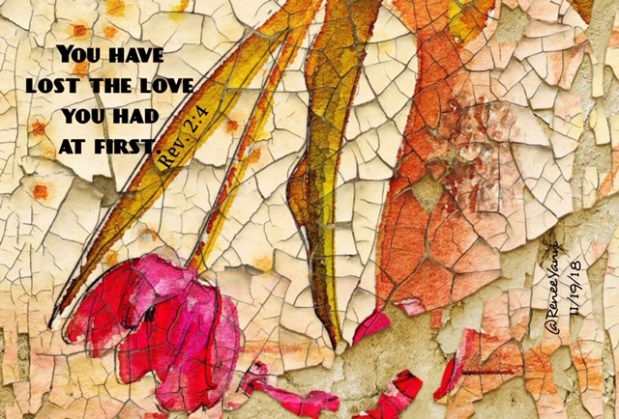
you have lost the love you had at first.

We might easily find ourselves in this passage. We’re trying hard to be faithful Christians. But, depending on where we are in our lives, have we lost that first fervor?

The continual grind of work, ministry, family and community responsibility can dim that first fire. Maybe the fresh flower has been choked in the daily weeds. Just the accumulation of years may obscure it. Just the unnoticed indifference within and around us can smother the love that once propelled us to choose God as our Everything.


Perhaps with the blind person in our Gospel, we might beg God to let us see where our faith has become dim or even blinded:

The people walking in front rebuked the blind man,
telling him to be silent,
but he kept calling out all the more,
“Son of David, have pity on me!”
Then Jesus stopped and ordered that he be brought to him;
and when he came near, Jesus asked him,
“What do you want me to do for you?”
He replied, “Lord, please let me see.”
Jesus told him, “Have sight; your faith has saved you.”

Luke 18:39-42

Today, let’s try to remember that first love which turned our hearts to God and to God’s work in the world. Let’s ask our generous God, Who longs for our love, to renew our passion and energy for the Divine Adventure.


Poetry: Consumed in Grace – Catherine of Siena

This poem is from a wonderful book which I highly recommend to you:

I first saw God when I was a child, six years of age.
The cheeks of the sun were pale before Him,
and the earth acted as a shy
girl, like me. 

Divine light entered my heart from His love
that did never fully wane, 

though indeed, dear, I can understand how a person’s
faith can at times flicker, 

for what is the mind to do
with something that becomes the mind’s ruin:
a God that consumes us
in His grace.

I have seen what you want;
it is there,
a Beloved of infinite
tenderness.

Music: Power of Your Love – Hillsongs

 Renee Yann, RSM  Disciples

The End Times

Thirty-third Sunday in Ordinary Time
November 13, 2022

Today’s Readings:

https://bible.usccb.org/bible/readings/111322.cfm

Today, in God’s Lavish Mercy, our readings carry the full flavor of the “end times” warnings, those repeated annually as we move closer to Advent (which is only two weeks away!) When I was a kid, these readings scared me. And now, even as an elder, I’m not particularly in love with them!

But, nevertheless, you gotta’ love Malachi! What a powerful poet! His message of impending judgement and necessary repentance definitely hits the mark.

Lo, the day is coming, blazing like an oven,
 when all the proud and all evildoers will be stubble…

Malachi 3:19

Wow! Really? Depending on where we stand in our moral life, our reaction to this announcement might range from:

Good! Go get ‘em, God!” 

to

Oh, dear God, I hope it’s not me!!!”.


Nobody wants to be “stubble” when the final fires blaze. So how can we avoid that? Paul resets us on the right track, from both “cheer” and “fear” to commitment. He instructs his readers to do their job, living and honest simple lives. He says something like this:

Listen! You must imitate your teachers in Christ.
Live with integrity, justice and generous mercy.
Navigate the world with these as your compass.
Then you will welcome the end times.


Lk21_19 perseverance

In Luke’s Gospel, Jesus offers an equally dire prediction of the end times. When we read the list of disasters and betrayals Jesus describes, we must admit that every one of them occurs somewhere in our world everyday. In essence, we already live in the “end times”, trying to welcome and foster Divine Grace in our piece of the universe.


Photo by Stas Knop on Pexels.com

Today’s readings are an alarm clock. They call us to recognize the geopolitical world we live in as the emerging Realm of God, and to do our part to bring that realm to full realization.

It is likely impossible to communicate God’s vision for the world in the language of politics.  Scripture offers us the transcendent gift of the eloquent prophets Malachi and Jesus describing not only their own times but ours as well.


Walter Brueggemann says this:

The prophet’s task is to imagine the world as though Yahweh, the God of Israel and the creator of heaven and earth, were a real character and a lively agent in the life of the world.  I believe that such a claim, then and now, has to be articulated poetically in order not to be co-opted by political absolutism or theological orthodoxy.

Our readings today give us this poetic vision and challenge. Read them with great longing to hear God’s voice for our times. The world so sorely needs the answer that will blossom by the perseverance of our lives.


Poetry: A Song on the End of the WorldCzeslaw Milosz

Czeslaw Milosz ranks among the most respected figures in 20th-century Polish literature, as well as one of the most respected contemporary poets in the world: he was awarded the Nobel Prize for Literature in 1980. 

On the day the world ends
A bee circles a clover,
A fisherman mends a glimmering net.
Happy porpoises jump in the sea,
By the rainspout young sparrows are playing
And the snake is gold-skinned as it should always be.

On the day the world ends
Women walk through the fields under their umbrellas,
A drunkard grows sleepy at the edge of a lawn,
Vegetable peddlers shout in the street
And a yellow-sailed boat comes nearer the island,
The voice of a violin lasts in the air
And leads into a starry night.

And those who expected lightning and thunder
Are disappointed.
And those who expected signs and archangels’ trumps
Do not believe it is happening now.
As long as the sun and the moon are above,
As long as the bumblebee visits a rose,
As long as rosy infants are born
No one believes it is happening now.

Only a white-haired old man, who would be a prophet
Yet is not a prophet, for he’s much too busy,
Repeats while he binds his tomatoes:
There will be no other end of the world,
There will be no other end of the world.

Warsaw, 1944


Music:  Let Justice Roll – video of the Salvation Army

Living Justice

Memorial of St. Josaphat
Saturday, November 12, 2022

Today’s Readings

https://bible.usccb.org/bible/readings/111222.cfm

Today, in God’s Lavish Mercy, our readings carry the themes of perseverance in prayer and commitment to Gospel justice.

Familiar Psalm 112 draws the theme forward for us.

That theme is justice, 
and what it really means for us in our daily lives.

Wealth and riches shall be in the blessed one’s house;
where generosity shall endure forever.
Light shines through the darkness for the upright;
who is gracious and merciful and just.

Psalm 112:3-4

In secular culture, the words “justice” and “law” carry very different interpretations from biblical meanings. In the Bible, justice is that right-balance of Creation in which all beings support one another in the fullness of God’s love.

It is a balance which we all must help achieve, as we see in our first reading from John. In this unique letter, addressed to only one person – a Christian named Gaius, – John requests material help for his early missionaries.

Beloved, you are faithful in all you do for the brothers and sisters,
especially for strangers;
they have testified to your love before the Church.
Please help them in a way worthy of God to continue their journey.

Such requests mark the life of the Church throughout the ages, because our call in Christian community is about helping one another to live a full life in Christ. We could easily read John’s plea as a plea to us, especially in these times of seeking just global immigration and economic policies.


In our Gospel, Jesus tells a parable which is overtly about prayer. But it carries deep themes of the justice God desires for all people, especially the vulnerable:

Will not God then secure the rights of God’s chosen ones
who call out day and night? 
Will God be slow to answer them? 
I tell you, God will see to it that justice is done for them speedily. 
But when the Son of Man comes, will he find justice on the earth?

Luke 18: 7-8

Practicing justice and righteousness means active advocacy for the vulnerable. It means doing the works of mercy as a way to love God.

Light shines through the darkness for the upright;
that person is gracious and merciful and just.
It is well for the one who is gracious and lends,
who lives a graceful justice;
they shall never be moved;
the just ones shall be in everlasting remembrance.

Psalm 112: 3-6

Poetry from Micah 6:8


Music: Seek Justice; Love Mercy – by Me in Motion

 Renee 

Lead by Love

Memorial of St. Martin of Tours
November 11, 2022

Today’s Readings:

https://bible.usccb.org/bible/readings/111122.cfm

Today, in God’s Lavish Mercy, our first reading is from John’s very brief second epistle.

This is a fascinating passage. It is addressed to “Kyria”, Greek for “Lady”. The contents encourage this revered lady to keep herself and her household true to Christ.

But now, Lady, I ask you,
not as though I were writing a new commandment
but the one we have had from the beginning:
let us love one another.
For this is love, that we walk according to his commandments;

2 John 5-6

Reading the passage, one wonders who “Kyria” is. At least three theories exist among scholars:

  • an actual religious leader 
  • a metaphor for the Church 
  • Mary, Mother of Jesus

The letter is beautifully personal in tone, so I like to think that Kyria was, indeed, an influential church leader and John’s beloved friend. So often, the names of early Christian women leaders are lost to history. Whether they were omitted in the original texts, or erased by subsequent misogynistic translators, we can only surmise. But the absence has served to support the misperception that women are of lesser consequence in the Church.


As we read 2 John, we can be aware of the major themes he entrusted to dear “Kyria”, whoever she might have been, to be transmitted to her household:

  • Truth is expressed through love, modeled to us in Jesus.
  • Obedience to God is expressed through service in God’s name.
  • Guard against any who distract you from these teachings.

Poetry: Seek Truth – Rumi

If you never searched for truth 
come with us 
and you will become a seeker. 

If you were never a musician 
come with us 
and you will find your voice… 

In our gathering one candle lights hundreds, 
we will light your path and give you courage 
so you will open like a flower 
and join in joyous laughter. 

Plant the seed of truth and watch it grow 
when it spreads its branches 
come with us and sit under the blossoms. 

Your eyes will open to the secret of the truth.


Music: Kyria (Lady) is the feminine form of Kyrie , as in “Kyrie eleison” (Lord, have mercy).

So the music I thought of for today is the magnificent Kyrie Eleison from Charles Gounod’s Mass for St. Cecilia.

Share this:

Invisible Presence

Memorial of St. Leo the Great
November 10, 2022

https://bible.usccb.org/bible/readings/111022.cfm

Today, in God’s Lavish Mercy, Jesus tells us a secret about the Kingdom of God:

“The coming of the Kingdom of God
cannot be observed,
and no one will announce,
‘Look, here it is,’ or, ‘There it is.’
For behold, the Kingdom of God
is among you.”

And it remains a bit of a secret, even after He tells it, because it is often very hard to discern the “Kingdom among us”. There is nothing more invisible than something hiding in plain sight.

Lk17_21JPG

Through prayer, we discover that it is about our eyes – not about visibility. It is about the power of grace within us to see beyond appearances. We need a soul that can “peel the onion” of experience to find the face of God resident within all things.

  • With that kind of eyes, you don’t just have a business meeting today.
    You have an opportunity to build God’s Kingdom through respect, encouragement and mutuality.
  • You don’t just pass a person begging on the corner.
    You walk near Christ himself accompanying a broken spirit.
  • You don’t just encounter the hurts and challenges of your life.
    You are invited by God into a living faith that finds God’s will in all things.
  • You don’t live in the world with just other creatures.
    You meet and honor the Divine Presence in every living thing.

Indeed, the Kingdom of God is right here among us.

May we see it!
May we treasure it!
May we reveal it!


Photo by Johannes Plenio on Pexels.com

Poetry: In No Strange Land – Francis Thompson

O world invisible, we view thee,
O world intangible, we touch thee,
O world unknowable, we know thee,
Inapprehensible, we clutch thee!

Does the fish soar to find the ocean,
The eagle plunge to find the air—
That we ask of the stars in motion
If they have rumour of thee there?

Not where the wheeling systems darken,
And our benumbed conceiving soars!—
The drift of pinions, would we hearken,
Beats at our own clay-shuttered doors.

The angels keep their ancient places;—
Turn but a stone and start a wing!
’Tis ye, ’tis your estrangèd faces,
That miss the many-splendoured thing.

But (when so sad thou canst not sadder)
Cry;—and upon thy so sore loss
Shall shine the traffic of Jacob’s ladder
Pitched betwixt Heaven and Charing Cross.

Yea, in the night, my Soul, my daughter,
Cry,—clinging to Heaven by the hems;
And lo, Christ walking on the water,
Not of Genesareth, but Thames!


Music:  Let Your Kingdom Come – Tommy Walker

A Parish Church

Feast of the Dedication of the St. John Lateran Basilica in Rome
November 9, 2022

Today, in God’s Lavish Mercy,  we celebrate a rare type of feast day – one that marks the dedication of a church building.  For many, that seems a little odd. We are accustomed to celebrating Mary, Joseph and other saints and feasts of Our Lord.

Here’s the thing: we are not actually celebrating a building.  We are celebrating what the building represents – the Body of Christ, the Church, made of living stones – us.

But sometimes it helps to have visible symbols of the things we venerate and celebrate. That’s why we have medals, rosary beads and candles – so that we can SEE something as we try to conceptualize a spiritual reality.


As we pray today, we might take time to remember the parish church of our youth. You might never love another parish like you loved that one – where you and your little friends snuck a whisper in the pews. Or – even now and again – maybe you fell off the kneeler in a stifled giggle as some neighbor lady leaped into soprano at the Miraculous Medal Novena.


Still, it might have been the place where we first prayed and first began to approach the beauty and wonder of God.

My memories are filled with unrepeatable treasures like:

  • our wonderful Sisters of St. Joseph, who at early morning Masses pre-Vatican II,
    mystically lowered their veils over their eyes on the way to Communion.
    I so wondered what their prayer was like!
  • the lingering smell of incense, beeswax, and holiness lingering in every corner,
    speaking a prayer for me that had no words
  • our very faithful and good priests
  • the beautiful Latin chants and prayers during which you had no idea what you were saying,
    but you knew exactly what you meant: God is Wonderful!
  • our old Irish pastor whose brogue was so thick we could not decipher a word except
    “Feast of the Great St. Patrick, boys and girrrrls! No school today!”

St. John Lateran is the Pope’s parish church. Since he is the Bishop of the whole People of God, his physical church has come to symbolize the universal Body of Christ, the world Church.

john lateran

Pope Benedict XVI in his Angelus Address, on November 9, 2008 said this:

Dear friends, today’s feast celebrates a mystery that is always relevant: God’s desire to build a spiritual temple in the world, a community that worships him in spirit and truth (cf. John 4:23-24).
But this observance also reminds us of the importance of the material buildings in which the community gathers to celebrate the praises of God.
Every community therefore has the duty to take special care of its own sacred buildings, which are a precious religious and historical patrimony. For this we call upon the intercession of Mary Most Holy, that she help us to become, like her, the “house of God,” living temple of his love.

st j lateran

As we pray today, we might want to consider the gift of faith on which our own lives are built – a faith whose cornerstone is Jesus Christ. In our second reading, Paul says this:

Brothers and sisters:
You are God’s building…..
Do you not know that you are the temple of God,
and that the Spirit of God dwells in you?

And in our Gospel, Jesus speaks of his own body as a temple which, though apparently destroyed by his enemies, will be raised up in three days.

By our Baptism, that same spiritual temple lives in us and in all the community of faith. That same power of Resurrection is alive in us! So in a very real sense, what we celebrate today is ourselves – the Living Church – raised up and visible as a sign of God’s Life in the world.

Happy Feast Day, Church!


Poetry: Sunday Morning – Ruby Archer (1873-1961) was an American port

How sweet to wait within a holy place
The hour of song and prayer,
To yield the heart unto a spell of grace,
Serenely brooding like a presence there. 

The hymns that live within the organ’s heart,
Flow silent o’er the soul;
Unsounded echoes from the memory start,
Like mystic writing from an angel’s scroll. 


Music: Cornerstone – Hillsong

The Light

Tuesday of the Thirty-second Week in Ordinary Time
November 8, 2022

Today’s Readings:

https://bible.usccb.org/bible/readings/110822.cfm

Today, in God’s Lavish Mercy, our readings carry a few strident tones. 

The description of the perfect Christian household in Paul’s world feels a little uncomfortable for us in today’s culture:

Similarly, older women should be reverent in their behavior,
not slanderers, not addicted to drink,
teaching what is good, so that they may train younger women
to love their husbands and children,
to be self-controlled, chaste, good homemakers,
under the control of their husbands,
so that the word of God may not be discredited.

We understand what Paul was driving at – harmonious, loving and faith-filled families that would nurture the growing Church. But times, attitudes, and understandings change, and the words don’t work so well today.


Our Gospel presents a bit of the same discomfort. It’s hard for us to relate to servanthood, slavery, and unequal accessibility to “the table”.

Jesus said to the Apostles:
“Who among you would say to your servant
who has just come in from plowing or tending sheep in the field,
‘Come here immediately and take your place at table’?
Would he not rather say to him,
‘Prepare something for me to eat.
Put on your apron and wait on me while I eat and drink.
You may eat and drink when I am finished’?


Sometimes the “dissonance” of words or cultural concepts in ancient scriptures might cause us too miss the point. Here’s what I found once I cracked through these passages in my prayer.

  • From Titus:

A deep self-respect and
a reverent mutuality in our relationships
allow God’s Presence to be felt in the world.
They are the signs that draw others to grace.

  • From Luke:

We don’t “deserve” anything from God.
All that God gives us is given
in lavish mercy and infinite generosity.
Everything we are and have is GIFT.
Therefore we are bound in gratitude
to live in love and worship,
and to work for the wholeness of all Creation.


Poetry and Music:

Enjoy the poetry of the mystic Rumi, words very much in the tone of John of Cross.

Choosing Goodness

Monday of the Thirty-second Week in Ordinary Time
November 7, 2022

Today’s Readings:

https://bible.usccb.org/bible/readings/110722.cfm

Today, in God’s Lavish Mercy, our readings raise and answer some powerful questions. How does faith inspire moral responsibility? What is the relationship between moral commitment and leadership? How do we measure a person’s “communal righteousness”?

Paul asks these questions with respect to bishops and presbyters, and the standards are stringent – extending even to the leader’s family.

… appoint presbyters in every town, as I directed you,
on condition that a man be blameless,
married only once, with believing children
who are not accused of licentiousness or rebelliousness

In our Gospel, Jesus is direct and practical about how morally good a leader needs to be:

Jesus said to his disciples,
“Things that cause sin will inevitably occur,
but woe to the one through whom they occur.
It would be better for him if a millstone were put around his neck
and he be thrown into the sea
than for him to cause one of these little ones to sin.

Choosing leaders, trusting them, moving forward with them to a chosen future is something we do not only in our faith communities, but also in the civic arena. Even though we try mightily to separate religion and politics, these will inevitably touch because they so significantly affect the human person.

I find it interesting that these readings permeate my thoughts and prayers as many of us in the United States prepare to vote tomorrow. How might my faith direct me to choose those candidates who lead toward inclusivity, peace, mutual charity, and care for the vulnerable?

What I need as I ponder these questions is exactly what the disciples requested of Jesus. In our Gospel, Jesus instructs the disciples on sin, repentance and forgiveness — all of which we encounter within the struggling community of faith. Hearing him, the  disciples immediately realize what it is they most need to engage the challenges before them:

Lord, increase our faith!

Let us join their prayer today for unity and love in our faith and civic communities.


Thought: By voting, we help answer Pope France’s prayer:

I beg the Lord to grant us more politicians 
who are genuinely disturbed
by the state of society,
the people, the lives of the poor!

Joy of the Gospel (205)

 Renee Yann, RSM

A God-aligned Heart

Thirty-second Sunday in Ordinary Time
November 6, 2022

Today’s Readings

https://bible.usccb.org/bible/readings/110622.cfm

Today, in God’s Lavish Mercy, one theme threaded through our readings is that of “The Law”.

“Law” is a frustratingly elastic word and concept which runs the gamut from tyranny to benevolent guidance depending on who administers it.

2thess3_5 scale

In both our first reading and our Gospel, we find people trying to curtail the freedom of others by invoking the Law. In 2 Maccabees, King Antiochus attempts to incorporate the Jewish people by fracturing their religious practice, that which identifies and unites them as Jews. On the surface, the story seems to be about eating pork, and one might wonder if that resistance is worth dying for.

But the real conflict is between tyrannical domination and spiritual freedom, between “Empire” and “Kingdom” – a struggle we have seen endlessly repeated through history and current events.

When “law” is interpreted to advantage some and suppress others, it is no longer law. The essence of law is always the wise administration of mercy balanced with justice. The understanding of such law grows from covenanted relationship with the Creator who wills the good and wholeness of all Creatures.


In today’s Gospel, some Sadducees (perhaps sincere, but more likely trying to trap Jesus) ask him to solve a hypothetical problem regarding marriage in the afterlife.

Jesus doesn’t bite. He explains to the questioners that eternal life transcends all their human perceptions of time, relationship and law. The earthly laws by which we either bind or free one another in this world evaporate in Heaven. Only Mercy and Justice order eternal life in the Kingdom of God. ultimately, “law” is alignment of heart with God’s.


Paul tells us that we are called to be examples of that eternal kingdom now. He knows how hard it is, and so he blesses us:

May our Lord Jesus Christ himself and God our Father,
who has loved us and given us everlasting encouragement
and good hope through his grace,
encourage your hearts and strengthen them in every good deed
and word.


May God’s law of love align our hearts
so that we
– like the Maccabees, like Jesus –
will have the courage and strength to live it
in a sometimes hostile world.


Poetry: The Higher Pantheism – Alfred, Lord Tennyson

The sun, the moon, the stars, the seas, the hills and the plains,- 
Are not these, O Soul, the Vision of Him who reigns?
 
Is not the Vision He, tho’ He be not that which He seems? 
Dreams are true while they last, and do we not live in dreams? 

Earth, these solid stars, this weight of body and limb, 
Are they not sign and symbol of thy division from Him? 

Dark is the world to thee; thyself art the reason why, 
For is He not all but thou, that hast power to feel “I am I”? 

Glory about thee, without thee; and thou fulfillest thy doom, 
Making Him broken gleams and a stifled splendour and gloom. 

Speak to Him, thou, for He hears, and Spirit with Spirit can meet- 
Closer is He than breathing, and nearer than hands and feet. 

God is law, say the wise; O soul, and let us rejoice, 
For if He thunder by law the thunder is yet His voice. 

Law is God, say some; no God at all, says the fool, 
For all we have power to see is a straight staff bent in a pool; 

And the ear of man cannot hear, and the eye of man cannot see; 
But if we could see and hear, this Vision-were it not He? 


Music: The Law of the Lord is Perfect