Today, in God’s Lavish Mercy, we pray with Psalm 146, a call to praise God. The call is supported by the particular verses of today’s reading. We should praise God, the psalmist says, because God:
secures justice for the oppressed
gives food to the hungry
sets captives free
gives sight to the blind
raises up the humble
loves the just
protects strangers
sustains fatherless and the widow
thwarts the way of the wicked
Reading this elaborate hymn of praise makes one think the Lord was pretty busy in ancient Israel. Were all these good things happening for otherwise unfortunate people?
For me, this psalm, rather than being a retrospective list of God’s generous accomplishments, is a call to realize the way God wants things to be. Within that call is another deeper call – to become an agent for God’s Will for good. In other words, God acts through us to make God’s mercy real in the world through the ways the psalm describes.
The loving will of God is always turning the world toward good. But sometimes our lack of faith inhibits our insight into that holy turning. Sometimes we see only the surface of life and get caught in its tangles.
Prayer is the ointment that releases our inner vision to find God in all things, either calling us to foster good or to thwart evil, as our psalm describes. As we cooperate with this call, God’s everlasting creative action opens before us and we see the world, and our role in it, with new eyes.
Today, in God’s Lavish Mercy, we pray with Psalm 46, a song of confidence, celebration, and joy.
The waters of the river gladden the city of God, the holy dwelling of the Most High!
A city gladdened! We know what it looks like. Just this week, we’ve seen it right here in my city, beloved Philadelphia – people dancing in the streets with those who are no longer strangers.
Perhaps people danced in the Roman plaza in 324 AD when Pope Sylvester dedicated the church. Not sure. But it is the power of a civic act, to give people a “place” wherein to claim renewed identity. ( The word “civic” comes from a Latin phrase describing an award given for a noble public deed.)
The dedication of St. John Lateran was such an act. The glorious building shouted out in its massive stones, “God lives among us, the Foundation of our lives.”
Or, as our psalmist puts it:
God is our refuge and our strength, an ever-present help in distress. Therefore, we fear not, though the earth be shaken and mountains plunge into the depths of the sea.
Our faith, and the morality it sustains, live deep under the surface of our lives, like the unseen roots of a magnificent tree. The power of those hidden roots is attested to by generations of leaves and branches unfurling in the cycle of life.
Those acts of faith, be they in the construction of sacred buildings or the washing of a beggar’s feet, shout out our conviction that, “God lives among us, the Foundation of our lives.”
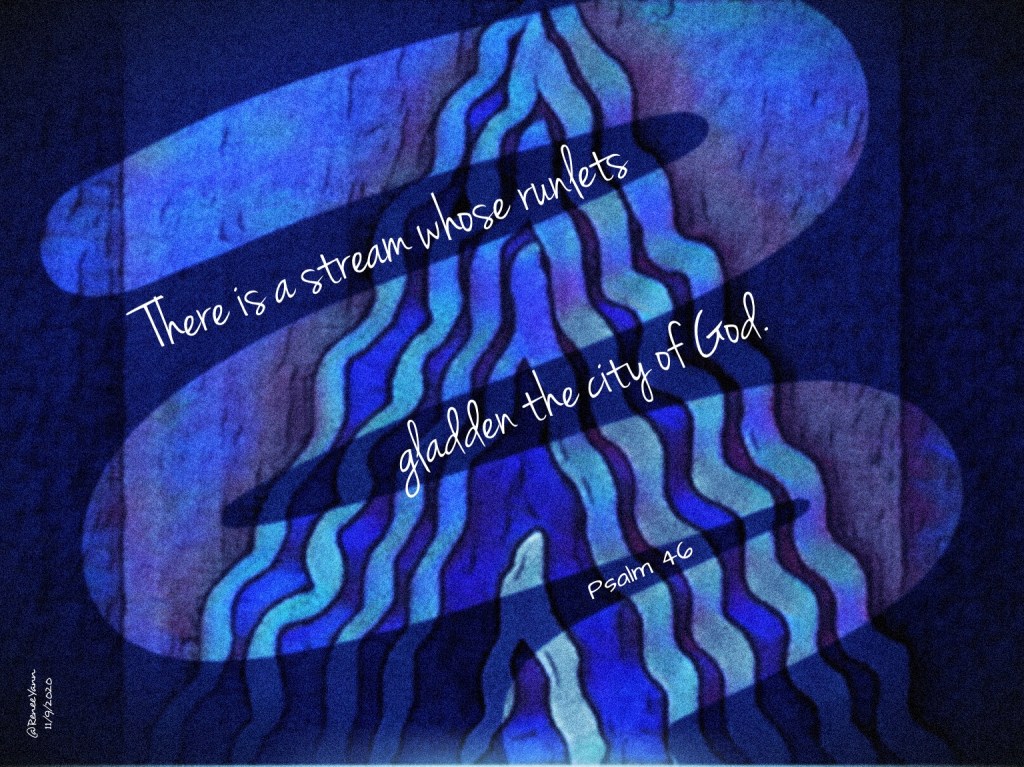
There is a stream whose runlets gladden the city of God, the holy dwelling of the Most High. God is in its midst; it shall not be disturbed; God will help it at the break of dawn.
I began thinking about this reflection last night after President-Elect Biden’s acceptance speech. To me, the world felt lighter than it had in four years. It had begun to breathe again. Hope was returning to its perch in our hearts. This after the terrible fear that it might have died or gotten lost in a long migration into darkness.
I think it is the greatest of sins to kill hope, especially for those who have only hope to cling to. Because, indeed, as Joe Biden assured us last night, when we share hope, we can do anything in the God who strengthens us.
Hope is its own great “basilica”, built from the stones of mutual charity, reverence, and trust which God fires in our hearts:
The LORD of hosts is with us; our stronghold is the God of Jacob. Come! behold the deeds of the LORD, the astounding things God has wrought on earth.
As we pray Psalm 42 today, let us ask for the continuing grace to exercise hope for and with one another.
Poetry: Hope Restored by Craig A. Roberts, a New Zealand poet. I thought this was a beautiful poem-prayer. His book of poetry can be found here.
Discouraging events,
entangling thoughts,
melancholic tsunamis form
in quick time, devastating my soul,
destroying the joyful breath of life.
Surges of futility, rejection
and self pity breach the dykes.
I churn and tumble in dark sucking swells.
I call to Him who loves me in abundance.
Swiftly He comes,
plucks me out of dark waters.
He is here now.
He whispers of promises never broken,
reminds me of my calling,
my inward journey,
my vocation.
He reassures my heart,
He restores my poise.
He sends me to wander by the waters edge,
immersed in His creative wonder
Christ breathes afresh into my created being.
O what joy. Bathed in His steadfast love
I trust all to Christ,
false illusions destroyed,
hope restored,
possibilities unfold,
His kingdom comes.
Today, in God’s Lavish Mercy, we pray again with Psalm 112, placed between two interestingly complementary readings.
Psalm 112 is basically a guide to what constitutes a happy life. The psalm tells us this:
Blessed and happy is the one:
who fears the LORD,
who greatly delights in God’s commands.
who is gracious and lends
who conducts affairs with justice
who gives to the poor
The psalmist tells us that this kind of humble, grateful generosity is its own reward.
Such a person
shall have a posterity which is mighty upon the earth
shall never be moved;
shall be in everlasting remembrance
shall be steadfast; shall not fear.
shall be remembered for enduring generosity
shall have a “horn” exalted in glory. ( “horn” = strength and power)
If we translate the biblical language here, what is Psalm 112 telling us.
This. True happiness comes from:
loving God
living within the law of love
being just, merciful, and generous
taking care of the vulnerable
Such happiness looks like this:
others can look up to you, especially the young
you stay faithful to goodness and righteousness
your faithfulness nourishes those who come after you
you are strong and courageous
your generosity inspires generosity in others
you are respected and loved for your goodness, even long after you’re gone
These are the kind of people Paul is depending on in our first reading to keep his ministry afloat. It sounds like he didn’t find too many of them, except finally in his Philippian community! Actually, under his eloquence, I think Paul sounds a little ticked off!😉
Jesus was looking for this kind of people too, but he certainly didn’t find them in the Pharisees of today’s Gospel. And Jesus let’s them have it in a dose of their own medicine.
What does Jesus, who “knows our hearts”, find when he looks at us? Let’s pray Psalm 112 today asking for the grace to grow in true, generous, faith so we can look back at Jesus with deep peace and HAPPINESS!
Poem: The Work of Happiness by May Sarton
I thought of happiness, how it is woven Out of the silence in the empty house each day And how it is not sudden and it is not given But is creation itself like the growth of a tree. No one has seen it happen, but inside the bark Another circle is growing in the expanding ring. No one has heard the root go deeper in the dark, But the tree is lifted by this inward work And its plumes shine, and its leaves are glittering.
So happiness is woven out of the peace of hours And strikes its roots deep in the house alone: The old chest in the corner, cool waxed floors, White curtains softly and continually blown As the free air moves quietly about the room; A shelf of books, a table, and the white-washed wall— These are the dear familiar gods of home, And here the work of faith can best be done, The growing tree is green and musical.
For what is happiness but growth in peace, The timeless sense of time when furniture Has stood a life’s span in a single place, And as the air moves, so the old dreams stir The shining leaves of present happiness? No one has heard thought or listened to a mind, But where people have lived in inwardness The air is charged with blessing and does bless; Windows look out on mountains and the walls are kind.
Music: Psalm 112 – 4Him
We only get so many times
To ride around this sun
And so many times to see a full moon shine
When day is done if anything's worth doing
Then it's worth doing right
So I looked for wisdom on how to
Best live this brief life I have found
Blessed is he who fears the Lord
Who finds delight in His commands
Blessed is he who fears the Lord
Who finds delight in His commands
I guess that we all gamble on some
Truth to guide our days
And we trust that it will bring us joy and meaning
On the way
I've got friends who feel betrayed by all the things
They once believed
So with everything I've seen I've gotta say
It seems to me
Blessed is he who fears the Lord
Who finds delight in His commands
Blessed is he who fears the Lord
Who finds delight in His commands
Please hear this from a humble heart
But I feel like Exhibit A
In the evidence that God is good to those
Who live by faith, that's why I believe
Blessed is he who fears the Lord
Who finds delight in His commands
Blessed is he who fears the Lord
Who finds delight in His commands
He will not be shaken
He will have no fear
He will then remember
Today, in God’s Lavish Mercy, we pray with Psalm 22, and it’s perfect for our prayer today.
I know God has no partisan interest. God’s interest is for the wholeness and blessing of God’s Creation. God’s interest is for justice and mercy for the poor, sick and suffering. God’s interest is for peace in hearts, families and nations.
All the ends of the earth shall remember and turn to the LORD; All the families of the nations shall bow down before God.
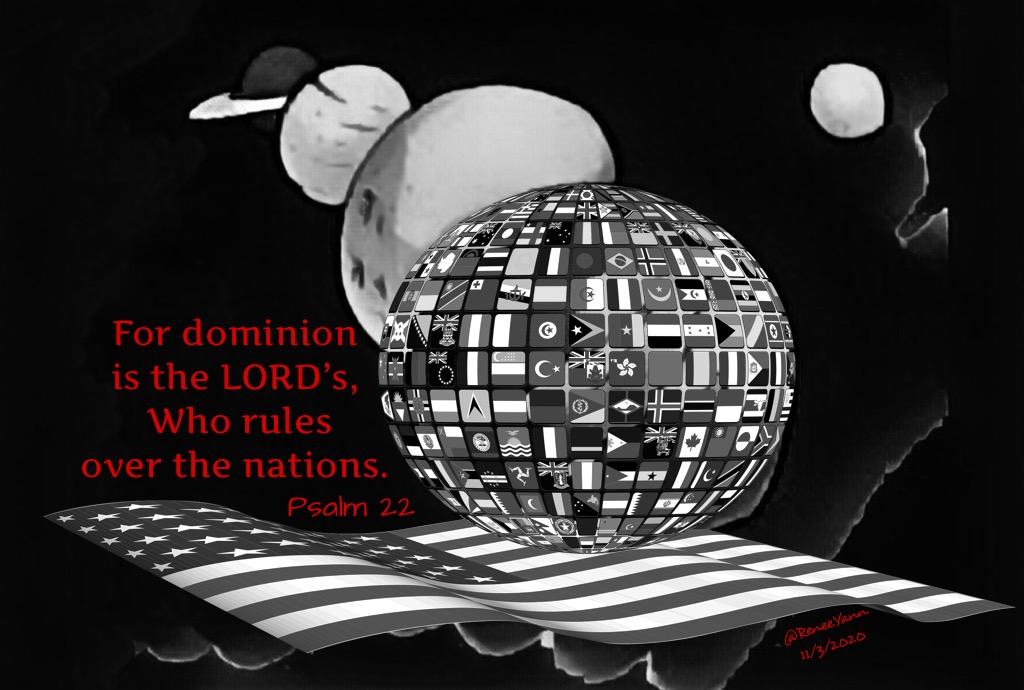
For dominion is the LORD’s, Who rules the nations. To God alone shall bow down all who sleep in the earth.
To God alone my soul shall live; my descendants shall serve God. Let the coming generation be told of the LORD that they may proclaim to a people yet to be born the justice God has shown.
Psalm 22
Still, let’s put it right out there. This is no ordinary Tuesday. Personally, I have been longing – no, agonizing – for this day since November 8, 2016. What about you?
I know there are many perspectives among my readers. Democrats and Republicans. Citizens of countries other than the USA. Still, I think all of us share some common hopes for today’s election because we care about all of God’s beloved Creation.
Here are some of my hopes.
I pray for, and believe that we must demand, a President and Congress who:
respect, reverence and legislate for life in all its stages, colors, genders, ethnicities, and religious and political affiliations.
do the hard work of building bridges, not walls, throughout the world
respect and care about those who are poor and marginalized
model American compassionate leadership rather than American isolationist primacy
generate unity and tolerance, not fear, division and hatred
choose others over self, truth over manipulation, leadership over greed
are thoughtful, brave statesmen and stateswomen not bullies and whiners
As we pray this psalm today, may we realize that to find these virtues in our leaders, we must first practice them ourselves. In the long run, we get what we deserve. Let’s humbly pray to live in a manner that propagates and deserves selfless moral leadership.
Poetry: LET US PRAY – Sister Joan Chittister
Give us, O God, leaders whose hearts are large enough to match the breadth of our own souls and give us souls strong enough to follow leaders of vision and wisdom. In seeking a leader, let us seek more than development of ourselves— though development we hope for, more than security for our own land— though security we need, more than satisfaction for our wants— though many things we desire.
Give us the hearts to choose the leader who will work with other leaders to bring safety to the whole world.
Give us leaders who lead this nation to virtue without seeking to impose our kind of virtue on the virtue of others.
Give us a government that provides for the advancement of this country without taking resources from others to achieve it.
Give us insight enough ourselves to choose as leaders those who can tell strength from power, growth from greed, leadership from dominancy, and real greatness from the trappings of grandiosity.
We trust you, Great God, to open our hearts to learn from those to whom you speak in different tongues and to respect the life and words of those to whom you entrusted the good of other parts of this globe.
We beg you, Great God, give us the vision as a people to know where global leadership truly lies to pursue it diligently, to require it to protect human rights for everyone everywhere.
We ask these things, Great God, with minds open to your eternal care.
Music: America- rendered in true American Jazz by the inimitable Ray Charles
Oh beautiful for heroes proved
In liberating strife
Who more than self, their country loved
And mercy more than life
America, America may God thy gold refine
'Til all success be nobleness
And every gain divined
And you know when I was in school
We used to sing it something like this, listen here
Oh beautiful, for spacious skies
For amber waves of grain
For purple mountain majesties
Above the fruited plain
But now wait a minute, I'm talking about
America, sweet America
You know, God done shed his grace on thee
He crowned thy good, yes he did, in brotherhood
From sea to shining sea
You know, I wish I had somebody to help me sing this
(America, America, God shed his grace on thee)
America, I love you America, you see
My God he done shed his grace on thee
And you oughta love him for it
'Cause he, he, he, he crowned thy good
He told me he would, with brotherhood
(From sea to shining Sea)
Oh Lord, oh Lord, I thank you Lord
(Shining sea)
Today, in God’s Lavish Mercy, we pray with Psalm 18
I love you, O LORD, my strength, O LORD, my rock, my fortress, my deliverer.
Psalm 18: 2-3
The psalm is almost a mirror reflection of 2 Samuel 22, and has been interpreted as a song that David sang throughout his life to praise God’s goodness to him.
Today the psalm connects several readings, which together give us:
a command
and a hint about how to fulfill that command.
Bottom line, our readings tell us this:
First, Love God
And, second, here’s where to find the God you desire to love.
If we trust the hint, and act on the command, we will be able to sing – like David – throughout our lives.
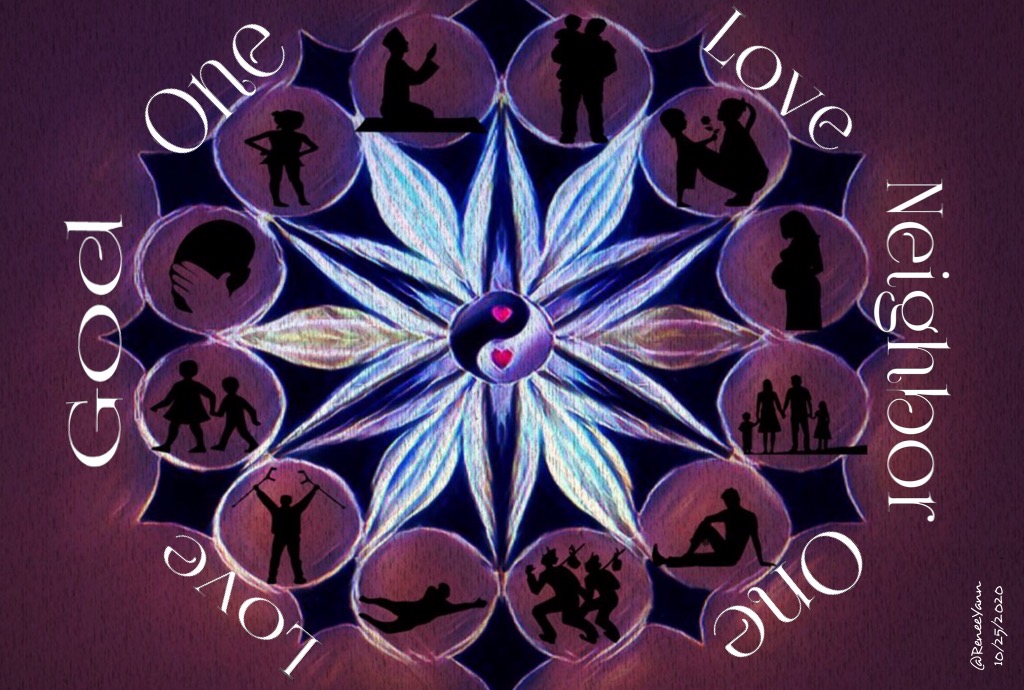
"You shall love the Lord, your God,
with all your heart,
with all your soul,
and with all your mind.
This is the greatest and the first commandment.
The second is like it:
You shall love your neighbor as yourself.
Here is a beautiful poetic interpretation of Psalm 18:
I open my heart to you, O God
for you are my strength, my fortress,
the rock on whom I build my life.
I have been lost in my fears and my angers
caught up in falseness, fearful, and furious.
I cried to you in my anguish.
You have brought me to an open space.
You saved me because you took delight in me.
I try to be good, to be just, to be generous
to walk in your ways.
I fail, but you are my lamp.
You make my darkness bright
With your help, I continue to scale the walls
and break down the barriers that fragment me.
I would be whole, and happy, and wise
and know your love
Always.
~ Christine Robinson
Today, in Mercy, we read the story of the Canaanite woman whom Jesus first meets with a sarcastic banter. The banter however serves to expose some of the alienating prejudices of Jesus’s time which he then dissolves in a sweeping act of mercy and inclusion. His actions signify a new culture of divine justice offered to all people. The reading challenges us to confront our own prejudices and any limitations we place on who belongs to the Kingdom of God.
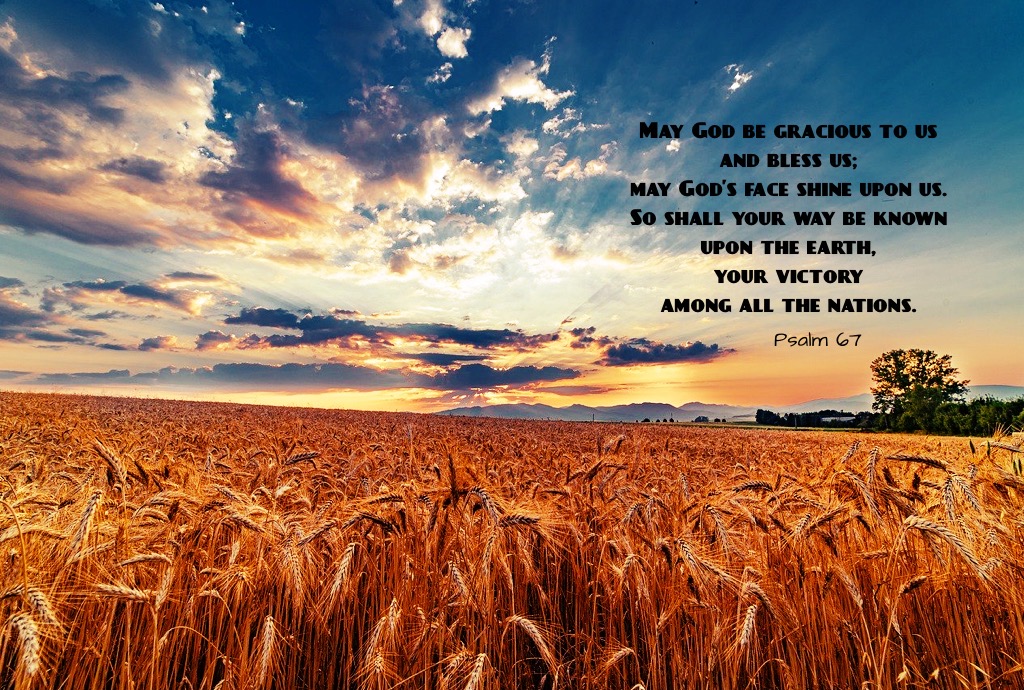
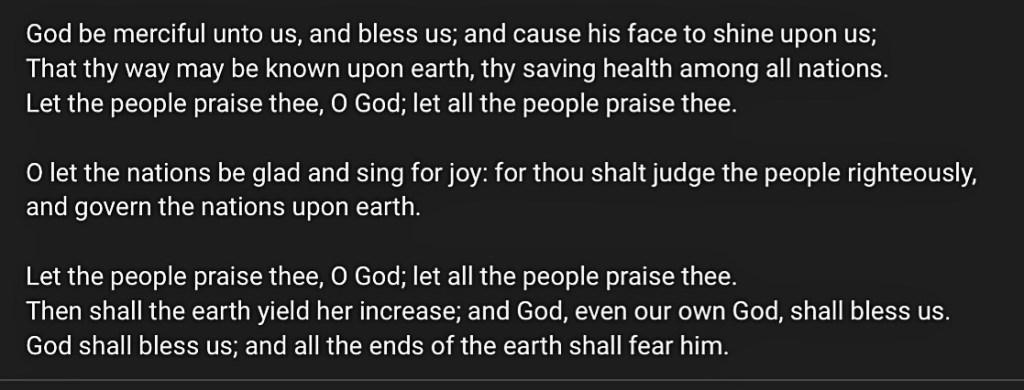
Today, in God’s Lavish Mercy, we pray with Psalm 67, a call to God for universal blessing on all Creation. Written to invoke a benediction on the land’s harvest, the Psalm blossoms into a generous prayer for the whole world to bask in God’s abundance.
May the nations be glad and rejoice; for you judge the peoples with fairness, you guide the nations upon the earth.
What if we prayed like that for all our brothers and sisters worldwide! What if we acted toward them with a justice that would make their abundance possible as well as our own! This is the Gospel mandate Jesus entrusted to us.
Psalm 67 shows the maturing of a nation from its own legitimate self-interests into its responsibility within all Creation.
In the USA, as our pre-election political awareness heightens, let’s learn from Psalm 67. Let’s broadly educate ourselves to the fundamental moral issues underlying various partisan platforms.
For a religious person, voting is hard. There are profound moral issues on all sides of the question. A single issue approach does not work. An adamant stance on a single issue is the easy but inadequate approach.
Even Jesus, in today’s Gospel, can be moved to a new way of thinking. The outcast Canaanite woman prevails on Jesus to broaden his kingdom. He opens his heart to another way of bringing mercy to all those longing for it.
Voting is a moral act. How we choose demonstrates the God we believe in.
May the peoples praise you, God; may ALL the peoples praise you!
Poetry: Selah by Honoreé Fannane Jeffers
“The past few weeks were very hopeful for me, as an African-American. I saw images of young Black people out in the streets protesting, to make this country a better place. As an older person who stayed inside while these young folks put their bodies on the line, I wanted to celebrate them. I wrote this poem as a spiritual exaltation of Black faith, that our hoped-for change for our country is coming.”
Honoreé Fanonne Jeffers
Selahafter Margaret Walker’s “For My People”
The Lord clings to my hands
after a night of shouting.
The Lord stands on my roof
& sleeps in my bed.
Sings the darkened, Egun tunnel—
cooks my food in abundance,
though I was once foolish
& wished for an emptied stomach.
The Lord drapes me with rolls of fat
& plaits my hair with sanity.
Gives me air,
music from unremembered fever.
This air
oh that i may give air to my people oh interruption of murder the welcome Selah
The Lord is a green, Tubman escape.
A street buzzing with concern,
minds discarding answers.
Black feet on a centuries-long journey.
The Lord is the dead one scratching my face,
pinching me in dreams.
The screaming of the little girl that I was,
the rocking of the little girl that I was—
the sweet hush of her healing.
Her syllables
skipping on homesick pink.
I pray to my God of confused love,
a toe touching blood
& swimming through Moses-water.
A cloth & wise rocking.
An eventual Passover,
outlined skeletons will sing
this day of air
for my people—
oh the roar of God oh our prophesied walking
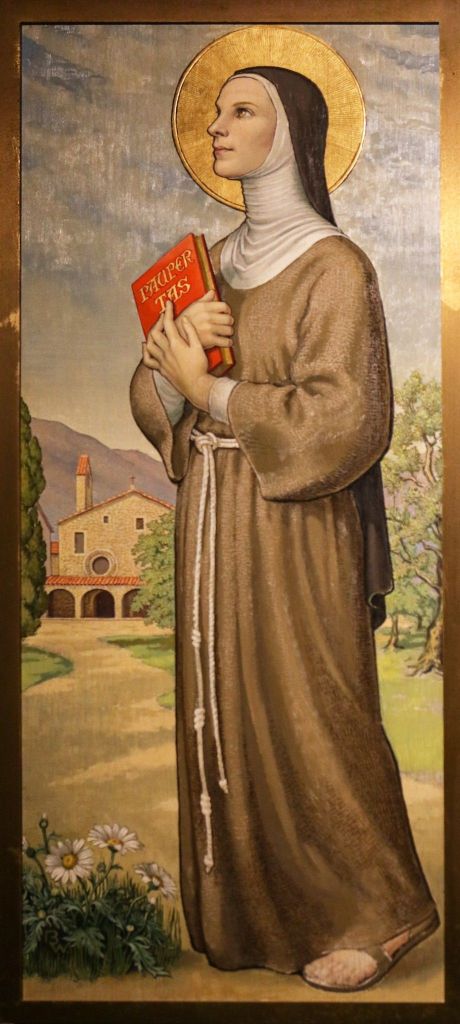
Today, in God’s Lavish Mercy, on this feast of the beautiful St. Clare, we pray with Psalm 119. How perfect is the response phrase from our psalm!
How sweet to my taste is your promise!
Last night, we watched an old Colombo movie in which one of the characters was a vintner who had developed a peerless taste for fine wine. He could identify every detail – year, grape, region, price. He was the consummate connoisseur.
As I prayed this morning’s psalm, it struck me that through the intentional practice of prayer, we become connoisseurs of the spirit. We are able to discern ever more delicately those realities which carry grace to our souls.
How sweet to my palate are your promises, sweeter than honey to my mouth!
As we deepen in spirit, we purify our taste from all that is not peace, goodness, justice, mercy, and charity. We let go of things that distract our souls from Love.
The law of your mouth is to me more precious than thousands of gold and silver pieces.
By our choices for what is truly precious, we build a legacy of sacred joy which sustains us throughout our lives:
Your decrees are my inheritance forever; the joy of my heart they are.
from National Shine, Detroit
Poetry: from Clare of Assisi
We become what we love and who we love shapes what we become. If we love things, we become a thing. If we love nothing, we become nothing. Imitation is not a literal mimicking of Christ, rather it means becoming the image of the beloved, an image disclosed through transformation. This means we are to become vessels of God's compassionate love for others.
Music: Mirror of Eternity (Clare of Assisi) – sung by John Michael Talbot
Place your mind before the mirror of eternity!
Place your soul in the brilliance of glory!
Place your heart in the figure of the divine substance!
And transform your whole being into the image of the Godhead Itself
through contemplation!
So that you too may feel what His friends feel
as they taste the hidden sweetness
which God Himself has reserved
from the beginning
for those who love Him~ Clare of Assisi
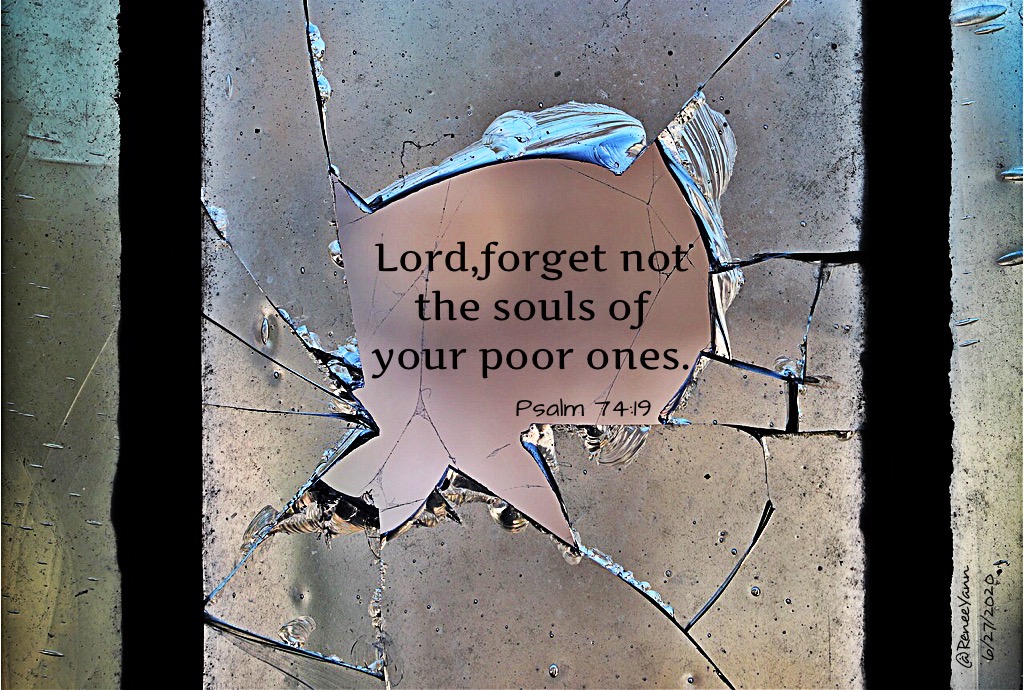
Today, in God’s Lavish Mercy, we pray with Psalm 74 which complements Psalm 79 in the intensity of its lament. It too reflects the devastation of Israel at the destruction of the Temple and, with it, a whole way of life.
Praying these psalms doesn’t make for a light and happy morning! There is no dawning sunrise or birdsong woven through these verses. To tell the truth, I’d be inclined to avoid 47 if I could.
To deepen the umbra, our first reading comes from the Book of Lamentations, five anguished poems of wrenching bereavement.
But what these doleful songs remind me of this morning is that there is profound misery in the world, even if – thank God – I am not experiencing it personally. There are people who need my prayers, my awareness of their suffering, my attention, and my action for their easement. I am reminded that even if I am filled with contentment, these suffering people are irrevocably connected to me.
Psalm 74 reminds me that God needs instruments to heal the misery of the world. I am called – as you are – to be one of them. In small or large ways, in global or very personal efforts, we are the means by which God answers this plea:
Look to your covenant, Lord, for the hiding places in the land and the plains are full of violence. May the humble not retire in confusion; may the afflicted and the poor praise your name.
In this verse, the psalmist asks God to look at his world’s suffering, believing that if God only sees, God will heal.
The psalm calls us to look too…
to not be impervious to the pain right before us nor at a distance from us
to hear the cry under appearances
to become a safe “hiding place” for those fleeing violence in its many forms – from bullying to genocide
to be Mercy in the world
Poetry: The poem today is Quaking Conversation by Lenelle Moïse. It looks at the world’s darkness through the tragedy of the earthquake in Haiti. The poem is a modern Psalm 74, asking the reader to “sit down” and listen to its pain.
Quaking Conversation
i want to talk about haiti.
how the earth had to break
the island’s spine to wake
the world up to her screaming.
how this post-earthquake crisis
is not natural
or supernatural.
i want to talk about disasters.
how men make them
with embargoes, exploitation,
stigma, sabotage, scalding
debt and cold shoulders.
talk centuries
of political corruption
so commonplace
it's lukewarm, tap.
talk january 1, 1804
and how it shed life.
talk 1937
and how it bled death.
talk 1964. 1986. 1991. 2004. 2008.
how history is the word
that makes today
uneven, possible.
talk new orleans,
palestine, sri lanka,
the bronx and other points
or connection.
talk resilience and miracles.
how haitian elders sing in time
to their grumbling bellies
and stubborn hearts.
how after weeks under the rubble,
a baby is pulled out,
awake, dehydrated, adorable, telling
stories with old-soul eyes.
how many more are still
buried, breathing, praying and waiting?
intact despite the veil of fear and dust
coating their bruised faces?
i want to talk about our irreversible dead.
the artists, the activists, the spiritual leaders,
the family members, the friends, the merchants
the outcasts, the cons.
all of them, my newest ancestors,
all of them, hovering now,
watching our collective response,
keeping score, making bets.
i want to talk about money.
how one man's recession might be
another man's unachievable reality.
how unfair that is.
how i see a haitian woman’s face
every time i look down at a hot meal,
slip into my bed, take a sip of water,
show mercy to a mirror.
how if my parents had made different
decisions three decades ago,
it could have been my arm
sticking out of a mass grave
i want to talk about gratitude.
i want to talk about compassion.
i want to talk about respect.
how even the desperate deserve it.
how haitians sometimes greet each other
with the two words “honor”
and “respect.”
how we all should follow suit.
try every time you hear the word “victim,”
you think “honor.”
try every time you hear the tag “john doe,”
you shout “respect!”
because my people have names.
because my people have nerve.
because my people are
your people in disguise
i want to talk about haiti.
i always talk about haiti.
my mouth quaking with her love,
complexity, honor and respect.
come sit, come stand, come
cry with me. talk.
there’s much to say.
walk. much more to do.
Today, in God’s Lavish Mercy, we pray with Psalm 31, just three of its twenty-five passionate verses in today’s liturgy. These three will echo in you, as will many others if you read the whole psalm. The images are so strong and yet comforting, the prayer so sincere.
In you, LORD, I take refuge.
Let me never be put to shame.
Incline your ear to me;
For you are my rock and my fortress.
I will rejoice and be glad in your mercy.
Let your face shine on your servant.
Save me in your mercy.
You hide your beloved in the shelter of your presence.
You heard my voice, my cry for mercy.
In my prayer, I focused on this line:
You hide your beloved in the shelter of your presence from the plottings of evil hearts; You screen them within your abode from the strife of tongues.
“The strife of tongues”. What a phrase! And what a reality! Our divisive culture is drowning in it – in political, religious and civic contexts. It is often very hard for us to know whom to listen to and believe. But the psalmist helps us to understand a key characteristic of destructive speech – pride and boasting:
Love the LORD, all you his faithful ones! The LORD keeps those who are constant, but more than requites those who act proudly.
Today, I prayed for anyone caught in a persecution of words. Specifically, I prayed for Pope Francis and for the Archbishop of Washington, DC, Wilton Gregory. Both men have been victims of “the strife of tongues”.
In a publicized letter written to Donald Trump, Pope Francis was targeted by reactionary clergyman Carlo Viganò who dabbles in conspiracy theories and misinformation in order to undermine Francis’s ministry.
Archbishop Gregory described Donald Trump’s photo op at the Shrine of St. John Paul II as “reprehensible“, condemning the politicization of religion for “manipulative” purposes. As a result, the Archbishop, who is Black, has been racially and sexually slurred by, among others, a far-right hate group claiming to be “Catholic”.
As I prayed for these good priests, and for all others condemned for truthful and compassionate testimony, I asked God to enfold them in the verse from Psalm 31, part of which Jesus prayed on the cross:
Into your hands I commend my spirit; you will redeem me, LORD, God of truth.
It is painful to witness this kind of sinful negativity in the Church, and the pain does enter into our prayer. Pope Francis points to a way to heal that pain:
Poetry: Our poem today is by a 19th century poet, Susan S. Button from her only book I could find which she published herself. She strikes me as an Emily Dickinson type without the same degree of literary accomplishment. There is very little information on her although she was notable enough in society to have a portrait by John Sartain (currently in the Pennsylvania Academy of Fine Arts.)
The poem, although on a serious topic, still provided a level of delight about what happens to those who slander the innocent. I offer just a few verses of the long composition and hope you enjoy it as much as I did!
Slander
What is the slander’s tongue? An arrow strong,
And sharp, and fierce, empoisoning many a word,
Such as to devil’s only do belong,
When they, by Envy and by Malice stirred,
Do contemplate dark deeds, and souls do gird
For vilest crimes, and with their deadly bane,
The good man rob of fame — with lies absurd
Asunder rend kind Friendship’s gold-linked chain,
And break the three-fold, silken cord of Love amain.
——
For though Slander’s pliant bow was newly strung,
And thick and fast her feathered arrows flew,
And through the misty air their echoes rung,
The light around his head more lustrous grew;
For Innonence forth from her treasures drew
A golden shield, and clasped it o’er his heart,
While Truth held up a golden lamp and new!
While through its lucent flame flew on the dart
From Slander’s quiver, brighter light it did impart.
It trembled on the shield of Innocence—
The good man gazed, and by its blood-stained shade
He knew full well who formed it, and from whence
It came — he plucked it from the shield and bade
The innocent “tremble not, nor be afraid.”
With force redoubled Slander drew her bow
And furious all her cruel haste betrayed,
But soon was heard a horrid shriek of woe,
As her rebounding dart did to her forehead go.
~ Susan S. Button (1858)
Music: Herr, auf dich traue ich – Otto Nicolai (1810-1849j, one of the founders of the Vienna Philharmonic
Psalm 31:1-2
Herr, auf dich traue ich, Laß mich nimmermehr zu Schanden werden, Errette mich nach deiner Barmherzigkeit, Und hilf mir aus. Neige deine Ohren zu mir, und hilf mir; Sei mir ein starker Hort, Ein Hort, dahin ich immer fliehen möge, Der du hast zugesaget mir zu helfen.
Lord, I trust in you, Let me never be ashamed; Deliver me in your mercy And assist me. Incline your ear to me and help me; Be a strong refuge for me, A refuge to which I may always flee, Which you have promised to me for my aid.
That word can cause a little confusion, both as we find it in scripture and in the history of Christian thought.
Baker’s Evangelical Dictionary of Biblical Theology says five connotations for “world” may be found in scripture:
The physical world – the actual plant Earth
The human world – the land and seas we can navigate
The moral world – the universe of good and evil
The temporal world – the world that will someday end
The coming world – eternal existence
In today’s Gospel, Jesus is talking about the moral world which, in the New Testament, refers to those people who are indifferent and hostile to Christ’s teaching.
If the world hates you, realize that it hated me first. If you belonged to the world, the world would love its own; but because you do not belong to the world… the world hates you.
A Wolf in Sheep’s Clothing
We understand this use of the word. We see the evil in the world. We are saddened, angered and confounded by it when we recognize it.
But do we always recognize it?
Blatant evils like murder are readily recognized. But the most insidious evils are those that masquerade as good.
These masquerading evils often pretend to protect our rights, our security, our safety. But they usually do so at the expense of someone else’s rights – the poor, the refugee, the aged, the homeless, people of color……and all who have become “disposable” in our society.
These deceptions hide behind brave and noble words like “America First”, “Second Amendment Rights”, “Protect Life” and a rash of other slogans which fail to examine the whole impact of single-issue politics.
It’s confusing because we love America, right? We believe in people’s constitutional rights, right? We respect life, right?
What if our slogans instead more clearly reflected Gospel values:
The Human Family First
Safety Rights for Everyone
Health Security for All Life – Womb to Tomb
How can we be spiritually discerning about what is good within such realities and what is rooted in sinful self-interest? Jesus tells us in these words:
Remember the word I spoke to you, ‘No slave is greater than his master.’ If they persecuted me, they will also persecute you.
We must look to the one who is hated and persecuted to find the Face of Christ. We must love that Face and learn its heartaches. We must become a companion in their search for wholeness. We must set aside any costume of self-righteousness and put on the garment of Mercy:
Therefore, as God’s chosen people, holy and dearly loved, clothe yourselves with mercy, kindness, humility, gentleness and patience. Bear with each other and forgive one another if any of you has a grievance against someone. Forgive as the Lord forgave you. And over all these virtues put on love, which binds them all together in perfect unity. Colossians 3:14-16