Twelve

Wednesday of the Fourteenth Week in Ordinary Time
July 12, 2023

Today’s Readings:

https://bible.usccb.org/bible/readings/071223.cfm


Today, in God’s Lavish Mercy, we have the stories of two sets of twelve men:

  • Joseph and his brothers, heads of the twelve tribes of Israel
    (Reuben, Simeon, Levi, Judah, Dan, Naphtali, Gad, Asher, Issachar, Zebulun, Joseph, and Benjamin)
  • the twelve Apostles chosen by Jesus
    (Simon Peter, Andrew, James, John, Philip, Bartholomew, Thomas, Matthew, James, Thaddeus, Simon, Judas)

Joseph Oversees Egypt’s Granaries – Lawrence Alma-Tadema


Each of these pillars of the Judea-Christian tradition had their individual faith stories which have called generations either to imitate or contradict them. We want to be like faithful, fumbling Peter but not like clever, devious Judas. We abhor the muderous jealousy of the 10 brothers, but admire the generous forgiveness of Joseph.

These ageless stories present us with the mysterious beauty of the Scriptures which allow us to find our best and worst selves within them. But more significantly, beyond mirroring all human experience, these stories reflect God’s abiding Presence in the unfolding of human and individual history.


The Joseph narrative, which we have a small part of today, presents a whole new way of looking at God’s relationship with Israel. God is not an overt actor in the narrative as in the early Pentateuch accounts, but rather the hidden Agency in a long and sustained drama.

(The Joseph narrative) urges that in the contingencies of history, the purposes of God are at work in hidden and unnoticed ways. But the ways of God are nonetheless reliable and will come to fruition….
The purposes of God are not wrought here by abrupt action or by (heavenly) intrusions, but by the ways of the world which seem to be natural and continuous.

Walter Brueggemann: Genesis, A Bible Commentary for Teaching and Preaching

As I read Bruggemann’s commentary, I think of the many times my religious community has come together for story-telling during a Sister’s funeral rites. Within an inspirational hour, the extended history of this Sister’s life is gathered into a powerful statement reflecting both God’s and her long fidelity.

As in Joseph’s story, God has not spoken aloud, but has spoken nonetheless clearly, in and through each remembered life. The grateful community is left in quiet and joyful awe at the end of each ritual, amazed and convinced that God is silently present in every person’s story, even one’s own.


Today’s Responsorial Psalm may capture our sentiments as we consider our own lives in the light of today’s readings. We can take great comfort in the belief that, in the eternal design, all things come to wholeness for those who trust God.

The LORD brings to nought the plans of nations;
and foils the designs of peoples.
But the plan of the LORD stands forever;
the design of God’s heart, through all generations.

Psalm 33:10-11

Poetry: The Thread of Life – Christina Rossetti

The irresponsive silence of the land,
The irresponsive sounding of the sea,
Speak both one message of one sense to me: —
Aloof, aloof, we stand aloof, so stand
Thou too aloof bound with the flawless band
Of inner solitude; we bind not thee;
But who from thy self-chain shall set thee free?
What heart shall touch thy heart? what hand thy hand?—
And I am sometimes proud and sometimes meek,
And sometimes I remember days of old
When fellowship seemed not so far to seek
And all the world and I seemed much less cold,
And at the rainbow's foot lay surely gold,
And hope felt strong and life itself not weak.

2

Thus am I mine own prison. Everything
Around me free and sunny and at ease:
Or if in shadow, in a shade of trees
Which the sun kisses, where the gay birds sing
And where all winds make various murmuring;
Where bees are found, with honey for the bees;
Where sounds are music, and where silences
Are music of an unlike fashioning.
Then gaze I at the merrymaking crew,
And smile a moment and a moment sigh
Thinking: Why can I not rejoice with you ?
But soon I put the foolish fancy by:
I am not what I have nor what I do;
But what I was I am, I am even I.

3

Therefore myself is that one only thing
I hold to use or waste, to keep or give;
My sole possession every day I live,
And still mine own despite Time's winnowing.
Ever mine own, while moons and seasons bring
From crudeness ripeness mellow and sanative;
Ever mine own, till Death shall ply his sieve;
And still mine own, when saints break grave and sing.
And this myself as king unto my King
I give, to Him Who gave Himself for me;
Who gives Himself to me, and bids me sing
A sweet new song of His redeemed set free;
He bids me sing: O death, where is thy sting?
And sing: O grave, where is thy victory?

Music: Air on the G String – J.S.Bach, played by Hauser


Beyond Expectation…

Tuesday of the Eleventh Week in Ordinary
June 20, 2023

Today’s Readings:

https://bible.usccb.org/bible/readings/062023.cfm

Today, in God’s Lavish Mercy, we receive an in-depth teaching on Christian generosity.

In the early Church, as in the Church today, evangelism and ministry require material support. In Paul’s time, the mother Church in Jerusalem needed funds to support ongoing mission activity.

In our first reading, Paul writes a “fund-raising” letter to the Greek Corinthians. He challenges them to be generous by raising up to them the outstanding example of the Macedonian churches (Philippi, Thessalonica, and Berea). These communities, despite their current hardship, gave beyond expectation to the Church’s need.

Macedonia and Greece had a competitive political relationship. Whether or not Paul was using this contention to stoke a response in Corinthian generosity, we can only guess. However, Paul is very clear about what should motivate the Christian heart to charity:

For you know the gracious act of our Lord Jesus Christ,
that for your sake he became poor although he was rich,
so that by his poverty you might become rich.

2 Corinthians 8:9

While Paul has offered a tutorial on material giving, Jesus inspires us to a much deeper generosity. Jesus asks us to imitate God in our loving benevolence:

Jesus said to his disciples:
“You have heard that it was said,
You shall love your neighbor and hate your enemy.
But I say to you, love your enemies
and pray for those who persecute you,
that you may be children of your heavenly Father,
for he makes his sun rise on the bad and the good,
and causes rain to fall on the just and the unjust.

Matthew 5:43-45

God’s generosity – God’s beautiful Mercy – does not distiguish between who is deserving and who is not. God’s love is universal and irrevocable. Jesus, who is the enfleshment of God’s Love, explains that God’s perfection consists in this Absolute Mercy. He tells us that we should strive to live a life in imitation of this Merciful Perfection.

For if you love those who love you, what recompense will you have?
Do not the tax collectors do the same?
And if you greet your brothers only,
what is unusual about that?
Do not the pagans do the same?
So be perfect, just as your heavenly Father is perfect.”

Matthew 5:46-48

Jesus is telling us that by living in generous mercy, beyond worldly expectation, we become “perfect” or whole in the Wholeness of God. Mercy heals not only those we touch, it heals us.


Poetry: To Live in the Mercy of God – Denise Levertov

To lie back under the tallest
oldest trees. How far the stems
rise, rise
before ribs of shelter
open!

To live in the mercy of God. The complete
sentence too adequate, has no give.
Awe, not comfort. Stone, elbows of
stony wood beneath lenient
moss bed.
And awe suddenly
passing beyond itself. Becomes
a form of comfort.
Becomes the steady
air you glide on, arms
stretched like the wings of flying foxes.
To hear the multiple silence
of trees, the rainy
forest depths of their listening.
To float, upheld,
as salt water
would hold you,
once you dared.
To live in the mercy of God.
To feel vibrate the enraptured
waterfall flinging itself
unabating down and down
to clenched fists of rock.
Swiftness of plunge,
hour after year after century,
O or Ah
uninterrupted, voice
many-stranded.
To breathe
spray. The smoke of it.
Arcs
of steelwhite foam, glissades
of fugitive jade barely perceptible. Such passion—
rage or joy?
Thus, not mild, not temperate,
God’s love for the world. Vast
flood of mercy
flung on resistance.

Music: Mormon Tabernacle Choir – Holy Art Thou »-(adapted from Handel’s Largo “Ombra mai fu” in “Xerxes”. A beautiful instrumental version is under the hymn lyrics below.)

Holy art Thou, Holy art Thou, Lord God Almighty
Glory and Majesty, in Heav′n are Thine
Earth’s lowly bending, swells the full harmony
Blessing and Glory to the Lamb, forevermore
For worthy, worthy art Thou
Worthy art Thou

Let all nations and kindreds and peoples
Give thanks to Thee, forevermore
Give thanks forevermore

Let all nations and kindreds and peoples
Give thanks to Thee, forevermore

A Grape Soon Ripe

Saint Charles Lwanga and Companions, Martyrs
June 3, 2023

Today’s Readings:

https://bible.usccb.org/bible/readings/060323.cfm

Today, in God’s Lavish Mercy, we pray with our final passage from the Book of Sirach. We will read Sirach only five or six times again scattered throughout the liturgical year.

In today’s reading, Sirach offers a grateful reflection on the early blessing of wisdom and pursuit of holiness in his life.

I thank the LORD and I praise him;
I bless the name of the LORD.
When I was young and innocent,
I sought wisdom openly in my prayer
I prayed for her before the temple…

Sirach 51:13-14

Sirach’s prayer will resonate with many of us whose earliest days were blessed with faithful parents and grandparents. These wisdom figures taught us to love and seek God in our lives. As we pray today, we think of them with gratitude, as well as of the many teachers who guided our young spirits into God’s Light.

Even if we have moved far from the parish church of our youth, we may recall the graces we received within her walls. We might prayerfully recollect our beloved grade school and high school where we were guided in the pursuit of a meaningful and reverent life.


Hopefully, our prayer brings us to realize how blessed we have been from the beginning of our lives. This is the kind of prayer Sirach prays in today’s reading. He is filled with gratitude and praise because he understands that it is all a gratuitous and undeserved blessing:

My heart delighted in Wisdom,
My feet kept to the level path
because from earliest youth I was familiar with her.
In the short time I paid heed,
I met with great instruction.
Since in this way I have profited,
I will give my teacher grateful praise.

Sirach 51:15-17

Sirach’s prayer brings him to that still and holy place deep in his heart — that place where he touches the Wisdom of God. He describes it like this:

I sought Wisdom openly in my prayer
I prayed for her before the temple,
and I will seek her until the end,
and she flourished as a grape soon ripe.

Sirach 51:13-15

Many of us are so busy and intent on living our lives forward – trying to make it through this day to the next. We may not take the time to consider and appreciate the “ripe grape” our life has already become.

I look around me in our convent chapel and realize that I am living with holy people. Of course, like me, they have their personal twists and trademarks. Still each one of them has walked through their roundabout years into the heart of God. Every day they live into a deeper goodness – aging like fine wine, unaware that the grape has already ripened and is blessing the world around them.

The Great Vintner accomplishes this holy transformation in us by a slow accumulation of blessings which saturate our hearts in God. Pausing, like Sirach, to recognize and give thanks fills us with generous gratitude and a confident courage for the days to come.


Take time to look at the holy people in your own life today, the ones through whom God’s Wisdom has poured into your life. They are the ones who love you into a better person by their goodness, honesty, humility, and generosity. You meet them in your family, friends and workplace. Or you may have met them only in a book, poem, song or story.

I met with great instruction.
Since in this way I have profited,
I will give my teacher grateful praise.

Sirach 51:16-17

Poetry: Our Responsorial Psalm 19 today beautifully complements Sirach’s prayer and can serve as a perfect poetic refletion for us.


The law of the LORD is perfect,
refreshing the soul.
The decree of the LORD is trustworthy,
giving wisdom to the simple.

The precepts of the LORD are right,
rejoicing the heart.
The command of the LORD is clear,
enlightening the eye.

Awe of the LORD is pure,
enduring forever;
The ordinances of the LORD are true,
all of them just.

They are more precious than gold,
than a heap of purest gold;
Sweeter also than syrup
or honey from the comb.


Music: Psalm 19 – Jess Ray

A Godly Person

Friday of the Eighth Week in Ordinary Time
June 2, 2023

Today’s Readings:

https://bible.usccb.org/bible/readings/060223.cfm

The Family Tree


Today, in God’s Lavish Mercy, Sirach sounds like he has been using Ancestry.com! As he comes close to the conclusion of his long meditation on God, the Universe, and Nature, he closes now with a reflection on humanity.

Now will I praise those godly men and women,
our ancestors, each in their own time.


In my childhood home, there was a fascinating table whose secrets I learned only when I got to about fifth or sixth grade. I had thought it was just a spot to place a pretty vase, but it was really a classic games table whose top swiveled to store the cards or games inside.

I lived with that table for years, and by the time I was ten or eleven years old, I had never seen that top swiveled nor the inside displayed. Reading Sirach today makes me remember why.

Stored in the table since the time of my grandmother’s death were all the tender remembrances of my deceased family members. Dried funeral flowers wrapped in faded wax paper. The war office telegram saying Uncle Jim had died on Iwo Jima. Black rimmed death announcements from another era – aunts, uncles and great-grands. There were cards from neighbors extolling my grandmother’s courage and goodness.

One day, my mother opened the table and we sat togather as she recounted the stories of the ancestors I never knew. I think it made her both happy and sad to finally share the stories with me. Reliving the losses made her sad. But placing the memories in me made her happy for the very reasons Sirach elaborates in today’s reading.

… these also were godly people
whose virtues have not been forgotten;
Their wealth remains in their families,
their heritage with their descendants;
Through God’s covenant with them their family endures,
their posterity, for their sake.


Our Gospel includes a description of Jesus’s encounter with the poor fig tree. Failing to bear fruit, the tree was cursed by Jesus. It seems like an uncharacteristically mean thing for Jesus to do until we realize that the fig tree is a symbol of the “ungodly” people Jesus has met in the Temple area.

He overturned the tables of the money changers
and the seats of those who were selling doves.
He did not permit anyone to carry anything through the temple area.
Then he taught them saying, “Is it not written:

My house shall be called a house of prayer for all peoples?
But you have made it a den of thieves.”


So our readings today give us two contrasting readings. Sirach tells us what makes a person “godly”, rememberable, and worthy of eternal life. Jesus shows us the fruitlessness and faithlessness that eternally nullifies and condemns a life.

Jesus tells us what faithfulness consists of and how we are to become a godly person – a person worth remembering. Praying with these scriptures, I remember my faith-filled ancestors who rest, not only in a hidden drawer, but in me and in how I live my life because of their legacy.

Jesus said to them in reply, “Have faith in God.
Amen, I say to you, whoever says to this mountain,
‘Be lifted up and thrown into the sea,’
and does not doubt in his heart
but believes that what he says will happen,
it shall be done for him.
Therefore I tell you, all that you ask for in prayer,
believe that you will receive it and it shall be yours.
When you stand to pray,
forgive anyone against whom you have a grievance,
so that your heavenly Father may in turn
forgive you your transgressions.”


Poetry: The Other Kingdoms – Mary Oliver

Consider the other kingdoms. The
trees, for example, with their mellow-sounding
titles: oak, aspen, willow.
Or the snow, for which the peoples of the north
have dozens of words to describe its
different arrivals. Or the creatures, with their
thick fur, their shy and wordless gaze. Their
infallible sense of what their lives
are meant to be. Thus the world
grows rich, grows wild, and you too,
grow rich, grow sweetly wild, as you too
were born to be.

Music: Memories of Blue – Vangelis

Praying for Those We Love

Thursday of the Seventh Week of Easter
May 25, 2023

Today’s Readings:

https://bible.usccb.org/bible/lecturas/052523.cfm

Today, in God’s Lavish Mercy, Jesus prays for those he loves.

In our Gospel. we come to the last section of John 17, the High-Priestly Prayer of Jesus. In his prayer, Jesus prays for three things:

  • God’s glory,
  • the spiritual strength of his disciples
  • for us and all who will believe in him down through history

Today’s passage is the third part. It is about us, and the long line of believers preceding and following our lifetimes. Listen to how Jesus loves us all and begs the Creator to enfold us in the same Abundant Unity whch holds the Trinity together in Love :

(I pray) for those who will believe in me through their word,
so that they may all be one,
as you, Father, are in me and I in you,
that they also may be in us,
that the world may believe that you sent me.
And I have given them the glory you gave me,
so that they may be one, as we are one,
I in them and you in me,
that they may be brought to perfection as one,
that the world may know that you sent me,
and that you loved them even as you loved me.

John 17:20-23

This is such a powerful passage. It tells us that when we truly love one another, with a love like God’s, we generate the image of God for our own time. That image is realized among us in many ways: Church, family, community, friendship, sisterhood, brotherhood. These are the constructs through which the human community experiences, learns ,and practices the Love which is Christ’s Gift to us.


Walter Brueggemann desribes this kind of love as “neighborliness” – that discipline of heart, mind, and spirit through which we are so connected to God’s Abundance that we willingly pass it along to one another. in a sacred mutuality of being. Brueggemann writes extensively and inspiringly on the topic, but I found some of his thoughts outlined in this excellent paper that you might want to reflect on someday at your leisure:

https://learningcenter.montpellier-bs.com/doc_num.php?explnum_id=5010


In his prayer, Jesus is tapping into the Infinite Generosity we call God,
that Generosity Who has loved us so much that we came into being,
that Generosity Who continues to love us eternally
into the abundance of life we call Heaven.

Being loved like this, can we be anything but generous in our love for others? It’s a good question to ask ourselves when we reflect on our day before we fall asleep each night.


Poetry: Neighbors by Rudyard Kipling – Kipling gives us an enjoyable interpretation of the Golden Rule to love our neighbors.

The man that is open of heart to his neighbor,
And stops to consider his likes and dislikes,
His blood shall be wholesome whatever his labor,
His luck shall be with him whatever he strikes.
The Splendor of Morning shall duly possess him,
That he may not be sad at the falling of eve.
And, when he has done with mere living, God bless him!
A many shall sigh, and one Woman shall grieve!
But he that is costive of soul toward his fellow,
Through the ways, and the works, and the woes of this life,
Him food shall not fatten, him drink shall not mellow;
And his innards shall brew him perpetual strife.
His eye shall be blind to God's Glory above him;
His ear shall be deaf to Earth's Laughter around;
His Friends and his Club and his Dog shall not love him;
And his Widow shall skip when he goes underground!

Music: Bring Him Home – original music by Claude-Michel Schönberg
Lyrics written by
Alain Boublil, Herbert Kretzmer

The sentiments of the beautiful song from Les Misérables are very similar in tone to the prayer that Jesus prays near the end of his life. Jesus wants his followers to live eternally. The singer seems to want the same thing.

Learning to Say Goodbye

Wednesday of the Seventh Week of Easter
May 24, 2023

Today’s Readings:

https://bible.usccb.org/bible/readings/052423.cfm

Today, in God’s Lavish Mercy, Jesus and Paul continue to teach us how to say goodbye.

I think most big goodbyes are pretty hard. Even if we’re not completely in love with our situation, we might still be comfortable in it. We don’t want to make the effort to change or to disconnect from the dailyness to which we are accustomed.

And when we are in love with our situation – with the people and activities that give us life – then goodbyes can be brutal. These kinds of goodbyes are often unchosen, unwelcome, and disorienting.


We can all recall scores of goodbyes we have either chosen or been forced to say. Most of them, I think, are a mix of the two descriptions above – a little bit of sugar and a little bit of vinegar.

One of the many goodbyes I remember came after I had lived in and taught at a lovely parish for over a decade. Our convent was blessed with a wonderful community of sisters. We loved our generous pastors, our welcoming parishioners, and the engaging neighborhood around us. I loved my students and the work I did with them. I loved the sisters I lived with. We recognized our blessings and often quipped to one another that we were living in our “Golden Years”.

But after eleven years, I knew it was time for something different in my life, A call to a new ministry emerged in my heart and that was exciting. But the leave-taking still cut like a razor.


That story has repeated itself several times in my life with different settings and different casts of characters. And I know the same thing is true in each of your lives. When we pause to reflect on all those goodbyes, we may realize that each led to an unimagined hello – hellos that offered us new graces to deepen our lives.


In our readings today, Jesus and Paul stand on that fragile beam which leads from goodbye to hello. Their disciples stand there with them, so both Jesus and Paul make every effort to help them balance themselves to step into the future.

Paul does it like this:

Be vigilant and remember that for three years, night and day,
I unceasingly admonished each of you with tears.
And now I commend you to God
and to that gracious word of his that can build you up
and give you the inheritance among all who are consecrated.

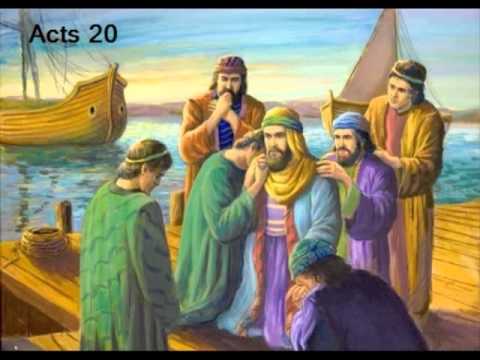
Acts 20:31-32

Jesus does it with a prayer:

Holy Father, keep them in your name
that you have given me,
so that they may be one just as we are one.
When I was with them I protected them in your name that you gave me,
and I guarded them, and none of them was lost
except the son of destruction,
in order that the Scripture might be fulfilled.
But now I am coming to you.
I speak this in the world
so that they may share my joy completely.

John 17:11-13

Today, we may want to spend a little time with Jesus and Paul looking back over the long beam of our lives, thanking God for the graces that poured from our many goodbyes and hellos.


Poetry: In My Dreams – Stevie Smith

In my dreams I am always saying goodbye and riding away,
Whither and why I know not nor do I care.
And the parting is sweet and the parting over is sweeter,
And sweetest of all is the night and the rushing air.

In my dreams they are always waving their hands and saying goodbye,
And they give me the stirrup cup and I smile as I drink,
I am glad the journey is set, I am glad I am going,
I am glad, I am glad, that my friends don’t know what I think.


Music: Every Goodbye Is Hello – Andrew Lippi from the musical “John and Jen”


There’s a wonderful place
Just waiting for you
There are wonderful things
You’ll get to do
Out there, somewhere, the world
And all its wonders
One small step is all it takes to know
Every goodbye is hello
There’s a magical phrase

I’ll tell it to you
Always honor the old
But live for the new
Out there, somewhere

About to be discovered
Trust yourself and
each new day will show
How every goodbye is hello
I will always be near

To hear of all the things you’ll be
Everyone needs a home to return to
And you can turn to me
There’s a time in our

lives when we will know
(There’s a time in our
lives when we will know)
There’s a time to stay home
And a time to grow
Out there, somewhere, your life
And all its promise
Sometimes part of love is letting go
But every goodbye is

Welcome to the world
(Welcome to the world)
Hello

Eternal Life

Seventh Sunday of Easter
May 21, 2023

Today’s Readings:

https://bible.usccb.org/bible/readings/052123-Sunday.cfm

A little explanation: For those of my readers who do not live in the Archdiocese of Philadelphia, today’s readings will be different from the ones used for the reflection. In the archdioceses and dioceses within the Ecclesiastical Provinces of Boston, Hartford, New York, Newark, Omaha, and Philadelphia, the Ascension of the Lord always falls on Thursday of the Sixth Week of Easter and is a Holyday of Obligation. In all other archdioceses and dioceses, the Ascension of the Lord is transferred to the Seventh Sunday of Easter.

If you wish, you may use the Ascension reflection from last Thursday, or refer to this reflection by the always excellent Mary McGlone from this week’s NCR.


Could this be a rarely seen 1st century photo of Mary (in blue)
with some friends and the Eleven.


Today, in God’s Lavish Mercy, our reading from Acts gives us a group photo of the “Apostolic Council”. Think of it as the foundational selfie of Catholic history. And all the big names are there in indelible magic marker with a few “also ran”s mentioned as a seeming afterthought.

Let’s talk about those “also ran”s – those unnamed champions of the faith who are there, who show up, who do the heavy lifting, and whose names disappear into history like the black powder in an Etch-a-Sketch. Let’s talk about them because they are us.


In his letter, Peter tells us to be joyful when our devotion to the faith brings us suffering! Doing so, we become the unnamed disciples of the Gospel carrying human history forward to eternal life.

Rejoice to the extent that you share in the sufferings of Christ,
so that when his glory is revealed
you may also rejoice exultantly.
If you are insulted for the name of Christ, blessed are you,
for the Spirit of glory and of God rests upon you.


Living with that kind of resolute joy is a huge challenge unless we understand the reason for it. Jesus explains the reason clearly in our Gospel – eternal life.

Father, the hour has come.
Give glory to your son, so that your son may glorify you,
just as you gave him authority over all people,
so that your son may give eternal life to all you gave him.
Now this is eternal life,
that they should know you, the only true God,
and the one whom you sent, Jesus Christ.


We not talking about a good life, a happy life, a complete life, an inspiring life. They are all really wonderful things. What we’re talking about here is THE only thing that matters:

Let’s ask for it. Let’s pray for it. Let’s do everything we can to open our hearts to it!


Poetry: Forever Is Composed of Nows – Emily Dickinson

Forever – is composed of Nows –
’Tis not a different time –
Except for Infiniteness –
And Latitude of Home –

From this – experienced Here –
Remove the Dates – to These –
Let Months dissolve in further Months –
And Years – exhale in Years …


Music: Song to the Moon – from Rusalka

Rusalka Op. 114, is an opera (‘lyric fairy tale’) by Antonín Dvořák. The “Song to the Moon” is so beautiful and one of my favorite arias. The vocal version is thrilling, but I found this instrumental version which is more fitting for meditation. I hope you enjoy it.

Colorful Faith

Monday of the Sixth Week of Easter
May 15, 2023

Today’s Readings:

https://bible.usccb.org/bible/readings/051523.cfm

Today, in God’s Lavish Mercy, our first reading opens with the beautiful image of Paul and co-ministers sailing off into the Mediterranean blue, finally ending up in Philippi.

There they meet Lydia, “a dealer in purple cloth”. Lydia was a notable figure. Some scripture scholars say she was businesswoman and head of a significant household who offered hospitality to Paul’s entire traveling team. Others see her as a morally questionable “huckster” whose invitation of men to her home would have been morally questionable.

In a magnificent paper for her doctoral dissertation, Alexandra Gruca-Macaulay argues for Lydia as the “Perceptive Disciple” whose true heart became an agent for God’s Word.

A complex but excellent read for those who might be interested.

However we imagine Lydia, Acts clearly notes that she was already a “worshipper of God”, Lydia listened to the disciples’ evangelization. God opened her heart and she accepted Jesus Christ. This is most significant because her heart-opening, much like Mary’s, allowed the Gospel to pass through to her household and, symbolically, to all of Asia Minor.

Halliday, Edward Irvine; St Paul Meeting Lydia of Thyatira; University of Liverpool; http://www.artuk.org/artworks/st-paul-meeting-lydia-of-thyatira-66511

Lydia is the first Christian convert in Philippi, a church which Paul grew to love deeply as we can discern from his beautiful letter to the Philippians. As Paul and his company finish their initial evangelization in Philipppi, the community is entrusted to the hands of Lydia and her devoted neighbors.

What exactly was Lydia’s role as Paul sailed on to other horizons? As in so many cases involving early Church women, history folds that answer into the opinionated edits of 2000 years of monks and translators.

I choose to think that Lydia continued at least as a presbyter, if not a priest. The community had long gathered around her generous and dynamic leadership. Why would that change after Paul departed?


In our Gospel, Jesus is speaking to people like Lydia and like us, down through the ages. He indicates that once we are transformed in the Holy Spirit, we can’t help but cry out the wonder of God in our lives.

Jesus said to his disciples:
“When the Advocate comes whom I will send you from the Father,
the Spirit of truth who proceeds from the Father,
he will testify to me.
And you also testify,
because you have been with me from the beginning.

John 15:26-27

Let’s pray to and for all true disciples, especially the women God has chosen to stand at the center of an ever-evolving Church and to weave its energy always toward an inclusive community.


Poetry: Epilogue – Sister Lou Ella Hickman, a widely published poet whose collection ” she:robed and wordless” captures the essence of many biblical women. Her poem cited here attracted me because of the colors – purple, of course, then oranges and reds. I can almost hear our Lydia reciting such a poem!


Music: Piano instrumental of the beautiful song Deep Purple


The Letter

Friday of the Fifth Week of Easter
May 12, 2023

Today’s Readings:

https://bible.usccb.org/bible/readings/051223.cfm

Today, in God’s Lavish Mercy, Judas Barsabbas and Silas are chosen to deliver a letter from the Apostles to the Gentiles in Antioch. It’s a critical letter – containing the apostolic decision regarding how the Antiochan church must observe religious practice.


Have you ever waited for a “decision letter”, one for which you were not sure of the outcome? Maybe a college or job acceptance letter? A bid on a new house? Or maybe a contest you entered desperate to win?

I remember waiting for the letter announcing whether or not the Sisters of Mercy would accept me into their community. It was a nerve-wracking wait for many reasons. I really wanted to be a Sister of Mercy but, after the initial interview, I wasn’t sure I could fill the bill.

The ride to the interview had seemed so distant from where I lived – in many ways. I had never seen such beautiful houses as those in the neighborhood surrounding the Motherhouse. And the entrance to the convent itself was, and still is, breath-taking. My six-foot self felt extremely small.

Sister Mary Assisium, who interviewed my parents and me, was an icon of the pre-Vatican II religious. She was perfection in her beautiful habit, cultured speech, quiet gait, and ultra-serious tone of voice. Her eyes seemed like big lakes in a sacred monument.

She scared me to death! I was a lanky, loping, gum-chewing teenager who still dropped the “g”s on my “ing”s. As we drove home from the meeting, I was pretty sure there was no way these women were going to invite me to join them! I think my parents were pretty sure too.


That interview happened on April 7, 1963. On June 2nd, I came home from work at the neighborhood deli, carrying a pastrami sandwich, to find an unopened letter lying on our dining room credenza. About ten feet away, Mom sat in the kitchen staring back and forth from the letter to me. For a few minutes, I stared back and forth from the letter to Mom, then finally got the guts to open it. It was dated May 31, 1963, Feast of the Queenship of Mary. ( After 1969, that date became Feast of the Visitation)


It said this, but in a lot of different, more beautiful words:


But the letter also implied, although not stated, an understanding that reassured my doubts.


Judas Barsabbas and Silas carried the same kind of letter to the Chrisitan Gentiles in Antioch. “You’re in. Just as you are.” And our Gospel today, tells us why that is so – Love.

Love is the test which measures us for Christianity – not religious practice, rituals, or personaility traits. The apostolic decision-makers understood this and came to a conclusion based on Gospel love.

Jesus makes this clear in our reading today, and how blessed are we to receive his invitation:

This is my commandment: love one another as I love you.
No one has greater love than this,
to lay down one’s life for one’s friends.
You are my friends if you do what I command you.
I no longer call you slaves,
because a slave does not know what his master is doing.
I have called you friends,
because I have told you everything I have heard from my Father.
It was not you who chose me, but I who chose you
and appointed you to go and bear fruit that will remain,
so that whatever you ask the Father in my name he may give you.
This I command you: love one another.


Poetry: Acceptance – Robert Frost

When the spent sun throws up its rays on cloud
And goes down burning into the gulf below,
No voice in nature is heard to cry aloud
At what has happened. Birds, at least must know
It is the change to darkness in the sky.
Murmuring something quiet in her breast,
One bird begins to close a faded eye;
Or overtaken too far from his nest,
Hurrying low above the grove, some waif
Swoops just in time to his remembered tree.
At most he thinks or twitters softly, 'Safe!
Now let the night be dark for all of me.
Let the night be too dark for me to see
Into the future. Let what will be, be.'

Music: The Letter – by the Boxtops: Well, the Sisters of Mercy didn’t exactly say they “couldn’t live without me no more”. But that’s the way I read it! 🙂

What About “Strangers”?

Thursday of the Fifth Week of Easter
May 11, 2023

Today’s Readings:

https://bible.usccb.org/bible/readings/051123.cfm

Peter Preaches to Jews and Gentiles


Today, in God’s Lavish Mercy, the Apostles continue to deal with the assimilation of Gentiles into the faith community. Their struggle is one that continually challenges the human community throughout history.

Think about it. What’s it like when someone new comes into your established community – your family, parish, workplace, convent, social group, etc.? How did it feel when you met your potential in-laws, or teacher-partner, or new boss, new novices, or your betrothed’s questionable friends?

And, maybe more importantly, how did they feel bumping up against your already solidly established relationships and practices?


It’s no fun being the new guy or gal. It’s exciting maybe, but it’s also a little scary. And it’s certainly no fun feeling different or like a stranger in one’s new environment.

And, in a way, it’s no fun being the old guy or gal either. It can be challenging, even annoying, to have to realign our comfortable routines to incorporate a newbie. And when these routines are centuries old religious practices, oh baby, we have a problem!


This is the challenge the early Christian community faced as the established Jerusalem church spread out across Asia and the Mediterranean basin to bring the Gospel to the Gentiles. Through Peter’s leadership, they seem to have handled the issue very well:

“My brothers, you are well aware that from early days
God made his choice among you that through my mouth
the Gentiles would hear the word of the Gospel and believe.
And God, who knows the heart,
bore witness by granting them the Holy Spirit
just as he did us.

God made no distinction between us and them,
for by faith he purified their hearts.
Why, then, are you now putting God to the test
by placing on the shoulders of the disciples
a yoke that neither our ancestors nor we have been able to bear?


On the contrary, we believe that we are saved
through the grace of the Lord Jesus, in the same way as they.”


What powerful lessons to learn as we continue to build an inclusive and universal Church, and to deal with the many blocks inhibiting us: racism, xenophobia, sexism and heterosexism, to name a few. All of these are based on a negative pre-judgment whose purpose is to maintain control and power in a dominant group.

By the power of the Holy Spirit, Peter was able to let go of that need. Let’s ask him to help us and our Church.


Poetry: Song of Myself #48 – Walt Whitman

I have said that the soul is not more than the body,
And I have said that the body is not more than the soul,
And nothing, not God, is greater to one than one’s self is,
And whoever walks a furlong without sympathy walks to his own funeral drest in his shroud,
And I or you pocketless of a dime may purchase the pick of the earth,
And to glance with an eye or show a bean in its pod confounds the learning of all times,
And there is no trade or employment but the young man following it may become a hero,
And there is no object so soft but it makes a hub for the wheel’d universe,
And I say to any man or woman, Let your soul stand cool and composed before a million universes.
And I say to mankind, Be not curious about God,
For I who am curious about each am not curious about God,
(No array of terms can say how much I am at peace about God and about death.)
I hear and behold God in every object, yet understand God not in the least,
Nor do I understand who there can be more wonderful than myself.
Why should I wish to see God better than this day?
I see something of God each hour of the twenty-four, and each moment then,
In the faces of men and women I see God, and in my own face in the glass,
I find letters from God dropt in the street, and every one is sign’d by God’s name,
And I leave them where they are, for I know that wheresoe’er I go,
Others will punctually come for ever and ever.

Music: You Don’t Have to Be Like Me – RebbeSoul