The Passover of the Lord

Friday of the Fifteenth Week in Ordinary Time
July 21, 2023

Today’s Readings:

https://bible.usccb.org/bible/readings/072123.cfm


Today, in God’s Lavish Mercy, we hear the familiar tones of the central Exodus story.

Waiting for Easter Vigil

As we prayerfully read this passage, we may be carried back to the many Holy Saturday liturgies we have attended in our lives. In our memories, it is early spring, the evenings are still dark, and chapel is barely lit. We know the momentous story we are about to hear and re-enact. We believe it is brought to fruition in the sacramental liturgy we are about to offer. And, within all the memories, all the rituals, and all the words, one phrase stands out:

It is the Passover of the Lord.

“This is how you are to eat the lamb:
with your loins girt, sandals on your feet

and your staff in hand,
you shall eat like those who are in flight.
It is the Passover of the LORD.


Walter Brueggemann says that, in the act of “passover”, the community chooses to move on from its prohibitive existence to a new way of being. It chooses an alternative that requires “departure”:

That alternative is not easy or obvious or automatic. It requires a departure, an intentional departure from that system that the Bible terms “exodus.” In that ancient narrative the Israelites did not want to go, and once they had gone they wished to resubmit to Pharaoh. The departure is a piece of demanding, sustained work. The capacity to think and imagine and act and live beyond that system requires imagination that has dimensions of the psychological, the economic, and the liturgical. Indeed, the core liturgy of Israel (Passover) and the derivative liturgies of the church are practiced departures that now and then take on reality in the world.

Walter Brueggemann: Journey to the Common Good

In our reading from Matthew, and continually throughout the Gospel, Jesus invites his community to a profound “departure” – to a new understanding of the Law as love not requirement.

When the Pharisees criticize the hungry disciples for plucking and eating grain heads on the Sabbath, Jesus confronts them:

I say to you, something greater than the temple is here.
If you knew what this meant, I desire mercy, not sacrifice,
you would not have condemned these innocent men.
For the Son of Man is Lord of the sabbath.”

Matthew 12:7-8

Something greater than the Temple?????? The Pharisees stare at Jesus in stunned amazement! Could such a thing be possible?

Our Gospel tells us that not only is it possible, it is reality. The “Temple” and the old Law had lost their heart to the belief that personal power and affluence trumped human need. Their “systems” for becoming holy had become vacuous.

Jesus teaches that gaining sanctity requires that we live in mercy toward ourselves and others. Rituals, Temples, Churches and codes of conduct are meaningless unless they direct us always to act in mercy. When these same institutions and practices contradict God’s Mercy, we must have the courage for “departure” and “passover”.

“Departure” though does not mean abandonment. It means ceasing the merciless practices condoned by institutionalization, and having the courageous perseverance to build new paths to meaning.


It is clear in the Jewish practice of Passover that the exodus memory became a paradigmatic narrative through which all social reality is described and re-experienced. That is, the narrative pertains to a one-time remembered social upheaval caused by God’s holiness; but the narrative looks beyond that one-time memory to see that the same transactions of oppression and emancipation continue everywhere to evoke holy power.

Walter Brueggemann, Journey to the Common Good

Every day of our lives, we are called to “passover” into greater spiritual awareness, merciful practice, and just living. We may hear the call in small personal interactions, or in the larger context of our fragmented world.

We are faced constantly with alternatives between (just to name a few):

  • selfishness or generosity
  • forgiveness or vengefulness
  • honesty or pretense
  • peacemaking or rabble-rousing
  • addiction or freedom
  • informed decision-making or arrogant ignorance
  • gossip or respect
  • action for the poor or indifferent comfort
  • political and economic elitism or social justice
  • respect fro Creation or utilitarian ignorance

The sacred bridge in each of these passovers is the Gospel of Jesus Christ. Choosing it wholeheartedly, we will arrive on the right side of God.


Poetry: Journey – by Mary Oliver

One day you finally knew
what you had to do, and began,
though the voices around you
kept shouting
their bad advice--
though the whole house
began to tremble
and you felt the old tug
at your ankles.
"Mend my life!"
each voice cried.
But you didn't stop.
You knew what you had to do,
though the wind pried
with its stiff fingers
at the very foundations,
though their melancholy
was terrible.
It was already late
enough, and a wild night,
and the road full of fallen
branches and stones.
But little by little,
as you left their voices behind,
the stars began to burn
through the sheets of clouds,
and there was a new voice
which you slowly
recognized as your own,
that kept you company
as you strode deeper and deeper
into the world,
determined to do
the only thing you could do--
determined to save
the only life you could save.

Music: Took Me Out of Egypt – David Baroni (lyrics below)

Lord I’m feel so empty seems like we’re so far apart
Even tho’ some may applaud me
You alone can see my heart
You don’t look at my achievements or my ability
All You really wants is all of me
And though it frightens me to give my control
There is only room for one King
In the throne room of my soul

Lord You took me out of Egypt
Now take Egypt out of me
You delivered me from Pharaoh
now set me free from me
Let my heart become a promised land
Where the desert used to be
Lord You took me out of Egypt
Now take Egypt out of me

Blessed are the pure in heart
For they shall see the Lord
But eyes that only look to earth
Will lose the rich reward
Of the fellowship eternal the blissful unity
Of the ones who live in Jesus
And no longer serve King Me

Lord You took me out of Egypt…….

Lord I love the gifts You’ve given me
But I love the Giver more
And to worship You more perfectly
That’s what those gifts are for

Lord You took me out of Egypt…….

Legacies

Memorial of St. Bonaventure
Saturday of the Fourteenth Week in Ordinary Time
July 15, 2023

Today’s Readings:

https://bible.usccb.org/bible/readings/071523.cfm


Today, in God’s Lavish Mercy, both our readings express the character of farewells or life testaments.

In our first reading, we close out our few weeks’ journey through Genesis with Jacob’s instructions to his posterity. These directives attach his passing and their future to Israel’s ancestral roots:

Jacob gave his sons this charge:
“Since I am about to be taken to my people,
bury me with my fathers in the cave that lies
in the field of Ephron the Hittite,
the cave in the field of Machpelah,
facing on Mamre, in the land of Canaan,
the field that Abraham bought from Ephron the Hittite
for a burial ground.

Genesis 49:29-30

Reading these verses, I remembered two sets of similar instructions that I had once received.

The first set was given to me and my brother.

Our beloved mother had just died after a few months’ illness. We were about the business of preparing for her burial. Our family storage systems were very simple but definite. Confident that no thief would want to do any tailoring while burglarizing the house, we kept important documents in an old tin sewing box. Jim and I knew the cemetery deed would be there, top shelf of the living room closet, under a couple of afghans.


What we didn’t know was that Mom, never much for sad or purple prose, had left us a letter in that box. The letter, penned in a strong hand, anticipated her death and counseled us for a future without her. Surprisingly, her letter had been written long before her terminal diagnosis, prompted no doubt by my Dad’s sudden death about a decade before.

Mom was brief but direct in her hopes and instructions, the core of which was this:

Know that I loved the two of you
more than anything in the world.
Love and care for each other when I am gone.


The second set of instructions was not the fruit of a bloodline inheritance, but of a spiritual one: my call to Mercy. My dear sponsor, realizing at my Silver Jubilee that the years were passing for us both, offered this wisdom so typical of her direct and good-natured style:


In our Gospel, Jesus anticipates a time when his disciples will be without his guiding presence. Like Jacob, and like my Mom and my sponsor, Jesus wants his beloved descendants to recognize, and find courage in, the amazing love which is their inheritance.

Are not two sparrows sold for a small coin?
Yet not one of them falls to the ground without your Father’s knowledge.
Even all the hairs of your head are counted.
So do not be afraid; you are worth more than many sparrows.
Everyone who acknowledges me before others
I will acknowledge before my heavenly Father.

Matthew 10:29-32

As we pray with today’s scriptures, we might give thanks for the blessings we have received from our ancestors, be they of blood or spirit.

Further, we might prayerfully consider those who need and deserve our blessing as they assume the future we will not see — our children, nieces, nephews, sisters and brothers in religious formation — any number of disciples and pupils who look to us for hopeful and grateful witness.


Poetry: My Legacy – Lucy Maude Montgomery
Lucy Maud Montgomery OBE (1874 – 1942), was a Canadian author best known for a collection of novels, essays, short stories, and poetry beginning in 1908 with Anne of Green Gables.

My friend has gone away from me
From shadow into perfect light,
But leaving a sweet legacy.
My heart shall hold it long in fee­
A grand ideal, calm and bright,
A song of hope for ministry,
A faith of unstained purity,
A thought of beauty for delight­
These did my friend bequeath to me;
And, more than even these can be,
The worthy pattern of a white,
Unmarred life lived most graciously.
Dear comrade, loyal thanks to thee
Who now hath fared beyond my sight,
My friend has gone away from me,
But leaving a sweet legacy.

Music: Standing on the Shoulders – Joyce Rouse

Coming to Forgiveness

Memorial of Saint Kateri Tekakwitha, Virgin
Friday of the Fourteenth Week in Ordinary Time
July 14, 2023

Today’s Readings:

https://bible.usccb.org/bible/readings/071423.cfm


Today, in God’s Lavish Mercy, our Gospel describes the suffering to be encountered by disciples as they live and preach the Gospel.

Jesus said to his Apostles:
“Behold, I am sending you like sheep in the midst of wolves;
so be shrewd as serpents and simple as doves.
But beware of men,
for they will hand you over to courts
and scourge you in their synagogues,
and you will be led before governors and kings for my sake
as a witness before them and the pagans.

Matthew 10:16-18

The suffering is predicted to come from many quarters, but perhaps the most heart-breaking is persecutioin within families:

Brother will hand over brother to death,
and the father his child;
children will rise up against parents and have them put to death.
You will be hated by all because of my name,
but whoever endures to the end will be saved.

Matthew 10:21-22

Our reading from Genesis, on the other hand, describes the loving resolution of a long-standing family rupture as Jacob (now called “Israel”) reunites with his long-lost son:

Israel had sent Judah ahead to Joseph,
so that he might meet him in Goshen.
On his arrival in the region of Goshen,
Joseph hitched the horses to his chariot
and rode to meet his father Israel in Goshen.
As soon as Joseph saw him, he flung himself on his neck
and wept a long time in his arms.
And Israel said to Joseph, “At last I can die,
now that I have seen for myself that Joseph is still alive.”

Genesis 46:28-30

Many of us have borne the pain of similar fractures in our various “families”: family of origin, community, church or friends. Sometimes the cause of these breaks may be contradictions in faith and moral practice. At other times, loving bonds break because of willfulness, arrogance, ignorance, small-heartedness or the many other forms of human limitation.

The outrageous jealousy of Joseph’s brothers cleft their otherwise contented family. But into that chasm, God poured time’s grace and Joseph’s healing. From these gifts, Joseph was able to step into reconciliation, inviting his repentant brothers to join him.


In our own lives, such a step can be inordinately huge. The longer we hesitate to take it, the more it widens, sometimes to the point of apparent no return. But the grace of forgiveness is always available to us even if actual reconciliation is impossible because of the recalcitrance, inaccessibility, or perhaps even death of the other party.

When they hand you over,
do not worry about how you are to speak
or what you are to say.
You will be given at that moment what you are to say.
For it will not be you who speak
but the Spirit of your Father speaking through you.

Matthew 10:19-20

Psalm Poem: Psalm 37 – interpreted by Christine Robinson

The evil prosper, but don’t you wallow in anger.
Do what you can and let it go.
Remember the long arc of the universe
and how it bends towards justice.
Set your feet on that path; it is True.
Be still.
Wait for God’s word to speak to your heart.
Enjoy your life as it is, find your work, love those around you.
Hold your head up and teach your children.
Notice those who are honest.
Join the upright
Make peace where you can
Trust in God.

Music: excerpts from Joseph and the Amazing Technicolor Dreamcoat – Andrew Llyod Webber

These two videos capture the story of Jacob’s arrival in Egypt and Joseph’s self-reconciliation. The first ends rather abruptly, but thesecond picks up the action. All lyrics are below.

[NARRATOR]
Joseph knew by this his brothers now were honest men
The time had come at last to reunite them all again

[JOSEPH]
Can’t you recognize my face? Is it hard to see
That Joseph, who you thought was dead, your brother
It’s me?

[ENESMBLE]
Joseph, Joseph, is it really true?
Joseph, Joseph, is it really you?

[NARRATOR & ENESMBLE]
Joseph! Joseph!

——————-

So Jacob came to Egypt
No longer feeling old
And Joseph came to meet him
In his chariot of gold
Of gold
Of gold
Of gold!

————-

[JOSEPH]
I closed my eyes, drew back the curtain
To see for certain what I thought I knew
Far, far away, someone was weeping
But the world was sleeping
Any dream will do

[JOSEPH & CHILDREN]
I wore my coat with golden lining
Bright colors shining, wonderful and new
And in the east, the dawn was breaking
And the world was waking
Any dream will do
A crash of drums

[NARRATOR]
A flash of light

[JOSEPH]
My golden coat flew out of sight

[JOSEPH & NARRATOR]
The colors faded into darkness
I was left alone

[JOSEPH, NARRATOR & CHILDREN]
May I return to the beginning?
The light is dimming, and the dream is too
The world and I, we are still waiting
Still hesitating
Any dream will do

Blessed Retrospect!

Thursday of the Fourteenth Week in Ordinary Time
July 13, 2023

Today’s Readings:

https://bible.usccb.org/bible/readings/071323.cfm


Joseph Forgives His Brothers – Joseph Von Cornelius

Today, in God’s Lavish Mercy, Joseph forgives his brothers and Jesus commissions his disciples.

The story of Joseph’s forgiveness makes a tender and indelible mark on the prayerful reader. How we wish we could be as magnanimous as Joseph in our forbearance!


Joseph’s experience is one of a long-held hurt that he sets aside to pursue another life. But even though he achieves tremendous success in his new environment, hurts like this are never forgotten. Joseph’s sobs at verse four indicate the painful memory’s depth.

Joseph could no longer control himself
in the presence of all his attendants,
so he cried out, “Have everyone withdraw from me!”
Thus no one else was about when he made himself known to his brothers.
But his sobs were so loud that the Egyptians heard him,
and so the news reached Pharaoh’s palace.
“I am Joseph,” he said to his brothers.
“Is my father still in good health?”
But his brothers could give him no answer,
so dumbfounded were they at him.

Genesis 45:1-3

“To forgive is to set a prisoner free
and discover that the prisoner was you.”

Lewis B. Smedes

So many lessons can be drawn from this passage, but clearly the power of forgiveness is most evident. Joseph has been able to live a fruitful life in Egypt because he has already forgiven his brothers’ treachery, long before they unexpectedly arrive at his palace doorstep. He has chosen not to live under the burden of their treacherous choice.

In the wider perspective of God’s timing, we see that the treachery actually yielded a blessing not only for Joseph, but for all of Israel. We ask for the grace to see how our own need to give and receive forgiveness holds a larger blessing for our lives.


Poetry: Let It Go – e.e.cummings

Let it go – the
smashed word broken
open vow or
the oath cracked length
wise – let it go it
was sworn to
go
 
let them go – the
truthful liars and
the false fair friends
and the boths and
neithers – you must let them go they
were born
to go
 
let all go – the
big small middling
tall bigger really
the biggest and all
things – let all go
dear
 
so comes love

Music: Remember Not the Things of the Past – Bob Hurd

Remember not the things of the past;
now I do something new,
do you not see it?
Now I do something new, says the Lord.
 
In our distress God has grasped us by the hand,
opened a path in the sea, and we shall pass over,
we shall pass over, free at last.
 
In our parched land of hypocrisy and hate,
God makes a river spring forth,
a river of mercy, truth and compassion;
come and drink.
 
And who among us is sinless in God’s sight?
Then who will cast the first stone,
when he who was sinless
carried our failings to the cross?
 
Pressing ahead, letting go what lies behind,
may we be found in the Lord, and sharing his dying,
share in his rising from the dead.

Twelve

Wednesday of the Fourteenth Week in Ordinary Time
July 12, 2023

Today’s Readings:

https://bible.usccb.org/bible/readings/071223.cfm


Today, in God’s Lavish Mercy, we have the stories of two sets of twelve men:

  • Joseph and his brothers, heads of the twelve tribes of Israel
    (Reuben, Simeon, Levi, Judah, Dan, Naphtali, Gad, Asher, Issachar, Zebulun, Joseph, and Benjamin)
  • the twelve Apostles chosen by Jesus
    (Simon Peter, Andrew, James, John, Philip, Bartholomew, Thomas, Matthew, James, Thaddeus, Simon, Judas)

Joseph Oversees Egypt’s Granaries – Lawrence Alma-Tadema


Each of these pillars of the Judea-Christian tradition had their individual faith stories which have called generations either to imitate or contradict them. We want to be like faithful, fumbling Peter but not like clever, devious Judas. We abhor the muderous jealousy of the 10 brothers, but admire the generous forgiveness of Joseph.

These ageless stories present us with the mysterious beauty of the Scriptures which allow us to find our best and worst selves within them. But more significantly, beyond mirroring all human experience, these stories reflect God’s abiding Presence in the unfolding of human and individual history.


The Joseph narrative, which we have a small part of today, presents a whole new way of looking at God’s relationship with Israel. God is not an overt actor in the narrative as in the early Pentateuch accounts, but rather the hidden Agency in a long and sustained drama.

(The Joseph narrative) urges that in the contingencies of history, the purposes of God are at work in hidden and unnoticed ways. But the ways of God are nonetheless reliable and will come to fruition….
The purposes of God are not wrought here by abrupt action or by (heavenly) intrusions, but by the ways of the world which seem to be natural and continuous.

Walter Brueggemann: Genesis, A Bible Commentary for Teaching and Preaching

As I read Bruggemann’s commentary, I think of the many times my religious community has come together for story-telling during a Sister’s funeral rites. Within an inspirational hour, the extended history of this Sister’s life is gathered into a powerful statement reflecting both God’s and her long fidelity.

As in Joseph’s story, God has not spoken aloud, but has spoken nonetheless clearly, in and through each remembered life. The grateful community is left in quiet and joyful awe at the end of each ritual, amazed and convinced that God is silently present in every person’s story, even one’s own.


Today’s Responsorial Psalm may capture our sentiments as we consider our own lives in the light of today’s readings. We can take great comfort in the belief that, in the eternal design, all things come to wholeness for those who trust God.

The LORD brings to nought the plans of nations;
and foils the designs of peoples.
But the plan of the LORD stands forever;
the design of God’s heart, through all generations.

Psalm 33:10-11

Poetry: The Thread of Life – Christina Rossetti

The irresponsive silence of the land,
The irresponsive sounding of the sea,
Speak both one message of one sense to me: —
Aloof, aloof, we stand aloof, so stand
Thou too aloof bound with the flawless band
Of inner solitude; we bind not thee;
But who from thy self-chain shall set thee free?
What heart shall touch thy heart? what hand thy hand?—
And I am sometimes proud and sometimes meek,
And sometimes I remember days of old
When fellowship seemed not so far to seek
And all the world and I seemed much less cold,
And at the rainbow's foot lay surely gold,
And hope felt strong and life itself not weak.

2

Thus am I mine own prison. Everything
Around me free and sunny and at ease:
Or if in shadow, in a shade of trees
Which the sun kisses, where the gay birds sing
And where all winds make various murmuring;
Where bees are found, with honey for the bees;
Where sounds are music, and where silences
Are music of an unlike fashioning.
Then gaze I at the merrymaking crew,
And smile a moment and a moment sigh
Thinking: Why can I not rejoice with you ?
But soon I put the foolish fancy by:
I am not what I have nor what I do;
But what I was I am, I am even I.

3

Therefore myself is that one only thing
I hold to use or waste, to keep or give;
My sole possession every day I live,
And still mine own despite Time's winnowing.
Ever mine own, while moons and seasons bring
From crudeness ripeness mellow and sanative;
Ever mine own, till Death shall ply his sieve;
And still mine own, when saints break grave and sing.
And this myself as king unto my King
I give, to Him Who gave Himself for me;
Who gives Himself to me, and bids me sing
A sweet new song of His redeemed set free;
He bids me sing: O death, where is thy sting?
And sing: O grave, where is thy victory?

Music: Air on the G String – J.S.Bach, played by Hauser


Beyond Expectation…

Tuesday of the Eleventh Week in Ordinary
June 20, 2023

Today’s Readings:

https://bible.usccb.org/bible/readings/062023.cfm

Today, in God’s Lavish Mercy, we receive an in-depth teaching on Christian generosity.

In the early Church, as in the Church today, evangelism and ministry require material support. In Paul’s time, the mother Church in Jerusalem needed funds to support ongoing mission activity.

In our first reading, Paul writes a “fund-raising” letter to the Greek Corinthians. He challenges them to be generous by raising up to them the outstanding example of the Macedonian churches (Philippi, Thessalonica, and Berea). These communities, despite their current hardship, gave beyond expectation to the Church’s need.

Macedonia and Greece had a competitive political relationship. Whether or not Paul was using this contention to stoke a response in Corinthian generosity, we can only guess. However, Paul is very clear about what should motivate the Christian heart to charity:

For you know the gracious act of our Lord Jesus Christ,
that for your sake he became poor although he was rich,
so that by his poverty you might become rich.

2 Corinthians 8:9

While Paul has offered a tutorial on material giving, Jesus inspires us to a much deeper generosity. Jesus asks us to imitate God in our loving benevolence:

Jesus said to his disciples:
“You have heard that it was said,
You shall love your neighbor and hate your enemy.
But I say to you, love your enemies
and pray for those who persecute you,
that you may be children of your heavenly Father,
for he makes his sun rise on the bad and the good,
and causes rain to fall on the just and the unjust.

Matthew 5:43-45

God’s generosity – God’s beautiful Mercy – does not distiguish between who is deserving and who is not. God’s love is universal and irrevocable. Jesus, who is the enfleshment of God’s Love, explains that God’s perfection consists in this Absolute Mercy. He tells us that we should strive to live a life in imitation of this Merciful Perfection.

For if you love those who love you, what recompense will you have?
Do not the tax collectors do the same?
And if you greet your brothers only,
what is unusual about that?
Do not the pagans do the same?
So be perfect, just as your heavenly Father is perfect.”

Matthew 5:46-48

Jesus is telling us that by living in generous mercy, beyond worldly expectation, we become “perfect” or whole in the Wholeness of God. Mercy heals not only those we touch, it heals us.


Poetry: To Live in the Mercy of God – Denise Levertov

To lie back under the tallest
oldest trees. How far the stems
rise, rise
before ribs of shelter
open!

To live in the mercy of God. The complete
sentence too adequate, has no give.
Awe, not comfort. Stone, elbows of
stony wood beneath lenient
moss bed.
And awe suddenly
passing beyond itself. Becomes
a form of comfort.
Becomes the steady
air you glide on, arms
stretched like the wings of flying foxes.
To hear the multiple silence
of trees, the rainy
forest depths of their listening.
To float, upheld,
as salt water
would hold you,
once you dared.
To live in the mercy of God.
To feel vibrate the enraptured
waterfall flinging itself
unabating down and down
to clenched fists of rock.
Swiftness of plunge,
hour after year after century,
O or Ah
uninterrupted, voice
many-stranded.
To breathe
spray. The smoke of it.
Arcs
of steelwhite foam, glissades
of fugitive jade barely perceptible. Such passion—
rage or joy?
Thus, not mild, not temperate,
God’s love for the world. Vast
flood of mercy
flung on resistance.

Music: Mormon Tabernacle Choir – Holy Art Thou »-(adapted from Handel’s Largo “Ombra mai fu” in “Xerxes”. A beautiful instrumental version is under the hymn lyrics below.)

Holy art Thou, Holy art Thou, Lord God Almighty
Glory and Majesty, in Heav′n are Thine
Earth’s lowly bending, swells the full harmony
Blessing and Glory to the Lamb, forevermore
For worthy, worthy art Thou
Worthy art Thou

Let all nations and kindreds and peoples
Give thanks to Thee, forevermore
Give thanks forevermore

Let all nations and kindreds and peoples
Give thanks to Thee, forevermore

A Grape Soon Ripe

Saint Charles Lwanga and Companions, Martyrs
June 3, 2023

Today’s Readings:

https://bible.usccb.org/bible/readings/060323.cfm

Today, in God’s Lavish Mercy, we pray with our final passage from the Book of Sirach. We will read Sirach only five or six times again scattered throughout the liturgical year.

In today’s reading, Sirach offers a grateful reflection on the early blessing of wisdom and pursuit of holiness in his life.

I thank the LORD and I praise him;
I bless the name of the LORD.
When I was young and innocent,
I sought wisdom openly in my prayer
I prayed for her before the temple…

Sirach 51:13-14

Sirach’s prayer will resonate with many of us whose earliest days were blessed with faithful parents and grandparents. These wisdom figures taught us to love and seek God in our lives. As we pray today, we think of them with gratitude, as well as of the many teachers who guided our young spirits into God’s Light.

Even if we have moved far from the parish church of our youth, we may recall the graces we received within her walls. We might prayerfully recollect our beloved grade school and high school where we were guided in the pursuit of a meaningful and reverent life.


Hopefully, our prayer brings us to realize how blessed we have been from the beginning of our lives. This is the kind of prayer Sirach prays in today’s reading. He is filled with gratitude and praise because he understands that it is all a gratuitous and undeserved blessing:

My heart delighted in Wisdom,
My feet kept to the level path
because from earliest youth I was familiar with her.
In the short time I paid heed,
I met with great instruction.
Since in this way I have profited,
I will give my teacher grateful praise.

Sirach 51:15-17

Sirach’s prayer brings him to that still and holy place deep in his heart — that place where he touches the Wisdom of God. He describes it like this:

I sought Wisdom openly in my prayer
I prayed for her before the temple,
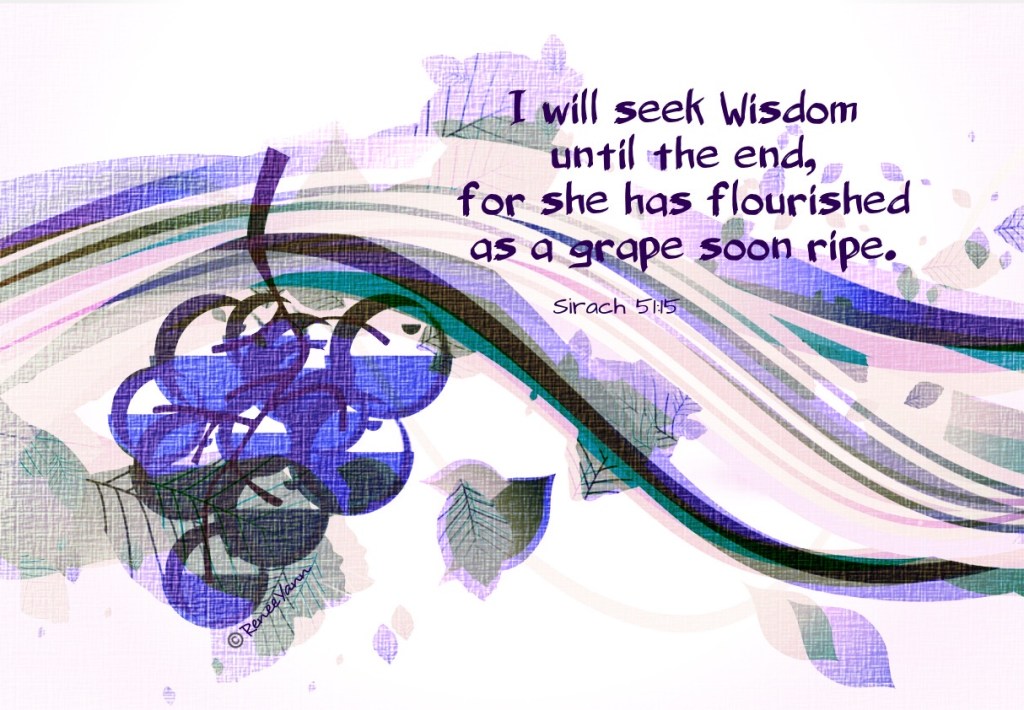
and I will seek her until the end,
and she flourished as a grape soon ripe.

Sirach 51:13-15

Many of us are so busy and intent on living our lives forward – trying to make it through this day to the next. We may not take the time to consider and appreciate the “ripe grape” our life has already become.

I look around me in our convent chapel and realize that I am living with holy people. Of course, like me, they have their personal twists and trademarks. Still each one of them has walked through their roundabout years into the heart of God. Every day they live into a deeper goodness – aging like fine wine, unaware that the grape has already ripened and is blessing the world around them.

The Great Vintner accomplishes this holy transformation in us by a slow accumulation of blessings which saturate our hearts in God. Pausing, like Sirach, to recognize and give thanks fills us with generous gratitude and a confident courage for the days to come.


Take time to look at the holy people in your own life today, the ones through whom God’s Wisdom has poured into your life. They are the ones who love you into a better person by their goodness, honesty, humility, and generosity. You meet them in your family, friends and workplace. Or you may have met them only in a book, poem, song or story.

I met with great instruction.
Since in this way I have profited,
I will give my teacher grateful praise.

Sirach 51:16-17

Poetry: Our Responsorial Psalm 19 today beautifully complements Sirach’s prayer and can serve as a perfect poetic refletion for us.


The law of the LORD is perfect,
refreshing the soul.
The decree of the LORD is trustworthy,
giving wisdom to the simple.

The precepts of the LORD are right,
rejoicing the heart.
The command of the LORD is clear,
enlightening the eye.

Awe of the LORD is pure,
enduring forever;
The ordinances of the LORD are true,
all of them just.

They are more precious than gold,
than a heap of purest gold;
Sweeter also than syrup
or honey from the comb.


Music: Psalm 19 – Jess Ray

A Godly Person

Friday of the Eighth Week in Ordinary Time
June 2, 2023

Today’s Readings:

https://bible.usccb.org/bible/readings/060223.cfm

The Family Tree


Today, in God’s Lavish Mercy, Sirach sounds like he has been using Ancestry.com! As he comes close to the conclusion of his long meditation on God, the Universe, and Nature, he closes now with a reflection on humanity.

Now will I praise those godly men and women,
our ancestors, each in their own time.


In my childhood home, there was a fascinating table whose secrets I learned only when I got to about fifth or sixth grade. I had thought it was just a spot to place a pretty vase, but it was really a classic games table whose top swiveled to store the cards or games inside.

I lived with that table for years, and by the time I was ten or eleven years old, I had never seen that top swiveled nor the inside displayed. Reading Sirach today makes me remember why.

Stored in the table since the time of my grandmother’s death were all the tender remembrances of my deceased family members. Dried funeral flowers wrapped in faded wax paper. The war office telegram saying Uncle Jim had died on Iwo Jima. Black rimmed death announcements from another era – aunts, uncles and great-grands. There were cards from neighbors extolling my grandmother’s courage and goodness.

One day, my mother opened the table and we sat togather as she recounted the stories of the ancestors I never knew. I think it made her both happy and sad to finally share the stories with me. Reliving the losses made her sad. But placing the memories in me made her happy for the very reasons Sirach elaborates in today’s reading.

… these also were godly people
whose virtues have not been forgotten;
Their wealth remains in their families,
their heritage with their descendants;
Through God’s covenant with them their family endures,
their posterity, for their sake.


Our Gospel includes a description of Jesus’s encounter with the poor fig tree. Failing to bear fruit, the tree was cursed by Jesus. It seems like an uncharacteristically mean thing for Jesus to do until we realize that the fig tree is a symbol of the “ungodly” people Jesus has met in the Temple area.

He overturned the tables of the money changers
and the seats of those who were selling doves.
He did not permit anyone to carry anything through the temple area.
Then he taught them saying, “Is it not written:

My house shall be called a house of prayer for all peoples?
But you have made it a den of thieves.”


So our readings today give us two contrasting readings. Sirach tells us what makes a person “godly”, rememberable, and worthy of eternal life. Jesus shows us the fruitlessness and faithlessness that eternally nullifies and condemns a life.

Jesus tells us what faithfulness consists of and how we are to become a godly person – a person worth remembering. Praying with these scriptures, I remember my faith-filled ancestors who rest, not only in a hidden drawer, but in me and in how I live my life because of their legacy.

Jesus said to them in reply, “Have faith in God.
Amen, I say to you, whoever says to this mountain,
‘Be lifted up and thrown into the sea,’
and does not doubt in his heart
but believes that what he says will happen,
it shall be done for him.
Therefore I tell you, all that you ask for in prayer,
believe that you will receive it and it shall be yours.
When you stand to pray,
forgive anyone against whom you have a grievance,
so that your heavenly Father may in turn
forgive you your transgressions.”


Poetry: The Other Kingdoms – Mary Oliver

Consider the other kingdoms. The
trees, for example, with their mellow-sounding
titles: oak, aspen, willow.
Or the snow, for which the peoples of the north
have dozens of words to describe its
different arrivals. Or the creatures, with their
thick fur, their shy and wordless gaze. Their
infallible sense of what their lives
are meant to be. Thus the world
grows rich, grows wild, and you too,
grow rich, grow sweetly wild, as you too
were born to be.

Music: Memories of Blue – Vangelis

Praying for Those We Love

Thursday of the Seventh Week of Easter
May 25, 2023

Today’s Readings:

https://bible.usccb.org/bible/lecturas/052523.cfm

Today, in God’s Lavish Mercy, Jesus prays for those he loves.

In our Gospel. we come to the last section of John 17, the High-Priestly Prayer of Jesus. In his prayer, Jesus prays for three things:

  • God’s glory,
  • the spiritual strength of his disciples
  • for us and all who will believe in him down through history

Today’s passage is the third part. It is about us, and the long line of believers preceding and following our lifetimes. Listen to how Jesus loves us all and begs the Creator to enfold us in the same Abundant Unity whch holds the Trinity together in Love :

(I pray) for those who will believe in me through their word,
so that they may all be one,
as you, Father, are in me and I in you,
that they also may be in us,
that the world may believe that you sent me.
And I have given them the glory you gave me,
so that they may be one, as we are one,
I in them and you in me,
that they may be brought to perfection as one,
that the world may know that you sent me,
and that you loved them even as you loved me.

John 17:20-23

This is such a powerful passage. It tells us that when we truly love one another, with a love like God’s, we generate the image of God for our own time. That image is realized among us in many ways: Church, family, community, friendship, sisterhood, brotherhood. These are the constructs through which the human community experiences, learns ,and practices the Love which is Christ’s Gift to us.


Walter Brueggemann desribes this kind of love as “neighborliness” – that discipline of heart, mind, and spirit through which we are so connected to God’s Abundance that we willingly pass it along to one another. in a sacred mutuality of being. Brueggemann writes extensively and inspiringly on the topic, but I found some of his thoughts outlined in this excellent paper that you might want to reflect on someday at your leisure:

https://learningcenter.montpellier-bs.com/doc_num.php?explnum_id=5010


In his prayer, Jesus is tapping into the Infinite Generosity we call God,
that Generosity Who has loved us so much that we came into being,
that Generosity Who continues to love us eternally
into the abundance of life we call Heaven.

Being loved like this, can we be anything but generous in our love for others? It’s a good question to ask ourselves when we reflect on our day before we fall asleep each night.


Poetry: Neighbors by Rudyard Kipling – Kipling gives us an enjoyable interpretation of the Golden Rule to love our neighbors.

The man that is open of heart to his neighbor,
And stops to consider his likes and dislikes,
His blood shall be wholesome whatever his labor,
His luck shall be with him whatever he strikes.
The Splendor of Morning shall duly possess him,
That he may not be sad at the falling of eve.
And, when he has done with mere living, God bless him!
A many shall sigh, and one Woman shall grieve!
But he that is costive of soul toward his fellow,
Through the ways, and the works, and the woes of this life,
Him food shall not fatten, him drink shall not mellow;
And his innards shall brew him perpetual strife.
His eye shall be blind to God's Glory above him;
His ear shall be deaf to Earth's Laughter around;
His Friends and his Club and his Dog shall not love him;
And his Widow shall skip when he goes underground!

Music: Bring Him Home – original music by Claude-Michel Schönberg
Lyrics written by
Alain Boublil, Herbert Kretzmer

The sentiments of the beautiful song from Les Misérables are very similar in tone to the prayer that Jesus prays near the end of his life. Jesus wants his followers to live eternally. The singer seems to want the same thing.

Learning to Say Goodbye

Wednesday of the Seventh Week of Easter
May 24, 2023

Today’s Readings:

https://bible.usccb.org/bible/readings/052423.cfm

Today, in God’s Lavish Mercy, Jesus and Paul continue to teach us how to say goodbye.

I think most big goodbyes are pretty hard. Even if we’re not completely in love with our situation, we might still be comfortable in it. We don’t want to make the effort to change or to disconnect from the dailyness to which we are accustomed.

And when we are in love with our situation – with the people and activities that give us life – then goodbyes can be brutal. These kinds of goodbyes are often unchosen, unwelcome, and disorienting.


We can all recall scores of goodbyes we have either chosen or been forced to say. Most of them, I think, are a mix of the two descriptions above – a little bit of sugar and a little bit of vinegar.

One of the many goodbyes I remember came after I had lived in and taught at a lovely parish for over a decade. Our convent was blessed with a wonderful community of sisters. We loved our generous pastors, our welcoming parishioners, and the engaging neighborhood around us. I loved my students and the work I did with them. I loved the sisters I lived with. We recognized our blessings and often quipped to one another that we were living in our “Golden Years”.

But after eleven years, I knew it was time for something different in my life, A call to a new ministry emerged in my heart and that was exciting. But the leave-taking still cut like a razor.


That story has repeated itself several times in my life with different settings and different casts of characters. And I know the same thing is true in each of your lives. When we pause to reflect on all those goodbyes, we may realize that each led to an unimagined hello – hellos that offered us new graces to deepen our lives.


In our readings today, Jesus and Paul stand on that fragile beam which leads from goodbye to hello. Their disciples stand there with them, so both Jesus and Paul make every effort to help them balance themselves to step into the future.

Paul does it like this:

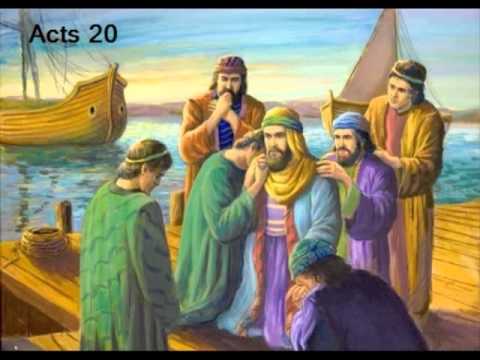
Be vigilant and remember that for three years, night and day,
I unceasingly admonished each of you with tears.
And now I commend you to God
and to that gracious word of his that can build you up
and give you the inheritance among all who are consecrated.

Acts 20:31-32

Jesus does it with a prayer:

Holy Father, keep them in your name
that you have given me,
so that they may be one just as we are one.
When I was with them I protected them in your name that you gave me,
and I guarded them, and none of them was lost
except the son of destruction,
in order that the Scripture might be fulfilled.
But now I am coming to you.
I speak this in the world
so that they may share my joy completely.

John 17:11-13

Today, we may want to spend a little time with Jesus and Paul looking back over the long beam of our lives, thanking God for the graces that poured from our many goodbyes and hellos.


Poetry: In My Dreams – Stevie Smith

In my dreams I am always saying goodbye and riding away,
Whither and why I know not nor do I care.
And the parting is sweet and the parting over is sweeter,
And sweetest of all is the night and the rushing air.

In my dreams they are always waving their hands and saying goodbye,
And they give me the stirrup cup and I smile as I drink,
I am glad the journey is set, I am glad I am going,
I am glad, I am glad, that my friends don’t know what I think.


Music: Every Goodbye Is Hello – Andrew Lippi from the musical “John and Jen”


There’s a wonderful place
Just waiting for you
There are wonderful things
You’ll get to do
Out there, somewhere, the world
And all its wonders
One small step is all it takes to know
Every goodbye is hello
There’s a magical phrase

I’ll tell it to you
Always honor the old
But live for the new
Out there, somewhere

About to be discovered
Trust yourself and
each new day will show
How every goodbye is hello
I will always be near

To hear of all the things you’ll be
Everyone needs a home to return to
And you can turn to me
There’s a time in our

lives when we will know
(There’s a time in our
lives when we will know)
There’s a time to stay home
And a time to grow
Out there, somewhere, your life
And all its promise
Sometimes part of love is letting go
But every goodbye is

Welcome to the world
(Welcome to the world)
Hello