Today, in God’s Lavish Mercy, we pray with Psalm 145, the only chapter of this Book which is specifically identified as a “psalm”, a hymn of praise.
I think of “praise” as gratitude steeped in awe, rising from our hearts when we are overwhelmed by God’s mercy, love, generosity or power.
Praise is a connection between God and us – so powerful that it is beyond words. It flows from us in song, dance, tears, and that profound silence which enfolds us in the Holy.
My whole family is filled with praise this week because, yesterday, we welcomed our second baby this week, precious Nathaniel.
Nathaniel joins his cousin Claire, born on Monday, both shining the beautiful Face of God on our family and the world! (And they join their treasured brother/cousins Robert and Ollie who must, of course, be mentioned in our praise🤗)
As we pray today, may each of us relish the sacred icons of Divine Life that God has given us. Sometimes these signs come in very surprising costumes. May we recognize them with the eyes of faith.
Poetry: Opening Heart – an interpretation of Psalm 145 by Christine Robinson
I exalt you, Holy One, and open my heart to you
by remembering your great love.
Your expansiveness made this beautiful world
in a universe too marvelous to understand.

Your desire created life, and you nurtured
that life with your spirit.
You cherish us all—and your prayer
in us is for our own flourishing.

You are gracious to us
slow to anger and full of kindness
You touch us with your love—speak to us
with your still, small voice, hold us when we fall.

You lift up those who are oppressed
by systems and circumstances.
You open your hand
and satisfy us.

You ask us to call on you—
and even when you seem far away, our
longings call us back to you.
Today, in God’s Lavish Mercy, we pray with Psalm 37, a psalm which Walter Brueggemann says describes “a world that works!”
Jalopy with headache 🙂
Living in a world that sometimes feels like a crumbling old jalopy, “a world that works” sounds very inviting. So how does the psalmist imagine such a world’s genesis?
Trust in the LORD and do good, that you may dwell in the land and be fed in security. Take delight in the LORD, you will be granted your heart’s requests.
When we hear a consoling verse like this, we might be tempted to picture a magical world where whatever we desire is granted to us – you know, sort of like the genie in the lamp! We’re good people – we deserve that, don’t we???
Rather, what we have been given, undeserved, is the eternal assurance that God is with us, and that as we open ourselves to God’s gracious Presence, our hearts will be transformed.
For ancient Israel, that heart-opening was accomplished by making just choices, remaining faithful in difficulty, and building a community of mutual care.
Turn from evil and do good, that you may abide forever; For the LORD loves what is right, and forsakes not his faithful ones. Criminals are destroyed and the posterity of the wicked is cut off.
So, in the end, it is surely not that our “every wish” is granted. It is, instead, that we become so aligned with God’s hope for all Creation that it becomes our greatest desire and delight. We trust and live within God’s loving and Omnipotent Will for our good.
The salvation of the just is from the LORD; God is their refuge in time of distress. And the LORD helps them and delivers them; delivering them from the wicked and saving them, because they take refuge in God.
Poetry: Primary Wonder – Denise Levertov ( I am repeating this poem and, oh my, it is so worthy of the repetition!)
Days pass when I forget the mystery.
Problems insoluble and problems offering
their own ignored solutions
jostle for my attention, they crowd its antechamber
along with a host of diversions, my courtiers, wearing
their colored clothes; cap and bells.
                                                        And then
once more the quiet mystery
is present to me, the throng's clamor
recedes: the mystery
that there is anything, anything at all,
let alone cosmos, joy, memory, everything,
rather than void: and that, O Lord,
Creator, Hallowed One, You still,
hour by hour sustain it.
Today, in God’s Lavish Mercy, on this feast of St. Monica, we pray with Psalm 145.
We can almost picture the psalm’s sentiments pouring out in Monica’s prayer. For years, she had prayed for her son Augustine’s conversion. She was canonized for the level of her persevering prayer – a prayer blessed with the amazing answer of St. Augustine’s holy life.
Every day will I bless you, and I will praise your name forever and ever. Great is the LORD and highly to be praised; his greatness is unsearchable.
Like the answer to most prayers, Monica’s came after the long working of God’s mysterious ways. Her own life was shaded by suffering and loss. But, she was steadfast in her hope over the nearly two decades it took to see Light dawn in Augustine.
Generation after generation praises your works and proclaims your might. They speak of the splendor of your glorious majesty and tell of your wondrous works.
As we reflect on the generations of our own families, and the decades of our own lives, there are many “Monica-Augustine” stories. Whenever we pray for life to lead us and our beloveds to God, we pray like Monica.
Today, let’s bring our own “Augustines” to God in hopeful prayer. And let’s thank God for any “Monica” who has done this loving service for us over our lives.
I think this morning of my mother’s well-worn prayer book. The little devotional volume had been fattened with a number of prayer cards stuffed in its thin pages. One day, just before my mother died, I noticed this one: Prayer for My Daughter, a Nun. I can’t say I was exactly surprised by it. I supposed Mom prayed for me. But the card blessed me in a vey tender way and made me confident that my life would continue to be blessed.
Discovering the card also made me aware of my responsibility to pray daily for my family, friends, and community. They are my “Augustines” in whatever challenges they may face in life – just as I hope I am somebody’s too. Because, friends, we belong to one another in the Communion of Saints, and our “family” is fed not by blood, but by the Spirit.
The generations discourse of the power of your awesome deeds and declare your greatness. They publish the fame of your abundant goodness and joyfully sing of your justice.
Poetry: St. Augustine and Monica by Charles Tennyson Turner
Her weeping kiss – for years, her sorrow flowed At last into his wilful blood; he owed To her his after-life of truth and bliss: And her own joy, what words, what thoughts could paint! When o’er his soul, with sweet constraining force, Came Penitence – a fusion from remorse – And made her boy a glorious Christian saint. Oh ye, who tend the young through doubtful years Along the busy path from birth to death, Parents and friends! forget not in your fears The secret strength of prayer, the holy breath That swathes your darlings! think how Austin’s faith Rose like a star upon his mother’s tears!
Music: (something for opera fans among us) La Conversione di Sant Agostino, Oratorio by Johann Adolph Hasse
Hasse begins La Conversione di Sant’ Agostino with an orchestral introduction that establishes the work‘s tonal center in the key of B-flat major, with most arias composed within related keys. From the grandeur and dynamic intensity of the Introduction comes the first vocal entrance of the oratorio. The listener acts as a voyeur into a conversation between Simpliciano (tenor), a priest, and Monica (soprano), the mother of Saint Augustine of Hippo, in which Monica expresses her fears that her son may never change his wicked ways. This urgent desire becomes the core dramatic theme throughout the oratorio with Alipio (alto), the friend, and Navigio (bass), the brother, serving to intensify the desperate desire for conversion. The role of Saint Augustine (alto) is secondary to that of his mother, Monica. Saint Augustine only has two arias, both dealing with his desire to find release from his sinful ways. His conversion is explicitly stated in the Part Two aria in which he begs God to look upon him with compassion following the censure of his own heart.
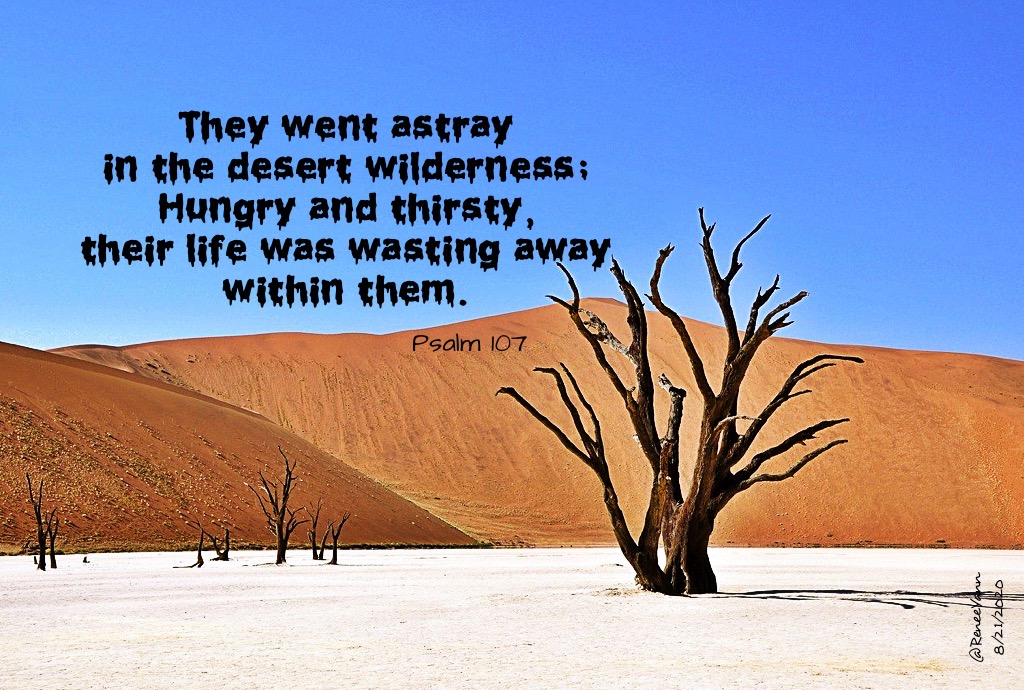
Today, in God’s Lavish Mercy, we pray with Psalm 107, a chant of gratitude to God’s Mercy from the lost who have been found.
There are all kinds of “lost”.
There are small “losts” like when I misinterpret my GPS and keep hearing “Recalculating route…”.
Then there are huge “losts” like when a beloved dies and our life’s anchor breaks.
This morning’s psalm and reading are speaking of a particular kind of “lost”, one that comes from wandering away from Love, for whatever reason that happens to us.
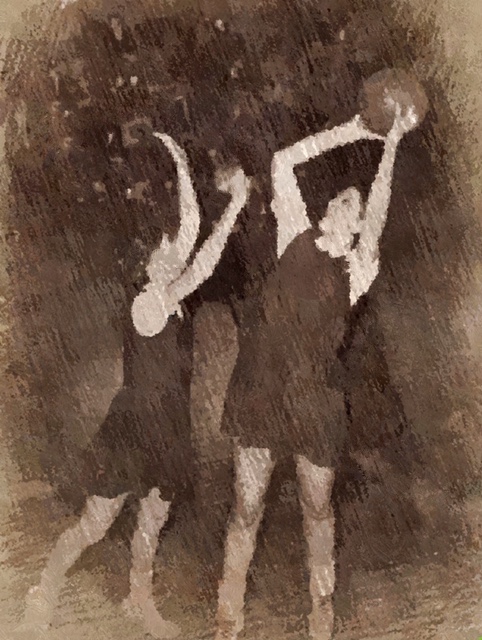
As I pray these readings, the face of a good high school friend comes to mind. Judy was a super basketball player. Everything about her was vigor, coordination, and that all-American beauty that needed no makeup to impress anybody.
After graduation, I went into the silence of the pre-Vatican II convent and Judy disappeared into her future. When our five-year reunion rolled around, I looked forward to reconnecting with her.
When I saw her, my heart broke. She was a shadow of herself, emaciated, listless, and lightless. She silently shouted a refrain like today’s verse from Ezekiel:
Our bones are dried up, our hope is lost, and we are cut off.
We were both twenty-three years old. I was just beginning to grow into my hopes. Judy was already divorced, alone, and the mother of a father-starved child.
That kind of “lost” feels almost irredeemable.
But Psalm 107 assures us that, in faith, no loss, no alienation is irredeemable.
They cried to the LORD in their distress; from their straits God rescued them. And led them by a direct way to the healing of community.
Judy and I stayed in touch for a few years. Despite her troubles, she kept faith. That was the key.
She did the hard work to find herself again with the help of family, friends, counselors, and a supportive faith community. Eventually, she remarried and was happy the last time I saw her before she moved to the west coast.
This morning, I see such apparent parallels between Israel’s and Judy’s story. That helps me look back over my own life for the same, perhaps not so dramatic, parallels and to be grateful for the many times God found me.
Let them give thanks for God’s Mercy and wondrous deeds to us, Because God has satisfied the longing soul and filled the hungry heart with good things.
Desolate and lone All night long on the lake Where fog trails and mist creeps, The whistle of a boat Calls and cries unendingly, Like some lost child In tears and trouble Hunting the harbor’s breast And the harbor’s eyes.
Today, in Mercy, we read the story of the Canaanite woman whom Jesus first meets with a sarcastic banter. The banter however serves to expose some of the alienating prejudices of Jesus’s time which he then dissolves in a sweeping act of mercy and inclusion. His actions signify a new culture of divine justice offered to all people. The reading challenges us to confront our own prejudices and any limitations we place on who belongs to the Kingdom of God.
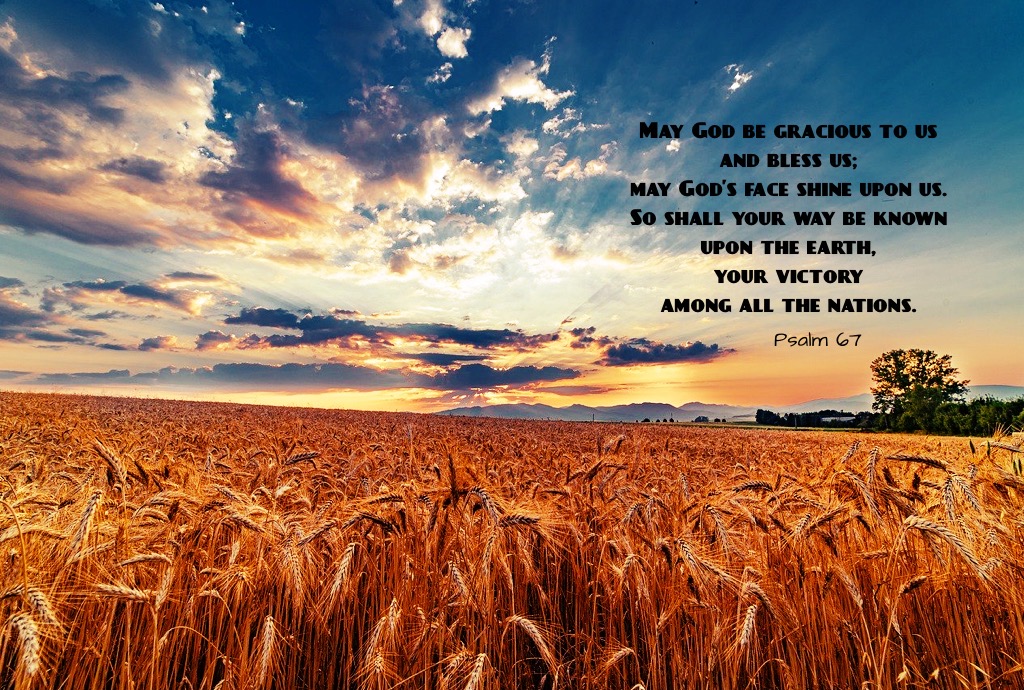
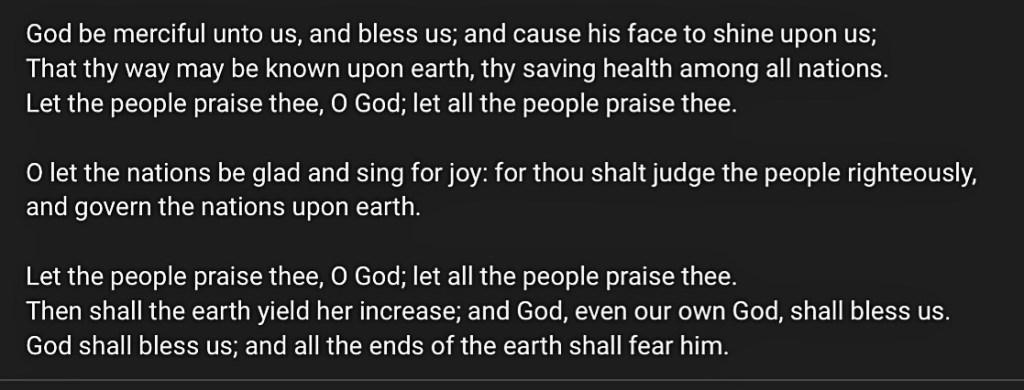
Today, in God’s Lavish Mercy, we pray with Psalm 67, a call to God for universal blessing on all Creation. Written to invoke a benediction on the land’s harvest, the Psalm blossoms into a generous prayer for the whole world to bask in God’s abundance.
May the nations be glad and rejoice; for you judge the peoples with fairness, you guide the nations upon the earth.
What if we prayed like that for all our brothers and sisters worldwide! What if we acted toward them with a justice that would make their abundance possible as well as our own! This is the Gospel mandate Jesus entrusted to us.
Psalm 67 shows the maturing of a nation from its own legitimate self-interests into its responsibility within all Creation.
In the USA, as our pre-election political awareness heightens, let’s learn from Psalm 67. Let’s broadly educate ourselves to the fundamental moral issues underlying various partisan platforms.
For a religious person, voting is hard. There are profound moral issues on all sides of the question. A single issue approach does not work. An adamant stance on a single issue is the easy but inadequate approach.
Even Jesus, in today’s Gospel, can be moved to a new way of thinking. The outcast Canaanite woman prevails on Jesus to broaden his kingdom. He opens his heart to another way of bringing mercy to all those longing for it.
Voting is a moral act. How we choose demonstrates the God we believe in.
May the peoples praise you, God; may ALL the peoples praise you!
Poetry: Selah by Honoreé Fannane Jeffers
“The past few weeks were very hopeful for me, as an African-American. I saw images of young Black people out in the streets protesting, to make this country a better place. As an older person who stayed inside while these young folks put their bodies on the line, I wanted to celebrate them. I wrote this poem as a spiritual exaltation of Black faith, that our hoped-for change for our country is coming.”
Honoreé Fanonne Jeffers
Selahafter Margaret Walker’s “For My People”
The Lord clings to my hands
after a night of shouting.
The Lord stands on my roof
& sleeps in my bed.
Sings the darkened, Egun tunnel—
cooks my food in abundance,
though I was once foolish
& wished for an emptied stomach.
The Lord drapes me with rolls of fat
& plaits my hair with sanity.
Gives me air,
music from unremembered fever.
This air
oh that i may give air to my people oh interruption of murder the welcome Selah
The Lord is a green, Tubman escape.
A street buzzing with concern,
minds discarding answers.
Black feet on a centuries-long journey.
The Lord is the dead one scratching my face,
pinching me in dreams.
The screaming of the little girl that I was,
the rocking of the little girl that I was—
the sweet hush of her healing.
Her syllables
skipping on homesick pink.
I pray to my God of confused love,
a toe touching blood
& swimming through Moses-water.
A cloth & wise rocking.
An eventual Passover,
outlined skeletons will sing
this day of air
for my people—
oh the roar of God oh our prophesied walking
Many of us grew up in households where we were surrounded by a strong devotional faith. I am happy to be one of those people. These simple, sacramental practices awakened and engaged my young faith and offered me a visible means to respond to its stirrings. These practices also offered my parents and grandparents the tools to teach me to love and trust God, Mary and the saints.
I remember with gratitude the many parameters of that deep devotion which accompanied our fundamental practice of a sacramental and liturgical life.
Our home had a crucifix in every room.
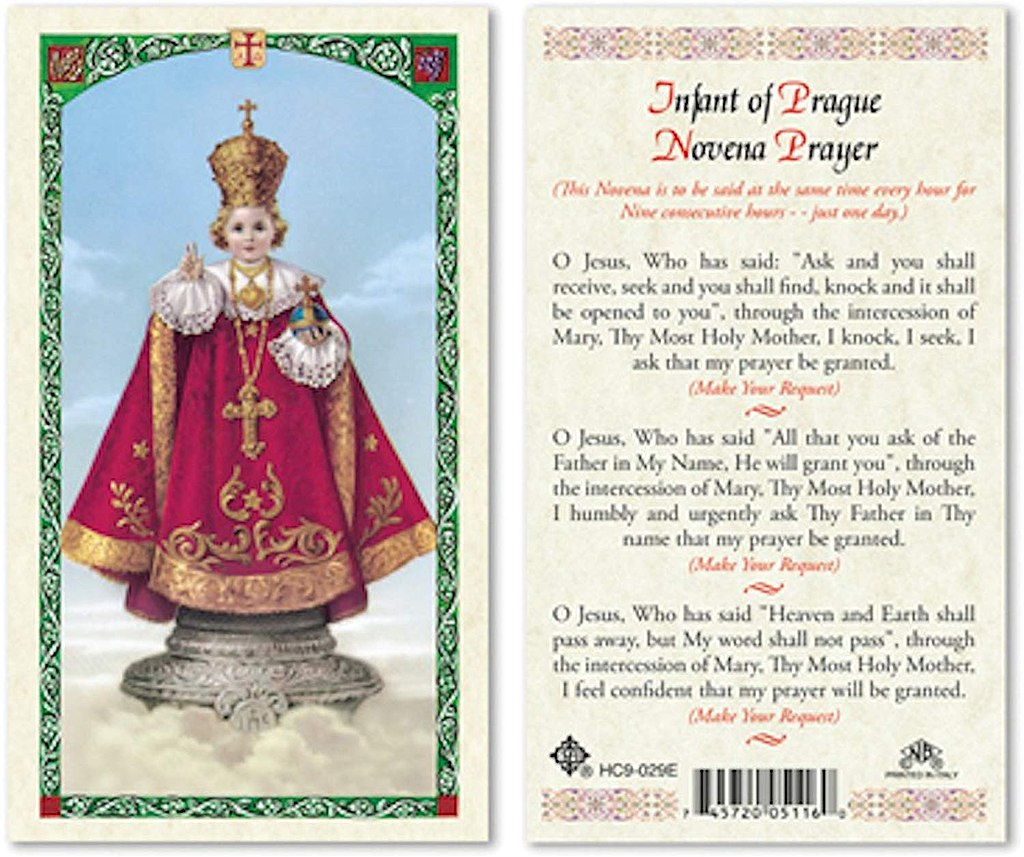
Over the main door was the statue of the Infant of Prague and the first Christmas card we had received depicting the Three Kings. (Under the statue was a single dime – so that we wold never completely run out of money!)
All year, Dad’s fedora sported a tiny piece of straw tucked into its plaid band. He had plucked it from the parish Christmas crèche, near to St. Joseph who was his patron.
During a really violent thunderstorm, we might get a sprinkling from Mom’s holy water flask kept for especially taxing situations.
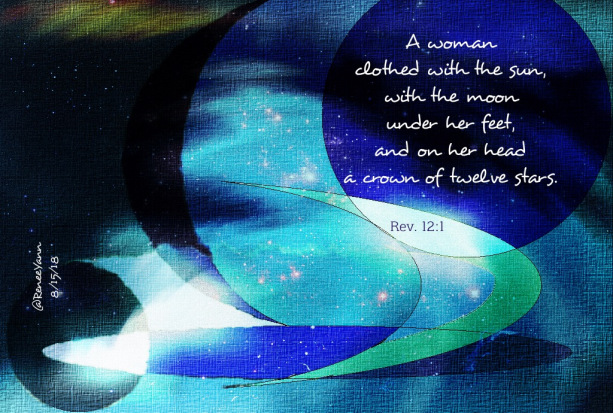
And, maybe because we live not too far from the ocean, we had one special summer practice. We went into the ocean on the Feast of the Assumption, believing that Mary offered us special healing and graces on that day.
I can still picture young boys helping their elderly grandparents into the shallow surf. I remember mothers and fathers marking their children’s brows with a briny Sign of the Cross. There was a humble, human reverence and trust in these actions that blesses me still.
While that August 15th ritual, like similar devotions, might seem superstitious and even hokey to some today, the memory of it remains with me as a testament to the simple faith and deep love of God’s people for our Blessed Mother.
On November 1, 1950, Pope Pius XII defined the dogma of the Assumption in the Apostolic Constitution Munificentissimus Deus (The Most Bountiful God). The world at that time was still healing from the horrors of World War II. The Pope himself, no doubt, was wounded beyond description by what he had witnessed. He begins his letter by saying:
“Now, just like the present age, our pontificate is weighed down by ever so many cares, anxieties, and troubles, by reason of very severe calamities that have taken place and by reason of the fact that many have strayed away from truth and virtue. Nevertheless, we are greatly consoled to see that, while the Catholic faith is being professed publicly and vigorously, piety toward the Virgin Mother of God is flourishing and daily growing more fervent, and that almost everywhere on earth it is showing indications of a better and holier life.“
It was just such devotion and faith, expressed over centuries by the faithful, that moved Pius XII to declare this dogma:
“We pronounce, declare, and define it to be a divinely revealed dogma: that the Immaculate Mother of God, the ever Virgin Mary, having completed the course of her earthly life, was assumed body and soul into heavenly glory.” (MUNIFICENTISSIMUS DEUS 44)
This belief is complementary to the dogma of the Immaculate Conception defined by Pope Pius IX in 1854. These two articles of faith embrace the totality of Mary’s life which was uniquely blessed among all humans. Mary offers us, in our humanity, both a model of and a supportive invitation to holiness.
Jan Van Eyke – Ghent Altarpiece
Sister Marie T. Farrell, RSM closes her scholarly essay on the Assumption with these words:
Mary assumed into heaven and Spiritualised in her whole personhood is a pro- phetic symbol of hope for us all. In his Resurrection-Ascension, Jesus has shown the way to eternal life. In the mystery of Assumption, the Church sees Mary as the first disciple of many to be graced with a future already opened by Christ, one that defies comprehension for ‘…no eye has seen, nor ear heard, nor the human heart conceived, what God has prepared for those who love him…’(1 Cor 2: 9)
Musical Reflection with Song: Prayer of Pure Love – Letty Hammock
The USCCB website (that you click for daily readings) has been beautifully updated. Make sure you take a look!
Today, in God’s Lavish Mercy, we pray again with Psalm 102. Today’s chosen verses proclaim the psalmist’s confidence that the Covenant Promise will endure through the generations.
The psalm really rings a bell for me today. We are expecting two new babies in my family within the next month. The excitement and joy are building throughout the family branches, scattered over several states and hundreds of miles.
Due to Covid-19, I probably won’t be with these new “grands” for a long time. That’s why I am so grateful for FaceTime to help me feel a real part of their lives.
Psalm 102 is David’s FaceTime. Through it, he looks into a future physically distant from him. He has confidence that that future is already blessed by God through the faith which it inherits.
Thinking about this, I realize that I am someone’s “future” – my parents, grandparents and all the long line of ancestors before them. They thought about me, hoped in me, prayed for me the way I am praying for these coming babies.
Those Elders passed on to me a strong faith, hard-earned on the soils of Ireland, hard-carried over immigrant waters, hard-kept in a highly secularized culture. Like David, they wanted God’s faithfulness to be remembered by all who came after them:
Let this be written for the generation to come, and let God’s future creatures praise the LORD …
When my Aunt Mary died last October, I became the oldest living member of our family. I take that role seriously. I pray for our entire family, by blood and law, every day.
Each day, I pick one who gets special prayers for blessing on his or her life. Sometimes I know they need it for a certain reason. Sometimes, they have no idea I am praying for them – or perhaps, if they are distant relatives, that I even know their names.
As we pray Psalm 119 today, let’s consider our place in the generations of faith, and our responsibility to give and receive the riches of that faith to one another.
The children of your servants shall abide, and their posterity shall continue in your presence, That the name of the LORD and God’s praise may be ever declared; When the peoples gather together and the families, to serve the LORD.
Poetry: Isaac’s Blessing by Janet Eigner whose adult daughter died young, leaving the freckled boy in this poem:
When Isaac, a small, freckled boy
approaching seven, visits us for Family Camp,
playing pirate with his rubber sword,

sometimes he slumps in grief,
trudging along, his sacrifice and small violin
in hand, his palm over his chest,

saying, Mother is here
in my heart. Before he leaves for home,
we ask if he’d like a Jewish blessing.

Our grandson’s handsome face ignites;
he chirps a rousing, yes, for a long life.
We unfold the prayer shawl,

its Hebrew letters silvering the spring light,
hold the white tallis above his head,
recite the blessing in its ancient language

and then the English, adding, for a long life.
Isaac complains, the tallis didn’t
touch his head, so he didn’t feel the blessing.

We lower its silken ceiling
to graze his dark hair,
repeat the prayer.
Music: As for Me and My House – a prayer for our families for the generations
Today, in God’s Lavish Mercy, we pray with Psalm 69, a heart-felt lament whose verses are often paralleled with the sufferings of Jesus.
I have become an outcast to my brothers, a stranger to my mother’s sons, Because zeal for your house consumes me, and the insults of those who blaspheme you fall upon me.
Psalm 69: 9
Christ did not please Himself; but as it is written, “The reproaches of those who reproached You fell on Me”.
Roman 15: 3
Praying with Psalm 69 this morning, and in the light of both our first reading and Gospel, I am aware of how God’s prophets suffer to proclaim mercy, justice, and truth.
Jeremiah suffered in the hope and conviction that God imagined a future of justice for all God’s people. He stood in the midst of the Temple worshippers and condemned their pretense of righteousness.
Jesus stood at the center of his hometown synagogue to proclaim that the long hoped-for redemption had come. But like Jeremiah’s listeners, Jesus’s neighbors also turned on him.
In our own lifetimes, we see the persecution and hatred which is leveled at modern prophets who call the world to justice and mercy. Even within our own Church, we see how Pope Francis is vilified by those whose privileged excesses are threatened by his charity.
As I write this reflection, our country celebrates the life of one of its noblest prophets, the sainted John Lewis. In the image of all the great Justice Witnesses, John endured incredible suffering for the sake of people’s dignity and freedom. He was able to do so because, like Jeremiah and Jesus, he didn’t look inward at his wounds. He looked outward for the redemption of others … the prize of justice:
Never give up, never give in, never give out. Keep the faith, and keep your eyes on the prize. Together, we can redeem the soul of America.
John Lewis
Let us pray today that the voices of true prophets may be heard and heeded. In this age when technology and social media can quickly disseminate vitriol, hatred, and conspiracy, let us pray for discerning hearts and courageous wills.
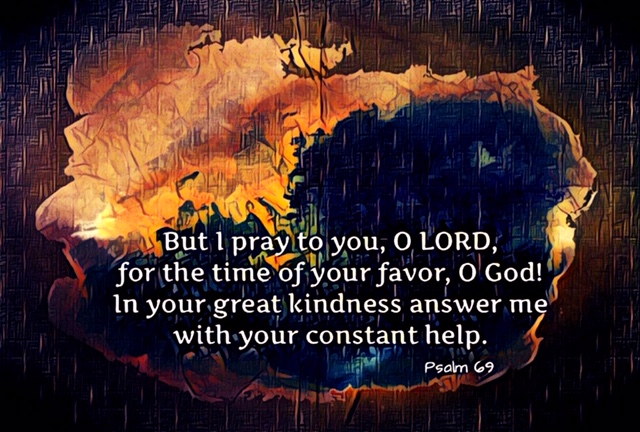
But I pray to you, O LORD, for the time of your favor, O God! In your great kindness answer me with your constant help.
Psalm 69; 14
Poetry: Prophet by Carl Dennis
Prophet
You'll never be much of a prophet if, when the call comes
To preach to Nineveh, you flee on the ship for Tarshish
That Jonah fled on, afraid like him of the people's outrage
Were they to hear the edict that in thirty days
Their city in all its glory will be overthrown.

The sea storm that harried Jonah won't harry you.
No big fish will be waiting to swallow you whole
And keep you down in the dark till your mood
Shifts from fear to thankfulness and you want to serve.
No. You'll land safe at Tarshish and learn the language
And get a job in a countinghouse by the harbor
And marry and raise a family you can be proud of
In a neighborhood not too rowdy for comfort.

If you're going to be a prophet, you must listen the first time.
Setting off at sunrise, you can't be disheartened
If you arrive at Nineveh long past midnight,
On foot, your donkey having run off with your baggage.
You'll have to settle for a room in the cheapest hotel
And toss all night on the lice-ridden mattress
That Jonah is spared. In the space of three sentences
He jumps from his donkey, speaks out, and is heeded, while you,

Preaching next day in the rain on a noisy corner,
Are likely to be ignored, outshouted by old-clothes dealers
And fishwives, mocked by schoolboys for your accent.
And then it's a week in jail for disturbing the peace.
There you'll have time, as you sit in a dungeon
Darker than a whale's belly, to ask if the trip
Is a big mistake, the heavenly voice mere mood,

The mission a fancy. Jonah's biggest complaint
Is that God, when the people repent and ask forgiveness,
Is glad to forgive them and cancels the doomsday
Specified in the prophecy, leaving his prophet
To look like a fool. So God takes time to explain
How it's wrong to want a city like this one to burn,
How a prophet's supposed to redeem the future,
Not predict it. But you'll be left with the question
Why your city's been spared when nobody's different,

Nobody in the soup kitchen you open,
Though one or two of the hungriest
May be grateful enough for the soup to listen
When you talk about turning their lives around.
It will be hard to believe these are the saving remnant
Kin to the ten just men that would have sufficed
To save Gomorrah if Abraham could have found them.

You'll have to tell them frankly you can't explain
Why Nineveh is still standing though you hope to learn
At the feet of a prophet who for all you know
May be turning his donkey toward Nineveh even now.
[from Practical Gods (2001)
Music: Lord, in Your Great Love – Orchard Enterprises
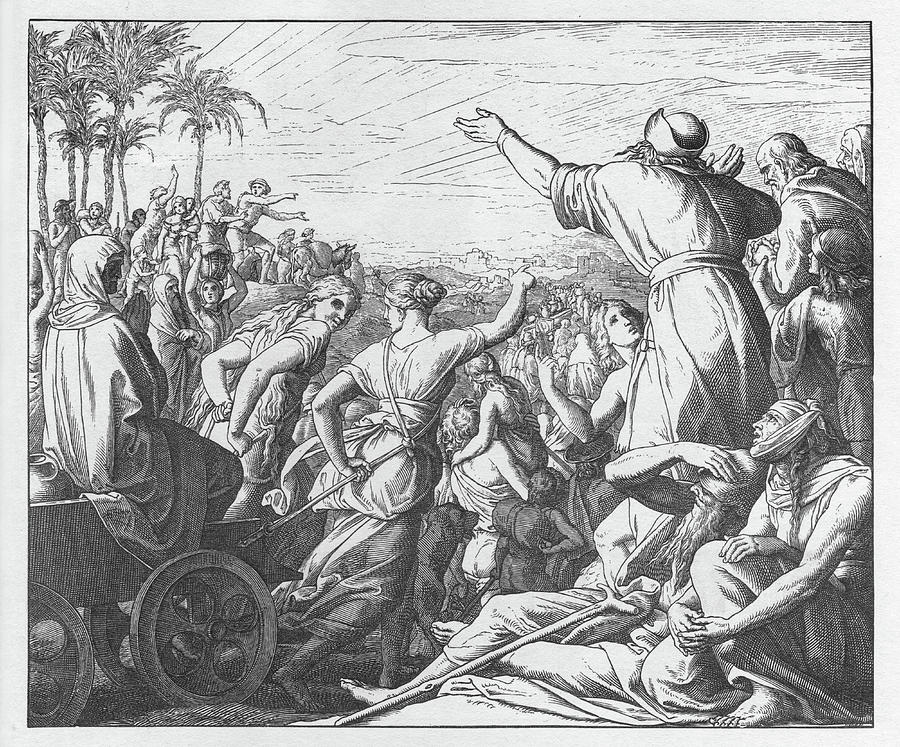
Return from Babylon by Julius Schnoor von Carolsfeld
Today, in God’s Lavish Mercy, we pray with Psalm 85. In Judaism, it is called “a psalm of returned exiles” as it reflects the experience of the Jews returning to their ravished land after the Babylonian exile. Things are a mess, and they have to start all over again to rebuild their Abrahamic nation.
But they pray as if it is already accomplished.
Despite their suffering and captivity, the people have not lost hope in the promise of Yahweh. They expect its fulfillment and call on God to make it happen.
You have favored, O LORD, your land; you have brought back the captives of Jacob. You have forgiven the guilt of your people; you have covered all their sins. You have withdrawn all your wrath; you have revoked your burning anger.
This is the power and beauty of a pure and faithful heart. It is free to “believe” God into action. We find this prayerful power expressed over and over in the Psalms. It is answered by God’s almighty and active desire for our good.
The Psalms mediate to us the great promise keeper whose resolve guarantees that the world is not a closed system. Creation, instead, is a world very much in process, sure to come to full shalom. Despair is the fate of a world “without god,” where there are no new gifts to be given. The Psalms refuse that world, knowing that God is not yet finished. Consequently, the Psalms can gather all the great words of the covenant and apply them to the future …
Walter Bruggemann
During these pandemic times, don’t prayer and promises like these speak to our hearts?
I find myself wondering what the world will be like when we finally “return” – come out of our “Covid exile” – what it will be like to see and hug the family, friends and community we love and miss right now, or to fully mourn those we have lost – what it will be like to resume our soul’s unworried dance with Creation and Time.
As we imagine that world, how might we hope for it to be more reflective of God’s dream for us than the world we closed down last March, than the “Babylon” we are experiencing? How will our prayers and actions for merciful justice “believe” God’s promises into reality for all God’s People?
Will you not instead give us life; and shall not your people rejoice in you? Show us, O LORD, your kindness, and grant us your salvation.
I picture some ancient Jewish woman or man standing amidst the rubble of the ruined Temple. How deep did that person have to reach to find the faith and hope to move God?
I picture us standing in a very sick and dysfunctional world. Can we reach that deep ourselves by praying in the childlike, confident spirit of the Psalms:
Lord, show us your mercy and love.
Poetry: Antidotes to Fear of Death – by Rebecca Elson, a gifted Canadian–American astronomer and writer. Elson was diagnosed with non-Hodgkin’s lymphoma at the age of 29. With treatment, it went into remission, and in 1996 she married the Italian artist Angelo di Cintio. However, the cancer returned soon afterwards. Elson died of the disease in Cambridge in May 1999, at the age of 39.
A volume of wide-ranging poetry and essays she wrote from her teens until shortly before her death was published posthumously as A Responsibility to Awe in 2001 in the United Kingdom, and in 2002 in the United States.
Antidotes to the Fear of Death
Sometimes as an antidote
To fear of death,
I eat the stars.

Those nights, lying on my back,
I suck them from the quenching dark
Til they are all, all inside me,
Pepper hot and sharp.

Sometimes, instead, I stir myself
Into a universe still young,
Still warm as blood:

No outer space, just space,
The light of all the not yet stars
Drifting like a bright mist,
And all of us, and everything
Already there
But unconstrained by form.

And sometime it’s enough
To lie down here on earth
Beside our long ancestral bones:

To walk across the cobble fields
Of our discarded skulls,
Each like a treasure, like a chrysalis,
Thinking: whatever left these husks
Flew off on bright wings.
Music: Going Home– based on Antonin Dvořák’s Largo from New World Symphony, lyrics by William Arms Fisher, sung here by Alex Boyé with the Mormon Tabernacle Choir
Today, in God’s Lavish Mercy, we again pray with Psalm 145 – different verses. The great tenderness in today’s other readings is reflected in the choice of these particular psalm lines.
Our first reading is God’s tender love song to Israel spoken through the prophet Hosea. Our Gospel recounts several acts of tenderness as Jesus ministers to the suffering people he meets.
Psalm 145 reminds us that if we look back over our lives, and even farther back over our ancestors’ lives, we too will discover God’s continual love and mercy to us.
Generation after generation praises your works and proclaims your might. They speak of the splendor of your glorious majesty and tell of your wondrous works.
Many ancestral blessings have been passed on to us – in skills, attitudes, physical strengths – but most importantly, in faith. We probably believe because someone before us taught us how.
There is no greater gift we can give to our children, and to all our beloveds, than to encourage their faith. Let’s take that to heart today as we pray. And let’s thank God for our own story and heritage of faith we have been given.
Poetry: Faith is the Pierless Bridge by Emily Dickinson, who appeared as more a dismissive critic of faith than a proponent. Yet, like many of us who bother to talk about a particular topic, she proved it to be more important to her than she professed.
Faith — is the Pierless Bridge
Supporting what We see
Unto the Scene that We do not —
Too slender for the eye
It bears the Soul as bold
As it were rocked in Steel
With Arms of Steel at either side —
It joins — behind the Veil
To what, could We presume
The Bridge would cease to be
To Our far, vacillating Feet
A first Necessity.















 Lavish Mercy