Today, in Mercy, Jesus asks his disciples, “Why do questions arise in your heart?”
Honestly, Lord? How could they not? You have, after all, just RISEN FROM THE DEAD! We’re not used to that, and we’re not sure how to handle it!
And about that Last Supper, when you said the bread and wine were your Body and Blood? It’s a pretty amazing statement, and we’re still trying to comprehend it.
We’re just human beings, Lord. Our minds naturally work to solve problems. That’s why we have questions – we like answers.
Only now, as Resurrection People, are we beginning to learn that you are much more the “The Answer”.
You will always be “The Mystery” – the Infinity we are invited to – where there is no end, only deeper, always deeper.
Help us to learn that our faith and our doubts are the same thing – they are our attempts to embrace the Question. Help us transform our doubts to faith by our unequivocal trust in your Mystery.
For God does not want to be believed in, to be debated and defended by us, but simply to be realized through us.” ― Martin Buber
Mystery is not to be construed as a lacuna in our knowledge, as a void to be filled, but rather as a certain plentitude. — Gabriel Marcel
Today, in Mercy, our readings present us with a picture of the nascent Church as it works toward understanding itself in the physical absence of Jesus.
Throughout the Gospels, we see a Christian community forming around a Leader they can see, hear and touch. Acts reveals how that community awakens to itself when Jesus is no longer materially present.
Acts shows us a Church like us. We have never seen Christ, nor heard him, nor touched him. And yet we believe, or want to believe.
In our reading today, Peter preaches with brutal honesty:
Let the whole house of Israel know for certain that God has made him both Lord and Christ, this Jesus whom you crucified.
Peter’s message gets through to the assembly, to the point that, when they hear it, they are “cut to the heart”.
This phrase indicates a profound conversion in the way they believed. Peter tells them that their faith, like Jesus’ life, must now become a sign of contradiction to a “corrupt generation “.
What might this powerful passage say to us?
For one thing, the reading calls us to be honest about the sincerity of our faith. Is it the core of our lives? Or is it, at best, a Sunday hobby? Does it pervade our relationships and choices, giving witness to Christ’s commission to love? Or is it a tool to judge and vilify those who differ from us?
The reading doesn’t demand that we “preach out loud”. It calls us to a much more courageous witness:
to be Truth in a world of lies
to be Peace in violence
to be Justice in the face of abuse and domination
to be Servant rather than be served
to be Love for those deemed unlovable
in other words, to be like Jesus
And to do it all because we have been “cut to the heart” by the witness of the Cross and Resurrection.
A blessed and happy Easter and passover to all of you!
Easter and Passover, because they are feasts of life, are family celebrations. It is a time to reconnect and gather with those who share our life story, with the tribe we were born into.
Each Pasch, we join our family with a renewed heart, setting aside any small or large fractures of the intervening year.
Dear Friends at a Long-Ago Easter
This freshness of spirit may be symbolized in a brand new Easter outfit or the spring cleaning of the house.
When I was young, Easter bonnets we’re still the thing, and maybe a new pair of Mary Janes. My little brother wore his first bow tie at Easter, although he wasn’t too happy about it as I recall. 🤗
Though we may have missed their deeper meaning, the house abounded in symbols of the Resurrection: jubilantly-dyed eggs, little chocolate bunnies, rainbowed jelly beans in a sea of papery grass, and elegant lilies.
Most importantly, the family shared a meal, often built of contributed elements from each participant. We waited expectantly for Aunt Peg’s pineapple filling and Mom’s chocolate pie. On occasion, Uncle Joe contributed a wondrous ham that had “fallen off the truck” as he made his rounds in North Philly. ( I learned only later in life that a few of our delicious meals were centered on heisted ham.)
This Easter and Passover offer us an invitation to reconnect with our families which we have been given either by nature or by grace. Not all families are bound by blood. They are are tied through the heart by mutual love, hope, vision, surmounted suffering, shared experience, and a host of other fragments that we shape into life’s mosaic.
Our families are the people we have laughed and cried with, the people we turn to when we’re afraid. They’re the ones who pray for us, look out for us, and yell (softly) at us when we are really stupid. They’re the ones who, no matter how long since we have spoken, we pick up a conversation right in the middle. They’re the ones who bring us flowers, ricotta pie, and a rotisserie chicken when we feel punk. They are beyond blood and genes.
May we reach out in renewed love and appreciation to those who have been “family” to us. May we be grateful and generous with those who look to us for life. May the gift and practice of family rise up in us this Easter morning!
Today, in Mercy, as we set out with Jesus on the path to Calvary, we might consider his companions who accompanied him.
Closest to Christ’s heart on this journey is his Father. Today’s first reading gives us some insight into that profound divine sharing:
Thus says God, the LORD, who created the heavens and stretched them out, who spreads out the earth with its crops, Who gives breath to its people and spirit to those who walk on it: I, the LORD, have called you for the victory of justice, I have grasped you by the hand; I formed you, and set you as a covenant of the people, a light for the nations, To open the eyes of the blind, to bring out prisoners from confinement, and from the dungeon, those who live in darkness.
In other words, “Have courage, Son, I am with you.”
His disciples, women and men committed to the Gospel, also share the dramatic events of these days. Our Gospel today gives us Mary of Bethany, a leader and gatherer of the early Christian community. Her heart is broken at the now obvious prospect of Jesus’s death. In the name of their primal church, Mary offers Jesus the first sacrament of anointing.
In other words, “Have courage, Beloved Leader, we are with you.”
On this Monday morning of Holy Week, where are we in the community gathered around Jesus? How are we speaking to him, comforting him, loving him?
Jesus’s Passion is enfleshed in our time in the suffering of the poor, the refugee, the sick, the disenfranchised, those called “vermin” by the powerful. How am I with Jesus in his anguish today?
Music:Two offerings today, one classical, one modern.
Timor et Tremor – from Quatre motets pour un temps de pénitence (Four Penitential Motets) by Francis Poulenc
Today, in Mercy, our readings describe God’s lavish mercy and the expectation for our reciprocity.
The passage from the Book of Daniel, written in lilting prose, quotes the prayer of Azariah. It gives us several phrases to savor in our own prayer, depending on the particular disposition of our heart on any given day:
To whom you promised …. like the stars of heaven, or the sand on the shore of the sea. What has God promised you to give you hope in your life? Can you call on those promises today in your prayer?
For we are reduced, O Lord, beyond any other nation… Are you feeling sad, disconnected, humiliated or depressed? Can you give these feelings to God and open your heart to healing?
We have in our day no prince, prophet, or leader, no burnt offering, sacrifice, oblation, or incense, no place to offer first fruits, to find favor with you. Do you ever feel abandoned by the institutions we all once depended on, whether Church, government, law etc.? Can we pray for the courage to depend only on God in all things?
Now we follow you with our whole heart… Have our life circumstances brought us to the point of placing ourselves totally in God’s care? Can we pray with that peaceful and holy abandonment?
Deliver us by your wonders, and bring glory to your name, O Lord.Can our prayer be one of giving glory to God for all the blessings in our lives?
God has been so good to us! Our Gospel enjoins us to be reciprocally good to others.
Music: Give Me Your Eyes – An interesting song by rock singer Brian Heath. As his plane is landing one night, he receives a grace to pray for new eyes — eyes that see and love all humanity as God does.
Today, in Mercy, our Gospel gives us the disturbing parable of the rich man, sometimes called Dives, and Lazarus, a very poor man.
The story is disturbing because
Lazarus suffers so desperately
Dives is impervious to that suffering
God won’t give Dives a break after his death
We fear being in either of these guys’ situations
Probably, like most people, we’d rather be rich than poor. But would we rather be generous with that wealth or selfish? Do we ever find ourselves thinking thoughts like this, deciding we’re not responsible for the gap between rich and poor:
“I worked hard for what I have. Let everybody else do the same!”
That wealth gap cannot be mended simply by giving a dollar to a corner beggar nor by donating our wornout clothes to Goodwill. This kind of re-balancing requires a conversion of heart which touches our economic, political and moral understanding.
I was struck this morning by this headline from The Economist, a British weekly magazine.
How can today’s Gospel inspire and encourage us in a global culture that infcreasingly marginalizes persons who are poor, resourceless, and politically oppressed?
May the story of Lazarus and Dives influence us to use the powers we have to make just and generous decisions.
We can vote for just, generous and moral leaders.
We can advocate for universally just policies.
We can donate to compassionate causes.
We can confront hateful speech and stereotyping.
We can speak and act for justice, peace, inclusivity and mercy.
We just have to be courageous before, like Dives, it is too late for us.
Today, in Mercy, our Gospel tells the story of Mrs. Zebedee, who sought a prejudiced advantage for her two disciple sons.
Jesus said to her, “What do you wish?” She answered him, “Command that these two sons of mine sit, one at your right and the other at your left, in your kingdom.”
Sounds a little like something ripped from today’s headlines, doesn’t it.
There is a natural inclination to advantage those we love. But when we do so to the unjust disadvantage of others, that’s a problem.
We know from experience that people use various points of leverage to gain advantage in life. We see people use money, power, political connections, and other influences to get a job, choose a school, land an important invitation, get a traffic ticket written off, etc., etc. Maybe, on occasion, we are one of those people.
Today’s Gospel teaches us a lesson. In gaining such advantage, we may, as Jesus says, “not know what we are asking for”. Can we actually DO the job, succeed in the school, … become a better person by what we have maniputively gained?
The Gospel also brings before us the “other people” who lost the right to what we unjustly claimed. How do they begin to see us? What do we lose in respect and mutuality within our community? How do we begin to see ourselves in relationship to justice, honesty, sincerity and truth?
Jesus hopes that we will love every person to the extent that we want her/his just advantage as much as we want our own? That is the “cup” He drinks through his Passion and Death.
Let us ponder Jesus’s question to us: Can you drink the cup that I will drink?
Today, in Mercy, our readings are about types of citizenship.
In Deuteronomy , Abraham is given a land for himself and his descendants.
In Philippians, Paul tells us the “our citizenship is in heaven”.
In Luke, the transfigured Jesus shows us that heavenly reality.
These readings confirm that, in God, we are not a people bound by borders, ethnicities, religious cult, or any other human categorization.
Every human being belongs to God and is called to live in the fullness of that Creation.This is our Divine citizenship.
Think about that in contrast to talk of border walls, ethnic and religious bans, white supremacy, anti-semitism, islamophobia and all the other multiple ways we try to isolate people from this Divine citizenship which makes us brothers and sisters in God.
Friends, on this blessed St. Patrick’s Day, when so many of us rejoice in our Hibernian heritage, let us pray for a world where every human being is respected and celebrated for the particular gifts she/he brings to Creation.
Music: Two Irish hymns today. What can I say? We Irish are noted for our loquaciousness. 😀☘️💚🇨🇮 (Keep scrolling. 2nd hymn way down.)
Hymn to Our Lady of Knock sung by Frank Patterson, “Ireland’s Golden Tenor”
(Lyrics below)
There were people of all ages gathered ’round the gable wall
poor and humble men and women, little children that you called
we are gathered here before you, and our hearts are just the same
filled with joy at such a vision, as we praise Your Name
Golden Rose, Queen of Ireland, all my cares and troubles cease
as we kneel with love before you, Lady of Knock, my Queen of Peace
Though your message was unspoken, still the truth in silence lies
as we gaze upon your vision, and the truth I try to find
here I stand with John the teacher, and with Joseph at your side
and I see the Lamb of God, on the Altar glorified
Golden Rose, Queen of Ireland, all my cares and troubles cease
as we kneel with love before you, Lady of Knock, my Queen of Peace
And the Lamb will conquer and the woman clothed in the sun
will shine Her light on everyone
and the lamb will conquer and the woman clothed in the sun,
will shine Her light on everyone
Hymn: Be Thou My Vision – Gaelic version by Maire Brennan
(English below)
Be Thou my Vision, O Lord of my heart
Naught be all else to me, save that Thou art
Thou my best Thought, by day or by night
Waking or sleeping, Thy presence my light
Be Thou my Wisdom, and Thou my true Word
I ever with Thee and Thou with me, Lord
Thou my great Father, I Thy true Child
Thou in me dwelling, and I with Thee one
Riches I heed not, nor man’s empty praise
Thou mine Inheritance, now and always
Thou and Thou only, first in my heart
High King of Heaven, my Treasure Thou art
High King of Heaven, my victory won
May I reach Heaven’s joys, O bright Heav’n’s Sun
Heart of my own heart, whate’er befall
Still be my Vision, O Ruler of all
Today, in Mercy, Jesus tells us to take it up a notch. It’s not good enough, he says, not to kill people.
You have heard that it was said to your ancestors, You shall not kill; and whoever kills will be liable to judgment. But I say to you …
When we first read this, we might think we’re pretty safe. After all, how many of us actually kill people?!?!
But let’s check that, Jesus says:
Don’t remain angry with your sister/brother
Don’t call them“empty head” (raqa)
Don’t call them fools
Jesus seems to be telling us that there are many ways to kill!
We can kill the possibility of relationship by our unresolved angers, grudges, sustained hatred of people.
We can kill hope in someone by labeling them stupid or foolish.
We can easily kill someone’s reputation by a false or injudicious word.
We can kill joy by our indifference.
We can kill love with ingratitude.
We can kill innocence with any of the seven deadly sins
It takes vigorous spiritual attention to live at the level Jesus is asking of us. Let’s give our souls that particular attention, especially during our Lenten journey.
Today, in Mercy, the voice of the Lord, in both Leviticus and Matthew, makes one thing abundantly clear: God lives in the “least ones”, and this is where we must love and serve God.
In our first reading, God tells the people to be holy – not by offering God sacrifice and praise, but like this:
Don’t steal.
Don’t lie.
Don’t make an empty vow.
Don’t cheat.
Don’t hurt those already hurting.
Don’t make false judgments.
Don’t be prejudiced.
Don’t do nasty gossip.
Don’t ignore your neighbor’s need.
Don’t hate, take revenge on, or begrudge others.
In other words,
You shall love your neighbor as yourself.
I am the LORD.
We are so accustomed to this passage that we may miss how startling it is! God asks nothing of us for himself! God asks only that we love God through our neighbor.
In Matthew’s Gospel, Jesus reiterates this command in the form of positive actions, adding how we will be judged by it. Jesus says:
Feed the hungry.
Hydrate the thirsty.
Welcome the stranger.
Clothe the naked.
Care for the sick.
Visit the imprisoned.
We are called to these works of mercy on many levels. Certainly the call is first to the physically suffering – the homeless, the refugee, the uncared for, the abused.
But we also know from our own experience that there are all kinds of hungers and thirsts in the human heart. There is a loneliness that persists even in a crowd. There is naked fear, depression and isolation even among those otherwise warmly dressed. There are sicknesses that come from selfishness and others that come from abandonment. There are prisons without bars.
We do not have to look far to find the “least ones” whom God wishes us to love and serve.
We do not have to look far to find God. We just have to look deep.
Music: The Circle of Mercy – Jeannette Goglia, RSM


 Today, in Mercy, our readings are about types of citizenship.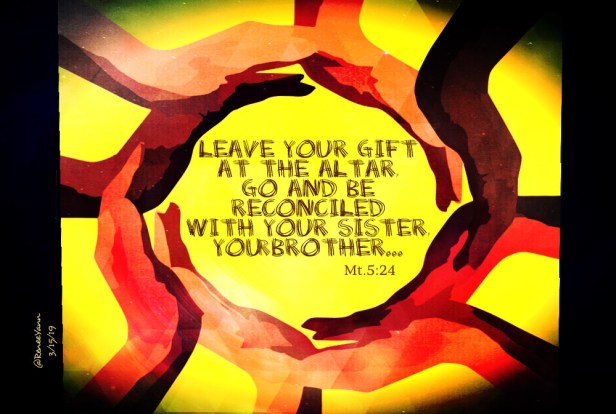

 Lavish Mercy