Embraced by Love

Seventh Sunday of Easter

June 2, 2019

Click here for readings

Today, in Mercy, our readings might make us burst out with, “Isn’t June a beautiful month!”

It is the month building up to Pentecost, when Christ again and again assures us of his love.  Look at this from Revelations today:

The Spirit and the bride say, “Come.”
Let the hearer say, “Come.”
Let the one who thirsts come forward,
and the one who wants it receive the gift of life-giving water.

And this from our Alleluia Verse:

I will not leave you orphans, says the Lord.
I will come back to you, and your hearts will rejoice.

And this from our Gospel:
Father, they are your gift to me.
I wish that where I am they also may be with me,
that they may see my glory that you gave me,
because you loved me before the foundation of the world.

Oh, how Jesus loves us. And now, as He prepares to rejoin the Father, Jesus promises the Holy Spirit, so that we who believe may be embraced by the Infinitely Complete Love that is Trinity.
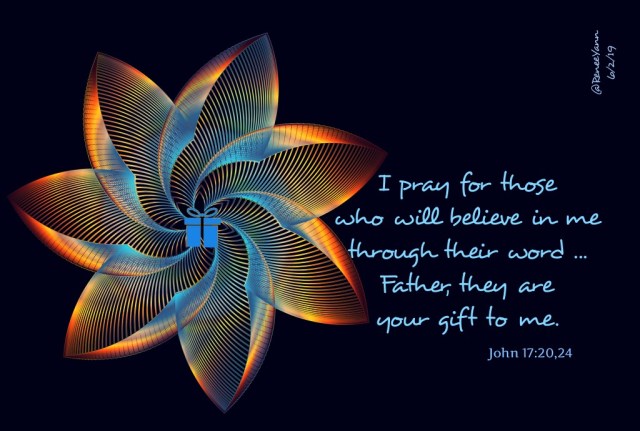
jn17_20_24

Friends, these are wonderful readings. On this warm June morning, let yourselves be loved by them.

Music: Cherubic Hymn to the Trinity- Tchaikovsky (English Lyrics below)

Let us represent the cherubim in mystic harmony, mystic harmony,
praise the Father, Son and Spirit,
raise our three-fold song, raise our three-fold song,
praise the Trinity, praise the Trinity, raise our three-fold song to the Trinity,
Let us now cast aside, cast aside, let us cast aside all this earthly life,
cast aside, cast aside, cast aside, all this earthly life.  Amen.

King of all, we may receive God the King, we may receive Him!
He who in glory enters in with mighty hosts of angels,
with mighty hosts of angels. Alleluia!
Good-bye Can Break Your Heart (Open)

Tuesday of the Sixth Week of Easter

May 28, 2019

Click here for readings

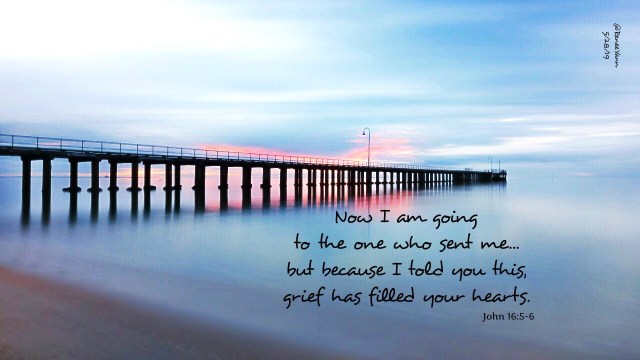
Today, in Mercy, Jesus offers his good-byes as time approaches for him to return to the Father.

Jn16_5

His friends are sad. Wouldn’t you be? What a guy to have known, and palled around with, and loved – in person! But now it’s time for Jesus to return to his role in the Blessed Trinity. And it is time for the Holy Spirit’s continuing role in the world to begin.

Jesus describes the Spirit’s role as one that will set things right by: 

  • showing the world its mistake in rejecting Jesus
  • making clear that Jesus’s teaching was right and just
  • condemning any evil that denies Christ’s teaching

The Holy Spirit will do all this in a different way from Jesus. Jesus was beside his disciples showing them the way to live – and he still is. But the Holy Spirit in within the People of God, working through our communal love, mercy, and justice to transform all Creation.

So Jesus is telling us not to be sad. He is still with us in Scripture and Sacrament. But now our experience of being with God is enriched by the indwelling Spirit who breathes Life to the world through our faith.

What an astounding good-bye Gift! Do we appreciate it, respond to it — even realize we have received it? We are capable of so much more than a small understanding of God. Let us ask to be opened to that Power.

Music: Holy Spirit Rain Down

The New Jerusalem

The Sixth Sunday of Easter

May 26, 2019

Click here for reading

(I know you’re having a holiday weekend but, if nothing else, listen to today’s glorious song)

Today, in Mercy,  in our readings, we definitely get the sense of a young Church growing in its self-understanding.

The early Church leaders, most of whom are Jews, grapple with the question of whether new Gentile followers must first be circumcised in order to be baptized.

Over twenty centuries later, the answer seems obvious. But the question nagging the disciples shows us how they experienced their Christianity as emerging from Judaism. They had no concept of the call to Christianity coming in any other way.

It seems it was a huge shift for some of them to realize that God is not Jewish, that God is the God of all peoples – just as some of us today have trouble understanding that God is not Catholic, Protestant, Muslim, male, white, born again or any other human limitation we attach to the Divine.

Rev21_2 Jerusalem

Our second reading reveals how John dealt with navigating this shift. Still cemented in his Jewish symbols, he sees “Jerusalem” coming down out of heaven from God. But it was a new Jerusalem – one without the central symbol of Judaism, the Temple:

I saw no temple in the city
for its temple is the Lord God almighty and the Lamb.
The city had no need of sun or moon to shine on it,
for the glory of God gave it light,
and its lamp was the Lamb.

For John, the New Creation in Christ included, but exceeded the Jewish narrative.

In our Gospel, Jesus prepares his disciples for life without his physical presence. They, too, need to learn to let go. He encourages them to open their hearts to even greater graces:

The Advocate, the Holy Spirit,
whom the Father will send in my name,
will teach you everything
and remind you of all that I told you.

Jesus is reminding his disciples, and us, that the graces and learnings of the New Creation are infinite. If we can learn when to let go of our old practices, our material symbols, our impregnable sureties, the Holy Spirit will astound us, and re-shape our understanding of God, just as She did for Mary, Peter, Paul, John and all the many enlightened saints through the ages.

As Pentecost approaches, let us pray for such Enlightenment in ourselves and especially in our Church. For the world grows ever more resistant to the Holy Spirit Whose Gifts are wisdom, understanding, counsel, fortitude, knowledge, piety, and awe of God.

Let us pray for a New Jerusalem where all are one in God.

Music: If you do nothing else with this reflection, please allow yourselves the thrill of listening to the celestial voice of Miss Jessye Norman. (Always gives me goosebumps!)

If … then. Uh oh!

Saturday of the Fifth Week of Easter 

May 25, 2019

Click here for readings

Today, in Mercy, our readings challenge us.

Jn15_20JPG

Jesus talks about the kind of blowback his disciples can expect for living their faith in  an inimical world. He gives us some “if … then” statements:

  • If the world hates you, realize that it hated me first.
  • If you belonged to the world, the world would love its own; but because you do not belong to the world, and I have chosen you out of the world, the world hates you.
  • If they persecuted me, they will also persecute you.

Reading these verses makes me wonder if I am really living the Gospel, because I don’t feel all that persecuted.

And then I think that this is because I really live in two worlds. I live in first world comfort and security. But there is also a part of me that agonizes daily over the injustice rampant in our shared world. Today’s Gospel challenges me to live more intentionally in that second world.

Walter Brueggemann says this:

Faith is both the conviction
that justice can be accomplished
and the refusal to accept injustice.”
Interrupting Silence: God’s Command to Speak Out

Jesus was not persecuted simply because he did miracles and preached love. This loving, life-giving ministry confronted the dominant, government-generated culture which relied on the subjugation and despair of those they dominated.

Jesus, just like other prophets, was killed because he gave hope to a people whose freedom threatened the status quo comfort of the dominators. Just like  Martin Luther King, Gandhi, Oscar Romero , Deitrich Bonhoeffer, Wang Zhiming , the Blessed Martyrs of Nowogrodek  (All names are clickable to find more information.)

I don’t aspire to martyrdom. But I do want to be a true disciple of Jesus. The way available to us is to live and act with mercy and compassion for the poor, marginalized people Jesus so loves. We can do this by voting, advocating for, and sponsoring programs and agendas for social justice.  This link from the Sisters of Mercy is a help on how to do that:

Click here for Sisters of Mercy Advocacy page

Brueggemann also says this:

Compassion constitutes a radical form of criticism, for it announces that the hurt is to be taken seriously, that the hurt is not to be accepted as normal and natural but is an abnormal and unacceptable condition for humanness. In the arrangement of “lawfulness” in Jesus’ time, as in the ancient empire of Pharaoh, the one unpermitted quality of relation was compassion. Empires are never built or maintained on the basis of compassion.” (Prophetic Imagination)

May our hearts be moved by grace to the depth of compassion we have learned from Jesus.

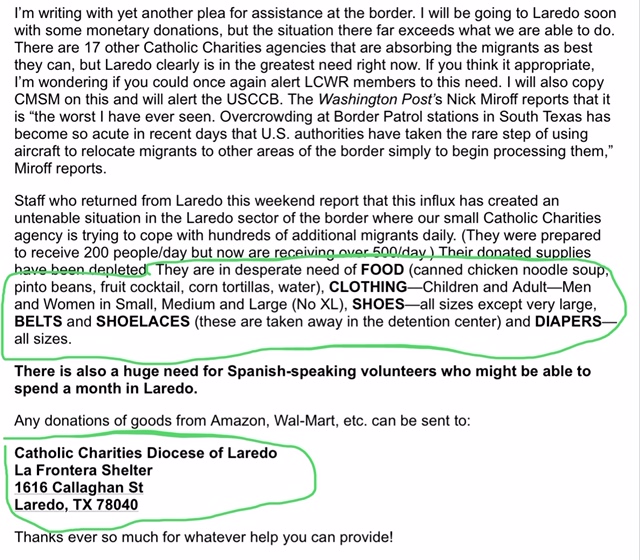
P.S. I know that many of you have responded to this request I placed on Facebook. Thank you. For those who don’t do Facebook, this is an urgent request for help for refugees at our southern border. It’s an easy way to do some good things.It was received from Sisters of Mercy Leadership Team in D.C.

Music for today is below this request. 


appeal


Music: Compassion- The Gettys 

Heritage of Faith

Thursday of the Fourth Week of Easter

May 16, 2019

Click here for readings

Today, in Mercy, our reading from Acts tells of Paul’s preaching in the synagogue at Antioch. Paul, himself steeped in the love and practice of his Jewish faith, comes before more faithful Jews to invite them to a transformed faith in Jesus, the Messiah they had been awaiting. That was no easy assignment!

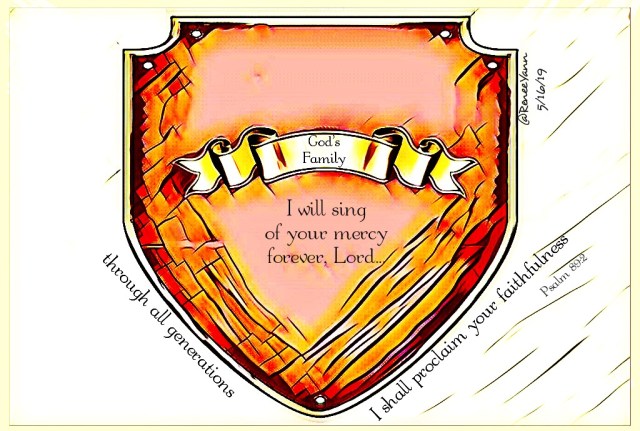
Ps89_2_family of God

But Paul, learned and erudite, traces the entire hereditary line of the Jewish faith, through the House of David, and leading to Jesus Christ. It’s a rich and beautiful homily that redefines the meaning and reach of God’s Family.

In our Gospel, Jesus too describes what it means to belong to God’s family. He says that whoever receives him, and lovingly serves like him, is one with him and with the Father.

These readings give the inspiration to consider and pray on many points. Perhaps these three may be helpful:

Through what human means and heritage has our faith been handed down to us? Who are the parents, grandparents, siblings, aunts, uncles and godparents of our cherished faith? Let’s pray with them today and remember their loving example.


What family of faith has been gifted to us through our community, church and graced friendships over our lifetime? Who are these with whom we share the DNA of our spirit, who have bolstered our faith throughout the journey? Let us pray in gratitude for the gift of these people in our life.


What about us? For whom are we a “faith family”? How do we give the gift of faith, love and service in that family?


Music: I Knew My Father Knew – Sally deFord and James Loynes

Open to the Light

Wednesday of the Fourth Week of Easter

Click here for readings

May 15, 2019

Today, in Mercy, Jesus calls himself the Light.

Jn12_46_Light

Surely he came to bring us out of darkness which is light’s polar opposite. Most of us receive that deliverance with gratitude, understanding it to be our redemption from sin and separation from God.

As we grow deeper in our spiritual life, we may realize that there are many degrees of opposition to the Light. We may not find ourselves in the deep darkness of habitual sin, but rather on those tantalizing edges of spiritual laziness that can halt our soul’s growth:

  • the fog of faithless religious practice
  • the clouds of unresolved hurts and failures in forgiveness
  • the shadows of our religious prejudices
  • the dusk of our early energy for charity and community
  • the eclipse of hope and confidence in God

May God give us the grace to see that Light, too, comes in many forms, beaming through the smallest openings in our spirit. Every act, every choice, every silent prayer made for the sake of Love allows that Light to grow. You may like to pray with that thought while appreciating this poem of Denise Levertov:

Bearing the Light

Rain-diamonds, this winter morning, 
embellish the tangle of unpruned pear-tree twigs; 
each solitaire, placed, it appears, with considered judgement, 
bears the light beneath the rifted clouds – 
the indivisible shared out in endless abundance.

Music: some beautiful instrumental music from Kathryn Kaye for your prayer time.

Anonymous in God

Tuesday of the Fourth Week of Easter 

May 14, 2019

Click here for readings

Matthias

Today, in Mercy, we celebrate the feast of St. Matthias, the one chosen by lot to take the place of Judas among the Twelve.

Matthias met the conditions for being an “Apostle” because he

… accompanied (the Apostles) the whole time
the Lord Jesus came and went among us,

beginning from the baptism of John
until the day on which he was taken up from us …

But there was another, upon whom the lot did not fall, who also met these conditions- Joseph Barsabbas Justus. This man was important enough to Luke, the writer of Acts, that his name is precisely recorded in history. But his name is all that we know of him. What he subsequently did for the spread of the Gospel remains folded in history’s shadows.

There are so many souls, down through these same shadows, who love and spread the Gospel but who remain relatively “anonymous in God”. I think of one such woman today, on what was once her Feastday.

Sister Mary Matthias Duggan was born in 1869 in the Irish Free State. She came to the United States in 1897. She joined the Sisters of Mercy as a lay sister, women who lacked the formal education to be teachers. Sister Matthias, and many others like her, cared for the household needs of the teaching sisters and resident students.

When I met Sister Matthias, she was in her nineties and lived on our infirmary wing. The trek from that wing to our Motherhouse chapel, though a skip and a jump for us novices, was a long journey on her cane for Sister Matthias. She carried ninety years of heavy work on her aged bones.

When any of us “youngsters” would come upon Sister Matthias or her peers on their chapel journey, we would offer an arm in accompaniment. Sister Matthias would give a lightly brogued “Thank you”, then begin a series of audible prayers for the accompanying novice. She always said, “These prayers are for your final perseverance.”

We will never know the blessed influence Joseph Barsabbas Justus had on the early Church. If it was anything near the Holy Gift that Sister Matthias quietly gave, then he too is a saint like she is.

Sister Mary Matthias Duggan, and all you Holy Women of Mercy, please continue to pray for us.

Music: For All the Saints

Open Your Heart’s Gate

Monday of the Fourth Week of Easter

May 13, 2019

Click here for readings

Today, in Mercy, our readings again visit the question, “Who belongs to family of God?”.

love like God

Peter, upon returning to Jerusalem from Joppa, faces the Jewish Christians who are only learning how to live their new faith. They don’t get it that Gentiles are invited too to this emerging faith community.

They, like many of us, find security in the categories we build into our lives. We separate those who belong and don’t belong – sometimes to assure ourselves that we belong in certain preferred categories. We decide who is OK and who is not. The Gentiles were not OK church members for the Jerusalem Christians.

Peter is very patient with these critics. Point by point, he explains how his own understanding was informed by the Holy Spirit, so that he saw clearly that Christ’s invitation was for all people.

This reading challenges us to examine our “categories”, our biases and prejudices. Who is OK in my book, and who is suspect or questionable? In my thinking, who has a “right” to certain goods, positions and privileges? Who would I not invite to my table based on my predetermined “categories”?

With Christ, there are no privileged categories. We are each the privileged child of God, universally redeemed in the blood of Christ.

As I pray with this thought today, how might my attitudes and choices be affected?

Music: We are Called – David Haas

The Amazing Invitation

The Fourth Sunday of Easter 

May 12, 2019

Click here for readings

invite

Today, in Mercy, our three readings make one thing very clear – we are ALL invited to membership in the Body of Christ. We are ALL welcome in the Beloved Community.

In our first reading,  Paul and Barnabas preach to Jews, converts to Judaism and to Gentiles – to the effect that:

All who were destined for eternal life came to believe,
and the word of the Lord continued to spread
through the whole region.

In our second reading:

John, had a vision of a great multitude,
which no one could count,
from every nation, race, people, and tongue.
They stood before the throne and before the Lamb.

And in our Gospel, Jesus says:

My sheep hear my voice;
I know them, and they follow me.
I give them eternal life, and they shall never perish.

These readings describe the family of God to which every human being has been given entrance through the Death and Resurrection of Christ.

Think about that: 

  • when you look into people’s eyes today
  • when you see their stories on the news
  • when you people-watch at the airport or the mall
  • when you drive by a cemetery where lives are remembered in stone 
  • when you look at your children, your friends, your foes
  • when you take that last look in the mirror tonight before you fall asleep

This person has been invited, with me, to the family of God. How might that thought influence my choices and actions each day?

All of us – ALL OF US- are welcome; all of us, equally loved.

Music: All Are Welcome – Marty Haugen

Word

Thursday of the Third Week of Easter 

May 9, 2019

Click here for readings

Today, in Mercy, Acts gives us the memorable story of Philip and the Ethiopian eunuch.

IMG_9263

When I was novice (back in the Middle Ages), I loved a book called “Unless Some Man Show Me” written by Alexander Jones. It was one of the first books that opened my mind to the study of scripture. At that time, the Church itself was continuing to explore a new age of scriptural scholarship.

Those of a certain age, like myself, will recall that we did not read the Bible directly when we were young. In school, we had “Bible Study”, but most of us never handled a real Bible. Even at Mass, the Gospel was read in Latin. We followed along in an English missal if we were lucky enough to have one.

In 1943, Pope Pius XII had issued the encyclical Divino Afflante Spiritu (Inspired by the Holy Spirit). The letter called for new translations of the Bible into vernacular forms. In a huge shift, the Pope encouraged the use of the original languages for these translations, rather than the historically used Latin Vulgate. 

This allowed for the removal of pietistical and dogmatic accretions which had been added over the many centuries of Vulgate interpretations. The eminent Catholic biblical scholar Raymond Brown described  the encyclical as a “Magna Carta for biblical progress”.

How fortunate we were in the 1960s to be exposed to the opening of the Church to a new dimension. I remember, as a high schooler being taught the exquisite Gelineau Psalms, my first taste of pure scripture.

By 1966, scholars had published the magnificent Jerusalem Bible, originally translated to French from the root languages, and then to English. I cherished that Bible, gifted to me by my parents for my final profession that very year. It stills sits beside my chair and accompanies my morning prayer.

Unless someone show us…” we may not grow in our love for sacred scripture. We may not realize that this Word lives in our lives and works to bring us to God!

I encourage you today, if you are so inclined, to deepen yourselves in the love and understanding of holy scripture. Below are some of my favorite authors who, over the past 50 years, have led me to a deep love of God’s Word.

(Sorry for the delayed post today.  I got caught down memory lane with some of these theologians!)

 Music: Breathe – Michael W. Smith

Jean Daniélou
Daniel Harrington
Marie-Joseph Lagrange
Edward Schillebeeckx
Dietrich Bonhoeffer
Yves Congar
Hans Küng
Bernard Lonergan
Johann Baptist Metz
Mary Daly
Karl Rahner
Rosemary Radford Ruether
Elisabeth Schüssler Fiorenza
Marcus Borg
Walter Bruggemann
Thomas Berry
Leonardo Boff
Charles Curran
Elizabeth Johnson
Thelma Hall, RC
Karhryn Sullivan, RSCJ