“Keeping” the Word

Memorial of Saints Cornelius, Pope, and Cyprian, Bishop, Martyrs
Saturday of the Twenty-third Week in Ordinary Time
September 16, 2023

Today’s Readings:

https://bible.usccb.org/bible/readings/091623.cfm


Today, in God’s Lavish Mercy, in his letter to Timothy, we see that Paul thought he had been the foremost of bad dudes.

This saying is trustworthy and deserves full acceptance:
Christ Jesus came into the world to save sinners.
Of these I am the foremost.

1 Timothy 1:15

Well, maybe – maybe not! It’s hard to imagine that a really bad guy could end up with the sacred portfolio Paul compiled before he met his maker. Jesus says as much in today’s Gospel:

A good tree does not bear rotten fruit,
nor does a rotten tree bear good fruit.
For every tree is known by its own fruit.

Luke 6:43-44

So let’s say Paul wasn’t really a “bad guy” before he got knocked off his Damascus-bound horse. Then what was he? The key word in Paul’s self-description is this: SINNER. Paul was a sinner.

Sinners are otherwise “good guys” who make bad choices for their spiritual lives. When those bad choices multiply and begin to feed on one another, the soul deteriorates like the rotten tree in Jesus’s image.


Jesus uses an additional metaphor to describe the process of continual spiritual conversion:

“Why do you call me, ‘Lord, Lord,’ but not do what I command?
I will show you what someone is like who comes to me,
listens to my words, and acts on them.
That one is like a man building a house,
who dug deeply and laid the foundation on rock;
when the flood came, the river burst against that house
but could not shake it because it had been well built.

Luke 6:46-48

We open our hearts to Mercy by these commitments to God’s Word in our daily spiritual life:

  • listening
  • acting
  • deepening

Integrity in these three spiritual practices requires dedicated prayer and reflection, a faithful “keeping” with the Word of God. As our Alleluia Verse assures us:

Alleluia, alleluia.
Whoever loves me will keep my Word,
and my Father will love them,
and we will come to them.

John 14:23

Poetry: [i carry your heart with me(i carry it in] – e.e.cummings

i carry your heart with me(i carry it in
my heart)i am never without it(anywhere
i go you go,my dear;and whatever is done
by only me is your doing,my darling)
i fear
no fate(for you are my fate,my sweet)i want
no world(for beautiful you are my world,my true)
and it’s you are whatever a moon has always meant
and whatever a sun will always sing is you
here is the deepest secret nobody knows
(here is the root of the root and the bud of the bud
and the sky of the sky of a tree called life;which grows
higher than soul can hope or mind can hide)
and this is the wonder that's keeping the stars apart

i carry your heart(i carry it in my heart)


Music: Remain in Me – Steve Angrisano
Simplicity Yields Freedom

Memorial of Saint John Chrysostom, Bishop and Doctor of the Church
September 13, 2023

Today’s Readings:

https://bible.usccb.org/bible/readings/091323.cfm


Today, in God’s Lavish Mercy, our Gospel gives us a quick and intense course in the upside-down, inside-out world of Jesus Christ. The course is known by various names:

  • the Blessings and Woes
  • the Sermon on the Plain
  • the “other” Beatitudes

But the passage might just as well be called, “The Loving Slap in the Face Wake-up Call”.


Picture it. The Twelve have just been commissioned by Jesus as his Apostles (refer to yesterday’s Gospel). I mean this is a big deal! They’ve passed the toughest job interview ever … to stand in for God in the world! They probably want to go home and tell their families, “Guess what! I have a new, fabulous job!”


But then Jesus gives them the orientation manual – the Blessings and Woes – and it’s shocking!

“Blessed are you who are poor,
for the Kingdom of God is yours.
Blessed are you who are now hungry,
for you will be satisfied.
Blessed are you who are now weeping,
for you will laugh.
Blessed are you when people hate you,
and when they exclude and insult you,
and denounce your name as evil
on account of the Son of Man.”


Really? This is what will make me successful in this new gig?

I am called to honor and accompany those who are poor, hungry, heartbroken, hated, excluded and insulted? THEY are the blessed, the “successful” in God’s estimation?


Like many of us, the Apostles may have thought success looked just the opposite – a lot of money, extravagant possessions, careless jocularity, universal adulation, and unquestioned consumption of common resources. You know. – a big boat, a lot of fish, an unconscious immunity from worrying about the poor, hungry guy outside the boatyard.


Jesus turns all of this upside-down and inside-out. He warns that excessive satisfaction with the world’s goods distracts us from true life in God. It hardens us against a loving compassion for one another. It weakens our capacity to receive the immense joy and freedom of life in the Spirit. Jesus calls us to a simplicity of heart that frees us to see and love God in ourselves and others.


As we proceed through Luke’s Gospel, Jesus continues to teach his apostles its contradictory truth. Eleven of the aspirants absorbed his words, transforming their life in a holy “inversion”. Only one, in the long run, proved resistant.

Where might we find ourselves if we stood among them?


Poetry: by C. Austin Miles

A little more kindness, a little less creed
A little more giving, a little less greed
A little more smile, a little less frown
A little less kicking, A man when he's down
A little more "we" a little less "I",
A little more laugh, a little less cry,
A little more flowers on the pathway of life
And fewer on graves at the end of the strife.

Music: A Simple Man – by Lynyrd Skynyrd

Idolatry

Memorial of Saint Pius X, Pope
Monday of the Twentieth Week in Ordinary Time
August 21, 2023

Today’s Readings:

https://bible.usccb.org/bible/readings/082123.cfm


Today, in God’s Lavish Mercy, our two readings connect to remind us of an essential truth: stay faithful to God’s Word in order to live in peace, justice, and joy.


The passage from Judges recounts the topsy-turvy history of Israel around 800 years before Christ. It was a time when various Judges served as leaders before the eventual establishment of the kingdom under Samuel.

The Twelve Judges of Israel (in technicolor!)

These were tough times for Israel. One after another, hostile forces rose against them. During each threat, someone would emerge as a deliverer and, with their heroic success, endure for a while as the Judge.


The writer equates Israel’s ups and downs with God’s pleasure or displeasure with the people. When the people broke faith, God punished them with political turmoil. When the people were repentant, God provided a deliverer.

Of course, this is an overly simplified interpretation of events. By infusing God with the human qualities of anger and appeasement, the writer explains complex history as a simple quid pro quo: You’re bad, you get zapped. You’re good, you get rewarded.


We know that our God does not vacillate between angry punishment and satisfied recompense. God is always loving, forgiving, and nurturing. So what can this passage teach us about our own faith life and the spiritual culture of our times?

I found a key reflection point in the passage’s initial phrase: The children of Israel offended the LORD by serving the Baals.

The “Baals” are false gods erected by those who manipulate “faith” to advance their self-absorbed agendas. In the time of the Judges, these Baals might have been represented by carved idols, or natural phenomena such as the moon or stars. In the end, this idolatry – like all idolatries – rewarded some hidden promoter with money, power, or influence.


But what are the “Baals” of our culture? What is our modern idolatry?

Britannica Dictionary offers this definition of idolatry: “A person becomes guilty of a more subtle idolatry, however, when, although overt acts of adoration are avoided, he attaches to a creature the confidence, loyalty and devotion that properly belong only to the Creator.”

As we pray with this passage, we might look to our own society with its infectious materialism, nationalism, consumerism, racism, sexism. These and other imposed societal shackles serve to bind some in order to exalt others to idol status. As it is with any communicable disease, some of these systems – acknowledged or not – may be lurking within us.


Worship of these “isms” falsly legitimizes:

  • the usurpation of the poor in a credit-bound economic system
    (e.g. how many times have you been offered “revolving credit” which makes money on ever-increasing interest rates)
  • the armed control of the defenseless
    (e.g. the insurmountable influence of the gun lobby to produce weapons of mass destruction despite the repeated massacres of our children)
  • the supersession of the haves over the have-nots
    (e.g. college placement of moneyed descendants over academically superior disadvantaged applicants)
  • the veiled acquiescence to white-advantage
    (e.g. entrenched indifference to colorless board rooms, executive suites, and other decision-making forums)
  • the subtle second-classism toward and objectification of women
    (e.g. the range of systemic oppressions suffered by women, from Taliban terrors and sex trafficking to indefensible Church exclusions)

Our Gospel clearly states the antidote to such idolatry:

Jesus answered the young man:

There is only One who is good.
If you wish to enter into life,

keep the commandments:
(Love God above all things,
and your neighbor as yourself.)

Jesus tells him further that if he wishes to be perfect, he will:

  • dispossess himself of anything that distracts him from God
  • follow Jesus and the Gospel with all his heart

I never read that Gospel without realizing that, just like that young man, I have a lot of work to do on my own often idolatrous soul.


Poetry: Sell All You Have – Malcolm Guite

To whom, exactly, are you speaking Lord?
I take it you’re not saying this to me,
But just to this rich man, or to some saint
Like Francis, or to some community,
The Benedictines maybe, their restraint
Sustains so much. But I can’t bear this word!
I bought the deal, the whole consumer thing,
Signed up and filled my life with all this stuff,
And now you come, when I’ve got everything,
And tell me everything is not enough!
But that one thing I lack, I cannot get.
Sell everything I have? That’s far too hard
I can’t just sell it all… at least not yet,
To whom exactly, are you speaking Lord?

Music: Simple Living (A Rich Young Man) – Keith & Kristyn Getty, Stuart Townend

Holy Whisper

Nineteenth Sunday in Ordinary Time
August 13, 2023

Today’s Readings:

https://bible.usccb.org/bible/readings/081323.cfm


Today, in God’s Lavish Mercy, we pray again with beautiful Psalm 85, so famous for its described eschatological “kiss”.

I thought this painting captured the Kiss of Mercy and Justice.
I could not find an attribution.

On this 19th Sunday, each of our readings invites us to deep meditation. We might choose one of the passages to deeply explore by reading it slowly several times. Be attuned to any single word that catches your heart. Rest in that word to hear what it is saying to you.


Our Psalm serves as a bridge connecting Elijah’s gentle whisper with Paul’s impassioned wish and Jesus’s invitation to walk on water.

These powerful readings will carry a personal message to every one of us if we take time to listen. As Psalm 85 confirms:

I will hear what God proclaims;
the LORD — Who proclaims peace.
Near indeed is salvation to those who stand in awe of God,
glory dwelling in our land.

Psalm 85:9

We are shaped by our personal experiences as well as the culture of our times. Let’s take a look at our circumstances today, allowing these realities to speak to our praying hearts. 

  • Like Elijah, how is God whispering to me today?
  • Like Paul, what great desire for faith and blessing rises in my prayer?
  • Like Peter, what invitation to profound faith is God speaking to me?

Poetic Prose: from Babette’s Feast by Isak Dinesen

There comes a time when our eyes are opened. 
And we come to realize that mercy is infinite. 
We need only await it with confidence and receive it with gratitude. 
Mercy imposes no conditions. 

 And, lo!  Everything we have chosen has been granted to us. 
And everything we rejected has also been granted. 
Yes, we get back even what we rejected. 
For mercy and truth are met together. 
Righteousness and bliss shall kiss one another. 

the character General Lowenhielm


Music: When God Whispers Your Name – Matthew West

When nobody listens
When nobody cares
When you lie wounded
And no one is there

When darkness surrounds you
And when your best friend is fear
When the words “I love you”
Are all you long to hear

That’s when God whispers your name
He’s never ashamed
To call you His own
That’s when God whispers your name

In your darkest night You’ll never be alone
When God whispers your name
For the tired and weary
For the hopelessly lost His arms will surround you
His blood has paid the cost
When all you hold onto
Is slipping through your hands
When there’s no one to turn to
And no one understands

That’s when God whispers your name
He’s never ashamed
To call you His own
That’s when God whispers your name
In your darkest night
You’ll never be alone
When God whispers your name

Listen !
A still, small voice
Calling Calling

That’s when God whispers your name
He’s never ashamed
To call you His own
That’s when God whispers your name
In your darkest night
You’ll never be alone
When God whispers your name

Hidden Motives

Memorial of Saint Dominic, Priest
Tuesday of the Eighteenth Week in Ordinary Time
August 8, 2023

Today’s Readings:

https://bible.usccb.org/bible/readings/080823.cfm


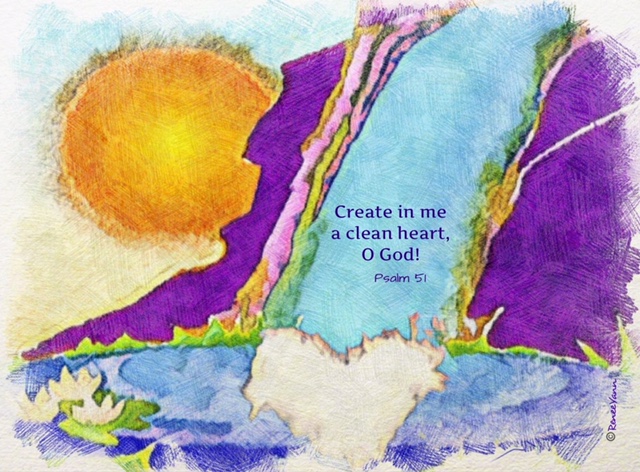
Today, in God’s Lavish Mercy, we pray with Psalm 51 which expresses the ardent desire for forgiveness and reconciliation.

The psalm reflects back to our first reading – an episode of sibling rivalry, jealousy, and hidden motives.

Moses, favored of God and leader of the people, makes a questionable choice. He marries outside the tribe, after telling everyone else not to. Hmmm. His siblings, Aaron and Miriam, don’t like that. So they indignantly complain:

Is it through Moses alone that the LORD speaks?
Does God not speak through us also?

Numbers 12:2

God hears their complaint and sees through it. God sees that they are less concerned about the marriage and more concerned about themselves. They’re tired of Moses telling them what to do. They think God could have picked a better leader — one of them!

God sets them straight about how special Moses is, and their responsibility to support, not undermine, him.

Should there be a prophet among you,
in visions will I reveal myself to him,
in dreams will I speak to him;
not so with my servant Moses!
Throughout my house he bears my trust:
face to face I speak to him;
plainly and not in riddles.
The presence of the LORD he beholds.

Numbers 12:6-7

The whole story is really about motives. Everything we do must be done out of love – out of reverence for God, and out of respect and hope for ourselves and others. This is what it means to have a clean heart. And it is the plea of Psalm 51.

A clean heart create for me, O God,
and a steadfast spirit renew within me.
Cast me not off from your presence,
and your Holy Spirit take not from me.

Psalm 51: 12-13

Prose: This is a great piece by Sister Joyce Rupp on a clean heart (published in America magazine)

https://www.ncronline.org/blogs/clean-heart


Music: Psalm 51 – Chant of the Heart

But Not Yet

Monday of the Eighteenth Week in Ordinary Time
August 7, 2023

Today’s Readings:

https://bible.usccb.org/bible/readings/080723.cfm


Today, in God’s Lavish Mercy, with passages from Numbers and Deuteronomy, we begin a week and a half of readings that complete our scriptural journey through the Pentateuch.

The Book of Numbers, so named because of the two censuses within it, draws the Exodus journey to a close. The people are nearly at the edge of the Promised Land – but not yet. They are tired and frustrated and they let Moses know it:

The children of Israel lamented,
“Would that we had meat for food!
We remember the fish we used to eat without cost in Egypt,
and the cucumbers, the melons, the leeks,
the onions, and the garlic.
But now we are famished;
we see nothing before us but this manna.”


“Not Yet” is one of the hardest times in a journey. Driving from Philly to Knoxville to visit my family, I marveled at how the last two hours seemed so much longer than the eight which had preceded them! If there are kids in the car, the point is painfully driven home:

Are we there yet? x 1000!= Frustration


In today’s reading, the Israelites frustrate Moses with their “Are we there yet” attitude. Moses begs God to give him a break because his leadership is crumbling in the hungry unrest of the people:

“Why do you treat your servant so badly?” Moses asked the LORD.
“Why are you so displeased with me
that you burden me with all this people?
Was it I who conceived all this people? 
Or was it I who gave them birth,
that you tell me to carry them at my bosom,
like a foster father carrying an infant,
to the land you have promised under oath to their fathers?

Numbers 11:11-12

A core message from today’s Numbers passage is that the people need to be “fed” or they will not continue on the journey. Jesus acknowledges this universal fact in today’s Gospel. The story recounts the miracle of a physical feeding of the crowds, but the real miracle is the resuscitation of their faith because they witness the power of God in Christ.


We, individually and as a Church, need to be fed in order to continue our journey of faith. It is important for each of us to build into our lives those practices which will nourish our faith and spirituality: reflective prayer, enlivening spiritual reading, and merciful service. It is also critical for us to assess the kind of communal nourishment we receive within our faith communities and, where that nourishment is lacking, to acknowledge distress and seek alternatives as the hungry Israelites did in the desert.

Recently I was with a group of deeply faithful Christians where this shocking phrase was spoken and acknowledged: “The Catholic Church is dead“. What the phrase connotes is that, in light of the clerical abuse and other institutional scandals, coupled with the absence of inspirational Church leadership, many Catholics are starving for nourishment on the journey. Clearly, the same may be said of other Christian Churches.


To varying degrees, we may be familiar with the Synod 2021-24 initiated by Pope Francis in October 2021.

The word synod comes from the Greek: σύνοδος [ˈsinoðos], meaning “assembly” or “meeting”; the term is analogous with the Latin word concilium meaning “council”.

The word synod comes from the Greek meaning “assembly” or “meeting”; the term is analogous with the Latin word concilium meaning “council”.

Traditionally, we are familiar with such gatherings being constituted primarily by the hierarchy of the Church. Synod 2021-24 is different.


The Synod on Synodality represents a new and exciting phase in the life of the Church. This phase deepens the ecclesiology of the People of God developed at the Second Vatican Council and invites us to generate processes of conversion and reform of relationships, communicative dynamics and structures in the Church. This will require a process of common discernment and formation in the short, medium and long term to stimulate the awareness of a Church lived and understood in a synodal key.

Boston College – School of Theology and Ministry

Many of us are old enough to remember the intense enthusiasm and hope which sprang from the Second Vatican Council a half-century ago. The inspired Vatican II documents fueled a dynamic revitalization for the People of God.

But over the course of 5o years, the Church’s landscape has changed:

  • plummeting numbers in religious and priestly vocations
  • scars from the sexual abuse scandal
  • misalignment between practice and teaching on sexuality, gender, and marriage
  • disaffection of women and young adults with the Church
  • widespread persecution of the missionary Church in totalitarian and extremist Islamic states

These are issues that must be addressed by the whole Church acting in a synodal manner similar to that of the inaugural Christian community:

At that time, as the number of disciples continued to grow, the Hellenists complained against the Hebrews because their widows were being neglected in the daily distribution.

So the Twelve called together the community of the disciples and said, “It is not right for us to neglect the word of God to serve at table.* Select from among you seven reputable disciples, filled with the Spirit and wisdom, whom we shall appoint to this task.

… The proposal was acceptable to the whole community.

Acts 6:1-5

The aim of the current synodal process is not to provide a temporary or one-time experience of synodality, but rather to provide an opportunity for the entire People of God to discern together how to move forward on the path towards being a more synodal Church in the long-term.
A basic question prompts and guides us: How does this journeying together allow the Church to proclaim the Gospel in accordance with the mission entrusted to Her; and what steps does the Spirit invite us to take in order to grow as a synodal Church?

Vatican Commentary on the Synodal Process

The prayers, participation, and support of faithful people are critical to the success of this Synod because it is truly a synod of the people. It is important for us to pray for the Church, for the Pope, and assess the level of our own contribution to the life of the community. I know I need to take my awareness and attention up a notch, and I thought perhaps some of my readers might too. Many of us may look to this synod as the sign of hope we need in deeply challenging times.


Prose: from Pope Francis on World Youth Day

We recall that the purpose of the Synod 
is not to produce documents,
but to plant dreams,
draw forth prophecies and visions,
allow hope to flourish,
inspire trust,
bind up wounds,
weave together relationships,
awaken a dawn of hope,
learn from one another
and create a bright resourcefulness
that will enlighten minds, warm hearts,
give strength to our hands.

Music: I Am the Bread of Life – Suzanne Toolan, RSM

Outside the Lines

Memorial of Saint John Vianney, Priest
Friday of the Seventeenth Week in Ordinary Time
August 4, 2023

Today’s Readings:

https://bible.usccb.org/bible/readings/080423.cfm


Today, in God’s Lavish Mercy, we dip our toes into the Book of Leviticus which is basically a set of instructions on how to live a good life.

Leviticus 23 establishes five holy times of prayer, reflection, and action for the people to grow in friendship with God.

  • the Sabbath (vv. 1–3)
  • the Feast of the Unleavened Bread, or Passover (vv. 4–14)
  • the Feast of Weeks, or Pentecost (vv. 15–23);
  • on the Day of Atonement (vv. 26-32)
  • the Feast of the Tabernacles (vv.33-44)

As Christians, we may be more familiar with Sabbath and Passover because their patterns are embodied in our Sunday and Easter celebrations. In the other less familiar feasts, we might recognize harvest sharing (Weeks), repentance (Atonement), reflection and recommitment (Tabernacles).


The Book of Leviticus is a formation manual for Israel’s spiritual life. Realizing that fact this morning, I thought about my Novitiate and early formation experiences in religious life. Readers who are religious sisters or brothers might share my experience, and those who are lay can probably think of their own comparisons. What were our earliest steps in our journey into God?

I wasn’t completely clueless when I came to the convent at 18 years of age. I did have a vigorous spiritual life and a deep desire to grow in relationship with God. What I needed was spiritual discipline and a quiet reverence in my whole being. And, in those early years, I received abundant amounts of both from multiple sources. It was my “Leviticus Time”.


But our “Leviticus Time” is only a launchpad. If we refuse to leave it, we will never fly. What we must move on to is a personal relationship with God, grounded in loving faith and Gospel commitment. While enhanced by exterior resources, the power of that relationship springs from an interior intimacy with God, as realized so clearly by our saint for today, John Vianney.


Today’s Gospel shows us a group of people unable to take that next step – beyond rules and practices into committed relationship. (“beyond” not “without” rules and practices – more on that in tomorrow’s reflection)

Jesus came to his native place and taught the people in their synagogue.
They were astonished and said,
“Where did this man get such wisdom and mighty deeds?
Is he not the carpenter’s son?
Is not his mother named Mary
and his brothers James, Joseph, Simon, and Judas?
Are not his sisters all with us?
Where did this man get all this?”
And they took offense at him.
But Jesus said to them,
“A prophet is not without honor except in his native place
and in his own house.”
And he did not work many mighty deeds there
because of their lack of faith.

Matthew 13:54-58

This is such a sad Gospel! Here God was right in the midst of these people! They could see him and hear him. He personally invited them to believe. But they refused to see God in Jesus. All they could see was their stagnated prejudgments and inert definitions.

These were probably good people. They more than likely kept all the Leviticus regulations. They colored within the lines, so to speak. Then Jesus came and asked them to step outside the lines. He asked them to believe that the poor are blessed and the persecuted happy. He asked them to cast their nets again into a sea that had denied them all night. He asked them to walk to him across the water. He asked them to sell everything they had and follow. He asked them to fall into the ground and die, as he would.

Only a courageous few set their safe scroll of Leviticus aside to give Jesus a wholehearted “Yes”.

What might we have done — what are we doing — when Jesus invites us outside the lines?


Poetry: Of Being – Denise Levertov

I know this happiness
is provisional:

the looming presences --
great suffering, great fear --

withdraw only
into peripheral vision:
but ineluctable this shimmering
of wind in the blue leaves:
this flood of stillness
widening the lake of sky:
this need to dance,
this need to kneel:
this mystery:

Music: Only You

Something a little different this morning – a picture to contemplate while you listen to a beautiful song. Just click the little white arrowhead in the grey bar below. Let the song take you where it will in your own spiritual landscape.

image by David Mark from Pixabay

Little Things Mean a Lot

Memorial of Saint Ignatius of Loyola, Priest
Monday of the Seventeenth Week in Ordinary Time
July 31, 2023

Today’s Readings:

https://bible.usccb.org/bible/readings/073123.cfm


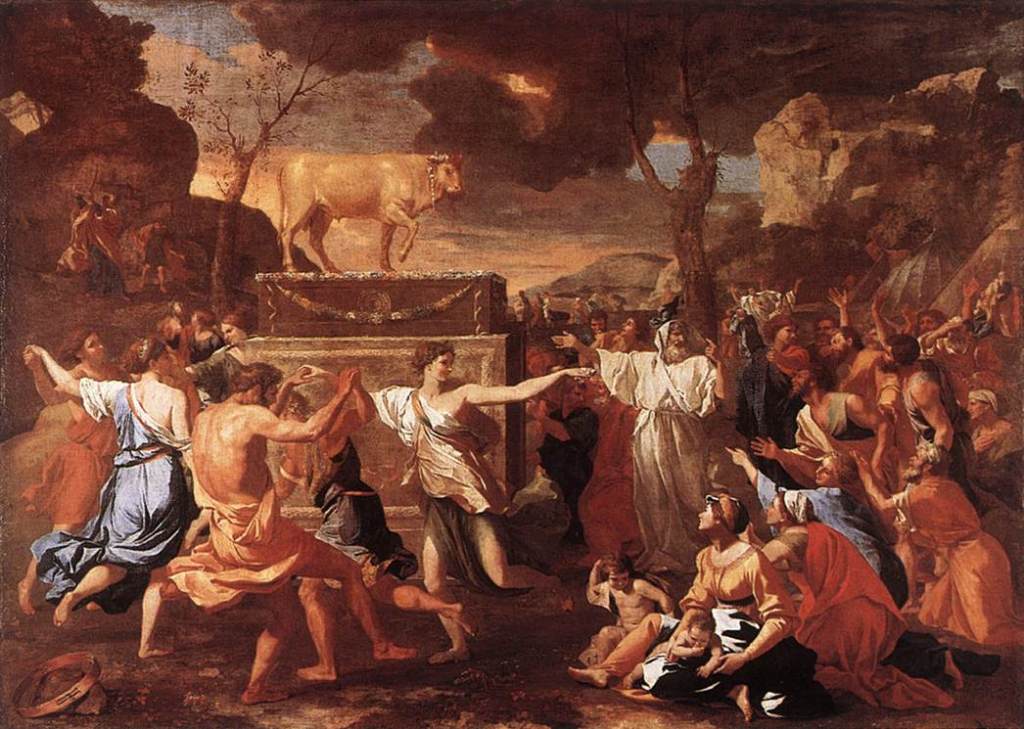
The Adoration of the Golden Calf – Nicholas Poussin

Today, in God’s Lavish Mercy, Aaron, brother of Moses, gets an “F” as a substitute teacher. While Moses is on the mountain negotiating with God for Israel’s future, Aaron caves to the people’s demands and assists them in creating an idol – the infamous “golden calf”.

As Walter Brueggemann says, “All it takes is a little gold to make a god”:

All you need in order to make a god is a measure of the substance that is most valuable in the community, in this case gold…and a mold that can shape the gold. The mold readily available to Aaron is a calf, well, better a “bull” – a symbol and embodiment of virility and fertility, the strength, power, and capacity to generate new life! All you need to make a god is a little gold and a pattern of vitality and fertility that bespeaks self-sufficiency,

Walter Brueggemann – from a Sunday sermon delivered in 2020

Moses was on the mountain for forty days. In his absence, and with God’s silence, the people became frightened. They felt powerless. In that powerlessness, they had a choice: to believe that God would be true to God’s word, or to construct an alternate god of their own design, one that made them feel powerful again. They made the wrong choice.


Praying with this passage today, we might ask ourselves what we do when circumstances render us powerless. What do we do when God seems silent and the supports we have trusted disappear or fail? What do we do when there seems to be no answer to our prayers?

And what is the substance, as Bruegemann notes, most valued in my various communities – the substance most likely to be turned to an idol: reputation, status, resources, influence, political power, physical strength or appearance?

Do we make the mistake of thinking things like this: My power rests in my money, or my looks, or my family name, or my business success, or my intelligence, or my intimidating reputation?

When it comes to the fundamental needs of our lives, none of these things can empower us. Every one of them can fail or disappear. Our only true power lies in God’s unfailing love for us and will for our good. That power is always with us but can be accessed only through faith.


Our Gospel tells us that all one needs is a little faith to ground oneself in the power of God’s love and fidelity..

Jesus proposed a parable to the crowds.
“The Kingdom of heaven is like a mustard seed
that a person took and sowed in a field.
It is the smallest of all the seeds,
yet when full-grown it is the largest of plants.
It becomes a large bush,
and the birds of the sky come and dwell in its branches.”

Matthew 13:31-32

I saw a great graphic on Facebook the other day. It pictured an open hand reaching out with a small speck on the index finger. The caption read:

I have a mustard seed,
and I’m not afraid to use it.


In the absence of a malleable, obeisant god, Israel mistakes their wealth for their god. They mold it into a figure that appears to restore their control over their lives. But they end up with only a clump of unresponsive metal.

God is not a divine butler waiting at the doorway for our next command. The ever-presnt Holy One is sometimes thickly veiled within the circumstances of our lives. It takes faith to stay in relationship with our often silent, but nonetheless abiding God.

Our Gospel tells us that if we have even the smallest seed of that faith, it will root in us and sustain us. And even the smallest measure of “holy yeast” will ferment to the point that others will find in us the inspiration to believe.


Poetry: The Golden Calf by John Newton, (1725 – 1807) who was an English evangelical Anglican cleric and slavery abolitionist. He had previously been a captain of slave ships and an investor in the slave trade. He served as a sailor in the Royal Navy (after forced recruitment) and was himself enslaved for a time in West Africa. He is noted for being author of the hymns Amazing Grace and Glorious Things of Thee Are Spoken.

When Israel heard the fiery law,
From Sinai's top proclaimed;
Their hearts seemed full of holy awe,
Their stubborn spirits tamed.
Yet, as forgetting all they knew,
Ere forty days were past;
With blazing Sinai still in view,
A molten calf they cast.
Yea, Aaron, God's anointed priest,
Who on the mount had been
He durst prepare the idol-beast,
And lead them on to sin.
Lord, what is man! and what are we,
To recompense thee thus!
In their offence our own we see,
Their story points at us.
From Sinai we have heard thee speak,
And from mount Calv'ry too;
And yet to idols oft we seek,
While thou art in our view.
Some golden calf, or golden dream,
Some fancied creature-good,
Presumes to share the heart with him,
Who bought the whole with blood.
Lord, save us from our golden calves,
Our sin with grief we own;
We would no more be thine by halves,
But live to thee alone.

Music: Amazing Grace


The Treasure

Seventeenth Sunday in Ordinary Time
July 30, 2023

Today’s Readings:

https://bible.usccb.org/bible/readings/073023.cfm


Today, in God’s Lavish Mercy, our readings pose an eternal question:

Are we wise enough to cherish
the treasure of God’s Kingdom?


The kind of life we live comes down to what we treasure. I won’t start a list here, but you might want to. For what do you sacrifice your time, attention, and effort? Where do you place the resources of your mind, body, and spirit?


In our first reading, Solomon has a dream in which he gets the amazing genie-like opportunity to actually name his treasure. He does so in an extremely clever prayer that woos God into acquiescence.

In the full version of this passage, Solomon has married the enemy Pharoah’s daughter, and has just finished sacrificing to false gods on the high mountain. He then falls asleep and has this dream in which he reminds God that, despite his marriage and worship practices, he is still like his ancestor David whom God loved completely for his faithfulness.


Solomon further shmoozes God by proclaiming himself an uniformed, youthful innocent who carries immense responsibilities on God’s behalf:

Now, LORD, my God, you have made me, your servant, king to succeed David my father; but I am a mere youth, not knowing at all how to act—

God falls for Solomon’s persuasions and ennobles him even beyond his request:

The LORD was pleased that Solomon made this request.
So God said to him:
“Because you have asked for this—
not for a long life for yourself,
nor for riches,
nor for the life of your enemies,
but for understanding so that you may know what is right—
I do as you requested.
I give you a heart so wise and understanding
that there has never been anyone like you up to now,
and after you there will come no one to equal you.”

1 Kings 3:10-13

In our second reading from Romans, Paul assures us that God already has in place for us the will and design for our good. We don’t have to make a wish in a dream the way Solomon did, nor proclaim ourselves patterned on the heritage of David.

Our salvation is accomplished in the person of Jesus Christ:

We know that all things work for good for those who love God,
who are called according to his purpose.
For those he foreknew he also predestined
to be conformed to the image of his Son,
so that he might be the firstborn
among many brothers and sisters.

Romans 8:28-29

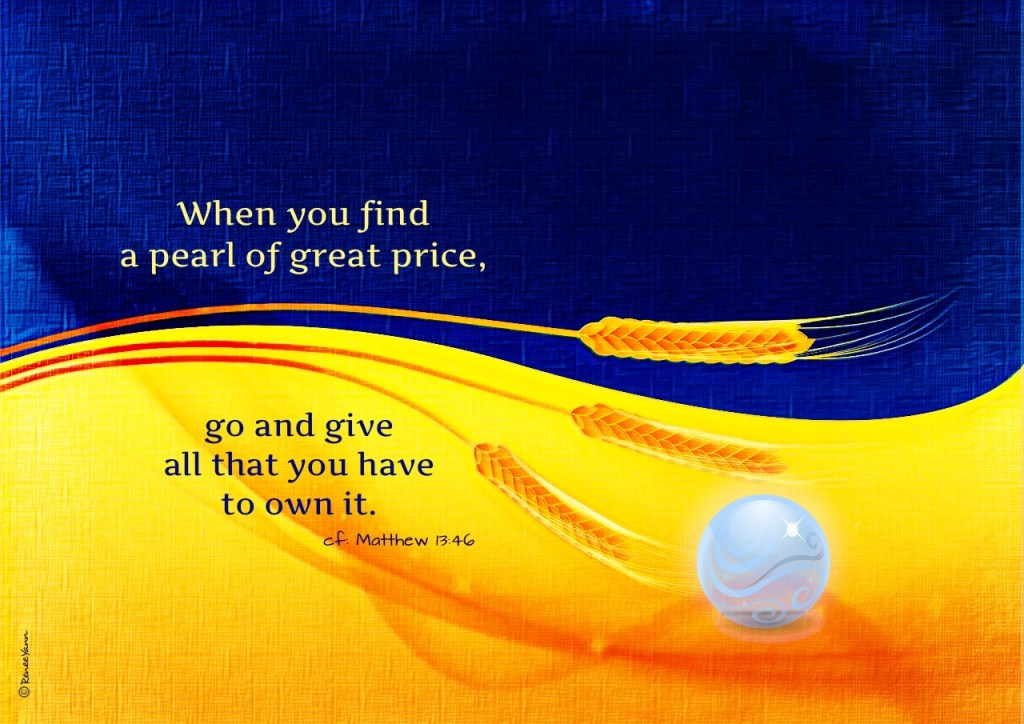
In our Gospel, Jesus reminds us that, although God has predestined a plan for our salvation, we must choose to participate in it. Finding the “treasure” should give us incomparable joy. Finding the “pearl” should impel us to give everything for its possession.

The kingdom of heaven is like a treasure buried in a field,
which a person finds and hides again,
and out of joy goes and sells all that he has and buys that field.
Again, the kingdom of heaven is like a merchant
searching for fine pearls.
When he finds a pearl of great price,
he goes and sells all that he has and buys it.

Matthew 13:44

History tells us that Solomon had his challenges holding on to the treasures granted in his dream. Paul offers his advice in Romans 8 to encourage the early Christians suffering persecution for the sake of their spiritual treasures. Jesus emphasizes that everybody find or hold on to their pearls until the end of time.

We can infer from these three facts that finding the pearl isn’t enough. Preserving its integrity and beauty is the work of a faithful lifetime.


Poetry: The Bright Field – R.S. Thomas

I have seen the sun break through
to illuminate a small field
for a while, and gone my way
and forgotten it. But that was the
pearl of great price, the one field that had
treasure in it. I realise now
that I must give all that I have
to possess it. Life is not hurrying
on to a receding future, nor hankering after
an imagined past. It is the turning
aside like Moses to the miracle
of the lit bush, to a brightness
that seemed as transitory as your youth
once, but is the eternity that awaits you.

Music: Treasure in a Field – Dan Schutte, sung by Josephina Albuquerque, RJM

Life Guide

Friday of the Sixteenth Week in Ordinary Time
July 28, 2023

Today’s Readings:

https://bible.usccb.org/bible/readings/072823.cfm


Moses with the Ten Commandments – Rembrandt


Today, in God’s Lavish Mercy, we are presented with a summary version the Ten Commandments.

But the daily readings have skipped over a dramatic passage. In between today’s reading and yesterday’s, Mount Sinai has exploded with the thunderous voice of God.

On the morning of the third day there were peals of thunder and lightning, and a heavy cloud over the mountain, and a very loud blast of the shofar,* so that all the people in the camp trembled.
But Moses led the people out of the camp to meet God, and they stationed themselves at the foot of the mountain.
Now Mount Sinai was completely enveloped in smoke, because the LORD had come down upon it in fire. The smoke rose from it as though from a kiln, and the whole mountain trembled violently.
The blast of the shofar grew louder and louder, while Moses was speaking and God was answering him with thunder.

Exodus 19:16-19

The writer of Exodus wants us to know that God was serious when delivering the Commandments:

With appropriate ritual preparation on the part of Israel (19:1–15), YHWH comes storming into the presence of Israel (19:16–25). This divine arrival, technically characterized as a theophany, a showing of God, is a disturbing upheaval of the mountain. This description of divine arrival is highly stylized and may reflect something of a repeatable liturgical performance. YHWH, shrouded in mystery, is accompanied by fire, smoke, the violent shaking of the mountain, a blast of trumpets, and thunder. The mountain, occupied by this assertive deity, is now saturated with dangerous holiness, so dangerous that YHWH might “break out against them” (19:22).

Walter Brueggemann – Delivered into Covenant (Pivotal Moments in the Old Testament)

These commandments, delivered clearly and deliberately in today’s passage, form the immutable groundwork for relationship with God. God makes it clear from the beginning that friends of God honor both God and neighbor, and in so doing honor themselves. While many of the Commandments are stated as prohibitions, they are really guides toward wholeness and balance in spiritual and communal life.


I remember, as a youngster, using the Commandments as a guide when preparing my list for weekly confession. It was hard to generate that list because, most of the time, I was a fairly good kid. I was pretty sure I hadn’t coveted my neighbor’s wife or anything like that.

I had not yet learned to capture the spirit of the Commandments which is just and humble relationship with God and God’s Creation. This relationship is rooted in awareness of and reverence for God’s Presence in all things.

In the Beatitudes, Jesus teaches us the perfection of the Ten Commandments. A magnificent book that helped me learn this is The Spirituality of the Beatitudes by Michael Crosby – another life-changing book.


But the seed sown on rich soil
is the one who hears the word and understands it,
who indeed bears fruit

and yields a hundred or sixty or thirtyfold.

Matthew 13:23

Like the seed variously scattered in today’s Gospel reading, our daily choices and actions may or may not fall short of the fertile ground. Of course, we have the spirit of the Commandments as a guide for that assessment. But the surer guide is the new Law of Love poured out for us on the still and silent Mount Calvary, and codified for us in the Gospel.


Poetry: The Garden of Love – William Blake, the famous mystical poet of late 18th and early 19th century England, was a deeply committed Christian. But he loathed organized religion because he felt that it destroyed the spirit of true faith. I chose this poem because it might reflect what happens when we see the Commandments only as spiritless rules.

I went to the Garden of Love,
And saw what I never had seen:
A Chapel was built in the midst,
Where I used to play on the green.
And the gates of this Chapel were shut,
And 'Thou shalt not' writ over the door;
So I turn'd to the Garden of Love,
That so many sweet flowers bore.
And I saw it was filled with graves,
And tomb-stones where flowers should be:
And Priests in black gowns, were walking their rounds,
And binding with briars, my joys & desires.

Music: The Ten Commandments – Johnny Cash – A delightful song that suggests we can find theologians anywhere if we just look for them! 😉