Alleluia: Turn toward God’s Face

Thursday of the Fourteenth Week in Ordinary Time
July 7, 2022

Today’s Readings

https://bible.usccb.org/bible/readings/070722.cfm

Today, in God’s Lavish Mercy, the Alleluia Verse repeats yesterday’s declaration with an added encouragement 

Alleluia, alleluia.
The Kingdom of God is at hand:
repent and believe in the Gospel.


In the tender passage from Hosea, we imagine God as a tender, grieving mother whose child has turned away from Her Love:

Thus says the LORD:
When Israel was a child I loved him, 
out of Egypt I called my son.
The more I called them,
the farther they went from me,
Sacrificing to the Baals
and burning incense to idols.
Yet it was I who taught Ephraim to walk,
who took them in my arms;
I drew them with human cords,
with bands of love;
I fostered them like one
who raises an infant to her cheeks;
Yet, though I stooped to feed my child,
they did not know that I was their healer.


Our Responsorial Psalm is a plea from that “child” to be welcomed back by God:

Once again, O LORD of hosts,
look down from heaven, and see:
Take care of this vine,
and protect what your right hand has planted,
the beloved creature whom you yourself made strong.


And in our Gospel, we receive the announcement and the urgent invitation telling us WHY it is time to turn toward God:

Jesus said to his Apostles:
“As you go, make this proclamation:
‘The Kingdom of heaven is at hand.’


I think it’s safe to say that in most lives there are elements that jeopardize, or at least inhibit, our relationship with God. We have both responsibilities and distractions that divert our intention from a deep spiritual life.

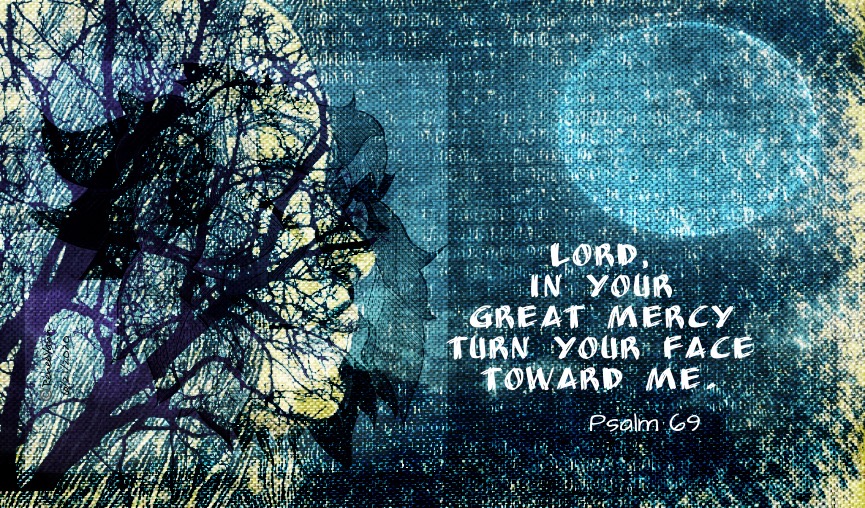
With today’s readings God is asking us to turn around from these distractions and look into the eyes of Infinite Love. We can begin by praying this simple and powerful verse from our Psalm – for ourselves and for our world.

Let us see your face, Lord, and we shall be saved.

Poetry: ― Rabindranath Tagore from Gitanjali

Day after day, O Lord of my life, 
shall I stand before thee face to face.
With folded hands, O Lord of all worlds,
shall I stand before thee face to face. 

Under thy great sky in solitude and silence,
with humble heart
shall I stand before thee face to face. 

In this laborious world of thine,
tumultuous with toil and with struggle,
among hurrying crowds
shall I stand before thee face to face. 

And when my work shall be done in this world,
O King of kings,
alone and speechless
shall I stand before thee face to face.

Music: Show Me Your Face, Lord – Steffany Gretzinger

Alleluia: Unmuted!

Tuesday of the Fourteenth Week in Ordinary Time
July 5, 2022

Today’s Readings:

https://bible.usccb.org/bible/readings/070522.cfm

Today, in God’s Lavish Mercy, a double-sided theme runs through our readings

Our first reading references idols of silver and gold, “the work of artisans, no god at all”. 

The Responsorial Psalm describes in detail how the power of God’s creative Word  contrasts to these mute and powerless idols.

Our God is in heaven;
whatever God wills, God does.
Their idols are silver and gold,
the handiwork of men.
R. Alleluia.

They have mouths but speak not;
they have eyes but see not;
They have ears but hear not;
they have noses but smell not.
R. Alleluia.

They have hands but feel not;
they have feet but walk not.
Their makers shall be like them,
everyone that trusts in them.
R. Alleluia

In today’s Gospel, we see the power of the Living Word, Jesus, to release the mute man from his demons. As we pray with this Gospel, we can think of the word “mute” in many ways.

Wherever truth, integrity, kindness and respect are stifled – whether in us or in others – God’s desire to speak to and through us is muted. 

Sometimes we mute ourselves by burying our true voice under a blanket of pretenses, frivolities, excuses, or useless ambitions. We can mute others by our prejudices, judgements and indifference. And we can do it all so easily, like flipping a button on the TV remote!

Let’s pray to be amazed today, as were the Gospel crowds, at the power of Jesus to free the Word in us!


Poetry: In Silence by Thomas Merton

Be still.
Listen to the stones of the wall.
Be silent, they try
to speak your

name.
Listen
to the living walls.

Who are you?
Who
are you? Whose
silence are you?

Who (be quiet)
are you (as these stones
are quiet). Do not
think of what you are
still less of
what you may one day be.

Rather
be what you are (but who?)
be the unthinkable one
you do not know.

O be still, while
you are still alive,
and all things live around you

speaking (I do not hear)
to your own being,
speaking by the unknown
that is in you and in themselves.

“I will try, like them
to be my own silence:
and this is difficult. The whole
world is secretly on fire. The stones
burn, even the stones they burn me.
How can a man be still or
listen to all things burning?
How can he dare to sit with them
when all their silence is on fire?”

Music: Echo of Our Souls – Kerani

Some lovely instrumental music to unmute the Word as we pray.

Alleluia: Saints for the Ages

Solemnity of Saints Peter and Paul
Wednesday, June 29, 2022

Today’s Readings:

https://bible.usccb.org/bible/readings/062922-day.cfm

Alleluia, alleluia.
You are Peter and upon this rock I will build my Church,
and the gates of the netherworld shall not prevail against it.


I, Paul, am already being poured out like a libation,
and the time of my departure is at hand.
I have competed well; I have finished the race;
I have kept the faith.


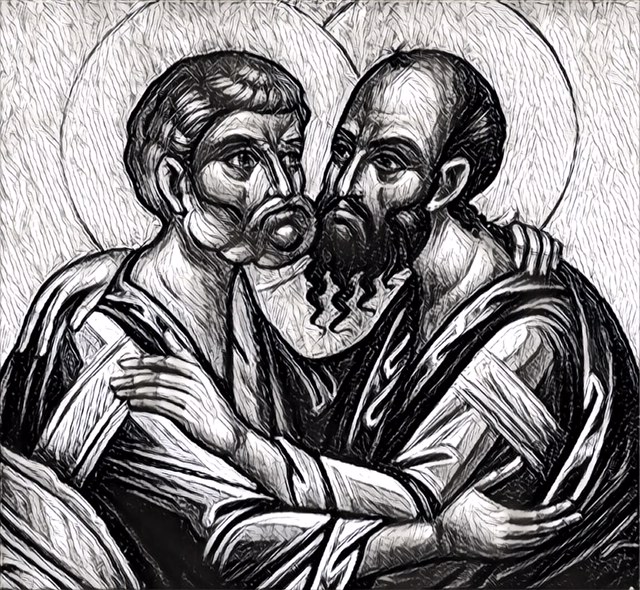
Today, in God’s Lavish Mercy, we celebrate the great Apostles Peter and Paul. The stories of these men embody all the hills and valleys of a Christian life, albeit to majestic scale: call, conversion of heart, ministry, miracles, sacrifice, suffering, failure and glory.

Every human being passes through these hills and valleys. Why do some emerge as saints for the ages and others not? 

Today’s readings would suggest this answer: they believed, and submitted their hearts to God’s unimaginable grace and power. Through that faith, they ultimately were led to the heights of holiness and carried the rest of us believers with them.

Paul says, 

“The Lord stood by me and gave me strength,
so that through me the proclamation of the Word
might be completed.”

When Jesus asks Peter what he believes, Peter says,

“You are the Christ, the Son of the living God.”

Ordinary men responding with a clear and extraordinary faith. May their lives and legacies bless and teach us.


Poetry: Two wonderful sonnets from Malcolm Guite

If you love Malcolm Guite’s poetry as much as I do, you might enjoy his blog found at this link:


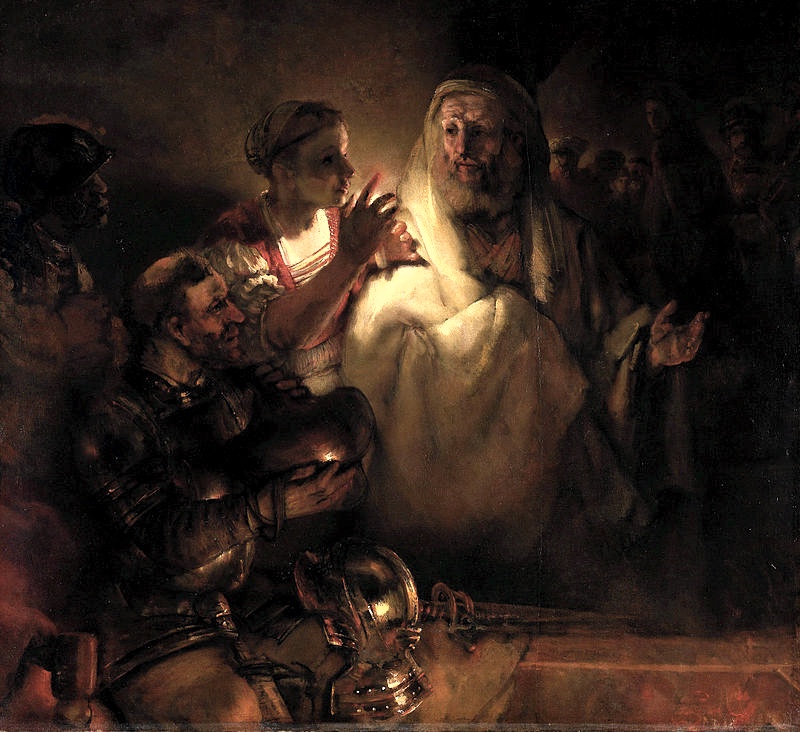
Peter Denies Christ – Rembrandt

St. Peter

Impulsive master of misunderstanding
You comfort me with all your big mistakes;
Jumping the ship before you make the landing,
Placing the bet before you know the stakes.
I love the way you step out without knowing,
The way you sometimes speak before you think,
The way your broken faith is always growing,
The way he holds you even when you sink.
Born to a world that always tried to shame you,
Your shaky ego vulnerable to shame,
I love the way that Jesus chose to name you,
Before you knew how to deserve that name.
And in the end your Saviour let you prove
That each denial is undone by love.

Apostle

Caravaggio’s Conversion of Saul
An enemy whom God has made a friend,
A righteous man discounting righteousness,
Last to believe and first for God to send,
He found the fountain in the wilderness.
Thrown to the ground and raised at the same moment,
A prisoner who set his captors free,
A naked man with love his only garment,
A blinded man who helped the world to see,
A Jew who had been perfect in the law,
Blesses the flesh of every other race
And helps them see what the apostles saw;
The glory of the lord in Jesus’ face.
Strong in his weakness, joyful in his pains,
And bound by love, he freed us from our chains.

Music: Nunc scio vere (Now I am sure…) – Introit from today’s liturgy

Alleluia: Trust!

Memorial of Saint Irenaeus, Bishop and Martyr
June 28, 2022

Today’s Readings

https://bible.usccb.org/bible/readings/062822.cfm

Today, in God’s Lavish Mercy, our Alleluia Verse, like so many of the Psalms, encourages us to TRUST.

“24” was an action-packed show popular a couple of decades ago. In that TV series, the protagonist was played by a tough Kiefer Sutherland. Iconic to each episode was his repeated assurance to his allies, “Trust me”. Doing so would supposedly get them out of every possible kind of fix!

Trusting him usually brought a few hairy escapes, gunfights and explosions. And I guess it can feel like that sometimes when we think we trust God.  But it shouldn’t.

Real and full trust in God yields deep peace
which then impels us to act for justice and mercy.

Alleluia, alleluia.
I trust in the LORD;
my soul trusts in God’s word.

Our readings this week from the prophet Amos portray a morally confused community who are tumbling toward God’s wrath. The prophet uses stunning imagery to declare his warning and to call the people to a repentance which acts for justice toward the poor and suffering.

The prophet speaks in imagery. The point is not a literal one. The point, rather, is to recognize that the cost of a disordered public life is inescapably very great. The cost cannot be denied or understated.

Walter Brueggemann

We too as a global community, and as individuals, are called to live lives ordered on God’s Law – lives patterned on justice, mercy, and love for all people.

How do you think we’re doing with that? I think Amos would have preaching tirade if he lived in our day!


But as our Alleluia Verse and our Gospel indicate, a first step toward redemption is TRUST. God is with us. Jesus is “in our boat”. These passages encourage us to get to know, understand, and trust God’s Presence through growing familiarity with the Word.

Once our spirits rest in this kind of assurance, we will have the freedom and courage not only to face ourselves, but to act for true justice, mercy, and love for every person.


Poetry: Poem 8 – Hadewijch of Antwerp, a 13th century mystic and poet.

Born is the new season as the old one that lasted so long is drawing to a close.
Those prepared to do love’s service will receive her rewards: new comfort and new strength.
If they love her with the vigor of love, they will soon be one with love in love.
To be one with love is an awesome calling and those who long for it should spare no effort.
Beyond all reason they will give their all and go through all.
For love dwells so deep in the womb of the Father that her power will unfold only to those who serve her with utter devotion.
First the lover must learn charity and keep God’s law.
Then he shall be blessed a hundredfold, and he shall do great things without great effort, and bear all pain without suffering.
And so his life will surpass human reason indeed.
Those who long to be one with love achieve great things, and shirk no effort.
They shall be strong and capable of any task that will win them the love of love, to help the sick or the healthy, the blind, the crippled or the wounded.
For this is what the lover owes to love.
He shall help the strangers and give to the poor and soothe the suffering whenever he can.
He shall pay loyal service to God’s friends, to saints and men, with a strength that is not human, by night and by day.
And when his strength seems to falter he will still place his trust in love.
Those who trust in love with all their being shall be given all they need.
For she brings comfort to the sad and guidance to those who cannot read.
Love will be pleased with the lover if he accepts no other comfort and trusts in her alone.
Those who desire to live in love alone with all their might and heart shall so dispose all things that they shall soon possess her all.

Music: Sleep in the Storm – by Unspoken Music

(Captures the essence of today’s Gospel where Jesus sleeps in a gusty storm – TRUST!)

Alleluia: God Loves to Talk with Us

Monday of the Thirteenth Week in Ordinary Time
June 27, 2022

Today’s Readings:

https://bible.usccb.org/bible/readings/062722.cfm

Today, in God’s Lavish Mercy, our readings dispense a serious dose of fire and brimstone! 

Beware, I will crush you into the ground
as a wagon crushes when laden with sheaves.

Amos 2:13

Consider this, you who forget God,
lest I rend you and there be no one to rescue you.

Psalm 50:22

Some of the prophets, and some preachers even now, have considered “F&B” an effective strategy to reach the hardened sinner. Even our sweet, gentle Jesus comes through tough in today’s Gospel:

Another of his disciples said to him,
“Lord, let me go first and bury my father.”
But Jesus answered him, “Follow me,
and let the dead bury their dead.”

Matthew 8:22

I’ve never been a fan of the hellfire approach to evangelization. I think it tends to raise a wall of fear around our hearts rather than invite a deep conversion.

Our Alleluia Verse helps me to cut through the sulfurous verbiage to the point that might actually change me: God wants to speak to me. Don’t be hard-hearted to God’s message.

Alleluia, alleluia.
If today you hear his voice,
harden not your hearts.

That’s it. That’s the message. Today it’s wrapped in some blazing language but the core is the same.

A loving God wants to speak to me
in every moment of my life.


Poetry: excerpt from Dante’s Inferno

This passage from the epic poem focuses on the sin of indifference, not caring enough to be either bad or good. It made me think of a powerful verse from the Book of Revelation:

I know your deeds, that you are neither cold nor hot. I wish you were either one or the other! So because you are lukewarm—neither hot nor cold—I am about to spit you out of my mouth.

Revelation 3: 15-16

And I — my head oppressed by horror — said:

“Master, what is it that I hear? Who are

those people so defeated by their pain?”

      And he to me: “This miserable way

is taken by the sorry souls of those

who lived without disgrace and without praise.

      They now commingle with the coward angels,

the company of those who were not rebels

nor faithful to their God, but stood apart.

      The heavens, that their beauty not be lessened,

have cast them out, nor will deep Hell receive them —

even the wicked cannot glory in them.” 

Dante Alighieri, Inferno

Music: De Profundis – Vasari Singers

Psalmus 129 (130)Psalm 129 (130)
1 De profundis clamavi ad te Domine1 Out of the depths I have cried to thee, O Lord:
2 Domine exaudi vocem meam fiant aures tuae intendentes in vocem deprecationis meae2 Lord, hear my voice. Let thy ears be attentive to the voice of my supplication.
3 Si iniquitates observabis Domine Domine quis sustinebit3 If thou, O Lord, wilt mark iniquities: Lord, who shall stand it.
4 Quia apud te propitiatio est propter legem tuam sustinui te Domine sustinuit anima mea in verbum eius4 For with thee there is merciful forgiveness: and by reason of thy law, I have waited for thee, O Lord. My soul hath relied on his word:
5 Speravit anima mea in Domino5 my soul hath hoped in the Lord.
6 A custodia matutina usque ad noctem speret Israel in Domino6 From the morning watch even until night, let Israel hope in the Lord.
7 Quia apud Dominum misericordia et copiosa apud eum redemptio7 Because with the Lord there is mercy: and with him plentiful redemption.
8 Et ipse redimet Israel ex omnibus iniquitatibus eius8 And he shall redeem Israel from all his iniquities.
______________________

Alleluia: Speak, Lord!

Thirteenth Sunday in Ordinary Time
June 26, 2022

Today’s Readings

https://bible.usccb.org/bible/readings/062622.cfm

Today, in God’s Lavish Mercy, our Alleluia Verse suggests an amazing consideration- that the Almighty God responds to our human invitation!

Alleluia, alleluia.
Speak, Lord, your servant is listening;
you have the words of everlasting life.

1 Sm 3:9; Jn 6:68


This humble, hopeful prayer encapsulates themes from each of today’s readings which all use the symbol of a yoke to illustrate their message.

Elisha, and the listeners to both Paul and Jesus understand what a yoke does. It ties the beast of burden to its task. It also ties the one who holds the reins and plow handle.

Although the symbols of ploughing and yoke may be less familiar to us, our readings instruct us that to truly hear God’s voice in our lives we must have a deep freedom from anything that burdens our spirits. How do we do that while living normal human lives with responsibilities, worries and frustrations?

Our verse today might offer us an answer. It all depends on how we perceive our daily lives. 

Speak, Lord, your servant is listening;
you have the words of everlasting life.

Do we see our life only for itself with all the burdens it might put on us? Or do we see it as the sacred unfolding of an infinitely deeper life – everlasting life?

  • Elisha’s life was so much more than the field he had to plow that day!
  • The Galatians lives were so much more than the “biting” arguments that plagued them that day!
  • Jesus’s invitation to follow him is to so much more than the surface concerns of our lives.

Our life in Christ is a call to live in the deep stream of grace – to live “everlasting life” even within the limits of time’s circumstances.

Doing so changes us. It breaks the yoke that constricts our vision, our hope, our capacity for mercy. It allows us to invite God to speak and to hear God’s voice in our ordinary day. It strengthens us to live with extraordinary love and “everlasting “ grace.

Poetry: from T.S.Eliot’s Ash Wednesday 

I have taken a few lines from this long poem of Eliot’s. He wrote it in his later years. He expresses his continuing struggle with living a deep faith. After the excerpt, there is a link to the entire poem. I find Eliot not to be an easy poet, but oh is he ever worth the effort!

If the lost word is lost, if the spent word is spent

If the unheard, unspoken

Word is unspoken, unheard;

Still is the unspoken word, the Word unheard,

The Word without a word, the Word within

The world and for the world;

And the light shone in darkness and

Against the Word the unstilled world still whirled

About the centre of the silent Word.

O my people, what have I done unto thee.

Where shall the word be found, where will the word

Resound? Not here, there is not enough silence

Not on the sea or on the islands, not

On the mainland, in the desert or the rain land,

For those who walk in darkness

Both in the day time and in the night time

The right time and the right place are not here

No place of grace for those who avoid the face

No time to rejoice for those who walk among noise and deny

the voice

Will the veiled sister pray for

Those who walk in darkness, who chose thee and oppose thee,

Those who are torn on the horn between season and season,

time and time, between

Hour and hour, word and word, power and power, those who wait

In darkness? Will the veiled sister pray

For children at the gate

Who will not go away and cannot pray:

Pray for those who chose and oppose

O my people, what have I done unto thee.

Will the veiled sister between the slender

Yew trees pray for those who offend her

And are terrified and cannot surrender

And affirm before the world and deny between the rocks

In the last desert before the last blue rocks

The desert in the garden the garden in the desert

Of drouth, spitting from the mouth the withered apple-seed.

O my people.

http://famouspoetsandpoems.com/poets/t__s__eliot/poems/15133


Music – I Can Hear Your Voice – Jean Watson, Michael W. Smith

Pentecost Sunday

June 5, 2022

Today, in God’s Lavish Mercy, we celebrate the great Feast of Pentecost when the Holy Spirit descended to eternally enliven the Church.

We are that Church, living today in a world that sorely needs God’s renewing breath of life!


For today’s Responsorial Psalm, we pray with Psalm 104 – a fitting plea for this glorious Feast of Pentecost.

Lord, send out your Spirit, 
and renew the face of the earth.

It is a bold prayer, an extravagant request. It asks for everything – a Fire of Love so complete that the whole earth is remade in its Divine Power.

It is a prayer based in mutual invitation as, in the Sequence, we invite the Holy Spirit to renew us:

Come, Holy Spirit, come!
And from your celestial home
Shed a ray of light divine!

Pentecost Sequence

And, as in any true relationship, the Spirit invites us too – to open our hearts to the infinite grace of this feast. The Book of Revelation describes this reciprocity in this profound passage:

“ I, Jesus, have sent my angel to give you this testimony for the churches. I am the Root and the Offspring of David, and the bright Morning Star.”

The Spirit and the bride say, “Come!” And let the one who hears say, “Come!” Let the one who is thirsty come; and let the one who wishes take the free gift of the water of life.

Revelation 22: 16-17

On this Birthday of the Church, we pray not only for our own soul’s kindling, but for the whole People of God. May the Grace of Pentecost ignite a new fire of charity over all the earth. May that fire clear the way for the Spirit’s gifts to flower, for Her fruits to blossom, for Her power to surprise us as it bursts forth in our hearts!


Poetry: The Golden Sequence

Veni Sancte Spiritus, sometimes called the Golden Sequence, is a sequence prescribed in the Roman Liturgy for the Masses of Pentecost and its octave. It is usually attributed to either the thirteenth-century Pope Innocent III or to the Archbishop of Canterbury, Cardinal Stephen Langton, although it has been attributed to others as well.

“Veni Sancte Spiritus” is one of only four medieval Sequences which were preserved in the Roman Missal published in 1570 following the Council of Trent (1545–63).

The other three occasions when we hear these beautiful ancient hymns are Easter Sunday (“Victimae Paschali Laudes”), Corpus Christi (“Lauda Sion Salvatorem”) and Our Lady of Sorrows (“Stabat Mater Dolorosa”). On Easter Sunday and Pentecost, the sequence must be sung, whereas on Corpus Christi and Our Lady of Sorrows, the sequence is optional.

Wikipedia

Come, Holy Spirit, come!
And from your celestial home
    Shed a ray of light divine!

Come, Father of the poor!
Come, source of all our store!
    Come, within our bosoms shine.

You, of comforters the best;
You, the soul’s most welcome guest;
    Sweet refreshment here below;

In our labor, rest most sweet;
Grateful coolness in the heat;
    Solace in the midst of woe.

O most blessed Light divine,
Shine within these hearts of yours,
    And our inmost being fill!

Where you are not, we have naught,
Nothing good in deed or thought,
    Nothing free from taint of ill.

Heal our wounds, our strength renew;
On our dryness pour your dew;
    Wash the stains of guilt away:

Bend the stubborn heart and will;
Melt the frozen, warm the chill;
    Guide the steps that go astray.

On the faithful, who adore
And confess you, evermore
    In your sevenfold gift descend;

Give them virtue’s sure reward;
Give them your salvation, Lord;
    Give them joys that never end. Amen.
    Alleluia.

Music: Veni Santé Spiritus – Chant of the Mystics

Wednesday of the Sixth Week of Easter

May 25, 2022

Today, in God’s Lavish Mercy, Paul gives a magnificent oration at the Areopagus in Athens. It was a big deal billing!

V&A_-_Raphael,_St_Paul_Preaching_in_Athens_(1515)
St. Paul at the Areopagus by Raphael (c.1515)

Areopagus, earliest aristocratic council of ancient Athens. The name was taken from the Areopagus (“Ares’ Hill”), a low hill northwest of the Acropolis, which was its meeting place.

In pre-classical times (before the 5th century BC), the Areopagus was the council of elders of the city, similar to the Roman Senate. Like the Senate, its membership was restricted to those who had held high public office.

The Areopagus, like most city-state institutions, continued to function in Roman times, and it was from this location, drawing from the potential significance of the Athenian altar to the Unknown God that Paul is said to have delivered the famous speech, “Now what you worship as something unknown I am going to proclaim to you. The God who made the world and everything in it is the Lord of heaven and earth and does not live in temples built by hands.” (Wikipedia)


diamonds


The sermon has so many beautiful lines, like glorious diamonds that can be turned over and over in prayer. Here are a few that glistened for me:


God … does not dwell in sanctuaries made by human hands
(Instead, God dwells within us)


God is not served by human hands because God needs nothing.
(Instead, our everything comes from God)


God made from one the whole human race to dwell on the entire surface of the earth.
(We are all connected in the One Creation)


God fixed the ordered seasons and the boundaries of their regions,
so that people might seek God,
even perhaps grope for him and find him,
though indeed he is not far from any one of us.
(We do grope, sometimes in darkness.)


God has overlooked the times of ignorance,
but now God demands that all people everywhere repent…
(Without Christ, we were in shadows of unknowing. With Christ, we are in Light.)


And my favorite:

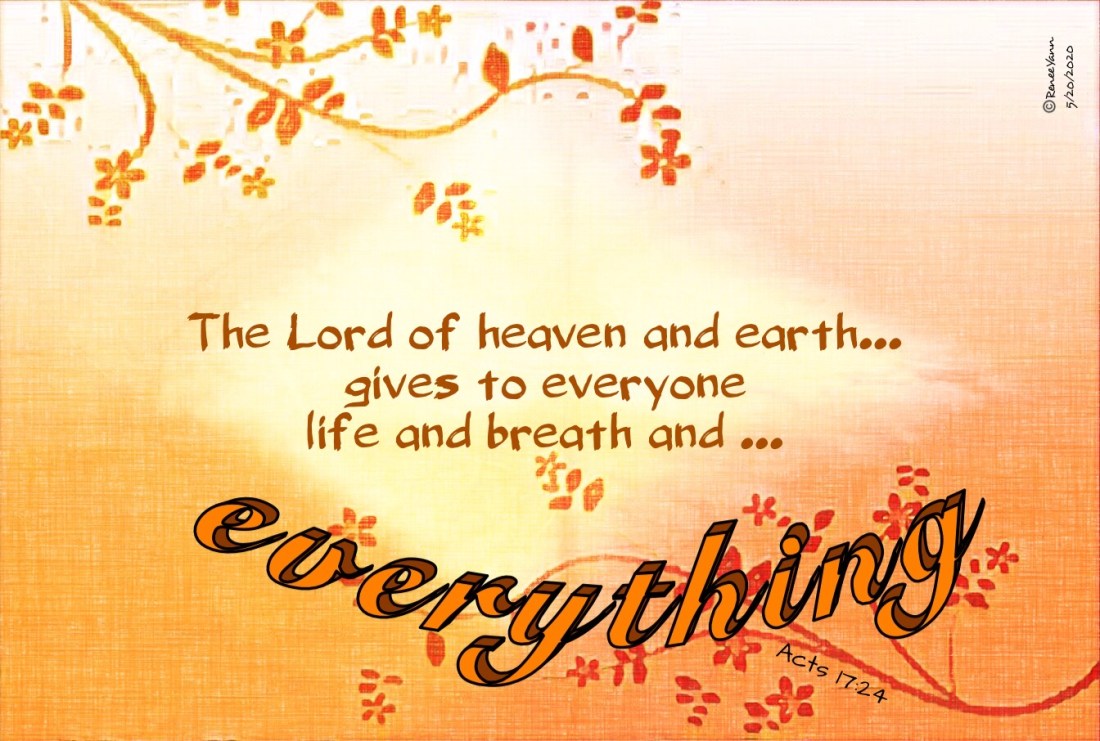
Acts17_24 everything

What is the “everything” that God is giving you today? What is the abundance of grace, or hope, or longing in your heart as you pray today? Let God’s fullness embrace any emptiness as you offer God your silence and waiting.


Poetry: Everything – Rumi

Love is
when God says to you
"I have created everything for you",
and you say
"I have left everything for You."

Music: Everything – Lauren Daigle

Thursday of the Fifth Week of Easter

May 19, 2022

Today, in God’s Lavish Mercy, Acts allows us to sit in on an early Church “convention”. The dynamics are fascinating, as well as amazingly familiar.

The community is a-bustle with concerns. Paul and Barnabas have been out gathering Gentile converts to the faith. The Jewish Christian community back in Jerusalem feels that these new converts should be required to submit to circumcision as a sign of their conversion. Peter offers an intense, lucid, yet gentle argument to convince the Jerusalem community that this is not necessary.

God, who knows the heart,
bore witness by granting them the Holy Spirit
just as he did us.
He made no distinction between us and them,
for by faith he purified their hearts.
Why, then, are you now putting God to the test
by placing on the shoulders of the disciples
a yoke that neither our ancestors nor we have been able to bear?

Acts 15:8-10

James, who appears to have influence in the Jerusalem Church, backs Peter up by referring to the prophet Amos who promised the rebuilding of the faith community:

After this I shall return
                        and rebuild the fallen hut of David;
            from its ruins I shall rebuild it
                        and raise it up again,
            so that the rest of humanity may seek out the Lord,
                        even all the Gentiles on whom my name is invoked.
            Thus says the Lord who accomplishes these things,
                        known from of old.

What a perfect reference to help convince the Jewish community that to be a Christian one did not have to also be a Jew nor follow the Old Law.

This passage helps us to be aware of our openness to new inspiration from the Holy Spirit not only in the Church but in our personal lives. God is the great “heart-reader” and knows when we are ready for growth and deepening. “Protecting” our faith with rituals and exercises that have lost meaning can be a way to avoid opening ourselves to conversion and spiritual transformation. The Holy Spirit invites us beyond such false securities:

And God, who knows the heart,
bore witness by granting them the Holy Spirit
just as he did us.

Acts 15:8

In our Gospel, Jesus reminds us of all that we need to make our faith — and our joy — complete:

Jesus said to his disciples:
“As the Father loves me, so I also love you.
Remain in my love.
If you keep my commandments, you will remain in my love,
just as I have kept my Father’s commandments
and remain in his love.

“I have told you this so that
my joy might be in you and
your joy might be complete.”

Poetry: Quench Your Heart’s Thirst – Hafiz

I know the way you can get
When you have not had a drink of Love:

Your face hardens,
Your sweet muscles cramp.
Children become concerned
About a strange look that appears in your eyes
Which even begins to worry your own mirror
And nose.

Squirrels and birds sense your sadness
And call an important conference in a tall tree.
They decide which secret code to chant
To help your mind and soul.

Even angels fear that brand of madness
That arrays itself against the world
And throws sharp stones and spears into
The innocent
And into one’s self.

O I know the way you can get
If you have not been drinking Love:

You might rip apart
Every sentence your friends and teachers say,
Looking for hidden clauses.

You might weigh every word on a scale
Like a dead fish.

You might pull out a ruler to measure
From every angle in your darkness
The beautiful dimensions of a heart you once
Trusted.

I know the way you can get
If you have not had a drink from Love’s
Hands.

That is why all the Great Ones speak of
The vital need
To keep remembering God,
So you will come to know and see Him
As being so Playful
And Wanting,
Just Wanting to help.

That is why Hafiz says:
Bring your cup near me.
For all I care about
Is quenching your thirst for freedom!

All a Sane man can ever care about
Is giving Love!”


Music: CHANGE MY HEART, O GOD

Wednesday of the Fifth Week of Easter

May 18, 2022

Today, in God’s Lavish Mercy, Acts reveals the tensions in the Church between Jewish and Gentile believers. For the Jews, the ritual of circumcision was a key expression of covenantal faith. Some felt it was necessary for Gentile converts to undergo the ritual in order to become Christians.

Which way is the right way?

Like all start-ups, the Church had many friction points which required decisions about what was essential and what was only customary. Those customs being thousands of years old, the decisions become even harder. Readings later this week describe more conflict points.

Nevertheless, under the guidance of the Holy Spirit, and despite the venerability of custom, the nascent Church was able embrace a new reality rooted in Christ’s inclusive love.

These kinds of philosophical and theological tugs-of-war have accompanied the Church down through history. Some of them have helped reveal deeper insights into our faith. But, as in all human communities, some of the tugs have been motivated by fear, greed, power, and other selfish interests.

Watching how the early Church handles their particular situation may give us hints about how we should handle them today.


In our Gospel, Jesus makes clear what is essential and inviolable to the faith:

I am the vine, you are the branches.
Whoever remains in me and I in him will bear much fruit,
because without me you can do nothing.

John 15:1-2
John15_4 Remain

I think “Remain” is a beautiful word. In the dictionary, it will be defined as ‘stay’. But it connotes much more to me.  Re–main asks us not just to choose to stay with Jesus, but to choose it over and over – like reenlist, renew, recommit.

Remain means to endure with the Beloved Vine through every season – winter’s cold and summer’s heat, and all that’s in between.

Remain means “Love Me, stay beside me, even when others fall away.”

May we remain.


Poetry: The Vine – Malcolm Guite

John 15:5 I am the vine, ye are the branches: He that abideth in me, and I in him, the same bringeth forth much fruit: for without me ye can do nothing.

How might it feel to be part of the vine?
Not just to see the vineyard from afar
Or even pluck the clusters, press the wine,
But to be grafted in, to feel the stir
Of inward sap that rises from our root,
Himself deep planted in the ground of Love,
To feel a leaf unfold a tender shoot,
As tendrils curled unfurl, as branches give
A little to the swelling of the grape,
In gradual perfection, round and full,
To bear within oneself the joy and hope
Of God’s good vintage, till it’s ripe and whole.
What might it mean to bide and to abide
In such rich love as makes the poor heart glad?


Music: I Am the Vine – John Michael Talbot