Today, in God’s Lavish Mercy, our liturgy repeats yesterday’s verses from Psalm 85. That’s how important they are to our Advent prayer! So let’s pray with our psalm in the light of the readings which surround it today.
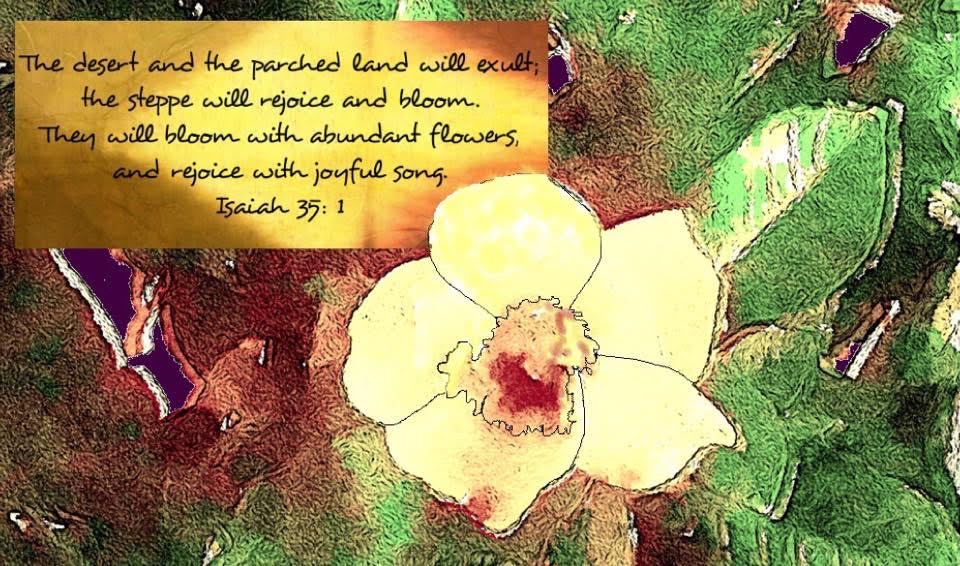
Today, in our first magnificent reading from the poet-prophet Isaiah, we read about the transformation God can accomplish even over the most broken and desolated landscapes. Isaiah encourages us to exuberant hope:
Strengthen the hands that are feeble, make firm the knees that are weak, Say to those whose hearts are frightened: Be strong, fear not! Here is your God, coming with vindication; With divine recompense – coming to save you.
Isaiah 35: 3-4
In our Gospel, Jesus transfigures both the inner and outer “landscape” of a young paralytic who has good and creative friends.
And some men brought on a stretcher a man who was paralyzed; they were trying to bring him in and set him in his presence. But not finding a way to bring him in because of the crowd, they went up on the roof and lowered him on the stretcher through the tiles into the middle in front of Jesus. When Jesus saw their faith, he said, “As for you, your sins are forgiven.”
Luke 5: 18-20
Our psalm reflects the transformative power in both readings as we pray:
I will hear what God proclaims; the LORD – who proclaims peace to the people. Near indeed is salvation to those who reverence God, glory dwelling in our land.
Psalm 85:9-10
“Glory dwelling in our land” – the land of our earth, and the land of our hearts. Let’s hope for it, believe it, invite it in our prayer today.
Poetry: Rumi
And you? When will you begin that long journey into yourself? Why do you stay in prison when the door is so wide open?
Music: Handel: Then Shall the Eyes of the Blind Be Opened / He Shall Feed His Flock
Today, in God’s Lavish Mercy, we pray with Psalm 85 which, sprinkled heavily with “will”s and “shall”s, is written almost completely in the future tense.
This psalm, though filled with hope, is italicized with a sense of “then, but not just yet”. In the midst of a long waiting, it fuels our patience with words like “near”:
I will hear what God proclaims; the LORD— who proclaims peace to the people. Near indeed is salvation to those who are awed by the Lord, glory dwelling in our land.
Psalm 85: 9-10
Oh, my! Do we know how that long patience feels?
The feeling recalls my Dad’s answer on any long journey when I repeatedly queried, “Are we there yet.”
Not yet. But near. Not now. But soon.
The whole world shares a similar feeling right now. As we see the promise of a vaccine rising on the horizon, we still live in the worry and isolation of this pandemic. Are we safe yet?
Not yet. But near. Not now. But soon.
Let us not miss the practical lessons nor the spiritual ones that emerge as we read the psalmist’s ancient words in our current stressful times.
The practical lessons for our situation are clear:
a vaccine is near
be patient, prepare
mask up
wash hands
stay home if possible
respect your bubble and everyone else’s
Some of the spiritual inspirations might be these.
Amazing Grace is always near to us
be patient, prepare
learn from your solitude
clear your spirit of any impediments to grace
find your home in God’s Presence
rest in that Presence until you are renewed
The psalm assures us that God is with us; that the Sacred Presence will appear as we open our eyes to God’s justice and mercy.
The LORD will give us benefits; our land shall yield its increase. Justice shall walk before the Lord and prepare the way of God’s steps.
Psalm 85: 13-14
Isaiah and Mark direct our hearts to the voice of the prophet John the Baptist who proclaims, “Prepare a way for the Lord!” That’s how near God is! Just on the other side of our soul’s expectation.
In our second reading, Peterreminds us of how to be ready for the moment when “soon” becomes “now”.
But according to God’s promise we await new heavens and a new earth in which righteousness dwells. Therefore, beloved, since you await these things, be eager to be found without spot or blemish before the Lord, at peace.
2 Peter 3:13-14
Poetry: ADVENT (On a Theme by Dietrich Bonhoeffer) by Pamela Cranston
Look how long
the tired world waited,
locked in its lonely cell,
guilty as a prisoner.
As you can imagine,
it sang and whistled in the dark.
It hoped. It paced and puttered about,
tidying its little piles of inconsequence.
It wept from the weight of ennui
draped like shackles on its wrists.
It raged and wailed against the walls
of its own plight.
But there was nothing
the world could do
to find its freedom.
The door was shut tight.
It could only be opened
from the outside.
Who could believe the latch
would be turned by the flower
of a newborn hand?
Music: Soon and Very Soon written and sung by Andraé Crouch, accompanied here by Jessy Dixon
Andraé Edward Crouch (July 1, 1942 – January 8, 2015) was an American Gospel singer, songwriter, arranger, record producer and pastor. Referred to as “the father of modern gospel music” by gospel music professionals.
Jessy Dixon (March 12, 1938 – September 26, 2011) was an American Gospel music singer, songwriter, and pianist, with success among audiences across racial lines. He garnered seven Grammy Award nominations during his career.
Today, in God’s Lavish Mercy, we pray with Psalm 80, an urgent call to a God from whom the psalmist has turned away.
How do we get to the point that we are turned away from God? And how do we correct that? Well, that’s what Advent is all about, and our psalm today gives us some hints about a remedy.
First: Disconnection
Sometimes with God, as with any relationship, we simply get disconnected. It’s as if the the phone lines go down and we don’t bother to fix them.
We pray less – well, you know, because we’re busy, right?
We lose the “holy intention” in our lives to always be with God and for God, even in our choices and actions.
Advent helps us remember that such “holy intention” can only be charged by our connection to God. Advent turns us to call that Power into our lives.
O shepherd of Israel, hearken, from your throne upon the cherubim, shine forth. Rouse your power, and come to save us.
Second: Confusion
Other times, we are confused about our soul’s intimate relationship with God. We haven’t forgotten it. Actually, we work very hard to be what we think God wants. We, like a satisfied Pharisee, think our “holiness” is the fruit of our own efforts. But our life in God withers, like a once beautiful plant that languishes, overwatered and scorched. For all our efforts, our souls feel empty.
Advent helps us realize that it is God who enlivens the vine and gives the blossom, not us. Advent turns us to a humble, hopeful waiting for grace as God desires to give it.
Once again, O LORD of hosts, look down from heaven, and see; take care of this vine, and protect what your right hand has planted the son of man whom you yourself made strong.
Third: Withdrawal
Our psalm recognizes that, at times, we withdraw from God. Perhaps we tire of working at our spiritual life. Or we weary when our works of mercy go unappreciated. Or we fail to find God’s Presence in a prayer that seems unanswered.
Advent helps us see that God is never the one who withdraws from the work of love. We do.
Advent turns us to new life by the simple calling of the Name that never fails to answer.
May your help be with the creature of your right hand, with the beloved whom you yourself made strong. Then we will no more withdraw from you; give us new life, and we will call upon your name.
As we begin this Advent journey that can so deepen us in grace and love, let us humbly place in God’s hands anything in our lives that needs “turning”.
Lord, make us turn to you; let us see your face and we shall be saved.
Poetry:Tagore – THE INFINITY OF YOUR LOVE
Stand before my eyes,
and let Your glance touch my songs into a flame.
Stand among Your stars,
and let me find kindled in their lights my own fire of worship.
The earth is waiting at the world’s wayside.
Stand upon the green mantle she has flung upon Your path,
and let me in her grass and meadow flowers spread my own salutation.
Stand in my lonely evening where my heart watches alone;
fill her cup of solitude,
and let me turn my heart toward the infinity of Your love.
Today, in God’s Lavish Mercy, we pray with Psalm 84, a praise and pilgrimage hymn.
It is a perfect prayer for us if we have any small sense of alienation, loss, or confusion in our own pilgrimage.
And, honestly, who doesn’t!?
Even in the best of times, life can be a twist! And in pandemic times, politically charged times, economically shaky times??? Never a better time to say, “God help us!”
But Psalm 84 orients us. It announces what the journey is really about … the desire to find a resting place in God. Once we realize that, the road slowly straightens with the power of faith.
In Psalm 84, the pilgrim’s heart, hungry for God, sets out on the spiritual journey.
My soul yearns and pines for the courts of the LORD. My heart and my flesh cry out for the living God.
There can be a deep trust in our journeying heart because “even the sparrow” finds a home in God’s tender care.
Even the sparrow finds a home, and the swallow a nest in which she puts her young– Your altars, O LORD of hosts, my king and my God!
The secret, though, is constancy.:
We pilgrims must stay with the essence of our journey – the deep desire for God.
We must listen to scripture’s “directions” about where God dwells – with the poor, humble, and merciful.
We must not let the flashy road signs of the “Me Culture” distract us.
“The Narcissism Epidemic,” by psychologists Jean M. Twenge and W. Keith Campbell studies the increase of narcissism or “me-ism” in our culture. Here’s an excerpt:
Although these seem like a random collection of current trends, all are rooted in a single underlying shift in the American psychology: the relentless rise of narcissism in our culture. Not only are there more narcissists than ever, but non-narcissistic people are seduced by the increasing emphasis on material wealth, physical appearance, celebrity worship, and attention seeking. Standards have shifted, sucking otherwise humble people into the vortex of granite countertops, tricked-out MySpace pages, and plastic surgery. A popular dance track repeats the words “money, success, fame, glamour” over and over, declaring that all other values have “either been discredited or destroyed.”
Let’s pray today for “staying power”. We have been given the grace to seek God in our lives. Let’s dwell in that seeking, moving from strength to strength in any twists life tosses in front of us.
Blessed they who dwell in your house! continually they praise you. Blessed are we whose strength you are! They go from strength to strength.
Poetry: The Journey – Tagore
The morning sea of silence broke into ripples of bird songs; and the flowers were all merry by the roadside; and the wealth of gold was scattered through the rift of the clouds while we busily went on our way and paid no heed.
We sang no glad songs nor played; we went not to the village for barter; we spoke not a word nor smiled; we lingered not on the way.
We quickened our pace more and more as the time sped by. The sun rose to the mid sky and doves cooed in the shade. Withered leaves danced and whirled in the hot air of noon.
The shepherd boy drowsed and dreamed in the shadow of the banyan tree, and I laid myself down by the water and stretched my tired limbs on the grass.
My companions laughed at me in scorn; they held their heads high and hurried on; they never looked back nor rested; they vanished in the distant blue haze. They crossed many meadows and hills, and passed through strange, far-away countries.
All honor to you, heroic host of the interminable path! Mockery and reproach pricked me to rise, but found no response in me.
I gave myself up for lost in the depth of a glad humiliation —in the shadow of a dim delight.
The repose of the sun-embroidered green gloom slowly spread over my heart. I forgot for what I had traveled, and I surrendered my mind without struggle to the maze of shadows and songs.
At last, when I woke from my slumber and opened my eyes, I saw thee standing by me, flooding my sleep with thy smile. How I had feared that the path was long and wearisome, and the struggle to reach thee was hard!
Music: How Lovely Is Your Dwelling Place – Jesuit Music
Today, in God’s Lavish Mercy, we pray with Psalm 149 which calls the community to sing and dance because God has delivered them.
This happy, celebratory summons is set, contrastingly, between two readings that mention weeping.
Then I saw a mighty angel who proclaimed in a loud voice, “Who is worthy to open the scroll and break its seals?” But no one in heaven or on earth or under the earth was able to open the scroll or to examine it. I shed many tears because no one was found worthy to open the scroll or to examine it.
Revelation 5:2-4
As Jesus drew near Jerusalem, he saw the city and wept over it, saying, “If this day you only knew what makes for peace– but now it is hidden from your eyes.
Luke 19; 41-42
The readings leave us with a sense that there is a secret to eternal life – a secret to which only grace can open our eyes and hearts.
John writes that “the Lion of Judah” has the key:
One of the elders said to me, “Do not weep. The lion of the tribe of Judah, the root of David, has triumphed, enabling him to open the scroll with its seven seals.”
Revelation 5:5-6
Jesus, Uncreated Grace, is the Lion of Judah. He has incarnated the sacred key in his Life, Death, and Resurrection. For those who receive him and share his life, the door is opened, the scroll unrolled.
So what is the path to such union with Jesus?
Our psalm contains a brief line tucked at its center which foreshadows the entire message of the Gospel.
Let them praise God’s name in the festive dance, let them sing praise with timbrel and harp. For the LORD loves us, and adorns the lowly with victory.
We will find a dancing, singing joy when we give ourselves to these truths:
God loves us irrevocably
We can fully receive this great love to the degree that we become like Christ whose image we find among the poor, lowly, and suffering.
Poetry: Dance from Rumi
Come to me, and I shall dance with you In the temples, on the beaches, through the crowded streets Be you man or woman, plant or animal, slave or free I shall show you the brilliant crystal fires, shining within I shall show you the beauty deep within your soul I shall show the path beyond Heaven. Only dance, and your illusions will blow in the wind Dance, and make joyous the love around you Dance, and your veils which hide the Light Shall swirl in a heap at your feet.
Today, in God’s Lavish Mercy, we pray with Psalm 15 which often is called an ‘entrance liturgy’, where a worshipper asks the conditions of entering the worship place and a priest answers.
The psalm’s first line, not included in today’s verses, asks that question of the Lord:
LORD, who may abide in your tent? Who may dwell on your holy mountain?
Psalm 15:1
Reading this line immediately reminded me of Jesus’s first encounter with his chosen twelve. Upon meeting Jesus, and obviously struck with his unique charisma, the disciples ask, “Lord, where do you live?”. They want to be with him, to learn about him. We do too.
It’s a gift to be invited to someone’s home – to see where and how they live, to share their dailyness. It is a first portal to the intimacy of friendship, a gift beyond price when it proves mutual and true.
In today’s Gospel, in a sort of reverse proposal, Jesus invites himself to dinner at Zaccheus’s home. Throughout all the Gospels, we often see Jesus inviting and accepting invitations which prove to be conversions and calls for his followers.
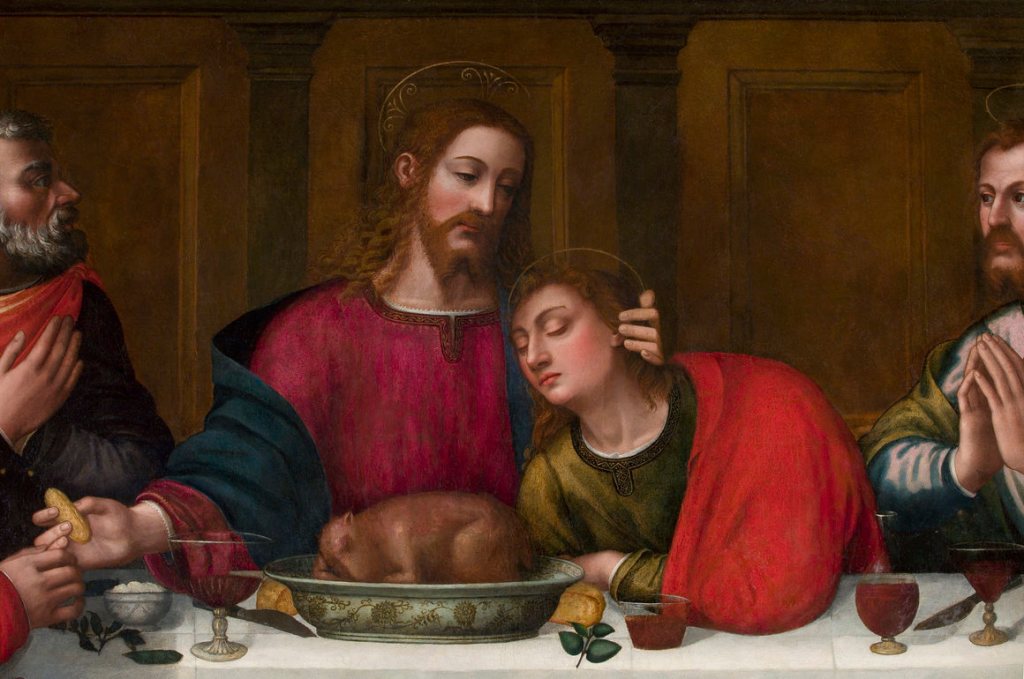
by Plautilla Nelli, an Italian nun who is said to have taught herself to paint in the 16th century. This is a section of her “Last Supper,” painted around 1568, and now newly installed in the old refectory of the Santa Maria Novella Museum.Of course, it shows Jesus with the “beloved” disciple.
In the reading from Revelation, the invitation takes an apocalyptic and corrective tone, but its heart is the same. In essence, God invites us to an intimacy of which we are capable only under certain conditions, i.e. “if you hear my voice“:
Behold, I stand at the door and knock. If you hear my voice and open the door, then I will enter and dine with you, and you with me. I will give the victor the right to sit with me on my throne, as I myself first won the victory and sit with my Father on his throne.
Today’s segment from Psalm 15 tells us what some of those conditions look like. It says to be someone who:
walks blamelessly and does justice
thinks the truth in your heart
slanders not with your tongue.
harms not your fellow human beings,
takes up no reproach against your neighbor
despises not the reprobate
honors those who fear the LORD
lends not your money at usury
accepts no bribe against the innocent
Our challenge from the psalm is to meditate on that list to see what such behavior looks like in modern terms. Beneath the psalmist’s ancient language, we might discover our attitudes and examine our conscience toward issues like:
criminal justice
capital punishment
war
poverty
immigration policy
refugee resettlement
propagandist media
economic equity
felon rehabilitation
respect for other religions
political oppression
– just to suggest a few.
Psalm 15 tells us, and our other readings affirm, that the one who gets these things right not only gets invited, but gets to remain in God’s house, God’s “tent”.
The one who does these things shall never be disturbed.
I know that’s Who I want to go eternally camping with! How about you?
Poem: Rainer Maria Rilke, Poems from the Book of Hours
You, neighbor God, if sometimes in the night
I rouse you with loud knocking, I do so
only because I seldom hear you breathe
and know: you are alone.
And should you need a drink, no one is there
to reach it to you, groping in the dark.
Always I hearken. Give but a small sign.
I am quite near.
Between us there is but a narrow wall,
and by sheer chance; for it would take
merely a call from your lips or from mine
to break it down,
and that without a sound.
The wall is builded of your images.
They stand before you hiding you like names.
And when the light within me blazes high
that in my inmost soul I know you by,
the radiance is squandered on their frames.
And then my senses, which too soon grow lame,
exiled from you, must go their homeless ways.
Today, in God’s Lavish Mercy, we pray with Psalm 128 which is used this Sunday to connect a series of readings about “fruitfulness” and its eternal endurance.
Our readings today intensify a tone evident in recent weeks – a theme I call “end of the line warnings”. Just two weeks out from Advent, and the end of the 2020 Liturgical Year, we have our annual confrontation with “The End Times”.
I have never enjoyed these readings. They actually scared me as a child, and they don’t make me too carefree even now. The only thing that makes them tolerable is that they herald the coming of Advent, a favorite time for hope-filled readings.
But to get to those Advent scriptural delights, we have to face:
sudden disaster like labor pains
darkness like a thief in the night
alert and sober sleeplessness
and, if we’re not vigilant, a potential toss into the darkness outside where there will be wailing and grinding of teeth.
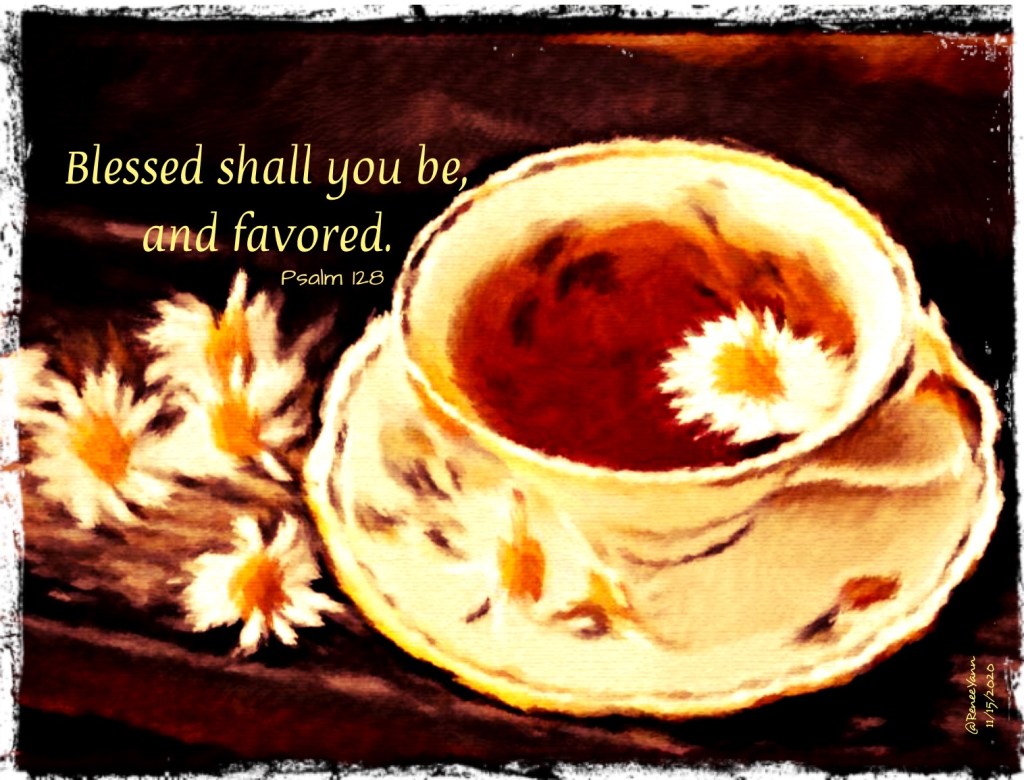
In the midst of these terror-producing readings, Psalm 128 can be like a calming cup of camomile tea. It reminds us – serenely, yet directly – of enduring blessings and how we secure them.
Blessed are you who fear the LORD, who walk in the Lord’s ways! For you shall eat the fruit of your handiwork; blessed shall you be, and favored.
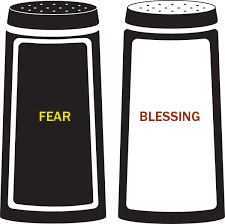
Today’s readings are sprinkled with two usually contrasting words: fear and blessing. However, our prayer may lead us to realize that these actions can be complementary from a spiritual perspective.
When we live in awe, or holy fear, before God’s Presence and Power, our life is blessed with fruitful – just and merciful – relationships with all Creation, including an anticipated joy in our eternal home. As Christine Robinson transliterates Psalm 128:
You are blessed, who know God’s grace and who follow the Way of Life. Happiness and contentment are yours. Your home is a place of growth and love. Your city a better place for your life in it. Your life of faithful work, prayerful reflection,and shared love blesses those around you with life and peace.
…and you can look forward with joy to your continuing eternal life with God and God’s beloved family.
Poetry: To Heaven by Ben Johnson who is among the best-known writers and theorists of English Renaissance literature, second in reputation only to Shakespeare. A prolific dramatist and a man of letters highly learned in the classics, he profoundly influenced the Augustan age through his emphasis on the precepts of Horace, Aristotle, and other classical Greek and Latin thinkers.
Good and great God, can I not think of thee But it must straight my melancholy be? Is it interpreted in me disease That, laden with my sins, I seek for ease? Oh be thou witness, that the reins dost know And hearts of all, if I be sad for show, And judge me after; if I dare pretend To ought but grace or aim at other end. As thou art all, so be thou all to me, First, midst, and last, converted one, and three; My faith, my hope, my love; and in this state My judge, my witness, and my advocate. Where have I been this while exil'd from thee? And whither rap'd, now thou but stoop'st to me? Dwell, dwell here still. O, being everywhere, How can I doubt to find thee ever here? I know my state, both full of shame and scorn, Conceiv'd in sin, and unto labour borne, Standing with fear, and must with horror fall, And destin'd unto judgment, after all. I feel my griefs too, and there scarce is ground Upon my flesh t' inflict another wound. Yet dare I not complain, or wish for death With holy Paul, lest it be thought the breath Of discontent; or that these prayers be For weariness of life, not love of thee.
Today, in God’s Lavish Mercy, we pray with Psalm 119 which is filled with repeated invitations to awake to the beauty of God’s Law all around and within us. But sometimes in our spiritual life, just as in our physical life, we just don’t want to wake up, do we?😉
Our psalm today tells us we need to be alert, to actively seek God in our lives:
Blessed are they who observe the Lord’s decrees, who seek God with all their heart.
Psalm 119: 2
It’s not easy to believe that God can be found in everything, even the things that challenge and hurt us. It requires a new way of looking, of seeing.
God’s presence isn’t always sweet and comforting. In our bitter times, God may be with us in a push to change, or to resist, or to protest. It helps to trust that there is an integrity to God’s path in our lives, and that, by grace, we will be led to holiness, even in challenge.
With all my heart I seek your path, let me not stray from your commands. Within my heart I treasure your promise, that I may not stray from your law.
Walking a labyrinth is a good way to intentionally practice this type of trusting prayer. Doing this, we rediscover the times God has already led us through life’s surprising, and sometimes immobilizing, twists.
We begin to see an order in what we thought was chaos, the order of God’s immutable law of love:
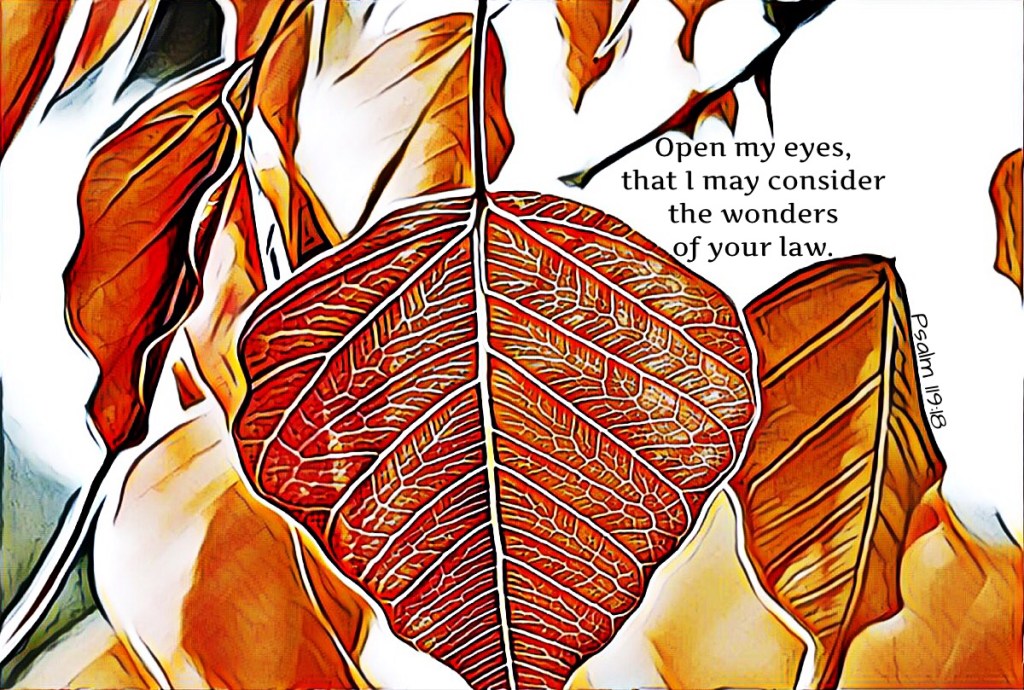
Open my eyes, that I may consider the wonders of your law.
If you would like to pray with a labyrinth, this website is a great start. The Dominican Sisters of Peace take us through praying with a “finger labyrinth”.
Poem: Excerpt from THE HOUND OF HEAVEN by Francis Thompson Here is just the beginning of Thompson’s great poem, which speaks of the “labyrinthine” ways…
I fled Him, down the nights and down the days; I fled Him, down the arches of the years; I fled Him, down the labyrinthine ways Of my own mind; and in the midst of tears I hid from Him, and under running laughter. Up vistaed hopes I sped; And shot, precipitated, Adown Titanic glooms of chasmed fears, From those strong Feet that followed, followed after. But with unhurrying chase, And unperturbéd pace, Deliberate speed, majestic instancy, They beat — and a Voice beat — More instant than the Feet 'All things betray thee, who betrayest Me'.
Music: The Peace of God – from Labyrinth by David Baloche
Today, in God’s Lavish Mercy, we pray with Psalm 146, a call to praise God. The call is supported by the particular verses of today’s reading. We should praise God, the psalmist says, because God:
secures justice for the oppressed
gives food to the hungry
sets captives free
gives sight to the blind
raises up the humble
loves the just
protects strangers
sustains fatherless and the widow
thwarts the way of the wicked
Reading this elaborate hymn of praise makes one think the Lord was pretty busy in ancient Israel. Were all these good things happening for otherwise unfortunate people?
For me, this psalm, rather than being a retrospective list of God’s generous accomplishments, is a call to realize the way God wants things to be. Within that call is another deeper call – to become an agent for God’s Will for good. In other words, God acts through us to make God’s mercy real in the world through the ways the psalm describes.
The loving will of God is always turning the world toward good. But sometimes our lack of faith inhibits our insight into that holy turning. Sometimes we see only the surface of life and get caught in its tangles.
Prayer is the ointment that releases our inner vision to find God in all things, either calling us to foster good or to thwart evil, as our psalm describes. As we cooperate with this call, God’s everlasting creative action opens before us and we see the world, and our role in it, with new eyes.
Today, in God’s Lavish Mercy, we pray with Psalm 37, a song of promise and encouragement to live a good life. Although I don’t usually choose to write a subjective reflection, a life-shaping memory keeps rising up from this psalm today.
I was nineteen years old, kneeling on an antique prie-dieu in front of the Superior General. She was about to rename me “Sister Something” for the rest of my life. You know, something like this picture – except that novice couldn’t sing quite as well as I did! 🙂
We postulants had been able to submit three suggestions, so I was expecting a name in honor of my mother or father, or my own baptismal name. How stunned was I when Mother intoned, “God bless you, Sister Mary Nathaniel”- a name I had heard maybe once in American Lit class! (You remember Hawthorne, right?)
But my shock is not the point of the story. Later, Mother took me aside and told me that she gave me the name because I reminded her of Nathaniel in the Gospel – the guileless one. Being guileless I guess, I told her I didn’t know what “guileless” meant. She said, “It means whole hearted. Be wholehearted, without pretense.”
The LORD watches over the lives of the wholehearted; their inheritance lasts forever. By the LORD are your steps made firm, as the Lord blesses your way.
Psalm 37 gave me the gift of that word, and that memory, again today. I realized that it is still taking me a lifetime to live into Mother’s long-ago challenge.
Trust in the LORD and do good, that you may dwell in the land and be fed in security. Take delight in the LORD, and God will grant you your heart’s requests.
Even though, after Vatican II, I eventually returned to my baptismal name, my heart has remained “Nathaniel”. Like the disciple under the fig tree, I am still trying to weave a true and loving life out of life’s tangled threads – still trying to do so wholeheartedly and without guile.
Gratefully and humbly, I thank God for watching over me. But God is not the only one. Mother Bernard came once more this morning, borne on memory’s beloved wing, to bless me with renewed hope and challenge.
As we pray this psalm today, let us call on the memory of those who have blessed us by their confidence and hope in us. Let us call on the God who watches over our desire to be truly wholehearted disciples.
Poem: Desiderata by Max Ehrmann (1927) – a writing I loved in my youth and have often passed on to those just beginning the glorious journey.
GO PLACIDLY amid the noise and the haste,
and remember what peace there may be in silence.
As far as possible, without surrender,
be on good terms with all persons.
Speak your truth quietly and clearly; and listen to others,
even to the dull and the ignorant; they too have their story.
Avoid loud and aggressive persons; they are vexatious to the spirit.
If you compare yourself with others, you may become vain or bitter,
for always there will be greater and lesser persons than yourself.
Enjoy your achievements as well as your plans.
Keep interested in your own career, however humble;
it is a real possession in the changing fortunes of time.
Exercise caution in your business affairs,
for the world is full of trickery.
But let this not blind you to what virtue there is;
many persons strive for high ideals,
and everywhere life is full of heroism.
Be yourself. Especially do not feign affection.
Neither be cynical about love;
for in the face of all aridity and disenchantment,
it is as perennial as the grass.
Take kindly the counsel of the years,
gracefully surrendering the things of youth.
Nurture strength of spirit to shield you in sudden misfortune.
But do not distress yourself with dark imaginings.
Many fears are born of fatigue and loneliness.
Beyond a wholesome discipline, be gentle with yourself.
You are a child of the universe no less than the trees and the stars;
you have a right to be here.
And whether or not it is clear to you,
no doubt the universe is unfolding as it should.
Therefore be at peace with God, whatever you conceive God to be.
And whatever your labors and aspirations,
in the noisy confusion of life, keep peace in your soul.
With all its sham, drudgery and broken dreams,
it is still a beautiful world.
Be cheerful. Strive to be happy.