Psalm 22: A Reverent Polity

Tuesday of the Thirty-first Week in Ordinary Time

November 3, 2020


Today, in God’s Lavish Mercy, we pray with Psalm 22, and it’s perfect for our prayer today.

I know God has no partisan interest. God’s interest is for the wholeness and blessing of God’s Creation. God’s interest is for justice and mercy for the poor, sick and suffering. God’s interest is for peace in hearts, families and nations.

All the ends of the earth
shall remember and turn to the LORD;
All the families of the nations
shall bow down before God.

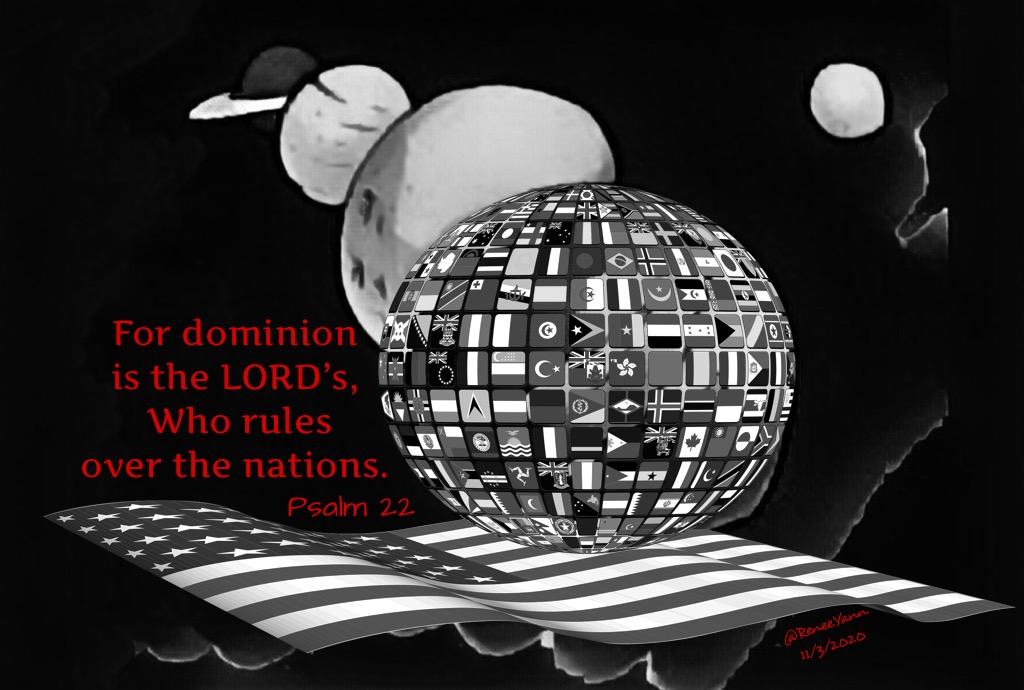
For dominion is the LORD’s,
Who rules the nations.
To God alone shall bow down
all who sleep in the earth.

To God alone my soul shall live;
my descendants shall serve God.
Let the coming generation be told of the LORD
that they may proclaim to a people yet to be born
the justice God has shown.

Psalm 22

Still, let’s put it right out there. This is no ordinary Tuesday. Personally, I have been longing – no, agonizing – for this day since November 8, 2016. What about you?

I know there are many perspectives among my readers. Democrats and Republicans. Citizens of countries other than the USA. Still, I think all of us share some common hopes for today’s election because we care about all of God’s beloved Creation.

Here are some of my hopes.

I pray for, and believe that we must demand, a President and Congress who:

  • respect, reverence and legislate for life in all its stages, colors, genders, ethnicities, and religious and political affiliations.
  • do the hard work of building bridges, not walls, throughout the world
  • respect and care about those who are poor and marginalized
  • model American compassionate leadership rather than American isolationist primacy
  • generate unity and tolerance, not fear, division and hatred
  • choose others over self, truth over manipulation, leadership over greed
  • are thoughtful, brave statesmen and stateswomen not bullies and whiners

As we pray this psalm today, may we realize that to find these virtues in our leaders, we must first practice them ourselves. In the long run, we get what we deserve. Let’s humbly pray to live in a manner that propagates and deserves selfless moral leadership.

Poetry: LET US PRAY – Sister Joan Chittister 

Give us, O God,
leaders whose hearts are large enough
to match the breadth of our own souls
and give us souls strong enough
to follow leaders of vision and wisdom.
In seeking a leader, let us seek
more than development of ourselves—
though development we hope for,
more than security for our own land—
though security we need,
more than satisfaction for our wants—
though many things we desire.

Give us the hearts to choose the leader
who will work with other leaders
to bring safety
to the whole world.

Give us leaders
who lead this nation to virtue
without seeking to impose
our kind of virtue
on the virtue of others.

Give us a government
that provides for the advancement
of this country
without taking resources from others
to achieve it.

Give us insight enough ourselves
to choose as leaders those who can tell
strength from power,
growth from greed,
leadership from dominancy,
and real greatness from the trappings of grandiosity.

We trust you, Great God,
to open our hearts to learn from those
to whom you speak in different tongues
and to respect the life and words
of those to whom you entrusted
the good of other parts of this globe.

We beg you, Great God,
give us the vision as a people
to know where global leadership truly lies
to pursue it diligently,
to require it to protect human rights
for everyone everywhere.

We ask these things, Great God,
with minds open to your eternal care.

Joan Chittister, OSB

Music: America- rendered in true American Jazz by the inimitable Ray Charles

Oh beautiful for heroes proved
In liberating strife
Who more than self, their country loved
And mercy more than life
America, America may God thy gold refine
'Til all success be nobleness
And every gain divined

And you know when I was in school
We used to sing it something like this, listen here

Oh beautiful, for spacious skies
For amber waves of grain
For purple mountain majesties
Above the fruited plain

But now wait a minute, I'm talking about
America, sweet America
You know, God done shed his grace on thee
He crowned thy good, yes he did, in brotherhood
From sea to shining sea

You know, I wish I had somebody to help me sing this
(America, America, God shed his grace on thee)
America, I love you America, you see
My God he done shed his grace on thee
And you oughta love him for it
'Cause he, he, he, he crowned thy good
He told me he would, with brotherhood
(From sea to shining Sea)
Oh Lord, oh Lord, I thank you Lord
(Shining sea)

Psalm 18: I Love You, Lord

Thirtieth Sunday in Ordinary Time

October 25, 2020


Today, in God’s Lavish Mercy, we pray with Psalm 18

I love you, O LORD, my strength,
O LORD, my rock, my fortress, my deliverer.

Psalm 18: 2-3

The psalm is almost a mirror reflection of 2 Samuel 22, and has been interpreted as a song that David sang throughout his life to praise God’s goodness to him.


Today the psalm connects several readings, which together give us:

  • a command 
  • and a hint about how to fulfill that command. 

Bottom line, our readings tell us this:

  • First, Love God
  • And, second, here’s where to find the God you desire to love.

If we trust the hint, and act on the command,
we will be able to sing – like David –
throughout our lives. 

"You shall love the Lord, your God,
with all your heart,
with all your soul,
and with all your mind.
This is the greatest and the first commandment.
The second is like it:
You shall love your neighbor as yourself. 

Here is a beautiful poetic interpretation of Psalm 18:

I open my heart to you, O God
  for you are my strength, my fortress, 
  the rock on whom I build my life.
I have been lost in my fears and my angers
   caught up in falseness, fearful, and furious.
I cried to you in my anguish.
You have brought me to an open space.
   You saved me because you took delight in me.

I try to be good, to be just, to be generous
   to walk in your ways.
I fail, but you are my lamp.
  You make my darkness bright
With your help, I continue to scale the walls
  and break down the barriers that fragment me.
I would be whole, and happy, and wise
  and know your love
Always.
~ Christine Robinson

Music: Overcome – Psalm 18 by James Block

Psalm 24: God’s Face

Friday of the Twenty-ninth Week in Ordinary Time

October 23, 2020


Today, in God’s Lavish Mercy, we pray with Psalm 24 which has been described as “an entrance psalm” for the Temple liturgies.

Praying Psalm 24 invites us to consider how we enter and meet God in the Holy Space of our lives. 

That space, first of all, belongs to God Who created all things. We do not create it. God opens it.

The LORD’s are the earth and its fullness;
the world and those who dwell in it.
For the Lord founded it upon the seas
and established it upon the rivers.

Psalm 24: 1-2

Everything within us and around us — that “fullness” of life — belongs to God. When we acknowledge this truth in humble faith and loving awareness, we realize that we already exist within God’s sanctuary:

Who can ascend the mountain of the LORD?
or who may stand in his holy place?
The one whose hands are sinless, whose heart  is clean,
who desires not what is vain.

Psalm 24: 3-4

The journey of the spiritual life is about finding that still point in our souls where we see God’s Face in all things. That sacred stillness holds us in God’s Presence until we let go of ourselves within that Love. The Lord blesses that letting go with a “reward”:

That person shall receive a blessing from the LORD,
a reward from God the savior.
Such is the race that seeks the Lord,
that seeks the face of the God of Jacob.

Psalm 24: 5-6

The psalm doesn’t clearly state what that “reward” is, but I think it might be the grace, insight, passion, and courage to live as Paul describes in our first reading:

to live in a manner worthy of the call you have received,
with all humility and gentleness, with patience,
bearing with one another through love,
striving to preserve the unity of the spirit
through the bond of peace;  
one Body and one Spirit,
as you were also called to the one hope of your call;
one Lord, one faith, one baptism;
one God and Father of all,
who is over all and through all and in all.

Poem: The light shouts in your tree-top, and the face
— Rainer Maria Rilke, Poems from the Book of Hours

The light shouts in your tree-top, and the face
of all things becomes radiant and vain;
only at dusk do they find you again.
The twilight hour, the tenderness of space,
lays on a thousand heads a thousand hands,
and strangeness grows devout where they have lain.
With this gentlest of gestures you would hold
the world, thus only and not otherwise.
You lean from out its skies to capture earth,
and feel it underneath your mantle’s folds.
You have so mild a way of being.
……………………………………………They
who name you loudly when they come to pray
forget your nearness. From your hands that tower
above us, mountainously, lo, there soars,
to give the law whereby our senses live,
dark-browed, your wordless power.

Music: I Have Loved You – Michael Joncas 

I Have Loved You

I have loved you with an everlasting love, I have called you and you are mine;
I have loved you with an everlasting love, I have called you and you are mine.
Seek the face of the Lord and long for him: He will bring you his light and his peace.

I have loved you with an everlasting love, I have called you and you are mine;
I have loved you with an everlasting love, I have called you and you are mine.
Seek the face of the Lord and long for him: He will bring you his joy and his hope.

I have loved you with an everlasting love, I have called you and you are mine;
I have loved you with an everlasting love, I have called you and you are mine.
Seek the face of the Lord and long for him: He will bring you his care and his love.

I have loved you with an everlasting love, I have called you and you are mine;
I have loved you with an everlasting love, I have called you and you are mine.

Psalm 105: God at the Center

Saturday of the Twenty-seventh Week in Ordinary Time

October 10, 2020


Today, in God’s Lavish Mercy, we pray with Psalm 105, a recounting of the marvelous works God has done from the Abrahamic covenant to the Exodus.

Sing to God, sing praise,
proclaim all God’s wondrous deeds.
Glory in the Holy Name;
rejoice, O hearts that seek the LORD!

Psalm 105: 2-3

Our psalm today enjoins us to remember God’s faithful mercy to us and to praise God as we remember.

Such sacred “remembering” is an act of radical faith which, first, recognizes God as the Center of our life, and second, acts from that radical awareness.


The word “obedience”, so commonly misconstrued as subservience, is another way of describing this radical faith which hears, listens, acknowledges, responds and centers itself on the voice of God. The word “obedience” comes from the same root as the word “listen”.

This freely-given and continually deepened obedience allows us to hear and discern the loving truth God weaves through our lives.

The counter-world of the Psalms contradicts our closely held world of amnesia and mediates to us a world of lively remembering….
… In Psalm 105, a long recital of the great deeds climaxes, “in order that they might keep his statutes and observe his laws” (v. 45). The purpose of remembering is thus to evoke a contemporary practice of obedience in the wake of the memory. The implied negative is that when the inventory of miracles is forgotten, there will be no contemporary obedience .

Walter Brueggemann, From Whom No Secrets Are Hid

In the encyclical Fratelli Tutti, Pope Francis points out how this obedience, (this holy remembering, listening and acting), is tied to the course of human affairs. Francis quotes JPII here:

In this regard, I wish to cite the following memorable statement: “If there is no transcendent truth, in obedience to which the human person achieves full identity, then there is no sure principle for guaranteeing just relations between people. Their self-interest as a class, group or nation would inevitably set them in opposition to one another. If one does not acknowledge transcendent truth, then the force of power takes over, and each person tends to make full use of the means at their disposal in order to impose personal interests or opinion, with no regard for the rights of others… The root of modern totalitarianism is to be found in the denial of the transcendent dignity of the human person who, as the visible image of the invisible God, is therefore by very nature the subject of rights that no one may violate – no individual, group, class, nation or state.

St. John Paul II, Encyclical Letter Centesimus Annus (1 May 1991)

Rootedness in this “remembering obedience” begins with each person’s own sincere prayer. With the psalmist, let us remember God’s loving fidelity to us and, in grateful response, live that Love faithfully into our conflicted world:

Look to the LORD’s strength;
seek to serve the Lord constantly.
Recall the wondrous deeds that God has wrought,
the signs, and the graces God has spoken in your life.

Psalm 105: 4-5

Poem: Called to Become – Edwina Gateley

You are called to become
A perfect creation.
No one else is called to become
Who you are called to be.
It does not matter
How short or tall
Or thick-set or slow
You may be.
It does not matter
Whether you sparkle with life
Or are as silent as a still pool.
Whether you sing your song aloud
Or weep alone in darkness.
It does not matter
Whether you feel loved and admired
Or unloved and alone
For you are called to become
A perfect creation.
No one's shadow
Should cloud your becoming.
No one's light
Should dispel your spark.
For the Lord delights in you.
Jealously looks upon you
And encourages with gentle joy
Every movement of the Spirit
Within you.
Unique and loved you stand.
Beautiful or stunted in your growth
But never without hope and life.
For you are called to become
A perfect creation.
This becoming may be
Gentle or harsh.
Subtle or violent.
But it never ceases.
Never pauses or hesitates.
Only is—
Creative force—
Calling you
Calling you to become
A perfect creation.

Music: Psalm 105 – Give Thanks – Sean Dayton

The Benedictus

Thursday of the Twenty-seventh Week in Ordinary Time

October 8, 2020


Today, in God’s Lavish Mercy, for our Responsorial, we pray with a passage from Luke’s Gospel. This passage is known as the Benedictus or Canticle of Zechariah. It is one of three canticles in the first two chapters of Luke, the others being the Magnificat and the Nunc Dimittis. The Angelic Hymn is often considered a fourth.


At the Wednesday General Audiences given by the Pope, a theme is chosen for “catechesis” or teaching. From October 2001 until February 2006, Popes John Paul II and Benedict XVI gave their teachings based on the Psalms. JPII closed the first section of these audiences with these words:

“Our commentary on the Psalms and canticles from Morning Prayer concludes today with the Canticle of Zechariah, commonly known as the Benedictus. It is a prophetic canticle, in which the father of John the Baptist, indicates three events in God’s liberation of Israel: the covenant with Abraham, the covenant with David, and the new covenant with Christ. Like the “dawn from on high,” Christ gives light and guides us into the way of peace.”

Wednesday General Audience, October 1, 2003

As we pray with the hope-filled verses of the Benedictus, we pray in a world still seeking the fullness of that Dawn of Tender Mercy …

… the tender mercy of our God
by which the daybreak from on high will visit us
to shine on those who sit in darkness and death’s shadow,
to guide our feet into the path of peace.


Pope Francis’s closing prayer in Fratelli Tutti reflects the same hope as his predecessors for that universal Dawn, that rising of Love in our hearts.

O God, Trinity of love,
from the profound communion 
of your divine life, 
pour out upon us a torrent 
of fraternal love.

Grant us the love reflected 
in the actions of Jesus, 
in his family of Nazareth,
and in the early Christian community.

Grant that we Christians 
may live the Gospel, 
discovering Christ in each human being, 
recognizing him crucified
in the sufferings of the abandoned
and forgotten of our world,
and risen in each brother or sister 
who makes a new start.

Come, Holy Spirit, 
show us your beauty, 
reflected in all the peoples of the earth,
so that we may discover anew
that all are important 
and all are necessary, 
different faces of the one humanity
that God so loves. Amen.

Music: A Mass for Peace: Benedictus- Karl Jenkins 

Psalm 118:

Thursday of the Twenty-fourth Week in Ordinary Time

Thursday, September 17, 2020


Today, in God’s Lavish Mercy, we pray with Psalm 118 (Confitemini Domino), part of the Hallel. Hallel consists of six Psalms (113–118), which are recited as a unit, on joyous occasions such as Passover.

This joy arises from the core belief
and experiential evidence that
 “God’s Mercy endures forever”.

Give thanks to the LORD, Who is good,
Whose mercy endures forever.
Let the house of Israel say,
“God’s mercy endures forever.”

Psalm 118: 1-2

Looking at the entire psalm, we see the prayer of a person delivered from enemies, one who has taken refuge in the Lord. And the Lord has responded both in protection and abiding relationship.


Our Gospel story of the woman with the alabaster jar reiterates this theme. Surely this woman is beset by enemies, both within and without. Ultimately, grace moves her to take refuge at the feet of Jesus’s Mercy. She does this by breaking through any inhibiting tradition in order to offer Jesus her own intimate act of tenderness. Moved, Jesus reciprocates.

As we seek to be fully embraced in God’s Lavish Mercy, what “ointments”, held too long, must we pour out to God. What illusions do we cling to convincing us we have no need for repentance, forgiveness, transformation?

What little jars of selfishness, pride, or arrogance keep us from fully giving and receiving Mercy?

In my distress, I poured my heart out to the LORD;
the LORD answered me and set me free.
The LORD is with me now, I am not afraid;
darkness has no power against me.

Psalm 118: 13-14

Poem: Mended by Annie Villiers

Invisible mending
This is the place where souls come
To be mended                               where
Tatty ends of unfinished business
Or business                              unravelled
Are drawn together and tenderly
Made new.
Nimble stitches
Seen                           only by the weaver
Whose loving                                 fingers
Repair the frangible fabric of lives.


Music: Confitemini Domino – Taize Community

Confitemini Domino, quoniam bonus, 
quoniam in sæculum misericordia ejus.

O give thanks unto the Lord, for he is gracious,
because his mercy endureth for ever.

Psalm 103: Be Like God

Twenty-fourth Sunday in Ordinary Time

Sunday, September 13, 2020

Today, in God’s Lavish Mercy, we pray with Psalm 103, and its gentle comforting refrain:

The Lord is kind and merciful, 
slow to anger, and rich in compassion.


Our Sunday readings encourage to become like this merciful, forgiving, patient, compassionate Lord.

I’m not doing so well at that. Anybody else with me? Sometimes I feel like we’re living in a desert devoid of humanness and reverence.

Somehow, in our current political and cultural environment, too often I feel angry and even outraged. Those kinds of feelings don’t leave much room for compassion and its accompanying virtues!


Recently I witnessed two wonderful friends openly spat on social media because of their opposing political camps. I’ve seen family members shut each other out for the same reasons. We can’t turn on the TV without seeing a barrage of hateful words and actions unleashed against other human beings.

I feel poisoned and sick when I see the culture we have brewed for ourselves!


In our first reading, Sirach seems to have felt pretty sickened by his environment too. He counsels his listeners:

Forgive your neighbor’s injustice;
then when you pray, your own sins will be forgiven.
Could anyone nourish anger against another
and expect healing from the LORD?


Paul, in our second reading, tells us why we should change our hateful behavior:

None of us lives for oneself, and no one dies for oneself.
For if we live, we live for the Lord,
and if we die, we die for the Lord;
so then, whether we live or die, we are the Lord’s.


In our Gospel, Jesus uses a stunning parable to drive home the commandment for forgiveness. I don’t think any of us really wants to end up like the selfish, wicked servant – handed over to the torture of our own hatreds.

This Sunday’s readings are serious. They’re not kidding. We have to change any sinful incivility or hate that resides in our hearts. We may not be able to change our feelings. But we can stop feeding them with lies, propaganda, and conspiracy theories.

What we can change are our actions and words. And we must.


Poetry: Love my enemies, enemy my love by Rebecca Seiferle

Oh, we fear our enemy’s mind, the shape
in his thought that resembles the cripple
in our own, for it’s not just his fear
we fear, but his love and his paradise
.
We fear he will deprive us of our peace
of mind, and, fearing this, are thus deprived,
so we must go to war, to be free of this
terror, this unremitting fear, that he might

he might, he might. Oh it’s hard to say
what he might do or feel or think.
Except all that we cannot bear of
feeling or thinking—so his might

must be met with might of armor
and of intent—informed by all the hunker
down within the bunker of ourselves.
How does he love? and eat? and drink?

He must be all strategy or some sick lie.
How can reason unlock such a door,
for we bar it too with friends and lovers,
in waking hours, on ordinary days?

Finding the other so senseless and unknown,
we go to war to feel free of the fear
of our own minds, and so come
to ruin in our hearts of ordinary days.

Music: Kyrie Eleison – Lord, have Mercy

This is an extended, meditative singing of the prayer. I like to listen to it in the very early morning. Just doing that is a good prayer for me.

Psalm 45: God Longs for Us

Wednesday, September 9, 2020

Today, in God’s Lavish Mercy, we pray with Psalm 45 which scripture scholars interpret as a Davidic wedding song. Many believe it refers to the marriage of a king to the daughter of a royal foreign house.

The psalm is set today between two powerful readings. 

In our first reading, Paul gives an extended opinion piece on celibacy and marriage, a reading which has spawned countless academic interpretations. Our Gospel, pivotal to our understanding of holiness, also has generated abundant scholarly commentary.

We may finish today’s readings wondering who must I be to become the person God wants me to be? Celibate? Poor? Hungry? Sorrowful? Persecuted?  Like Francis Thompson in his famous poem, The Hound of Heaven, we may feel pursued by a God we might rather ignore!

For, though I knew His love Who followèd, 
        Yet was I sore adread 
Lest, having Him, I must have naught beside

Indeed, the answer is not simple. Each person’s path to God’s heart is different. The readings don’t give us a foolproof map. Instead, they give us prompts about where we might go off the path.

In other words, the readings spread the stars across our heavens. But we must find our own bearings in life to allow us to continually deepen our relationship with God. If our current circumstances and choices prevent that in any way, we must reorient ourselves.


For me the lesson is this. God desires our complete love and worship. God wants to be the center of our lives. That’s why we exist. All the rest is incidental.

Our psalm captures it in this way:

Hear, my child, and see; turn your ear,
forget those things to which you are accustomed.
So shall the Lord desire your full commitment;
the Lord Whom you must worship with your life.


Our Gospel is uncompromising in its warning that obsession with material goods, personal comfort, and selfish success blocks our awareness of how distant we can grow from God:

But woe to you who are rich,
for you have received your consolation.
But woe to you who are filled now,
for you will be hungry.
Woe to you who laugh now,
for you will grieve and weep.
Woe to you when all speak well of you,
for their ancestors treated the false 
prophets in this way.


We are blessed if we are free of these woes, but it is hard in a culture spiritually crippled by these obsessions.

Psalm 45 calls us to “bend our ear” toward God’s invitation. By sincere prayer and loving vigilance, we can hear the Divine whisper within our circumstances, leading us to fullness of life with God. We will recognize it by this: it always calls us to justice, mercy, and charity.

You love justice and hate wrongdoing;
therefore God, your God, has anointed you
with the oil of gladness above your peers.


Poetry: Excerpt from The Hound of Heaven by Francis Thompson

( It’s a little “frilly” with early 20th century Romanticism, but – oh my! – some of its lines get burned into the memory!)

I fled Him, down the nights and down the days; 
I fled Him, down the arches of the years; 
I fled Him, down the labyrinthine ways 
Of my own mind; and in the mist of tears 
I hid from Him, and under running laughter. 
Up vistaed hopes I sped; 
And shot, precipitated, 
Adown Titanic glooms of chasmèd fears, 
From those strong Feet that followed, followed after. 
But with unhurrying chase, 
And unperturbèd pace, 
Deliberate speed, majestic instancy, 
They beat—and a Voice beat 
More instant than the Feet— 
‘All things betray thee, who betrayest Me.’ 

Music: I Long for You – Ro Atilano

Psalm 63: The Longing

Twenty-second Sunday in Ordinary Time

August 30, 2020

Today, in God’s Lavish Mercy, we pray with the magnificent Psalm 63 which captures the soul’s deep longing for God.

It is a longing that, once released in the heart, must be satisfied.


In our first reading, Jeremiah experiences it akin to an addiction, the power of it consuming his life:

I say to myself, I will not mention him,
I will speak in his name no more.
But then it becomes like fire burning in my heart,
imprisoned in my bones;
I grow weary holding it in, I cannot endure it.

Jeremiah 20:9

Paul, in his letter to the Romans, says not to resist the longing, but to let ourselves be consumed by it like a sacrificial offering:

I urge you, brothers and sisters, by the mercies of God,
to offer your bodies as a living sacrifice,
holy and pleasing to God, your spiritual worship. 

Romans 12:1

Jesus, in our Gospel, is the One who surrenders himself fully to that holy longing. He calls us to imitate him:

For whoever wishes to save his life will lose it,
but whoever loses his life for my sake will find it.


These are profound readings calling us a place that words cannot describe, a place where the Cross intersects with the truth of our lives. May we have the grace to hear and believe.


Poetry: The Longing – Rumi

There is a candle in your heart,
ready to be kindled.
There is a void in your soul,
ready to be filled.

You feel it, don't you?
You feel the separation
from the Beloved.

Invite Love to quench you,
embrace the fire.

Remind those who tell you otherwise that 
Love
comes to you of its own accord, 
and the longing for it cannot be learned in any school.

Music: The Prayer – Montserrat Cabalé

Psalm 51: Begin Again

Memorial of Saint Bernard, Abbot and Doctor of the Church

August 20, 2020

Today, in God’s Lavish Mercy, we pray with Psalm 51 in which God promises refreshment to our parched and hardened hearts.


Let’s talk about “parched”. Early in the pandemic, a dear friend gifted us with a vigorous basil plant. A practical culinary addition to our meager garden, it really was so much more. It became a symbol of hope over these pandemic days that can be cloudy in more than meteorological terms!

I have taken good care of the plant. But last week! I got distracted by something., something so important I have forgotten what it was! In my distraction, my little basil became parched.


Our souls become parched too, often because we let ourselves become distracted from their care. Like beautiful plants, our spirits have to be tended daily, nurtured with prayer, silence, gratitude and charity.

Psalm 51 reminds me that God is patient with our “distractions”. God will refresh and renew even the most neglected garden.

Give me back the joy of your salvation,
and a willing spirit sustain in me.


Our first reading from Ezekiel offers a further encouragement that anything gnarled or hardened in our hearts can be resurrected by God’s Mercy.

I will sprinkle clean water upon you
to cleanse you from all your impurities,
and from all your idols I will cleanse you.
I will give you a new heart and place a new spirit within you,
taking from your bodies your stony hearts


Poetry: Houseplants in Winter by Eamon Grennan

Their survival seems an open question:
I make a mess of watering, prune
without discretion, grieve over the leaf
whose borders burn and curl. Their
fresh petals a perpetual surprise – 
minute coral hearts, magnesium stars. 

I've lined them up on the table
I work and eat at, facing the small window
that faces almost south, placing myself
under the pale sway of their silence.
They play their deaths and resurrections out
in our cramped common quarters.

I gave the rose-geranium too much water:
its roots grew bog-black, sodden, and
nothing could keep its sweetness
in our lives. The jade, for all its
early promise and parakeet-green shoots,
won't root: it bows its leathery heads. 

The rest seem busy getting by. Removed
to the margins of our noisy mealtimes
when my children visit, they grow used
to the smell of bread frying in goosefat
for breakfast, small talk, the after-
dinner pungency of a peeled tangerine.

The speechless life they lead is Greek
to me: when live flowers rise
out of dead heads, I reckon it's as much,
for the moment, as I need to know.
The light that falls on them
strikes me too, till I feel as rooted

as I'll ever be in this home
from home. Look at us, they seem to say,
flourishing under straitened circumstances:
you see we make do with your handfuls
of earth, your cups of water, these daily
visitations of winter light that cast our
impeccable shadows on your razed page.

Music: Psalm 51 – Shuv Creative
from their website: This worship video sung in Biblical Hebrew directly from the Scriptures is a powerful tool to open the heart for repentance.