Hot Potato Psalm

Tuesday of the Twentieth Week in Ordinary Time

August 18, 2020


Today, in God’s Lavish Mercy, we pray with a little more Deuteronomy. Coupled once again with Ezekiel’s excoriations and with the Gospel warnings, today’s Responsorial Psalm is a hot potato!

To tell you the truth, I’ve pretty much had enough of it, but I trust there’s a treasure buried in its hard words.

You will come to appreciate the full force & magnetic beauty of Deuteronomy only as you read its pages….Nothing in literature matches the majesty of its eloquence. Nothing in the Old Testament has any more powerful appeal for the spiritual life. No book in all the Word of God pictures better the life that is lived according to God’s will & the blessings showered upon the soul who comes into the richness & fullness of spiritual living along the rugged pathway of simple obedience…If you want a taste of heaven on earth, become familiar with Deuteronomy.

Henrietta Mears in her book “What the Bible Is All About” (over 3 million copies sold)

Taken together, today’s passages remind me that it is so easy to get full of ourselves and our comforts, ultimately forgetting our dependence on God.

Ezekiel gives this divine judgement to the people:

By your wisdom and your intelligence
you have made riches for yourself;
You have put gold and silver
into your treasuries.
By your great wisdom applied to your trading
you have heaped up your riches;
your heart has grown haughty from your riches–
therefore thus says the Lord GOD:
Because you have thought yourself
to have the mind of a god,
Therefore I will bring against you
foreigners, the most barbarous of nations.


Deuteronomy 32 warns us:

You were unmindful of the Rock that begot you,
you forgot the God who gave you birth.
The LORD saw and was filled with loathing,
provoked by his sons and daughters.


And in our Gospel, Jesus gives us that classic zing which makes all of us wonder if we’re sleek enough to be saved:

Again I say to you,
it is easier for a camel to pass through the eye of a needle
than for one who is rich to enter the Kingdom of God


I don’t think we need a road map to find the message in these readings. God wants to be our one, true God. The love of wealth, power, and self obscures that Truth. It can even fool us into thinking that we are like gods in control of our lives.

The corrective, as our Alleluia Verse indicates, is to imitate Jesus:

Jesus Christ became poor although he was rich
So that by his poverty you might become rich as he is.


Poetry: Salvation by Stephen Dunn

Finally, I gave up on obeisance,
and refused to welcome
either retribution or the tease
of sunny days. As for the can’t-be-
seen, the sum-of-all-details,
the One—oh, when it came
to salvation I was only sure
I needed to be spared
someone else’s version of it.
The small prayers I devised
had in them the hard sounds
of split and frost.
I wanted them to speak
as if it made sense to speak
to what isn’t there
in the beaconless dark.
I wanted them to startle
by how little they asked.

Music: My Own Little World – Matthew West

Moses’ Psalm: Light and Dark

Monday of the Twentieth Week in Ordinary Time

August 17, 2020

Today, in God’s Lavish Mercy, we pray once again with Deuteronomy 32, the Psalm of Moses. Today’s verses describe an angry God who decides to take vengeance a faithless people. 

To pray with these verses is not easy. Taken in isolation, they paint a God who contradicts our larger experience of mercy and tenderness. But the Psalm, like the jarring first reading from Ezekiel, has a lesson for us.

Ezekiel from Biblical Images by James Padgett

In that reading, Ezekiel suffers the sudden death of his beloved wife. The experience opens his prophetic spirit to more fully understand God’s relationship with Israel. He allows his life to be a witness for the people that God expects their repentance and faithfulness.

Like many Old Testament readings, these portray God by way of human analogy because that is the only context we have available to us. Therefore, the temptation when reading these passages might be to think of God solely in human terms playing tit-for-tat with us when we stray from the Law. But God is infinitely greater than any capacity we, or the scripture writers, have to describe Divinity.


The narrative provided by this prophetic book is not one of comfort; its merciless accusations and its violent imagery do not make it an easy scroll to swallow (Ezek 2:8–3:3). While much of Ezekiel’s language, imagery, and reasoning will appear foreign to modern readers, his narrative would have been clearly intelligible to his contemporaries—even though presumably it would have been hard to accept. The exile, according to this narrative, is both inevitable and deserved; it is portrayed as God’s judgement for the constant and complete failure of God’s people.

At the same time, it is not God’s last word. While resisting both optimism and despair, Ezekiel offers a narrative that sheds light on his present and arrives at an original, if peculiar, imagination of hope, founded solely on theological conviction.

Janina M. Hiebel – Hope in Exile: In Conversation with Ezekiel

So then, what might we take from today’s dark readings? For me, it is this:

God is always Light.
It is we who get caught in darkness.


God does speak to us in our circumstances, as God did to Ezekiel and Moses. By faithful prayer and sincere desire, we can deepen in our love and understanding of God through every experience of our lives, even the painful ones. When we live with that kind of faith and hope, our lives witness to God’s fidelity and love.


Poetry: two offerings today

Motto – Bertold Brecht

In the dark times 
Will there also be singing? 
Yes, there will also be singing.
About the dark times.

Light – Alice Jones

The morning when I first notice
the leaves starting to color,
early orange, and back-lit,
I think how rapture doesn't
vanish, merely fades into
the background, waits for those
moment between moments.

I think this and the door pens,
the street takes on its glistening
look, Bay fog lifting, patches of sun
on sycamore -- yellow sea.
I am in again, and swimming.

Music: Lavender Shadows – Michael Hoppé

Psalm 67: Bless Us All!

Twentieth Sunday in Ordinary Time
August 16, 2020

Today, in Mercy, we read the story of the Canaanite woman whom Jesus first meets with a sarcastic banter. The banter however serves to expose some of the alienating prejudices of Jesus’s time which he then dissolves in a sweeping act of mercy and inclusion. His actions signify a new culture of divine justice offered to all people. The reading challenges us to confront our own prejudices and any limitations we place on who belongs to the Kingdom of God.

from this Sunday’s Reflection – 2017

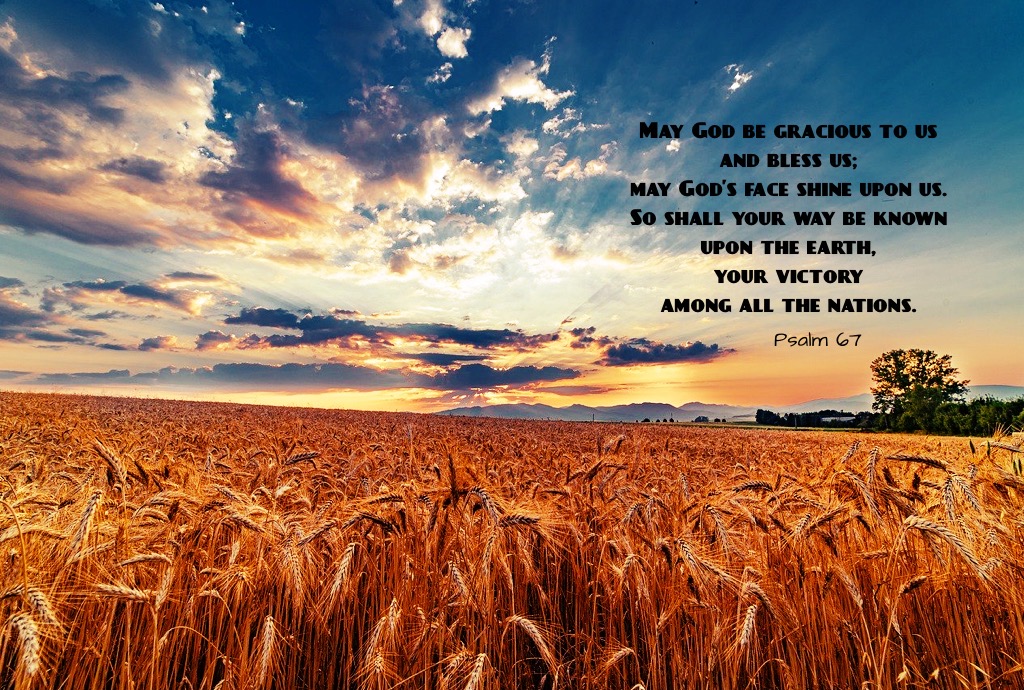
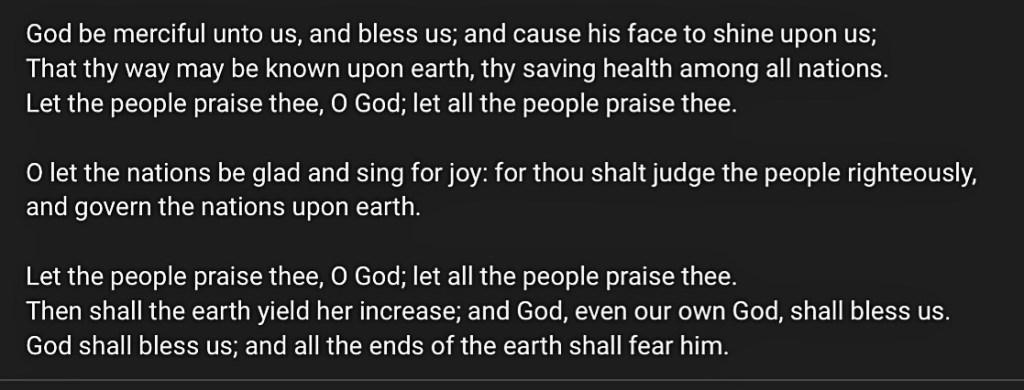
Today, in God’s Lavish Mercy, we pray with Psalm 67, a call to God for universal blessing on all Creation. Written to invoke a benediction on the land’s harvest, the Psalm blossoms into a generous prayer for the whole world to bask in God’s abundance.

May the nations be glad and rejoice;
for you judge the peoples with fairness,
you guide the nations upon the earth.

What if we prayed like that for all our brothers and sisters worldwide! What if we acted toward them with a justice that would make their abundance possible as well as our own! This is the Gospel mandate Jesus entrusted to us.

Psalm 67 shows the maturing of a nation from its own legitimate self-interests into its responsibility within all Creation.


In the USA, as our pre-election political awareness heightens, let’s learn from Psalm 67. Let’s broadly educate ourselves to the fundamental moral issues underlying various partisan platforms. 

For a religious person, voting is hard. There are profound moral issues on all sides of the question. A single issue approach does not work. An adamant stance on a single issue is the easy but inadequate approach. 


Even Jesus, in today’s Gospel, can be moved to a new way of thinking. The outcast Canaanite woman prevails on Jesus to broaden his kingdom. He opens his heart to another way of bringing mercy to all those longing for it.


Voting is a moral act. How we choose demonstrates the God we believe in.


May the peoples praise you, God;
may ALL the peoples praise you!


Poetry: Selah by Honoreé Fannane Jeffers

“The past few weeks were very hopeful for me, as an African-American. I saw images of young Black people out in the streets protesting, to make this country a better place. As an older person who stayed inside while these young folks put their bodies on the line, I wanted to celebrate them. I wrote this poem as a spiritual exaltation of Black faith, that our hoped-for change for our country is coming.”

Honoreé Fanonne Jeffers

Selah
after Margaret Walker’s “For My People”


The Lord clings to my hands
             after a night of shouting. 
                           The Lord stands on my roof 
             & sleeps in my bed. 
Sings the darkened, Egun tunnel— 
             cooks my food in abundance, 
                           though I was once foolish 
             & wished for an emptied stomach. 
The Lord drapes me with rolls of fat 
             & plaits my hair with sanity. 
                           Gives me air, 
             music from unremembered fever. 
This air
                            oh that i may give air to my people 
                            oh interruption of murder 
                                         the welcome Selah
The Lord is a green, Tubman escape. 
             A street buzzing with concern, 
                           minds discarding answers. 
             Black feet on a centuries-long journey.
The Lord is the dead one scratching my face, 
             pinching me in dreams. 
                           The screaming of the little girl that I was, 
             the rocking of the little girl that I was— 
the sweet hush of her healing. 
             Her syllables 
                           skipping on homesick pink. 
             I pray to my God of confused love, 
a toe touching blood 
             & swimming through Moses-water. 
                           A cloth & wise rocking. 
             An eventual Passover, 
outlined skeletons will sing 
             this day of air 
                           for my people—
                                         oh the roar of God 
                                         oh our prophesied walking

Music: Charles Ives – Psalm 67

Psalm 78: It’s Harsh

Thursday of the Nineteenth Week in Ordinary Time

August 13, 2020

Today, in God’s Lavish Mercy, we pray with Psalm 78, one of the twelve “Psalms of Asaph”. These psalms have a common theme of God’s judgement relative to Israel’s faithlessness to the Law.

Psalm 78 is the second longest psalm, the whole of which reads a lot like a history lesson. It recounts God’s enduring faithfulness even in the face of Israel’s fickleness.

They tempted and rebelled against God the Most High,
and kept not his decrees.
They turned back and were faithless like their fathers;
they recoiled like a treacherous bow.


The psalm fits well with today’s readings. Poor Ezekiel is commanded by God to act out the impending Assyrian devastation of the kingdom. He has to pack up, dig through a wall, hide his face, and escape into the night — just as Israel will have to do when the conquerors besiege them. All this, because God is passing judgement on Israel’s infidelities and God wants them to recognize it.

They angered him with their high places
and with their idols roused his jealousy.
God heard and was enraged
and utterly rejected Israel.


Psalm 78 remembers this history and retells it for the instruction of the generations. It is a reminiscence not unlike one that we all practice, I think.

Sometimes, especially in prayer or retreat, don’t we look back over our lives to rediscover how God was with us even in difficulty and darkness? Even in our poorest choices and most stupid sins? Aren’t we gratefully surprised that God’s Mercy was the ultimate fruit of such trials? When we face new challenges, don’t we remind ourselves of these things for the sake of our future courage and hope?

That’s what Psalm 78 is doing. Israel messed up, suffered judgement, and was made new in Mercy. The psalmist wants future generations never to forget.


Each of us, both as individuals and within our communities, experience such cycles of sin and redemption. Each turn should make us stronger, grateful, more faithful. Our witness to God’s abiding mercy should be shared for the sake of the generations… our personal Psalm 78 – written not in words, but in the fidelity of our lives.

Psalm 78 is not pretty or easy. Life isn’t always that way either. In our Gospel, Jesus assures us that God is a generous Creator who wants to redeem us in Mercy. But we have to do our part too, or we could wind up like the unfaithful servant – defeated by our own selfish choices.


Poetry: Mercy by David Baker

Small flames afloat in blue duskfall, beneath trees
anonymous and hooded, the solemn trees—by ones
and twos and threes we go down to the water's level edge
with our candles cupped and melted into little pie-tins
to set our newest loss free. Everyone is here.

Everyone is wholly quiet in the river's hush and appropriate dark.
The tenuous fires slip from our palms and seem to settle
in the stilling water, but then float, ever so slowly,
in a loose string like a necklace's pearls spilled,
down the river barely as wide as a dusty road.

No one is singing, and no one leaves—we stand back
beneath the grieving trees on both banks, bowed but watching,
as our tiny boats pass like a long history of moons
reflected, or like notes in an elder's hymn, or like us,
death after death, around the far, awakening bend.

Music:  Mercy – Amanda Cook

Moses’s Psalm: Dark to Light

Friday of the Eighteenth Week in Ordinary Time

August 7, 2020

Today, in God’s Lavish Mercy, we pray once again with Deuteronomy 32, often referred to as the Psalm of Moses. And once again, our psalm links the heavy messages of our two main readings.

In our first reading from Nahum, the prophet describes Israel’s future restoration after the bloody destruction of Nineveh, chief city of the Assyrian conquerors.

In our Gospel, Jesus foretells his own Passion and Death, and the necessity that his disciples carry their own crosses.

The tenor of both readings is soberly captured in our psalm:

Learn then that I, I alone, am God,
and there is no god besides me.
It is I who bring both death and life,
I who inflict wounds and heal them.


Given the heavy, stormy morning here where I live, these readings are hitting me like a wet blanket! It’s hard to find the link to Light within them, but I believe there always is one – and I’ll suggest one subsequently. But first this.

Often in life, too, it’s hard to find the link to light. Harsh and insufferable realities can stubbornly darken our horizons.

Just this morning, I read about a podcast in which Michelle Obama had revealed a struggle with depression:

“These are not, they are not fulfilling times, spiritually,” Mrs Obama said. “I know that I am dealing with some form of low-grade depression. Not just because of the quarantine, but because of the racial strife, and just seeing this administration, watching the hypocrisy of it, day in and day out, is dispiriting.”


Mrs. Obama is describing her “Nineveh”.  Mine is pretty similar. What’s yours?
And how do we hold faith, even in the middle of “Nineveh”?

These assuring verses from Nahum offer the flicker of Light and the promise of Salvation. They encourage us to stay strong, remain faithful. We must keep lifting our eyes to the future that God dreams for all people, discerning its rising like the sun in a morning mist.

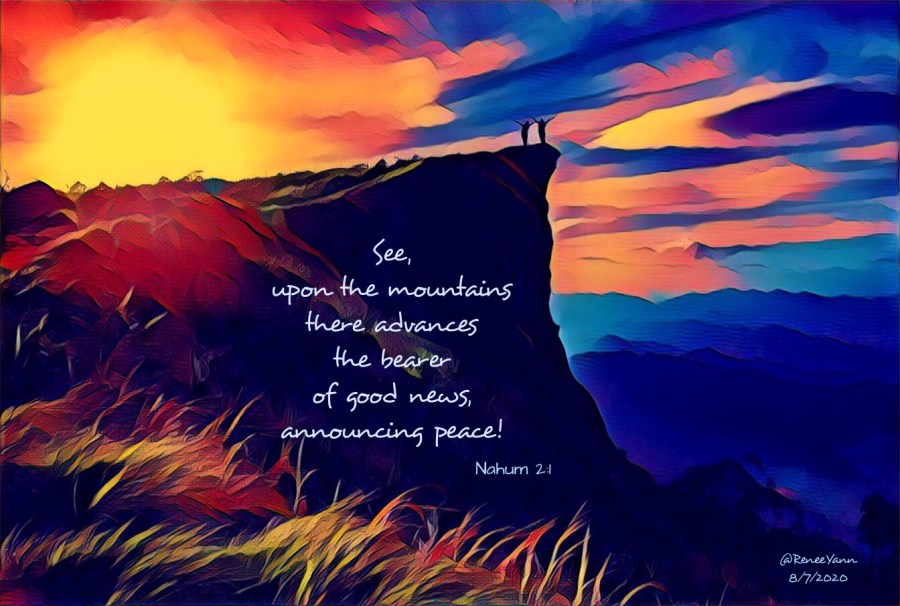
See, upon the mountains there advances
the bearer of good news, 
announcing peace!
Celebrate your feasts, O My people,
fulfill your vows!
…. The LORD will restore the beloved vine,
its hope, courage and strength …


Poetry: The Good God and the Evil God – Kahlil Gibran

The Good God and the Evil God 
met on the mountain top.
The Good God said, 
“Good day to you, brother.”
The Evil God did not answer.

And the Good God said, 
“You are in a bad humour today.”
“Yes,” said the Evil God, 
“for of late I have been often mistaken for you, 
called by your name, and treated 
as if I were you, and it ill-pleases me.”
And the Good God said, 
“But I too have been mistaken for you 
and called by your name.”

The Evil God walked away 
cursing the stupidity of humankind.

Music: How Beautiful – Joe Wise

Jeremiah: An Ancient Love

Wednesday of the Eighteenth Week in Ordinary Time

August 5, 2020


Today, in God’s Lavish Mercy, we pray with a beautiful pastoral segment from Jeremiah. This Responsorial Psalm follows on the first reading, both passages affirming God’s everlasting love for us.

Jeremiah wrote at a time of great suffering and confusion for Israel. The Kingdom was falling apart, having been beset by overwhelming enemies. Near the end of Jeremiah’s life, the nation falls into the Babylonian Captivity. Much of the Book of Jeremiah prophesies, judges, and laments these troubles.

But today’s verses come from Chapters 30 – 33, part ofJeremiah often referred to as the “Book of Comfort” or “Little Book of Consolation.” These are the brighter and more hopeful chapters of an otherwise heavy set of writings.

Moreover, these three chapters speak to a significant shift in understanding God’s relationship with Israel. The original covenant with Abraham is stated in conditional terms- “You will be my People and I will be your God”. I hate to use the now sullied term, but it was sort of a “quid pro quo”.

The renewed covenant described in Jeremiah is an unconditional relationship sustained, despite Israel’s weaknesses, by a Divine and Everlasting Love, by the Good Shepherd:

As Israel comes forward to be given his rest,
the LORD appears to him from afar:
With age-old love I have loved you;
so I have kept my mercy toward you.


As we look over our lives past and present, we can pray in gratitude that we are embraced by the same Ancient and Everlasting Love.

Probably each of us has had a few personal little “Babylons”. We may even have had some of our personal “temples” destroyed. You know, those self-absorbed campaigns and petty addictions that distract us from the sacred essence of our life that:

We are God’s Love made flesh,
called to live in that Truth.


Video Poem: Three Poems from Rilke’s Book of Hours

Music: This Ancient Love – Carolyn McDade

Deuteronomy 32: Moses’ Psalm

Monday of the Seventeenth Week in Ordinary Time

July 26, 2020

Today, in God’s Lavish Mercy, we pray with Deuteronomy 32, commonly referred to as the Song of Moses. Most biblical scholars agree that the selection was composed long after Moses died and inserted in Deuteronomy perhaps at the time of the prophet Samuel.

As literature, the poem shows Moses prophesying the troubles that will come upon the people because of their faithlessness. As history, these troubles have already occurred and are referenced as a lesson for the future.


The verses highlighted today are unhappy ones. With exaggerated anthropomorphism, God is characterized as really mad and passive-aggressive with Israel. It’s not a nice picture of how God relates to us. It’s not real either.

Still, the writer was a human being searching for some rational way to understand the trauma Israel was experiencing at the hands of their enemies. The logic, or illogic, goes something like this:

  • things are a mess
  • it must be our fault
  • we did bad things
  • so God’s mad and did bad things back
  • we better straighten up
  • then God might relent

We are all tempted to reason like this when we experience misfortune, pain, and trauma. We think evil should make sense. It doesn’t. The interplay of good and evil is a mystery we will never understand in this life.


What we can understand is faithfulness – God’s to us, and ours to God.

God, you are my Rock—how faultless are your deeds,
how right all your ways!
You are faithful God, without deceit,
You are Justice, Righteousness, and Mercy

This is the true message of the Song of Moses: Our merciful God is always faithful. When we experience suffering in life, – even the kind we bring on ourselves and one another – let our sorrow draw us ever closer to God’s Mercy which abides with us in all our troubles. Within the sacred mystery of grace, that Mercy seeks to transform us into Mercy ourselves.


Poetry:  Possible Answers to Prayer by Scott Cairns
The poem gives a wake up call about self-absorption in our prayers, and – with its own touch of anthropomorphism – images how God might perceive narrow prayers. The poem encourages us to accompany others in their greater sufferings.

Your petitions—though they continue to bear
just the one signature—have been duly recorded.
Your anxieties—despite their constant,

relatively narrow scope and inadvertent
entertainment value—nonetheless serve
to bring your person vividly to mind.

Your repentance—all but obscured beneath
a burgeoning, yellow fog of frankly more
conspicuous resentment—is sufficient.

Your intermittent concern for the sick,
the suffering, the needy poor is sometimes
recognizable to me, if not to them.

Your angers, your zeal, your lipsmackingly
righteous indignation toward the many
whose habits and sympathies offend you— 
      
these must burn away before you’ll apprehend
how near I am, with what fervor I adore
precisely these, the several who rouse your passions.

Music: Audite Caeli – Michel Richard Delalande

This motet captures the opening words of the Song of Moses, Deuteronomy 32.

Audite, caeli, quae loquor: audiat terra verba oris mei.
Concrescat ut pluvia doctrina mea, fluat ut ros eloquium meum,
quasi imber super herbam, et quasi stillae super gramina.
Quia nomen Domini invocabo: date magnificentiam Deo nostro.
Dei perfecta sunt opera, et omnes viae ejus judicia.

Hear, O ye heavens, the things I speak,
let the earth give ear to the words of my mouth.Let my doctrine gather as the rain, let my speech distil as the dew,
as a shower upon the herb, and as drops upon the grass.
Because I will invoke the name of the Lord: give ye magnificence to our God.
The works of God are perfect, and all his ways are judgments.

Jeremiah’s Psalm

Friday of the Sixteenth Week in Ordinary Time

July 24, 2020

Today, in God’s Lavish Mercy, we pray with Jeremiah’s Psalm. The verses come from chapter 31, part of what is referred to as the “Book of Comfort”. (Chapter 31-33)

In total, the Book of Jeremiah is full of woe. It was written as a message to the Jews in Babylonian exile, blaming their faithlessness for their current predicament. The prophet admonishes the people, calling them to return to the Lord and allow themselves to be made new according to God’s design.

Jeremiah is notable for its complementary tactics of confronting the people with their sorrows while comforting them with God’s mercy. 

Hear the word of the LORD, O nations,
proclaim it on distant isles, and say:
He who scattered Israel, now gathers them together,
he guards them as a shepherd his flock.


Jeremiah forces his listeners to acknowledge that their destruction is deserved. They have shifted their trust from God’s Promise to a political power that devolved into greed, militarism, and the illusion of self-sufficiency. Once that acknowledgement is accomplished, repentance and renewal are possible.

Our passage today describes that possibility:

The LORD shall ransom Jacob,
he shall redeem him from the hand of his conqueror.
Shouting, they shall mount the heights of Zion,
they shall come streaming to the LORD’s blessings:
The grain, the wine, and the oil,
the sheep and the oxen.


Believing that scripture speaks to our experiences as well as to their own times, we may discover stark parallels between our world and that of Jeremiah. As we pray with this psalm, let’s ask to see where we have shifted from God’s hope for Creation. Where do we feel a sense of loss, confusion, desperation or anger? Where have we lost truth, compassion, and reverence for the life we share with all the human community?


As my small community watches the evening news, we audibly mourn the sorry state to which our world has come. We encourage one another to moral and political responsibility to change the forces that have led to this collapse.

This cycle of acknowledgement and grace-filled action can allow us to return, as did Jeremiah’s community, to God’s dream for Creation:

I will turn their mourning into joy,
I will console and gladden them after their sorrows.


Poetry:  What Babylon Was Built About – Judson Crews (1917- 2010) American poet

Music: I Will Restore – Maranatha Music

What was lost in battle
What was taken unlawful
Where the enemy has planted his seed
And where health is ailing
And where strength is falling
I will restore to you all of this and more

I will restore
I will restore
I will restore to you all of this and more

I will restore
I will restore
I will restore to you all of this and more

Where your heart is breaking
And where dreams are forsaken
When it seems what was promised; will not be given to you
And where peace is confusion
And reality an illusion
I will restore
I will restore
I will restore to you all of this and more

Psalm 10: Lord, Don’t Turn Away

Saturday of the Fifteenth Week in Ordinary Time

July 18, 2020

Today, in God’s Lavish Mercy, we pray with Psalm 10. It is known in Latin by its first mournful line:

Ut quid Domine recessisti

Lord, why are You standing so far from me?


The image that comes to my mind is of two people at a large social gathering. One is not speaking to the other because of a profound disagreement. But the other is desperately sorry and wants to be forgiven and restored. Still, the first person remains distant, off in the room’s far corner, and seems to ignore any imploring glances.


In Psalm 10, Israel is that imploring person. They lament all the discord around them and wonder why their powerful Friend seems to ignore them, failing to help.

I know that I have talked to God about this feeling hundreds of times. What about you?

I continually ask the age-old question, “Why do bad things happen to good people?” Are you not paying attention, Lord?  Did you accidentally fire the “Bad Things Gun” in the wrong direction, or do you just not care?

Why do You seem not to notice or care?


But the psalmist eventually stills herself at the center of these spinning questions. In that stillness, she rests in utter dependency on God. We creatures do not see through the mystery of good and evil, but God does. When we accept that, and look for God in the circumstances, peace settles in.

You do see, for you behold misery and sorrow,
taking them in your hands.
On you the unfortunate one depends;
of the fatherless you are the helper.


Psalm 10, for all its heart-wrenching mournfulness, is really a psalm of exultant victory. Within its prayer, the vulnerable one is transformed to comprehend the secret. God favors them and assures their deliverance by faith.

If for some reason, we might feel that God is on the other side of the room ignoring us, let us not turn away. Walk over and tug God’s sleeve with your prayer.  Lift the burdens from your shoulders into God’s open arms.

You listen, LORD, to the needs of the poor;
you strengthen their heart and incline your ear.

Poetry:  another excerpt from Burnt Norton – T.S. Eliot

IV
Time and the bell have buried the day,
the black cloud carries the sun away.
Will the sunflower turn to us, will the clematis
Stray down, bend to us; tendril and spray
Clutch and cling?
Chill
Fingers of yew be curled
Down on us? After the kingfisher’s wing
Has answered light to light, and is silent, the light is still
At the still point of the turning world.

Music: D’où vient cela – Claudin de Sermisy – written in, and sung here, in French by a German choir. This melody was originally a popular love chanson, reworked in the 16th century to be Psalm 10. I could find only the French and German translations (below). For those, like me, who understand neither, the music itself is sufficiently beautiful.

Isaiah’s Psalm

Friday of the Fifteenth Week in Ordinary Time

July 17, 2020

Today, in God’s Lavish Mercy, we pray with Isaiah 38 as our Responsorial Psalm.

Although the verses are under Isaiah, they are actually the words of Hezekiah, a king of Israel during Isaiah’s time. Our first reading relates the story of Hezekiah’s mortal illness and the prophetic role Isaiah plays in his recovery.

Our psalm reemphasizes the power and mercy of God who delivers Hezekiah from death. Hezekiah’s vibrant images reveal the depth of his desperation:

Once I said,
“In the noontime of life I must depart!
To the gates of the nether world I shall be consigned
for the rest of my years.”


We all know what the prayer for deliverance feels like. It rises from the depths of our souls and repeats itself in a constant, “Please…”. We can think of nothing else but the favor we are praying for. We linger in our begging, sometimes for years.

Hezekiah stretches into the full extent of his pain with these striking metaphors:

My dwelling, like a shepherd’s tent,
is struck down and borne away from me;
You have folded up my life, like a weaver
who severs the last thread.


Deliverance is that condition in which we, having lost all personal power to effect change, must be carried by another hand to life and well-being. If we can do that in faith, our prayer will be answered.

When it is, by either a merciful “Yes” or “No”, we will understand. It will be as if we have fallen from hanging by our fingernails into the enveloping caress of a feathered bed.

Those live whom the LORD protects;
yours is the life of my spirit.
You have given me healing and life.


Poetry: For Deliverance from a Fever by Anne Bradstreet (1612 – 1672),  the most prominent of early English poets of North America and first writer in England’s North American colonies to be published. She is the first Puritan figure in American Literature.

When sorrows had begirt me round, 
And pains within and out, 
When in my flesh no part was found, 
Then didst Thou rid me out.

My burning flesh in sweat did boil, 
My aching head did break, 
From side to side for ease I toil, 
So faint I could not speak.

Beclouded was my soul with fear 
Of Thy displeasure sore, 
Nor could I read my evidence 
Which oft I read before.

“Hide not Thy face from me!" I cried, 
"From burnings keep my soul. 
Thou know'st my heart, and hast me tried; 
I on Thy mercies roll." 

“O heal my soul," Thou know'st I said, 
"Though flesh consume to nought, 
What though in dust it shall be laid, 
To glory t' shall be brought." 

Thou heard'st, Thy rod Thou didst remove 
And spared my body frail 
Thou show'st to me Thy tender love, 
My heart no more might quail.

O, praises to my mighty God, 
Praise to my Lord, I say, 
Who hath redeemed my soul from pit, 
Praises to Him for aye. 

Music: You Will Redeem It All – Travis Cottrell

You were there at the 
loss of all the innocence
You were there at the 
dawn of all the shame 
You were there, felt the
weight of all the helplessness 
put Yourself into the agony and pain


Nothing is hidden from Your eyes 
You flood the darkness with Your light 
I have this hope
as an anchor for my soul
You will redeem it all, redeem it all
Out of the dust into something glorious
You will redeem it all, redeem it all


You are here in the middle of my circumstance
You are here bringing purpose out of pain 
You are here restoring every broken path
Speaking life, You raise me once again
Nothing is hidden from Your eyes 
Out of the ashes I will rise  
 
Hallelujah in the waiting
Hallelujah even then  
Hallelujah for the healing
You will make a way again 


Hallelujah in the waiting
Hallelujah even then  
Hallelujah for the healing
You will make a way again 


Hallelujah my Redeemer
You redeem me by Your blood
Hallelujah! What a Savior
You turn evil back for good 
 Hallelujah! What a Savior!
Hallelujah! My Redeemer!
My Redeemer!