Outrageous Grace

Monday of the Fourth Week in Ordinary Time

February 3, 2020

Click here for readings

Today, in Mercy, we have two highly dramatic passages. If there were an Oscar category for “Best Biblical Drama”, these stories would definitely be nominees!

In our ongoing “David Saga”, the troubled king flees Jerusalem because his own son Absalom is plotting to overthrow him. David, at this point in time, is humbled and not a little wearied by the theatrics of his life. His sins continue to haunt him and wreak a recompense. 


dirt thrower
Shimei curses David by Julius Schnorr von Karolsfeld

In today’s passage, we meet Shimei who has his own little miniseries going on in the Bible. Shimei is part of Saul’s family and holds David responsible for Saul’s demise. When meeting David in this passage, Shimei dangerously, and we might say stupidly, sets on him, throwing dirt and stones at the King. David prevents the troops from responding to the wildly outraged man. David even suggests that God may be trying to teach David something in the attack.


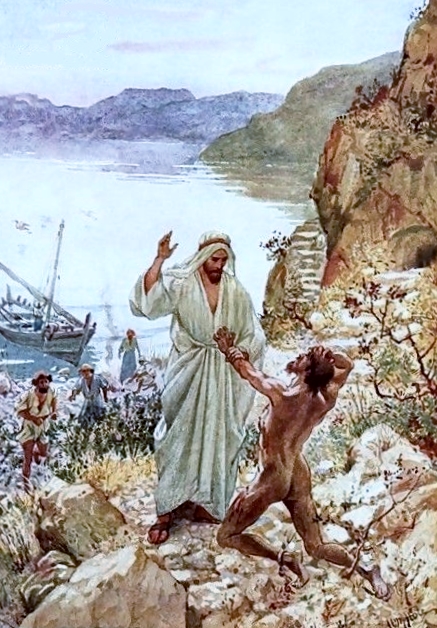
In our Gospel, we meet another wildly outraged man. This one is tormented by his inner demons, causing him also to put himself in dangerous situations. Jesus names this man’s tormentor and casts it out, giving the man control of himself again.


Have you ever been so offended, humiliated or injured that you felt outrage for yourself or another? Such fury chains us, making rationality and reconciliation close to impossible. Sometimes, it renders us impotent to name and address the deep source of our indignation. Instead, we lash out with stones of anger and hate – throwing the dirt of condemnation rather than seeking inner balance and healing.

dementor

Most of us have encountered large or small “dementors” in our life. (Thanks for the term AND the image, Harry Potter) 


But when I think of those who have endured unbelievable degrees of torment, I am amazed at their stories of faith and resolution: Anne Frank, Victor Frankel, Nelson Mandela, Harriet Tubman …. Jesus Christ. How did they come through it whole and blessed?


Mk5_1_20demoniac

Maybe the possessed man in Mark’s Gospel was just lucky that day to run into Jesus. Or maybe he sought out Christ, trying to find stability in the midst of his derangement.

When we face our own imbalances can we stay still long enough to ask, as David did, “What is God teaching me in this. How can this lead me closer to God?” If we could, might we not be surprised to see our demons named, cast into the greater sea of God’s eternal wisdom, peace and love?

Music: Amazing Grace – Sean Clive
It’s All About the Temple

Feast of the Presentation of the Lord

February 2, 2020

Click here for readings

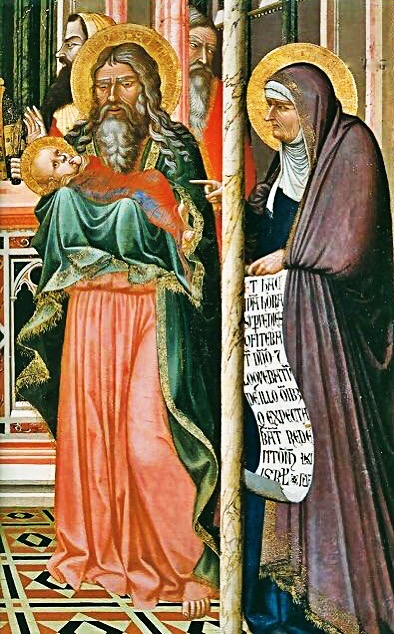
Today, in Mercy, we begin with a reading from the prophet Malachi, a hurler of fire and brimstone in the 4th-5th century before Christ. It’s an interesting choice and begs the question of how it relates to this Feast when a little baby comes to be blessed in the Temple.

Presentation of Our Lord
Presentation of Our Lord – Ambrogio Lorenzetti (Wikipedia.org_ not for commercial use)

Ah, perhaps that’s the hinge – the Temple, both actual and symbolic.

Malachi writes at a time when the second Temple has been restored. In other words, God is about giving the people a second chance to behave according to the Covenant. But they’re not doing such a good job — especially those in charge, the priests:

A son honors his father,
and a servant fears his master;
If, then, I am a father,
where is the honor due to me?
And if I am a master,
where is the fear due to me?
So says the LORD of hosts to you, O priests,
who disdain my name.
Malachi 1:6

A Little Extra Music: Handel – But Who May Abide (You know you have time to listen just before the Super Bowl!)

Through a series of prophetic oracles, Malachi admonishes the people to repent before it is too late because no unrepentant soul will withstand the judgement.

Yes, he is coming, says the LORD of hosts.
But who will endure the day of his coming?
And who can stand when he appears?
For he is like the refiner’s fire,
or like the fuller’s lye.


In the passage from Hebrews, Paul presents the perfect priest, Jesus Christ. In taking flesh, Christ’s Body becomes the new Temple of our redemption. We stand before judgement already saved by his Passion, Death, and Resurrection.


In our Gospel, two aged and venerable prophets wait in the Temple for the Promised One. Their long years of prayer have already proven them faithful. Now, Simeon’s and Anna’s long and complete fidelity is rewarded by seeing their Savior. They know Him because they have already created a place for him in the Temple of their hearts. Now, they will meet their judgement in total peace. As Simeon’s prays:

“Now, Master, you may let your servant go
in peace, according to your word,
for my eyes have seen your salvation,
which you prepared in the sight of all the peoples:
a light for revelation to the Gentiles,
and glory for your people Israel.”

It’s a beautiful, total-hearted prayer!  Don’t we all hope to be able to offer it one day?

( I wrote an earlier reflection about dear Anna.  You might like to see it again here:

Music: Nunc Dimittis – Taizé (Latin and English text below)

Nunc dimittis servum tuum,
Now dismiss your servant
Domine, Domine,
Lord, Lord,
Secundum verbum tuum in pace.
according to your word in peace
Domine.
Lord.

Choices

Friday of the Third Week of Ordinary Time

January 31, 2020

Click here for readings

Today, in Mercy, if this first reading doesn’t smack you right between the eyes, check your political pulse, dear Friends!

David has become King, called to lead his people with a largeness of heart for their good…. but…

power


Power tends to corrupt, and the corruption is hard to resist even for the likes of David. With no checks and balances on him, David commandeers anything he desires – nations, goods, women, human lives! He is convinced that he can do anything he wants to do. His choices lurch him into a spinning culture of death, evil, and selfishness.

This passage from 2 Samuel is threaded with the very same lines woven into this morning’s newspapers: plotting, manipulation, lying, obstruction, projection, irresponsibility, crudeness, disrespect….

Aren’t we just so sick and tired of it all!?

Over the coming days, we will see how David’s corruption affects him – and it’s quite a drama! But for our prayer today, what can we learn?


Perhaps the Gospel offers us a key.

Mk4_30

Jesus talks about “the Kingdom of Heaven”. He uses the symbols of a healthy harvest and a tiny mustard seed. He teaches his listeners that when the things of God are planted deep in us, we too yield a life-giving harvest. We become large-hearted, God-hearted.

Through the gift of free will, God gives us power. We can choose between good and evil, self and others, life and death. In today’s passage, David makes some huge, selfish mistakes in his choices.

Throughout history and even today, people make the same good and bad choices. When leaders make such choices, the whole world feels the impact.

Today, I might want to check how I’m doing, not only in my personal choices, but in my advocacy for a moral and just world for all people.

Music:  A Pure Heart – Rusty Nelson

Who’s Boss?

Thursday of the Third Week in Ordinary Time

January 30, 2020

Click here for readings

Today, in Mercy, David has received a wake up call from God, delivered by the prophet Nathan:

Go and tell David my servant, Thus says the LORD:
Is it you who would build me a house to dwell in?
 
2 Samuel 7:5

As a follow up to David’s big idea of building a house for God, God says,”Wait a minute! I don’t think so!” Gently, but ever so clearly, God reminds David of a phrase very popular on social media today:

boss

It seems David has gotten a little full of himself. He likes being King. He decides to use his power and position to do something nice for God. But God uses the occasion to remind David that all that David has comes from God. David is not God’s King, he is God’s servant. David can’t do anything for God except to offer thanks, praise and worship.

Ps119 lamp

This huge spiritual insight turns David’s heart to see himself truly as God sees him. His subsequent prayer is full of humility and gratitude as David asks God for continued blessing on David’s House.

The lesson for me today is this: God is God. I am nothing without God. Everything I have and am comes from the Divine Goodness.

Meister Eckhart echoes here:

If the only prayer we say
in our entire lives is

“Thank You”,
it is enough.

Music: Thank You, God – mantra video composed by Michelle Sherliza

God Gets Tough

Feast of the Conversion of Saint Paul, Apostle

January 25, 2020

Click here for today’s readings

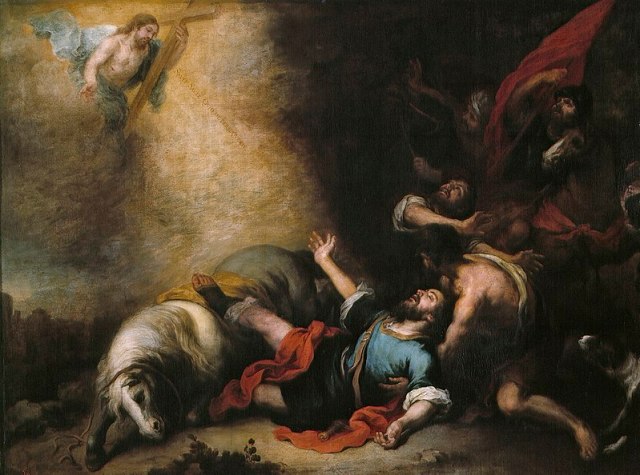
Today, in Mercy, we ride with Paul on the road to Damascus, there to be struck with him by a Godly Light.

800px-La_conversión_de_san_Pablo_(Murillo)
The Conversion of St. Paul — Bartolomé Esteban Murillo

Have you ever been knocked off your “high horse” by the sudden realization of something to which you had been totally blind? It’s shocking, isn’t it? 

We might react by castigating ourselves with remarks like:

  • How could I have missed that?
  • Wow, I was really stupid, or foolish, or naïve, or prejudiced, or misled, or … or what?

God, in a kind of ironic twist, strikes Paul blind in order to cure him of his real blindness: the right he claimed to persecute others for a faith he didn’t understand.

Sometimes God has to be pretty tough with us to wake us up to the truth of our souls. John Donne, the pre-eminent English metaphysical poet, prayed for that kind of Divine Toughness in his poem Batter my heart, three-personed God.

png-divider-lines--1400

Since I have blogged twice previously about this feast,


Links available here:

Click here for 1/24/2019 Reflection

Click here for 4/19/2018 Reflection


I thought my readers might like to pray with Donne’s poem, read by Tom O’Bedlam

Holy Sonnets: Batter my heart, three-person’d God
Batter my heart, three-person’d God, for you
As yet but knock, breathe, shine, and seek to mend;
That I may rise and stand, o’erthrow me, and bend
Your force to break, blow, burn, and make me new.
I, like an usurp’d town to another due,
Labor to admit you, but oh, to no end;
Reason, your viceroy in me, me should defend,
But is captiv’d, and proves weak or untrue.
Yet dearly I love you, and would be lov’d fain,
But am betroth’d unto your enemy;
Divorce me, untie or break that knot again,
Take me to you, imprison me, for I,
Except you enthrall me, never shall be free,
Nor ever chaste, except you ravish me.

Here also is a musical interpretation of the poem.
The University of South Florida Chamber Singers perform Richard Nance’s “Batter my heart” under the direction of Dr. James Bass 

Fill the World with Love

Memorial of Saint Francis de Sales, bishop and doctor of the Church

January 24, 2020

Click here for readings

Today, in Mercy, David spares Saul’s life even though Saul is in murderous pursuit of him. (Here is a video for kids featuring the moment. But I thought it was pretty cool. Maybe you will too.)

Is David noble or naïve? Is he magnanimous or stupid? As I pray this morning, I ask myself what it is that God might be saying to me through this passage.

Two things rise up:

  1. Above all else, David is motivated by a deep respect for God’s Will and Presence in his life.

David said to his men,
“The LORD forbid that I should do such a thing to my master,
the LORD’s anointed, as to lay a hand on him,
for he is the LORD’s anointed.”

    2.  David engages Saul directly and respectfully in the hope of reaching a resolution of    their issues.

When David finished saying these things to Saul, Saul answered,
“Is that your voice, my son David?”
And Saul wept aloud.

Reverence and honesty rooted in sincere love and respect for one another! What a world we would live in if each of us practiced these things unfailingly!


In our Gospel, Jesus calls his disciples to live in the world in just such a way – to bring healing and wholeness in the Name of Christ, for the sake of Love.

Our Alleluia Verse today captures the essence of Christ’s call to them —- and to us:

God was reconciling the world to himself in Christ,
and entrusting to us the message of that reconciliation.


Music: To Fill the World with Love sung by Richard Harris
(Lyrics below, but you will no doubt recall them from the fabulous film “Goodbye Mr. Chips”.)

In the morning of my life I shall look to the sunrise.
At a moment in my life when the world is new.
And the blessing I shall ask is that God will grant me,
To be brave and strong and true,
And to fill the world with love my whole life through.

And to fill the world with love
And to fill the world with love my whole life through

In the noontime of my life I shall look to the sunshine,
At a moment in my life when the sky is blue.
And the blessing I shall ask shall remain unchanging.
To be brave and strong and true,
And to fill the world with love my whole life through

In the evening of my life I shall look to the sunset,
At a moment in my life when the night is due.
And the question I shall ask only You can answer.
Was I brave and strong and true?
Did I fill the world with love my whole life through?

The Green-Eyed Monster

Thursday of the Second Week in Ordinary Time

January 23, 2020

Click here for readings

Today, in Mercy, both David and Jesus deal with the effects of immense popularity.

jealous

In David’s case, Saul is so jealous and threatened by David’s military success that he plots to murder him. Saul’s son Jonathan, David’s dear friend intervenes to turn his father’s evil intention. Ultimately though, Saul remains a man destroyed by jealousy.


green eye

Jealousy is aptly characterized as the “Green-Eyed Monster”:

The phrase ‘green-eyed jealousy’ was used by, and possibly coined by, Shakespeare to denote jealousy, in The Merchant of Venice, 1596.

In Othello, 1604, Shakespeare refers explicitly to the ‘green-eyed monster’ as jealousy when treacherous Iago counsels Othello:

O, beware, my lord, of jealousy;
It is the green-eyed monster which doth mock
The meat it feeds on; that cuckold lives in bliss
Who, certain of his fate, loves not his wronger;
But, O, what damned minutes tells he o’er
Who dotes, yet doubts, suspects, yet strongly loves!


These powerful words capture what it is like to feel, or to be the object of, jealousy – a feeling which grows out of one’s own insecurity. But since it is a feeling, it is not a sin. It is when we act on our jealousy, as Saul planned to do, that we sin.

I think, at sometime in our lives, most of us have experienced jealousy- either as donor or recipient. How we responded either fortified or eroded our character. Sincere reflection on those responses can continue to help us grow in charity.

Thinking about that, I benefitted from reading this passage from the Catholic Encyclopedia:

Jealousy is here taken to be synonymous with envy. It is defined to be a sorrow which one entertains at another’s well-being because of a view that one’s own excellence is in consequence lessened. Its distinctive malice comes from the opposition it implies to the supreme virtue of charity. The law of love constrains us to rejoice rather than to be distressed at the good fortune of our neighbor.

Our daily prayer and ever-deepening relationship with God can free us to face any “green-eyed monsters” we encounter, turning them into occasions of grace. Let’s pray for that!

Music:  Envy and Jealousy – Sweet Comfort Band (Lyrics below)

David, God’s Servant

Memorial of Saint Agnes, virgin and martyr

January 21, 2020

Click here for readings

Ps89_David

Today, in Mercy, we meet David, whose thrilling and passionate story unfolds and echoes throughout the rest of biblical history.

In today’s passage, David is called in from the fields to receive, quite unexpectedly, Samuel’s anointing:

David
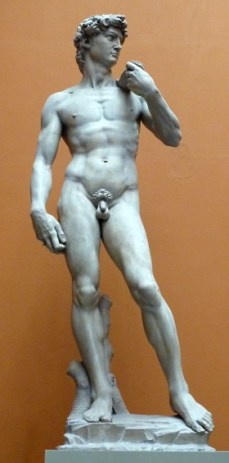
Michaelangelo’s David


“The LORD has not chosen any one of these.”
Then Samuel asked Jesse,
“Are these all the sons you have?”
Jesse replied,
“There is still the youngest, who is tending the sheep.”
Samuel said to Jesse,
“Send for him;
we will not begin the sacrificial banquet until he arrives here.”
Jesse sent and had the young man brought to them.
He was ruddy, a youth handsome to behold
and making a splendid appearance.


Now, the passage doesn’t indicate which field David was in. But maybe he was out in proverbial “left field”, the place from which many human beings are called to do important things, to respond in courageous ways.


Most of us, like David, are just living our ordinary daily lives –relatively oblivious to grace – when the life-changing moments come. Those moments may not be as momentous as David’s, but they are big deals for us. 

  • We get a college acceptance (or rejection) letter.
  • We get a job offer (or we get laid off).
  • We get elected to a position (or we don’t)

Someone asks us:

  • Want to go steady?
  • Will you marry me?
  • Have you ever considered religious life?

Young people, like young David, seem to meet a lot of these obvious directional points in their unfolding lives. But, in reality, we continue to meet them as we move to full maturity. Until the day we die, God is always calling to become deeper, more honest, more loving, more gracefully beautiful, more fully in God’s image.

Where have the pivotal calls and turning points come in your life? What are the junctures at which everything would have been different had you made another choice?What made young, innocent David ready when his first, and ensuing, calls came? 

Here’s why:
David had an exquisite love and constant relationship with God.
And God loved him back, just like God loves us.

Every critical point in our life’s journey is charged with the power of God’s love. That power comes disguised in routine circumstances, like a parent calling his shepherd son home for dinner. But if our hearts are tuned to God, we hear the call deep within those ordinary appearances and we receive the moment’s anointing.

May it be so, until we meet the Beloved Face to face.

Music: Anoint Me, Lord – written by Vickie Yohe, sung by Jonathan Matthews

Anointed

Saturday of the First Week in Ordinary Time

January 18, 2020

Click here for readings

Today, in Mercy, Samuel anoints Saul King of Israel.

Then, from a flask he had with him, Samuel poured oil on Saul’s head;
he also kissed him, saying:
“The LORD anoints you commander over his heritage.
You are to govern the LORD’s people Israel,
and to save them from the grasp of their enemies.

1Sam10_1

Throughout Scripture, the act of anointing signifies being blessed, commissioned by grace. The sacred oil heals and strengthens the anointed to do the work of God.

We share in the grace of anointing through the sacraments – Baptism, Confirmation and Anointing of the Sick. We may not think about the power these rituals give us to live our lives in the pattern of Christ. But it is an amazing power which creates saints out of ordinary human beings like you and me!


Caritas_Bruegel
Caritas, The Seven Acts of Mercy, pen and ink drawing by Pieter Bruegel the Elder, 1559. Counter-clockwise from lower right: feed the hungry, give drink to the thirsty, ransom the captive, bury the dead, shelter the stranger, comfort the sick, and clothe the naked

In a less formal way, we can anoint one another by our acts of generosity, honesty, justice and love. Think of the woman who anointed Jesus with nard from her alabaster jar. How that act strengthened him for the suffering he had to face!

There are so many chaffed and sore places in our world awaiting the oil of mercy!

works of Mercy

We can also “anoint” our own life by gratefully remembering God’s presence in our lives:  the blessings we have received, the challenges we have gracefully met, the love we have both given and received – all that strengthened us to do the work of God over our lifetime.

Music:  Holy, Anointed One – Vineyard Worship

Be Careful What You Ask For

Memorial of Saint Anthony, abbot

January 17, 2020

Click here for readings

www-St-Takla-org--b3h-50-israel-demands-a-king
1 Samuel 8:19 – Israel demands a king. J. Winter – from “The Bible and its Story” book, authored by Charles Horne, 1909

Today, in Mercy, our first reading startles us with how foolish the Israelites are about their leaders. Oh, wait a minute, why are we so surprised? Don’t we see the same dynamics all around us?

Israel is desperate for a “strong man” who will mimic the tyrants leading their enemies. They say a king will “rule us and to lead us in warfare and fight our battles.” They begin to envision a nation of their own design, not God’s.

They believe that having an absolute leader will make them strong. They are indifferent to Samuel’s warnings that such a choice will usurp their freedom, and lead to their devastation and enslavement.

lossy-page1-441px-Olivetan_Master_-_Leaf_from_an_Antiphonary-_Historiated_Initial_P_with_the_Prophet_Samuel;_Ar_-_1999.131_-_Cleveland_Museum_of_Art.tif
This leaf is distinguished by a large initial P depicting Samuel, the last and one of the greatest of Israel’s judges. It introduces the text Preparte corda vestra domino et servite (“Prepare your hearts for the Lord and serve”). In the lower margin are the arms of the Visconti family, rulers of Milan, featuring an eagle (left) and a coiled serpent (right). At bottom center is the emblem of the Olivetan Order, a reformed branch of the Benedictines founded in 1319 known as the “white monks.” The Olivetan monastery in Milan was founded in 1400 and it appears that this leaf belonged to a set of choral books presented to the monastery by one of the Visconti, perhaps about 1439–47. The so-called Olivetan Master takes his name from a luxuriously illustrated psalter made for the order’s monastery in Milan, where he was undoubtedly a monk

God tells Samuel that, in rejecting the choice for responsible, spiritually-grounded, and mutually sustained leadership, the people are rejecting God and God’s plan for them.

In a nutshell, Israel’s problem is this: they have forgotten who and whose they are. For the sake of expected political dominance, they are willing to sacrifice their identity as a people formed and led by God.


Centuries later, in today’s Gospel, Jesus comes among these dispirited people. Their choice hasn’t worked. They are still a politically dominated nation. Their religious practice has lost its vigor, denigrating into lifeless rules and practices. A corrupt religious class manipulates them.

Jesus, ignoring their religiously manufactured limitations on the Spirit, cures a paralytic. The scribes are scandalized. But Jesus confronts their equivocation:

Jesus said, “Why are you thinking such things in your hearts?
Which is easier, to say to the paralytic,
‘Your sins are forgiven,’
or to say, ‘Rise, pick up your mat and walk’?
But that you may know
that the Son of Man has authority to forgive sins on earth”
–he said to the paralytic,
“I say to you, rise, pick up your mat, and go home.”
He rose, picked up his mat at once,
and went away in the sight of everyone.
They were all astounded
and glorified God …

What would the world be like if we left ourselves so open to grace and mercy that God could work through us for the good of all Creation? Can we even imagine such freedom and trust? Can we even imagine the marriage of our faith and politics to the point that we all live for the common good?

Ps89 name_justice

Music: Come, Holy Spirit – Bright City