Rachel Still Weeps

Feast of the Holy Innocents, martyrs

December 28, 2019

Click here for readings

Today, in Mercy, John tells us a hard truth:

If we say, “We are without sin,”
we deceive ourselves, and the truth is not in us.

Rachel

As I read the Gospel account of the slaughter of the Holy Innocents, John’s words pummel me, as do the images we view routinely on the evening news:

  • toddlers caged on the US-Mexico border
  • infants lying dead on Syrian and Kurdish hillsides
  • kindergarteners bulleted by AK47s
  • youngsters trafficked to the rich and powerful
  • children of color victimized by prejudice
  • acolytes defiled by their priests
  • students lunch-shamed for their poverty
  • kids bullied for their differences
  • hungry babies cut from assistance to fund military excess

In today’s world, so bereft of social justice and moral policy, we don’t have to read the Gospel to find the Holy Innocents. They are staring us, teary-eyed, right in our faces!

This morning’s is an uncomfortable prayer! What can I do to be sinless in the face of such injustice? What is morally required of me to shed complicity in these outrages?

Like many of you, I feel helpless and overwhelmed at times, just as Herod’s populace must have felt.

But then I remember that I do not live under a “Herod”, unless I passively allow myself to. I can advocate, protest, contribute and most of all VOTE. I can do everything in my power to assure that a moral and rational leadership holds the right to stand for me and for my responsibilities to my sisters and brothers.

Yes, today in our prayer, we may weep like Rachel. But then, let us finish weeping. Let us seek the ways that we can repent any complicit sinfulness. Let us acknowledge and repudiate the normalized culture of war and domination which we have accepted. Let us inform ourselves and act clearly and consistently for merciful justice – for innocent life in all its stages!

Music: Save the Children – Marvin Gaye
Witness for Christ

Feast of Saint Stephen, Protomartyr

December 26, 2019

Click here for readings

stephenJPG

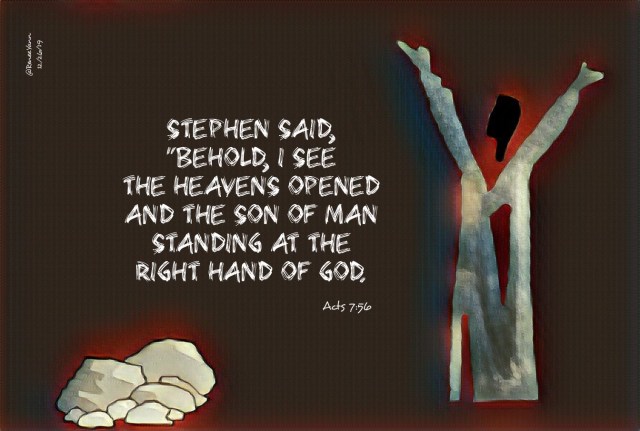
Today, in Mercy, we celebrate St. Stephen, the first martyr for the Christian Faith. Martyrdom is a somber distance from the comforting angels and kindly stars of Christmas. But I think there’s a reason our liturgy places its hard reality here.

 The story surrounding Stephen’s death reveals his beautiful soul. These are some of words describing Stephen:

  • filled with grace and power
  • working great wonders and signs
  • speaking with wisdom and spirit
  • filled with the Holy Spirit

Why would anyone want to kill such a man!

It is a question which resounds down the centuries following Stephen.

Why is innocence persecuted?
Why is faith opposed?
Why is goodness crushed?
Why is freedom strangled?
Why is love for neighbor so frightening?

Our reading from Acts exposes an “infuriated” crowd, burning with anger at Stephen. Why? How had he injured them?


lock web


The human heart can become so fixed in its securities, can’t it? Sometimes we build walled worlds where we are always right, first, best, strongest, and smartest. Smarter than anybody!

These oppressive little worlds are places where for me to be right, you must be wrong. For me to be first, you must be at least second, if not last. For me to be strong, you must be weak. If we live in such a crippling world, a challenge to listen and change is earth-shattering to our fearful, manufactured security.


Christ came to free us all from needing such worlds. Omnipotent Mercy chose to be born in utter vulnerability and poverty. Christmas was our first lesson on how to live in a world secured only by Grace. Stephen’s story, following so close upon Christmas, drives home the consequences of such a faith-filled life.

Rather than right, first, best, strongest and smartest, the invitation of Christ is to be open, humble, generous, courageous, wise. Stephen’s debaters didn’t like that invitation. His faithful conviction was so true that they could offer no argument against it to defend their walled-in lives. So they killed him.


broken doll

All over our planet, we see innocent life crushed by war, trafficking, economic subjugation, prejudice, divisiveness, irrational hatred, and soulless indifference. We see both small and large tyrannies enacted on the global political stage, in business, in the Church, in schools and in families.

The witness of Stephen, first martyr, inspires us to live a life so open to the Holy Spirit that we may stand up strong and, like him, “see the glory of God and Jesus” even through the shadows of a sinful world.

Music: I Will Stand As a Witness for Christ – Sally DeFord

Days of Elijah

Memorial of Saint John of the Cross, Priest and Doctor of the Church

December 14, 2019

Click here for readings

Today, in Mercy, we think about John the Baptist. For several days in this middle part of Advent, our Gospel makes reference to John, the Precursor of the Messiah.

411px-Saint_John_The_Baptist_Preaching_In_The_Wilderness_by_Anton_Raphael
John the Baptist by Anton Raphael Mengs – looking a lot better than he probably really looked!!!!

Faithful Jews had an expectation that there would be a Messiah, and that a fiery Precursor would announce him. They identified this forerunner with the prophet Elijah, based on writings like today’s from Sirach:

How awesome are you, Elijah, in your wondrous deeds!
Whose glory is equal to yours?
You were taken aloft in a whirlwind of fire,
in a chariot with fiery horses.
You were destined, it is written, in time to come
to put an end to wrath before the day of the LORD…

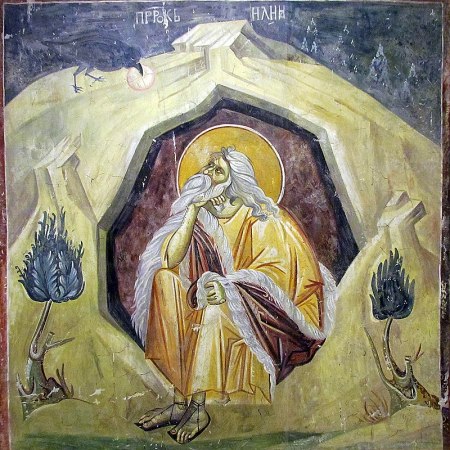
800px-Elijah,_a_prophet_and_a_miracle_worker
Elijah, a prophet and a miracle worker, Gračanica monastery


In our Gospel, Jesus indicates that John the Baptist is the new Elijah, preparing the way for Jesus’s ministry.

Scripture scholars can get pretty bundled up in trying to explicate the meanings around Elijah and his return. For the purpose of our prayer, I find it helpful to take another approach.

  • What is it in my life that prepares me to receive God in my heart?
  • What inspires me “prepare the way of the Lord” in the worlds that I touch?
  • Do I pay attention to God’s “announcements”, those quiet inklings that tell me God is trying to make something new in my life?

Jesus says that Elijah “has already come” but has been rejected by the people.

  • Are there habits and choices in my life that make it hard for God to get through to me?
  • Maybe God is sending an “Elijah”or “Baptist” my way today. Will I recognize that Precursor? Will I be open to the message?

Music: Days of Elijah – Robin Mark. 

The commentary in the Worship & Song Leader’s Edition contains a good summary of this hymn’s text: “This is a song of victory and of hope, of God’s triumph forever over death and of Christ’s eternal reign. It also calls believers to stand fast, even in the face of troubles, and to witness to the promised coming of Christ.”


Choose Your Kingdom

Second Sunday of Advent

December 8, 2019

Click here for readings

Today, in Mercy, Our readings counterbalance each with other peace and urgency.

HicksJPG
A Peaceable Kingdom by Edward Hicks

Isaiah, on the one hand, describes the Peaceable Kingdom where:

the wolf shall be a guest of the lamb,
and the leopard shall lie down with the kid;
the calf and the young lion shall browse together,
with a little child to guide them.
The cow and the bear shall be neighbors,
together their young shall rest;
the lion shall eat hay like the ox.
The baby shall play by the cobra’s den,
and the child lay his hand on the adder’s lair.
There shall be no harm or ruin on all my holy mountain;
for the earth shall be filled with knowledge of the Lord
As water covers the sea.


Matthew, on the other hand, presents us with John the Baptist, who preached a fiery message. No doubt shocking in his camel hair tunic, a scrap of leather holding it in place, John railed at the pompous Pharisees for their deceitful, pretentious lives:

You brood of vipers!
Who warned you to flee from the coming wrath?
Produce good fruit as evidence of your repentance.
And do not presume to say to yourselves,
‘We have Abraham as our father.’

For I tell you,
God can raise up children to Abraham from these stones.

Even now the ax lies at the root of the trees.

Mt3_10 ax

The message of this Second Sunday is clear for us. We may have lived a half-hearted faith at times in our lives and gotten away with it. Those times are over.

For the One is coming who will “baptize with the Holy Spirit and with Fire”. 

“Fake” will not hold up against his mighty gaze.

So this Second Sunday is a time to test the sincerity of our faith as proven by our actions. It is a time to check what kind of fruit we bear for the world. As we pass through the circumstances of our lives, do we leave a trail of peace, wisdom, counsel,and all the other blessings Isaiah envisions?

We can do this only by uniting ourselves in prayer and actions to the One rising today from the Root of Jesse, the One to whom both Isaiah and John tied their souls in unquenchable hope.

Music: A song of peace (Charles Villiers Stanford, (30 September 1852 – 29 March 1924) an Irish composer, music teacher, and conductor.) Lyrics below

1 And there shall come forth a rod out of the stem of Jesse,
and a Branch shall grow out of his roots:

2  And the spirit of the Lord shall rest upon him,
the spirit of wisdom and understanding,
the spirit of counsel and might,
the spirit of knowledge and of the fear of the Lord;

3  And he shall not judge after the sight of his eyes,
neither reprove after the hearing of his ears:

4  And with righteousness shall he judge the poor,
and reprove with equity the meek of the earth:
and he shall smite the earth: with the rod of his mouth,
and with the breath of his lips shall he slay the wicked.

5  And righteousness shall be the girdle of his loins,
and faithfulness the girdle of his reins.

6  The wolf also shall dwell with the lamb,
and the leopard shall lie down with the kid;
and the calf and the young lion and the fatling together;
and a little child shall lead them.

9  They shall not hurt nor destroy in all my holy mountain:
for the earth shall be full of the knowledge of the Lord,
as the waters cover the sea.

10  And in that day there shall be a root of Jesse,
which shall stand for an ensign unto the people;
and his rest shall be glorious.

The Promise of Wholeness

Memorial of Saint Ambrose, Bishop and Doctor of the Church

Saturday, December 7, 2019

Click here for readings

Today, in Mercy, Isaiah – in glorious prophecy – promises God’s People better times.

hope

Oh my, don’t we all long for the fulfillment of that promise! Sometimes, I can’t even watch the news anymore because the world is in such seemingly irreversible pain!


Perhaps we can use our prayer within these readings today to call on God for the healing they promise.

It is a healing that requires our cooperation. Isaiah says that we must name our pain to God – for ourselves and for all who suffer in our world:

The Lord will be gracious to you when you cry out,
as soon as he hears he will answer you.

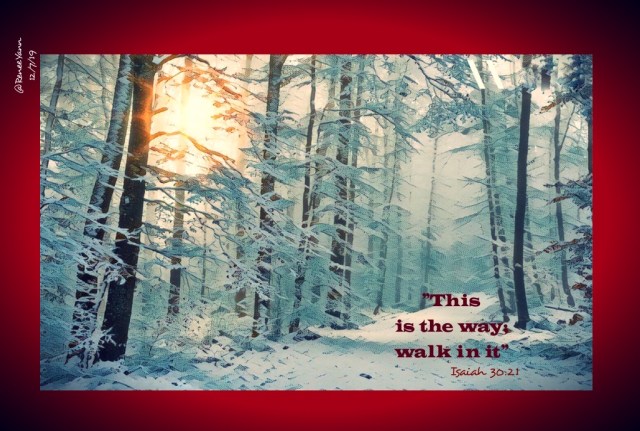
Is30_21 Walk

The prophet says that this crying out will change us. We will see the Lord with us in our suffering. God will lead us through that suffering by our acts of faith, hope, love, justice and mercy:

No longer will your Teacher hide himself,
but with your own eyes you shall see your Teacher,
While from behind, a voice shall sound in your ears:
“This is the way; walk in it,”
when you would turn to the right or to the left.


Christ_Healing_the_Mother_of_Simon_Peter’s_Wife_by_John_Bridges
Healing Peter’s mother-in-law by John Bridges, 19th century

Our Gospel tells us that we are called to be Christ’s disciples, and that disciples are healers. By letting our lives become sources of healing in the world, Isaiah’s prophecy is fulfilled for our time.

Jesus sent out these twelve after instructing them thus,
“Go to the lost sheep of the house of Israel.
As you go, make this proclamation: ‘The Kingdom of heaven is at hand.’
Heal the sick, raise the dead, cleanse lepers, drive out demons.

Without cost you have received; without cost you are to give.”

How we do these wondrous deeds in the world is an ongoing revelation. When I was very young, I took the proclamation quite literally. I soon lost confidence that I would ever really “cure” someone of anything!

Life has blessed me with the realization that there are many degrees of healing. There  many ways in which living people are caught in deadly lives. There are all kinds of “lepers ” in our society, rendered so by the prejudices of others. Certainly, many of us carry all sorts of crippling demons.

Acknowledging the pain in ourselves and others, and trusting that God wants us to be healed and whole, is the work of true discipleship. Let’s keep our eyes on Isaiah’s promise to give us a generous, merciful courage for our call! Let’s keep our eyes on Jesus as he shows us the way.

Music: (Can you take a little hint of “country” this morning?)

Turn Your Eyes upon Jesus – written by Helen Howarth Lemmel (1863-1961) and sung here by Alan Jackson, one of the best-selling music artists of all time, having sold over 75 million records.

Ask to See

Friday of the First Week of Advent

December 6, 2019

Click here for readings

Today, in Mercy, we stand with Isaiah on the rim of hope. We wait, trusting that “in a very little while”, the Lord will make Creation whole.

Is29_18 blindJPG

It’s a precipitous place, this cliff called “Hope”. It requires that we risk ourselves solely on the promises of a God we cannot see. It invites us to leap into a mist we cannot control.

Or can we?

In today’s Gospel, Jesus invites the blind men to the cliff’s edge by asking them:

Do you believe that I can do this?

Well, that’s everything, isn’t it? If our answer is “No”, “Maybe”, or “Kinda’”, we might as well just lie down on this side of the Promise.

faint


But if our answer is brave, like the Gospel blind ones, we too may have our vision cleared to see that there is no leap required. We already stand beside God.

When his children see
the work of my hands in his midst,
They shall keep my name holy;
they shall reverence the Holy One of Jacob,
and be in awe of the God of Israel.
Isaiah 29:23

Music: Amazing Grace sung by Il Divo

Don’t Sleepwalk Your Life!

Monday of the Thirty-fourth Week in Ordinary Time

November 25, 2019

Click here for readings

Today, in Mercy, we begin a series of readings from the Book of Daniel. It is the only time throughout the Liturgical Year that we get a good dose of Daniel. And it is well placed, coming in this final week before Advent.

Daniel is apocalyptic literature, a genre which conveys the author’s perception of the end times through dreams, visions and prophecies. Like many of our readings of the past weeks, Daniel focuses us on God’s Final Coming into time by interpreting current circumstances in a spiritual light.

Today’s Gospel does the same thing, but in a little different way. 

Jesus tells the story of the poor widow who gave everything she had for the sake of the poor. This widow, in a sense, already lives in the “end times”, a time when our only “possessions” will be the good we have done in our lives.

Both these readings set us up to reflect on our lives and times as we approach Advent. This sacred season is the annual reenactment of Christ’s First Coming in order to prepare us for:

  • Christ’s daily revelation in our lives
  • Christ’s Final Coming at the end of time

Mt24_awake

All of Daniel’s complex visions and prophecies can feel a little confusing, but we can focus on this:

  • God is continually revealing Godself in the ordinary circumstances of time.
  • We can open ourselves to this revelation by our humble prayer and good works.
  • Staying awake like this in our hearts and souls will allow us to pass seamlessly into God’s Presence when the end times come.

Music: Be Thou My Vision

We Were Made for Heaven

Saturday of the Thirty-third Week in Ordinary Time

November 23, 2019

Click here for readings

Lk20_36 eternal life

Today, in Mercy, Maccabees gives us a colorful account of the defeat, dismay and ultimate death of Antiochus IV, persecutor of the Jews. The account, like most of the Books of Maccabees, is primarily historical, not spiritual or theological. But threaded through the books, of course, is the underlying biblical orientation that God-Yahweh is present and active in all life’s circumstances.

Today’s passage has even pagan Antiochus considering how God/Fate has brought him to judgement- to “payback” time:

But I now recall the evils I did in Jerusalem,
when I carried away all the vessels of gold and silver
that were in it, and for no cause
gave orders that the inhabitants of Judah be destroyed.
I know that this is why these evils have overtaken me;
and now I am dying, in bitter grief, in a foreign land.


Our Gospel repeats an incident we prayed with just the Sunday before last, in which some Sadducees question Jesus about marriage laws and the afterlife. Their questioning reminds me of modern songwriter Eric Clapton’s musings in his song:

Tears in Heaven – Eric Clapton

Jesus doesn’t sing to the Sadducees, as far as I know. Rather, he answers them this way:

Those who are deemed worthy to attain to the coming age
and to the resurrection of the dead
neither marry nor are given in marriage.
They can no longer die,
for they are like angels;
and they are the children of God
because they are the ones who will rise.


So for us today, the questions and concerns of both Antiochus and the Sadducees might lead us to consider how we feel about the “afterlife”.

Do you ever wonder what heaven will be like? Will we see our beloveds once again? Will we see our “unbeloveds” too and what will that be like!! Do you calculate whether or not you’ll even make the cut through the Pearly Gates?

When I think about heaven these two promises of Jesus sustain, comfort and animate me. Maybe you’ll consider their power too as you pray today.

I have come that you may have life,
and have it to the full.
John 10:10


Eternal life is this, that they know you,
the only true God,
and Jesus Christ, whom you have sent.
John 17:3

Music: That You May Have Life – André Crouch
(Lyrics below)

(I come that you might have life more abundantly)
(I come that you might have life through eternity)
I didn’t come to condemn the world
nor to shame you for your wrong no no
but I came to mend your broken heart and give your heart a song
(I come to give you life more abundantly – more abundantly)
Your life without Christ
is like a star that will never never shine
It’s like a winding road that goes nowhere
Woah but Jesus said (I come) I come (to give you life) to give you life (more)
(I come) I come (to give you joy) to give you joy
(I come to give you life more abundantly ee ee ee ee more abundantly)
but Jesus said (I come to give you life more) oh I left my home in glory
(I come) I come (to give you joy) just to bring you joy
(I come) I love you I love you (to give you life) and I want to give you life
(more abundantly) more abundantly
Mmmm (ee ee ee ee) more abundantly (more abundantly)
People all over the world (all I want to do is give you life)
listen to the LORD speaking right now
(more abundantly ooh ooh ooh ooh) people all over the world
(all I want to do is give you joy more abundantly ooh ooh ooh ooh)
(all I want to do is give you life . . 

A Transformed Heart

Memorial of Saint Cecilia, Virgin and Martyr

November 22, 2019

Click here for readings

Saint_Cecilia
Poster of fresco after John Dryden’s poem “A Song for Saint Cecilia’s Day

(Following in a second post will be John Dryden’s A Song for St. Cecilia’s Day, 1687)

Today, in Mercy, we celebrate the feast of St. Cecilia who is the patron of musicians. A Christian martyr of the 2nd century, she is one of seven women in addition to the Blessed Virgin mentioned by name in the Canon of the Mass. Her deep spirituality led to a sacred intimacy with God which gave her the faith and courage to endure martyrdom.

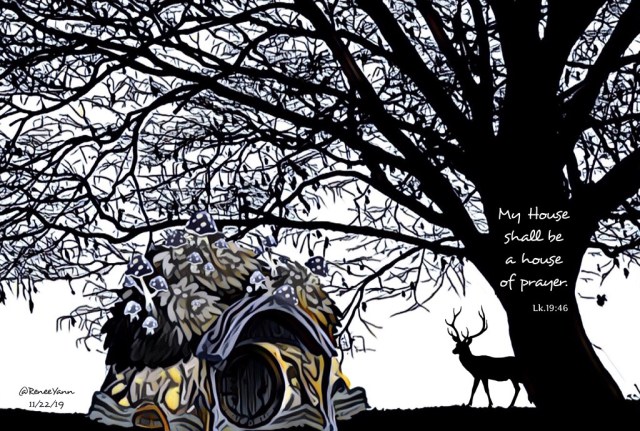
Both readings today speak about the Temple. After the victory of Judas Maccabeus, the Jewish people restore their Temple with exuberant celebration, recognizing it as a symbol of God’s Presence with them.

In today’s Gospel. Jesus also “restores” the Temple by driving out the merchants who have diverted the Temple’s purpose as representative of God’s Presence.

Our bodies too are temples of the Holy Spirit.

Paul, in his letter to the Corinthians tells us:

Do you not know
that your bodies are temples of the Holy Spirit,
who is in you, whom you have received from God?
You are not your own; you were bought at a price.

Through our Baptism into the Passion, Death and Resurrection of Christ, the Holy Spirit dwells in us. We are called to be transformed by this Indwelling. As in any relationship, this transformation is accomplished through transparency, communication, listening and acting on behalf of the Beloved.

Geoffrey Brown, a deeply spiritual poet, offers us this imaginative image of waiting for and welcoming, as Cecilia did, the transformative Presence of God in our lives:

I must remember to go down to the heart cave
And sweep it clean, make it warm, with fire on the hearth
And candles in their niches
The pictures on the walls glowing with quiet lights

I must remember to go down to the heart cave
And make the bed with the quilt from home
Strew rushes on the floor
And hang lavender and sage from the corners

I must remember to go down to the heart cave
And be there when you come.

Music:  Marc-Antoine Charpentier – Caecilia Virgo et Martyr


For more on Charpentier’s magnificent works, click here

Charpentier’s Histoires Sacrées, or sacred histories, are in reality, dramatic religious scenes taken from the bible or the lives of the saints and set to music.

Cæcilia, virgo et martyr octo vocibus dates from around 1677. This tells the story of St Cecilia, the patron saint of music and musicians, and an early Christian martyr. Cecilia’s husband and brother are executed for converting to Christianity, with Cecilia following shortly afterwards. Perhaps the highpoint of this piece is the final Guay – Nolite flere fideles where firstly the angels claim that Cecilia has been ‘crowned by them’, before the rest of the chorus sing ‘Come, then, let us sing and exult in Cecilia’s victory.’ Quite wonderful in the way it incorporates Cecilia’s position among musicians. (Stuart Sillitoe)

Jesus Wept

Memorial of the Presentation of the Blessed Virgin Mary

November 21, 2019

Click here for readings

Today, in Mercy, the Book of Maccabees introduces us to Mattathias, revered leader of the Jews in the city of Modein. He violently refuses the Greek Seleucid command to worship their gods, thus initiating the Maccabean Revolt. The wars lasted nearly a decade. Final victory is commemorated in the Feast of Hanukkah:

The Jewish festival of Hanukkah celebrates the re-dedication of the Temple following Judah Maccabee’s (Mattathias’s son)victory over the Seleucids. According to tradition, victorious Maccabees could find only a small jug of oil that had remained pure and uncontaminated by virtue of a seal, and although it contained only enough oil to sustain the Menorah for one day, it miraculously lasted for eight days, by which time further oil could be procured. (Wikipedia)

Our first reading is really describing the beginning of civil and intercultural wars by which dedicated Jews sought to establish both their religion and their nation. Core to their motivation was the desire to freely be in relationship with their one God according to their own custom and law.

In our Gospel, Jesus has come as the full manifestation of that One God. He has invited the Jewish people to a new and complete relationship with God, but they have resisted.

Lk19_41 weptJPG

Now, as he nears his final fate in Jerusalem, Jesus realizes that his dream for the People will not be fully realized. They will experience a destruction like the one once feared by Mattathias. The reality causes Jesus to weep.

Are the passages only  about the Jews, their religion and their history? Yes, and no.

For us, they are about choosing a faithful, evolving relationship with God – a relationship that will demand truth, action and at times suffering as we pursue deeper and deeper understanding of God’s Presence in our lives.

Our world and its culture place many godless choices before us, choices that could make Jesus weep because of the suffering they cause others. These choices are not as easy to identify as they were in the time of Mattathias. They don’t come dressed as a pagan soldier ready to kill our resistance.

They come in the large subtleties of politics, economics, human rights, global relationships. These choices show themselves in the small exercise of our respect, care, and reverence for all Creation. But they do come to us in every moment and they demand our witness.

Jesus wants the new Kingdom to rise in us when we open our hearts to his Word. It is an ongoing and daily Resurrection. Let’s pray for to courage for it!

Music:  When Jesus Wept – William Billings

One of the most well-known of the early American canons, originally appeared in the New England Psalm Singer. It was written in 1770 by William Billings, a self-taught singing-school teacher and composer who served as choir leader at Old South Church in Boston.

(Lyrics below)

When Jesus wept, the falling tear
In Mercy flowed beyond all bound;
When Jesus groaned at rambling fear
Seized all the guilty world around.

Per a valued friend:

There is a statue in Oklahoma City called “Jesus Wept.”  It is on the grounds of St. Joseph Church in the city – which is right across from where the Oklahoma City Federal Building had been located.  The people of the parish wanted to erect the statue on their grounds because the memorial on the federal property couldn’t be religious.  It is a very moving statue.