Remember Your Fig Trees

Friday, August 24, 2018

Readings: Click here.
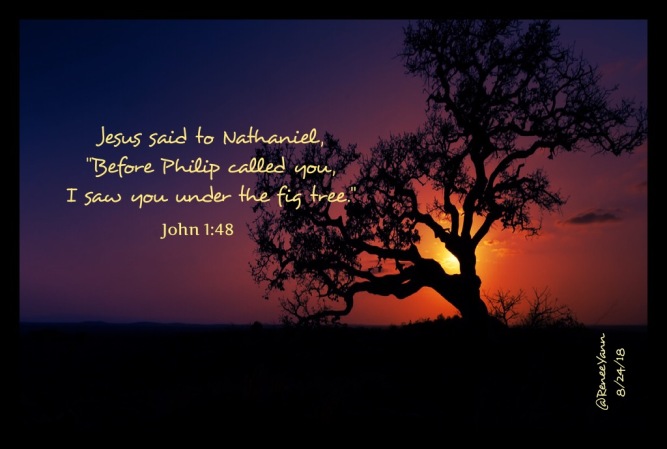
Jn 1_48 fig

Today, in Mercy, we celebrate the Feast of the Apostle Bartholomew, also known as Nathaniel. As with many of the Apostles, little is known of Bartholomew’s life outside of a few Gospel stories. John’s Gospel tells the wonderful story of Nathaniel’s call by Christ.

The encounter is a very personal one. Jesus and Nathaniel share a conversation that must have impressed the other listeners because it was remembered and recounted word for word in the Gospel.

One exchange, in particular, carries deep significance for Nathaniel. Jesus says that there is no duplicity, or pretense, in Nathaniel. There is a transparency in him shared even with God. Nathaniel wonders out loud , “How do you know me?” Jesus answers, “Before Philip called you, I saw you under the fig tree.”

What was going on with Nathaniel under that fig tree? A moment of intense prayer, questioning, decision, doubt, hope? Whatever it was, Jesus had shared it, even at a distance. When Nathaniel realizes this, his faith in Jesus and vocation to follow Him are confirmed. Nathaniel professes, “Rabbi, you are the Son of God; you are the King of Israel.”

Where are the fig trees in your life story — those moments when, looking back, you realize that God was with you even though seeming distant?

What were the turning points in your faith, when you came out from under the shadow of a challenging experience, to the grateful amazement that God had accompanied you through it.

What are those pivotal, intimate moments when it was just you and God – those transparent moments that changed your life?

If you can’t recall any such moments, perhaps you are not giving yourself the time and space to let God reach you.

It might be time to seek out a “fig tree” – a place of spiritual solitude where you may speak honestly and directly to God about the most important things in your life. Open your heart, like Nathaniel, to hear what God already knows about you.

Music: The Memory of Trees – Enya (Some lyrical New Age music to listen to under your fig tree!)


A Stony Heart

Thursday, August 23, 2018

Readings: http://www.usccb.org/bible/readings/082318.cfm

Ez36_26 stone

Petrified! We’ve all been there:

  • an unexplained sound in the house at night
  • the suggestion of a traumatic diagnosis
  • a threat delivered by natural or human power

These are just some of the circumstances that come into our lives, causing us to freeze – to be unable to respond.

But there are internal forces too that immobilize us:

  • indecision
  • buried anger or pain
  • depression 
  • envy and jealousy 
  • self-doubt
  • addiction
  • all the seven “deadlies” in their multiple disguises

These conditions of the spirit have their root in fear – fear of making the wrong decision, of engaging someone who angers us, of not being successful or popular, of looking foolish, of confronting pain, of losing the things we have no hold on anyway, of being different, alone, or abandoned.

These immobilizers suck the life out of us, rendering us but a stony outline of the full and glorious spirit God intends us to be. They ensnare us and blind us to the depth and power of our hearts. Faith, hope and charity become brittle in us. We fragment, rather than thrive, in the normal challenges of living.

This happened to Israel as they yielded their allegiance to idols and sin. But our ever-merciful God says he is going to wash these numbing poisons out of their hearts, giving them new hearts to love and serve him.

Sometimes we are so used to our dysfunctions that we don’t even see all the petrified spots in our relationships and behaviors. Maybe today, trusting God’s promise of a new heart, we might be willing to examine ourselves for signs of stoniness toward God, Creation, and Self.

Music: Heart of Stone ~ David Bilborough

Who’s First?

Tuesday, August 21, 2018

Readings: http://www.usccb.org/bible/readings/082118.cfm

first Last

Today, in Mercy, our readings are full of “either – or” talk, opposing categories that render us either blessed or damned:

  • rich or poor
  • death or life
  • first or last

The distance between these contrasts appears to be measured in possessions and power:

  • Ezekiel pronounces God’s Word to the Prince of Tyre: “ … your heart has grown haughty from your riches…”
  • The responsorial from Deuteronomy cautions: “It is I – not you- Who give life and deal death.”
  • And the Gospel advises, “Anyone who has given up (possessions) for My sake … will inherit eternal life.”

For centuries, Christians have struggled with these concepts. It is counterintuitive to want to divest of one’s “riches”. Yet Jesus is telling us that it is almost impossible not to be coöpted by our possessions – not to have our spirits so distracted by their acquisition and retention that they displace God as the center of our lives. Jesus says is like a camel trying to pass through a needle’s eye.

Ezekiel suggests that to believe we possess anything is an illusion. Everything can be taken from us in an instant. Jesus says the illusion will be flipped in the Kingdom of Heaven where the “first”and “last” will switch places.

These are radical concepts that each Christian must absorb into her own life through prayer and service in order to find grace for her own circumstances. Life is not “either/or” for most of us. There is a lot of grey where we constantly weigh what God would want of us.

Through prayer and service, we can invite God to patiently change our perception of where true riches lie. The degree of change will determine whether we possess our “riches”, or they possess us.

Music: Only Jesus – Casting Crowns

Follower of Christ

Monday, August 20, 2018 – Memorial of St. Bernard

Readings: http://www.usccb.org/bible/readings/082018.cfm

st Bernard

Today, in Mercy, our Gospel tells us the story of a rich young man with a good and holy heart. He asked Jesus what he needed to do, beyond keeping the commandments, to become perfect in God’s sight. 

Jesus tells him to sell what he has, give the proceeds to the poor, and follow Him. Apparently, this is too much for the man to accept and he goes away sad.

On the other hand, we have St. Bernard of Clairvaux whose feast we celebrate today. Bernard, too, had been a wealthy young man. Hearing Christ’s call to leave everything behind and follow Him, Bernard entered the Cistercian monastery. 

He desired only to live a deeply contemplative life, but his many intellectual and spiritual gifts brought him significant roles in the broader life of the Church. Doctor of the Church, Abbot, Advisor of Popes, Reformer of Religious Life – any of these titles fit Bernard today. 

But perhaps the title he would treasure most is the one he first pursued: Follower of Christ.

We do not need to be a monk or a nun to follow Jesus. We simply need to know where our true treasure lies, and to give everything for it.

Music: Follow Me – Casting Crowns

A Clean Heart

Saturday, August 18, 2018

Readings: http://www.usccb.org/bible/readings/081818.cfm

Ps51_clean heart

Today, in Mercy, God tells Ezekiel that each person will be judged according to her/his own ways – not according to the deeds of our parents, family or friends.

In the Gospel, Jesus blesses the innocent children and says that those in the Kingdom of Heaven must be like them.

Most of us are a long way from innocence. We have our agendas, our politics, our status, our possessions, our grudges, our prejudices that often come between us and a spiritually pure heart.

If we want to be different, today’s Psalm 51 allows us to lay it all on the heart of Jesus.   Create in me a clean heart, O Lord.

(I hope you enjoy this gentle rendering of the psalm in Hebrew.)

Music: Choneni Elohim, from Psalm 51 (Be Gracious to me O G-d) ~ Christine Jackman

The Scripture of Our Lives

Monday, August 13, 2018

Readings: http://www.usccb.org/bible/readings/081318.cfm

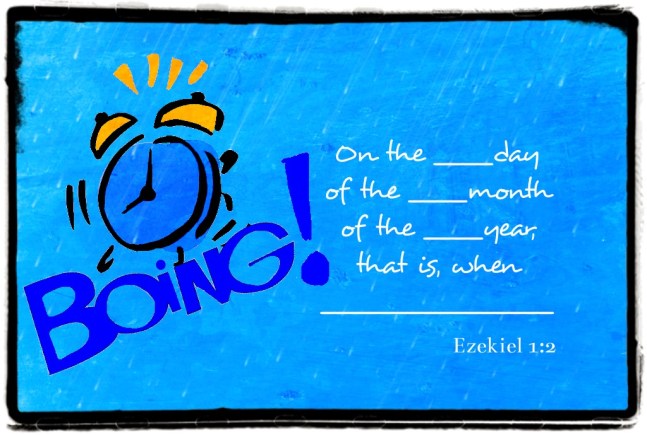
Ez1 boing

Today, in Mercy,  in our first reading, Ezekiel signals that something really important has happened. He does this by means of a prophetic word formula – repeated and patterned phrases found throughout the Bible. 

One pattern that we’re accustomed to is, “Amen, Amen, I say to you..” Jesus used it to say, “Listen up! Important info to follow!”

Another pattern is the specific setting of time and place to mark an event as pivotal. One such beloved phrase: “It came to pass in those days, that Caesar Augustus issued a decree that a census should be taken of the entire Roman world.

Ezekiel’s formulaic phrase is a marker in his spiritual life: 

On the fifth day of the fourth month of the fifth year,
that is, of King Jehoiachin’s exile,
The word of the LORD came to the priest Ezekiel…

If we look back over our own lives, we will remember moments when God clearly entered our experience. We may not have realized it until long after. We may be surprised to remember a point in time as the opportunity God took to embrace us. But through reflective prayer, we begin to see that God is with us, even in our darkest moments, bringing the revelation of God’s infinite Love and Mercy.

What if we filled in the blanks in Ezekiel’s formula with our own life markers? What if we thanked God for each of them, dark or light – asking for the grace to understand their revelation?

Each of our lives is its own scripture, telling the story of God’s love and presence. Spend time with yours today.

Music: God of All My Days ~ Casting Crowns

Ever Complain to God?

Saturday, August 11, 2018

Memorial of St. Clare

Readings: http://www.usccb.org/bible/readings/081118.cfm

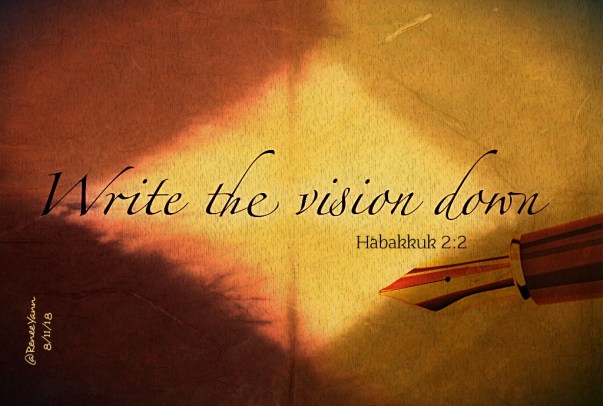
Hab 2_2 write

Today, in Mercy, we have a rare appearance from the prophet Habakkuk, whose contribution to the Hebrew Scriptures is brief — three short chapters. The first two chapters are known as the First and Second Complaint of Habakkuk.

In his first complaint, Habakkuk is upset with the way the world is going. You know what he feels like. He saw the political infrastructure rife with corruption, enemies attacking the heart of Jewish religion, and economic deadlock. Habakkuk asks God to explain why this is happening.

God says that Habakkuk has to have faith, that ultimately God will work things out.

That doesn’t float with Habakkuk, so he complains again. He basically tells God that, as the all-Powerful One, God should be able to do better.

Have you ever talked to God like that in your prayer – just so frustrated with your life or the world situation that you pour it all out in one massive complaint?

The fullness of Habakkuk’s faith evolved over time, because God abided with him, telling Habakkuk to be patient:

Write down the vision
Clearly upon the tablets,
so that one can read it readily.
For the vision still has its time,
presses on to fulfillment, and will not disappoint;
If it delays, wait for it,
it will surely come, it will not be late.
The rash man has no integrity;
but the just man, because of his faith, shall live.

This passage is a good incentive to maintain a spiritual journal.  When we go back over past challenges, we are often amazed to see how God did, indeed, abide with us — just as God did with Habakkuk.

Ready for some haunting beautiful Gaelic? (English lyrics below.)

Music: Bi Thusa Mo Shuile (Be Thou My Vision)
( Be Thou My Vision is a traditional hymn from Ireland. The words are based on a Middle Irish poem often attributed to the sixth-century Irish Christian poet Dallán Forgaill. The best-known English version was translated by Eleanor Hull and published in 1912. Since 1919 it has been commonly sung to the Irish folk tune “Slane”.)

Be Thou my Vision, O Lord of my heart
Naught be all else to me, save that Thou art
Thou my best Thought, by day or by night
Waking or sleeping, Thy presence my light
Be Thou my Wisdom, and Thou my true Word
I ever with Thee and Thou with me, Lord
Thou my great Father, I Thy true son
Thou in me dwelling, and I with Thee one
Riches I heed not, nor man’s empty praise
Thou mine Inheritance, now and always
Thou and Thou only, first in my heart
High King of Heaven, my Treasure Thou art

The Prophet is Never Welcome

Friday, August 3, 2018

Readings: http://www.usccb.org/bible/readings/080318.cfm

ordinary miracles

Today, in Mercy,  Jesus returns to his hometown to speak with his neighbors in the synagogue.  We can imagine the scene – maybe a few buddies who grew up with Jesus, kicking a ball around the dusty streets of Nazareth. Maybe there were neighbor ladies who went to the well daily with Mary., or a few older guys who had exchanged the secrets of woodworking with Joseph.

They might have come to the synagogue expecting little but to hear the old scriptures interpreted in the old way. They could live with that.  They had become entrenched in their ordinary lives and, despite its drudgeries, it was comfortable for them.

We can understand these people. In many ways, we might be like them.  We might go to church on Sunday and pray everyday, but we don’t want our faith to get too mixed up in our lives. We certainly don’t want some preacher telling us we have to change our comfortable ways because “the Kingdom of God is at hand”.

But that’s what Jesus did that Sabbath in the hometown synagogue.

You see their reaction. “Who the heck is this guy to tell us what to do? Isn’t he merely one of us?”

Their defenses and prejudices bar them from hearing the liberating word of Jesus.  He asks them to break open their ordinary lives to find the call to grace hidden within. He doesn’t want them to abandon their lives. He wants them to transform their lives by recognizing the presence of God in the everyday miracles of human life, love, mercy and forgiveness. He challenges them to welcome the same miracles in the poor, the stranger, even the enemy. Now wait a minute!!!!

There may have been some who heard and responded to him that day. But their voices were drowned out by those whose souls had atrophied with comfort, selfishness, ignorance and fear.

We don’t have to go too far to find such scenes today.  It may be at a church, a political event, a family conversation, an exchange among friends. These situations may confront us with the stark difference, in ourselves and in others, between truth and opinion, between faith and religion, between justice and law. 

In these common situations of our lives, can we find the miracles God is offering us? Can we listen beyond the words with a faith-filled heart and hear God’s Word? Can we allow our thinking to be transformed by the challenging graces of our ordinary lives? Can we ask ourselves sincerely, “If Jesus were here for this moment, what would he want to happen in my heart and actions?”

Music: Word of God Speak by MercyMe

How Does God Think We Are Doing?

Tuesday, July 31, 2018

Readings: http://www.usccb.org/bible/readings/073118.cfm

Today, in Mercy, the readings from Jeremiah and Matthew squarely place the reality of sin in our sight. Nobody likes to talk about sin, at least if they’re normal. We like to talk about fun, success, winning, freedom, prosperity. But when the distortion of these things get in the way of our relationship with God and neighbor, then we’re talking about sin.

Ps79 Deliver usJPG

How do you feel about our world today? The small area of my world is abundantly blessed and happy, as I hope yours is. The inhabitants of Jeremiah’s world felt the same way — until the devastation touched them! Then they realized that their “comfortable “ world was woefully out of line with God’s hope.

They had been blind to the sin around them, and their –  perhaps –  unwitting part in it. Ultimately, they were visited with destruction. We might read their plight and say, “Oh well, they worshipped false idols.  No wonder God was displeased with them.”

A better read might be:

  • Are there any false gods in my life? Who or what do I really worship above all things?
  • Are there false gods in our world? How do I respond to them- in the political arena, in the workplace, in my social sets?

The world is so much bigger than our  living rooms or offices. And we are called to be faithful witnesses to God in that bigger world. How are we doing? Today, Jeremiah and Jesus offer us an examination of conscience.

Today is also the feast of St. Ignatius Loyola. This is a version of the five-step Daily Examen that St. Ignatius practiced.

  1. Become aware of God’s presence.
  2. Review the day with gratitude. 
  3. Pay attention to your emotions.
  4. Choose one feature of the day and pray from it.
  5. Look toward tomorrow.

For more on Ignatian spirituality see:

Click here to go to Ignatian Spirituality website

Music: Take, Lord, Receive – The Prayer of St. Ignatius by John Foley

Would God Divorce Us?

Saturday, July 28, 2018

Readings:  http://www.usccb.org/bible/readings/072818.cfm

Today, in Mercy, we hear from Jeremiah, a “sock-it-to-‘em” prophet. He lived in a disastrous time for Judah, and had to deliver some difficult challenges to the people. Today’s passage is called the Temple Sermon. It confronts his listeners with the fact that there is a big difference between their professed faith and their daily practice. In other words, they are living a lie.

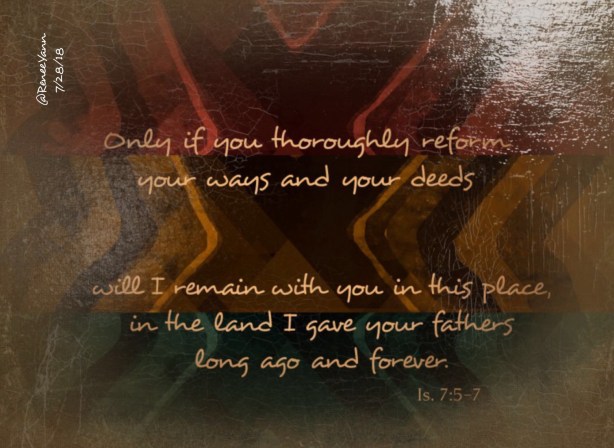
Jeremiah7_5

The people seem to think that no matter how idolatrous or immoral their choices are, the Temple building will protect them from God’s anger. It’s a mentality that might remind us of the film “The Godfather”, where the mafioso kill and cheat all week but always fulfill their sacramental obligations.

God tells Jeremiah to go stand at the Temple gate and tell the people that their fake piety won’t work. Instead they are to:

  • thoroughly reform their ways and deeds
  • deal justly with their neighbor
  • no longer oppress the resident alien, the orphan, and the widow
  • no longer shed innocent blood in this place (cease human sacrifice)
  • or follow strange gods to their own harm

Otherwise, Jeremiah says, they risk losing God because God will not live in a desecrated Temple.

The message to us that comes wrapped in the ancient words of Jeremiah?

  • Examine your life.
  • Is our faith sincere, proven by our practices?
  • Do we give others not only the benefit of the doubt, but also the benefit of our kindness?
  • Do we support and foster immigrants, orphans, widows … in other words the vulnerable?
  • Do we stand against the suffering of innocents caused by war and unjust policy?
  • Do we resist the “gods” competing for our souls — all the destructive isms and addictions of our time?

Otherwise, Jeremiah says, we risk losing God because God will not live in a heart-temple that is desecrated.

Music: Fill This Temple – Don Moen

https://m.youtube.com/watch?v=r1CIpLFywdc