Remove from me the way of falsehood, and favor me with your law. Take not the word of truth from my mouth, for in your ordinances is my hope. Psalm 19:29,43
The passage from Jeremiah tells the story of the false prophet Hananiah who offered a counterfeit hope because he did not have a true relationship with God. Jeremiah’s message, which called for sincere repentance, was honest but not popular.
Today’s Psalm 19 is a prayer for the courage to listen to and live in God’s Truth, not to ascribe to a false message just because that is the one we want to hear.
Today, in God’s Lavish Mercy: We pray for the courage to hear God’s Word in the truth of our hearts, a truth created by living a life of prayer, spiritual honesty, repentance, and mercy.
Poetry: Tell All the Truth – Emily Dickinson
Tell all the truth but tell it slant —
Success in Circuit lies
Too bright for our infirm Delight
The Truth's superb surprise
As Lightning to the Children eased
With explanation kind
The Truth must dazzle gradually
Or every man be blind —
Music: Great Is Thy Faithfulness – written by Thomas Chisholm (1866–1960)
In today’s readings, both Jeremiah and John the Baptist encounter persecution. Jeremiah is saved, but John is not. Maybe both of them had questions about how, when they were so dedicated to God, evil yet pursued them. Perhaps they felt they had run into a spiritual wall. Ever felt like that?
Our Responsorial Psalm captures the longing for an answer – an understanding of how and why God works in our lives.
Lord, in your great love, answer me.
Psalm 69:14
Today, in God’s Lavish Mercy: I think it’s safe to say that we all have questions about life and death, good and evil, grace and darkness, worldly success and spiritual peace, God’s Presence and God’s apparent absence.
Poetry: The Answer – Carl Sandberg
You have spoken the answer. A child searches far sometimes Into the red dust On a dark rose leaf And so you have gone far For the answer is: Silence.
In the republic Of the winking stars and spent cataclysms Sure we are it is off there the answer is hidden and folded over, Sleeping in the sun, careless whether it is Sunday or any other day of the week,
Knowing silence will bring all one way or another.
Have we not seen Purple of the pansy out of the mulch and mold crawl into a dusk of velvet? blur of yellow? Almost we thought from nowhere but it was the silence, the future, working.
Music: Popule Meus – Motet by Tomás Luis de Victoria (1548-1611)
Ecce lignum crucis: In quo salus mundi pependit, Venite, adoremus.
Popule meus, quid feci tibi? Aut in quo contristavi te? Responde mihi.
Quia eduxi te de terra Aegypti, Parasti Crucem Salvatori tuo.
Hagios o Theos. Sanctus Deus. Hagios Ischyros. Sanctus Fortis. Hagios Athanatos, eleison himas. Sanctus Immortalis, miserere nobis.
Quia eduxi te per desertum Quadraginta annis, Et manna cibavi te, Et introduxi te in terram satis bonam, Parasti Crucem Salvatori tuo.
Hagios o Theos. Sanctus Deus. Hagios Ischyros. Sanctus Fortis. Hagios Athanatos, eleison himas. Sanctus Immortalis, miserere nobis.
Ego propter te flagellavi Aegyptum Cum primogenitis suis: Et tu me flagellatum tradidisti.
Popule meus, quid feci tibi? Aut in quo contristavi te? Responde mihi.
Ego te eduxi de Aegypto, Demerso Pharone in mare Rubrum, Et tu me tradidisti Principibus sacerdotum.
Popule meus, quid feci tibi? Aut in quo contristavi te? Responde mihi.
Ego ante te aperui mare, Et tu aperuisti lancea latus meum.
Popule meus, quid feci tibi? Aut in quo contristavi te? Responde mihi.
Behold the wood of the cross: On which hung the salvation of the world, Come, let us adore.
O my people, what have I done to you? Or wherein have I grieved you? Answer me.
Because I led you out of the land of Egypt: You have prepared a Cross for your Saviour.
O Holy God. O Holy God. O Holy Strong One. O Holy Strong One. O Holy and Immortal, have mercy upon us. O Holy and Immortal, have mercy upon us.
Because I led you through the desert, For forty years, And fed you with manna, And brought you into a land exceeding good, You have prepared a Cross for your Savior.
O Holy God. O Holy God. O Holy Strong One. O Holy Strong One. O Holy and Immortal, have mercy upon us. O Holy and Immortal, have mercy upon us.
For you I scourged Egypt, And its firstborn, And you have delivered me to be scourged.
O my people, what have I done to you? Or wherein have I grieved you? Answer me.
I brought you out of Egypt, And sank Pharaoh in the Red Sea, And you bave delivered Me To the chief priests.
O my people, what have I done to you? Or wherein have I grieved you? Answer me.
I opened the sea before you, And you have opened my side with a spear.
O my people, what have I done to you? Or wherein have I grieved you? Answer me.
I went down to the potter’s house and there he was, working at the wheel. Whenever the object of clay which he was making turned out badly in his hand, he tried again, remaking of the clay another object of whatever sort he pleased. Then the word of the LORD came to me: Can I not do to you, house of Israel, as this potter has done? says the LORD. Indeed, like clay in the hand of the potter, so are you in my hand, house of Israel. Jeremiah 18:3-6
In the simple image of a potter with clay, we come to understand the transformative power of God’s grace. Like nourishment for a precious plant, that divine grace breathes new life into any fading flowers of faith, hope, and love. Jesus came among us so that we might be remade in his image as the Beloved of God.
Today, in God’s Lavish Mercy: We pray for a supple heart, an acute attention, and a patient openness to God’s power in our lives.
Poetry: The Song of the Potter – Henry Wadsworth Longfellow
Turn, turn, my wheel! Turn round and round,
Without a pause, without a sound:
So spins the flying world away!
This clay, well mixed with marl and sand,
Follows the motion of my hand;
For some must follow, and some command,
Though all are made of clay!
Turn, turn, my wheel! All things must change
To something new, to something strange;
Nothing that is can pause or stay;
The moon will wax, the moon will wane,
The mist and cloud will turn to rain,
The rain to mist and cloud again,
To-morrow be to-day.
Turn, turn, my wheel! All life is brief;
What now is bud will soon be leaf,
What now is leaf will soon decay;
The wind blows east, the wind blows west;
The blue eggs in the robin's nest
Will soon have wings and beak and breast,
And flutter and fly away.
Turn, turn, my wheel! This earthen jar
A touch can make, a touch can mar;
And shall it to the Potter say,
What makest thou? Thou hast no hand?
As men who think to understand
A world by their Creator planned,
Who wiser is than they.
Turn, turn, my wheel! 'Tis nature's plan
The child should grow into the man,
The man grow wrinkled, old, and gray;
In youth the heart exults and sings,
The pulses leap, the feet have wings;
In age the cricket chirps, and brings
The harvest home of day.
Turn, turn, my wheel! The human race,
Of every tongue, of every place,
Caucasian, Coptic, or Malay,
All that inhabit this great earth,
Whatever be their rank or worth,
Are kindred and allied by birth,
And made of the same clay.
Turn, turn, my wheel! What is begun
At daybreak must at dark be done,
To-morrow will be another day;
To-morrow the hot furnace flame
Will search the heart and try the frame,
And stamp with honor or with shame
These vessels made of clay.
Stop, stop, my wheel! Too soon, too soon
The noon will be the afternoon,
Too soon to-day be yesterday;
Behind us in our path we cast
The broken potsherds of the past,
And all are ground to dust at last,
And trodden into clay.
Again, the Kingdom of heaven is like a merchant searching for fine pearls. When he finds a pearl of great price, he goes and sells all that he has and buys it. Matthew 13:45-46
On this feast, our readings offer us a perfect understanding of what motivated the life of St. Ignatius Loyola – he gave everything to possess the pearl of eternal life.
Today, in God’s Lavish Mercy: We pray the Suscipe of Ignatius, asking to deepen in our understanding of how we are called to holiness in our particular life circumstances.
Poetry: As Kingfishers Catch Fire – Gerard Manley Hopkins, SJ
As kingfishers catch fire, dragonflies draw flame; As tumbled over rim in roundy wells Stones ring; like each tucked string tells, each hung bell’s Bow swung finds tongue to fling out broad its name; Each mortal thing does one thing and the same: Deals out that being indoors each one dwells; Selves — goes itself; myself it speaks and spells, Crying Whát I dó is me: for that I came.
I say móre: the just man justices; Keeps grace: thát keeps all his goings graces; Acts in God’s eye what in God’s eye he is — Chríst — for Christ plays in ten thousand places, Lovely in limbs, and lovely in eyes not his To the Father through the features of men’s faces.
Music: Take, Lord, Receive – John Foley, SJ
Take, Lord, receive all my liberty, My memory, understanding, my entire will.
Give me only Your love and Your grace, that’s enough for me. Your love and Your grace, are enough for me.
Take, Lord, receive all I have and possess. You have given all to me, now I return it.
Give me only Your love and Your grace, that’s enough for me. Your love and Your grace, are enough for me.
Take, Lord, receive, all is Yours now. Dispose of it, wholly according to Your will
Give me only Your love and Your grace, that’s enough for me. Your love and Your grace, are enough for me.
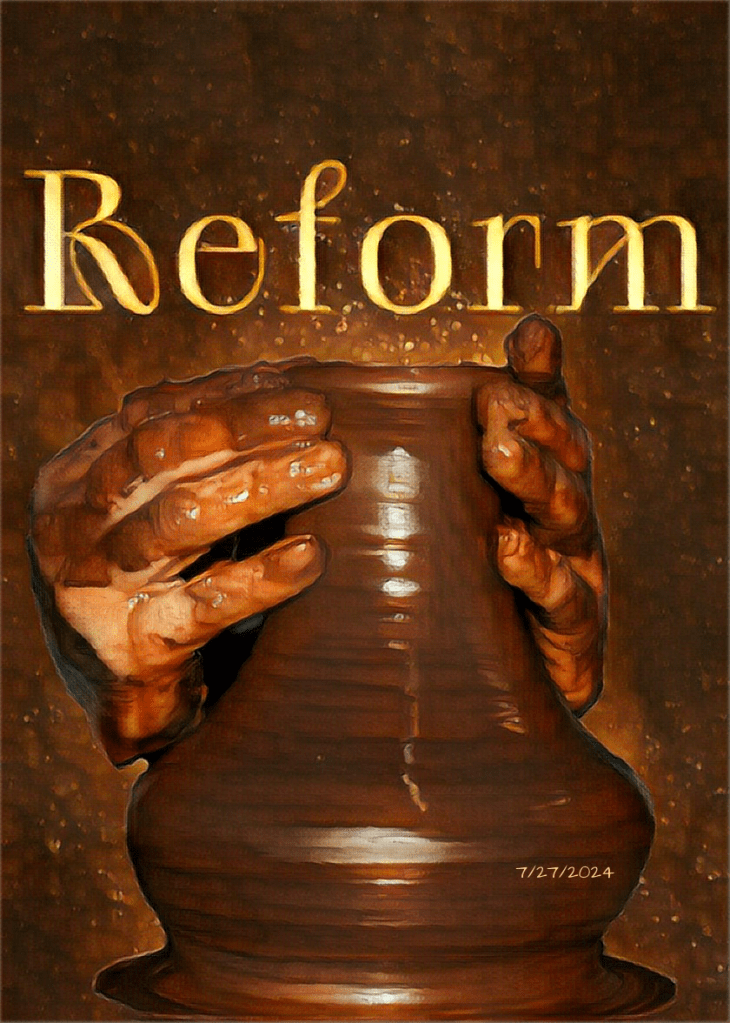
Thus says the LORD of hosts, the God of Israel: Reform your ways and your deeds, so that I may remain with you in this place. Put not your trust in the deceitful words: “This is the temple of the LORD! The temple of the LORD! The temple of the LORD!” Only if you thoroughly reform your ways and your deeds; if each of you deals justly with his neighbor; if you no longer oppress the resident alien, the orphan, and the widow; if you no longer shed innocent blood in this place, or follow strange gods to your own harm, will I remain with you in this place, in the land I gave your fathers long ago and forever. Jeremiah 7:3-7
Jeremiah tells the people that God wants to reform them in a very particular way. They are to be reshaped by justice, truthfulness, mercy, holy hospitality, non-violence, and faithful worship.
Today, in God’s Lavish Mercy: We examine our lives for where we need reformation. Don’t tell me you don’t need it. Everybody needs it. We get weary, distracted, hurt, stubborn, fooled, proud, and arrogant. These human conditions knock us out of spiritual shape. How great that God grants us the indulgence to reform and gladly assists us in the process!
Wisdom:
“In a higher world it is otherwise, but here below to live is to change, and to be perfect is to have changed often.”
Shepherd your people with your staff, the flock of your inheritance, That dwells apart in a woodland, in the midst of Carmel. Let them feed in Bashan and Gilead, as in the days of old; As in the days when you came from the land of Egypt, show us wonderful signs… Who is there like you, the God who removes guilt and pardons sin for the remnant of his inheritance; Who does not persist in anger forever, but delights rather in mercy… Micah 7:14-15; 18
Micah prophesied about 700 years before Christ. His world was under siege by Sennacherib the Assyrian king. In the midst of this devastation, many abandoned the one true faith. But there was a small faithful portion of believers – the remnant – whom Micah sought to both warn and encourage by his prophecies.
Today, in God’s Lavish Mercy: We, too, live in a time of siege. Our faith is constantly challenged by our culture, our politics, religious institutionalization, and our self-serving economy.
But Micah reminds us that still God shepherds us tenderly. God awaits our recognition of God’s graces and call to be among the remnant who do not lose faith.
Poetry: Friday – Elizabeth Jennings (1926-2001) Jennings ranks among the finest British poets of the second half of the twentieth century. She is also England’s best Catholic poet since Gerard Manley Hopkins.
We nailed the hands long ago,
Wove the thorns, took up the scourge and shouted
For excitement's sake, we stood at the dusty edge
Of the pebbled path and watched the extreme of pain.

But one or two prayed, one or two
Were silent, shocked, stood back
And remembered remnants of words, a new vision,
The cross is up with its crying victim, the clouds
Cover the sun, we learn a new way to lose
What we did not know we had
Until this bleak and sacrificial day,
Until we turned from our bad
Past and knelt and cried out our dismay,
The dice still clicking, the voices dying away.
Music: Arise and Shine – New Wine
Not a pleasing piece of music, but perhaps what Micah would sound like were he preaching today?
Jesus said: “Come to me, all you who labor and are burdened, and I will give you rest. Take my yoke upon you and learn from me, for I am meek and humble of heart; and you will find rest for yourselves. For my yoke is easy, and my burden light.”
Matthew 11:28-30
It is not that Jesus’s listeners are unfamiliar with being “yoked” – irrevocably tied to burdens and labor. But the yoke Jesus offers is different. Choosing it, they will be tied to him in learning his way of peace and love. When these gifts fill one’s heart, life’s weight is lightened. When we abide in such proximity to Jesus, the journey is easy.
Today, in God’s Lavish Mercy:
We listen to Jesus’s invitation, “Come …”. What is it that we are trying to carry without the help of his grace? Let’s tie those burdens to Christ’s love and open our hearts to learn from him.
Poetry: spring song by Lucille Clifton
the green of Jesus
is breaking the ground
and the sweet
smell of delicious Jesus
is opening the house and
the dance of Jesus music
has hold of the air and
the world is turning
in the body of Jesus and
the future is possible
Music: My Yoke is Easy – John Michael Talbot
All who are weary come unto Me All who find life a burden I will refresh you Your soul will find rest For My yoke is easy And My burden is light
Take my yoke on your shoulders and learn For I am gentle and humble I will refresh you Your soul will find rest I am gentle and humble of heart
My yoke is easy My burden is light Your soul will find rest Take My yoke on your shoulders and learn I am gentle and humble of heart
Come unto Me Your soul will find rest My yoke is easy My burden is light I am gentle and humble of heart
Jesus began to reproach the towns where most of his mighty deeds had been done, since they had not repented. “Woe to you, Chorazin! Woe to you, Bethsaida! For if the mighty deeds done in your midst had been done in Tyre and Sidon, they would long ago have repented in sackcloth and ashes. Matthew 11:20-21
Chorazin and Bethsaida were privileged. They had been blessed to see God’s power miraculously displayed in Jesus. And yet they failed to believe! How can that be? Hard-heartedness? Stupidity?
I think that, more likely, it was fear – the woeful condition that holds us back from giving ourselves to the truth. What would be required of them if they believed? What changes would they have to make in their lives? How would their comfortable world be turned upside-down?
Repentance: that would be the fruit of faith in Jesus. Many of them just couldn’t face it.
Today in God’s Lavish Mercy:
How committed is my faith? How is the Truth of Jesus alive in my life? What repentance, large or small, do I need to offer God?
Poetry: Savior – Maya Angelou
Petulant priests, greedy centurions, and one million incensed gestures stand between your love and me.
Your agape sacrifice is reduced to colored glass, vapid penance, and the tedium of ritual.
Your footprints yet mark the crest of billowing seas but your joy fades upon the tablets of ordained prophets.
Visit us again, Savior. Your children, burdened with disbelief, blinded by a patina of wisdom, carom down this vale of fear. We cry for you although we have lost your name.
Whatever town or village you enter, look for a worthy person in it, and stay there until you leave. As you enter a house, wish it peace. If the house is worthy, let your peace come upon it; if not, let your peace return to you. Whoever will not receive you or listen to your words— go outside that house or town and shake the dust from your feet. Matthew 10: 11-14
Jesus gives his disciples a lesson on how to deal with disappointment and frustration as they spread the Gospel. Not every heart is going to be open to them. Jesus wants them to give their mission a heartfelt try. But if it meets a wall, they should not bang their head against it. Just turn around, let it go, and shake off their concern. Let it be like so much “dust in the wind”.
Today, in God’s Lavish Mercy:
All disciples of Jesus, all who sincerely live and preach the Gospel, are going to meet frustration at many points in their lives. We live in a world that is often diametrically opposed to the Beatitudes, the Magnificat, the Our Father. We live with people who cover classroom walls with the Ten Commandments while breaking every one of them in personal practice.
It can be frustrating, but Jesus says not to get caught in that frustration. Rather, he teaches, shake it off and move on to more receptive ground.
Jesus was serious about this and, in another passage, used some harsh words to make his point:
Do not give what is holy to the dogs; nor cast your pearls before swine, lest they trample them under their feet, and turn and tear you in pieces. Matthew 7:6-7
Today, in God’s Lavish Mercy:
Over the course of our lives, we will find ourselves somewhere in these passages – disciples or frustraters, pearl- givers or swine! Wherever we stand, God’s grace awaits us.
Poetry: Shake Thyself from the Dust – Mary Hoyt Loveland
Shake thyself from the dust, faint heart; Loose thyself from bands that bind. Thou art not Assyria’s thrall; Captive, rise and freedom find!
Captive, this is Love’s own realm! Lo! the very hills rejoice That oppression is cast down; Yea, the streams lift up their voice.
Yea, each dewy blossom glows, Freed from error’s withering blight. Loosed from tyranny and fear, Captive, turn ye to the light!
Turn ye to the light, and see That no evil can dismay, Gathering clouds of bitterness, Hiding harmony from day.
Turn ye to the light, faint one; In the truth is freedom won!
Wednesday of the Fourteenth Week in Ordinary Time July 10, 2024
Jesus sent out these Twelve after instructing them thus, “Do not go into pagan territory or enter a Samaritan town. Go rather to the lost sheep of the house of Israel. As you go, make this proclamation: ‘The Kingdom of heaven is at hand.’” Matthew 10: 5-7
In this passage, Jesus is concerned with those who were offered faith in One God but have lost touch with it — “lost sheep of the house of Israel”. He wants these lost believers to be given the message, “The Kingdom of heaven is at hand.”
While the message conveys a sense of urgency (Hurry up and get your act together), it also offers a calming security. When something is “at hand”, we can touch it. We can hold on to it for balance. We can feel support and accompaniment as we we hold hands with a Loving Presence.
Today, in God’s Lavish Mercy: We may hear Jesus’s words either as a warning or an invitation to intimacy. Love is at hand for us, even if our faith has become distracted and our direction “lost”. We are invited to reach out to the God Who waits for us.
Poetry:
“The Beloved is with you in the midst of your seeking! God holds your hand wherever you wander.
Rumi
Music: Hold to God’s Unchanging Hand – Jennie Bain Wilson (1857) Sung here by Lynda Randle
Time is filled with swift transition, Naught of earth unmoved can stand, Build your hopes on things eternal, Hold to God’s unchanging hand. Refrain: Hold to God’s unchanging hand, Hold to God’s unchanging hand; Build your hopes on things eternal, Hold to God’s unchanging hand.
Trust in Him who will not leave you, Whatsoever years may bring, If by earthly friends forsaken Still more closely to Him cling.
When your journey is completed, If to God you have been true, Fair and bright the home in glory Your enraptured soul will view.







 Lavish Mercy