Whispers of God

Friday, June 15, 2018

Readings: http://www.usccb.org/bible/readings/061518.cfm

Whisper 6_15_18

Today, in Mercy, our first reading continues to follow the journey of Elijah, one wild and crazy guy – with a holy obsession for God.  Elijah is so frustrated with the hard-heartedness of the Israelites, that he whines constantly to God about it. God calls Elijah to Mt. Horeb (the same place where He first chatted with Moses) to talk the situation over. Elijah tries to find God’s voice there in a howling wind, an earthquake and a huge fire. No dice!

Elijah is so like us in this! Don’t we call on God in our troubled times, asking Him to fix things in a flash and glam? It is one of the ways we try to deal with the presence of evil in the world. We would love the security of a “Superman” God Who dramatically intervenes to reverse reality according to our comfort.

But how rare are such miracles! Instead, God abides quietly and steadily in the unfolding of our life, both in sorrow and joy. God whispers the directions to eternal life, deep under the noise of our human challenges – even evil, even death.

God’s word did come to Elijah eventually, not in the fiery demonstration he expected. It came in the gentle breeze of mercy, patience, fidelity and hope which most truly reflects the omnipotent nature of God.

Divinity is so quietly vibrant in all life. We must become equally quiet in our prayer and awareness to hear God’s whispers for us.

Music:  The Whispers of God ~ Marilyn Baker
Fired by Love

Wednesday, June 13, 2018

Readings: http://www.usccb.org/bible/readings/061318.cfm

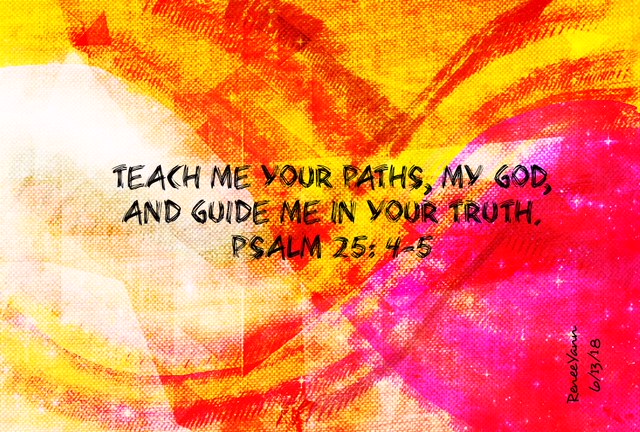
Ps 25 6_13_18

Today, in Mercy, when reading the passage about Elijah and the prophets of Baal, I was reminded of the Irving Berlin song, “Anything You Can Do, I Can Do Better”. In the reading, Elijah tests and even taunts Baal’s 450 prophets in a contest to prove whose God is true. Of course, Elijah wins in a stunning blast of fire. It is a religious exercise of “eradicate and supplant”.

The Gospel reading carries a similar theme.  Jesus’ followers seem to conclude that, because he is teaching something new, he is nullifying the customary Hebrew teachings. But Jesus says that, to the contrary, He is here to fulfill the Law, not to abolish it.

Religion, like any entrenched practice, tends over time to suffer the ill effects of institutionalization. Our rituals and devotions may become lifeless; our scriptures become rote. The power of our sacraments may be carelessly invoked and distractedly attended. A chasm grows between what we profess and what we live. We may become frozen. Sometimes, it might seem best to set the whole thing aflame and start all over again, like Elijah.

But Jesus challenges to us to go deeper than “practice”. Mere practice can easily become empty. Jesus shows us in his life what a fulfilled faith looks like. It is a faith expressed in service, sacrifice and inclusive mercy. It is a faith that, when brought to the pulpit and altar, carries the lives of those we love and serve. It is a faith, like the Psalmist’s, that listens for God’s direction deep in the experiences of life. It is a faith, not in contradiction to Law, but beyond it. It is a faith fired – transformed – by Love.

Music: Living Spirit, Holy Fire ~ David Haas

Radical Benediction

Monday, June 11, 2018

Readings: http://www.usccb.org/bible/readings/061118.cfm

Today, in Mercy, we begin several weeks of readings from Matthew’s Gospel. In today’s passage, Jesus starts out by turning the world upside-down!

Blessed 6_11_18

In the earlier chapters of his Gospel, Matthew has set the tone for the announcement of Jesus’ message – a new reign of grace and glory. The crowds gather in great anticipation. Most are overwhelmed and beleaguered by life under Roman occupation. Many hope for a political Messiah who will deliver them from their current circumstances, returning to them the material control of their lives. 

Instead, Jesus announces that:

“The kingdom of God can only be received by empty hands. Jesus warns against
(a) worldly self-sufficiency: you trust yourself and your own resources and don’t need God
(b) religious self-sufficiency: you trust your religious attitude and moral life and don’t need Jesus.”
~ Michael H. Crosby, Spirituality of the Beatitudes: Matthew’s Vision for the Church in an Unjust World

We are so used to hearing the Beatitudes that they may have become tamed for us — lovely consolations to the downtrodden that things will eventually be OK. On the contrary, the Sermon on the Mount proclaims a shocking message to those gathered with Jesus — AND to us. The radical blessedness of life is to be found within our ordinary joys and sorrows, embraced humbly, faithfully and joyfully.  It is to be found in right-relationship with all Creation, not in any kind of dominance by one over another – political, economic, or personal.

The poor in spirit, the meek, the bereaved, the justice-seekers, the merciful, the pure of heart, the peacemakers, the persecuted: Jesus says these people are blessed – even FORTUNATE – because there are no barriers between them and the fullness of God. Power, prestige and possessions block us, perhaps even cripple us, from our shared immersion in God’s ever-present love and grace.

It is likely that many who gathered on that Galilean Hill didn’t want to hear Jesus’ astonishing message. Their myopic vision of prosperity was turned upside down. They were challenged to an unexpected, comfort-shattering, radical blessedness. Would they accept the challenge? Will we?

Music:  Blessings ~ Laura Story

An Eternal Weight of Glory

Sunday, June 10, 2018

Readings: http://www.usccb.org/bible/readings/061018.cfm

Today, in Mercy,  is a powerful Sunday!

woke 6_10_18

In our readings, we encounter one of the more perplexing Gospel passages. Jesus, in the thick of controversy with the scribes and Pharisees, goes home to seek some respite. But the crowds follow, harassing him with questions and demands for signs. His friends and family are increasingly concerned for him, as the animosity to his challenging message rises. Some even think he is unhinged to jeopardize himself by confronting the evils and blindnesses of his society. His mother and brothers arrive, concerned for him. When Jesus learns this, he delivers what may seem a hard-hearted comment, “Who are my mother and my brothers?” — they are the ones who do the will of God.

With this question, Jesus is not disowning his family and those who love him. He is stating clearly that, rather than deter him from his redemptive work, they need to open their minds to the deeper purpose of his life. To use a contemporary phrase rooted in the socially conscious African-American community – they need to be “woke” people. 

How hard it must have been for them! How hard to love a prophet, to fear for their safety in times when truth and justice are assailed!

Walter Brueggemann, in my all-time favorite book Prophetic Imagination, says this:

“In both his teaching and his very presence, Jesus of Nazareth presented the ultimate criticism of the royal consciousness (or self-serving power of the dominant state). He has, in fact, dismantled the dominant culture and nullified its claims. The way of his ultimate criticism is his decisive solidarity with marginal people and the accompanying vulnerability required by that solidarity. The only solidarity worth affirming is solidarity characterized by the same helplessness they know and experience.” 

In today’s second reading, Paul is experiencing the same kind of vulnerability as Jesus. Paul says that he is not discouraged for:

“ … although our outer self is wasting away,
our inner self is being renewed day by day.
For this momentary light affliction
is producing for us an eternal weight of glory
beyond all comparison,
as we look not to what is seen but to what is unseen;
for what is seen is transitory, but what is unseen is eternal.”

As Christians, we are called to live prophetic lives in imitation of Jesus. We are called to foster that kind of witness in others, to work together for that “eternal weight of glory”.

The prophet Dorothy Day puts it this way:

“As we come to know the seriousness of the situation, the war, the racism, the poverty in our world, we come to realize that things will not be changed simply by words or demonstrations. Rather, it’s a question of living one’s life in a drastically different way.”

On this powerful Sunday, the message is this: we need to be “woke” people!

Music: Wake Up My Heart ~ The Afters

Ransomed

Wednesday, May 30, 2018

Readings: http://www.usccb.org/bible/readings/053018.cfm

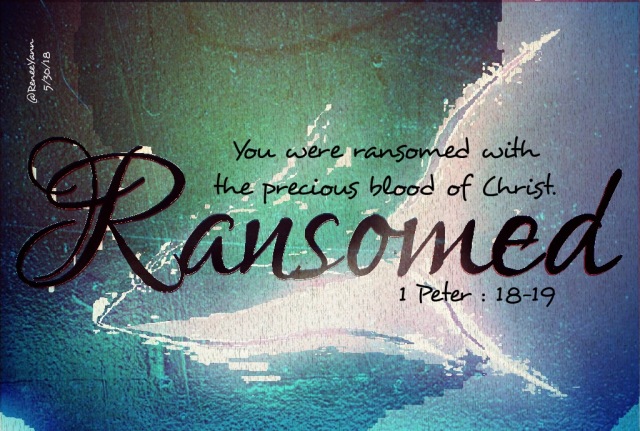
1 Pet1_18 ransomed

Today, in Mercy, Peter tells us that we have been ransomed at an infinite price – the blood of Jesus. And what have we been ransomed from? The early Christians were quite familiar with slavery, some having been enslaved themselves. Peter shows them that their souls too may be enslaved.

In any form, slavery is a restriction or loss of freedom. It may be physical, psychological, emotional, spiritual or intellectual. It is that place where our Truth is constricted by the negativity of another force.

Peter tells us that we have been freed “so that our faith and hope are in God” and not in anything that can chain our souls. He tells us that we have been born anew so that we can love one another intensely from a pure heart.

Today, let’s pray for those, even ourselves, enslaved in any way – through illness, addiction, stereo-typing, racism, domination, poverty or ignorance; for those who are trafficked, for immigrants cruelly separated from family, for the unjustly or inhumanely imprisoned, for those forced from their homeland by war and violence.

Let us pray for conversion and forgiveness for any role we may have played, however unwittingly, in sustaining these social evils.

Music: Chorus of the Hebrew Slaves from Verdi’s opera Nabucco. Inspired by Psalm 137, this mournful melody recalls the enslavement of Jews during the Babylonian Captivity.

Break the Chains, Lord!

Tuesday, May 8, 2018

Readings: http://www.usccb.org/bible/readings/050818.cfm

Today, in Mercy, the reading from Acts gives us high drama drawn from real-life events. Paul and Silas, singing hymns and praying after their torture, are sprung from prison chains by God’s power in the form of an earthquake. It’s movie material!

But how does it apply to our lives? Are there chains holding us back from the fullness of our spiritual life? Unredeemed sorrows, cherished vengeances, life-sapping addictions, self-absorbed agendas – so many poor choices can block us from freedom and amazement in God! Let’s pray today for our own little earthquakes. Let’s acknowledge the chains and pray for them to break even if it shakes our world up a bit!

Acts 16_26 Chains

The Road to Conversion

Friday, April 20, 2018:

Readings: Acts 9:1-20, Psalm 117:1-2; John 6:52-59

Today, in Mercy, we ride with Paul on the road to Damascus. His soul is struck by grace and he realizes his sinfulness – that he has failed to see the presence of God in all people. He turns from his persecution to actually become a Christian himself. Conversion!

One wonders what that same road might look like today – the countryside and its people devastated by the continuing Syrian War. War would be impossible if we truly could see the face of God in one another. Let’s pray today for a conversion of hearts in leaders, in all those who profit from war, and in ourselves. Let’s pray especially for the people devastated by war and the exercise of irresponsible power.