Trust not Fear

Memorial of Saint Cecilia, Virgin and Martyr
Wednesday of the Thirty-third Week in Ordinary Time
November 22, 2023

Today’s Readings:

https://bible.usccb.org/bible/readings/112223.cfm

Today, in God’s Lavish Mercy, our two readings are dramatically intense. 

Who can read the story of the Maccabean Martyrs without a mix of horror, empathy, and astonishment?

It happened that seven brothers with their mother were arrested
and tortured with whips and scourges by the king,
to force them to eat pork in violation of God’s law.
Most admirable and worthy of everlasting remembrance was the mother,
who saw her seven sons perish in a single day,
yet bore it courageously because of her hope in the Lord.

2 Maccabees 7: 1;20

And don’t we all feel a pang of pity for the poor, fearful servant who hid his talent in a handkerchief much to the King’s displeasure?

‘Sir, here is your gold coin;
I kept it stored away in a handkerchief,
for I was afraid of you, because you are a demanding man;
you take up what you did not lay down
and you harvest what you did not plant.’
He said to him,
‘With your own words I shall condemn you,
you wicked servant.
You knew I was a demanding man,
taking up what I did not lay down
and harvesting what I did not plant;
why did you not put my money in a bank?

Luke 19:20-23

The two stories paint a contrasting picture of courageous faith against fearful subservience. The difference between the actors lies in their capacity, or lack thereof, to look beyond themselves toward eternal life.
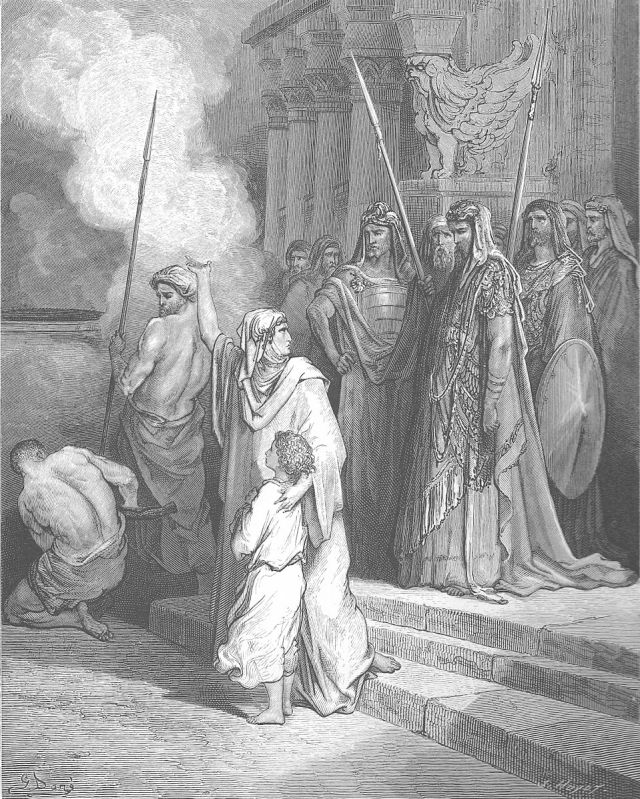
The Courage of a Mother – Gustave Doré

Mother Maccabee bolsters her sons with her faith in a life beyond their current circumstances:

… the Creator of the universe
who shapes each man’s beginning,
as he brings about the origin of everything,
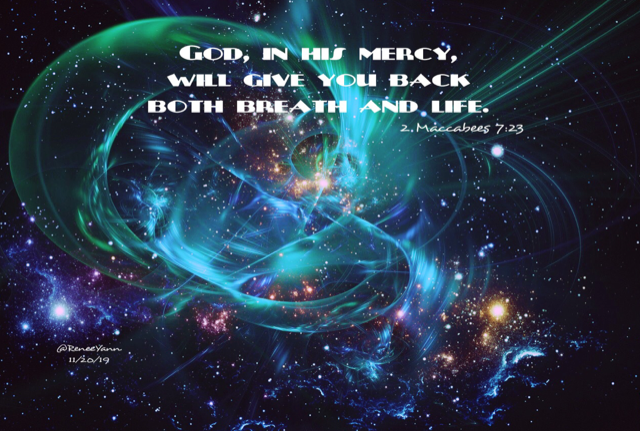
he, in his mercy,
will give you back both breath and life,
because you now disregard yourselves
for the sake of his law.


The poor soul in Jesus’s parable doesn’t have that faith and vision. His perception of God, represented by the King, is one of only harsh judgment. His fear causes him to bury not only his talent, but also his openness to the possibilities of grace and transformed relationship with God.


Jesus told his parable because indeed the Kingdom was at hand. He and his disciples were near Jerusalem where the Passion, Death and Resurrection events would begin.

He wants his followers to realize the challenging gift they have been given in their call to be his disciples. He wants them to see that it is now on them to magnify his message courageously and generously until he returns to perfect the Kingdom.

He wants us to understand that too.


Poetry – John Milton, Sonnet 19

Milton (1608- 1674) is widely considered one of the preeminent writers of the English language. By 1652, Milton had become totally blind and had to dictate his verse. He appears to wonder, in this sonnet, how his God-given talent for writing will be enhanced now that he is “light denied”. He looks to another parable for his answer – the Parable of the Workers. Even those who only stood and waited were rewarded.

When I consider how my light is spent,
Ere half my days, in this dark world and wide,
And that one Talent which is death to hide
Lodged with me useless, though my Soul more bent
To serve therewith my Maker, and present
My true account, lest he returning chide;
“Doth God exact day-labor, light denied?”
I fondly ask. But patience, to prevent
That murmur, soon replies, “God doth not need
Either man’s work or his own gifts; who best
Bear his mild yoke, they serve him best. His state
Is Kingly. Thousands at his bidding speed
And post o’er Land and Ocean without rest:
They also serve who only stand and wait.”

Music:   Be Not Afraid – written by Bob Dufford, SJ, sung here by Cat Jahnke

Stretching for God

Memorial of the Presentation of the Blessed Virgin Mary
Tuesday of the Thirty-third Week in Ordinary Time
November 21, 2023

Today’s Readings:

https://bible.usccb.org/bible/readings/112123.cfm


Today, in God’s Lavish Mercy, our readings are about living in the big picture of God’s vision for us.

Lk19_3 forest_trees

Once again, we meet Zacchaeus who, due to his short stature, was unable to get a glimpse of Jesus walking nearby. He wasn’t getting the whole picture but he wanted to!

Zacchaeus ran ahead and climbed a sycamore tree in order to see Jesus,
who was about to pass that way.
When he reached the place, Jesus looked up and said,
“Zacchaeus, come down quickly,
for today I must stay at your house.”
And he came down quickly and received him with joy.

Luke 19:4-5

Sometimes we miss Christ in our midst, don’t we? It may be because we’re “short” on time, patience, faith, attention, courage, peace, desire … you name it.

Zacchaeus may have been physically short, but he was tall in will and intention to see Jesus. The trees became his tools, not his obstacles.


In our first reading, Eleazar was a giant in the virtues necessary to “see beyond the trees” of his current circumstances. A more spiritually short-sighted person might have succumbed to the temptation to save himself at the cost of his faith and witness.

But Eleazar’s faith was long, both in years and in depth. He kept the eyes of his heart focused on that faith and was delivered beyond any short-sighted choices.

Eleazar made up his mind in a noble manner,
worthy of his years, the dignity of his advanced age,
the merited distinction of his gray hair,
and of the admirable life he had lived from childhood;
and so he declared that above all
he would be loyal to the holy laws given by God.

2 Maccabees 6:23

It’s hard sometimes to see the forest beyond the trees – to direct our choices, attitudes, and actions by a vision we glimpse only in the stretch of faith and prayer.

Perhaps these two God-seekers can inspire us today by their courage, steadfastness and faith to always live within God’s long eternal vision for us.


Zaccheus – by Richard Medrington

I hope you enjoy this clever poem as much as I did.

Here’s a man we all despise,
Damn his hide and damn his eyes.
Pray that God will some day free us,
From that loathsome leech Zacchaeus.
See him sitting at his table,
Takes as much tax as he’s able,
Stashes some away for later,
Dirty, double-dealing traitor.
Lord of liars, chief of crooks,
Look at how he cooks the books!
Renders what is ours to Caesar,
Cheating, money-grubbing geezer.
He’s the man we love to hate,
Vulgar, vapid reprobate,
Lounging in his lavish house,
Cringing toady, thieving louse.
Wonder how he got so rich?
Greedy, filching, little snitch.
We would lynch the poison gnome,
Were he not employed by Rome.
Then when Jesus comes to town,
See his smile turn to a frown!
Though he’s arrogant and proud,
He cannot see above the crowd.
How we laugh to see him squirm,
Nasty, creeping, crawling worm,
But here’s a thing not seen before:
A sell-out in a sycamore!
Now he’s shouting from the tree,
“Jesus, Jesus look at me!”
Hope he falls, the tiresome tyke,
Falls and lands upon a spike.
Careful Jesus. Don’t be conned,
Just ignore him, don’t respond.
Move on quickly, if you linger
He will twist you round his finger.
Then a voice rings loud and clear,
“Zack mate, get yourself down here!
I spy you in that sycamore,
And you’re the man I’m looking for.”
Now he’s off to have his dinner
With a man who is a sinner
And a traitor to our nation!
He’s gone down in our estimation.
Fraternising with our foe,
Of all the places he could go!
Who would think a man like that
Would take his meals with such a rat?
I beg your pardon, did you say
Zach’s giving half his wealth away?
Dispensing money to the poor?
This too has not been seen before.
And if he’s asked for too much tax
He’s giving fourfold rebates back?
Well, that’s amazing! If it’s true,
There’s going to be a massive queue.
I’m not that easy to deceive.
When I see it, I’ll believe.
He’ll fleece us when the Master’s gone,
It’s just another taxman’s con.
But Jesus says, “It is no scam,
He is a son of Abraham.
Salvation landed here today,
I seek for those who’ve gone astray,
And even though you think it strange,
Occasionally people change,
So do not look at him askance
But give the man a second chance.”
Of course at first this all seemed grand,
The thought of all that cash in hand!
But very soon we came to see
That nothing in this world is free.
In righteous wrath we had estranged him,
Then someone came along and changed him!
Thank you, Jesus. Smashing! Great!
Now there’s no one left to hate!
Since Zach is generous and kind
We’ve nothing left to hide behind.
He radiates with joy and thus
His kindly light exposes us.
His very presence seems to say,
“My life has changed from night to day.
Now tell me what is stopping you
From changing things in your life too?”
So here’s the source of our complaints:
Zacchaeus made us feel like saints,
But now we must admit it’s true
That we are rotten sinners too.
We pray that God will soon restore
Zacchaeus as he was before,
Or Jericho shall rue the day
That Jesus chose to pass this way.

Music: Zacchaeus – An oldie but goodie from Sister Miriam Therese Winter and the Medical Mission Sisters

Endurance

Monday of the Thirty-third Week in Ordinary Time
November 20, 2023

Today’s Readings:

https://bible.usccb.org/bible/readings/112023.cfm


Today, in God’s Lavish Mercy, we enter the liturgical year’s final two weeks. Our companions from the Hebrew Scriptures will be the Maccabees and Daniel. Our New Testament companion will continue to be the eloquent Luke.


The singular virtue proclaimed through the Books of Maccabees and Daniel is this: FAITHFUL ENDURANCE. As we approach the “end times” of our Liturgical Year, the Church is reminding us to pursue and value this virtue in our own lives.

Anthiochos – Michel Francois DandrE Bardon
(Anthiochos IV Epiphanes Orders the Massacre of the Maccabees)

In today’s passage from Maccabees, we read about King Antiochus Epiphanes’s sacrilegious enculturation of the Israelites in an attempt to gain civil appeasement and material prosperity. Antiochus was a mean and bad guy. Likely because he felt his power threatened by them, he tried – in the vilest of ways – to suppress the Jews and their religious culture. The Book of Maccabees is the story of Jews who stood up to the suppression.


In our Gospel, Jesus meets a blind person who pleads with him, “Lord, please let me see!”. Jesus restores the person’s vision with the assurance that faith has wrought the miracle. In other words, the blind person already “saw” in a deeper way because of faith. That faith offered the insight to engage Jesus’s Divine Power for complete healing.


Because of their profound faith, the Maccabees could see through the king’s faithless campaign. They could endure ruthless persecution to remain faithful to the God they believed in.

Few of us will meet the kind of physical persecution for the faith endured by the Maccabees. But throughout our lives, our fidelity will be ruthlessly tested by our culture. We will continually be tempted to compromise our faithful practice for the sake of convenience, appeasement, material prosperity, or advantage over others.


And so often we are blind to these enculturations. We become insensitive or indifferent to the injustices and fallacies of our culture and how they might be affecting our attitudes, choices, and behavior.

As we journey with the Maccabees, Daniel, and Luke over these two weeks, let’s pray for clear vision and courageous action around the profound sacrileges of our times: war, violence, irreverence for life, exaltation of gun culture, economic domination, immigration injustice, and the many systemic “isms” by which we marginalize our sisters and brothers.


Prayer: Our Responsorial Psalm today offers a powerful plea to be delivered from the culture of death so predominant in our world:

R. Give me life, O Lord, and I will do your commands.
Indignation seizes me because of the wicked
who forsake your law.
R. Give me life, O Lord, and I will do your commands.
Though the snares of the wicked are twined about me,
your law I have not forgotten.
R. Give me life, O Lord, and I will do your commands.
Redeem me from the oppression about me,
that I may keep your precepts.
R. Give me life, O Lord, and I will do your commands.
I am attacked by malicious persecutors
who are far from your law.
R. Give me life, O Lord, and I will do your commands.
Far from sinners is salvation,
because they seek not your statutes.
R. Give me life, O Lord, and I will do your commands.
I beheld the apostates with loathing,
because they kept not to your promise.
R. Give me life, O Lord, and I will do your commands.


Music: For What It’s Worth – Buffalo Springfield

Swooped into God!

Memorial of Saint Elizabeth of Hungary
Friday of the Thirty-second Week in Ordinary Time
November 17, 2023

Today’s Readings:

https://bible.usccb.org/bible/readings/111723.cfm


Today, in God’s Lavish Mercy, our two readings remind us that the journey into God is an ever-deepening passage to which we must continually open our hearts.

The Wisdom writer addresses those who sincerely seek God, but who cannot see beyond God’s handiwork. So they are satisfied to make gods of these created wonders:

All persons were by nature foolish who were in ignorance of God,
and who from the good things seen did not succeed in knowing him who is,
and from studying the works did not discern the artisan;
But either fire, or wind, or the swift air,
or the circuit of the stars, or the mighty water,
or the luminaries of heaven, the governors of the world, they considered gods.
Now if out of joy in their beauty they thought them gods,
let them know how far more excellent is the Lord than these;
for the original source of beauty fashioned them.

Wisdom 13:1-3

The writer seems astounded that these seekers get lost on their way to full knowledge of God:

For they search busily among his works,
but are distracted by what they see,
because the things seen are fair.
But again, not even these are pardonable.
For if they so far succeeded in knowledge
that they could speculate about the world,
how did they not more quickly find its Lord?

Wisdom 13: 7-9

I don’t find it so astounding. The invisible God we love and worship can be elusive, and the world through which we seek that God can be deeply distracting. I think it’s pretty easy to get stuck worshipping signs of God (which we can see) rather than God (Whom we cannot see). I think that’s what Jesus might have meant when he said, “Blessed are the pure of heart, for they shall see God.”


Our Gospel reading gives us a hint about truly seeking God. It’s a reading I have always found a little bit scary. As a child, I envisioned myself, or the dear person next to me, getting swooped up in some unexpected divine tornado. It wasn’t a comfortable image.

I tell you, on that night there will be two people in one bed;
one will be taken, the other left.
And there will be two women grinding meal together;
one will be taken, the other left.”
They said to him in reply, “Where, Lord?”
He said to them, “Where the body is,
there also the vultures will gather.”

Luke 17: 34-37

I mean, really, this is nobody’s favorite scripture passage! But what can it teach us? Maybe this: just like the unfulfilled worshippers in our Wisdom passage, the folks Jesus describes were distracted by the necessities and frivolities of life. In their spiritual journeys, they had not fully opened their hearts to the holy expectation of God. When God comes in a swoop of Infinite Grace, they’re just not ready for the swooping!


In our readings today, both the Wisdom writer and Jesus are encouraging us to meet every life experience as an opportunity to move deeper into the mystery of God.

The Wise One tells us to look beyond the beautiful distractions of our lives into the One Who ordains them:

Now if out of joy in their beauty they thought them gods,
let them know how far more excellent is the Lord than these;
for the original source of beauty fashioned them.

Wisdom 13:3

And Jesus very bluntly tells us that our visible experiences hold a deeper meaning that we will never know unless we yield our life fully to God’s transforming grace:

Whoever seeks to preserve their life will lose it,
but whoever loses it will save it.

Luke 17:33

Poetry: If only there were stillness, full, complete – Rainer Maria Rilke

If only there were stillness, full, complete.
If all the random and approximate
were muted, with neighbors’ laughter, for your sake,
and if the clamor that my senses make
did not confound the vigil I would keep —
Then in a thousandfold thought I could think
you out, even to your utmost brink,
and (while a smile endures) possess you, giving
you away, as though I were but giving thanks,
to all the living.

Music: Jessye Norman – Sanctus from Messe solennelle de Sainte Cécile in G major, by Charles Gounod

I never hear this piece without being awestruck by Ms. Norman’s magnificent voice. I had the great joy of meeting her and working with her briefly on a project over thirty years ago. She was majestic in every way. May she rest in Peace.

Outrageous Faith

Memorial of Saint Frances Xavier Cabrini
Monday of the Thirty-second Week in Ordinary Time
November 13, 2023

Today’s Readings:

https://bible.usccb.org/bible/readings/111323.cfm


Today, in God’s Lavish Mercy, we have only three weeks left in Ordinary Time before Advent. Today, we begin a week of first readings from the beautifully written Book of Wisdom.

These will be counterpointed by readings from Luke 17, filled with familiar images like millstones, mustard seeds, ungrateful lepers, a grateful one, and the one plowman taken from a field while the shocked other is left.


While our Gospel readings call us to be alert to the end of time and the coming of the Reign of God, our Wisdom readings – while cautionary – stretch us beyond time to the awareness of an Eternal Love rooted in our own hearts:

For wisdom is a kindly spirit,
yet she acquits not the blasphemer of their guilty lips;
Because God is the witness of the inmost self
and the sure observer of the heart
and the listener to the tongue.
For the Spirit of the Lord fills the world,
is all-embracing, and knows what the human heart says.

Wisdom 1: 6-7

In our Gospel, Jesus calls us to model goodness, practice forgiveness, and exercise an outrageous faith.

And the Apostles said to the Lord, “Increase our faith.”
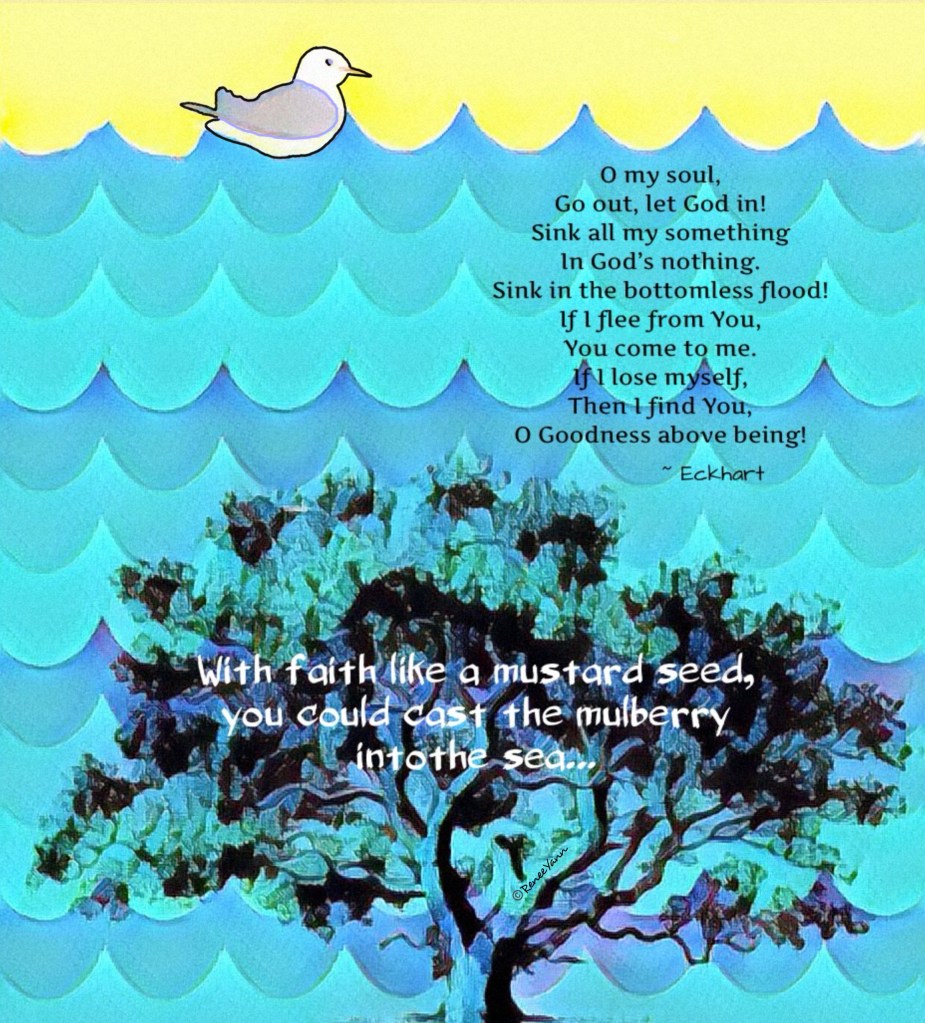
The Lord replied, “If you have faith the size of a mustard seed,
you would say to this mulberry tree,
‘Be uprooted and planted in the sea,’ and it would obey you.”

Luke 17: 5-6

Perhaps we’re not really too interested in throwing a mulberry tree into the sea, but let’s desire to live our faith so fully that the world considers us outrageously foolish for the sake of Christ.

Thinking about that this morning, I remember dear Mr. Stein, the owner of the delicatessen where I worked throughout my high school years. The Stein family loved me and all were so kind to me. But when I told them I would be leaving to enter the convent, they were shocked and terribly upset. You would have thought I was leaving for a life sentence in Sing Sing! Mr. Stein took me aside and said, “Renee, please don’t be so foolish and waste your life! I’ll buy you a new car if you don’t go!”

Besides the fact that I didn’t drive at the time, Mr. Stein’s offer didn’t sway me. I knew the treasure I had found. I just hoped that, watching my life unfold over the coming years, Mr. Stein (and quite a few other skeptics!) might recognize the treasure too.
(P.S. I didn’t learn to drive for almost another twenty years!)


Poetry: The Mustard Seed – Meister Eckhart

I.

In the Beginning
High above understanding
Is ever the Word.
O rich treasure,
There the Beginning always bore the Beginning.
O Father’s Breast,
From thy delight
The Word ever flows!
Yet the bosom
Retains the Word, truly.

II.

From the two as one source,
The fire of love.
The bond of both,
Known to both,
Flows the All-Sweet Spirit
Co-equal,
Undivided
The Three are One.
Do you understand why? No.
It best understands itself.

III.

The bond of three
Causes deep fear.
Of this circle
There is no understanding.
Here is a depth without ground.
Check and mate
To time, forms, place!
The wondrous circle
Is the Principle,
Its point never moves.

IV.

The mountain of this point
Ascend without activity.
O intellect!
The road leads you
Into a marvelous desert,
So broad, so wide,
It stretches out immeasurably.
The desert has,
Neither time nor place,
Its mode of being is singular.

V.

The good desert
No foot disturbs it,
Created being
Never enters there:
It is, and no one knows why.
It is here, it is there,
It is far, it is near,
It is deep, it is high,
It is in such a way
That it is neither this nor that.

VI.

It is light, it is clear,
It is totally dark,
It is unnamed,
It is unknown,
Free of beginning or end.
It stands still,
Pure, unclothed.
Who knows its dwelling?
Let him come forth
And tells us what sort it is.

VII.

Become like a child,
Become deaf, become blind.
Your own something
Must become nothing;
Drive away all something, all nothing!
Leave place, leave time,
Avoid even image!
Go without a way
On the narrow path,
Then you will find the desert’s track.

VIII.

O my soul,
Go out, let God in!
Sink all my something
In God’s nothing.
Sink in the bottomless flood!
If I flee from You,
You come to me.
If I lose myself,
Then I find You,
O Goodness above being!

Music: This Ancient Love – Carolyn McDade

Beyond Fear

Memorial of Saint Martin of Tours, Bishop
November 11, 2023

Today’s Readings:

https://bible.usccb.org/bible/readings/111123.cfm


Today, in God’s Lavish Mercy, there is a graceful coincidence of several themes calling me to prayer. I share them with you:

  • On November 11th, Sisters of Mercy throughout the world commemorate the death of our beloved founder Catherine McAuley.
  • This year that commemoration falls on the feast of the beautiful St. Martin of Tours.
  • Our readings for the day prompt us to consider our beloved companions on our spiritual journey who provide a harbor of blessings in a fearsome world.

Not just today, but often, I think about what Catherine would be like if she lived among us today. In her day, she was ever practical, focusing on healing the greatest unmet needs around her.

Her “un-technologized” world was smaller than ours. She encountered need simply by a walk through Dublin’s neighborhoods. Were she here today, need would pour into her awareness from every corner of the earth via technological means. How would she focus the power of her merciful heart for our times?


Our readings prompt me to think that Catherine would do the same three things she did almost two hundred years ago:

  • She would gather her companions on the journey
  • Together, they would empty their spirits of anything that was not of God
  • In that profound spiritual clarity, they would see where God called them to be Mercy for the world.

In our first reading, Paul names a number of his companions, those who strengthened and assisted him in life and ministry. Catherine too had beloved companions without whom she could not have met the challenges of her call.


In our Gospel, Jesus affirms that our hearts must be emptied of the undue love of anything that distracts us from God and God’s Way:

No servant can serve two masters.
He will either hate one and love the other,
or be devoted to one and despise the other.
You cannot serve God and mammon.”
The Pharisees, who loved money,
heard all these things and sneered at him.And he said to them,
“You justify yourselves in the sight of others,
but God knows your hearts;
for what is of human esteem is an abomination in the sight of God.”

Luke 16: 12-15

While in her times, Catherine encountered the ravages of material poverty, I think that something much less tangible, but exponentially more destructive, would capture her ministerial awareness today.

Our world suffers from an intrinsic and debilitating fear which inclines us to amass power and possessions to the impoverishment of those around us. The fear of not being or having enough drives the systemic predation of the rich upon the poor, and the powerful over the weak. It is a fear that grows in a heart emptied of God.

While Catherine would continue to address the needs of those suffering from poverty and disenfranchisement, I think she would reach out in a new way to the healing of those underlying fears. These fears fester in a culture of spiritual ignorance endemic to our modern society. The naming and healing of that ignorance is deeply congruous with Catherine’s charism and calls to us urgently today.


About St. Martin de Porres, Pope John XXIII said this:

“He loved his neighbors with the benevolence
of the heroes of the Christian faith.”

So did Catherine McAuley. So must we.


Poetry: Where the Mind is Without Fear – Rabindranath Tagore

Where the mind is without fear and the head is held high
Where knowledge is free
Where the world has not been broken up into fragments
By narrow domestic walls
Where words come out from the depth of truth
Where tireless striving stretches its arms towards perfection
Where the clear stream of reason has not lost its way
Into the dreary desert sand of dead habit
Where the mind is led forward by thee
Into ever-widening thought and action
Into that heaven of freedom, my Father, let us awake.


Music: There is No Fear in Love – The Bible Project

Phat Phylacteries!

Thirty-first Sunday in Ordinary Time
November 5, 2023


Today’s Readings:

https://bible.usccb.org/bible/readings/110523.cfm


Today, in God’s Lavish Mercy, our readings perfectly complement one another delivering a clear message: all leadership, including spiritual leadership, requires the disciplines of humility, honesty, justice, mercy, and love.

These disciplines are so easy to lose in the euphoria of power and the delusions of superiority. Malachi, prophet of the 5th century before Christ, vehemently points this out. Speaking for God, the prophet states:

O priests, … I will send a curse upon you
and of your blessing I will make a curse.
You have turned aside from the way,
and have caused many to falter by your instruction;
you have made void the covenant of Levi,
says the LORD of hosts.
I, therefore, have made you contemptible
and base before all the people,
since you do not keep my ways,
but show partiality in your decisions.

Malachi 2:2

Five hundred years later, Jesus echoes the rebuke to his own generation:

Do not follow the example of the scribes and Pharisees.
For they preach but they do not practice.
They tie up heavy burdens hard to carry
and lay them on people’s shoulders,
but they will not lift a finger to move them.
All their works are performed to be seen.
They widen their phylacteries and lengthen their tassels.
They love places of honor at banquets, seats of honor in synagogues,
greetings in marketplaces, and the salutation ‘Rabbi.’

Matthew 23: 3-7

What are phylacteries anyway, and what is Jesus talking about when he describes them as widened?


The wearing of phylacteries in Jewish practice is similar to Christians wearing crosses or being signed with ashes on Ash Wednesday, All of these devotional acts are intended to demonstrate one’s faith and invite others to faithful practice. But when exaggerated, such practices draw attention to oneself rather than to the faith. It is often an attempt to proclaim the superiority of one’s faith perhaps because, in our hearts, we are unsure of it.


Jesus says that such exaggerated devotion is unnecessary when our lives speak for themselves, demonstrating faith through our works of mercy.

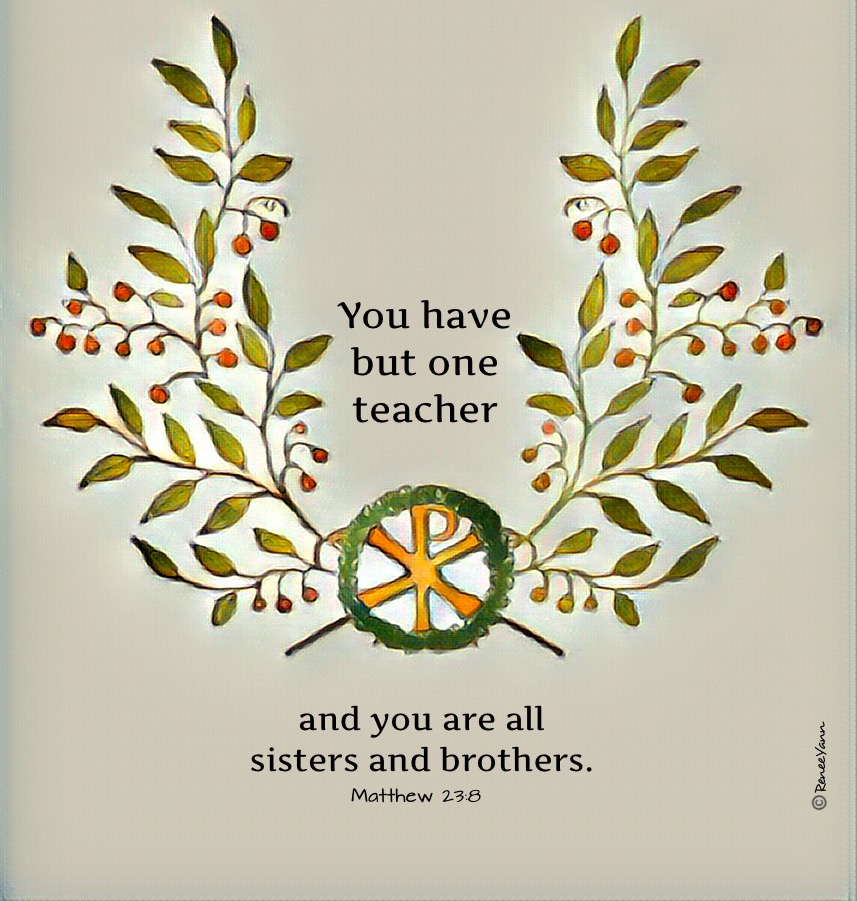
You have but one teacher, and you are all brothers.
Call no one on earth your father;
you have but one Father in heaven.
Do not be called ‘Master’;
you have but one master, the Christ.
The greatest among you must be your servant.
Whoever exalts himself will be humbled;
but whoever humbles himself will be exalted.

Matthew 23: 8-12

We are all leaders at some level in our lives — parents, teachers, supervisors, politicians, clinicians, and everyone who has influence over another’s life. In each of these roles, our soul’s lens can be turned toward ourselves, or it can be turned in merciful care toward the other. The way we effectively turn the lens is to continually deepen ourselves in the greatest commandment: Love God above all things and your neighbor as yourself.


Poetry: Some keep the Sabbath going to Church – Emily Dickinson

Some keep the Sabbath going to Church –
I keep it, staying at Home –
With a Bobolink for a Chorister –
And an Orchard, for a Dome –
Some keep the Sabbath in Surplice –
I, just wear my Wings –
And instead of tolling the Bell, for Church,
Our little Sexton – sings.
God preaches, a noted Clergyman –
And the sermon is never long,
So instead of getting to Heaven, at last –
I’m going, all along.

Music: Where I Find God – Larry Fleet

The night I hit rock bottom, sittin’ on an old barstool
He paid my tab and put me in a cab, but he didn’t have to
But he could see I was hurtin’, oh, I wish I’d got his name
‘Cause I didn’t feel worth savin’, but he saved me just the same

That day out on the water, when the fish just wouldn’t bite
I put my pole down, I floated around, was just so quiet
And I could hear my old man sayin’ “Son, just be still
‘Cause you can’t find peace like this in a bottle or a pill”

From a bar stool to that Evinrude
Sunday mornin’ in a church pew
In a deer stand or a hay field
An interstate back to Nashville
A Chevrolet with the windows down
Me and him just ridin’ around
Sometimes, whether I’m lookin’ for Him or not
That’s where I find God

Sometimes late at night, I lie there and listen
To the sound of her heart beatin’
And the song the crickets are singin’
And I don’t know what they’re sayin’
But it sounds like a hymn to me
Naw, I ain’t too good at prayin’
But thanks for everything

From a bar stool, to that Evinrude
Sunday mornin’ in a church pew
In a deer stand or a hay field
An interstate back to Nashville
A Chevrolet with the windows down
Me and him just ridin’ around
Sometimes, whether I’m lookin’ for Him or not
That’s where I find God

From a bar stool, to that Evinrude
Sunday mornin’ in a church pew
In a deer stand or a hay field
An interstate back to Nashville
A Chevrolet with the windows down
Me and him just ridin’ around
Talkin’, well I do that a lot
Well, I do that a lot
That’s where I find God

The Glory Yet to Come

Tuesday of the Thirtieth Week in Ordinary Time
October 31, 2023

Today’s Readings:

https://bible.usccb.org/bible/readings/103123.cfm


Today, in God’s Lavish Mercy, we pray with Psalm 126, a song of hope fulfilled:

When the LORD brought back the captives of Zion,
    we were like men dreaming.
Then our mouth was filled with laughter,
    and our tongue with rejoicing.

Then they said among the nations,
    “The LORD has done great things for them.”
The LORD has done great things for us;
    we are glad indeed.

Psalm 126: 1-3

In our readings, we are called to be people of hope – to live in gratitude for hopes fulfilled, and to live in confidence of future blessing.


Paul blesses us with some of his most powerful words:

I consider that the sufferings of this present time are as nothing
compared with the glory to be revealed for us.

Romans 8:18

How often, over the ensuing centuries, have these words uplifted and bravened a struggling heart! Paul reminds us of what he so passionately believed – that we are not here for this world alone; that we, with all Creation, are being transformed for eternal life in God.


Jesus too reminds us that our life in faith is so much bigger than we perceive. We see a tiny mustard seed, but God sees the whole tree of eternal life blossoming in us.  We see a fingertip of yeast, but God sees the whole Bread of Life rising in us.

Paul tells us to be People of Hope who do not yet expect to see the object of their hope but who, nonetheless, believe and love with all their hearts.

May we pray this today for ourselves, and for anyone burdened by suffering or hopelessness at this time in their lives.


Poetry: Hope – Czeslaw Milosz – poet, prose writer, translator, and diplomat. He primarily wrote his poetry in Polish. Regarded as one of the great poets of the 20th century, he won the 1980 Nobel Prize in Literature. In its citation, the Swedish Academy called Miłosz a writer who “voices our exposed condition in a world of severe conflicts”.

Hope is with you when you believe
The earth is not a dream but living flesh,
that sight, touch, and hearing do not lie,
That all thing you have ever seen here
Are like a garden looked at from a gate.
You cannot enter. But you're sure it's there.
Could we but look more clearly and wisely
We might discover somewhere in the garden
A strange new flower and an unnamed star.
Some people say that we should not trust our eyes,
That there is nothing, just a seeming,
There are the ones who have no hope.
They think the moment we turn away,
The world, behind our backs, ceases to exist,
As if snatched up by the hand of thieves.

Music:  Living Hope – Phil Wickham

Bear Witness to the Light

Thursday of the Twenty-ninth Week in Ordinary Time
October 26, 2023

Today’s Readings:

https://bible.usccb.org/bible/readings/102623.cfm


Today, in God’s Lavish Mercy,  Jesus says he has come to set fire on the earth! He says that, because of him, there will not be peace but division, setting households against one another. It’s not a comforting Gospel.

“I have come to set the earth on fire,
and how I wish it were already blazing!
There is a baptism with which I must be baptized,
and how great is my anguish until it is accomplished!
Do you think that I have come to establish peace on the earth?
No, I tell you, but rather division.

Luke 12: 49- 1

We don’t live in a comforting world, do we? We see human beings set against each other in war, political corruption, economic despoiling, human trafficking, ecological crime, and other deeply ingrained systemic abuses.


Pope John Paul II in his encyclical EVANGELIUM VITAE refers to these realities as a “culture of death”.

Some threats come from nature itself, but they are made worse by the culpable indifference and negligence of those who could in some cases remedy them. Others are the result of situations of violence, hatred and conflicting interests, which lead people to attack others through murder, war, slaughter and genocide.

And how can we fail to consider the violence against life done to millions of human beings, especially children, who are forced into poverty, malnutrition and hunger because of an unjust distribution of resources between peoples and between social classes? And what of the violence inherent not only in wars as such but in the scandalous arms trade, which spawns the many armed conflicts which stain our world with blood? What of the spreading of death caused by reckless tampering with the world’s ecological balance, by the criminal spread of drugs, or by the promotion of certain kinds of sexual activity which, besides being morally unacceptable, also involve grave risks to life? It is impossible to catalogue completely the vast array of threats to human life, so many are the forms, whether explicit or hidden, in which they appear today! 


Paul says that, through our Baptism, we are called and strengthened to bear witness against such a culture:

But now that you have been freed from sin and have become slaves of God,
the benefit that you have leads to sanctification,
and its end is eternal life.
For the wages of sin is death,
but the gift of God is eternal life in Christ Jesus our Lord.

Romans 6:22-23
poor child

Every day, each of us has the opportunity to stand up for mercy and justice by the choices we make, the attitudes we affirm, and the values we stand for. But sometimes it’s hard, because doing so can set us against some of the people around and close to us. That’s when the rubber meets the road! Do we belong to Christ, or not?


Poetry: A Blessing – Bob Holmes

May the quiet fire of God’s love
arise within you.
May its flames of joy and peace
Enlighten your steps in this world,
And may you be like the burning bush,
The presence of God for each other,
That holy healing of light of love,
The breath of God made manifest
In you.

Music: Gabriel’s Oboe – written by Ennio Morricone, played by Hauser

Be Brave!

Tuesday of the Twenty-ninth Week in Ordinary Time
October 24, 2023

Today’s Readings:

https://bible.usccb.org/bible/readings/102423.cfm

Today, in God’s Lavish Mercy, Paul contrasts the sin of “Adam” with the gift of Jesus, demonstrating the specifics of Christ’s redemptive act.

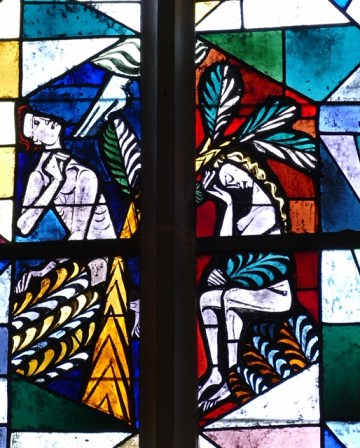
Adam

A key phrase for our prayer might be the following. The concupiscence of human nature will always make the sinful choice a possibility. But we can gain courage and strength from this powerful line from Paul:

Where sin increased,
grace overflowed all the more….

Romans 5:15

In our Gospel, Jesus teaches a lesson about perseverance in the spiritual life. He says if we stick with it, God will welcome us the way a generous master thanks and embraces a loyal servant. He adds a comforting thought for those of us of “a certain age”.

And should he come in the second or third watch
and find them prepared in this way,
blessed are those servants.

Luke 12:38

Speaking personally now, I find that moving into “the second or third watch” can be a little scary. As various physical functions occasionally fail me, and some of my joints are replaced with earth minerals, a line from Yeats’s poem comes to mind – “things fall apart“:

Turning and turning in the widening gyre
The falcon cannot hear the falconer;
Things fall apart; the centre cannot hold;
Mere anarchy is loosed upon the world...

As I look through my reading glasses at the information for my new titanium knee, I remember the young athlete who could drive a basketball down the lane for an explosive layup, often being knocked on her nethers by a powerful opponent. Nevertheless, she would jump up for the next rebound. What happened to that girl?

This Gospel reminds me that she is still inside me, but she is golden now — lifting her spirit, by God’s grace, to deeper challenge.


 I am beginning to understand that aging is its own life phase, not just a final comfortable fixity in one’s maturing. Just as every other life phase requires a gradual mastery of its challenges, so does aging. Toddlers must conquer balance and language skills. Teens must gain confidence and self-direction. Young adults work for greater wisdom and meaningful life relationships. Those “post-50” evaluate and may be challenged by the “successes” of their past years. And those in the sometimes not-so-really golden years are still doing all these earlier tasks while meeting the unique challenges of aging. One must be brave!


I hope some of you are Harry Potter fans. The books have powerful little encouragements tucked in their magical dialogue. One of my favorites is this. Harry, encouraging his elderly and fearful teacher to make a courageous choice, says, “Be brave, Professor… Otherwise, the bowl will remain empty… forever.”


The bowl of our life is never filled until it’s filled. Jesus reminds us that none of us knows when that day of fulfillment will come and we must be vigilant for it until it does.

Blessed are those servants
whom the master finds vigilant on his arrival.
Amen, I say to you, he will gird himself,
have them recline at table, and proceed to wait on them.

Luke 12:37

We draw courage for that vigilance not from Harry Potter of course, but from Christ’s own promise to us that there is a special blessing especially for us 2nd or 3rd watchers:

And should he come in the second or third watch
and find them prepared in this way,
blessed are those servants.

Luke 12:38

I believe that if we prayerfully listen, we will find that this blessing already suggests itself this side of Christ’s final arrival. As Paul indicates in our first reading, when we remain open to graceful relationship with God, we already live in the peaceable kingdom.

… how much more will those who receive the abundance of grace
and the gift of justification
come to reign in life through the one Jesus Christ…

Romans 5:17

Poetry: Sailing to Byzantium – William Butler Yeats

I

That is no country for old men. The young
In one another’s arms, birds in the trees,
—Those dying generations—at their song,
The salmon-falls, the mackerel-crowded seas,
Fish, flesh, or fowl, commend all summer long
Whatever is begotten, born, and dies.
Caught in that sensual music all neglect
Monuments of unageing intellect.

II

An aged man is but a paltry thing,
A tattered coat upon a stick, unless
Soul clap its hands and sing, and louder sing
For every tatter in its mortal dress,
Nor is there singing school but studying
Monuments of its own magnificence;
And therefore I have sailed the seas and come
To the holy city of Byzantium.

III

O sages standing in God’s holy fire
As in the gold mosaic of a wall,
Come from the holy fire, perne in a gyre,
And be the singing-masters of my soul.
Consume my heart away; sick with desire
And fastened to a dying animal
It knows not what it is; and gather me
Into the artifice of eternity.

IV

Once out of nature I shall never take
My bodily form from any natural thing,
But such a form as Grecian goldsmiths make
Of hammered gold and gold enamelling
To keep a drowsy Emperor awake;
Or set upon a golden bough to sing
To lords and ladies of Byzantium
Of what is past, or passing, or to come.


Music: Candlelight – Ottmar Liebert

Liebert is a German classical guitarist, songwriter and producer best known for his Spanish-influenced music. A five-time Grammy Award nominee, he is also an ordained Zen monk.