Today, in God’s Lavish Mercy, Paul counsels us to be steadfast in our faith. Jesus counsels us to avoid greed. How might the two be connected?
Perhaps like this. Only by faith do we have the courage to repudiate the allurements of greed.
Paul lauds Abraham whose faith convinced him that God’s promise to him would be fulfilled. Jesus promises us eternal life in a realm apart from any earthly treasure. If we believe in Jesus’s promise, we realize the futility of possessiveness, greed and consumerism.
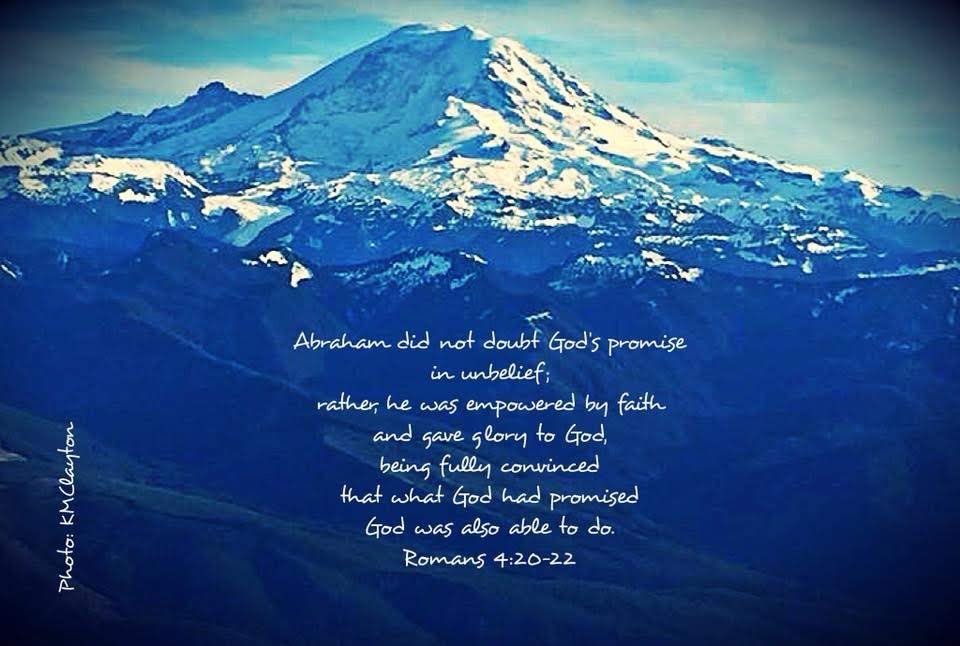
Abraham did not doubt God’s promise in unbelief; rather, he was empowered by faith and gave glory to God and was fully convinced that what God had promised he was also able to do. That is why it was credited to him as righteousness.
Romans 4:20-22
That’s a really hard call in our society which makes it hard to believe in anything including God and ourselves! Every type of media conspires to convince us that we are not enough as we are. We need a better car, house, clothes, haircut, and on and on to make us “acceptable”. Populism and racism ingrained in our politics convince us that we need to be a certain color, nationality, religion, speak a certain language to be worth anything.
Jesus says NO. You are beautiful just as I created you. And you already have everything you need to merit my promise of eternal life. You have only one need in this world — to love yourself and one another so that my promise can be released in you and in all Creation.
Then Jesus said to the crowd, “Take care to guard against all greed, for though one may be rich, one’s life does not consist of possessions.”
Luke 12:15
Poetry: from Rumi
When I am with you, everything is prayer.
I prayed for change,
so, I changed my mind.

I prayed for guidance
and learned to trust myself.

I prayed for happiness
and realized I am not my ego.

I prayed for peace
and learned to accept others unconditionally.

I prayed for abundance
and realized my doubt kept it out.

I prayed for wealth
and realized it is my health.

I prayed for a miracle
and realized I am the miracle.

I prayed for a soul mate
and realized I am with the One.

I prayed for love
and realized it is always knocking,
but I have to allow it in.
Music: How Could Anyone Ever Tell You – Shaina Noll
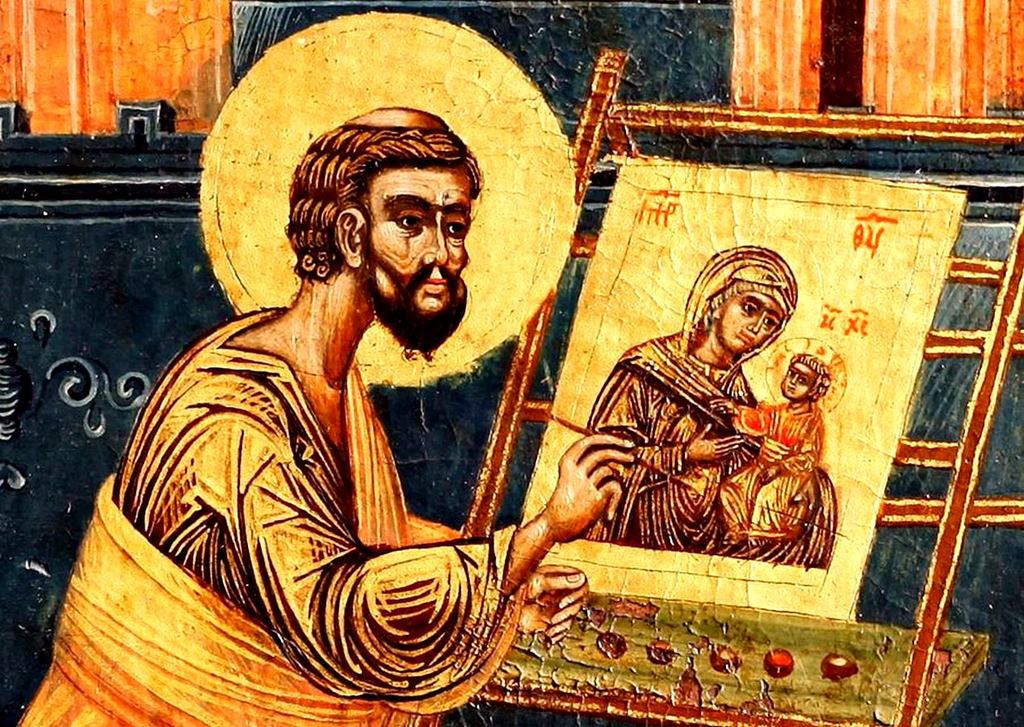
“The Tradition of the Orthodox Church says that Luke was a painter who created icons of Mary. Historian Theodorus Lector mentions St Luke drawing the Virgin; Saint Andrew of Crete wrote about St Luke depicting both Mary and Christ; Saint Simeon the Metaphrast, historian and the author of many biographies of saints, mentioned one icon of the Virgin Mary holding Christ. He said that it was painted by St Luke and is “honored even to this day.” (from the Convent of St. Elizabeth website: https://obitel-minsk.org/history)
Today, in God’s Lavish Mercy, we pray with St. Luke, the elegant author who has painted a tender picture of God on human hearts. That picture has the beautiful face of Jesus Christ, Incarnate Mercy for all people.
God is portrayed throughout the Old and New Testaments as a warrior or a stern judge, but Luke, through his parables, presents God as a loving, anxious father who forgives his erring son before the boy can ask to be forgiven and lavishes love on him.
Joseph Blenkinsopp: Luke’s Jesus
Today’s first reading gives us some insight into Luke’s character and personal committment to the spread of the Gospel:
Beloved: Demas, enamored of the present world, deserted me and went to Thessalonica, Crescens to Galatia, and Titus to Dalmatia. Luke is the only one with me.
2 Timothy 4:10
Apparently Luke, unlike Demas, was not “enamored of the present world”. Wow! What a packed description that is! Paul is obviously disappointed. It would appear that Demas, Crescens, and Titus decided to opt out of their contracts. Only Luke hung on with a rather gloomy-sounding Paul who is pining for his cloak and papyrus rolls.
I would imagine Paul was not an easy boss to work for. He was a firebrand – both when he fought against the Gospel and when he fought for it. No doubt he demanded the same intensity from those who directly assisted him. And the work itself was daunting. Luke recounts in the Acts of the Apostles the many trials that had to be met before any small success.
Some of the apostolic candidates just didn’t vibe with all of that. But Luke could work with Paul’s fire. And he could uncover the glorious story within the many challenging folds they navigated. What a blessing he must have been to the wildly dynamic and sometimes mercurial Paul!
Luke had incorporated into his own life Jesus’s ministerial call so clearly described in today’s Gospel:
Go on your way; behold, I am sending you like lambs among wolves. Carry no money bag, no sack, no sandals; and greet no one along the way. Into whatever house you enter, first say, ‘Peace to this household.’ If a peaceful person lives there, your peace will rest on him; but if not, it will return to you.
Luke 10:3-6
Like Paul, Luke never met Jesus in person. Both were born shortly after Jesus’s time on earth. But the two of them knew Christ intimately and carried that inspirited knowledge to their own world and to the ages.
Our picture of Jesus would be a lot blurrier without Luke. Nearly half of Luke’s content is not found in the other three Gospels.
Many stories, sayings, and images found only in Luke have become an indispensable part of Christian consciousness. The Prodigal Son, the Good Samaritan, the Rich Man and Lazarus, the Pharisee and the Publican, the encounter with the Risen One on the Road to Emmaus, the Magnificat, the angel’s song Peace on Earth are only in Luke, but it is difficult to imagine the Christian tradition without them.
Eugene Boring: Introduction to the New Testament: History, Literature, Theology
Perhaps you have a favorite among the exclusive stories cited above. This feast of St. Luke may be a good day to remember why that story is important to you and to thank Luke for its gift.
Poetry: Luke – Malcolm Guite
His gospel is itself a living creature
A ground and glory round the throne of God,
Where earth and heaven breathe through human nature
And One upon the throne sees it is good.
Luke is the living pillar of our healing,
A lowly ox, the servant of the four,
We turn his page to find his face revealing
The wonder, and the welcome of the poor.
He breathes good news to all who bear a burden
Good news to all who turn and try again,
The meek rejoice and prodigals find pardon,
A lost thief reaches paradise through pain
The voiceless find their voice in every word
And, with Our Lady, magnify Our Lord.
Music: Luke’s Gospel contains four special canticles connected to the Birth of Jesus:
(I chose to offer a reflection on the readings for the Memorial of St. Francis rather than for Wednesday of the Twenty-sixth Week)
Today, in God’s Lavish Mercy, we pray with St. Francis of Assisi (1181-1226) , one of the most revered figures in Christianity, an Italian mystic and Catholic friar who founded the Franciscans.
The simple holiness of St. Francis has had an immeasurable effect not only on Christianity but even on secular culture. No matter their religious interest, most people would recognize this humble, medieval itinerant preacher and understand the witness of his life.
from phillyvoice.com
Our current Holy Father, in a surprise move, chose St. Francis as his patron and model:
When the former Cardinal Jorge Mario Bergoglio went over the 77 votes needed to become pope, he said that his friend Cardinal Hummes “hugged me, kissed me and said, ‘Don’t forget the poor.’” At the time of his election, Pope Francis told thousands of journalists that he took to heart the words of his friend and chose to be called after St. Francis of Assisi, “the man of poverty, the man of peace, the man who loves and protects creation.”
In our readings today, both the Responsorial Psalm and the Gospel echo a spirituality deeply compatible with the Franciscan spirit.
Francis, who renounced his wealthy lifestyle and inheritance for the riches of Christ, surely found inspiration when he prayed Psalm 16:
You are my inheritance, O Lord. Keep me, O God, for in you I take refuge. I say to the LORD, “My Lord are you.” O LORD, my allotted portion and my cup, you it is who hold fast my lot.
I bless the LORD who counsels me; even in the night my heart exhorts me. I set the LORD ever before me; with him at my right hand I shall not be disturbed.
You will show me the path to life, fullness of joys in your presence, the delights at your right hand forever.
Most of us reading this reflection have so much in life. We are blessed beyond description with everything we need and even want. Praying in the spirit of St. Francis can help us discern how to honor and use what we have in a way that pleases God.
Keep a clear eye toward life’s end. Do not forget your purpose and destiny as God’s creature. What you are in God’s sight is what you are and nothing more. Remember that when you leave this earth, you can take nothing that you have received…but only what you have given; a full heart enriched by honest service, love, sacrifice, and courage.
Francis of Assisi
Poetry: ST. FRANCIS OF ASSISI – A SERMON TO THE BIRDS Francis made his deep spirituality and radical teaching easily accessible with unpretentious parables like this one. He imitated Jesus himself who taught us how to live by telling simple stories in which we could find ourselves. So let’s learn from this one, my little “birds”.
My little sisters the birds,
Ye owe much to God, your Creator,
And ye ought to sing his praise at all times and in all places,
Because he has given you liberty to fly about into all places;
And though ye neither spin nor sew,
He has given you a twofold and a threefold clothing
For yourselves and for your offspring.
Two of all your species He sent into the Ark with Noah
That you might not be lost to the world;
Besides which, He feeds you, though ye neither sow nor reap.
He has given you fountains and rivers to quench your thirst,
Mountains and valleys in which to take refuge,
And trees in which to build your nests;
So that your Creator loves you much,
Having thus favored you with such bounties.
Beware, my little sisters, of the sin of ingratitude,
And study always to give praise to God.” Amen
Today, in God’s Lavish Mercy, we begin the first of three passages from the prophet Zechariah to be read over the next few days. These are the only times we meet Zechariah in our cycle of readings, other than December 12th, the Feast of Our Lady of Guadalupe.
For that reason, we could easily overlook Zechariah, a minor prophet whose visions, so specifically directed to the post-exilic Israelite community, may seem alien and extraneous to our own spirituality.
But we should not overlook Zechariah. Here’s why.
These two prophets (Zechariah and Haggai) seek to rally the identity and vocation of Jews in a time when faith is hard and prospects are lean. Such a time, they assert, is a time for vigorous action. The rebuilding of the temple is thus an act of faith, confident in the reality of God, and an act of defiance against the established imperial order of the world, even the imperial order that funded the project. We might well read these prophets in our own time of “small things” when the church seems to lack energy, courage, and imagination. In just such a time it is urgent to enact visible faithful gestures (like the temple building) that defy business as usual. Thus the prophetic imagination given here outruns historical possibility. That is the quality and depth of faith held here to which we are invited.
Walter Brueggeman: From Judgement to Hope
Zechariah invites the people to imagine a world vastly beyond their present perceptions. It is a world where the Temple is rebuilt as a symbol of God’s Presence, central to their identity. That Divine Presence provides any protection needed, thus removing the need for “walls” of isolation, fear, oppression, defensiveness, and exclusion.
People will live in Jerusalem as though in open country, because of the multitude of men and beasts in her midst. But I will be for her an encircling wall of fire, says the LORD, and I will be the glory in her midst.
Zechariah 2:8-9
Surely we could use such holy imagination in our times! And surely this is the sacred energy Pope Francis seeks as he leads the Church in synodality.
As our shared geopolitical world seems daily to become more fragmented and hostile, the power of our communal, Resurrection faith is crucial to its graceful restoration.
Zechariah calls the people to sing, even in the midst of their disheartening exile, and to dream of a world without vicious walls. We are called to the same hope even in a world that conspires to feed cynicism and indifference rather than justice and mercy.
Sing and rejoice, O daughter Zion! See, I am coming to dwell among you, says the LORD. Many nations shall join themselves to the LORD on that day, and they shall be his people and he will dwell among you.
Zechariah 2:14
Prose: The Monk Manifesto – Christine Valtners Paintner
Monk Manifesto is a public expression of one’s commitment to live a compassionate, contemplative, and creative life. When I read it, I find encouragement to act for a more integrated world, one without dissociative walls.
I commit to finding moments each day for silence and solitude, to make space for another voice to be heard, and to resist a culture of noise and constant stimulation.
I commit to radical acts of hospitality by welcoming the stranger both without and within. I recognize that when I make space inside my heart for the unclaimed parts of myself, I cultivate compassion and the ability to accept those places in others.
I commit to cultivating community by finding kindred spirits along the path, soul friends with whom I can share my deepest longings, and mentors who can offer guidance and wisdom for the journey.
I commit to cultivating awareness of my kinship with creation and a healthy asceticism by discerning my use of energy and things, letting go of what does not help nature to flourish.
I commit to bringing myself fully present to the work I do, whether paid or unpaid, holding a heart of gratitude for the ability to express my gifts in the world in meaningful ways.
I commit to rhythms of rest and renewal through the regular practice of Sabbath and resist a culture of busyness that measures my worth by what I do.
I commit to a lifetime of ongoing conversion and transformation, recognizing that I am always on a journey with both gifts and limitations.
Music: One World – Toby Mac
I’m not a big fan of rap, but I think this song is pretty good for today’s reflection.
Today, in God’s Lavish Mercy – and tomorrow – we will hear from Haggai, one of the twelve minor prophets of the Hebrew Scriptures. These dozen writers are referred to as “minor” because of the length of their writings, not their value.
So Haggai, even though many of us have never heard of him, has something important to say for Judeo-Christian tradition and for each of us who read him. Let’s see what that might be.
Haggai is prophesying during the Persian period of Jewish history, around the middle of the 6th century, BC. The Jewish people had been back home from the Babylonian captivity for almost 20 years. When they first returned they were passionate about rebuilding the Temple. But as the decades passed, and opposition from their non-Jewish neighbors increased, their commitment waned.
The building of worship places has always been an activity with fans on both sides of the aisle. Some argue that God needs a spot where the Divine Presence can be recognized and revered. Others believe that the effort and resources expended in such building could better be used in human services for God’s poor and needy people. Haggai’s community had people in both camps. (Sound familiar?)
Haggai offers a turning point for their arguments. He tells the people they are a mess. The absence of a central symbol for their faith has weakened and scattered them to their own selfish pursuits. He tells them to look at themselves:
Consider your ways! You have sown much, but have brought in little; you have eaten, but have not been satisfied; You have drunk, but have not been exhilarated; have clothed yourselves, but not been warmed; And whoever earned wages earned them for a bag with holes in it.
The Temple, while it is important, isn’t the most important part of Haggai’s prophecy. He tells the people they have lost their souls. The lack of a central, shared faith has caused them to forget who they are. They will remember only when they remember God’s centrality in their lives.
Haggai appeals to the people to restore a public life which gives honor to God. For their time and circumstance, such a return is symbolized by the rebuilding of the Temple which had been destroyed at the time of their enslavement by Babylon.
We humans often forget what’s important. We chip away at, and ultimately destroy, what makes us who we are by little acts of faithlessness, deceit, covetousness, and envy. These small treacheries grow into big ones redeemable only by an impeachment of the soul and the renewal of a common moral purpose. Haggai offered that conversion to Israel. Pope Francis is offering it to us today.
Video: TED Talk by Pope Francis given at the Annual TED Conference in 2017 and pleading for a “Revolution of Tenderness”. (Yes, it’s long, but it is profound. When he delivered this talk, the Pope was given a standing ovation by some of the most prestigious business people of our time.)
Today, in God’s Lavish Mercy, Luke gives us a jolt with this Gospel passage that has always disturbed me:
The mother of Jesus and his brothers came to him but were unable to join him because of the crowd. He was told, “Your mother and your brothers are standing outside and they wish to see you.” He said to them in reply, “My mother and my brothers are those who hear the word of God and act on it.”
Luke 8:19-21
Honestly, I don’t want Jesus to sound officious like that with his family! I want him to wiggle through the crushing crowd and run into Mary’s loving arms. I want him to hug his mom to bits and pummel his little brothers on the back with callow delight.
And you know what – I think that might be exactly what Jesus did, on the way uttering the seemingly callous phrase which Luke has isolated and immortalized.
Like all scripture passages, we can read this one in the slant of our own light. At the same time, it is important to access the wisdom of scripture scholars in order to understand depths we might not otherwise discern. There is a scholarly consensus that this Lucan passage is intended to show us how radically dedicated Jesus was to his mission. The passage affirms that the mission is more important even than family ties … in other words, more important than anything. For thirty years Jesus had lived a quiet life somewhere within his mother’s circle of care. In this Gospel, that quiet time is over and he is on the path to his Passion, Death, and Resurrection.
I understand that radicality and the courage it takes to live it. I failed at it once (at least) but learned immensely from the failure.
When I was a young religious, there was a call for US nuns to minister in Nicaragua. I wanted to answer that call. When I told my mother about my emerging decision, she froze in time. My father had died just about a year and a half before. The thought of also “losing” me to a socio-politically volatile Central America traumatized my mom.
But my mom was so brave. She didn’t say, “Don’t go.” She simply said, “Take me with you. I can cook for all of you.”
Mom and I at the 41st Eucharistic Congress Philadelphia (1976)
Needless to say, I wasn’t going to take my mom into a political boiler in order to satisfy my plans. But I also wasn’t going to leave her alone in the thinly-veiled desperation of her offer. I didn’t go to Nicaragua and, like Robert Frost’s split road, that has made a profound difference in my life.
That decision almost fifty years ago was a good one, and opened the way for me into other opportunities to serve God’s people. The Gospel did not suffer because of my hesitations or my mother’s. We both trusted our humanity that had, for all our lives, been directed toward God’s love.
But at this juncture in Jesus’s life, the Gospel demands that he open his heart beyond any familial or personal ties in order to embrace all people in the Gospel.
There are frequent times in each of our lives when we must choose for the largeness of the Gospel over limited self-interest. Enriching ourselves daily in scriptural wisdom will strengthen us to respond generously at those times.
Prose: Pope Francis on praying with the scriptures:
Through prayer a new incarnation of the Word takes place. And we are the “tabernacles” where the words of God want to be welcomed and preserved, so that they may visit the world. This is why we must approach the Bible without ulterior motives, without exploiting it. The believer does not turn to the Holy Scriptures to support his or her own philosophical and moral view, but because he or she hopes for an encounter; the believer knows that those words were written in the Holy Spirit, and that therefore in that same Spirit they must be welcomed and understood, so that the encounter can occur.
Music: O Word of God – Ricky Manolo – In this hymn, passages from the Psalms – snippets of God’s Word – are sung in a round within the plea for God’s Word to come into our hearts.
O Word of God, come into this space. O Word of God, come send us your grace. Open our minds; show us your truth. Transform our lives anew.
O Word of God, come into this space. O Word of God, come send us your grace. Open our minds; show us your truth. Transform our lives anew.
Here I am, O Lord my God I come to do your Will.
Blessed are the poor in spirit, the Kingdom of Heaven is theirs.
To the upright, I will show the saving power of God.
Let all the nations praise You, O God. Let all the nations praise You.
The Lord is my shepherd, there is nothing I shall want.
Today, in God’s Lavish Mercy, we begin three weeks of readings from some of the lesser known prophets and reformers in ancient Israel:
Ezra: instrumental in restoring the Jewish scriptures and religion to the people after the return from the Babylonian Captivity and is a highly respected figure in Judaism.
Nehemiah: his book describes his work in rebuilding Jerusalem during the Second Temple period.
Haggai: a Hebrew prophet during the building of the Second Temple in Jerusalem, and one of the twelve minor prophets in the Hebrew Bible. He is known for his prophecy in 520 BCE, commanding the Jews to rebuild the Temple
Zechariah: His greatest concern was with the building of the Second Temple
Baruch: the prophet Jeremiah’s scribe who is mentioned at Baruch 1:1. The book is a reflection of a late Jewish writer on the circumstances of Jewish exiles from Babylon
Malachi: Malachi describes a priesthood that is forgetful of its duties, a Temple that is underfunded because the people have lost interest in it, and a society in which Jewish men divorce their Jewish wives to marry out of the faith. (W. Gunther Plaut)
Joel: delivers a message of warning and repentance to the southern kingdom of Judah after the nation was divided.
Jonah: prophesied the destruction of Nineveh, but attempts to escape his divine mission.
Now some of my readers who are scripture geeks like me may have been interested in the above list. The rest of you skipped down to this paragraph to see if I had anything at all interesting to say about today’s readings. 😉
How about this? While Israel’s prophets and reformers speak to a certain time in history, their themes speak powerfully to our own times and culture as well:
Walter Brueggemann describes the prophets’ two primary themes:
First, they are very sure that political economic arrangements that contradict the purpose of God cannot be sustained.
Second, the prophets are voices of hope that affirm that God is a future-creating agent who keeps promises and who, against all odds, creates a new world reality that is distinct from present power arrangements.
Walter Brueggemann: From Judgment to Hope
The prophets remind us that, beyond any purely temporal interpretation of life, God is real and intimately involved in the unfolding of both our personal and global histories. When we pray with the prophets, we are strengthened in courage to engage our world, and to act in hope for the redemption of our culture.
In today’s reading, the reformer Ezra speaks a word of liberating alternative hope to a people who had been decimated by the Babylonian Captivity. Many of them thought they had lost their soul in Babylon. Ezra, by the power of God, breathes it back into them.
Therefore, whoever among you belongs to any part of his people, let him go up, and may his God be with them! Let everyone who has survived, in whatever place they may have dwelt, be assisted by the people of that place with silver, gold, goods, and cattle, together with free-will offerings for the house of God in Jerusalem
Ezra 1:3-4
As we consider our own times, our “breathers of hope” may come to mind: Pope Francis working to rebuild the Church, and Martin Luther King inspiring a vision of equity, respect and inclusion. We may think of voices like St. Oscar Romero, Venerable Catherine McAuley, Simone Weil, St. Edith Stein, Greta Thunberg, Servant of God Dorothy Day, or Pierre Teilhard de Chardin. Each one has spoken selflessly for peace, mercy, justice, and wholeness in a fragmented, sinfully distracted society.
In today’s Gospel, Jesus, Divine Daystar of every prophet’s hope, calls each one of us to the work of hope-filled prophecy, and faith-filled listening:
Jesus said to the crowd: “No one who lights a lamp conceals it with a vessel or sets it under a bed; rather, he places it on a lampstand so that those who enter may see the light. For there is nothing hidden that will not become visible, and nothing secret that will not be known and come to light. Take care, then, how you hear. To anyone who has, more will be given, and from the one who has not, even what he seems to have will be taken away.”
Matthew 5:1-6
Poetry: Advice to a Prophet – Richard Wilbur
When you come, as you soon must, to the streets of our city,
Mad-eyed from stating the obvious,
Not proclaiming our fall but begging us
In God’s name to have self-pity,
Spare us all word of the weapons, their force and range,
The long numbers that rocket the mind;
Our slow, unreckoning hearts will be left behind,
Unable to fear what is too strange.
Nor shall you scare us with talk of the death of the race.
How should we dream of this place without us?—
The sun mere fire, the leaves untroubled about us,
A stone look on the stone’s face?
Speak of the world’s own change. Though we cannot conceive
Of an undreamt thing, we know to our cost
How the dreamt cloud crumbles, the vines are blackened by frost,
How the view alters. We could believe,
If you told us so, that the white-tailed deer will slip
Into perfect shade, grown perfectly shy,
The lark avoid the reaches of our eye,
The jack-pine lose its knuckled grip
On the cold ledge, and every torrent burn
As Xanthus once, its gliding trout
Stunned in a twinkling. What should we be without
The dolphin’s arc, the dove’s return,
These things in which we have seen ourselves and spoken?
Ask us, prophet, how we shall call
Our natures forth when that live tongue is all
Dispelled, that glass obscured or broken
In which we have said the rose of our love and the clean
Horse of our courage, in which beheld
The singing locust of the soul unshelled,
And all we mean or wish to mean.
Ask us, ask us whether with the worldless rose
Our hearts shall fail us; come demanding
Whether there shall be lofty or long-standing
When the bronze annals of the oak tree close.
Lily of the Valley, let your sweet aroma fill my life
Rose of Sharon show me how to grow in beauty in God's sight
Fairest of ten thousand make me a reflection of your light
Daystar shine down on me let your love shine through me in the night

Lead me Lord, I'll follow. Anywhere you open up the door
Let your word speak to me, show me what I've never seen before
Lord I want to be your witness, you can take what's wrong and make it right
Daystar shine down on me, let your love shine through me in the night

Lord I've seen a world that's dying wounded by the master of deceit
Groping in the darkness, haunted by the years of past defeat
But when I see you standing near me shining with compassion in your eyes
I pray Jesus shine down on me let your love shine through me in the night

Lead me Lord, I'll follow anywhere you open up the door
Let your word speak to me, show me what I've never seen before
Lord I want to be your witness, you can take what's wrong and make it right
Daystar shine down on me, let your love shine through me in the night
Today, in God’s Lavish Mercy, we have our final reading from 1 Timothy. In the closing words of this letter, Paul pleads with Timothy, and with the community Timothy shepherds, to stay faithful. Paul encourages them to do this even though the Power they believe in is invisible.
… keep the commandment without stain or reproach until the appearance of our Lord Jesus Christ that the blessed and only ruler will make manifest at the proper time, the King of kings and Lord of lords, who alone has immortality, who dwells in unapproachable light, and whom no human being has seen or can see. To him be honor and eternal power. Amen.
1 Timothy 6:14-16
In our Gospel today, Jesus describes the Word of God aa a seed that falls upon the human heart with varying results. It is a parable we are familiar with and we get it. If we don’t have a ready heart, plowed and furrowed with faith and charity, that lonely seed is going to die.
The problem is that even when that seed falls into our very faithful hearts, we don’t always SEE the results. The work of faith is a work with invisible powers. It is a work with hope, with trust, with perseverance, with courage – much like the work in any garden.
I hear really good people, whose lives are beautiful witnesses to faith, still question themselves and their goodness. Because their lives are threaded with challenges and disappointments, they think their lack of faith might be the cause. Because the world at large may appear to be a mess, they wonder if the God they believe in is really there!
Indeed, even though the seed of God’s Word is alive, still it is buried in the realities of our lives. And we wait in sometimes doubtful anticipation for its flowering.
Paul knew that Timothy would encounter these roadblocks just as we all do. That is why his letters to Timothy are a powerful source of encouragement to us all as we strive to live a holy life. As we close these letters today, don’t put them on a shelf forever. I go back to Timothy often just to grab a few verses for light in a shadowy time. I encourage you to do the same.
The final verses of 1 Timothy struck me with a smile as I read them today. They follow just after today’s reading:
O Timothy, guard what has been entrusted to you. Avoid profane babbling and the absurdities of so-called knowledge. By professing it, some people have deviated from the faith.
Poetic Prose: Rainer Maria Rilke
When I think of the Paul’s letters to young Timothy, I am reminded of Rilke’s Letters to a Young Poet. Here is a favorite passage:
You are so young; you stand before beginnings…
have patience with everything that
remains unsolved in your heart.
Try to love the questions themselves,
like locked rooms and like
books written in a foreign language.
Do not now look for the answers.
They cannot now be given to you
because you could not live them.
It is a question of experiencing everything.
At present you need to live the question.
Perhaps you will gradually,
without even noticing it,
find yourself experiencing the answer,
 some distant day.
Today, in God’s Lavish Mercy, we honor John the Baptist under the title of his “Passion”. The memorial used to be called “the Beheading of John the Baptist”, a title that more referenced the act of the criminal rather than the perseverance of the martyr.
The Gospel narrative is gripping, as is much of the history of John the Baptist. He was no smoldering wick. Rather, John was on fire with the Truth of the Messiah and he never compromised.
Herod was the one who had John the Baptist arrested and bound in prison on account of Herodias, the wife of his brother Philip, whom he had married. John had said to Herod, “It is not lawful for you to have your brother’s wife.” Herodias harbored a grudge against him and wanted to kill him but was unable to do so.
Mark 6: 17-19
In a commentary on this Gospel, Pope Francis described the central players like this: There are four characters:
King Herod “corrupt and indecisive”
Herodias, the wife of the king’s brother who “knew only how to hate”
Salome, “the vain ballerina”,
the “prophet, decapitated and alone in his cell”.
Pope Francis continued:
John had pointed Jesus out to His first disciples, indicating that He was the Light of the world. He, instead, gave his life little by little, to the point of being extinguished in the darkness of a prison cell. Life has value only when we give it; when it is given in love, in truth; when we give it to others, in daily life, in our families. It should always be given. If someone grasps his or her life in order to keep it, like the king by his corruption, or the woman with her hatred, or the child, the young girl with her vanity that was that of an adolescent, naive, life dies, life ends up withered, it is useless”
Homily of Pope Francis, Santa Marta, 8 February 2019
PopeBenedict XVI also offered some compelling thoughts on the Passion of John the Baptist: “Celebrating the martyrdom of St. John the Baptist also reminds us – Christians in our own times – that we cannot give into compromise when it comes to our love for Christ, for his Word, for his Truth. The Truth is the Truth; there is no compromise. The Christian life requires, as it were, the ‘martyrdom’ of daily fidelity to the Gospel; the courage, that is, to allow Christ to increase in us and to direct our thoughts and actions.”
Francis and Benedict give us plenty to think about as we celebrate this solemn feast. Let us pray for the courage to live our faith wholeheartedly, inspired by the unswerving fidelity of St. John the Baptist.
Poetry: from “Saint John the Baptist” by Thomas Merton
St. John, strong Baptist,
Angel before the face of the Messiah
Desert-dweller, knowing the solitudes that lie
Beyond anxiety and doubt,
Eagle whose flight is higher than our atmosphere
Of hesitation and surmise,
You are the first Cistercian and the greatest Trappist:
Never abandon us, your few but faithful children,
For we remember your amazing life,
Where you laid down for us the form and pattern of
Our love for Christ,
Being so close to Him you were His twin.
Oh buy us, by your intercession, in your mighty heaven,
Not your great name, St. John, or ministry,
But oh, your solitude and death:
And most of all, gain us your great command of graces,
Making our poor hands also fountains full of life and wonder
Spending, in endless rivers, to the universe,
Christ, in secret, and His Father, and His sanctifying Spirit.
Music: Jesu, Joy of Man’s Desiring – J.S. Bach – This beautiful hymn befits John’s great love and devotion to Jesus.
Today, in God’s Lavish Mercy, we read the tender and beloved story of Ruth and Naomi. We have come to love the beautiful exchange between these two women, filled with devotion and selfless love:
But Ruth said to Naomi, “Do not ask me to abandon or forsake you! For wherever you go, I will go, wherever you lodge I will lodge, your people shall be my people, and your God my God. Where you die I will die, and there be buried. May the LORD do thus to me, and more, if even death separates me from you!”
Ruth 1: 16-17
Who doesn’t long to be devoutly loved the way Ruth loved Naomi? Who, especially in elder years or lonely times, isn’t filled with gratitude for the faithful companionship of dear ones? Who isn’t moved at a wedding ceremony when young couples make brave promises like Ruth’s, having no idea what their vow will require down the years?
Reading the story of Ruth from these perspectives can carry us to deep reflection, but it can also leave us with an insubstantial or idealized perception of the infinite Love mirrored in this Scripture.
The Book of Ruth is so much more than an admirable devotion.
In the Book of Ruth, significant theological formation occurs, presenting a beautifully written story placed distinctively between the chaos of the Book of Judges and the epic struggle between the prophet Samuel and the intractable King Saul in the first book of Samuel. Nestled in between this chaotic downward spiral and the recalcitrance of Saul, Ruth exhibits resilience amidst vulnerability, an outsider grafted into the Davidic lineage and its climactic conclusion in Christ. A theology of hope for those found outside the normative structures of patriarchal, religious, and cultural normative spheres.
Bradford Parker: Ruth: A Theology of Resilience Amidst Vulnerability
Various authors suggest a host of underlying theological themes in Ruth:
the community is responsible for those who are hungry;
the experience of despair cannot be ignored;
people young and old are to be cared for; and
the marginalized are to push to the center, and those at the center are to move toward the marginalized. (Katherine Doob Sakenfeld: Ruth, Interpretation)
Another writer sees “Ruth is herself the “mirror of God” by reflecting Yahweh through her actions of devotion throughout the narrative.” (John C. Holbert: Preaching the Old Testament)
Andre LaCocque argues that “Ruth belongs to the extraordinary. She is characterized by hesed (Mercy).” (Ruth: Continental Commentary)
The Book of Ruth, on surface appearance, is a simple yet compelling story. But reading under its words, we will find astounding depth:
a faithful elder who now feels abandoned by God (Naomi),
a vulnerable young woman who chooses to act for mercy and justice (Ruth)
a man who, by aligning himself unselfishly to the Law, allows the continuation of the familial line which will lead through Obed to David and ultimately to Jesus.(Boaz)
Naomi teaches us how to respond from the depths of loss, sadness, diminishment, or fear. Ruth shows us how courage, fidelity, and mercy act in the everyday world. Boaz models faithfulness, responsibility, and justice given without question when needed.
It is not a stretch to say that Ruth is a Christ figure, foreshadowing the Merciful Jesus who accompanies us in our vulnerabilities and who, by loving us, teaches us how to love:
“Teacher, which commandment in the law is the greatest?” He said to him, “You shall love the Lord, your God, with all your heart, with all your soul, and with all your mind. This is the greatest and the first commandment. The second is like it: You shall love your neighbor as yourself. The whole law and the prophets depend on these two commandments.”
Matthew 22:36-40
Poetry: Rather than choose a single poem for you, here is the link to a series of thoughtful, poetic reflections on the characters in the Book of Ruth.






 Lavish Mercy