Today, in God’s Lavish Mercy, we pray with Psalm 114, eight short but extremely powerful verses. They summarize the entire faith journey of Israel, a People born in the Exodus and coming to full promise as they pass over the Jordan.
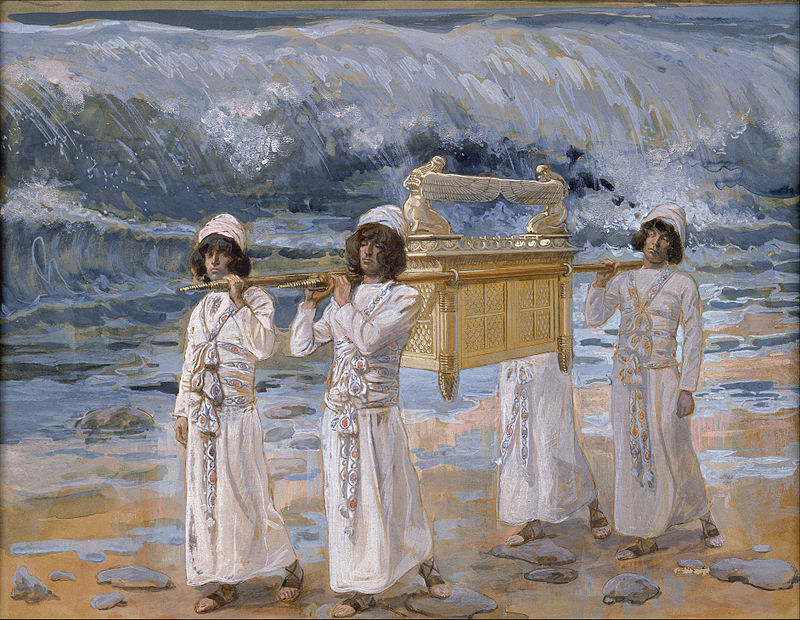
Crossing the Jordan by James Tissot
Our first reading describes the Jordan passage which mirrors the miraculous passage through the Red Sea. Joshua becomes the new Moses leading the people, finally, into the Promised Land.
As early as the 6th century, Psalm 114 was included in funeral and burial liturgies in order to emphasize the triumphant and joyful character of our final passage into heaven.
It’s hard for us to think of death that way. On a purely human level, death feels sad – like an end or a loss. But our faith says differently.
Even throughout life, in all our smaller losses, frustrations and failures, our faith encourages us to see things differently. Faith calls us to see each “exodus” , each “crossing”, as the beginning of a journey to a new promise. It calls us to remember that the seas and rivers will part – that God always makes a way.
Faith calls us to receive life’s contradictions and impasses as opportunities to learn a different way.
In Psalm 114, the poet-psalmist uses natural metaphors to remind us of God’s transformative presence in our lives. The Red Sea disappears. The Jordan River opens a path. Mountains skip and hills leap out of our way.
Why was it, sea, that you fled? Jordan, that you turned back? Mountains, that you skipped like rams? You hills, like lambs?
Psalm 114:5-6
When we face turbulent seas, overwhelming passages, exoduses from the comfortable places, may we find courage in remembering God’s faithfulness as Psalm 114 encourages us to do.
Poetry: The Valley of Vision – Taken from The Valley of Vision: A Collection of Puritan Prayers & Devotions, edited by Arthur Bennett.
Lord, high and holy, meek and lowly,
Thou hast brought me to the valley of vision,
where I live in the depths but see Thee in the heights;
hemmed in by mountains of sin I behold Thy glory.
Let me learn by paradox that the way down is the way up,
that to be low is to be high,
that the broken heart is the healed heart,
that the contrite spirit is the rejoicing spirit,
that the repenting soul is the victorious soul,
that to have nothing is to possess all,
that to bear the cross is to wear the crown,
that to give is to receive,
that the valley is the place of vision.
Lord, in the daytime stars can be seen from deepest wells,
and the deeper the wells the brighter Thy stars shine;
let me find Thy light in my darkness,
Thy life in my death,
Thy joy in my sorrow,
Thy grace in my sin,
Thy riches in my poverty,
Thy glory in my valley.
Today, in God’s Lavish Mercy, our readings continue to take us through Deuteronomy, and for the next two weeks, through Joshua, Judges, and Ruth.
The word “Deuteronomy” means “second law” because the book is a reiteration and refinement of the Law given in Exodus. The Book of Deuteronomy is basically three big speeches by Moses, the commissioning of Joshua as Israel’s next leader, and a recounting of the death of Moses.
Today’s speech is powerful and beautiful. Moses calls on the people to remember and give thanks for the immense blessings they have received at the hand of God.
Ask now of the days of old, before your time, ever since God created man upon the earth; ask from one end of the sky to the other: Did anything so great ever happen before? Was it ever heard of? Did a people ever hear the voice of God speaking from the midst of fire, as you did, and live?
Deuteronomy 4:32-33
At length, Moses recounts the sacred history of the people and tells them that, because of it, they are called to respond in covenanted fidelity.
This is why you must now know, and fix in your heart, that the LORD is God in the heavens above and on earth below, and that there is no other. You must keep his statutes and commandments which I enjoin on you today, that you and your children after you may prosper, and that you may have long life on the land which the LORD, your God, is giving you forever.”
Deuteronomy 4: 39-40
Moses offered these encouraging and directive speeches because he sensed he was near the end of his life and that Israel was moving into a new phase of its life.
In our Gospel, Jesus feels the same way. In the section immediately preceding today’s reading, Matthew says this:
From that time on, Jesus began to show his disciples that he must go to Jerusalem and suffer greatly from the elders, the chief priests, and the scribes, and be killed and on the third day be raised
In today’s passage, Jesus calls his disciples to live in covenanted fidelity by imitating his life.
Whoever wishes to come after me must deny himself, take up his cross, and follow me. For whoever wishes to save his life will lose it, but whoever loses his life for my sake will find it. What profit would there be for one to gain the whole world and forfeit his life? Or what can one give in exchange for his life?
Matthew 16: 25-26
I’ve read this Gospel passage a thousand times in the past sixty or seventy years. And I ask myself each time, “Do you really take this seriously? Do you really understand that your life is not for yourself but for God and all of God’s beloved creatures?”
It takes radical courage to live that kind of understanding. But continually remembering God’s Presence and Promises throughout our own lives strengthens us. That’s what Moses was trying to tell his people. That’s what Jesus is encouraging his disciples to recognize.
Jesus promises that, at the end of time, each will be repaid according to the level of their generosity. But the repayment doesn’t wait for the end times. Remembering our lives in grateful prayer will convince us of this: there is no true happiness, no deep joy, unless we learn to live beyond our own self-interests.
Poetry: Unless a Grain of Wheat Falls into the Ground and Dies – Malcolm Guite
Oh let me fall as grain to the good earth
And die away from all dry separation,
Die to my sole self, and find new birth
Within that very death, a dark fruition,
Deep in this crowded underground, to learn
The earthy otherness of every other,
To know that nothing is achieved alone
But only where these other fallen gather.

If I bear fruit and break through to bright air,
Then fall upon me with your freeing flail
To shuck this husk and leave me sheer and clear
As heaven-handled Hopkins, that my fall
May be more fruitful and my autumn still
A golden evening where your barns are full.
Music: Unless a Grain of Wheat – Bernadette Farrell
Unless a grain of wheat shall fall upon the ground and die, it remains but a single grain with no life.
If we have died with him then we shall live with him; if we hold firm, we shall reign with him. Unless a grain of wheat shall fall upon the ground and die, it remains but a single grain with no life.
If anyone serves me then they must follow me; wherever I am my servants will be. Unless a grain of wheat shall fall upon the ground and die, it remains but a single grain with no life.
Make your home in me as I make mine in you; those who remain in me bear much fruit. Unless a grain of wheat shall fall upon the ground and die, it remains but a single grain with no life.
If you remain in me and my word lives in you, then you will be my disciples. Unless a grain of wheat shall fall upon the ground and die, it remains but a single grain with no life.
Those who love me are loved by my Father; we shall be with them and dwell in them. Unless a grain of wheat shall fall upon the ground and die, it remains but a single grain with no life.
Peace I leave with you, my peace I give to you; peace which the world cannot give is my gift. Unless a grain of wheat shall fall upon the ground and die, it remains but a single grain with no life.
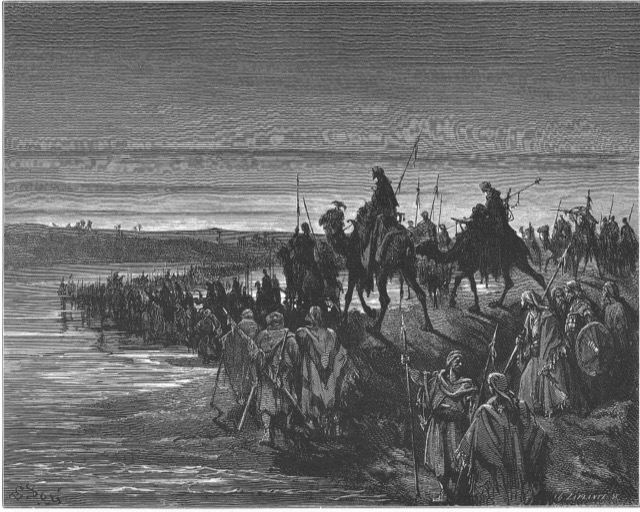
Today, in God’s Lavish Mercy, our reading from Numbers is about trust versus fear. The Israelites have finally made it to the front door of the Promised Land. But they hesitate to go in. They get Moses to bargain with God to allow scouts to go ahead of them, checking out the lay of the land. These scouts return with a mixed report: arable land, but ferocious current residents! The community freezes in fear, refusing to go farther.
The Israelites Cross the Jordan River by Gustave Doré 1832-1883
So what’s this all about for us? Is it wrong for us to be deliberate about our decisions, reversing them when the situation becomes threatening? No, of course not. So what’s the difference here in our Numbers community?
At this moment in Israel’s history, God has made clear what is expected of them. They are in covenant with God – “all in” to follow God’s plan for their lives. God has demonstrated an irrevocable commitment to them in numerous ways, and forgiven earlier disloyalties.
The question before them now is have they given God their whole hearts.
Or will this be a sham covenant in which they pick and choose when they will be for God and when they will be just for themselves?
The life of deep spiritual commitment to God is not always smooth. We get really mixed up sometimes in our self-concerns and fears. Many years ago, one of my eighth grade students asked me this: what if there really is no God and you’ve wasted your life believing there was?
It was quite a question, and I’ll bet you want to know my answer.
I said that I wouldn’t change a thing about how I have chosen to live my life. Trusting God and giving my life to God has given me a freedom beyond the limits of this world. Even if, at the end, her doubt proved true, I would have had a blessed and joyous life.
The fact is that we, just like those Israelites standing on the edge of Canaan, don’t know what will happen to us if we trust God. Life and the future is an intimidating open border that challenges our faith and resolve.
But if we constantly hedge our self-gift to God, we will never be capable of receiving the fullness of God’s gift in return.
Today, let’s pray for the trust to step over into God’s country by our acts of faith, hope, love, mercy, generosity, truthfulness, hospitality and courage.
This beautiful reinterpretation of today’s Responsorial Psalm may inspire you as it did me. It is from the website of Christine Robinson, a Unitarian Universalist minister: Click here for Psalm renderings
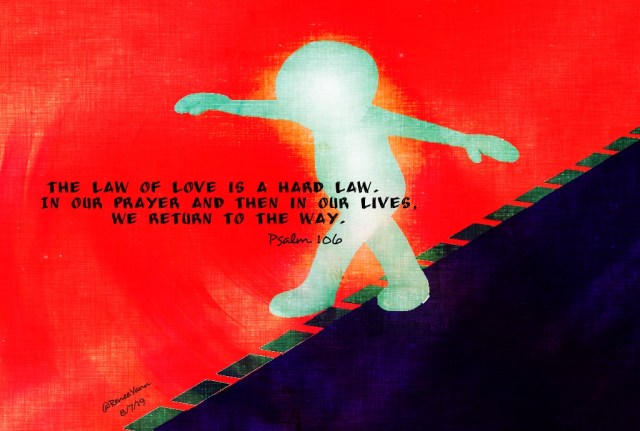
Psalm 106: Returning “Give thanks to God, who is good whose mercy endures forever.”
We stand in awe of an infinity
which we cannot begin to comprehend
We set ourselves to live in tune with the universe—
that we may be glad with the gladness of people of faith.
Yes, time and time again we have gone astray,
We have despoiled this beautiful, wonderful world
dealt unjustly with our compadres
The law of love is a hard law.
In our prayer and then in our lives,
we return to the Way.
Today, in God’s Lavish Mercy, we celebrate St. James the Greater. As you know, there were two Aposltes named James. It can get confusing. I know because about half the men in my family are named James. It’s hard to call out to one of them at a family reunion because four or five people will answer when you yell, “Hey, Jim!”
So tradition has solved the St. James name problem by designating one as “the Greater” and one as “the Less”, descriptors based on age not importance. Today we celebrate James the Greater.
Mary Salome and Zebedee with Sons James and John according to Hans Seuss Kolmback – c.1511 (Love the hat, or what? And, baby John is already holding the “cup”!)
James and his brother John were sons of Zebedee. In Mark 17, Jesus nicknames the two of them “Sons of Thunder”, so he must have had some early insight into their fiery nature. That nature was clearly displayed after the Transfiguration when Jesus began his final journey to Jerusalem. He had sent the disciples ahead to prepare an overnight stay in a Samaritan village, but the villagers rejected Jesus. This made the Zebedee boys mad so they asked Jesus:
… the people there did not welcome him, because he was heading for Jerusalem. When the disciples James and John saw this, they asked, “Lord, do you want us to call fire down from heaven to destroy them?” But Jesus turned and rebuked them. Then he and his disciples went to another village.
Luke 9:53-56
You know what, I really like these guys! James and his brother John were all-in to Jesus and the Gospel. Their thundery enthusiasm got convoluted at times but, by word and example, Jesus continued to redirect their immense energy toward God’s Will.
I like their mother too. She had her own kind of fire and wanted the best for her boys as today’s Gospel indicates:
The mother of the sons of Zebedee approached Jesus with her sons and did him homage, wishing to ask him for something. He said to her, “What do you wish?” She answered him, “Command that these two sons of mine sit, one at your right and the other at your left, in your Kingdom.”
Matthew 20:20-21
With a surface reading of this passage, we might consider Mrs. Zebedee a little dense or arrogant. But Jesus simply responded by reminding her that her sons too, like him, would experience suffering before any heavenly reward.
The Gospel does not record Mrs. Zebedee’s response, whether she was miffed, chastened, frightened, or apologetic. What later chapters do record is that she got the message and embraced it. Of all the disciples she, with only a few other brave women and her boy John, showed up at the foot of the cross.
Where our man James the Greater was on that Good Friday we do not know. But he certainly stuck with Jesus in the long run.
The Zebedee Family, with its many Gospel appearances, can teach us so much about relationship with Jesus, about maturing slowly – sometimes haltingly – in Gospel faith, and about long-term fidelity to God’s Will. Let us pray with them today.
Poetry: from The Parables of Our Lord and Savior Jesus Christ, c.1763
PARABLE LXIII.
The two Sons of Zebedee.
The spouse of Zebedee, that bare
The sons of Thunder, made a pray'r,
As she to Christ adoring came;
And Jesus said, What would the dame?
‘Grant me, O Lord, that either son
‘Be with thee in thy kingdom; one
‘Upon thy right hand to appear,
‘The other on the left as near.’
But Jesus answer'd their desire,
‘Ye know not what ye would require.
‘Do ye yourselves of strength believe.
‘The cup I drink of to receive?
‘And in that baptism be baptiz'd,
‘Which is for Christ himself devis'd?’
O Lord, we do, they answer make.
‘Ye shall indeed my cup partake,
‘Be baptiz'd in my baptism too;
‘But 'tis not of my gifts to you,
‘On right or left to place, but theirs
‘For whom my heav'nly Sire prepares’
But when this thing was told the ten,
They were enrag'd at both the men:
But Jesus call'd them all, and said,
‘Ye know the Gentiles chuse a HEAD,
‘And that great prince that holds the reins,
‘Will plead a merit for his pains:
‘But with you it shall not be so;
‘Who would be great, he shall be low,
‘And he th'aspiring chief of all
‘A lord at ev'ry servant's call.
‘'Tis with the Son of Man the same,
‘To serve, and not be serv'd, he came;
‘A minister of no esteem,
‘Which dies the myriads to redeem.’
When Christ the multitudes had fed
With God's good fishes and his bread,
At once so great was his renown,
The people proffer'd him a crown,
From which in haste the Lord withdrew
To better points he had in view.
Christians must honour and obey
Such men as bear the sov'reign sway.
But, in respect of each to each,
The Lord and his apostles teach,
That we should neither load nor bind,
But be distributive and kind
Music: Congaudeant Catholici from the Codex Calixtinus – Music for the Feast of St. James the Apostle
The Codex Calixtinus (or Codex Compostellus) is a manuscript that is the main element of the 12th-century Liber Sancti Jacobi (‘Book of Saint James’), a pseudepigraph whose likely author is the French scholar Aymeric Picaud. The codex was intended as an anthology of background detail and advice for pilgrims following the Way of Saint James to the shrine of the apostle Saint James the Great, located in the cathedral of Santiago de Compostela, Galicia. The collection includes sermons, reports of miracles and liturgical texts associated with Saint James, and a set of polyphonic musical pieces. In it are also found descriptions of the route, works of art to be seen along the way, and the customs of the local people.
Three parts of the Codex Calixtinus include music: Book I, Appendix I, and Appendix II. These passages are of great interest to musicologists as they include early examples of polyphony. (Wikipedia)
Today’s selection is the Congaudeant Catholici. I could not find an English translation of the lyrics but, for the Latin scholars reading here, go to it with the text below! For the rest of us, it’s just a beautiful ancient melody to pray with.
Today, in God’s Lavish Mercy, Jesus is pestered by scribes and Pharisees who want him to prove himself by a sign.
Jesus answers their jibing in a kind of spiritual code.
Some of the scribes and Pharisees said to Jesus, “Teacher, we wish to see a sign from you.” He said to them in reply, “An evil and unfaithful generation seeks a sign, but no sign will be given it except the sign of Jonah the prophet. Just as Jonah was in the belly of the whale three days and three nights, so will the Son of Man be in the heart of the earth three days and three nights.
Matthew 12:38-40
So what exactly is “The Sign of Jonah”? Sounds like the title of a Dan Brown novel, doesn’t it?
Well, it is the title of a wonderful book, but not one by Dan Brown.
When I was in high school, I was obsessed with the writings of Thomas Merton. The fire was ignited by my freshman homeroom teacher who gave me a copy of his “Seeds of Contemplation” — another book that changed my life. Inspired by that first read, I slowly made my way through Seven Storey Mountain, No Man is an Island, Thoughts in Solitude … finally coming, in a veil of limited understanding, to “The Sign of Jonas”.
I didn’t understand the title. What I did begin to understand, as Merton journaled his daily life in the Abbey of Gethsemane, was that we discover God not by any external revelation or intellectual acquisition, but by our choices for love in the pattern of Jesus.
In today’s Gospel, the scribes and Pharisees seek an external demonstration that Jesus is all powerful. But their seeking is an insincere attempt at self-satisfaction, not a choice for Gospel love.
So what does Jonah have to do with the Pharisees’ insincerity? Jonah, given a mission by God, could not initially align himself with God’s call. At God’s irresistable invitation, Jonah spent three days of solitude in a whale’s belly contemplating his circumstances. By the graces gained in his solitude, Jonah emerged as a prophet for God.
As recounted in his book, the whale’s belly for Merton was his life in Gethsemane Abbey where he found the profound meaning and deep awareness of his vocation.
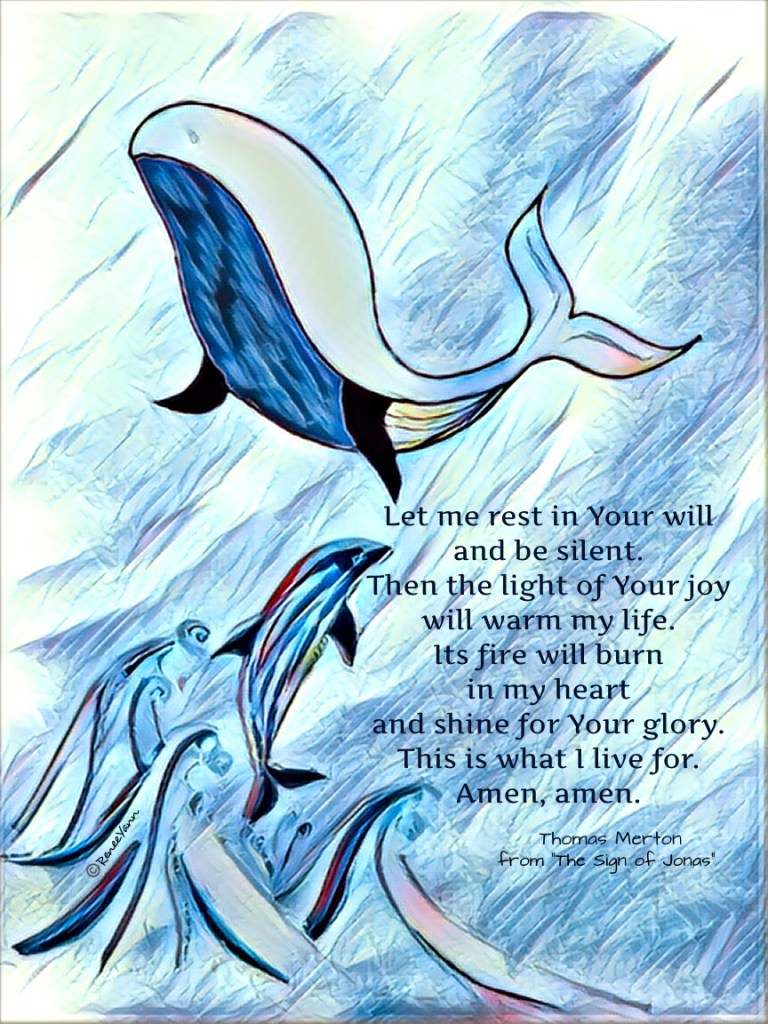
Let me rest in Your will and be silent. Then the light of Your joy will warm my life. Its fire will burn in my heart and shine for Your glory. This is what I live for. Amen, amen.
It may not sound all that inviting, but every one of us is called to the “whale’s belly”. Our transformation there is accomplished by our congruity with Christ’s sojourn in the tomb. Like Jesus, we must die to self for the sake of others. Like Jonah, we must abandon our fears and conveniences to become signs of God’s love in the world.
The Pharisees didn’t get it. And, God help them, I understand. It’s hard to get it! Life seems so much easier if we run away from this deep call like Jonah did at first. But the call remains: to be God’s Word in the world – to “shine for God’s glory“.
The editorial staff of the National Catholic Reporter wrote this about Merton’s Sign of Jonas:
Thomas Merton wrote in his early journals that the “sign of Jonas” — the mystery of Christ’s death and resurrection — is “burned into the roots of our being.” Sooner or later, everyone faces the universal truth that only through death to self do we find life. Merton embraced this sign and described himself as one like Jonah, because “I find myself traveling toward my destiny in the belly of a paradox.”
We may need to choose a little “whale-belly” time to get our hearts straight with this astounding yet universal call to be “for God” in our paradoxical world.
Poetry: two poems from “You! Jonah!” by Thomas John Carlisle
THE GREAT INTRUDER
It is exasperating
to be called
so persistently
when the last thing
we want to do
is get up and go
but God
elects
to keep on
haunting
like some
holy ghost.
———————–
COMING AROUND
And Jonah stalked
to his shaded seat
and waited for God
to come around
to his way of thinking.
And God is still waiting
for a host of Jonahs
in their comfortable houses
to come around
to His way of loving.
Music: Jonah and the Whale – Louis Armstrong – lyrics below
Jonah was a man who got a word from the Lord Go and preach the Gospel to the sinful land‿ But he got on a ship and he tried to get away And he ran into a storm in the middle of the sea
Now the Lord, He made the waves just roll so high The ship begin to sink and they all begin to cry So they pulled ole Jonah out of the hole And they jumped him in the water just to lighten up the load
Now the Lord made a whale, long and wide Lord, Lord waddnat a fish And he swallowed up Jonah, hair and hide Lord, Lord waddnat a fish, Mmm, Lord, mmm, Lord
Now Jonah started to pray in the belly of the whale Lord, Lord waddnat a fish He repented of his sins like a man in jail Lord, Lord waddnat a fish Mmm, Lord, mmm, Lord
Now Jonah must o’ been a bad man, he must o’ been a sinner Lord, Lord waddnat a fish Cos when the whale got him down, he didn’t like his dinner Lord, Lord waddnat a fish Mmm, Lord, mmm, Lord
Well he swum around the ocean, sick as he could be Lord, Lord waddnat a fish And after three days, whoops! he had to set him free Lord, Lord waddnat a fish, mmm
So the whale spit Jonah out onto dry land Lord, Lord waddnat a fish And went on to preaching like a righteous man Lord, Lord waddnat a fish
Then the people quit their sins when they heard him the town Lord, Lord waddnat a fish So when you hear the call, don’t you turn the Gospel down Lord, Lord waddnat a fish, mmm?
Today, in God’s Lavish Mercy, our readings revolve around the dynamic of hope – God’s hope planted in our spirits and our hope entrusted to God’s Mercy.
As we pray with these passages, it helps to remind ourselves of the true definition of “hope”. It is a word that many of us use carelessly to the point that we may have lost the power of its meaning – as in when we say things like, “I hope it doesn’t rain”. What we really mean is that we wish it wouldn’t rain.
Hope is not the same as wishing. Wishing is a mental activity that has no power to make its object come true. Hope, on the other hand, is a resident condition of our spirits that frees us to live with enthusiasm and gratitude despite whatever outcome may arise.
Wishing dissapates when conclusions pass. Hope is eternal because it draws its energy from faith in God’s Infinite Mercy and the promise of eternal life.
The Book of Wisdom’s author understood the Source from which hope springs:
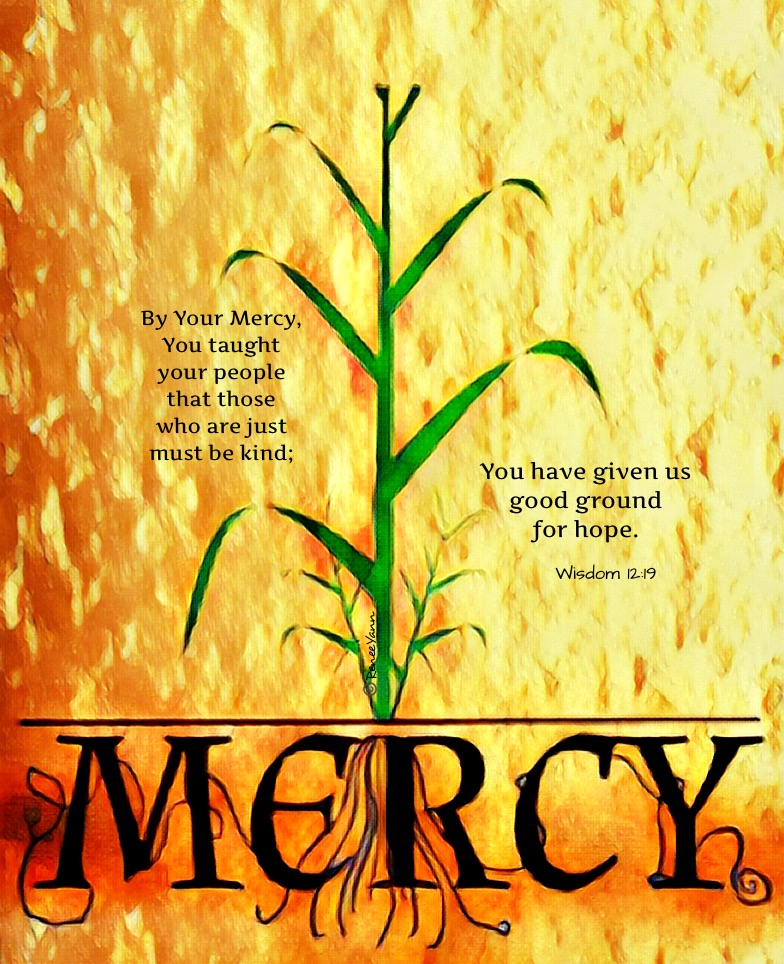
Though you are master of might, you judge with clemency, and with much lenience you govern us; for power, whenever you will, attends you. And you taught your people, by your deeds, that those who are just must be kind; and you gave your children good ground for hope that you would permit repentance for their sins.
Wisdom 12:18-19
Paul, in another passage from magnificent Romans 8, acknowledges that we can sustain hopeful hearts only by the power of the Holy Spirit who lifts us up and prays within us when we are too overwhelmed to do so ourselves.
The Spirit comes to the aid of our weakness; for we do not know how to pray as we ought, but the Spirit intercedes with inexpressible groanings. And the one who searches hearts knows what is the intention of the Spirit, because Spirit intercedes for the holy ones according to God’s will.
Romans 8:26-27
Jesus gives us a great parable for understanding hope. How discouraged might that farmer have been when the enemy tried to ruin his crop! But instead, the farmer realized that his field, like life, can sustain both the wheat and the weeds. If we live hopefully and faithfully, the wheat can be gathered from the harvest, and the weeds ultimately cast aside.
How many times in our own lives have we nearly been overwhelmed by the weeds! There is no life which passes without its hurts, disappointments, confusions, and dashed wishes! Some experience a sparse scattering of these weeds, and some lives are thick with difficulty. How surprising that it is often in the latter circumstance that hope rises up and sustains hearts.
As our Responsorial Psalm reminds us, those who live simply and sincerely are most able to tap deeply into the mysterious power of hope.
Blessed are you, Father, Lord of heaven and earth; you have revealed to little ones the mysteries of the kingdom.
Poetry: From “Odes”– George Santayana was a Spanish-American philosopher known more for his aphorisms than his poetry. He came up with lines like, ‘Those who cannot remember the past are doomed to repeat it”, and “Fanaticism consists in redoubling your effort when you have forgotten your aim.”
IV
Slowly the black earth gains upon the yellow,
And the caked hill-side is ribbed soft with furrows.
Turn now again, with voice and staff, my ploughman,
Guiding thy oxen.
Lift the great ploughshare, clear the stones and brambles,
Plant it the deeper, with thy foot upon it,
Uprooting all the flowering weeds that bring not
Food to thy children.
Patience is good for man and beast, and labour
Hardens to sorrow and the frost of winter.
Turn then again, in the brave hope of harvest,
Singing to heaven.
Music: Weed and Wheat – Silayio Kirisua is a Maasi woman who represented Kenya in the Voice of Holland singing competition. After winning the competition, she has become an international sensation.
Today, in God’s Lavish Mercy, silence plays a role in both our readings, but they are silences that differ profoundly from each other.
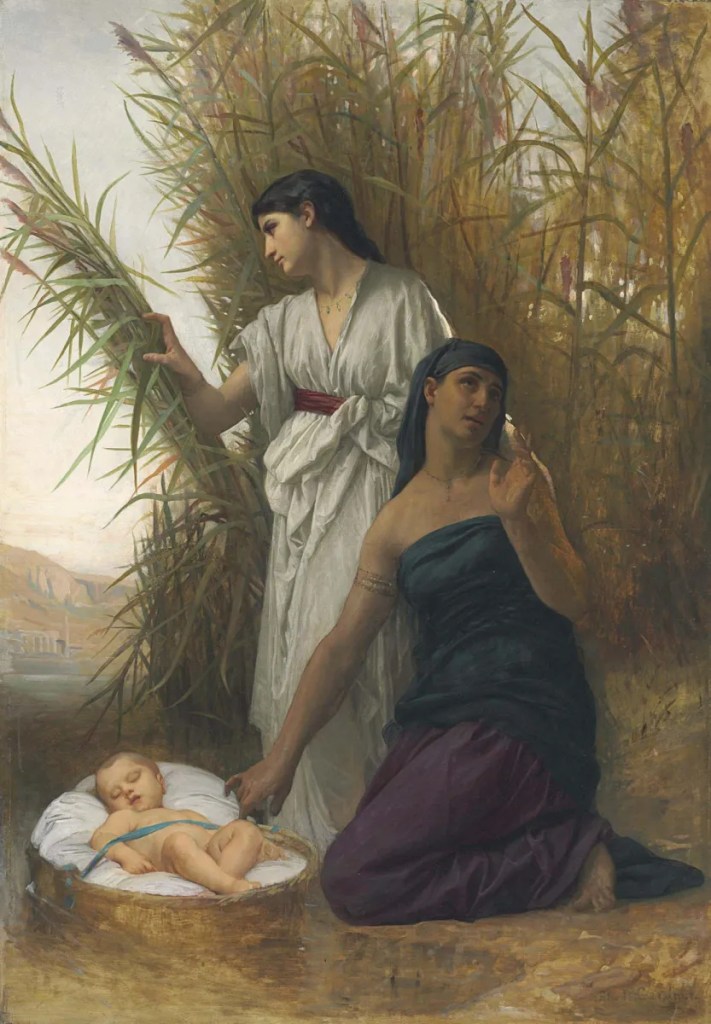
Moses in the Bulrushes – by Elizabeth Jane Gardner
In Exodus, we see the power of silent resistance to turn the tide of history. It is the resistance of righteousness.
Pharaoh, out of fear, has ordered all Hebrew boy babies drowned at birth. But Moses’s mother (Jochebed), aided by his sister (Miriam), silently resists.
A certain man of the house of Levi married a Levite woman, who conceived and bore a son. Seeing that he was a goodly child, she hid him for three months. When she could hide him no longer, she took a papyrus basket, daubed it with bitumen and pitch, and putting the child in it, placed it among the reeds on the river bank. His sister stationed herself at a distance to find out what would happen to him.
Her resistance, though silent, was nonetheless active. Look at all the intricate steps she took to assure the success of her plot.
The resistance cited in Matthew is of a different nature entirely. It reflects a hard heart not a determined heart. It is the resistance of indifference.
Christ Preaching at Capernaum – by Maurycy Gottlieb
Capernaum had become Jesus’s own home town. He had moved there as a young adult in order to begin his ministry after his own neighborhood had rejected him. But despite Jesus’s miracles and witness, Capernaum resisted the call of the Gospel:
Jesus began to reproach the towns where most of his mighty deeds had been done, since they had not repented.
And as for you, Capernaum:
Will you be exalted to heaven? You will go down to the netherworld.
For if the mighty deeds done in your midst had been done in Sodom, it would have remained until this day. But I tell you, it will be more tolerable for the land of Sodom on the day of judgment than for you.
We might find ourselves anywhere in these stories. We all experience resistances within, around, and toward us – sometimes for good reasons, sometimes not. We just have to fill in the blank to imagine all the resistances we are capable of:
I tend to resist ______________________________.
What did you come up with? Maybe some of these?
change
work
quiet
commitment
injustice
direction
strangers
programming
affection
cronyism, and on and on and on……
Jesus wanted to break through the negative resistance of his dearest communities.
Jocebed and her courageous women companions used positive resistance to break through abusive domination.
In our spiritual lives, we must, by prayer and informed reflection, lower our resistance to God’s transforming Word.
We must, at the same time, assume our role in resisting the injustice and violence of our times. Like Jocebed, we might consider our precious world and its peoples as if they were our own children, threatened by fear-blinded tyranny. In that case, what determined steps would we be willing to take to preserve its sacred life?
Poetry: Rosa Parks by Nikki Giovanni
This is for the Pullman Porters who organized when people said they couldn’t. And carried the Pittsburgh Courier and the Chicago Defender to the Black Americans in the South so they would know they were not alone. This is for the Pullman Porters who helped Thurgood Marshall go south and come back north to fight the fight that resulted in Brown v. Board of Education because even though Kansas is west and even though Topeka is the birth- place of Gwendolyn Brooks, who wrote the powerful “The Chicago Defender Sends a Man to Little Rock,” it was the Pullman Porters who whispered to the traveling men both the Blues Men and the “Race” Men so that they both would know what was going on. This is for the Pullman Porters who smiled as if they were happy and laughed like they were tickled when some folks were around and who silently rejoiced in 1954 when the Supreme Court announced its 9—0 decision that “sepa- rate is inherently unequal.” This is for the Pullman Porters who smiled and welcomed a fourteen-year-old boy onto their train in 1955. They noticed his slight limp that he tried to disguise with a doo-wop walk; they noticed his stutter and probably understood why his mother wanted him out of Chicago during the summer when school was out. Fourteen-year-old Black boys with limps and stutters are apt to try to prove themselves in dangerous ways when mothers aren’t around to look after them. So this is for the Pullman Porters who looked over that fourteen-year-old while the train rolled the reverse of the Blues Highway from Chicago to St. Louis to Memphis to Mississippi. This is for the men who kept him safe; and if Emmett Till had been able to stay on a train all summer he would have maybe grown a bit of a paunch, certainly lost his hair, probably have worn bifocals and bounced his grand- children on his knee telling them about his summer riding the rails. But he had to get off the train. And ended up in Money, Mississippi. And was horribly, brutally, inexcusably, and unac- ceptably murdered. This is for the Pullman Porters who, when the sheriff was trying to get the body secretly buried, got Emmett’s body on the northbound train, got his body home to Chicago, where his mother said: I want the world to see what they did to my boy. And this is for all the mothers who cried. And this is for all the people who said Never Again. And this is about Rosa Parks whose feet were not so tired, it had been, after all, an ordi- nary day, until the bus driver gave her the opportunity to make history. This is about Mrs. Rosa Parks from Tuskegee, Alabama, who was also the field secretary of the NAACP. This is about the moment Rosa Parks shouldered her cross, put her worldly goods aside, was willing to sacrifice her life, so that that young man in Money, Mississippi, who had been so well protected by the Pullman Porters, would not have died in vain. When Mrs. Parks said “NO” a passionate movement was begun. No longer would there be a reliance on the law; there was a higher law. When Mrs. Parks brought that light of hers to expose the evil of the system, the sun came and rested on her shoulders bringing the heat and the light of truth. Others would follow Mrs. Parks. Four young men in Greensboro, North Carolina, would also say No. Great voices would be raised singing the praises of God and exhorting us “to forgive those who trespass against us.” But it was the Pullman Porters who safely got Emmett to his granduncle and it was Mrs. Rosa Parks who could not stand that death. And in not being able to stand it. She sat back down.
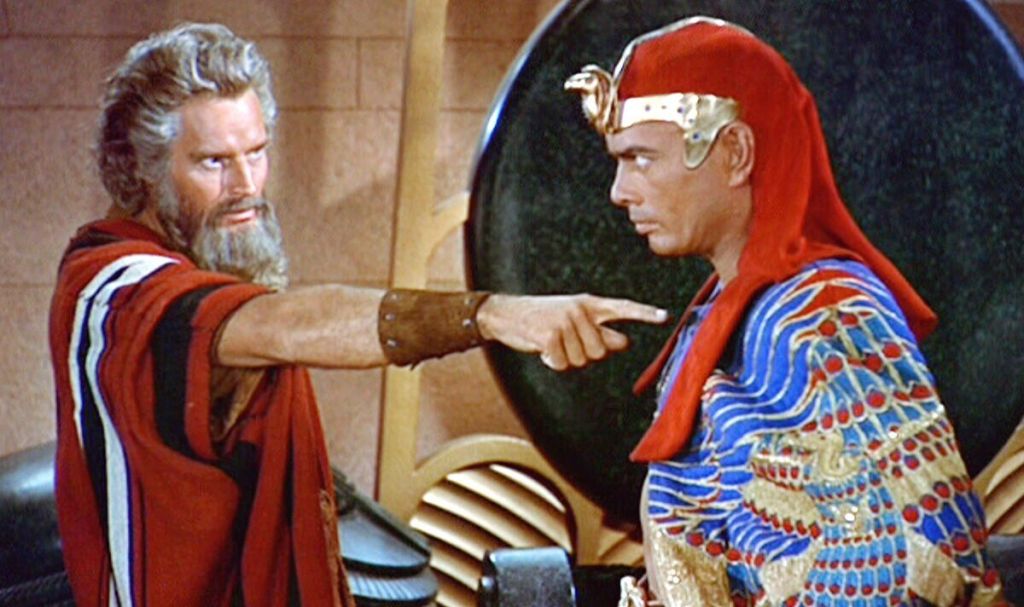
Today, in God’s Lavish Mercy, as we continue with Matthew, we begin a nearly three-week engagement with the Book of Exodus. Our companion along the way will be Moses (and, on occasion, Charlton Heston).
The Book of Exodus, a literary masterpiece, has profoundly influenced religion and culture for over 3000 years. Finally written down about 300 years before Christ, it is a gathering of the rich oral traditions and salvation history of the Judea-Christian faith. A total of forty chapters, the Book can be divided into two key parts: the liberation from Egyptian enslavement and the formation of a new, life-giving Covenant with God.
The Book’s enduring influence can be ascribed to these two themes. They reflect the universal life cycles in all of nature and in each one of our lives. The totality of human culture as well as our individual biographies are stories of breaking forth from whatever binds us into the call and promise of fuller life.
Today’s chapter is an introduction or bridge from the time of Joseph, (when Israel thrived in Egypt), to just before the emergence of Moses, (when Israel suffered in Egypt).
A new king, who knew nothing of Joseph, came to power in Egypt. He said to his subjects, “Look how numerous and powerful the people of the children of Israel are growing, more so than we ourselves! Come, let us deal shrewdly with them to stop their increase; otherwise, in time of war they too may join our enemies to fight against us, and so leave our country.”
Accordingly, taskmasters were set over the children of Israel to oppress them with forced labor.
Exodus 1:8-11
The theme of suffering also anchors our passage from Matthew:
Jesus said to his Apostles: “Do not think that I have come to bring peace upon the earth. I have come to bring not peace but the sword.
Matthew 10:34
The suffering imposed upon both “the children of Israel” and true disciples of Jesus generates from the same source – fear:
Pharaoh is afraid of what he will lose should the growing Israelite community turn on him.
The fear of losing one’s life in Christ inhibits the heart from true discipleship.
As we pray and study these next few weeks with the Book of Exodus, we may be moved to consider the fears both within and around us that prevent us from growing to fuller life.
Our world is full of the fears that induce violence and retribution. Our own spirits may be restrained with the fear of what we might lose by falling deeper into a Gospel life.
Our journey through Exodus offers us a time to consider and examine the fears we perceive. These fears may not necessarily be big spiritual impediments. They may be as simple as the fear of not being right, first, liked, included, or successful. But those very simple fears, left moldering in our hearts, are the seeds of the isolation, domination, and dissolution we see so rampant in our current culture.
Praying with Exodus, may we ask for courage to name and expose our personal and societal fears to God’s healing grace. We might begin with this thought from Paula D’Arcy:
Who would I be, and what power would be expressed in my life, if I were not dominated by fear?
Israel finally answered that question by coming into Covenant with God and Community with one another. The path is much the same for us in our lives.
Poetry: Immortality by Lisel Mueller
In Sleeping Beauty’s castle the clock strikes one hundred years and the girl in the tower returns to the world. So do the servants in the kitchen, who don’t even rub their eyes. The cook’s right hand, lifted an exact century ago, completes its downward arc to the kitchen boy’s left ear; the boy’s tensed vocal cords finally let go the trapped, enduring whimper, and the fly, arrested mid-plunge above the strawberry pie fulfills its abiding mission and dives into the sweet, red glaze. As a child I had a book with a picture of that scene. I was too young to notice how fear persists, and how the anger that causes fear persists, that its trajectory can’t be changed or broken, only interrupted. My attention was on the fly: that this slight body with its transparent wings and life-span of one human day still craved its particular share of sweetness, a century later.
Music: Fear is a Liar by Zach Williams – in this song, Williams images God as Fire, a Fire upon Whom we can cast our fears for a return of Love.
Today, in God’s Lavish Mercy, Genesis takes us deeper into the story of Jacob, and Matthew tells of a faith-filled centurion and a hope-filled woman. These are a wonderful narratives painted in images so intense that they have infused the prayers of generations.
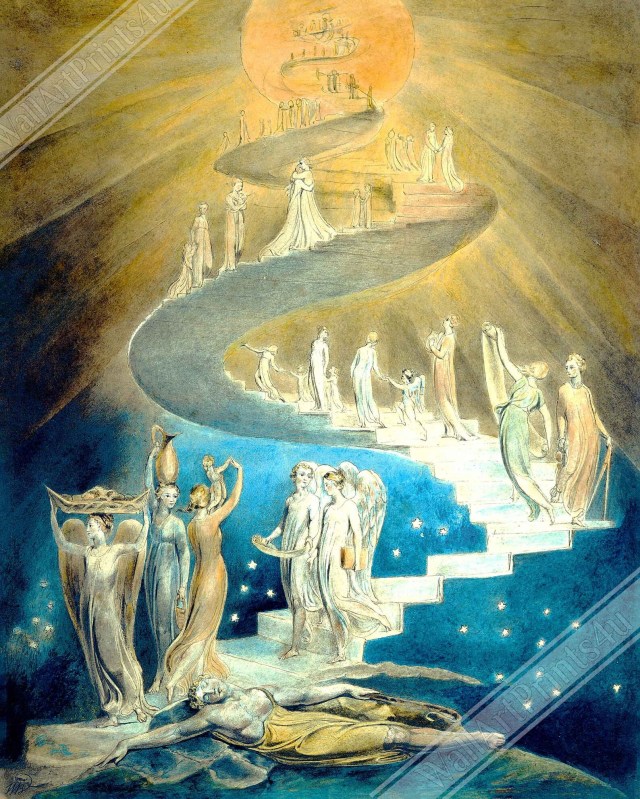
Jacob’s Ladder by William Blake
Jacob and his mother have successfully stolen the birthright from Esau. But now Jacob, threatened with muder by his wronged brother, is an exile seeking a place to live out his life.
Jacob is on a journey in between his past and his future, between his choices and his regrets, between his security and his hope. He is in a place of momentous “ifs” because he has no “for sures” in hand.
Pausing at a shrine, Jacob sleeps and dreams of angels, of a laddered freeway to heaven. God appears and speaks to him, reiterating the essence of the Abrahamic promises.
By Divine Graciousness, God has intruded on Jacob’s “in-betweeness”
In you and your descendants all the nations of the earth shall find blessing. Know that I am with you; I will protect you wherever you go, and bring you back to this land. I will never leave you until I have done what I promised you.”
Genesis 28:14-15
The experience moves Jacob to make a vow, hinged on a particular word of hope : IF
“If God remains with me, to protect me on this journey I am making and to give me enough bread to eat and clothing to wear, and I come back safe to my father’s house, the LORD shall be my God. This stone that I have set up as a memorial stone shall be God’s abode.”
Genesis 28:20-22
If I But Touch the Hem by James Tissot
In our Gospel, the suffering woman pivots her hope on the same word: IF
A woman suffering hemorrhages for twelve years came up behind him and touched the tassel on his cloak. She said to herself, “If only I can touch his cloak, I shall be cured.” Jesus turned around and saw her, and said, “”Courage, daughter! Your faith has saved you.”” And from that hour the woman was cured.
Matthew 9:20-22
It is clear from God’s spontaneous generosity in both these passages that Divine Mercy does not swing on an “IF“. God waits for us to open our hearts. God’s Promise is constant, and God’s Will for our wholeness in immutable. The “IFs” are our constructions, not God’s. God is with us no matter what, not if.
Most of our life is spent atwix one thing and another – between youth and old age, sickness and healing, security and contentment, courage and fear, indifference and awareness … beginnings and endings in a thousand forms. It is at these in-between places that God waits for us, as God did for Jacob, as Jesus did for the suffering woman.
“In-between” is usually an uncomfortable place because we are stretched between growth and passivity. But in the stretch, we may find a holy place, as Jacob did. In the reach of our heart for the hem of God’s garment we, like the extravasating woman, may find new life.
Poetry: That Passeth All Understanding – Denise Levertov
An awe so quiet
I don’t know when it began.

A gratitude
had begun
to sing in me.

Was there
some moment
dividing
song from no song?

When does dewfall begin?

When does night
fold its arms over our hearts
to cherish them?

When is daybreak?
Music: In Between – J.J. Pfeifer (lyrics below)
In between the day and the night In between the dark and the light In between what′s wrong and what’s right I′ll find you
I’m not really sure just why I care My heart is broken and I’m scared Walls are coming down My defense is on the ground I′m falling
In between the day and the night In between the dark and the light In between what′s wrong and what’s right I′ll find you
I don’t want to lose you Can′t stand the pain I wanna feel the sun Not always feel the rain Walls are coming down My defense is on the ground I’m falling
In between the day and the night In between the dark and the light In between what′s wrong and what’s right I’ll find you (find you)
I′ll find you Forever beside you (beside you) I′ll find you Breathing inside you I’ll find you
Today, in God’s Lavish Mercy, our readings encourage us not to be afraid.
“Do not be afraid”, or one of its many forms (e.g. “take courage”, “be at peace”), is a phrase that appears frequently in scripture. It is often uttered by God. And it usually occurs at a point of human desperation but spiritual opportunity for the one who actually is afraid.
Today, Genesis offers us the story of Hagar, the enslaved concubine of Abraham and mother of his eldest son Ishmael. Hagar draws the fearful scorn of Sarah after Sarah bears Isaac. Sarah is afraid that the older boy, Ismael, will inherit what she wants only for her own son. Sarah forces Abraham to send Hagar away as our passage today describes:
Sarah noticed the son whom Hagar the Egyptian had borne to Abraham playing with her son Isaac; so she demanded of Abraham: “Drive out that slave and her son! No son of that slave is going to share the inheritance with my son Isaac!”
Genesis 21:9-10
Sarah is worried about Abraham’s material legacy, but God knows there is an infinitely greater endowment to be left to the children of Abraham. God does not limit that promise to Isaac alone:
God said to Abraham: “Do not be distressed about the boy or about your slave woman. Heed the demands of Sarah, no matter what she is asking of you; for it is through Isaac that descendants shall bear your name. As for the son of the slave woman, I will make a great nation of him also, since he too is your offspring.”
Gemesis 21:12-13
Poor Hagar trods off into the desert with baby Ismael where, finally bereft of water, food, and energy she sits down near some bushes to die.
As she sat opposite Ishmael, he began to cry. God heard the boy’s cry, and God’s messenger called to Hagar from heaven: “What is the matter, Hagar? Don’t be afraid; God has heard the boy’s cry in this plight of his. Arise, lift up the boy and hold him by the hand; for I will make of him a great nation.” Then God opened her eyes, and she saw a well of water. She went and filled the skin with water, and then let the boy drink.
Genesis 21:14-19
God opened Hagar’s eyes and she could see the means of her survival – a fresh well in the desert.
“Seeing” is a key reflection point of this passage. When no one else cared to see Hagar as a person, God saw her. When Hagar was at the very edge of existence, her spiritual eyes were cleared and she saw God.
This passage from Genesis invites us to reflect on:
times we have felt “invisible” or afraid in our lives, and how that circumstance may have offered us a new understanding of God
times when we have been blind to the fear or desperation of others who needed us to notice their marginalization
Hagar, (like Adam, Abraham, Jonah, David, Ruth), is an archetype of the Hebrew Scriptures. Yet her powerful story often takes second place to those of the great ancestors, just as she herself took second place to Sarah in the Abrahamic canon. I found an excellent article about Hagar as I prepared this reflection. If you would like to read it, the link is below.
Poetry: I Return to the Church – Carolyn Marie Rogers
I like this poem because it speaks to me of the appreciation which grows in us as we mature in faith and experience. The poet seems to have passed through a “desert”, from youth to a later age. It is only then that she recognizes all the grace she did not “see” in her earlier life.
Spoons of love and
grace, mushy with mercy,
like oatmeal in a bowl
hushes my mouth into
sugary sweet solemnity.
A neophyte’s reverence.
Holiness. Me. God’s witness
recipient.
A finger to make a cross
across my lips.
And is this love?
Oh yes, this is love
when I come, returned from
the world from walking through
hells, my hungry years.
Hunger that is called youth
looking for rainbows, promised
lands, edens, and paradises.
Only to find it all
that I left behind, that
I could not see like Hagar.
And I did not
even know the word,
desert.
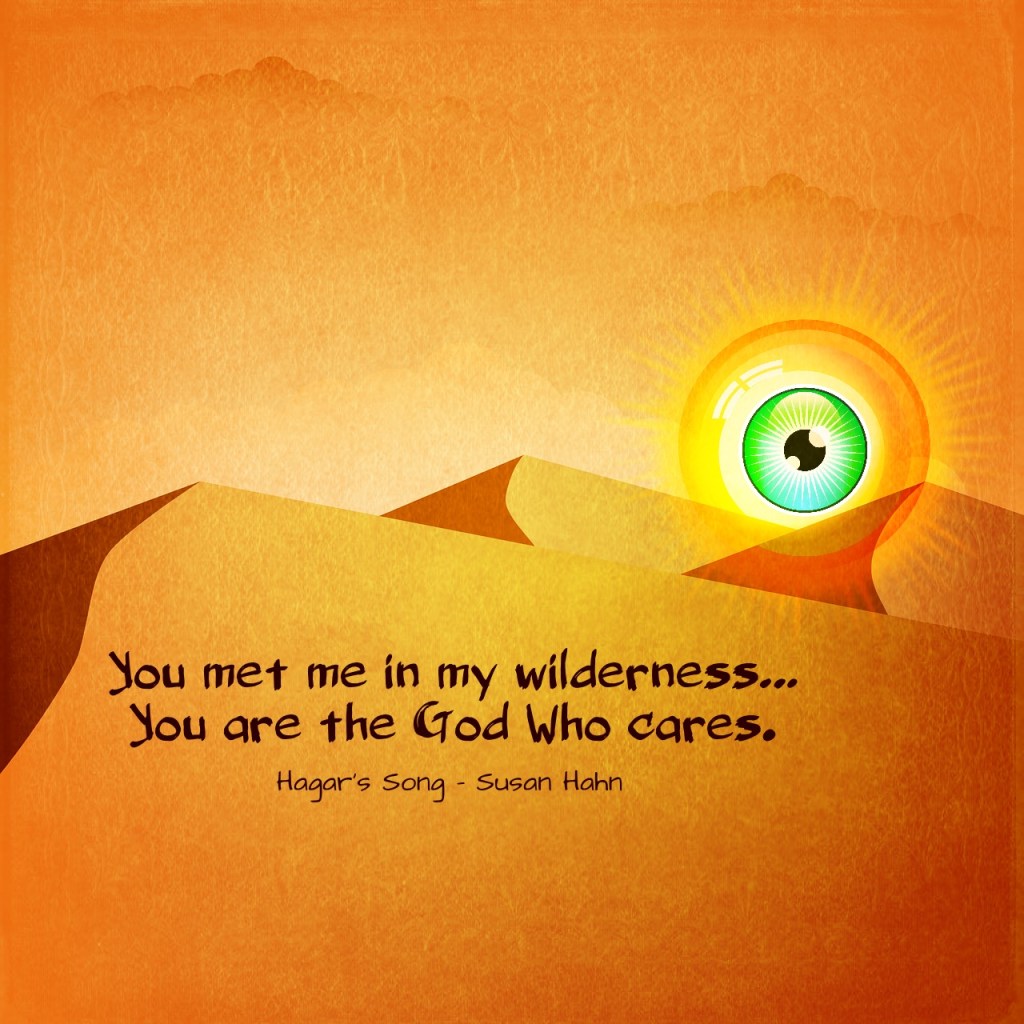
Music: Hagar’s Song – Sue Hahn, writer; Amanda Hopper, vocalist (lyrics below)
A life of injustice is all I have known. Shamed and mistreated I’ve never been loved. My dignity’s taken. I finally fled alone and forsaken in this wilderness
You speak my name like you really know me. You ask where I’ve come from and where I am going You tell me return, there is no need to run. You give me your blessing, a name for my son.
You are the God who sees me. You are the God who hears me. You keep all your promises. You know all my fears. You met me in my wilderness wandering in despair. I will choose to trust and obey. You are the God who cares.
Now we are abandoned, a wasteland to roam. My son won’t survive here, nowhere to call home. Life seems so hopeless. We’ve cried all we can. I thought you’d protect us . Did I misunderstand? You speak my name, “Hagar, Don’t Be Afraid”. You’ve seen all our tears and your plan hasn’t changed. They’ve reawakened, you open my eyes. A well in the desert proves You will provide.
You are the God who sees me. You are the God who hears me You keep promises. You know all my fears. You met me in my wilderness wandering in despair. I will choose to trust and obey. You are the God who cares This is not the path I would have chosen but it’s the one that led me straight to You. Just when I was sure my life was over You retold my story with your truth. You see me; You know me. Hallelujah, Hallelujah you see me and you know me Hallelujah, Hallelujah











 Lavish Mercy