Me? A Prophet?

Thirteenth Sunday in Ordinary Time
July 2, 2023

Today’s Readings:

https://bible.usccb.org/bible/readings/070223.cfm

Today, in God’s Lavish Mercy, our readings instruct us on the nature of prophecy.


Walter Bruggemann, in his transformational book “The Prophetic Imagination” writes about prophets. He indicates that prophets emerge in the context of “totalism” – those paralyzing systems which attempt to control and dominate all freedom and possibility.

Totalism kills ideas, hope, freedom, choice, self-determination, and creativity for the sake of controlling reality for its own advantage. Totalism is the ultimate “abusive relationship“. Examples in our society include cults, hate groups, mob rule, or any relationship that subjugates another’s free will.

Brueggemann defines the prophet as one engaged in these three tasks to restore hope and freedom:

  • the prophet is clear on the force and illegitimacy of the totalism.
  • the prophet pronounces the truth about the force of the totalism that contradicts the purpose of God.
  • the prophet articulates the alternative world that God has promised, and that God is actually creating within the chaos around us.

Our first reading comes from the Second Book of Kings which was written about 600 years before Christ. The Jewish people experienced the totalism of the Babylonian Captivity.. First and Second Kings was written to help the people understand their situation, to remain faithful to God, and to move toward freedom.


These two books are full of powerful figures pulling the people both toward and away from God – biblical Baddies and Goodies who carried profound messages about faith or its abandonment.


One of the Goodies is Elisha the Prophet whom we meet in today’s verses. Elisha confronts barrenness and death with the transformative power of faith. The Summanite woman is able to benefit from this power because she believes.


In our second reading, Paul doesn’t use the word “prophet” but he talks about the Resurrection Power we receive through our Baptism. This power calls us and confirms us as bearers of God’s transformative Word in a hostile and unfree world.


In our Gospel, Jesus is direct with his disciples about the rewards which fall to those who have prophetic faith:

“Whoever receives you receives me,
and whoever receives me receives the one who sent me.
Whoever receives a prophet because he is a prophet
will receive a prophet’s reward,
and whoever receives a righteous man
because he is a righteous man
will receive a righteous man’s reward.
And whoever gives only a cup of cold water
to one of these little ones to drink
because the little one is a disciple—
amen, I say to you, he will surely not lose his reward.”

Matthew 10:40-42

So, are we actually called to be prophets? The answer is YES. We are called by the Gospel and through our Baptism to do what Walter Brueggemann describes above:

  • to name the structures of unfreedom in our lives and in our world
  • to speak truth and stand against those things which contradict God’s Mercy and Love
  • to witness hope and courage by the joyous, generous service of our lives

Photo by Ashley Batz on Unsplash


Poetry: Onto a Vast Plane – Rainer Maria Rilke

You are not surprised at the force of the storm—
you have seen it growing.
The trees flee. Their flight
sets the boulevards streaming. And you know:
he whom they flee is the one
you move toward. All your senses
sing him, as you stand at the window.

The weeks stood still in summer.
The trees’ blood rose. Now you feel
it wants to sink back
into the source of everything. You thought
you could trust that power
when you plucked the fruit:
now it becomes a riddle again
and you again a stranger.

Summer was like your house: you know
where each thing stood.
Now you must go out into your heart
as onto a vast plain. Now
the immense loneliness begins.

The days go numb, the wind
sucks the world from your senses like withered leaves.

Through the empty branches the sky remains.
It is what you have.
Be earth now, and evensong.
Be the ground lying under that sky.
Be modest now, like a thing
ripened until it is real,
so that he who began it all
can feel you when he reaches for you.


Music: When the Prophet Speaks – Van Morrison (lyrics below)

When the prophet speaks, mostly no one listens
When the prophet speaks and no one hears
Only those who have ears to listen
Only those that are trained to hear

Come closer now, I'll tell you what they whisper
Closer now, we'll whisper it in your ear
What big ears you've got when you get the details
Do you understand, do I make it clear?

When the prophet speaks, yeah, no one listens
When the prophet speaks, mostly no one hears
Only those that are trained to listen
Only those who have ears to hear

When the prophet speaks, yeah, no one listens
Baby, baby, baby, baby, baby
Don't you have no fear
You gotta get the truth on what is happening

When the prophet speaks, have to make it clear
Come closer now and I will whisper
Whisper the secret in your ear
What thick ears you've got when you get all the details

Do you understand, do I make myself clear?
When the prophet speaks, you've got to listen
When the prophet speaks, you've got to get the truth
When the prophet speaks, don't need no explanation

When the prophet speaks, have to make it move
Prophet speaks, no one listens
When the prophet speaks, mainly nobody hears
Only those that are trained to listen

Only those who have ears to hear

Paul’s Insanity

Friday of the Eleventh Week in Ordinary Time
June 23, 2023

Today’s readings:

https://bible.usccb.org/bible/readings/062323.cfm


Today in God’s Lavish Mercy, our dear Apostle Paul is pretty much around the twist with the Corinthians. As the Church grows and the faith spreads, many “Christian” teachers arise. Some are truly called to the mission and ministry. They engage it and discharge it with humility and grace.

But some get their motives all mixed up with their own agenda for aggrandizement. They are flashy eloqutionists who can mesmerize an audience with their practiced charms. But they have missed the point of the Gospel of Jesus Christ. Instead they make the mission all about themselves – their wealth, success, prosperity and power. . These are the ones who are driving Paul “nuts” – to the point of speaking “insanely” in verse 23:

Are they ministers of Christ? (I am talking like an insane person.) 
I am still more,
with far greater labors, far more imprisonments,
far worse beatings, and numerous brushes with death.

2 Corinthians 11:23

Living the Gospel is not easy, and preaching it with integrity may be even harder. The Gospel contradicts everything our unredeemed human nature craves. To demonstrate this, Paul says that he too will boast like the errant preachers boast. But Paul contradicts them by boasting not of his personal gifts and powers, but of his sufferings, weaknesses, anxieties and catastrophes. He shows that he loves the Gospel and the Church so much that he will suffer for it to keep it aligned with the Truth of Jesus Christ.


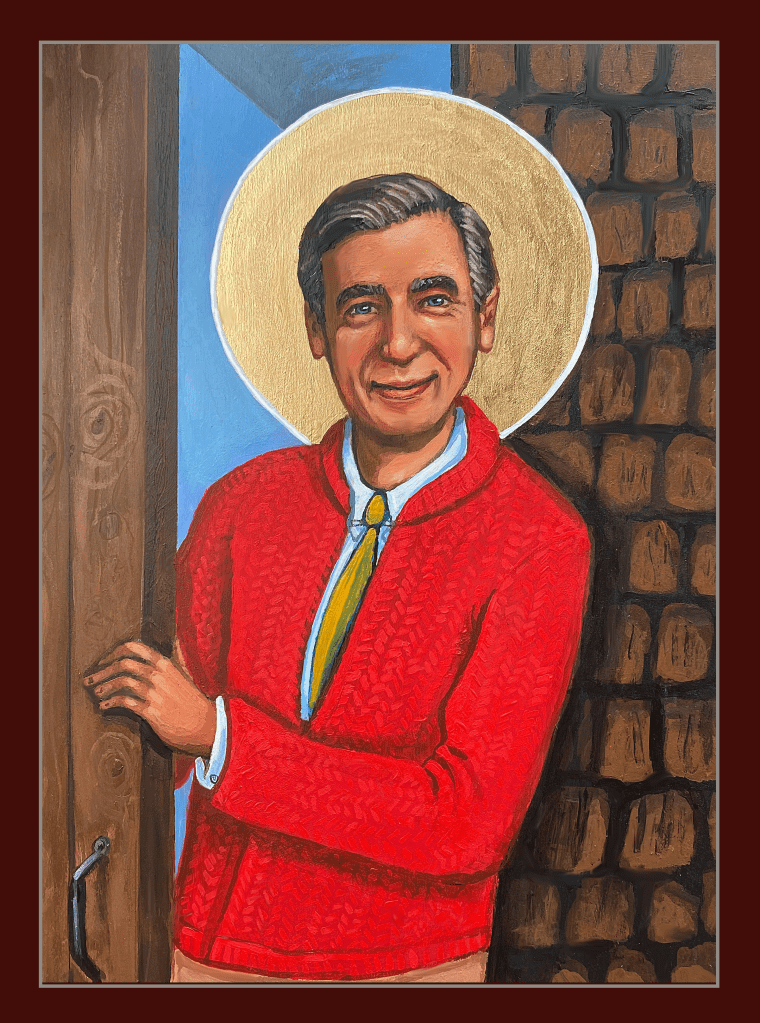
Kelly Latimore IconsMr. Rogers ( a truthful preacher himself)

When I read 2 Corinthians, I realize that Paul was no Mr. Rogers humming soft philosophy to his followers. Paul could be a fiery hot head unafraid to show his anxious love and indignant frustration for a dense yet beloved community. When they were “stupid” enough to be infatuated with a worldly teacher, Paul suffered intensely for their loss of the Gospel:

And apart from these things, there is the daily pressure upon me
of my anxiety for all the churches.
Who is weak, and I am not weak?
Who is led to sin, and I am not indignant?

2 Corinthians 11:28-29

In our Gospel, Jesus paints an ominous metaphor for those who distort truth for their own purposes. If we allow ourselves, as individuals or as a culture, to normalize dishonesty, we are doomed to an incomprehensible darkness. When we practice such normalization, we eventually forget how to even discern the truth and we become convinced of the lie we have become.

“The lamp of the body is the eye.
If your eye is sound, your whole body will be filled with light;
but if your eye is bad, your whole body will be in darkness.
And if the light in you is darkness, how great will the darkness be.”


These are powerful readings and have much to say to us and to our socio-political institutions. If we truly are people of faith, we will listen.


Poetry: We Grow Accustomed to the Dark – Emily Dickinson

We grow accustomed to the Dark –
When Light is put away –
As when the Neighbor holds the Lamp
To witness her Good bye –
A Moment – We Uncertain step
For newness of the night –
Then – fit our Vision to the Dark –
And meet the Road – erect …

Music: The Sound of Silence – Simon and Garfunkel

The Other Cheek

Monday of the Eleventh Week in Ordinary Time
June 19, 2023

Today’s Readings:

https://bible.usccb.org/bible/readings/061923.cfm


Today, in God’s Lavish Mercy, Matthew hits us right between the eyes with one of the most difficult Gospel passages to defend, to explain, and – most certainly – to practice.

Jesus said to his disciples:
“You have heard that it was said,
An eye for an eye and a tooth for a tooth.
But I say to you, offer no resistance to one who is evil.


“Oh, wow’, we might think. “Did Jesus have any idea what kind of a world I’d be living in someday?!”


Violence is so rampant in our society that some of us have stopped looking at the news because we can’t stand it! Here in the U.S., we are traumatized by statistics around the number and kind of artillery in our neighborhoods and who dies as a result – children, worshippers, movie-goers, picnickers. Are these the “enemy” for whom we have designed our lethal weapons?

We see gunpoint carjackings, drive-by shootings, and unlicensed militia defending their political prejudices. We see children afraid to go to school. Mothers afraid to go shopping. Believers afraid to go to their place of worship. We have even seen an assault on the American government stoked by a nationalistic rhetoric of hostility, hatred, and aberrant machismo.

There are so many guns now on American streets that we may think the best response is to carry our own. The “law” allows that. We may consider ourselves valiant if we “stand our ground”, legally shooting some innocent bystander who happened to wander onto our property or drive into our traffic lane!

So what, in God’s Name, does this Gospel have to say to us who have descended almost beyond recue into the chasm of violence?


Remember, Jesus has just finished talking about the Law. He has assured his followers that he has come to fulfill the Law rather than to abolish it. Jesus honors and recognizes the Law as the framework that has held in place Israel’s centuries-long relationship with God.

But Jesus indicates that following the letter of the Law while not fulfilling its spirit is contradictory to the Reign of God. We can use the “law” as an excuse for our complacency – keeping in place those unexamined tenets that make us comfortable, rich, and more powerful to the detriment of others. This is what the Pharisees and Saducees had done.


In each of the five situations listed in today’s Gospel, Jesus isn’t telling us to lie down like a doormat and let ourselves be walked on. What he’s saying is that with God’s help, there is a better way, a deeper response that we can give to the conflicts in our lives.

Jesus encourages his followers not to meet the other with resistance. So often, resistance is our first defense rather than patience, negotiation, honesty, listening, or forgiveness. Jesus is asking us to stand still for a moment before lashing back – and in that moment move toward a more graced and courageous resolution. He is counseling us to listen, to imagine mutuality, and to work together for an equilibium of justice with mercy.

It must be admitted that sometimes this just doesn’t seem to work. Those with the power to make positive change can block the way, just as they did for Jesus. We can end up looking like “losers” – or even die – like Jesus did. But even though he had the power – the Omnipotence to do so – Jesus did not resist. If we really understand the Paschal Mystery and believe in the Resurrection, we will know why, and we will try to imitate him.


So where do we start? I think it starts with:

  • the level of reverence in our everyday interactions,
  • our attitudes toward “the other” – someone different from me in race, ethnicity, religion, sexuality, nationality, economic status, or opinion.
  • with our efforts toward reasonable gun legislation, educational equity for all children, universally available mental health services, and the eradication of abysmal poverty in our cities.

Can I do something to advance these changes? Not all by myself. But as a community of faith, Christians can bring amazing influence to these issues. Today’s Gospel is telling me to act on that belief.


Poem: Some – Daniel Berrigan, SJ

Some stood up once and sat down.
Some walked a mile and walked away.
Some stood up twice and sat down
I’ve had it, they said.
Some walked two miles and walked away
It’s too much, they cried.
Some stood and stood and stood.
They were taken for dummies
They were taken for fools
They were taken for being taken in.
Some walked and walked and walked.
They walked the earth
They walked the waters
They walked the air.
Why do you stand?
they were asked, and
Why do you walk?
Because of the children, they said, and
Because of the heart, and
Because of the bread.
Because
the cause
is the heart’s beat
and the children born
and the risen bread.

Music: Where Have All the Flowers Gone – written by Pete Seeger, sung by Joan Baez

Fidelity in Exile

Memorial of Saint Boniface, Bishop and Martyr
June 5, 2023

Today’s Readings:

https://bible.usccb.org/bible/readings/060523.cfm

Today, in God’s Lavish Mercy, we begin a series of readings from the Book of Tobit. This fascinating scripture is actually a biblical novel written by an unknown author about 200 years before Jesus was born. It tells the story of a character who lived 800 years before that. It is not an autobiography or history. It is a combination of fiction, poetry, allegory and wisdom. Probably a “best seller” in its own time, it is actually really fun to read – and it gives us a good dose of spiritual wisdom!


In a nutshell, the book of Tobit relates how two suicidal characters, one blind
(Tobit) and one haunted by a husband-killing demon (Sarah) are healed with
medicinal fish organs by Tobit’s son Tobiah with the guidance of the angel
Raphael. Tobiah marries Sarah and acquires wealth and property into the
bargain. In addition to being entertaining, the book of Tobit
maintains that one can withstand temporary misfortune
and ultimately enjoy a happy life if one performs righteous deeds.

Delicious Prose: Reading the Tale of Tobit with Food and Drink, by Naomi S.S. Jacobs

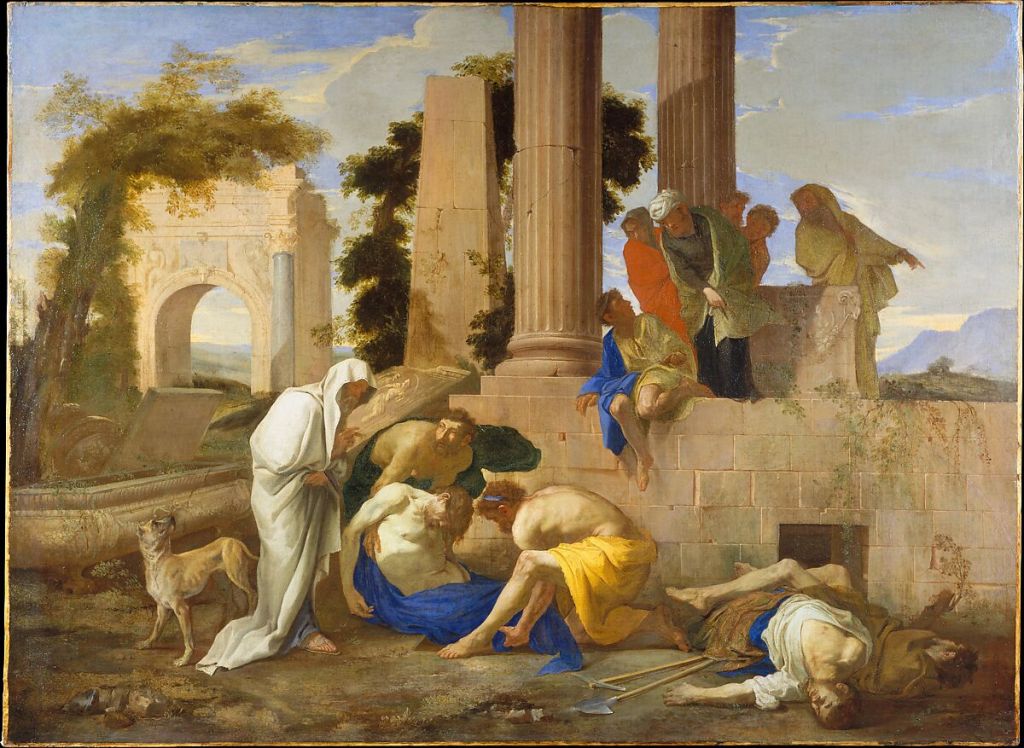
In today’s passage, Tobit introduces himself as a good man who wants to share his blessings with someone less fortunate. He sends his son Tobiah on the noble errand to find such a person. On his way, Tobiah discovers a murdered kinsman left unburied where he died. Upon hearing of it, Tobit “springs” into action, doing the right thing for this unfortunate victim. As a result of his righteous response, Tobit incurs the wrath not only of the Assyrian overlords, but also of his wimpy Israelite neighbors who are too afraid (or lazy) to keep the Mosaic Law while in exile.

Tobit Burying the Dead – Andrea DiLeone


Big lessons from this reading? Remember, the author of Tobit was writing for a community that had been ripped from their spiritual and material home. They knew the waning hope of one in exile. They needed to be reminded of and supported by stories of covenantal fidelity – both God’s and humanity’s.

By the rivers of Babylon we sat and wept when we remembered Zion.(Ps.137)


But even if our lives are not quite so dramatic as theirs, the reading holds quite a few lessons for us as well.

  • Circumstances may cause one to feel “exiled” from the comfort of their faith, but it is essential to retain a stabilizing religious devotion and practice.
  • It is important to invite and include others, especially the young, in the faithful practice of charity and justice.
  • It is normal and healthy to grieve the spiritual losses or emptiness we may experience. Such recognition is a first step to healing, and can give us the release to move on to what we need to do:

Returning to my own quarters, I washed myself
and ate my food in sorrow.
I was reminded of the oracle
pronounced by the prophet Amos against Bethel:
All your festivals shall be turned into mourning,
and all your songs into lamentation.

And I wept.
Then at sunset I went out, dug a grave, and buried him.

Tobit 2:5-7

Prose: How to Be Hopeful by Barbara Kingsolver, from her commencement address at Duke University, May 11, 2008

HOPE: AN OWNER’S MANUAL
Look, you might as well know, this thing
is going to take endless repair: rubber bands, crazy glue, tapioca, the square of the hypotenuse. Nineteenth century novels. Heartstrings, sunrise: all of these are useful. Also, feathers.

To keep it humming, sometimes you have to stand on an incline, where everything looks possible;
on the line you drew yourself. Or in
the grocery line, making faces at a toddler secretly, over his mother's shoulder.

You might have to pop the clutch and run
past all the evidence. Past everyone who is laughing or praying for you. Definitely you don't want to go directly to jail, but still, here you go, passing time, passing strange. Don't pass this up.

In the worst of times, you will have to pass it off.
Park it and fly by the seat of your pants. With nothing in the bank, you'll still want to take the express.
Tiptoe past the dogs of the apocalypse that are sleeping in the shade of your future. Pay at the window.
Pass your hope like a bad check.
You might still have just enough time. To make a deposit. 

Music: Take Courage – Kristine DiMarco

A Grape Soon Ripe

Saint Charles Lwanga and Companions, Martyrs
June 3, 2023

Today’s Readings:

https://bible.usccb.org/bible/readings/060323.cfm

Today, in God’s Lavish Mercy, we pray with our final passage from the Book of Sirach. We will read Sirach only five or six times again scattered throughout the liturgical year.

In today’s reading, Sirach offers a grateful reflection on the early blessing of wisdom and pursuit of holiness in his life.

I thank the LORD and I praise him;
I bless the name of the LORD.
When I was young and innocent,
I sought wisdom openly in my prayer
I prayed for her before the temple…

Sirach 51:13-14

Sirach’s prayer will resonate with many of us whose earliest days were blessed with faithful parents and grandparents. These wisdom figures taught us to love and seek God in our lives. As we pray today, we think of them with gratitude, as well as of the many teachers who guided our young spirits into God’s Light.

Even if we have moved far from the parish church of our youth, we may recall the graces we received within her walls. We might prayerfully recollect our beloved grade school and high school where we were guided in the pursuit of a meaningful and reverent life.


Hopefully, our prayer brings us to realize how blessed we have been from the beginning of our lives. This is the kind of prayer Sirach prays in today’s reading. He is filled with gratitude and praise because he understands that it is all a gratuitous and undeserved blessing:

My heart delighted in Wisdom,
My feet kept to the level path
because from earliest youth I was familiar with her.
In the short time I paid heed,
I met with great instruction.
Since in this way I have profited,
I will give my teacher grateful praise.

Sirach 51:15-17

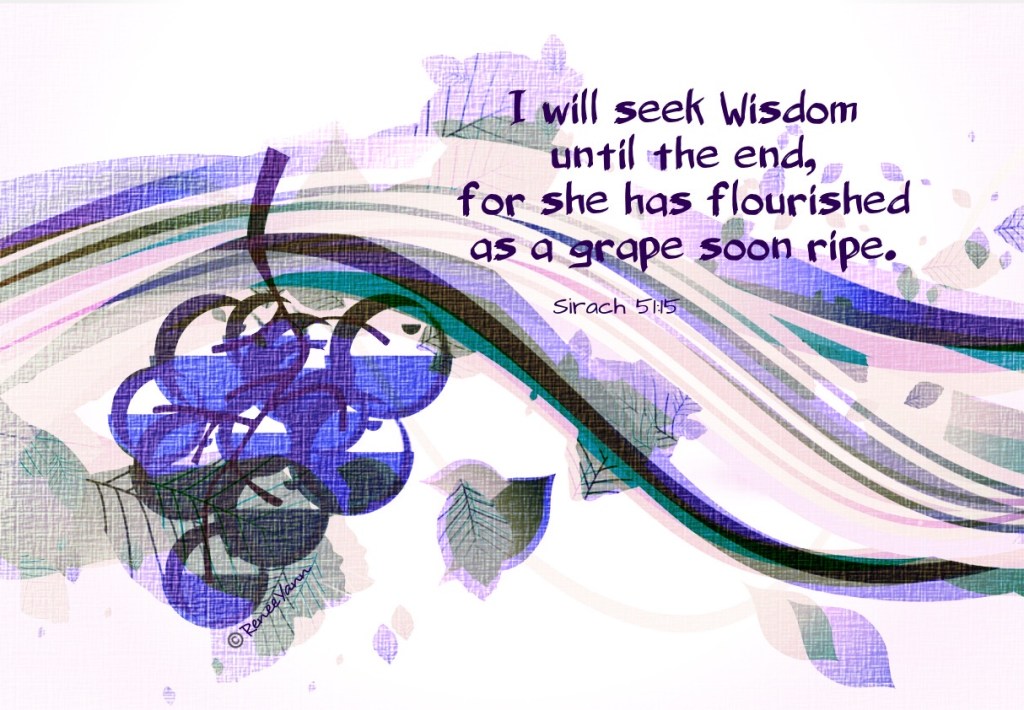
Sirach’s prayer brings him to that still and holy place deep in his heart — that place where he touches the Wisdom of God. He describes it like this:

I sought Wisdom openly in my prayer
I prayed for her before the temple,
and I will seek her until the end,
and she flourished as a grape soon ripe.

Sirach 51:13-15

Many of us are so busy and intent on living our lives forward – trying to make it through this day to the next. We may not take the time to consider and appreciate the “ripe grape” our life has already become.

I look around me in our convent chapel and realize that I am living with holy people. Of course, like me, they have their personal twists and trademarks. Still each one of them has walked through their roundabout years into the heart of God. Every day they live into a deeper goodness – aging like fine wine, unaware that the grape has already ripened and is blessing the world around them.

The Great Vintner accomplishes this holy transformation in us by a slow accumulation of blessings which saturate our hearts in God. Pausing, like Sirach, to recognize and give thanks fills us with generous gratitude and a confident courage for the days to come.


Take time to look at the holy people in your own life today, the ones through whom God’s Wisdom has poured into your life. They are the ones who love you into a better person by their goodness, honesty, humility, and generosity. You meet them in your family, friends and workplace. Or you may have met them only in a book, poem, song or story.

I met with great instruction.
Since in this way I have profited,
I will give my teacher grateful praise.

Sirach 51:16-17

Poetry: Our Responsorial Psalm 19 today beautifully complements Sirach’s prayer and can serve as a perfect poetic refletion for us.


The law of the LORD is perfect,
refreshing the soul.
The decree of the LORD is trustworthy,
giving wisdom to the simple.

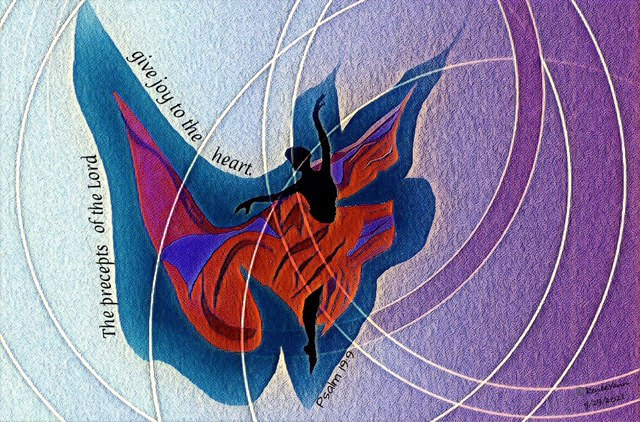
The precepts of the LORD are right,
rejoicing the heart.
The command of the LORD is clear,
enlightening the eye.

Awe of the LORD is pure,
enduring forever;
The ordinances of the LORD are true,
all of them just.

They are more precious than gold,
than a heap of purest gold;
Sweeter also than syrup
or honey from the comb.


Music: Psalm 19 – Jess Ray

Learning to Say Goodbye

Wednesday of the Seventh Week of Easter
May 24, 2023

Today’s Readings:

https://bible.usccb.org/bible/readings/052423.cfm

Today, in God’s Lavish Mercy, Jesus and Paul continue to teach us how to say goodbye.

I think most big goodbyes are pretty hard. Even if we’re not completely in love with our situation, we might still be comfortable in it. We don’t want to make the effort to change or to disconnect from the dailyness to which we are accustomed.

And when we are in love with our situation – with the people and activities that give us life – then goodbyes can be brutal. These kinds of goodbyes are often unchosen, unwelcome, and disorienting.


We can all recall scores of goodbyes we have either chosen or been forced to say. Most of them, I think, are a mix of the two descriptions above – a little bit of sugar and a little bit of vinegar.

One of the many goodbyes I remember came after I had lived in and taught at a lovely parish for over a decade. Our convent was blessed with a wonderful community of sisters. We loved our generous pastors, our welcoming parishioners, and the engaging neighborhood around us. I loved my students and the work I did with them. I loved the sisters I lived with. We recognized our blessings and often quipped to one another that we were living in our “Golden Years”.

But after eleven years, I knew it was time for something different in my life, A call to a new ministry emerged in my heart and that was exciting. But the leave-taking still cut like a razor.


That story has repeated itself several times in my life with different settings and different casts of characters. And I know the same thing is true in each of your lives. When we pause to reflect on all those goodbyes, we may realize that each led to an unimagined hello – hellos that offered us new graces to deepen our lives.


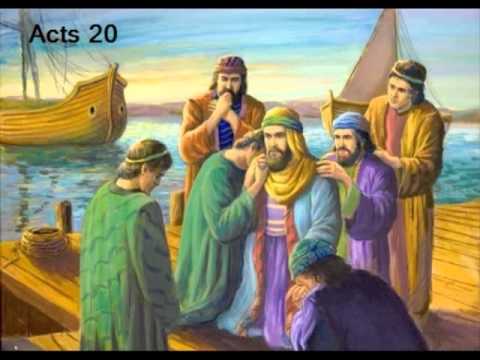
In our readings today, Jesus and Paul stand on that fragile beam which leads from goodbye to hello. Their disciples stand there with them, so both Jesus and Paul make every effort to help them balance themselves to step into the future.

Paul does it like this:

Be vigilant and remember that for three years, night and day,
I unceasingly admonished each of you with tears.
And now I commend you to God
and to that gracious word of his that can build you up
and give you the inheritance among all who are consecrated.

Acts 20:31-32

Jesus does it with a prayer:

Holy Father, keep them in your name
that you have given me,
so that they may be one just as we are one.
When I was with them I protected them in your name that you gave me,
and I guarded them, and none of them was lost
except the son of destruction,
in order that the Scripture might be fulfilled.
But now I am coming to you.
I speak this in the world
so that they may share my joy completely.

John 17:11-13

Today, we may want to spend a little time with Jesus and Paul looking back over the long beam of our lives, thanking God for the graces that poured from our many goodbyes and hellos.


Poetry: In My Dreams – Stevie Smith

In my dreams I am always saying goodbye and riding away,
Whither and why I know not nor do I care.
And the parting is sweet and the parting over is sweeter,
And sweetest of all is the night and the rushing air.

In my dreams they are always waving their hands and saying goodbye,
And they give me the stirrup cup and I smile as I drink,
I am glad the journey is set, I am glad I am going,
I am glad, I am glad, that my friends don’t know what I think.


Music: Every Goodbye Is Hello – Andrew Lippi from the musical “John and Jen”


There’s a wonderful place
Just waiting for you
There are wonderful things
You’ll get to do
Out there, somewhere, the world
And all its wonders
One small step is all it takes to know
Every goodbye is hello
There’s a magical phrase

I’ll tell it to you
Always honor the old
But live for the new
Out there, somewhere

About to be discovered
Trust yourself and
each new day will show
How every goodbye is hello
I will always be near

To hear of all the things you’ll be
Everyone needs a home to return to
And you can turn to me
There’s a time in our

lives when we will know
(There’s a time in our
lives when we will know)
There’s a time to stay home
And a time to grow
Out there, somewhere, your life
And all its promise
Sometimes part of love is letting go
But every goodbye is

Welcome to the world
(Welcome to the world)
Hello

Potholes

Saturday of the Fifth Week of Easter
May 13, 2023

Today’s Readings:

https://bible.usccb.org/bible/readings/051323.cfm

Today, in God’s Lavish Mercy, our readings can serve to remind us that Christian discipleship is not always a smooth ride. There are “potholes” — as in all of life.

Pothole 1: Rejection in Lycaonia
Paul, after being stoned, rejected and otherwise harassed, takes off for Derbe and Lystra to test the readiness of that community to receive the Gospel. There, Paul meets Timothy who would become a beloved friend and companion, traveling and ministering with Paul for the next decade.

Pothole 2: Sorry, Tim!
But the relationship starts out with a problem. Timothy’s dad was Greek and, per custom, did not have Timothy circumcised at birth. Even though the Jerusalem apostles had adjudicated circumcision as unnecessary, Paul – who had been its main critic – requires the rite for Timothy. Paul was convinced that the Jews to whom they would be preaching would reject Timothy otherwise.

Pothole 3: Rejection in Asia
They traveled through the Phrygian and Galatian territory
because they had been prevented by the Holy Spirit
from preaching the message in the province of Asia.
(Acts 16:6)

Pothole 4: Bypassing Bithynia
When they came to Mysia, they tried to go on into Bithynia,
but the Spirit of Jesus did not allow them,
so they crossed through Mysia and came down to Troas.
(Acts 16:7)


When we see the massive success and widespread influence of the Church today, we might think it was easy to get this whole thing started – to light the fire of faith in the early years. It wasn’t! And it’s still not easy, despite some appearances.

Jesus counseled his disciples that it would be this way, and encouraged them:

Jesus said to his disciples:
“If the world hates you, realize that it hated me first.
If you belonged to the world, the world would love its own;
but because you do not belong to the world,
and I have chosen you out of the world,
the world hates you.
Remember the word I spoke to you,
‘No slave is greater than his master.’
If they persecuted me, they will also persecute you.
If they kept my word, they will also keep yours.
And they will do all these things to you on account of my name,
because they do not know the one who sent me.”

John 15:18-21

That encouragement was enough for Paul and Timothy to keep going. May it be so for us, and for all who would lead the Church into the future Jesus desired for us..


Poetry: Portia Nelson, There’s a Hole in My Sidewalk from The Romance of Self-Discovery

I walk down the street.
There is a deep hole in the sidewalk.
I fall in.
I am lost… I am helpless.
It isn’t my fault.
It takes forever to find a way out.

I walk down the same street.
There is a deep hole in the sidewalk.
I pretend I don’t see it.
I fall in again.
I can’t believe I am in the same place.
But, it isn’t my fault.
It still takes me a long time to get out.

I walk down the same street.
There is a deep hole in the sidewalk.
I see it is there.
I still fall in. It’s a habit.
My eyes are open.
I know where I am.
It is my fault. I get out immediately.

walk down the same street.
There is a deep hole in the sidewalk.
I walk around it.

I walk down another street.


Music: just for some pothole fun today – I Love My Juggernaut – an Irish lorry driven bemoans the pothole problem. Lyrics below.

This is an enjoyable Irish song highlighting a long-standing pothole problem in Cavan, a small city near the border with Northern Ireland. The town is located on the junction of two national routes, the N3 to Dublin and N55 to Athlone. Until recently there was no bypass around Cavan town to eliminate the heavy traffic passing through an already congested town –thus, the legendary pothole problem!

Oh believe it or believe it not, I love me Juggernaut !!
I’ve been all over Ireland, to the North I’ve seen the lot.
I’m hauling great big bales of hay, I’m heading for Mayo.
With potholes all through Cavan, sure I’ll have to drive so slow.

In the morning I’m up early on the road at half past five.
The air is fresh and crispy boy it’s great to be alive.
I fall in behind a crawler put me foot down on the gas.
But the roads are to bumpy for me Juggernaut to pass.

Chorus

Oh believe it or believe it not i love me Juggernaut !!
I’ve been all over Ireland, to the North I’ve seen the lot.
I’m hauling great big bales of hay, I’m heading for Mayo.
With potholes all through Cavan, sure i’ll have to drive so slow.

(Johnny) “Breaker, Breaker, I’m looking for a copy”
(Richie) “10/4…This is big Rich’ come back”
(Johnny) “Ah, this is your auld pal Johnny”
(Richie) “A, Johnny what’s your 20”

I’m in the County Offaly and I’m awfully sorry now.
I broke the mirrors of me cab and I’d like to tell you how.
With sceachs, bows and bushes rubbing of me load.
I wish the county council would trim along the road.

Chorus

Oh believe it or believe it not I love me Juggernaut !!
I‘ve been all over Ireland, to the North I’ve seen the lot.
I’m hauling great big bales of hay, I’m heading for Mayo.
With potholes all through Cavan, sure I’ll have to drive so slow.

(Richie) “Come back Johnny, come back”

Some people call us Juggernaut’s, Artic’s or big trucks.
Some people even give us horrid dirty looks.
I know you’ve got your reasons, sometimes for to frown.
But did you ever try to drive a Scania through your town.

Chorus

Oh believe it or believe it not I love me Juggernaut !!
I’ve been all over Ireland to the North, I’ve seen the lot.
I’m hauling great big bales of hay, I’m heading for Mayo.
With potholes all through Cavan, sure I’ll have to drive so slow.

(Richie) “Stay wut her Johnny, stay wut her”
(Johnny ) “That’s right, that’s the truth, rev’er on the corners”
(Richie) “And face her for Mount Leinster”

I know I swing me volvo all around your market square.
I know that you think lorry drivers we just don’t care.
But the streets are so narrow, built so many years ago.
They were built for horses carts, not juggernauts you know.

Chorus

Oh believe it or believe it not I love me juggernaut!!
I’ve been all over Ireland, to the North I’ve seen the lot.
I’m hauling great big bales of hay, I’m heading for Mayo.
With potholes all through Cavan, sure I’ll have to drive so slow.

(Richie) “Come back Johnny, come back, we’ll leave the last one to you”

I’m in the County Offaly and I’m awfully sorry now.
I broke the mirrors off me cab and I’d like to tell you how.
With sceachs, bows and bushes the council will not cut.
When I get back to the depot, the boss will do his nut.
Oh when I get back to the depot, the boss will do his nut.

Nothing Can Harm You

Tuesday of Fifth Week of Easter
May 9, 2023

Today’s Readings:

https://bible.usccb.org/bible/readings/050923.cfm

Today, in God’s Lavish Mercy, the stone-throwers finally get to Paul, but their acted-out fear is ineffective:

In those days, some Jews from Antioch and Iconium
arrived and won over the crowds. 
They stoned Paul and dragged him out of the city,
supposing that he was dead.
But when the disciples gathered around him,
he got up and entered the city. 
On the following day he left with Barnabas for Derbe.

Acts 14:19-20

Paul is amazingly resilient. He just got the stuffing beaten out of him to the point of appearing DOA, but he departs on a preaching pilgrimage the very next day! So what’s the story?


I think it is unlikely that Paul just “got up and entered the city'” after the vicious assault upon him.

The supernatural presence of the Holy Spirit permeated that little Lycaonian alleyway. Note the “disciples gathered around him“. Imagine a reiki-like power eminating from these ardent believers. Visualize that power drawing Paul back to his full self in the Name of Jesus Christ.


We believers today are not unlike those gathered disciples. I’ll bet every one of us, after some devasting blow to our spirit, has had our heart put back by someone who loved and believed in us.

And I hope that every one of us has been that person who gathers with the fallen, failed, and frustrated to lift and remind them of Love’s Promise to those who believe.

That’s the kind of community Jesus wants us to be, drawing our strength for it from his awesome promise in today’s Gospel:

“Peace I leave with you; my peace I give to you.
Not as the world gives do I give it to you.
Do not let your hearts be troubled or afraid.
You heard me tell you,
‘I am going away and I will come back to you.’

John 14:27-28

Jesus faced a very dismal future as he finished these consoling words at the Last Supper. Judas had already gone out to pursue his dark agenda. Jesus knew what would come next:

And now I have told you this before it happens,
so that when it happens you may believe.
I will no longer speak much with you,
for the ruler of the world is coming.
He has no power over me,
but the world must know that I love the Father
and that I do just as the Father has commanded me.”

John 14:29-31

We will face our own Gethsemane’s as we try to live and to share Gospel Truth. Sometimes, our lights will dim from both internal and external shadows. But Jesus has anointed us with his profound assurance that God, Creator-Redeemer-Spirit, hovers over us in eternal rekindling.


Poetry: The Peace of Wild Things – Wendell Berry

When despair for the world grows in me
and I wake in the night at the least sound
in fear of what my life and my children’s lives may be,
I go and lie down where the wood drake
rests in his beauty on the water, and the great heron feeds.
I come into the peace of wild things
who do not tax their lives with forethought
of grief. I come into the presence of still water.
And I feel above me the day-blind stars
waiting with their light. For a time
I rest in the grace of the world, and am free.

Music: My Peace I Give Unto You

This Day I Have Begotten You

Friday of the Fourth Week of Easter
May 5, 2023

Today’s Readings:

https://bible.usccb.org/bible/readings/050523.cfm

Today, in God’s Lavish Mercy, our readings again draw our hearts to the power of the Resurrection to transform our lives.

The passage from Acts gives us the first half of Paul’s sermon in Pisidian Antioch, to a gathering of both Jews and Gentiles. Paul, who did not know Christ before the Resurrection, calls on the witness of the original disciples who shared earthly ministry with Jesus:

For even though (the inhabitants of Jerusalem and their leaders) 
found no grounds for a death sentence,
they asked Pilate to have Jesus put to death,
and when they had accomplished all that was written about him,
they took him down from the tree and placed him in a tomb. 
But God raised him from the dead,
and for many days he appeared to those
who had come up with him from Galilee to Jerusalem. 
These are now his witnesses before the people.

Acts 13:28-31

These witnesses attest to the primordial element of our faith:

Jesus Christ conquered death
and, in doing so,
gave all of us
the gift of eternal life in him.

This amazing truth is not something outside or distant from us. This truth is the core of our lives in faith. By believing it, remembering it, calling its dynamism into our dailyness, we are endowed with the power of God to live beyond death even in the midst of it.


In the life of my religious community, spring is always a time of Jubilee – a time to acclaim God’s rejuvenation of nature and life.

Just after Easter, we capture Alleluia grace to celebrate our sisters and their decades of fidelity. These Silver, Golden and Diamond years unfold in a perpetual wave from the time of Catherine McAuley. At Jubilee, we bathe in their awesome and unwordable grace. Last Friday evening, we held this year’s celebration, one bursting with the sentiments of “L’chiam” – To Life!


But just on that same Friday afternoon, one of our venerable sisters had died after living over 70 years in Mercy. I know the contrasting emotions struck many of us in our jubilant chapel. These feelings became even more evident as we read the back cover of our program naming all those Jubilarians who had preceded us to heaven.

Will we all meet in heaven?

O what joy even to think of it.

Catherine McAuley: Letter to Teresa White February 3, 1841


And that, my dear friends, is the key word: HEAVEN – another word for the eternal life given us in the Resurrected Christ. We don’t always realize it but, through Easter grace, we are living in heaven right now. Death, transformed forever in Jesus, is the unmasking which allows our full realization.


This is what Jesus conveyed to his disciples in today’s Gospel. Don’t be afrain of anything – not even death. I am already completely with you.

Jesus said to his disciples:
“Do not let your hearts be troubled. 
You have faith in God; have faith also in me. 
In my Father’s house there are many dwelling places.
If there were not,
would I have told you that I am going to prepare a place for you?
And if I go and prepare a place for you,
I will come back again and take you to myself,
so that where I am you also may be.
Where I am going you know the way.”

John 14:1-4

In Greek, the phrase for “do not be troubled” ( ταρασσεσθω – tar-as’-so) pertains particularly to the dread of death natural to the human condition. This is the fear that Jesus wishes to alleviate for his disciples, especially as he moves into the Paschal event.

He wishes to soothe that fear in us as well. We have the inifinite assurance of eternal life. When we face death, the loss of friends, or the overwhelming weight of the passing years, we can reach through any heaviness to that Resurrecting Light. By the life-giving invitation of Christ, we – and all whom we ever love – are already residents in the mansion of God.

Alleluia – Jubilate


The Jubilarian celebrants, most in the video above, are:

75 years: Sister Mary Jude DiSciascio, Sister Mary Klock, Sister Eileen Trinity

70 years: Sister Maryann Burgoyne, Sister Maria Madonna Johnson, Sister Joanne McIlhenney, Sister Rosemary Powers

60 years: Sister Sara Anne Condart, Sister Maureen Crissy, Sister Georgia Greene, Sister LaVerne Marie King, Sister Patricia Leipold, Sister Dorothea Maholland, Sister Mary Mulholland, Sister Beverly Palumbo, Sister Benvinda Ann Pereira, Sister Elaine Schaeffer, Sister Monica Sheehy, Sister Bonita Marie Smith, Sister Renee Yann

50 Golden Years: Maureen Roe, Terry Saetta, Susan Walsh and Regina Ward.


Poetry: Near Sunset on the Shore – Renee Yann, RSM


Four o’clock, life’s waning autumn afternoon;
daylight spent against the salted sea.
Tide, this moment, turns to imperceptible ebb.
Evening imagines its own midnight, indigo.

Same shore; same horizon. Only
sky, drunk deep, betrays change.
Jigger of sunset, rubied brandy,
introduced to unintoxicated day.

Now come the memories, wave
upon wave, inviting immersion. Now come
the lingering hopes, vortex of longing for
all that has or might have been loved.

Now in near-dusk, understanding,
feeble at first, then determined.
Can so little really have mattered?
Can the one truth simply have been

riveted presence, moment by moment,
to pain and to joy; fascination, ennui?
Has Sacred Fire smoldered so long
In such innocent ashes?

The question, or is it the answer, hovers and stills.
Sweet, purple evening rises like smoke from the embers
Of the inessential and shorn. Once, some distant morning,
hearts were set to this moment in brilliant, unproven vows.

The ocean of years, in hypnotic cadence,
Allowed, then rescinded, distraction.
Now, under its waves, tenacious and constant,
deep diving down in the luminous darkness of God.


Music: Divine Mystery – Heather Houston (lyrices below)


Oh I am opening up for a dance with Divine Mystery
Oh I am trusting the path that’s unfolding before me with ease

Just let go now, trust the flow
Just let go now, then you’ll know

Right on time now, I’ve arrived
Right on time now, I’m aligned

The Narrow Gate

Fourth Sunday of Easter
April 30, 2023

Today’s Readings:

https://bible.usccb.org/bible/readings/043023.cfm

Today, in God’s Lavish Mercy, Jesus tells us the he is “the gate”. If he were here, preaching to us in person today, the symbol wouldn’t work as well as it did in his own time. In the countryside of the Gospels, there were gates all over the place protecting flocks from the multiple threats around them.

But my guess is that you haven’t seen one of these things recently or likely EVER.


So what have we seen that might bring home the essence of the Gospel to us? I’ll tell you what came to my mind.

On occasion, we buy bulk candy for our Sisters at our nursing facility. The candy factory has been around for decades and, as in some neighborhoods of the old city, the area surrounding it has become a residential and commercial desert. With that isolation, the property has become unsafe, an unfortunate target for thieves and vandals.

And so the site has been fortified – metal shields, wired windows, old sealed doors. Just try to get inside without the right directions, information, invitation or credentials! See that little red door about the middle of the photo? It doesn’t open for everyone! You have to know the way to get to the sweets inside!


Jesus is telling us that the same thing is true for those seeking salvation. There is only one way, and it is through Jesus – the Gate.

Jesus refers to this symbol frequently so he must be pretty serious about it!

Enter through the narrow gate.
For wide is the gate
and broad is the road that leads to destruction,
and many enter through it.
But small is the gate and narrow the road
that leads to life, and only a few find it.

Matthew 7:13-14

Strive to enter through the narrow door.
For many, I tell you, will seek to enter
and will not be able.

Luke 13:24

Today’s readings remind us about just how serious Jesus is. The folks in Jerusalem, hearing Peter and scared for their complicity in the Crucifixion, want to get directions for passage through the Gate. Peter tells them:

Repent and be baptized, every one of you,
in the name of Jesus Christ for the forgiveness of your sins;
and you will receive the gift of the Holy Spirit.

Acts 2:38

In his letter today, Peter tells us that repentance translates to imitation of Christ in our lives

If you are patient when you suffer for doing what is good,
this is a grace before God.
For to this you have been called,
because Christ also suffered for you,
leaving you an example that you should follow in his footsteps.
He committed no sin, and no deceit was found in his mouth.

1 Peter 2:20-22

In our Gospel, Jesus says that the Gate is available to everyone, but only through him:

I am the gate.
Whoever enters through me will be saved,
and will come in and go out and find pasture.

John 19:7-8

Bottom line? How do I pass through the Gate to the richness inside?

  • Believe
  • Repent – Turn from anything that blocks me from living the Gospel
  • Imitate Christ in my own life

Poetry: A Gate – Donna Mancini – the recipient of a National Endowment for the Arts Fellowship and a New York Foundation for the Arts Grant. She is a professor of English at Hunter College. The poem portrays the poet ,at a spiritually vulnerable time in her life, seeking the Gate to peace.

I have oared and grieved,
grieved and oared,
treading a religion
of fear. A frayed nerve.
A train wreck tied to the train
of an old idea.
Now, Lord, reeling in violent
times, I drag these tidal
griefs to this gate.
I am tired. Deliver
me, whatever you are.
Help me, you who are never
near, hold what I love
and grieve, reveal this green
evening, myself, rain,
drone, evil, greed,
as temporary. Granted
then gone. Let me rail,
revolt, edge out, glove
to the grate. I am done
waiting like some invalid
begging in the nave.
Help me divine
myself, beside me no Virgil
urging me to shift gear,
change lane, sing my dirge
for the rent, torn world, and love
your silence without veering
into rage.

Music: Shepherd Me – Ann Sweeten